
Written by Arthur Simitian | PartsAdvisory
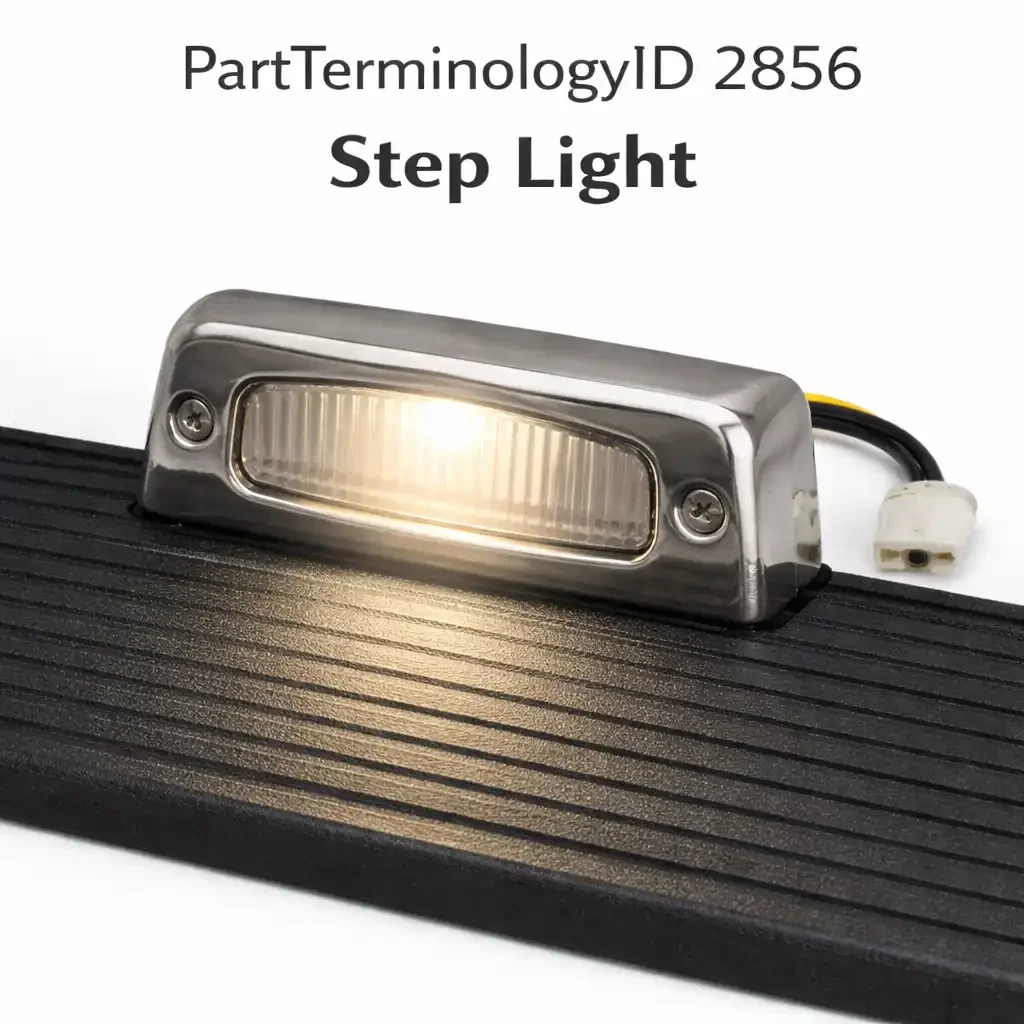
PartTerminologyID 2856, Step Light, is the lamp assembly mounted on the vehicle's door sill, running board, or lower door frame that activates from the door-open circuit when a door is opened and directs light downward or outward to illuminate the entry step or ground surface below the door opening, allowing the occupant to see the step clearly when entering or exiting the vehicle in low-light and nighttime conditions. That definition covers the illumination function and the door-circuit activation correctly and leaves unresolved every question that determines whether the replacement housing is sealed to the weatherproof standard required for a component mounted at road level exposed to spray, mud, and debris, whether the mounting position is a door sill cavity, a running board channel, or an underdoor frame pocket with different housing contour requirements at each position, whether the part is a bulb replacement for an intact housing or a complete assembly replacement for a cracked or corroded housing, whether the door-open activation uses a direct door switch circuit or a BCM-controlled courtesy circuit that monitors the lamp load, whether the replacement covers the front door position or the rear door position where the two use different housing contours on vehicles with separate front and rear step light assemblies, whether the body style affects the door sill geometry and housing pocket dimensions, and whether the vehicle's running board uses an integrated step light that is a component of the running board assembly rather than a standalone housing.
It does not specify whether the part is a bulb or assembly, the housing sealing specification, the mounting position, the front versus rear door designation, whether the lamp is integrated into the running board, the body style, or the BCM circuit monitoring status. A listing under PartTerminologyID 2856 that states only year, make, and model without mounting position and housing sealing specification cannot be evaluated by a buyer who needs a replacement for a rear door step light whose housing lens has cracked and admitted water, corroding the socket and requiring complete assembly replacement at a different mounting depth than the front door assembly.
For sellers, PartTerminologyID 2856 is the exterior entry lighting PartTerminologyID with the most direct weather exposure of any lighting component in this series. The step light housing occupies a position at the lowest point of the door structure, less than 12 inches above the road surface on most passenger vehicles and even closer on low-profile vehicles. Every drive through a puddle, every rain event, and every road-spray episode directly contacts the step light housing. A housing without an adequate weatherproof seal, or a replacement housing with a seal that deteriorates faster than the original, produces water ingress within one to three seasons depending on usage conditions, leading to socket corrosion, repeat bulb failure, and eventual housing replacement. The sealing specification is not a minor technical footnote for this PartTerminologyID. It is the primary determinant of whether the repair is durable or whether the buyer returns for a second replacement within the year.
What the Step Light Does
Door-open circuit activation and BCM courtesy light architecture
The step light activates on the same circuit as the interior dome light and courtesy lights when the door is opened. On direct-switch architectures, the door switch completes a ground path for the step light circuit, and the step light activates whenever the door switch is closed regardless of BCM state. On BCM-controlled courtesy light architectures, the BCM monitors the door switch and drives the courtesy light circuit including the step light through a current-limited output. The BCM may add a fade-in and fade-out effect, a delay after door closing before the lights extinguish, or a load monitoring self-diagnostic that detects open circuit faults in the courtesy light network.
On BCM-monitored courtesy circuits, the same LED current threshold problem described for dome lights and reading lights applies to the step light. An LED step light that draws significantly less current than the original incandescent may fall below the BCM courtesy circuit self-test threshold, producing a BCM fault code for the step light circuit and potentially disabling the step light output in the fault state. The listing must note BCM courtesy circuit compatibility for all LED step light assemblies and must state whether a load resistor is required to restore the correct current level on monitored circuits.
Housing sealing standards and the road-level exposure requirement
A step light housing must be sealed to prevent water ingress from road spray, rain, puddle splash, and car wash equipment. The minimum sealing standard for a step light housing at road level is IP65, which indicates complete protection against dust ingress and protection against water jets from any direction. Some premium applications use IP67 or IP68 rated housings that provide protection against temporary or continuous submersion, appropriate for applications where the running board or door sill is likely to be submerged in puddles or standing water during off-road use or in heavy rain accumulation conditions.
A replacement housing rated below IP65 will admit water through the lens seal or the harness entry point under road spray conditions that a fully sealed housing would survive. The buyer who installs a below-spec housing will experience lens fogging from condensation within the first few weeks, followed by socket corrosion from moisture accumulation, followed by repeated bulb failures from intermittent contact. The IP rating or weatherproof specification must be stated in every step light assembly listing, and the catalog must prevent the listing of assemblies without stated sealing specifications for this PartTerminologyID.
Running board integration versus standalone sill mounting
On vehicles with factory running boards, the step light is frequently integrated into the running board assembly as a lens and socket unit built into the upper surface of the running board. This integrated design is part of the running board structure and the step light housing is not a separately removable component. When the step light fails in a running board-integrated design, the repair options are to replace the running board assembly, to replace the LED module within the running board if the running board design allows module-level servicing, or to convert to an external surface-mount step light if the running board's outer surface allows mounting a standalone housing.
A listing under PartTerminologyID 2856 that covers a standalone door sill step light assembly will not fit a running board-integrated application and must note the running board integration inapplicability. Conversely, a running board step light module listing must state the specific running board part number or assembly it is compatible with, because different running board designs from the same manufacturer may use different LED module specifications even within the same model year range.
Why This Part Generates Returns
Buyers return step lights because the assembly is rated below IP65 and the lens fogs within two weeks of installation from condensation admitted through an inadequate lens gasket, the front door assembly is delivered and the buyer needed the rear door assembly which is 22mm longer to fit the rear door sill cavity, the part is a standalone sill mounting assembly and the vehicle has a running board-integrated step light requiring a running board module, the bulb base type is a T10 and the housing socket accepts only a festoon 31mm and the two base types are physically incompatible, the assembly activates continuously rather than extinguishing when the door closes because the buyer's vehicle uses a BCM-controlled courtesy circuit and the direct-switch replacement does not integrate into the BCM circuit correctly, the housing color is black and the door sill trim is chrome requiring a chrome-bezel assembly that the listing did not distinguish, and the quantity is one and the buyer needed four assemblies to replace all four door positions simultaneously.
Status in New Databases
PIES/PCdb: PartTerminologyID 2856, Step Light
PIES 8.0 / PCdb 2.0: No change in PartTerminologyID or terminology label.
Top Return Scenarios
Scenario 1: "Below-spec seal, lens fogs within two weeks, socket corrodes, repeat failure"
The replacement housing does not state an IP rating. The lens gasket is below IP65. After two weeks of normal driving including rain and puddle spray, the lens shows condensation fogging from moisture that entered through the inadequate gasket. Within six weeks the socket contacts corrode and the bulb produces intermittent illumination. The buyer returns the housing and requests a sealed IP65-rated replacement.
Prevention language: "Sealing: [IP65 weatherproof / IP67 submersion resistant]. This housing is rated [IP spec]. Step lights at road level are directly exposed to road spray and must meet IP65 minimum sealing to prevent socket corrosion. A housing without a stated IP rating or with a seal below IP65 will admit water under normal driving conditions."
Scenario 2: "Front door assembly for rear door position, 22mm length mismatch"
The vehicle uses different step light assemblies for the front and rear doors. The front sill cavity is 68mm wide. The rear sill cavity is 90mm wide. The listing covers the model year without distinguishing door position. The delivered assembly is the front door unit. It does not fill the rear sill cavity and cannot be mounted flush in the rear door position.
Prevention language: "Door position: [front door / rear door / fits all doors, symmetric design]. This assembly is designed for the [position] door sill cavity. Verify the door position before ordering. Front and rear door step light cavities differ in length and depth on many vehicles."
Scenario 3: "Running board integrated application, standalone sill unit delivered, no mounting surface"
The vehicle's step light is integrated into the factory running board assembly. The listing covers a standalone door sill step light housing. The buyer cannot mount the standalone housing because there is no door sill cavity on this vehicle outside the running board. The part is returned unused and the buyer requires a running board module replacement.
Prevention language: "Mounting: [standalone door sill cavity / running board surface mount]. This assembly is designed for [mounting]. Does not apply to running board-integrated step light applications. Verify whether the step light is a standalone sill assembly or a component of the running board before ordering."
Listing Requirements
PartTerminologyID: 2856
component: Step Light
part type: bulb only or complete assembly (mandatory, in title)
mounting position: door sill cavity, running board surface, or underdoor frame (mandatory)
door position: front, rear, or fits all (mandatory where assemblies differ by door position)
housing sealing: IP65, IP67, or IP68 rating (mandatory for complete assemblies)
activation circuit: direct door switch or BCM courtesy circuit (mandatory)
BCM courtesy circuit compatibility for LED listings (mandatory)
housing bezel color: black, chrome, or body-color (mandatory where trim variants exist)
running board integration inapplicability note (mandatory)
bulb base type and wattage (mandatory)
body style where door sill geometry differs (mandatory)
quantity per package: note for complete four-door sets (mandatory)
OEM part number cross-reference (mandatory)
Catalog Checklist for ACES/PIES Teams
PartTerminologyID = 2856
require part type: bulb or assembly in title (mandatory)
require mounting position (mandatory)
require door position where front and rear differ (mandatory)
require IP sealing rating for complete assemblies (mandatory)
require activation circuit type (mandatory)
require BCM compatibility for LED listings (mandatory)
require running board integration inapplicability note (mandatory)
prevent below-spec sealing: any step light assembly without a stated IP65 or higher sealing rating must not be listed as a complete outdoor assembly for road-level mounting; sealing specification is mandatory
prevent front-rear door conflation: different door positions use different sill cavity dimensions on many vehicles; door position must be required where assemblies differ
prevent running board application: running board-integrated step lights require running board module replacement; the inapplicability note is mandatory for all listings covering standalone sill assemblies
differentiate from Dome Light (PartTerminologyID 2772): both activate on door opening but the dome light is an interior overhead lamp providing compartment illumination; the step light is an exterior entry lamp providing ground illumination at the door opening
differentiate from Reading Light (PartTerminologyID 2820): both are courtesy lamps activated by occupant access events but the reading light is an interior focused beam lamp; the step light is an exterior weathersealed entry lamp
FAQ (Buyer Language)
What does the step light do?
The step light illuminates the entry step or ground surface when the door is opened, allowing the occupant to see the step clearly when entering or exiting at night. It activates from the door-open circuit and extinguishes when the door closes.
Why does the housing need to be sealed?
The step light is at road level, directly exposed to road spray, rain, and puddle splash. Without an IP65 or higher weatherproof seal, water enters the housing cavity and corrodes the socket contacts, causing repeated bulb failures. An unsealed replacement at this position will fail within one to three seasons.
Is it the same as the door courtesy light?
Not exactly. The courtesy light illuminates the interior floor when the door opens. The step light faces outward or downward to illuminate the exterior step or ground. Both activate on door opening but illuminate different areas.
Cross-Sell Logic
Running Board: when the step light fails in a running board-integrated design and the running board itself is cracked or worn; replacing both simultaneously avoids a second removal and installation labor event
Door Sill Trim Panel: for vehicles where the step light housing is mounted in the door sill trim panel; a broken trim panel may need replacement before the step light housing can be properly seated
Complete Four-Door Step Light Set: for buyers replacing one failed step light who want to refresh all four door positions simultaneously on a high-mileage vehicle where remaining assemblies are near end of life
Final Take for PartTerminologyID 2856
Step Light (PartTerminologyID 2856) is the exterior courtesy lamp PartTerminologyID where housing sealing is the primary quality differentiator between a durable repair and a return purchase. The function is simple. The regulatory requirements are minimal. But the service environment at road level is among the harshest in the vehicle's exterior lighting system. A sealed IP65-rated housing lasts years at this position. An unsealed housing lasts months. The IP rating belongs in the listing as the primary quality indicator, and the catalog must prevent the listing of unsealed housings for road-level mounting positions without an explicit below-spec durability disclosure.
State the part type in the title. State the mounting position. State the door position where front and rear differ. State the IP sealing rating. State the activation circuit. State BCM compatibility for LED listings. Include the running board inapplicability note. State the body style where geometry differs. State the quantity for multi-door sets. For PartTerminologyID 2856, housing sealing rating, door position, and activation circuit type are the three attributes that determine whether the replacement survives the road-level environment, fits the correct door sill cavity, and integrates correctly with either a direct door switch or a BCM-controlled courtesy circuit.