
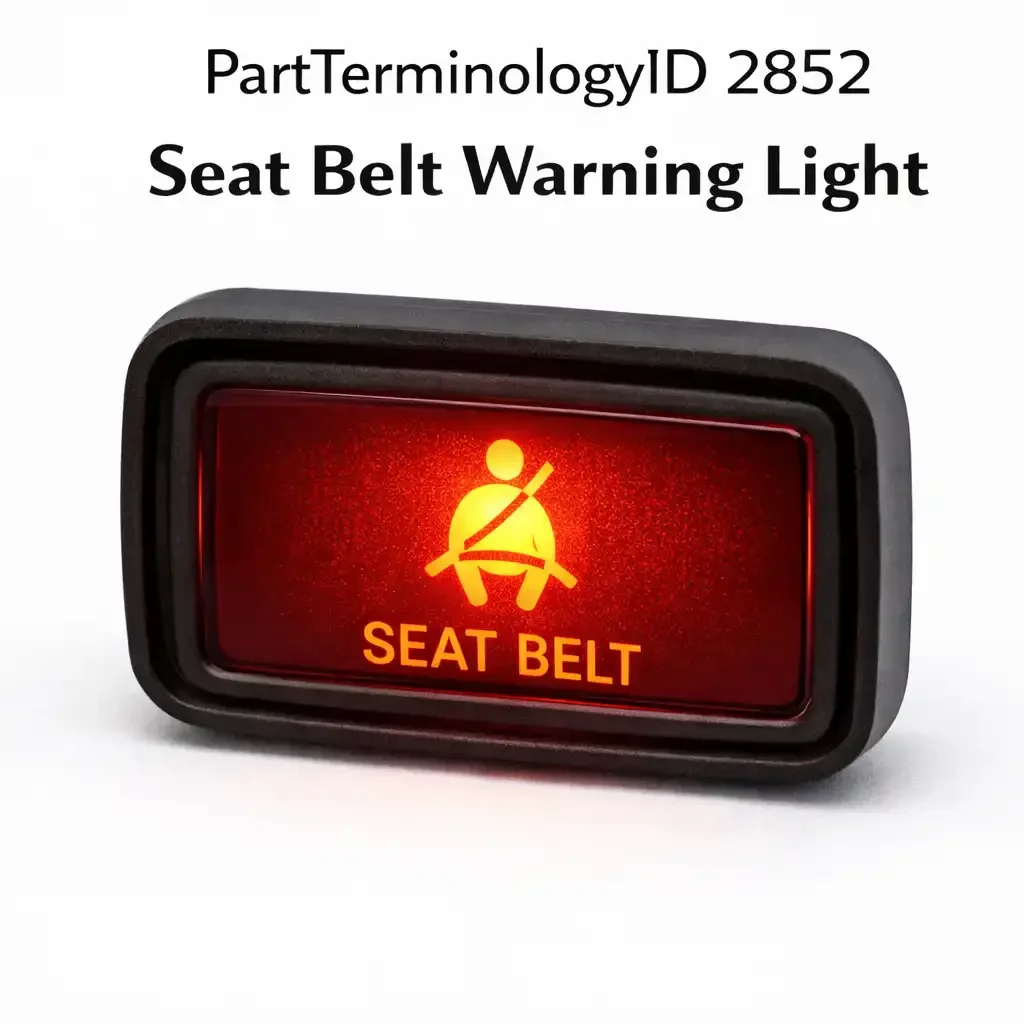
Written by Arthur Simitian | PartsAdvisory
PartTerminologyID 2852, Seat Belt Warning Light, is the instrument cluster indicator lamp required by FMVSS 208 that illuminates and flashes to remind the driver and front passenger to fasten their seat belts when the ignition is active and one or both front seat belt buckles are unlatched, operated by the BCM or a dedicated seat belt reminder module that monitors the buckle latch sensors and drives the indicator lamp on a timed or speed-triggered flash sequence depending on the model year's regulatory compliance configuration. That definition covers the reminder function and the federal mandate correctly and leaves unresolved every question that determines whether the replacement bulb base type and lens color match the specific cluster position for the seat belt indicator, whether the BCM drives the indicator through a monitored circuit that will generate a fault code if the LED replacement draws too little current, whether the indicator position is shared with the airbag warning light on some cluster layouts requiring careful position identification before ordering, whether the cluster uses a socket-mount or PCB architecture, whether the indicator is a discrete replaceable bulb or a rendered icon on a full digital display cluster, and whether the flash sequence requirement of FMVSS 208 is driven by the BCM independently of the bulb so that a failed bulb does not affect the regulatory flash sequence timing.
It does not specify the bulb base type, the lens color, whether the BCM monitors the indicator circuit current, whether the position is shared with an adjacent warning lamp, the cluster architecture, or the digital display inapplicability. A listing under PartTerminologyID 2852 that states only year, make, and model without lens color and base type cannot be evaluated by a buyer who has the cluster removed and is comparing two adjacent indicator positions, both using the same base type socket, trying to confirm from the listing which lens color applies to the seat belt indicator position specifically before placing an order.
For sellers, PartTerminologyID 2852 occupies a regulatory tier similar to the high beam indicator and the check engine light in this series: the lamp is federally required and its failure constitutes a specific regulatory non-compliance under FMVSS 208. Unlike the check engine light, which is regulated under OBD II as a driver-warning system for emission faults, the seat belt warning light is regulated under FMVSS 208 as a passive safety system component. The distinction matters for the listing because a buyer replacing this lamp is not simply restoring a comfort feature. They are restoring a federally mandated safety reminder that the vehicle is required to provide and that a safety inspection may verify. The FMVSS 208 compliance framing belongs in every seat belt warning light listing description alongside the bulb specification.
What the Seat Belt Warning Light Does
FMVSS 208 telltale requirement and the flash sequence mandate
FMVSS 208 requires all passenger vehicles to include an occupant crash protection system that encompasses the seat belt reminder telltale as one of its components. The standard specifies that the seat belt warning system must include a visual signal that illuminates when the ignition is in the start or on position and the driver's seat belt is not fastened. The minimum active duration, the flash pattern for advanced reminder systems, and the conditions that trigger the reminder vary by model year and regulatory revision, with later revisions requiring more persistent and speed-triggered reminders to comply with updated occupant protection standards.
The flash sequence itself is controlled by the BCM or the dedicated seat belt reminder module, not by the bulb. The BCM monitors the buckle latch sensor output and drives the indicator lamp through the cluster driver circuit on the programmed flash sequence. A failed bulb produces a dark indicator but the BCM continues executing the flash sequence on the driver circuit. Replacing the bulb restores the visual indicator. It does not reprogram the BCM or alter the flash sequence. On vehicles where the BCM stores a cluster circuit fault for an open indicator lamp circuit, the BCM may disable the driver output in the fault state and the fault code must be cleared after bulb replacement to restore normal BCM-driven flash operation.
Red versus amber lens color and the FMVSS 208 color convention
FMVSS 208 does not specify a color for the seat belt reminder visual indicator by name, but the regulatory convention across all U.S. manufacturers is red for the seat belt warning telltale to classify it as an immediate-attention safety indicator alongside the oil pressure warning and the brake system warning lamps. The red convention is consistent with the SAE J2819 instrument cluster symbol standard, which assigns the seat belt reminder symbol to the red priority category.
On some older vehicles, particularly those with amber-dominant cluster layouts from the 1980s and early 1990s where red was reserved for only the most critical fault indicators, the seat belt warning light uses an amber lens because the reminder function was classified as a courtesy alert rather than an immediate safety warning. The lens color for a specific cluster application is determined by the manufacturer's cluster design specification, not by a universal standard. The replacement must match the original lens color for the specific cluster and model year, which requires stating the lens color in the listing and providing an OEM cross-reference to the specific cluster position.
BCM current monitoring and the LED compatibility problem
On BCM-driven cluster circuits, the BCM monitors the current draw on the seat belt indicator driver output as part of its cluster self-diagnostic function, the same architecture described for the high beam indicator and other BCM-driven telltales in this series. An LED replacement that draws significantly less current than the original incandescent may register as an open circuit at the BCM self-test, causing the BCM to store a cluster driver fault code and potentially disable the indicator output in the fault state. On vehicles where the FMVSS 208 reminder is BCM-driven and the BCM monitors indicator circuit current, an LED replacement must either draw sufficient current to meet the BCM self-test threshold or must be paired with a load resistor to restore the correct current level. This requirement is the same for the seat belt warning light as for any other BCM-monitored cluster telltale and must be stated in the listing for all LED replacements under PartTerminologyID 2852.
Shared position with airbag warning and the position identification requirement
On some instrument cluster layouts, the seat belt warning light position and the airbag or supplemental restraint system warning light position are adjacent in the cluster with similar or identical base types. On clusters with limited indicator real estate, the two positions may be so close together that a buyer who has not precisely identified the seat belt indicator position may replace the wrong lamp, leaving the seat belt indicator dark and unnecessarily disturbing the adjacent SRS indicator lamp. The listing must provide sufficient position identification information, including a description of the cluster legend at the seat belt indicator position and the OEM bulb number cross-reference, to allow the buyer to confirm the correct position before installation.
Why This Part Generates Returns
Buyers return seat belt warning lights because the lens color is red and the cluster's seat belt indicator position uses an amber lens on this specific model year's cluster variant, the LED draws too little current and the BCM stores a cluster circuit fault and disables the indicator output, the buyer installs the replacement at the airbag warning position rather than the seat belt indicator position because the two are adjacent and the base types are identical, the cluster is a PCB design and the socket-mount bulb cannot be installed without a socket adapter, the full digital display cluster for this model year has no replaceable seat belt indicator bulb and the dark telltale indicates a cluster software fault, the wattage is 3 watts and the cluster circuit for this position is designed for a 1.4-watt bulb and the higher current overloads the cluster resistor, and the BCM requires a fault code clear after bulb replacement to restore the flash sequence and the buyer assumes the repair is complete when the bulb alone is installed and finds the flash sequence has not resumed.
Status in New Databases
PIES/PCdb: PartTerminologyID 2852, Seat Belt Warning Light
PIES 8.0 / PCdb 2.0: No change in PartTerminologyID or terminology label.
Top Return Scenarios
Scenario 1: "Red lens installed at amber-lens cluster position, wrong color visible on ignition-on"
The cluster's seat belt indicator position uses an amber lens. The listing covers the vehicle year and model without stating lens color. The delivered bulb has a red lens. Installed at the amber position, the red lens produces a red indicator that does not match the original amber output. The buyer notes the color change and returns the red-lens bulb requesting the amber variant.
Prevention language: "Lens color: [red / amber / clear with color produced by cluster window]. This listing covers a [color] lens bulb. Verify the seat belt indicator position's original lens color before ordering. Lens color is determined by the cluster design specification for the specific model year and trim level."
Scenario 2: "LED current below BCM threshold, BCM disables indicator output, flash sequence not restored"
The BCM monitors the seat belt indicator circuit current. The LED draws 12 milliamperes. The original drew 110 milliamperes. The BCM interprets 12 milliamperes as an open circuit and stores a cluster driver fault. The BCM disables the indicator output in the fault state. After bulb installation, the seat belt indicator remains dark and the FMVSS 208 flash sequence does not resume. The buyer requires a load resistor or a higher-current LED, plus a fault code clear at the BCM, to restore full function.
Prevention language: "BCM current monitoring compatibility: [compatible / verify current draw]. This LED draws [X] milliamperes. On vehicles where the BCM monitors cluster indicator circuit current, a load resistor may be required alongside the LED to meet the BCM self-test threshold. A BCM fault code clear may also be required after installation to restore the FMVSS 208 flash sequence."
Scenario 3: "Buyer installs at airbag position, seat belt indicator still dark, SRS lamp unnecessarily disturbed"
The seat belt indicator and airbag warning positions are adjacent in the cluster and both use a T5 wedge base. The buyer removes the cluster and installs the replacement at the airbag position rather than the seat belt position, replacing a functional airbag warning lamp with the new bulb and leaving the seat belt indicator dark. The buyer discovers the error when the seat belt indicator remains dark after reinstalling the cluster.
Prevention language: "Position: seat belt reminder indicator, adjacent to airbag and SRS warning indicator on most clusters using this base type. OEM cross-reference: [bulb number]. Verify the correct position in the cluster before installation. The seat belt indicator and airbag indicator positions use the same base type on many clusters; the cluster legend symbol distinguishes the two positions."
Listing Requirements
PartTerminologyID: 2852
component: Seat Belt Warning Light
bulb base type: T5, T4.2, or PCB LED (mandatory, in title)
lens color: red, amber, or clear with color-source note (mandatory, in title)
FMVSS 208 compliance note (mandatory in description)
wattage (mandatory)
current draw for LED listings (mandatory)
BCM current monitoring compatibility for LED listings (mandatory)
BCM fault code clear requirement note (mandatory for BCM-driven applications)
replacement method: socket-mount or PCB solder (mandatory)
cluster architecture: analog socket-mount, PCB, or digital display not applicable (mandatory)
position identification note distinguishing from adjacent airbag indicator (mandatory)
OEM bulb number cross-reference (mandatory)
quantity per package (mandatory)
Catalog Checklist for ACES/PIES Teams
PartTerminologyID = 2852
require bulb base type in title (mandatory)
require lens color in title (mandatory)
require FMVSS 208 compliance note in description (mandatory)
require wattage (mandatory)
require BCM current monitoring compatibility for LED listings (mandatory)
require BCM fault code clear note for BCM-driven applications (mandatory)
require replacement method (mandatory)
require cluster architecture with digital display inapplicability (mandatory)
require position identification note distinguishing from airbag indicator (mandatory)
prevent lens color omission: red and amber seat belt indicators are used on different model years and cluster variants; wrong-color installation is visible on every ignition-on cycle
prevent LED BCM fault omission: a BCM that disables the indicator output after an LED installation produces a dark seat belt telltale that is functionally identical to the original failure and makes the repair appear unsuccessful; BCM compatibility must be stated
prevent airbag position conflation: adjacent T5 positions require explicit position identification; the OEM cross-reference is mandatory to prevent installation at the wrong cluster position
differentiate from Airbag Warning Light: the airbag or SRS warning lamp monitors the supplemental restraint system; the seat belt warning light monitors buckle latch status; both are safety-critical indicators but under different federal standards (FMVSS 208 seat belt versus FMVSS 208 airbag provisions) and at different cluster positions
differentiate from Check Engine Light (PartTerminologyID 2753): the MIL is OBD II regulated for emission system faults; the seat belt warning light is FMVSS 208 regulated for occupant restraint reminder; both are federally required cluster indicators but in entirely different regulatory frameworks
FAQ (Buyer Language)
What does the seat belt warning light do and is it required?
The seat belt warning light is the cluster indicator that illuminates and flashes when the ignition is on and the driver's seat belt is unlatched, required by FMVSS 208 as part of the vehicle's occupant crash protection system. A non-functional seat belt warning light is an FMVSS 208 non-compliance. A failed bulb does not affect the seat belt's mechanical function or the airbag system.
What color is it?
Red on most U.S. vehicles, following the SAE convention for immediate-attention safety indicators. Amber on some older clusters where the reminder was classified as a courtesy alert. The correct color is determined by the cluster design specification for the specific model year and trim. Verify the original lens color before ordering.
Does a failed bulb affect the seat belt or airbag?
No. The indicator circuit is independent of the seat belt mechanical function and the airbag deployment system. A failed bulb removes the visual reminder but does not affect restraint system operation. On BCM-monitored circuits, a BCM fault code clear may be required after bulb replacement to restore the FMVSS 208 flash sequence.
Cross-Sell Logic
Instrument Cluster Bulb Assortment: for buyers refreshing all cluster warning positions simultaneously; the seat belt indicator, high beam telltale, and check engine light are often replaced together in a comprehensive cluster bulb restoration on high-mileage analog clusters
Check Engine Light (PartTerminologyID 2753): companion cluster indicator replacement for buyers restoring multiple federally required telltales in the same cluster disassembly event
High Beam Indicator Light (PartTerminologyID 2800): another federally required cluster telltale commonly replaced alongside the seat belt warning light in complete cluster bulb refresh procedures
Final Take for PartTerminologyID 2852
Seat Belt Warning Light (PartTerminologyID 2852) is the instrument cluster PartTerminologyID in this series where the regulatory compliance framing is most directly connected to occupant safety. The check engine light's regulatory requirement is about emissions monitoring. The high beam indicator's blue color requirement is about driver information clarity. The seat belt warning light's FMVSS 208 requirement is about reminding the occupant to use the physical restraint that directly reduces injury severity in a collision. The compliance framing belongs in the listing description not as regulatory background but as the primary reason the repair matters.
State the bulb base type in the title. State the lens color in the title. State FMVSS 208 compliance in the description. State the wattage. State the BCM current monitoring compatibility for LED listings. State the BCM fault code clear requirement. State the replacement method. State the cluster architecture. Include the position identification note. Include the digital display inapplicability. Cross-reference the OEM bulb number. For PartTerminologyID 2852, lens color, BCM current compatibility, and position identification are the three attributes that determine whether the replacement illuminates the correct color at the seat belt indicator position, functions correctly on a BCM-monitored circuit, and is installed at the seat belt position rather than the adjacent airbag warning position.