
Written by Arthur Simitian | PartsAdvisory
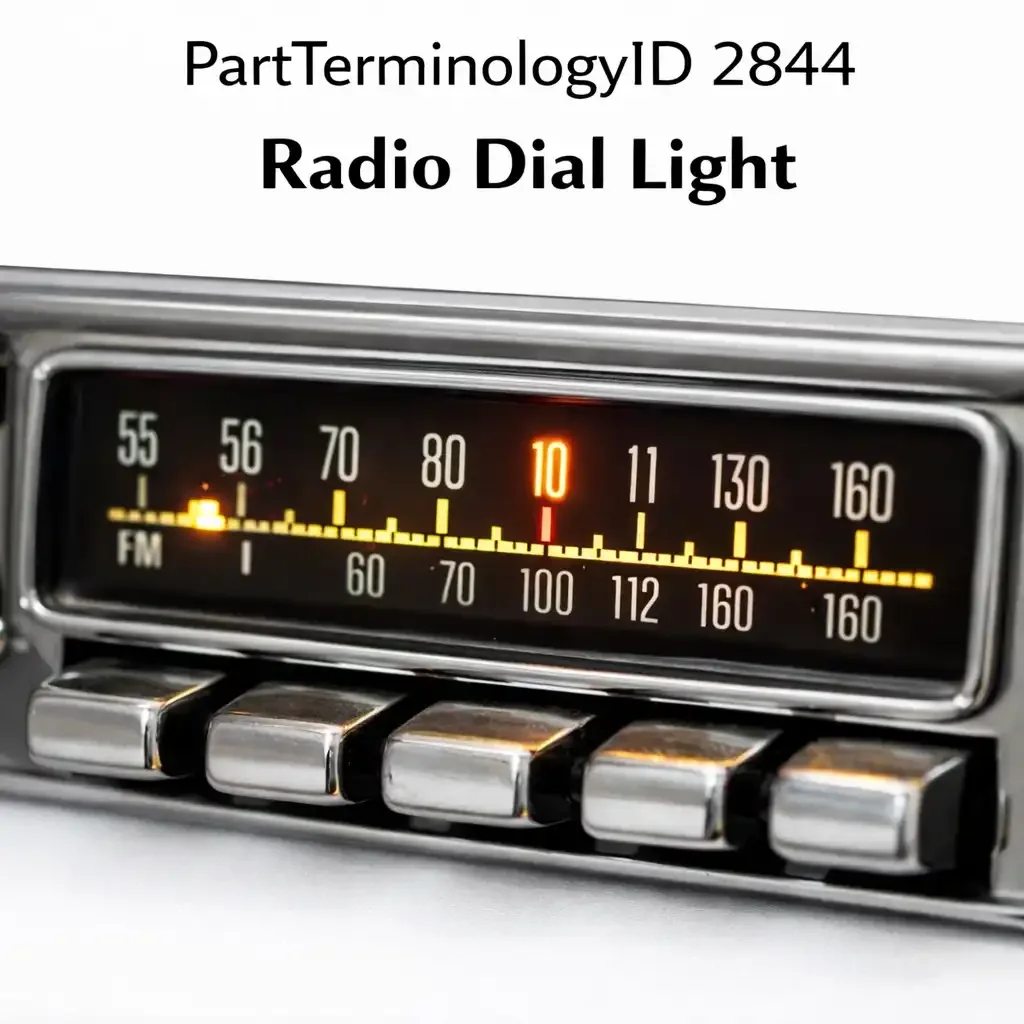
PartTerminologyID 2844, Radio Dial Light, is the small bulb or LED element inside the audio head unit that backlights the frequency display, tuning dial markings, volume scale, and button legends so the driver can read and operate the radio controls in low-light and nighttime conditions, powered by the interior illumination circuit and activating with the instrument panel lights when the headlamps or parking lamps are switched on. That definition covers the backlighting function correctly and leaves unresolved every question that determines whether the replacement bulb base type matches the socket inside the specific head unit model, whether the lens color matches the original backlighting color scheme so the replaced bulb does not appear as a differently colored zone against the surrounding radio face illumination, whether the replacement requires removing and opening the head unit housing to access the bulb position or whether the socket is accessible from the rear of the unit after removal from the dashboard, whether the head unit uses a discrete replaceable socket-mount bulb or a surface-mount PCB LED that requires soldering, whether the head unit is the original factory unit for the vehicle or an aftermarket replacement with a different bulb specification than the OEM unit, whether the wattage is consistent with the head unit's circuit design at the illumination position, and whether the vehicle's head unit has been replaced with a touchscreen unit or a modern digital display unit where the display backlight is integral to the display panel and has no discrete replaceable bulb.
It does not specify the bulb base type, the lens color, the head unit model number, the access method, the replacement method, the wattage, or whether the head unit uses a discrete replaceable bulb or an integral display backlight. A listing under PartTerminologyID 2844 that states only year, make, and model without the head unit model number or OEM part number cross-reference cannot be evaluated by a buyer who has already removed the head unit from the dashboard and is looking at the PCB inside the opened unit trying to identify the illumination bulb position from an ambiguous listing that does not cross-reference the head unit's own part number.
For sellers, PartTerminologyID 2844 sits at the end of the interior lighting series covered in this batch as the PartTerminologyID with the narrowest viable application window and the highest proportion of inapplicable applications within a given model year range. The radio dial light as a discrete replaceable bulb exists primarily on vehicles with analog or early digital audio head units produced before approximately 2005. On vehicles produced after that window, the audio head unit is increasingly a touchscreen or digital display unit whose illumination is integral to the display module and not a separately serviceable bulb. For any model year range that spans the transition from discrete-bulb analog units to integral-display digital units, the listing must distinguish which head unit type it covers and must note the inapplicability to digital display units explicitly.
What the Radio Dial Light Does
Interior illumination circuit connection and the panel color scheme consistency requirement
The radio dial light connects to the same interior illumination circuit that powers the instrument panel bulbs, the HVAC switch panel bulbs, and the clock light, activating and dimming in synchrony with the panel rheostat. The driver adjusts the panel brightness rheostat and all connected illumination positions, including the radio dial, dim simultaneously to the driver's preferred nighttime level. A replacement radio dial bulb of a different wattage than the original will appear brighter or dimmer than the surrounding panel illumination at mid-rheostat settings, creating the same visual inconsistency described for instrument panel light wattage mismatches in PartTerminologyID 2812.
The lens color requirement for the radio dial light follows the same logic as the instrument panel light: the replacement lens color must match the head unit's original backlighting color scheme to prevent a single differently colored zone from being visible against the surrounding illumination. On most domestic and Japanese vehicles with amber or green panel illumination schemes, the radio dial bulb uses an amber or green lens to match the surrounding panel color. On European-heritage vehicles with white panel illumination, the radio dial bulb uses a clear or white lens. Installing a green-lens bulb in a unit that originally used amber produces a green radio dial face against amber surrounding panel illumination, which is visible every night the vehicle is driven after dark.
Head unit disassembly requirement and the access method disclosure
The radio dial light bulb is not accessible from the dashboard front panel. It is located inside the head unit housing, behind the face plate, and is reachable only after removing the head unit from the dashboard. On some head units the bulb socket is accessible from the rear of the unit after pulling the unit from the dash slot, without opening the head unit case. On others, the bulb is mounted on the interior of the face plate circuit board and the face plate must be detached from the main unit housing before the bulb socket is accessible.
On head units where the face plate must be separated from the housing, the disassembly procedure varies by manufacturer and model. Some face plates release with a standard set of plastic pry clips and ribbon cable disconnections. Others use proprietary connectors and retention mechanisms that require specific tools or knowledge of the head unit's service procedure to avoid breaking the face plate clips or damaging the ribbon cable. The listing must state whether bulb access requires removing the unit from the dashboard only, removing the unit and opening the case, or removing the unit and detaching the face plate, because these three procedures represent significantly different skill and time requirements that determine whether the buyer can perform the repair independently.
PCB versus socket-mount and digital display inapplicability
Head units produced from the early 1990s to approximately 2005 commonly use discrete socket-mount bulbs in T5 wedge, T4.2 miniature wedge, or capless miniature base types mounted in plastic sockets on the head unit face plate circuit board. These are pull-and-replace repairs once the socket is accessible. Head units produced from approximately 2000 onward increasingly use surface-mount LEDs soldered directly to the face plate PCB without discrete sockets. Replacing a failed surface-mount LED requires identifying the specific LED footprint, sourcing a compatible SMD LED, desoldering the failed element, and soldering the replacement at the board position.
Fully digital touchscreen head units, which became common from approximately 2010 onward and are now standard on most new vehicles, use LCD or OLED display panels whose backlight is an integral fluorescent or LED backlight module bonded to the display panel. There is no discrete replaceable bulb in these units. A dark or dim touchscreen indicates a failed display module, a failed backlight driver board, or a failed display panel, none of which is addressed by a bulb replacement. The listing must include the digital display inapplicability note for any model year range that includes touchscreen or digital display head unit variants, because a buyer who orders a radio dial light bulb for a vehicle with a dark touchscreen has a display module problem, not a bulb problem.
Why This Part Generates Returns
Buyers return radio dial lights because the vehicle has a touchscreen head unit with no discrete replaceable bulb and a dark display indicates a failed display module rather than a burned-out bulb, the head unit is an aftermarket replacement with a different bulb specification than the OEM unit covered by the listing, the lens color is green and the head unit's original illumination scheme is amber producing a green radio face against the amber surrounding panel, the wattage is 3 watts and the original was 1.4 watts producing a radio dial face noticeably brighter than the surrounding instrument panel at mid-rheostat settings, the replacement is a socket-mount bulb and the head unit uses a surface-mount PCB LED requiring soldering, the base type is a T5 and the head unit socket accepts only a T4.2 miniature wedge and the T5 physically does not seat fully in the smaller socket, the head unit requires face plate disassembly to access the bulb and the buyer discovers this only after removing the unit from the dash and finding no accessible socket at the rear, and the part covers the factory OEM head unit but the vehicle has a dealer-installed upgraded audio system with a different unit and different bulb specification installed at the dealer before the original owner purchased the vehicle.
Status in New Databases
PIES/PCdb: PartTerminologyID 2844, Radio Dial Light
PIES 8.0 / PCdb 2.0: No change in PartTerminologyID or terminology label.
Top Return Scenarios
Scenario 1: "Touchscreen head unit, no discrete bulb, dark display indicates module fault not bulb failure"
The buyer's audio touchscreen display is dark. The listing covers the vehicle year and model under the radio dial light PartTerminologyID without noting the touchscreen inapplicability. The buyer orders the bulb, removes the head unit, and discovers there is no discrete socket. The display backlight is integral to the display panel and cannot be replaced with a bulb. The part is returned unused and the buyer requires display module diagnosis and repair instead.
Prevention language: "Applies to: [vehicles with analog or early digital head units with discrete socket-mount illumination bulbs]. Does not apply to: touchscreen, LCD, or OLED display head units where the display backlight is integral to the display module. A dark touchscreen display indicates a failed display module or backlight driver, not a burned-out bulb. Verify the head unit type before ordering."
Scenario 2: "Aftermarket head unit installed, different bulb specification than OEM unit covered by listing"
The vehicle's original OEM head unit has been replaced with an aftermarket unit installed by a previous owner. The listing covers the OEM head unit bulb specification. The aftermarket head unit uses a different base type, wattage, and lens color than the OEM unit. The delivered bulb does not fit the aftermarket unit's socket and has the wrong wattage and lens color for that unit's illumination circuit. The buyer returns the OEM-spec bulb and must identify the aftermarket unit's own bulb specification from the unit's service documentation.
Prevention language: "Applies to: OEM factory head unit part number [X]. If the vehicle's original head unit has been replaced with an aftermarket unit, the bulb specification may differ from this listing. Identify the head unit's model number and cross-reference the unit's own service documentation for the correct replacement bulb specification."
Scenario 3: "Face plate disassembly required, buyer discovers procedure after dash removal, returns part"
The buyer removes the head unit from the dashboard expecting to find an accessible bulb socket at the rear of the unit. The bulb is located on the interior of the face plate circuit board and is not accessible from the rear of the unit without separating the face plate from the housing. The face plate separation requires tools and a service procedure the buyer did not anticipate. The buyer returns the part rather than risk damaging the face plate clips or ribbon cable without proper guidance.
Prevention language: "Access method: [socket accessible from rear of unit after dashboard removal / face plate disassembly required, see service procedure / unit housing opening required]. This bulb is accessible via [method]. Verify the access method is within available tools and skill level before ordering. Face plate disassembly on some head units requires specific tools to release retention clips without damage."
Listing Requirements
PartTerminologyID: 2844
component: Radio Dial Light
bulb base type: T5 wedge, T4.2 miniature wedge, capless, or PCB SMD LED (mandatory, in title)
lens color: amber, green, white, or clear (mandatory, in title)
wattage in watts (mandatory)
voltage rating: 12V DC (mandatory)
bulb type: incandescent or LED (mandatory)
replacement method: socket-mount plug-in or PCB solder (mandatory)
access method: rear of unit, face plate disassembly, or housing opening (mandatory)
head unit OEM part number cross-reference (mandatory)
touchscreen and digital display inapplicability note (mandatory)
aftermarket head unit inapplicability note (mandatory)
quantity per package (mandatory)
Catalog Checklist for ACES/PIES Teams
PartTerminologyID = 2844
require bulb base type in title (mandatory)
require lens color in title (mandatory)
require wattage (mandatory)
require replacement method (mandatory)
require access method (mandatory)
require head unit OEM part number cross-reference (mandatory)
require touchscreen inapplicability note (mandatory for all model year ranges with touchscreen variants)
require aftermarket head unit inapplicability note (mandatory)
prevent touchscreen application: a discrete bulb listing for a touchscreen head unit generates a return from every touchscreen-equipped buyer; the inapplicability note is mandatory
prevent access method omission: face plate disassembly is not a universally available skill; the access method must be disclosed before purchase so the buyer can assess whether the repair is within their capability
prevent aftermarket unit application: an OEM-spec bulb does not fit an aftermarket head unit; the OEM part number cross-reference is mandatory to prevent cross-application to replacement units
prevent lens color omission: a wrong-color radio dial face is visible every night against the surrounding panel illumination; lens color must be in the title
differentiate from Instrument Panel Light (PartTerminologyID 2812): the instrument panel light backlights gauge cluster and switch panel positions outside the head unit; the radio dial light is inside the head unit housing; both are on the same illumination circuit but at different positions requiring different access procedures
differentiate from Clock Light (PartTerminologyID 2756): the clock light illuminates the instrument panel clock; the radio dial light illuminates the audio head unit; both are small interior illumination bulbs but in different housings with different access methods and different unit-specific OEM part number cross-references
FAQ (Buyer Language)
What does the radio dial light do?
It backlights the audio head unit's frequency display, dial markings, and button legends so the radio controls are readable at night. It connects to the interior illumination circuit and activates with the instrument panel lights when the headlamps or parking lamps are on.
Can it be replaced without removing the head unit?
No. The bulb is inside the head unit housing and is not accessible from the dashboard front. The head unit must be removed from the dash. Depending on the unit design, the bulb may be accessible from the rear of the unit after removal, or may require opening the unit case or separating the face plate from the housing. The listing must state the access method.
Is it the same as the instrument panel light?
No. The instrument panel light backlights the gauge cluster and dashboard switch panels. The radio dial light is inside the head unit and requires head unit removal to access. Both are on the same interior illumination circuit but are physically separate and use different bulb specifications.
Cross-Sell Logic
Instrument Panel Light (PartTerminologyID 2812): the dashboard backlighting bulbs on the same illumination circuit as the radio dial light; buyers replacing the radio dial light often replace all interior illumination bulbs simultaneously for a consistent panel brightness refresh
Clock Light (PartTerminologyID 2756): the instrument panel clock backlight on the same illumination circuit; often replaced alongside the radio dial light in a comprehensive interior illumination service event on high-mileage analog-cluster vehicles
HVAC Control Light: the switch panel illumination for the heating and air conditioning controls, on the same illumination circuit, frequently replaced in the same service event as the radio dial light when the buyer is already performing interior illumination restoration on a high-mileage vehicle
Final Take for PartTerminologyID 2844
Radio Dial Light (PartTerminologyID 2844) closes the interior lighting subset of this series as the PartTerminologyID with the narrowest applicable vehicle age window and the highest inapplicability rate among model year ranges that span the analog-to-digital head unit transition. For vehicles produced before approximately 2005 with analog or early digital head units containing discrete socket-mount illumination bulbs, the listing serves a real replacement need. For vehicles produced after that window with touchscreen and digital display head units, the listing generates returns from every buyer whose dark display indicates a module fault rather than a burned-out bulb. The touchscreen inapplicability note is the single most important disclosure in the listing for any model year range that spans this transition.
State the bulb base type in the title. State the lens color in the title. State the wattage. State the replacement method. State the access method. Cross-reference the head unit OEM part number. Include the touchscreen inapplicability note. Include the aftermarket head unit inapplicability note. For PartTerminologyID 2844, head unit OEM part number cross-reference, access method, and touchscreen inapplicability are the three attributes that determine whether the replacement is the correct specification for the specific head unit in the vehicle, can be installed with the access procedure the buyer is capable of performing, and is applicable to a head unit that actually has a discrete replaceable illumination bulb.