
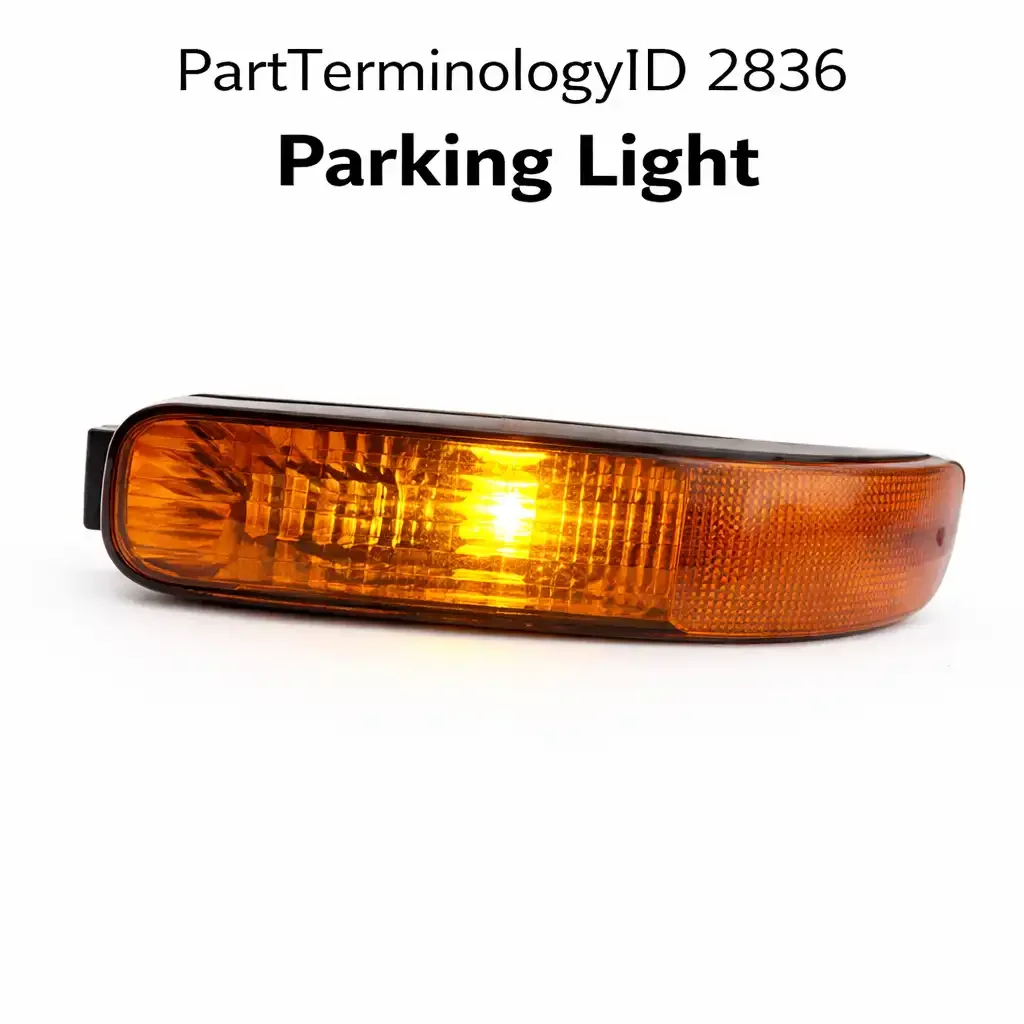
Parking Light (PartTerminologyID 2836): Where Bulb Type, Lens Color, and Integrated Assembly Functions Determine Whether the Front Position Lamp Meets FMVSS 108 and Connects to Every Active Circuit
Written by Arthur Simitian | PartsAdvisory
PartTerminologyID 2836, Parking Light, is the forward-facing front position lamp that illuminates at the vehicle's front corners when the parking lamp switch is activated or when the headlamps are on, making the vehicle visible from ahead to approaching drivers in low-light and nighttime conditions, required by FMVSS 108 to emit white or amber light and to be visible through a horizontal arc of at least 45 degrees to each side of the lamp axis at minimum photometric output values measured in candela. That definition covers the forward position lamp function and the federal visibility requirement correctly and leaves unresolved every question that determines whether the replacement bulb is a single-filament or dual-filament type where the parking light and turn signal share a dual-filament socket, whether the housing is a standalone parking light assembly or a combination unit integrated with the turn signal, the DRL, the headlight, or the front side marker in the same housing, whether the side designation is correct for an asymmetric front corner lens design, whether the lens color is amber or white and whether the color is in the lens or the bulb, whether the assembly bears DOT certification markings, whether the part covers a vehicle where the parking light position serves as the DRL element at reduced voltage requiring a specific wattage tolerance, whether the connector type matches the vehicle's parking light harness, whether the housing mounting tab configuration matches the headlight assembly surround or bumper fascia pocket into which the parking light assembly seats, and whether the body style affects the front fascia geometry at the parking light position.
It does not specify the bulb filament type, the assembly integration content, the side designation, the lens color and source, the DOT certification, the DRL dual-function compatibility, the connector type, the mounting configuration, or the body style. A listing under PartTerminologyID 2836 that states only year, make, and model without bulb filament type and integrated function content cannot be evaluated by a technician replacing a burned-out parking light bulb on a vehicle where the same socket serves the parking light on one filament and the turn signal on the other, and where a single-filament replacement would leave one of those two functions without a light source.
For sellers, PartTerminologyID 2836 is the front exterior lighting PartTerminologyID with the most complex multi-function integration overlap of any position-lamp PartTerminologyID in this series. The parking light position on the front corner is the most crowded functional position in the vehicle's front lighting system. At the same physical location and in some cases in the same socket, a single front corner lamp may simultaneously serve as the parking light, the front turn signal, the front side marker, the DRL, and on some vehicles a dedicated amber turn signal separate from the parking light. Each function adds a circuit, a filament or LED element, and a connector wire. A replacement that covers fewer circuits than the original leaves some of these functions without a light source and generates BCM fault codes for missing lamp loads on monitored circuits.
The additional complexity specific to PartTerminologyID 2836 is the DRL overlap. On vehicles where the BCM uses the parking light bulb as the DRL element by reducing the supply voltage to the parking light circuit during daytime operation, the bulb must be rated for the DRL reduced-voltage operating condition in addition to the full-voltage parking and headlamp-on operating condition. A replacement bulb rated only for 12-volt full-voltage operation that is subjected to repeated 7-volt reduced-voltage DRL cycling may have a shorter service life than the original if the original was rated for DRL cycling at reduced voltage. The DRL compatibility requirement belongs in the listing for any application where the parking light position serves a dual park-and-DRL function.
What the Parking Light Does
Front position lamp function and FMVSS 108 photometric requirements
The parking light serves as the vehicle's primary front position lamp, the lamp that tells approaching drivers where the front of the vehicle is when the driver activates the parking lamp circuit. FMVSS 108 requires the front position lamp to be visible from directly ahead and through a 45-degree horizontal arc to each side, with minimum photometric output of four candela at the most demanding test angle. The lamp must produce white or amber light and must illuminate whenever the parking lamp switch is on, including when only parking lamps are active without the headlights, and when the headlights are on.
The practical significance of the parking light function is most pronounced during street parking in darkness, during low-speed travel in parking lots and garage structures, and during the brief activation period when the driver first turns on the headlamps at dusk and the parking lamps illuminate the front corners before the headlamps dominate the front lighting. A non-functional parking light at a single front corner is not typically detected by the driver under normal driving conditions because the headlamps provide overwhelming forward illumination that obscures the missing parking light. But at parking speeds with only parking lamps on, the asymmetric front illumination is visible and may draw attention from other drivers or patrol officers observing the vehicle from the front.
Single-filament versus dual-filament bulbs and the turn signal overlap
The most consequential bulb type attribute for PartTerminologyID 2836 is the filament count. On vehicles where the parking light and the front turn signal share a single socket, a dual-filament bulb provides one filament for the steady parking light function at lower wattage and a second filament for the flashing turn signal function at higher wattage. The most common dual-filament bulb type for this application is the 3157 or 1157 series, which provides a low-intensity filament for the park function and a high-intensity filament for the turn signal function in a standard bayonet base.
Installing a single-filament replacement in a dual-filament socket connects only one of the two circuits in the socket. If the single-filament bulb connects to the turn signal circuit, the parking light is dark when the parking lamps are on and the vehicle fails the FMVSS 108 front position lamp requirement. If the single-filament bulb connects to the parking circuit, the turn signal does not flash and the vehicle fails the FMVSS 108 turn signal requirement. Neither failure is immediately obvious to the driver from inside the vehicle in daylight, but both produce FMVSS 108 non-compliance and both will fail a vehicle inspection. The filament count must be stated in the listing and must match the socket type in the specific application.
DRL function overlap and reduced-voltage bulb compatibility
On vehicles introduced from the mid-1990s onward where the BCM uses the parking light filament as the DRL element, the parking light bulb is subjected to a daily duty cycle that alternates between full-voltage parking lamp operation, reduced-voltage DRL operation during daytime driving, and off. The reduced-voltage DRL operating condition typically runs the parking light filament at 60 to 75 percent of its rated voltage, producing approximately 40 to 55 percent of its rated light output and extending bulb service life compared to full-voltage continuous operation. However, the repeated thermal cycling between the DRL operating temperature and the full-voltage parking lamp temperature, combined with the mechanical vibration of vehicle operation, affects filament longevity differently than either continuous full-voltage or continuous reduced-voltage operation alone.
Original equipment parking light bulbs for DRL-function applications are rated for this specific duty cycle. Aftermarket replacements rated for standard 12-volt continuous operation may have a different filament gauge or coil design that is less tolerant of the DRL thermal cycling pattern. A replacement with a shorter service life than the original in the same DRL application generates a repeat purchase and a potential warranty claim. The listing must note DRL function compatibility for applications where the BCM uses the parking light position as the DRL element.
Combination lamp assemblies and the multi-function connector requirement
The parking light assembly on modern vehicles is rarely a standalone single-function housing. On most vehicles produced after the mid-1990s, the parking light is an element within a front corner lamp assembly that also contains the turn signal lamp, the DRL element, and in many cases the front side marker lamp as well. The assembly has a multi-pin connector that carries separate circuit wires for each function. The parking light circuit is one wire in this connector, along with wires for the turn signal, DRL, side marker, and ground.
A replacement assembly that integrates fewer functions than the original, or that uses a connector with fewer pins, will leave some of the original harness wires unconnected after installation. An unconnected DRL circuit generates a BCM fault code. An unconnected side marker circuit removes lateral front visibility from one corner. An unconnected turn signal circuit generates a fast-flash fault and removes the turn signal function from that corner. The listing must enumerate all integrated functions in the replacement assembly and must state the connector pin count so the buyer can confirm all active circuits will be connected after installation.
Lens color, white versus amber, and the FMVSS 108 compliance options
FMVSS 108 gives manufacturers a choice between white and amber for the front position lamp. This choice produces two distinct replacement markets for PartTerminologyID 2836. Vehicles with amber parking lights use amber-lens assemblies with clear or amber-base bulbs to produce the required amber output. Vehicles with white parking lights, most common on European-heritage brands and some premium American vehicles, use clear-lens assemblies with clear bulbs, relying on the headlight assembly's overall lens design to frame the white parking light element visually.
The aftermarket styling segment offers clear-lens replacements for amber-lens applications as a visual modernization upgrade. A clear-lens replacement in an amber-lens application changes the parking light output from amber to white, which is federally permissible because FMVSS 108 allows both colors. However, a clear-lens replacement with a clear bulb must confirm that the assembly meets the minimum photometric output values at the required test angles, because a replacement designed as a styling product may not have been engineered to meet FMVSS 108 photometric minimums despite producing the permitted white color. The DOT certification status confirms whether the assembly was tested to meet the photometric requirements, not merely the color. The listing must state both the lens color and the DOT certification status for every complete parking light assembly.
Why This Part Generates Returns
Buyers return parking lights because a single-filament bulb is installed in a dual-filament socket and the turn signal no longer functions on the corner where the replacement was installed, the replacement assembly does not include the DRL element and the BCM stores a DRL circuit fault code after installation, the assembly is designed for the driver side and the buyer needed the passenger side at a corner where the lens contour is asymmetric, the clear-lens styling replacement does not bear DOT markings and the vehicle fails a front position lamp photometric check at inspection, the lens is white and the vehicle originally had amber requiring a re-order of the amber version that the listing did not distinguish, the connector has three pins and the vehicle harness has five pins because the original assembly integrates the turn signal, DRL, side marker, and parking circuits all in one multi-function connector, the assembly mounting tabs are calibrated for the headlight assembly surround on the base trim and the buyer has the sport trim with a different fascia cutout depth, the DRL-compatible bulb specification was not followed and the replacement bulb fails within four months from DRL thermal cycling, the body style is a coupe and the delivered assembly is the sedan version with a longer lens contour that overhangs the coupe's fascia opening, and the quantity is one and the buyer needed two to replace both front corner parking light assemblies simultaneously after a front-end wash damaged both lenses.
Status in New Databases
PIES/PCdb: PartTerminologyID 2836, Parking Light
PIES 8.0 / PCdb 2.0: No change in PartTerminologyID or terminology label.
Top Return Scenarios
Scenario 1: "Single-filament bulb in dual-filament socket, turn signal non-functional after installation"
The buyer replaces a burned-out parking light bulb. The socket is a dual-filament type that serves both the parking light and the turn signal. The listing covers a replacement bulb for the vehicle application without specifying filament count. The delivered bulb is a single-filament 1156. The original was a dual-filament 1157. After installation, the parking light illuminates when parking lamps are on but the turn signal on that corner does not flash because the single-filament 1156 has no second filament for the turn signal circuit. The vehicle now fails the FMVSS 108 turn signal requirement.
Prevention language: "Bulb type: [single-filament 1156 / dual-filament 1157 / dual-filament 3157]. This listing covers a [bulb type]. On applications where the parking light and turn signal share a dual-filament socket, a single-filament replacement will disable one of the two functions. Verify the socket type requires a single or dual-filament bulb before ordering."
Scenario 2: "DRL element absent in replacement assembly, BCM stores DRL fault after installation"
The original front corner lamp assembly includes a dedicated DRL LED element in addition to the parking light bulb socket. The DRL element operates on a separate circuit driven by the BCM. The replacement assembly includes the parking light socket but does not include the DRL element. After installation, the BCM detects no load on the DRL circuit and stores a DRL fault code. The vehicle's DRL function is disabled and the exterior lighting warning lamp illuminates.
Prevention language: "Integrated functions: [parking light / parking light and turn signal / parking light, turn signal, and DRL / parking light, turn signal, DRL, and side marker]. This assembly includes [function list]. Verify all integrated functions in the original assembly are present in the replacement. A missing DRL element generates a BCM fault code on vehicles where the BCM monitors the DRL circuit load."
Scenario 3: "Clear-lens styling replacement, no DOT markings, fails photometric check at inspection"
The buyer installs a clear-lens aftermarket parking light assembly to update the vehicle's front appearance. The assembly produces white output that is FMVSS 108 permissible for front position lamps. However, the assembly does not bear DOT certification markings because it was engineered to a styling specification rather than a photometric compliance standard. At the vehicle inspection, the photometric output at the 45-degree test angle falls below the FMVSS 108 four candela minimum. The vehicle fails the front position lamp inspection. The buyer must replace the styling assembly with a DOT-certified unit to pass reinspection.
Prevention language: "DOT certification: [yes, FMVSS 108 compliant / no, styling product, photometric compliance not certified]. Clear-lens parking light assemblies designed as styling upgrades may not meet FMVSS 108 minimum photometric output requirements. Verify DOT certification before purchasing a clear-lens replacement for street use. An assembly without DOT markings has not been tested to confirm photometric compliance."
Scenario 4: "Five-pin original connector, three-pin replacement, DRL and side marker circuits unconnected"
The original front corner lamp assembly uses a five-pin connector carrying the parking light, turn signal, DRL, side marker, and ground circuits. The replacement assembly uses a three-pin connector covering only the parking light, turn signal, and ground. After installation, the DRL circuit and side marker circuit are unconnected. The BCM stores a DRL fault and the front side marker does not illuminate with the parking lamps. The buyer requires an assembly with a five-pin connector matching all original circuits.
Prevention language: "Connector: [X-pin covering parking, turn signal, DRL, side marker, and ground]. This assembly uses a [X]-pin connector. Verify the pin count matches the original harness connector. An assembly with fewer pins than the original leaves active circuits unconnected, generates BCM fault codes, and removes regulated lamp functions from the vehicle."
Scenario 5: "Amber lens needed, white lens delivered, buyer requires color-specific reorder"
The vehicle uses amber parking lights. The listing covers parking light assemblies for the model year without specifying lens color. The delivered assembly has a white clear lens. Installed at the front corner, the white assembly produces white parking light output. The buyer prefers to restore the original amber appearance and the clear-lens output appears mismatched against the adjacent amber turn signal housing. The buyer returns the white assembly and requests the amber variant.
Prevention language: "Lens color: [amber / white-clear]. This assembly has a [color] lens. FMVSS 108 permits both amber and white front position lamps. Verify the lens color matches the original or the desired replacement appearance before ordering. Amber and white parking light assemblies are not interchangeable in applications where consistent front corner color is required."
What to Include in the Listing
Core essentials
PartTerminologyID: 2836
component: Parking Light
part type: bulb only or complete assembly (mandatory, in title)
side: driver side, passenger side, or fits both (mandatory for asymmetric designs)
bulb filament type: single or dual filament with bulb number (mandatory, in title for bulb listings)
lens color: amber or white-clear (mandatory, in title)
integrated functions: parking only, parking and turn signal, parking and DRL, full combination (mandatory)
connector pin count with function mapping (mandatory for complete assemblies)
FMVSS 108 compliance and DOT certification status (mandatory for complete assemblies)
DRL function compatibility for DRL-overlap applications (mandatory)
body style where front fascia geometry differs (mandatory)
mounting tab configuration (mandatory for complete assemblies)
bulb base type and wattage (mandatory)
OEM part number cross-reference (mandatory)
quantity per package (mandatory)
Fitment essentials
year/make/model/submodel/trim/body style
side designation for asymmetric front corner lenses
note for DRL-equipped versus non-DRL trim levels
note for combination versus standalone lamp configurations by trim level
note for single versus dual filament socket by model year where revised mid-cycle
Image essentials
assembly shown from front with lens color and DOT markings visible
assembly shown from rear with connector pin count and mounting tab positions labeled
driver-side and passenger-side shown separately with side designation labeled for asymmetric designs
integrated function zones labeled on combination assemblies
dual-filament bulb shown separately for bulb-only listings with filament identification
Catalog Checklist for ACES/PIES Teams
PartTerminologyID = 2836
require part type: bulb or assembly in title (mandatory)
require side designation in title for asymmetric designs (mandatory)
require bulb filament type in title for bulb listings (mandatory)
require lens color in title (mandatory)
require integrated function content (mandatory)
require connector pin count with function mapping for assembly listings (mandatory)
require FMVSS 108 compliance and DOT certification status (mandatory)
require DRL compatibility note for DRL-overlap applications (mandatory)
require body style where fascia geometry differs (mandatory)
prevent single versus dual filament omission: a single-filament bulb in a dual-filament socket disables turn signal or parking function; filament type must be in the title for all bulb listings
prevent integrated function omission: a replacement with fewer functions than the original generates BCM fault codes; all integrated functions must be listed and verified against the original
prevent connector pin omission: a three-pin replacement on a five-pin original leaves DRL and side marker unconnected; connector pin count is mandatory for all assembly listings
prevent clear lens without DOT certification: styling clear-lens assemblies may not meet FMVSS 108 photometric minimums; DOT certification status is mandatory for all complete assembly listings
prevent DRL compatibility omission: parking light positions used as DRL elements require DRL-rated bulbs; omitting the DRL compatibility note generates repeat bulb failures from thermal cycling
differentiate from Turn Signal Light (PartTerminologyID 2872): the turn signal flashes to indicate a direction change; the parking light provides steady forward position illumination; both may be in the same housing or socket but serve different primary FMVSS 108 functions
differentiate from Headlight (PartTerminologyID 2796): the headlight provides regulated forward illumination for nighttime driving; the parking light is a low-output position lamp for vehicle visibility; both are front exterior lamps but at different regulatory tiers with different output requirements
differentiate from Side Marker Light (PartTerminologyID 2824): the side marker faces laterally; the parking light faces forward; both may be amber and both may be in the same combination housing but they serve different FMVSS 108 visibility functions at different angles
differentiate from Cornering Light (PartTerminologyID 2764): the cornering light activates during turns from steering input; the parking light is a steady position lamp active whenever parking lamps or headlamps are on; both are front amber lamps but with entirely different activation circuits
FAQ (Buyer Language)
What does the parking light do and is it required?
The parking light is the forward-facing front position lamp that makes the vehicle visible from ahead when parking lamps or headlights are active. FMVSS 108 requires it on all U.S. vehicles. It must emit white or amber light and must be visible through a 45-degree arc to each side. A non-functional parking light is an FMVSS 108 violation and a common vehicle inspection failure.
What color is it required to be?
White or amber. Both are federally compliant for the front position lamp. Most U.S. vehicles use amber to match the adjacent turn signal color. Some European-heritage and premium vehicles use white. Verify the original lens color before ordering to match the existing front corner appearance. A clear-lens replacement must bear DOT certification to confirm it meets photometric output requirements, not just the permitted color.
Is the parking light the same as the turn signal?
On many vehicles, the same socket serves both functions using a dual-filament bulb. One filament powers the steady parking light; the other powers the flashing turn signal. A single-filament replacement in this socket will disable one of the two functions. Verify whether the application uses a single or dual-filament socket before ordering a replacement bulb.
What is a DRL and does it affect the parking light bulb?
On vehicles where the BCM uses the parking light bulb as the DRL element at reduced voltage during daytime driving, the bulb is subjected to daily reduced-voltage thermal cycling in addition to full-voltage parking lamp operation. A bulb rated for this DRL duty cycle will last longer than a standard replacement. Verify whether the vehicle uses the parking light position as its DRL element before selecting a replacement bulb.
Cross-Sell Logic
Turn Signal Light (PartTerminologyID 2872): the companion front flash circuit lamp frequently in the same housing as the parking light; when a front corner assembly is replaced, both the parking and turn signal elements should be confirmed as covered
Side Marker Light (PartTerminologyID 2824): the lateral front corner lamp often in the same combination housing as the parking light; replacing the front corner assembly should confirm the side marker function is included
Headlight (PartTerminologyID 2796): the primary forward illumination lamp at the same front corner; collision damage that cracks the parking light assembly often damages the headlight simultaneously; both should be assessed in the same repair event
DRL Module: for buyers installing a parking light assembly on a vehicle not originally equipped with DRL where the new assembly includes a DRL element requiring an activation circuit
Front Bumper Fascia: for collision repair cases where the parking light lens is cracked as part of a front impact that also damaged the fascia; fascia and parking light should be replaced together for a complete cosmetic and functional repair
Final Take for PartTerminologyID 2836
Parking Light (PartTerminologyID 2836) is the front exterior lighting PartTerminologyID where the single-filament versus dual-filament bulb distinction produces the most immediately consequential FMVSS 108 failure of any bulb-type attribute in the series. A buyer who installs a single-filament 1156 in a dual-filament 1157 socket leaves a front turn signal non-functional, which is a safety defect that is invisible to the driver from inside the vehicle during daylight but is observable by every driver and patrol officer who can see the non-flashing corner during a turn. The filament count is not a minor technical detail. It is the difference between a compliant and a non-compliant front corner lighting circuit, and it belongs in the title of every parking light bulb listing.
State the part type in the title. State the side designation in the title for asymmetric designs. State the bulb filament type in the title for bulb listings. State the lens color in the title. State all integrated functions. State the connector pin count with function mapping. State FMVSS 108 compliance and DOT certification. State DRL compatibility for dual-function applications. State the body style where fascia geometry differs. For PartTerminologyID 2836, bulb filament type, integrated function content, and connector pin count are the three attributes that determine whether the replacement restores the correct parking and turn signal function from the correct filament, connects to all active front corner circuits, and does not generate BCM fault codes from missing lamp loads after installation.