
Side Marker Light (PartTerminologyID 2824): Where Bulb Type, Lens Color, and Position Determine Whether the Vehicle's Lateral Visibility Meets FMVSS 108 Color Requirements
Written by Arthur Simitian | PartsAdvisory
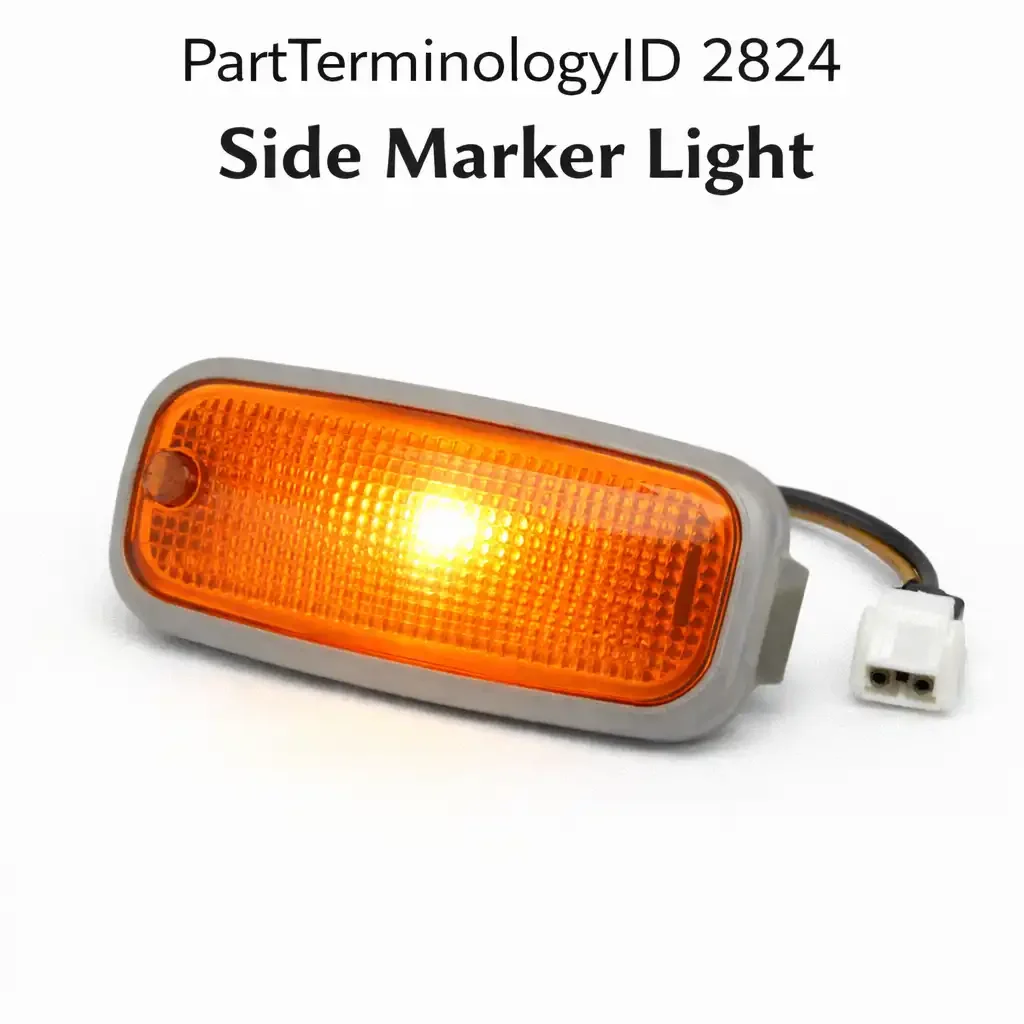
PartTerminologyID 2824, Side Marker Light, is the small lamp assembly mounted on the front and rear corners of the vehicle's body side that makes the vehicle visible from the side to other drivers approaching from the front quarter or rear quarter in darkness or low-visibility conditions, required by FMVSS 108 on all U.S. passenger vehicles and light trucks since 1968, emitting amber light at the front positions and red light at the rear positions as specified by the federal standard to provide directional visibility cues consistent with the vehicle's forward-facing and rear-facing lamp color conventions. That definition covers the lateral visibility function and the federal color requirements correctly and leaves unresolved every question that determines whether the replacement part is a bulb or a complete housing assembly, whether the front or rear position is covered given that front and rear side markers use different FMVSS 108 color requirements making them non-interchangeable, whether the driver-side or passenger-side housing is the correct unit for asymmetric body side designs, whether the housing is a standalone side marker or a combination lamp that integrates the side marker function with the parking lamp or tail lamp function in the same housing, whether the lens color is amber for front positions and red for rear positions as required or whether the color is in the bulb and the lens is clear, whether the assembly bears DOT certification markings, whether the front side marker is wired to flash with the turn signal circuit on the corresponding side and whether the replacement is compatible with that flash circuit, and whether the body style affects the fender or quarter panel mounting position where side markers of different shapes are used.
It does not specify whether the part is a bulb or assembly, the position, the side designation, whether the lamp is standalone or integrated, the lens color and color source, the DOT certification status, the turn signal integration, or the body style where panel geometry differs. A listing under PartTerminologyID 2824 that covers a vehicle without position and side designation cannot be evaluated by a buyer who has a cracked front driver-side side marker housing on a vehicle where the front side marker flashes with the turn signal, needing to confirm the replacement is the front amber unit with turn signal flash circuit compatibility rather than the rear red unit or a non-flash-compatible version.
For sellers, PartTerminologyID 2824 is the exterior lighting PartTerminologyID where the front-versus-rear color requirement creates the highest-consequence return when the position attribute is omitted. Installing a red rear side marker at the front position violates FMVSS 108 which requires amber at the front. Installing an amber front side marker at the rear position also violates FMVSS 108 which requires red at the rear. Both installations would fail a vehicle safety inspection. A catalog that conflates front and rear side marker positions under a single undifferentiated listing will deliver a federally non-compliant lamp to one of the two position buyer populations in every ambiguous transaction.
The additional complexity specific to PartTerminologyID 2824 is the standalone versus combination lamp configuration. On many vehicles, particularly trucks, SUVs, and some passenger cars, the front side marker function is combined with the parking lamp function in a single housing that serves both the lateral visibility and the forward position lamp functions simultaneously. On these vehicles, the side marker is not a separate small housing on the fender but a dual-function element of the front corner lamp assembly. A listing under PartTerminologyID 2824 for a combination lamp application must note the combined function and must confirm the replacement assembly covers both the side marker and the parking lamp circuits rather than only the side marker element.
What the Side Marker Light Does
FMVSS 108 lateral visibility requirements and the color mandate
FMVSS 108 requires all passenger vehicles to be equipped with side marker lamps at the front and rear of each side of the vehicle body. The standard specifies that front side marker lamps must emit amber light and rear side marker lamps must emit red light, a color convention that matches the front-facing amber turn signal and parking lamps and the rear-facing red stop and tail lamps so that a driver observing the vehicle from the side can immediately identify the vehicle's orientation from the lamp colors visible on the side. An amber side marker lamp at the front corner indicates the driver is approaching the front of the vehicle. A red side marker at the rear corner indicates the driver is approaching the rear.
The minimum photometric output requirements for side marker lamps in FMVSS 108 are specified in candela at test angles measuring 45 degrees forward and rearward from the lamp axis and 10 degrees above and below horizontal. These test angles confirm the lamp is visible to approaching drivers across the lateral arc without requiring direct perpendicular viewing. A replacement side marker assembly must meet these photometric values at the required test angles to be compliant. An assembly with a smoked or darkened lens that reduces total output below these values is non-compliant regardless of the lens color's nominal designation.
Standalone versus combination lamp configurations
The standalone side marker configuration uses a small, purpose-built housing mounted in the vehicle's front fender or rear quarter panel at the body corner, serving only the side marker function. The housing is a compact unit designed to fit into a small panel cutout and typically contains a single bulb or LED element with a colored lens producing the required amber or red output. This is the most common configuration on passenger cars and is the configuration most buyers visualize when searching for a side marker replacement.
The combination lamp configuration integrates the side marker function with the parking lamp at the front or with the tail lamp at the rear in a single larger housing that performs both functions simultaneously with either separate bulb elements for each function or a single dual-element bulb serving both circuits. On many trucks and SUVs, the front corner lamp is a combination parking-and-side-marker unit where the parking lamp element faces forward and the side marker element faces laterally from the same housing. Replacing this assembly requires a part that covers both circuits, and the replacement must be installed with both harness connectors connected to restore both functions. A listing that covers a standalone front side marker for an application that uses a combination lamp will deliver a part that cannot be mounted in the combination lamp housing cavity and does not cover the parking lamp circuit.
Turn signal flash integration and the LED load compatibility requirement
On most U.S.-market vehicles produced from the 1990s onward, the front side marker lamp on each side is wired to flash with the front turn signal on the corresponding side. When the left turn signal is active, the left front side marker flashes in alternation with the left front turn signal lamp: as the turn signal reaches peak brightness the side marker extinguishes, and as the turn signal extinguishes between flashes the side marker illuminates at steady park brightness. This alternating flash pattern is sometimes called the sequencing or breathing side marker effect and it provides following and oncoming drivers with a lateral turn signal indication from the side of the vehicle in addition to the front and rear turn signal lamps.
This flash circuit architecture creates a specific load requirement for LED replacements. The turn signal flash rate is determined by a thermal relay or an electronic flasher module that monitors the total current load on the turn signal circuit. When the original incandescent front side marker is replaced with a lower-current LED, the reduced load on the combined turn signal and side marker circuit changes the flasher module's frequency calculation. This produces either a fast-flash condition where the turn signal flashes at twice the normal rate or a continuous-on condition where the turn signal does not flash at all, depending on the flasher module type. A load resistor in parallel with the LED side marker restores the original circuit current load and prevents the flash rate change. Some aftermarket LED side marker assemblies include a built-in load resistor specifically for this application.
Front and rear position designation and the color compliance consequence
The color difference between front amber and rear red is not a visual preference distinction. It is a federal compliance distinction with inspection and enforcement consequences. A vehicle inspected by a state safety inspection station that checks side marker lamp color will fail for a red side marker at the front position or an amber side marker at the rear position. The color cannot be corrected by a lens swap in most housing designs because the lens is integral to the housing assembly. The complete assembly must be replaced with the correct-color front or rear unit.
Some aftermarket side marker assemblies use a clear lens with a colored bulb to produce the required output color. On these designs, replacing the bulb with a different color changes the output color. A clear-lens amber-bulb front side marker that is upgraded to a white LED bulb produces white output that is neither the required amber nor the prohibited red, which is a non-compliant neutral color that will fail an inspection for insufficient amber output at the front position. The listing must state whether the color is produced by the lens, the bulb, or both, and must state the compliance consequence of changing either element.
Why This Part Generates Returns
Buyers return side marker lights because the rear red unit is delivered for a front position that requires amber, the front amber unit is delivered for a rear position that requires red, the part is a standalone side marker assembly and the vehicle uses a combination parking-and-side-marker housing that the standalone unit cannot replace, the LED replacement changes the turn signal flash rate from the correct 60 to 120 flashes per minute to a hyper-flash condition requiring a load resistor not included with the lamp, the lens is smoked and reduces lateral output below FMVSS 108 photometric minimums causing an inspection failure, the assembly does not bear DOT markings and the buyer's state requires certified replacements, the driver-side assembly is delivered and the buyer needed the passenger-side unit on a vehicle where the two fender positions use different housing contours due to asymmetric aerodynamic body styling, the assembly is specified for the two-door coupe and the buyer has the four-door sedan whose fender side marker pocket is 15mm longer, the front side marker is a turn-signal-flash-capable unit and the listing covers a non-flash version with a simpler two-wire connector that does not include the park circuit wire present in the original three-wire connector, and the OEM housing used a snap-fit fender clip and the replacement uses a screw-mount tab requiring a new hole in the fender panel.
Status in New Databases
PIES/PCdb: PartTerminologyID 2824, Side Marker Light
PIES 8.0 / PCdb 2.0: No change in PartTerminologyID or terminology label.
Top Return Scenarios
Scenario 1: "Rear red unit delivered for front position, amber output required by FMVSS 108, vehicle fails inspection"
The buyer's front driver-side side marker housing is cracked. The listing covers the vehicle year and model without stating front or rear position. The delivered assembly is the rear red side marker. Installed at the front fender position, the red lens produces red lateral output at the front corner where FMVSS 108 requires amber. At the annual safety inspection, the inspector notes the red front side marker and fails the vehicle for non-compliant front side marker color. The buyer must remove the rear red unit and install the correct front amber unit.
Prevention language: "Position: [front, amber / rear, red]. FMVSS 108 requires front side marker lamps to emit amber and rear side marker lamps to emit red. This assembly is the [position] unit with [color] lens. Installing the wrong position unit at a front or rear location produces non-compliant output and will fail a safety inspection."
Scenario 2: "Standalone unit for combination parking-and-side-marker application, cannot mount, parking circuit incomplete"
The vehicle uses a combination front corner lamp that serves both the parking lamp and the side marker functions in a single housing. The listing covers the vehicle model year under the side marker PartTerminologyID without noting the combination lamp configuration. The delivered part is a standalone side marker housing designed for a fender panel cutout that does not exist on this vehicle because the entire front corner lamp position is occupied by the combination unit. The standalone side marker cannot be mounted and does not cover the parking lamp circuit.
Prevention language: "Lamp configuration: [standalone side marker only / combination parking and side marker, covers both circuits]. This vehicle uses a [configuration] at the front corner. A standalone side marker assembly does not replace a combination lamp and does not restore parking lamp function. Verify the lamp configuration before ordering."
Scenario 3: "LED hyper-flash on turn signal circuit, load resistor required and not included"
The buyer installs a LED front side marker replacement. The front side marker is wired in parallel with the front turn signal on this vehicle. The LED draws 80 milliamperes. The original incandescent drew 350 milliamperes. The combined circuit load drops below the thermal flasher module's minimum load threshold. The turn signal enters hyper-flash at approximately 180 flashes per minute. The rapid flash is distracting and indicates a circuit fault to the driver and following drivers. The LED is returned and the buyer seeks a load-resistor-equipped version.
Prevention language: "Turn signal flash circuit: [front side marker is wired in parallel with front turn signal on this application]. LED replacement: [includes built-in load resistor / load resistor required separately to prevent hyper-flash]. On vehicles where the front side marker is wired to the turn signal circuit, an LED replacement without a load resistor will cause hyper-flash. Verify whether the replacement includes a load resistor before ordering."
Scenario 4: "Smoked lens, lateral output below FMVSS 108 minimum, fails inspection"
The buyer installs a smoked side marker assembly for cosmetic purposes. The smoked lens reduces the lateral photometric output below the FMVSS 108 minimum candela values at the required 45-degree test angles. At the annual vehicle inspection, the inspector measures insufficient lateral output and records a side marker failure. The vehicle must have the smoked assembly replaced with a DOT-certified clear or properly colored lens assembly to pass reinspection.
Prevention language: "Lens: [clear with amber bulb, FMVSS 108 compliant / amber lens with clear bulb, FMVSS 108 compliant / smoked, output below FMVSS 108 minimum, for show use only]. FMVSS 108 requires minimum lateral photometric output at 45-degree test angles. A smoked lens reduces output below this minimum. Smoked side marker assemblies are for show use only and are not legal for nighttime street operation."
Scenario 5: "Three-wire original, two-wire replacement, park circuit unconnected, side marker dark when headlamps on"
The original front side marker assembly uses a three-wire harness connector: one wire for the park circuit that illuminates the side marker steadily when headlamps are on, one wire for the turn signal flash circuit, and one ground. The replacement assembly uses a two-wire connector with only the turn signal and ground wires, omitting the park circuit wire. After installation, the side marker flashes with the turn signal but does not illuminate steadily when the headlamps are on because the park circuit wire is unconnected. The side marker does not meet the FMVSS 108 requirement that it illuminate with the parking lamps.
Prevention language: "Connector: [two-wire turn signal and ground / three-wire park, turn signal, and ground]. This assembly uses a [connector type]. On vehicles where the front side marker illuminates steadily with the parking lamps and also flashes with the turn signal, the replacement must include the park circuit wire. A two-wire replacement on a three-wire application will produce a side marker that flashes but does not illuminate steadily with the headlamps."
What to Include in the Listing
Core essentials
PartTerminologyID: 2824
component: Side Marker Light
part type: bulb only or complete assembly (mandatory, in title)
position: front amber or rear red (mandatory, in title)
side: driver side, passenger side, or symmetric (mandatory for asymmetric housings)
lamp configuration: standalone or combination parking-and-side-marker (mandatory)
lens color: amber, red, or clear with color-source note (mandatory)
FMVSS 108 compliance and DOT certification status (mandatory for complete assemblies)
turn signal flash integration: yes or no with load resistor inclusion note for LED (mandatory for front positions)
connector type and pin count: two-wire or three-wire (mandatory)
bulb base type and wattage (mandatory)
LED load resistor included: yes or no (mandatory for LED front side marker listings)
mounting type: snap-fit clip or screw-mount tab (mandatory)
body style where fender geometry differs (mandatory)
OEM part number cross-reference (mandatory)
quantity per package (mandatory)
Fitment essentials
year/make/model/submodel/body style/trim
front or rear position designation
side designation for asymmetric fender designs
note for combination lamp variants within same model year
note for turn-signal-flash-integrated versus non-integrated variants
Image essentials
assembly shown from front with lens color clearly visible
assembly shown from rear with connector pin count and mounting tab type labeled
front and rear position units shown separately with color designation labeled
combination lamp assembly shown with both function zones labeled where applicable
load resistor shown where included in LED assembly
Catalog Checklist for ACES/PIES Teams
PartTerminologyID = 2824
require position: front amber or rear red in title (mandatory)
require part type: bulb or assembly in title (mandatory)
require side designation for asymmetric housing designs (mandatory)
require lamp configuration: standalone or combination (mandatory)
require lens color with color-source note (mandatory)
require FMVSS 108 compliance and DOT certification status (mandatory)
require turn signal flash integration and connector pin count for front positions (mandatory)
require LED load resistor inclusion status for LED front side marker listings (mandatory)
require mounting type (mandatory)
require body style where fender geometry differs (mandatory)
prevent front-rear position conflation: amber at front and red at rear are federal color requirements; a wrong-position unit fails an inspection; position must be in the title without exception
prevent standalone-combination conflation: a standalone side marker cannot replace a combination parking-and-side-marker housing; lamp configuration must be required
prevent LED hyper-flash omission: front side marker turn signal flash circuit + LED = hyper-flash without load resistor; load resistor inclusion must be stated for all LED front side marker listings
prevent two-wire versus three-wire connector omission: a two-wire replacement on a three-wire application produces a side marker that does not illuminate with parking lamps; connector pin count is mandatory
prevent smoked lens street-use representation: smoked output below FMVSS 108 minimum fails inspection; show-use-only disclosure is mandatory for all smoked listings
differentiate from Parking Light (PartTerminologyID 2836): the parking light is the forward-facing amber front position lamp; the front side marker is the laterally facing amber lamp at the same corner; both are amber but face different directions and serve different FMVSS 108 functions
differentiate from Turn Signal Light (PartTerminologyID 2872): the turn signal lamp flashes to indicate a direction change; the side marker lamp provides steady lateral visibility with parking lamps and flashes with the turn signal only where wired to do so; the two share a circuit on many vehicles but serve different primary functions
differentiate from Cornering Light (PartTerminologyID 2764): the cornering light activates during turns to illuminate the lateral path; the side marker provides steady lateral vehicle visibility in all driving conditions; both are side-facing lamps but with entirely different activation circuits and functions
FAQ (Buyer Language)
What is a side marker light and is it required?
A side marker light is a small lamp on the front and rear body corners that makes the vehicle visible from the side. FMVSS 108 has required them on all U.S. vehicles since 1968. Front side markers must emit amber. Rear side markers must emit red. A non-functional or wrong-color side marker will fail a safety inspection and is a basis for a traffic stop in all U.S. jurisdictions.
What color are they required to be?
Front: amber. Rear: red. The color applies to the light output at the lamp surface, not just the lens color. A clear-lens front side marker with a clear bulb produces white output that is not compliant amber. The listing must state both the lens color and the bulb color source so the buyer can confirm the combined output meets the FMVSS 108 color requirement at the specific position.
Why does my turn signal hyper-flash after installing an LED side marker?
On vehicles where the front side marker is wired in parallel with the front turn signal, the turn signal flasher monitors total circuit current to set the flash rate. An LED draws less current than the incandescent it replaced, reducing the total load below the flasher's minimum threshold and causing hyper-flash. A load resistor wired in parallel with the LED restores the original circuit current. Some LED side markers include a built-in load resistor for this exact application.
Can I install a side marker from any position at any corner?
No. Front and rear side markers are not interchangeable because FMVSS 108 mandates different colors for each position. Installing a rear red unit at a front position or a front amber unit at a rear position produces non-compliant output and will fail a safety inspection. Verify the position before ordering.
Cross-Sell Logic
Parking Light (PartTerminologyID 2836): the forward-facing amber position lamp at the same front corner as the side marker; when the front corner is damaged both lamps are often replaced simultaneously
Turn Signal Light (PartTerminologyID 2872): the front turn signal lamp that shares the flash circuit with the front side marker; a simultaneous turn signal and side marker failure at the same corner suggests a shared circuit fault rather than two independent bulb failures
Load Resistor Kit: for LED front side marker conversions on vehicles where the side marker is wired to the turn signal circuit; prevents hyper-flash without requiring a flasher module replacement
Headlight (PartTerminologyID 2796): for collision damage cases where the front corner impact that cracked the side marker housing also damaged the headlight assembly; both are at the same front corner and often replaced in the same repair event
Final Take for PartTerminologyID 2824
Side Marker Light (PartTerminologyID 2824) is the exterior lighting PartTerminologyID where a single omitted attribute, the front-versus-rear position designation, produces the highest-consequence compliance failure in the series. Installing the wrong color at either position violates a specific FMVSS 108 color requirement, fails a safety inspection, and requires a second replacement purchase. The position designation is not a fitment courtesy note. It is a federal color compliance attribute that belongs in the title of every side marker listing without exception.
State the position in the title. State the part type in the title. State the side designation for asymmetric housings. State the lamp configuration: standalone or combination. State the lens color and color source. State FMVSS 108 compliance and DOT certification. State the turn signal flash integration and connector pin count for front positions. State the LED load resistor inclusion. State the mounting type. State the body style where geometry differs. For PartTerminologyID 2824, position, lamp configuration, and turn signal flash connector pin count are the three attributes that determine whether the replacement produces the federally required color at the correct body corner, fits the application's combination or standalone housing cavity, and connects to all active circuit wires without leaving the park circuit or flash circuit unconnected.