
Written by Arthur Simitian | PartsAdvisory
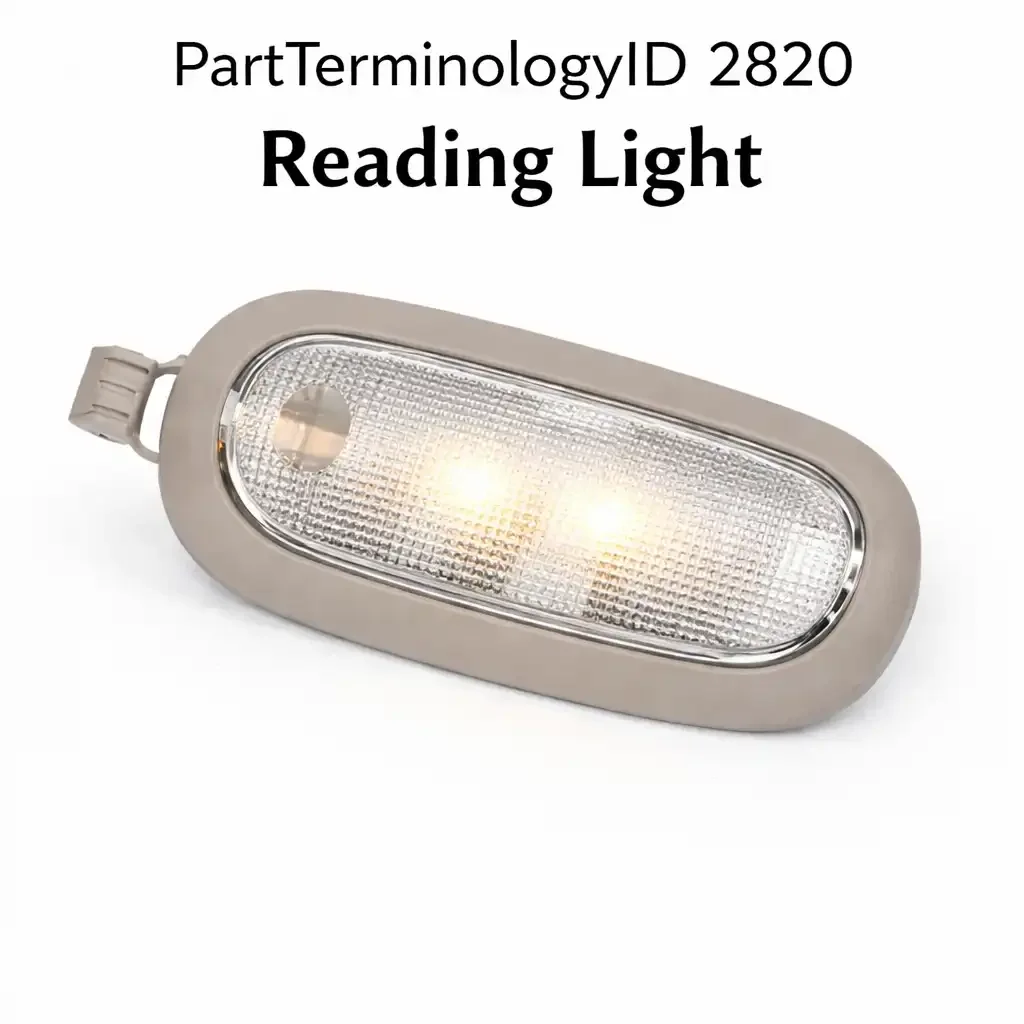
PartTerminologyID 2820, Reading Light, is the focused directional lamp mounted in the vehicle's overhead console, headliner, or seat back that provides individual occupant illumination for reading, map navigation, and task lighting during nighttime driving without illuminating the full passenger compartment or creating light spill to adjacent occupants and the driver, typically activated by the occupant's individual switch built into the reading light housing or located on the adjacent overhead console panel. That definition covers the focused individual illumination function correctly and leaves unresolved every question that determines whether the replacement part is a bulb only or a complete reading light assembly, whether the assembly configuration matches the mounting position in the vehicle's overhead console or headliner at the specific seating position being serviced, whether the switch type is an integral push-button, a touch-activated lens, or a separate rocker switch on the console panel adjacent to the lamp, whether the beam angle of the replacement produces the same focused individual illumination as the original or spreads light more broadly and disturbs adjacent occupants, whether the part covers the driver-side or passenger-side reading light position where the two positions are separate assemblies in the overhead console, whether the replacement is designed for the front overhead console or a rear overhead console used in three-row vehicles where rear passengers have individual reading lights at a different ceiling position, and whether the assembly integrates into an overhead console module alongside the dome light and sunroof controls.
It does not specify whether the part is a bulb or complete assembly, the interior seating position, the switch type, the beam angle, the driver-side versus passenger-side designation for paired front reading lights, the front versus rear position for multi-row vehicles, or the overhead console integration status. A listing under PartTerminologyID 2820 that states only year, make, and model without interior position and switch type cannot be evaluated by a buyer replacing the passenger-side front reading light assembly whose integral push-button switch has failed, needing to confirm the replacement includes the integrated switch rather than covering only the lamp element with no switch.
For sellers, PartTerminologyID 2820 shares the overhead console integration complexity discussed for the dome light but adds the beam pattern and switch type dimensions that distinguish reading light assemblies from dome light assemblies within the same overhead console module. On many vehicles, the front reading lights and the dome light are all components of the same overhead console assembly, with the reading lights as separate lens-and-switch units built into the same housing as the dome light. A buyer who needs a reading light assembly replacement for a burned-out reading light bulb with a failed integral switch may not realize the reading light is part of the overhead console assembly and that replacing the reading light element requires replacing or disassembling the full overhead console module. The listing must state the console integration status and the access method before the buyer commits to the purchase.
What the Reading Light Does
Focused beam design and the individual illumination function
The reading light differs from the dome light in its optical design as fundamentally as a flashlight differs from a ceiling lamp. The dome light uses a diffuser lens to spread light as broadly as possible across the passenger compartment floor and seating area. The reading light uses a focused reflector or directional LED array to concentrate light output into a beam narrow enough to illuminate a book or map held in the lap of one occupant without producing significant light output beyond that occupant's immediate area.
The beam angle on a typical reading light is 20 to 40 degrees, compared to the dome light's 120 to 160 degree diffused output. This focused beam allows a passenger in the right seat to read while the driver maintains dark-adapted vision for nighttime driving, because the reading light's narrow beam does not reach the driver's eye position or the windshield reflection angle. A replacement reading light bulb that produces a wider beam angle than the original, or a replacement assembly with a shallower reflector than the original, will produce a broader beam that spills onto the driver or the windshield and impairs nighttime driving vision. The beam angle must match the original assembly specification for the reading light to serve its individual illumination function correctly.
Switch types and the assembly versus bulb distinction
The reading light switch is the element that most frequently determines whether the buyer needs a bulb replacement or a complete assembly replacement. A reading light whose bulb has failed but whose integral push-button switch is functional requires only the bulb. A reading light whose integral push-button switch has failed but whose bulb is intact requires the complete assembly because the switch is integrated into the housing and is not separately serviceable. A reading light whose touch-activated lens has cracked from contact damage requires the complete assembly because the touch sensor is part of the lens-housing unit.
On vehicles where the reading light is activated by a separate rocker switch on the overhead console panel rather than an integral switch on the reading light housing itself, a failed switch requires replacing the switch element on the console panel, which may be a separate PartTerminologyID from the reading light assembly. A buyer who orders a reading light assembly expecting the rocker switch to be included will find the delivered assembly covers only the lamp element and that the console panel switch must be ordered separately. The listing must state the switch type and whether the switch is included in the assembly or is a separate service component.
Front versus rear position and the paired reading light design
Most vehicles with individual reading lights install them in pairs at the front overhead console: one for the driver and one for the front passenger. These two reading lights are frequently mirror-image asymmetric designs within the same overhead console housing, with the driver-side reading light positioned to illuminate the driver's seating area and the passenger-side reading light positioned to illuminate the passenger's area. On vehicles where the reading lights are identical and interchangeable, a single part covers both positions. On vehicles where the driver-side and passenger-side reading lights are different assemblies, or where the driver-side position is omitted because the driver is expected to use the instrument panel illumination rather than a reading light, separate listings are required for each position.
On three-row vehicles, rear passenger reading lights are provided at the rear overhead console above the second or third row, or in the seat backs of the first and second rows for second and third row passengers respectively. These rear reading light positions use different assemblies than the front overhead console reading lights, typically with different base types, different housing configurations designed for the rear ceiling or seat back mounting position, and different activation switches accessed from the rear seating positions. The interior position designation must distinguish front overhead, rear overhead, and seat back reading light positions for any vehicle where different assemblies are used at each location.
Overhead console integration and the module replacement scope
As discussed in the dome light section of this series, many modern vehicles integrate the front reading lights into the overhead console module alongside the dome light, sunroof controls, compass display, and HomeLink buttons. On these vehicles the reading light is not a discrete standalone assembly but a component of the console module. The reading light lens, bulb socket, and integral switch are built into the console housing, and the module must be removed from the headliner to access the reading light socket from the rear of the console.
On some console designs, the reading light socket is accessible through the lens cover from below the console without removing the console from the headliner. On others, the socket is only reachable after the console is unclipped from its mounting points and disconnected from the harness. The listing must state the access method explicitly: accessible through lens cover or requires console removal. A buyer who expects a two-minute lens-pop swap and discovers a 20-minute console removal procedure involving multiple harness disconnections will return the part regardless of whether it is the correct fitment, because the repair scope exceeded their available time and tools.
Why This Part Generates Returns
Buyers return reading lights because the replacement assembly does not include the integral push-button switch and the buyer needed the switch to restore activation function, the beam angle of the LED replacement is 60 degrees and the original was 30 degrees causing light spill to the driver and windshield reflection that impairs nighttime vision, the part is specified for the passenger-side position and the buyer needed the driver-side assembly whose switch and lens orientation are mirror-image reversed, the front overhead reading light assembly is delivered and the buyer needed the rear overhead console reading light used above the second row, the assembly is designed for the standalone non-console configuration and the buyer has the overhead console trim level where the reading light is a module component with a different mounting interface, the LED replacement produces 6,500 Kelvin output and the reading light reflector concentrates the blue-white beam directly onto the windshield creating a reflection that the original warm-white incandescent did not produce at the same beam angle, the integral switch is a push-button type and the delivered assembly has a touch-activated lens that the buyer finds unresponsive compared to the tactile push-button original, and the seat back reading light for a second-row passenger is delivered when the buyer needed the front overhead assembly above the first row.
Status in New Databases
PIES/PCdb: PartTerminologyID 2820, Reading Light
PIES 8.0 / PCdb 2.0: No change in PartTerminologyID or terminology label.
Top Return Scenarios
Scenario 1: "Assembly without integral switch, buyer needed switch to restore activation function"
The buyer's passenger-side reading light integral push-button switch has failed. The light can only be activated by momentarily connecting the circuit directly, not by pressing the switch. The listing covers a reading light replacement for the vehicle without stating whether the switch is included. The delivered assembly covers the lamp element with a lens cover but no integral switch. The activation function is not restored. The buyer returns the switchless assembly and seeks the version with the integrated push-button switch.
Prevention language: "Switch included: [yes, integral push-button switch / yes, touch-activated lens / no, lamp element only, switch is a separate service component]. This assembly [includes / does not include] the activation switch. If the switch has failed, verify the replacement includes the switch before ordering. A lamp-only replacement does not restore activation function when the switch is the fault."
Scenario 2: "Wide-angle LED, light spill to driver and windshield reflection impairing nighttime vision"
The buyer installs a 60-degree wide-angle LED in the passenger-side reading light socket to replace the failed incandescent. The original beam was 28 degrees. The LED's wider beam spills beyond the passenger's reading area to the driver's peripheral vision and reflects off the windshield at the angle produced by the reading light's ceiling position. The driver notices the windshield reflection during nighttime highway driving and finds it distracting. The wide-angle LED is returned and the buyer seeks a narrow-beam replacement compatible with the original beam angle.
Prevention language: "Beam angle: [X degrees]. This LED produces a [X] degree beam. Reading light reflectors are designed for a specific beam angle to contain light within the intended occupant zone. A wider-angle replacement will spill light beyond the intended area. Verify the beam angle matches the original reading light specification to prevent windshield reflection and driver distraction."
Scenario 3: "Driver-side assembly delivered, buyer needed passenger-side, switch and lens orientation reversed"
The vehicle's overhead console has a driver-side reading light and a passenger-side reading light with mirror-image lens and switch orientations. The listing covers both sides under one listing without a side selector. The buyer orders without specifying a side and receives the driver-side assembly. The driver-side assembly's switch is on the right side of the lens when viewed from below. The passenger-side assembly needs the switch on the left side. The orientation is wrong and the assembly cannot be installed in the passenger position without the switch being on the incorrect side for passenger access.
Prevention language: "Side: [driver side / passenger side / fits both sides, symmetric design]. This assembly is the [side] unit. On vehicles with asymmetric reading light designs, driver-side and passenger-side assemblies have different switch and lens orientations. Verify the side before ordering."
Scenario 4: "Overhead console integration, buyer expected standalone access, 20-minute console removal required"
The buyer expects to pop the reading light lens cover and swap the bulb in two minutes. The vehicle has an overhead console where the reading light socket is only accessible from the rear of the console after removing the console from the headliner. The listing does not state the access method. The buyer discovers the console removal requirement after receiving the part and does not have the tools or time for the procedure. The part is returned unused.
Prevention language: "Access method: [lens cover accessible from below, no console removal required / console removal required to access socket from rear]. This reading light socket is [access method]. Verify the access requirement before ordering to confirm the repair is within available tools and time."
Listing Requirements
PartTerminologyID: 2820
component: Reading Light
part type: bulb only or complete assembly (mandatory, in title)
interior position: front overhead, rear overhead, or seat back (mandatory, in title)
side: driver side, passenger side, or symmetric fits both (mandatory for paired front reading lights)
switch type and inclusion: integral push-button, touch-activated, separate console switch not included (mandatory)
beam angle in degrees (mandatory for complete assembly and LED bulb listings)
overhead console integration status and access method (mandatory)
bulb base type (mandatory)
bulb wattage (mandatory)
LED color temperature for LED listings (mandatory)
LED beam angle for LED bulb listings (mandatory)
quantity per package: note for paired reading light sets (mandatory)
OEM part number cross-reference (mandatory)
Catalog Checklist for ACES/PIES Teams
PartTerminologyID = 2820
require part type: bulb or assembly (mandatory, in title)
require interior position (mandatory, in title)
require side designation for paired asymmetric front reading lights (mandatory)
require switch type and inclusion status (mandatory)
require beam angle for assembly and LED bulb listings (mandatory)
require overhead console integration and access method (mandatory)
require LED color temperature (mandatory for LED listings)
prevent switch omission: a failed reading light switch requires a complete assembly with the switch included; a lamp-only listing does not restore activation; switch inclusion must be stated
prevent beam angle omission: a wide-angle LED in a focused reading light reflector causes windshield reflection and driver distraction; beam angle must be stated for all LED bulb listings
prevent side omission for asymmetric designs: driver and passenger reading light assemblies have different switch orientations on many vehicles; side must be required for all asymmetric applications
prevent console access omission: console removal for socket access is a 20-minute procedure that many buyers cannot perform; access method must be disclosed before purchase
differentiate from Dome Light (PartTerminologyID 2772): the dome light provides broad overhead compartment illumination; the reading light provides focused individual illumination; both may be in the same overhead console but serve different functions and use different optical designs
differentiate from Under Hood Light (PartTerminologyID 2876): the under hood light is an exterior-facing lamp for engine compartment visibility; the reading light is an interior occupant lamp; both are task-specific lamps but in entirely different positions and circuits
FAQ (Buyer Language)
What is a reading light and how does it differ from a dome light?
A reading light is a focused directional lamp that illuminates one occupant's area for reading or task lighting without lighting the full passenger compartment. A dome light provides broad diffused overhead illumination for the entire compartment. The reading light's 20 to 40 degree beam keeps light contained to one occupant's area so the driver maintains dark-adapted vision while a passenger reads.
What switch type does my reading light use?
Reading lights use an integral push-button switch in the housing, a touch-activated lens, or a separate rocker switch on the overhead console panel adjacent to the lamp. The switch type is part of the assembly design. If the switch has failed, the replacement assembly must include the switch to restore activation. A lamp-only replacement does not restore function when the switch is the fault.
Can I replace it with an LED?
Yes. Match the base type and verify the LED beam angle matches the original. A wide-angle LED in a focused reading light reflector will spill light beyond the intended zone to the driver and windshield. Also verify the LED color temperature produces comfortable warm or neutral white rather than a blue-tinted output that can reflect distractingly off the windshield at night.
Cross-Sell Logic
Dome Light (PartTerminologyID 2772): the companion overhead lamp frequently replaced alongside the reading light in a complete overhead lighting refresh event; both are typically in the same overhead console and both are accessible in the same console removal procedure
Overhead Console Assembly: for vehicles where the reading light is integrated into the overhead console module; if the console housing is cracked or the surrounding console electronic components have failed, the complete console module replacement is the correct repair scope
Interior LED Bulb Kit: for buyers converting all interior lamps to LED simultaneously; includes the reading light, dome light, map light, and courtesy lamp positions in a complete interior conversion kit
Seat Back Trim Panel: for rear seat back reading light applications where the reading light is mounted in the seat back trim panel; a damaged seat back panel may require panel replacement before the reading light can be reinstalled in a serviceable mounting surface
Final Take for PartTerminologyID 2820
Reading Light (PartTerminologyID 2820) is the interior lighting PartTerminologyID where the beam angle is a functional safety attribute rather than a cosmetic specification. A wide-angle LED in a reading light reflector that was designed for a 28-degree beam produces windshield reflections at night that impair the driver's forward vision. This is not a comfort complaint. It is a visibility impairment that the replacement part's beam angle attribute, stated in the listing, would have prevented. Beam angle belongs in the listing for every reading light LED bulb and every complete assembly listing, not as a technical footnote but as a primary attribute that determines whether the replacement serves the individual illumination function without creating a driving hazard.
State the part type in the title. State the interior position in the title. State the side designation for asymmetric paired designs. State the switch type and inclusion. State the beam angle. State the overhead console integration and access method. State the LED color temperature. State the quantity for paired sets. For PartTerminologyID 2820, interior position, switch inclusion, and beam angle are the three attributes that determine whether the replacement illuminates the correct occupant zone, restores activation function when the switch was the fault, and contains the beam within the intended area without impairment to the driver's nighttime forward vision.