
Written by Arthur Simitian | PartsAdvisory
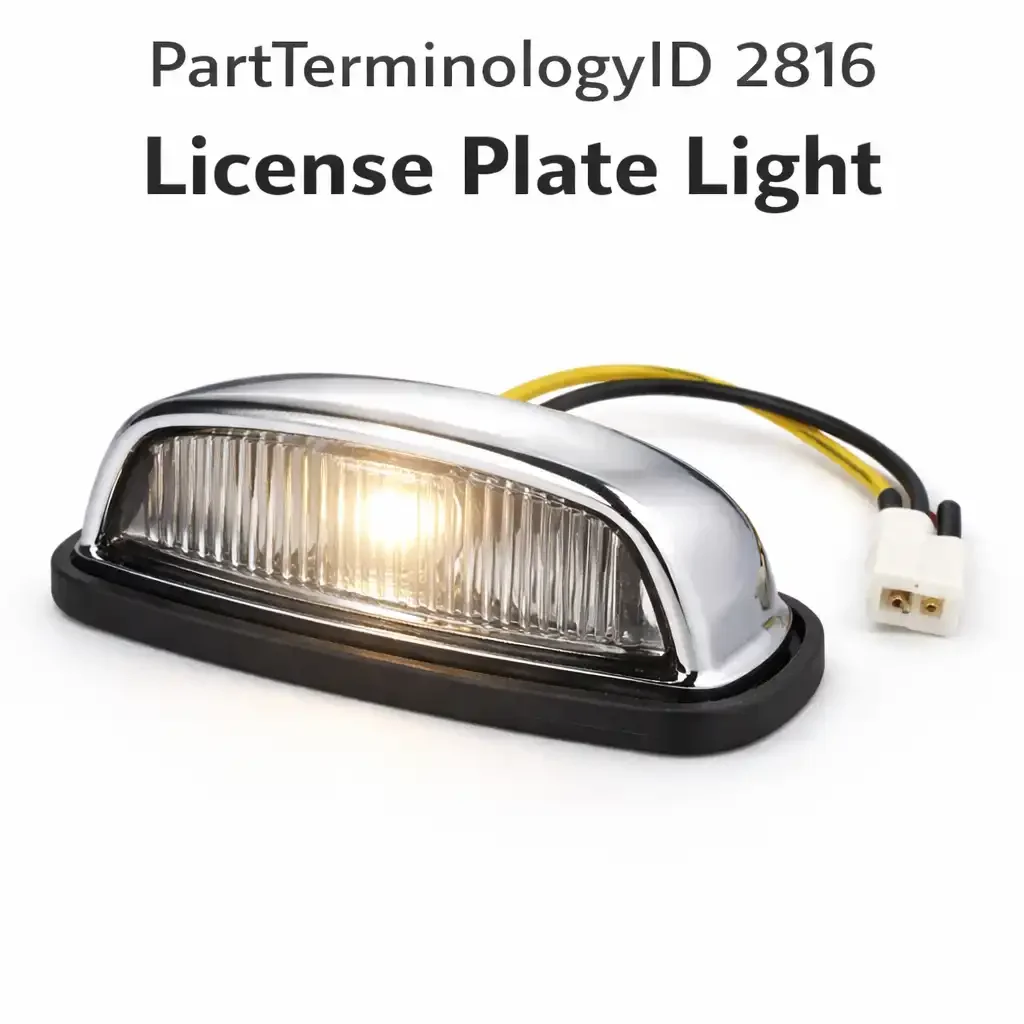
PartTerminologyID 2816, License Plate Light, is the lamp assembly or bulb that illuminates the rear license plate with white light when the headlamps or parking lamps are activated, making the plate characters readable from a minimum distance of 50 feet to the rear of the vehicle as required by FMVSS 108 and by every U.S. state's vehicle lighting regulations, with the housing typically mounted above or beside the license plate recess in the rear bumper fascia, trunk lid, tailgate, or rear body panel. That definition covers the illumination function and the federal distance requirement correctly and leaves unresolved every question that determines whether the replacement part is a bulb only or a complete housing assembly, whether the housing configuration and mounting tab pattern match the license plate light cavity in the vehicle's rear panel, whether the lens is clear as required by FMVSS 108 for white light output, whether the assembly bears DOT certification markings, whether the part covers a single-lamp or a dual-lamp application where two housings are mounted at either side of the license plate recess, whether the LED replacement produces true white output or a blue-tinted white that does not meet the FMVSS 108 white illumination requirement, whether the connector type matches the vehicle's license plate light circuit harness, whether the housing is sealed for the exposed rear bumper position, and whether the replacement is designed for the specific body style whose rear panel geometry determines the housing pocket dimensions and mounting tab spacing.
It does not specify whether the part is a bulb or complete assembly, the housing mounting configuration, the lens clarity, the DOT certification status, whether the application uses one or two lamp positions, the LED output color temperature and white light compliance, the connector type, the housing sealing specification, or the body style where rear panel geometry differs. A listing under PartTerminologyID 2816 that states only year, make, and model without quantity and housing configuration cannot be evaluated by a buyer replacing a cracked license plate light housing on a sedan where the plate recess uses two lamp housings mounted at the left and right edges of the plate area and the buyer needs to confirm whether to order one or two assemblies to complete the repair.
For sellers, PartTerminologyID 2816 sits at the intersection of three enforcement realities that give this seemingly minor exterior lamp disproportionate urgency in the buyer's repair timeline. The first is law enforcement: a non-functional license plate light is one of the most frequently cited reasons for a traffic stop during nighttime driving in every U.S. jurisdiction because the absence of plate illumination is visible from a following patrol vehicle at a considerable distance. The second is the vehicle inspection: license plate light function and output color are checked in most state annual vehicle safety inspections. The third is the insurance claim: in rear-end collision investigations, a non-functional license plate light on the struck vehicle can be cited as a contributing factor if the collision occurred in darkness and the plate light failure contributed to the following driver's inability to identify the vehicle ahead. These three enforcement realities mean the buyer's urgency for a license plate light replacement is higher than for almost any other single-bulb exterior lamp, and a listing that creates unnecessary friction through ambiguous part type or missing application detail adds purchase barrier exactly where the buyer's urgency is highest.
The additional complexity specific to PartTerminologyID 2816 is the single versus dual lamp application distinction and the LED color temperature compliance problem. Many vehicles mount a single license plate light centered above the plate recess. Others mount two lamps at the left and right edges of the plate area. A buyer who orders one assembly for a dual-lamp application and installs it will have one illuminated and one dark side of the plate, which still fails an inspection because the plate is not uniformly illuminated. The LED color temperature issue is equally specific to this PartTerminologyID: many LED license plate light replacements produce a 6,000 to 8,000 Kelvin blue-white output that appears visually bright but technically produces a blue-tinted illumination on the plate surface rather than the neutral or warm white required by FMVSS 108. At a vehicle inspection, an inspector who checks the plate illumination color will note the blue tint and may reject the lamp as non-compliant with the white output requirement.
What the License Plate Light Does
FMVSS 108 illumination requirements and the 50-foot readability standard
FMVSS 108 requires the license plate lamp to illuminate the rear license plate so the plate characters are readable from a distance of 50 feet directly to the rear of the vehicle with the headlamps or parking lamps active. The standard specifies minimum illumination levels on the plate surface in lux, measured at multiple points across the plate area to confirm uniform coverage. A replacement lamp that produces adequate center illumination but insufficient illumination at the plate edges does not meet the uniform coverage requirement even if the center point exceeds the minimum lux value.
The 50-foot readability requirement is the practical enforcement standard that law enforcement and inspection stations apply. A patrol officer who cannot read the plate characters at 50 feet in the rear-view mirror has grounds for a stop, and a vehicle inspection station that tests plate illumination by confirming readability at the specified distance will record a failure for any lamp that does not meet the threshold. The minimum illumination values in FMVSS 108 are calibrated to produce readability at 50 feet under worst-case conditions, and a replacement assembly that meets the DOT certification standard has been tested to confirm it meets those values. An assembly without DOT certification has not been tested to confirm compliance.
Single versus dual lamp applications and the quantity confusion
License plate light applications divide into three mounting configurations that each present different quantity requirements for a complete repair. The first is a single centered lamp mounted above the center of the license plate recess, used on most sedans and coupes where the plate is set into a recessed area in the trunk lid with a single housing above. The second is a dual-lamp configuration with two housings mounted at the left and right upper corners of the plate recess, used on vehicles where the plate area spans a wider trunk lid and a single central lamp cannot illuminate the full plate width to the FMVSS 108 minimum edge illumination levels. The third is an integrated lamp configuration where the license plate lamp is built into the tail lamp assembly or the rear bumper fascia as part of a larger rear lighting module rather than a separate standalone housing.
A catalog entry that does not state the application's lamp count will generate returns from two buyer populations simultaneously. Single-lamp application buyers who receive a quantity-two set will return one assembly as unnecessary. Dual-lamp application buyers who receive a quantity-one assembly will install it and discover the opposite side of the plate is dark, then return the single assembly and reorder a pair. The listing must state the lamp count explicitly as a primary attribute: one assembly for single-lamp applications, two assemblies for dual-lamp applications, and integrated tail lamp assembly for applications where the license plate lamp is part of the tail lamp module.
LED color temperature and the blue-white FMVSS 108 compliance problem
The LED license plate light replacement market contains a significant volume of ultra-high-color-temperature LEDs in the 6,000 to 8,000 Kelvin range that produce visually impressive crisp white output at maximum brightness but technically emit a color that crosses from neutral white into blue-white at the high end of the range. FMVSS 108 requires white light output from the license plate lamp. The standard's white light definition corresponds approximately to color temperatures between 2,500 and 6,000 Kelvin, with the upper limit varying depending on the measurement method and ambient conditions at the time of measurement.
An LED replacement producing 7,000 Kelvin blue-white output illuminates the plate brightly but casts a blue tint on the plate surface that is visually distinguishable from neutral white. Under photometric measurement at the specific test angles required by FMVSS 108, a 7,000 Kelvin LED may fail the white light chromaticity test even if its lux output exceeds the minimum illumination values. At a vehicle inspection station that performs a color check on the plate illumination, the blue-tinted LED will be noted as non-white output and the vehicle will fail the lamp color portion of the inspection. The listing must state the LED color temperature and must note the FMVSS 108 white light compliance status for all LED listings under this PartTerminologyID.
Housing sealing, corrosion, and the replacement trigger beyond bulb failure
The license plate light housing is mounted in one of the most corrosion-exposed positions on the vehicle: the rear bumper fascia or trunk lid at road level, directly in the path of road spray, mud, salt, and debris kicked up by the rear tires. The housing lens and gasket are exposed to this environment every time the vehicle moves. Over time, the lens gasket deteriorates, allowing water to enter the housing cavity. Water in the housing cavity corrodes the socket contacts, which produces intermittent and then permanent license plate light failure that cannot be resolved by bulb replacement because the socket contacts no longer make reliable electrical contact even with a new bulb.
On vehicles in salt-belt regions, license plate light housing corrosion is a predictable failure mode that typically presents at five to ten years depending on the housing material and gasket quality. A buyer who replaces the bulb in a corroded socket and finds the new bulb does not illuminate, or illuminates briefly and then fails again within days, has a socket corrosion problem requiring complete housing replacement. The listing must note that socket corrosion in exposed housing positions is a common companion fault to bulb failure, and that a new bulb in a corroded socket will have reduced service life. Complete assembly replacement is the permanent repair for a corroded license plate light housing.
Why This Part Generates Returns
Buyers return license plate lights because the part is a single assembly and the vehicle uses a dual-lamp configuration with one dark side of the plate remaining after installation, the LED produces 7,500 Kelvin blue-white output that fails the white light color check at the vehicle inspection, the assembly is designed for a sedan trunk lid mounting position and the buyer has a hatchback whose license plate is mounted in the rear bumper fascia with a different housing pocket geometry, the lens has a smoked tint that reduces illumination below the 50-foot readability threshold, the assembly does not bear DOT markings and the buyer's jurisdiction requires certified replacement lamps, the mounting tab configuration uses two tabs and the vehicle's housing cavity uses three tabs in different positions, the connector is a bare pigtail and the vehicle uses a weatherproof sealed two-pin connector requiring an adapter, the new bulb is installed in a corroded socket and fails within one week from poor contact, the LED replacement triggers a bulb-out warning on the vehicle's tail light monitoring circuit, and the housing is specified for a US-market vehicle with the plate light centered but the buyer has a Canadian-market vehicle with the plate light offset to accommodate the wider Canadian plate format.
Status in New Databases
PIES/PCdb: PartTerminologyID 2816, License Plate Light
PIES 8.0 / PCdb 2.0: No change in PartTerminologyID or terminology label.
Top Return Scenarios
Scenario 1: "Single assembly for dual-lamp vehicle, one side of plate illuminated, fails inspection"
The vehicle uses two license plate light housings mounted at the left and right edges of the plate area. The listing covers the vehicle year and model without stating the lamp count. The buyer orders one assembly assuming a single lamp is standard. After installation, the left side of the plate is illuminated and the right side is dark. The vehicle fails its annual inspection for insufficient plate illumination at the right side. The buyer returns the single assembly and reorders a pair.
Prevention language: "Lamp count: [1 assembly, single-lamp application / 2 assemblies, dual-lamp application, sold as a set / sold individually, order 2 for dual-lamp applications]. This listing covers [lamp count]. Verify the vehicle's license plate light configuration before ordering. Dual-lamp applications require two assemblies for complete plate illumination coverage."
Scenario 2: "LED produces blue-white output, plate illumination fails FMVSS 108 color check at inspection"
The buyer installs a high-color-temperature LED replacement. The LED produces 7,200 Kelvin output that appears crisp white at maximum brightness but casts a blue tint on the white plate background. At the annual vehicle inspection, the inspector notes the blue-tinted plate illumination and records a non-white output failure for the license plate lamp. The vehicle must have the blue LED replaced with a neutral-white LED or an incandescent to pass reinspection.
Prevention language: "LED color temperature: [X] Kelvin. FMVSS 108 compliance: [meets white light output requirement / may produce blue-tinted output above 6,000 Kelvin that does not meet FMVSS 108 white light requirement at the plate surface]. Verify the LED color temperature produces neutral or warm white output on the plate surface. LEDs above 6,000 Kelvin may appear blue-white and fail a vehicle inspection color check."
Scenario 3: "Socket corrosion, new bulb fails within one week, complete assembly required"
The buyer's license plate light is dark. The socket contacts inside the housing are corroded from years of road spray ingress through a deteriorated lens gasket. The buyer replaces the bulb. The new bulb illuminates initially but fails again within one week because the corroded socket contacts are not providing reliable electrical contact and the intermittent arcing through the corrosion layer damages the new bulb's filament. The buyer returns the second failed bulb and concludes the bulbs are defective. The actual fault is the corroded socket requiring complete assembly replacement.
Prevention language: "Socket corrosion note: If a new bulb fails repeatedly within days of installation in the same socket, the socket contacts are corroded and the housing requires complete replacement. A new bulb installed in a corroded socket will have severely reduced service life from intermittent contact. Complete assembly replacement is the permanent repair for corroded license plate light housings in salt-belt and high-humidity applications."
Scenario 4: "Hatchback fascia position, sedan trunk lid assembly delivered, housing geometry mismatch"
The vehicle was produced as a sedan and hatchback on the same platform. The sedan mounts the license plate light in the trunk lid above the plate recess. The hatchback mounts the license plate light in the rear bumper fascia below the liftgate, at a different height and with a different housing pocket geometry. The listing covers the model name without distinguishing body style. The delivered assembly is the sedan trunk lid housing. The hatchback bumper fascia pocket has different dimensions and the sedan housing cannot be seated flush in the bumper cavity.
Prevention language: "Body style: [sedan / hatchback / wagon / truck]. Mounting position: [trunk lid / rear bumper fascia / tailgate / rear body panel]. This assembly is designed for the [body style] [mounting position]. Verify the body style and mounting position match before ordering. License plate light mounting positions differ significantly between body styles on the same platform."
Scenario 5: "Smoked lens, plate illumination below 50-foot readability threshold, vehicle stopped by law enforcement"
The buyer installs a smoked lens license plate light assembly. At night, the smoked lens reduces total plate illumination below the level required for 50-foot readability. A patrol officer following the vehicle at 60 feet cannot read the plate characters in the rear-view mirror and initiates a traffic stop. The officer cites the vehicle for non-compliant license plate illumination. The buyer must replace the smoked assembly with a clear-lens DOT-certified replacement before operating the vehicle at night.
Prevention language: "Lens clarity: [clear, FMVSS 108 compliant / smoked, reduces output below 50-foot readability threshold, not legal for nighttime street use]. A smoked license plate light lens reduces plate illumination below the FMVSS 108 minimum and is one of the most commonly cited license plate illumination violations. Smoked assemblies are for show or daytime display use only."
What to Include in the Listing
Core essentials
PartTerminologyID: 2816
component: License Plate Light
part type: bulb only or complete assembly (mandatory, in title)
lamp count: single or dual with per-side or set quantity note (mandatory, in title)
body style and mounting position where they differ (mandatory)
lens clarity: clear or smoked with compliance note for smoked (mandatory)
FMVSS 108 compliance and DOT certification status for complete assemblies (mandatory)
LED color temperature in Kelvin for LED listings with white light compliance note (mandatory for LED)
bulb base type for bulb-only and assembly listings (mandatory)
bulb wattage (mandatory)
connector type (mandatory for assembly listings)
housing sealing specification: IP rating or weatherproof note (mandatory for complete assemblies)
mounting tab count and configuration (mandatory for complete assemblies)
socket corrosion note for high-mileage and salt-belt applications (recommended)
load-sensing circuit compatibility for LED listings (mandatory)
quantity per package (mandatory)
OEM part number cross-reference (mandatory)
Fitment essentials
year/make/model/submodel/body style
mounting position: trunk lid, bumper fascia, tailgate, rear body panel
lamp count per vehicle
market designation where US and Canadian plate formats differ
note for integrated tail lamp assembly applications where license plate lamp is not a standalone housing
Image essentials
housing shown from front with lens clarity and DOT markings visible
housing shown from rear with mounting tab configuration and connector type labeled
lens shown illuminated on a white plate surface to demonstrate actual plate color output for LED listings
dual-lamp set shown together with both assemblies labeled
socket shown in detail for bulb-only listings with base type labeled
Catalog Checklist for ACES/PIES Teams
PartTerminologyID = 2816
require part type: bulb or assembly (mandatory, in title)
require lamp count in title (mandatory)
require body style and mounting position where they differ (mandatory)
require lens clarity with FMVSS 108 compliance note or smoked off-road disclosure (mandatory)
require DOT certification status for complete assemblies (mandatory)
require LED color temperature with white light compliance note for LED listings (mandatory)
require housing sealing specification (mandatory for complete assemblies)
require mounting tab configuration for assembly listings (mandatory)
require load-sensing circuit compatibility for LED listings (mandatory)
prevent lamp count omission: dual-lamp applications with one assembly installed leave one side of the plate dark and will fail inspection; lamp count is mandatory in the title
prevent LED blue-white compliance omission: LEDs above 6,000 Kelvin may produce non-compliant blue-tinted output; color temperature and white light compliance must be stated for all LED listings
prevent smoked lens street-use representation: a smoked license plate light is one of the most commonly cited nighttime violations; the off-road or show-use-only disclosure is mandatory for all smoked listings
prevent socket corrosion oversight: buyers in salt-belt states who replace a bulb in a corroded socket will experience repeat failure; the socket corrosion note should appear in listings for high-mileage applications and all vehicles from salt-affected regions
prevent body style conflation: sedan trunk lid and hatchback bumper fascia positions use different housing geometries; body style and mounting position must be required where they differ
differentiate from Back Up Light (PartTerminologyID 2748): both are rear exterior lamps but the back up light activates in reverse and emits white light on demand; the license plate light activates with headlamps and illuminates a fixed target; the two serve different functions and use different housing positions
differentiate from Tail Light (PartTerminologyID 2864): the tail light is the red position lamp in the tail lamp assembly; the license plate light is the white lamp illuminating the plate; both are rear lamps that activate with headlamps but at different positions and with different color requirements
FAQ (Buyer Language)
What does the license plate light do and is it required by law?
The license plate light illuminates the rear plate with white light so it is readable from 50 feet when the headlamps are on. FMVSS 108 requires it on all vehicles. Every U.S. state independently requires functioning license plate illumination at night. A non-functional license plate light is one of the most common reasons for a traffic stop and a common vehicle inspection failure.
What color light is required?
White. FMVSS 108 requires white light output on the plate surface. The housing lens must be clear. A smoked or colored lens does not produce compliant white output. LED replacements must produce neutral or warm white, typically below 6,000 Kelvin, to avoid a blue-tinted output that may fail an inspection color check.
Why did my license plate light fail while the tail lights still work?
The license plate light is typically on a separate circuit branch from the tail lights. A blown fuse at the license plate circuit, a burned-out bulb, or corroded socket contacts from water ingress through a deteriorated lens gasket can produce a non-functional license plate light without affecting the tail lights. If a new bulb fails within days, the socket contacts are corroded and the housing requires complete replacement.
Can I use an LED replacement?
Yes. Match the base type and confirm the LED produces neutral or warm white output below 6,000 Kelvin for FMVSS 108 compliance. On vehicles with load-sensing tail light circuits, the lower LED current draw may trigger a bulb-out warning. A load resistor in parallel with the LED can restore the correct current if needed.
Does the housing need to be DOT certified?
Yes. A complete replacement housing must bear DOT certification markings confirming compliance with FMVSS 108 illumination requirements. An assembly without DOT markings has not been certified. Individual replacement bulbs installed in an existing compliant housing do not require separate certification.
Cross-Sell Logic
Tail Light (PartTerminologyID 2864): the rear position lamp assembly adjacent to or containing the license plate light on many vehicles; collision damage and housing failure at the rear often affect both the tail lamp and the license plate light housing simultaneously
Back Up Light (PartTerminologyID 2748): another rear exterior lamp frequently replaced alongside the license plate light in rear lighting restoration events on high-mileage vehicles
Load Resistor Kit: for LED license plate light conversions on vehicles with load-sensing tail light monitoring circuits that produce false bulb-out warnings with LED replacements
Wiring Repair Connector: for applications where the license plate light harness connector is corroded or damaged at the housing connection and requires a pigtail repair connector rather than a complete harness replacement
Rear Bumper Fascia: for collision damage cases where the license plate light housing is broken as part of a rear bumper impact; if the fascia is damaged the housing replacement may require fascia replacement first to provide a mounting surface
Final Take for PartTerminologyID 2816
License Plate Light (PartTerminologyID 2816) is the exterior lighting PartTerminologyID whose failure carries the highest immediate law enforcement consequence of any single exterior lamp after the headlight and stop lamp. A non-functional license plate light is observable by a following patrol officer at road distance, generates a valid stop reason in every U.S. jurisdiction, and appears as a failure in virtually every state safety inspection. The buyer's urgency is correspondingly high, which means listing friction from missing application detail translates directly into lost sales and preventable returns at a moment when the buyer has the highest motivation to complete the purchase quickly.
State the part type in the title. State the lamp count in the title. State the body style and mounting position. State the lens clarity with the FMVSS 108 compliance note. State DOT certification. State the LED color temperature with the white light compliance note. State the housing sealing specification. State the mounting tab configuration. State load-sensing circuit compatibility. Include the socket corrosion note. For PartTerminologyID 2816, lamp count, LED color temperature compliance, and housing sealing specification are the three attributes that determine whether the replacement illuminates the full plate in compliant white light, serves both lamp positions on a dual-lamp application, and survives the exposed rear bumper environment long enough to avoid a repeat replacement within the first service year.