
Instrument Panel Light (PartTerminologyID 2812): Where Bulb Type, Panel Zone, and Dimmer Compatibility Determine Whether the Dashboard Is Evenly Illuminated at Every Dimmer Setting
Written by Arthur Simitian | PartsAdvisory
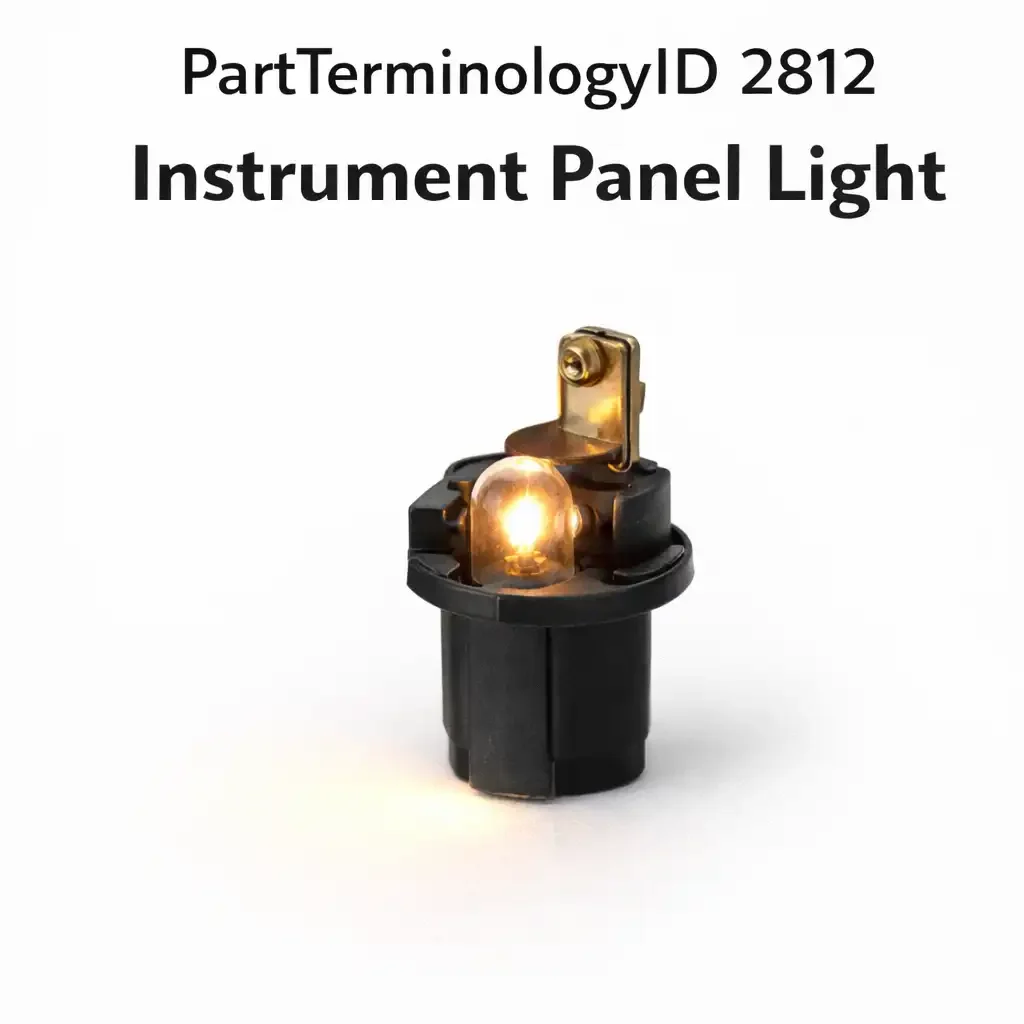
PartTerminologyID 2812, Instrument Panel Light, is the backlighting bulb or LED element that illuminates the instrument gauges, switches, and dashboard controls from behind so the driver can read all panel legends, gauge scales, and control labels in low-light and nighttime driving conditions, connected to the interior illumination circuit and controlled by the panel dimmer rheostat that allows the driver to adjust panel brightness from maximum to minimum without affecting the gauge readability required for safe vehicle operation. That definition covers the backlighting function and the dimmer circuit connection correctly and leaves unresolved every question that determines whether the replacement bulb base type matches the socket type at the specific panel zone position being serviced, whether the lens color matches the original panel illumination color scheme so a replaced bulb does not appear as a differently colored zone against the surrounding panel illumination, whether the wattage is consistent with the adjacent bulbs so the replaced zone does not appear brighter or dimmer than surrounding zones at mid-dimmer settings, whether the replacement is a single bulb for a specific position or a complete set covering the full panel illumination circuit, whether the panel zone being serviced is in the gauge cluster itself or in a separate switch panel on the dashboard outside the cluster, whether the dimmer circuit uses a variable-voltage rheostat or a PWM dimmer module and whether the LED replacement dims smoothly across the full rheostat range, and whether the cluster uses socket-mount discrete bulbs or a PCB architecture requiring soldering at specific board positions.
It does not specify the panel zone, the lens color, the wattage, whether the part is a single bulb or a complete set, the dimmer circuit type and LED compatibility, the cluster architecture, or the gauge cluster versus switch panel distinction. A listing under PartTerminologyID 2812 that states only year, make, and model without panel zone and lens color cannot be evaluated by a buyer who has a dark speedometer face and intact tachometer and fuel gauge illumination, trying to determine from a listing whether the speedometer position uses the same bulb as the tachometer or a different base type at the speedometer-specific socket.
For sellers, PartTerminologyID 2812 covers the largest individual bulb population of any single interior lighting PartTerminologyID in this series because a complete instrument panel illumination circuit on a full-size dashboard can contain between eight and thirty individual panel bulbs at different positions serving different gauge zones, switch legends, and control labels. A catalog strategy that covers all these positions under a single undifferentiated listing will generate returns from buyers who receive the wrong wattage, the wrong lens color, or the wrong base type for the specific position they are servicing. The most efficient catalog structure for PartTerminologyID 2812 is a position-by-position breakdown with each listing specifying the zone, the base type, the lens color, and the wattage, supplemented by a complete set listing that covers the full panel illumination circuit with every bulb type and quantity specified.
What the Instrument Panel Light Does
Zone-by-zone panel illumination and the multi-bulb circuit architecture
The instrument panel illumination circuit on an analog gauge cluster uses individual bulbs positioned at each gauge face and switch legend to backlight that specific zone from behind. Each bulb illuminates a defined area of the panel face: the speedometer bulb illuminates the speedometer scale and needle; the fuel gauge bulb illuminates the fuel gauge face; the HVAC switch panel bulbs illuminate each switch legend; and so on across the full panel. The zones overlap slightly on most panels so that a single failed bulb produces a dimmer area rather than a hard dark boundary, but the failed zone is distinguishable at night as a noticeably darker region against the surrounding lit panel.
The circuit architecture groups these individual bulbs into parallel branches on the illumination circuit, all supplied from the same fused circuit through the dimmer rheostat. A failed bulb opens its individual branch but does not affect other branches. The dimmer rheostat varies the supply voltage to all branches simultaneously, dimming all panel zones in unison. When a single zone is replaced with a bulb of a different wattage than the original, that zone's brightness relative to adjacent zones changes with dimmer position: at full brightness all zones may appear similarly lit, but at mid-dimmer settings the higher-wattage replacement zone remains brighter than adjacent lower-wattage zones, creating an uneven panel appearance that is particularly noticeable at the driver's preferred nighttime dimmer position.
Lens color and the panel color scheme consistency requirement
Instrument panel illumination is not white on most vehicles. Manufacturers design their panel color schemes using specific lens colors that produce the intended panel appearance at night. Green and blue-green panel illumination was standard on most American and Japanese vehicles through the 1990s and into the 2000s. Amber and orange panel illumination is common on European vehicles and on some premium American applications. Red illumination is used on some performance-oriented applications where red preserves night vision adaptation more effectively than green or white. White illumination is used on modern vehicles with LED-backlit digital panels and on some premium trim levels that sought a contemporary appearance.
A replacement bulb with the wrong lens color produces a visibly different zone color against the surrounding panel illumination scheme. A single green-lens replacement in an amber-scheme panel produces a green zone that is immediately visible against the amber surrounding zones at night. On multi-bulb complete set replacements, installing a set of green-lens bulbs in an amber-scheme panel converts the entire panel color from amber to green, which changes the vehicle's interior character at night in a way the buyer may not have intended if the listing did not state the lens color explicitly. Lens color must be stated for every panel illumination listing and must match the original panel color scheme specification for the vehicle.
Dimmer compatibility: rheostat versus PWM and the LED dimming problem
The panel dimmer circuit on older vehicles uses a variable-resistance rheostat that reduces the supply voltage to the panel illumination circuit by increasing the resistance in series with the bulb circuit. As the rheostat resistance increases, the voltage across the bulb circuit decreases and the incandescent bulbs dim proportionally. This architecture works perfectly with incandescent bulbs, which dim continuously and smoothly from full brightness to off as voltage decreases.
LED panel bulbs in a variable-voltage rheostat circuit face a forward voltage threshold problem. An LED requires a minimum forward voltage to conduct current. Below this threshold the LED extinguishes abruptly rather than dimming further. On a rheostat dimmer circuit, an LED panel bulb will dim smoothly from full brightness down to the point where the rheostat reduces the circuit voltage below the LED's forward voltage threshold, at which point the LED goes dark rather than continuing to dim to the driver's preferred minimum setting. The practical result is that the driver cannot set the panel to a dim glow for nighttime highway driving because the LED extinguishes before reaching the preferred low setting. A load resistor in parallel with the LED can shift the effective forward voltage threshold lower on some circuits, but the most reliable solution is to verify LED dimmer compatibility with the specific circuit before purchasing LED panel bulbs for a rheostat-dimmer application.
Gauge cluster versus switch panel zones and the separate listing requirement
On many vehicles the gauge cluster assembly and the surrounding dashboard switch panels are separate assemblies on separate circuit branches with different fuse positions. The gauge cluster illumination circuit powers the bulbs behind the speedometer, tachometer, fuel gauge, temperature gauge, and warning indicator positions. The switch panel illumination circuit powers the bulbs behind the HVAC controls, audio head unit controls, window switch legends, and other dashboard switch legends. The two circuits may use different bulb base types, different wattages, and different lens colors even on the same vehicle because the gauge cluster was designed by the cluster supplier and the switch panels were designed by the instrument panel assembly supplier, each to their own specifications.
A catalog entry that covers PartTerminologyID 2812 for a vehicle without distinguishing gauge cluster zone from switch panel zone will deliver gauge cluster bulbs to buyers servicing switch panel positions and vice versa, with mismatched base types and wattages in both directions. The zone designation is as important as the base type for this PartTerminologyID and must be required in every listing.
Why This Part Generates Returns
Buyers return instrument panel lights because the lens color is green and the panel uses an amber illumination scheme producing a single visibly green zone against the amber surrounding panel, the wattage is 3 watts and all original panel bulbs are 1.4 watts producing one noticeably bright zone at the replaced position at mid-dimmer settings, the part is a gauge cluster bulb and the buyer needed a switch panel bulb that uses a different base type, the LED replacement extinguishes abruptly at the low end of the rheostat dimmer range and the driver cannot achieve the preferred dim setting for highway driving, the base type is a T5 wedge and the specific position in this vehicle's cluster uses a T4.2 miniature wedge at that zone, the complete set listing covers 12 bulbs and the cluster requires 16 causing four positions to remain dark after the set is installed, the PCB cluster at this position requires a soldered LED and the delivered socket-mount bulb has no socket to receive it, and the listing covers the gauge cluster circuit and the buyer's dark zone is in the HVAC switch panel on a separate circuit with a different bulb specification.
Status in New Databases
PIES/PCdb: PartTerminologyID 2812, Instrument Panel Light
PIES 8.0 / PCdb 2.0: No change in PartTerminologyID or terminology label.
Top Return Scenarios
Scenario 1: "Wrong lens color, single green zone visible against amber panel scheme at night"
The vehicle's full instrument panel uses amber-lens bulbs producing a consistent amber illumination scheme at night. The buyer replaces one failed bulb with a green-lens replacement of the correct base type and wattage. The replaced zone illuminates green against the amber surrounding panel. The single green zone is immediately visible every time the interior lights are on at night. The buyer returns the green-lens bulb requesting the amber-lens variant.
Prevention language: "Lens color: [amber / green / white / red / clear]. This bulb has a [color] lens. Verify the lens color matches the vehicle's panel illumination color scheme before ordering. A single bulb with the wrong lens color produces a visibly different zone against the surrounding panel illumination scheme."
Scenario 2: "LED extinguishes at low dimmer setting, driver cannot achieve preferred night driving brightness"
The vehicle uses an analog variable-resistance rheostat dimmer. The buyer installs LED panel bulbs. The LEDs dim smoothly from full brightness to approximately 30 percent brightness before the rheostat voltage drops below the LED forward threshold. The LEDs extinguish abruptly at the dimmer position the driver typically uses for highway night driving. The panel goes dark rather than remaining at the preferred low glow. The buyer returns the LED set and requests incandescent replacements compatible with the rheostat dimmer.
Prevention language: "Dimmer compatibility: [compatible with PWM dimmer / compatible with variable-voltage rheostat dimmer / verify dimmer type before ordering LED]. This LED [is / may not be] compatible with variable-voltage rheostat dimmer circuits. On vehicles with rheostat dimmers, LEDs may extinguish abruptly at low dimmer settings rather than reaching the minimum glow. Verify the vehicle's dimmer circuit type before installing LED panel bulbs."
Scenario 3: "Complete set covers 12 bulbs, cluster requires 16, four positions remain dark"
The listing covers a complete instrument panel bulb set described as a full replacement set for the vehicle application. The set contains 12 bulbs. The vehicle's gauge cluster has 16 individual bulb positions. After installing all 12 bulbs, four cluster positions remain dark because the set did not include bulbs for those positions. The buyer returns the incomplete set and seeks a complete set with the correct bulb count.
Prevention language: "Quantity: [X] bulbs covering [specific positions listed]. This set covers the following positions: [list]. Verify the total bulb count and positions against the vehicle's cluster layout before ordering. Clusters on the same vehicle can vary in bulb count between trim levels and production date ranges. A complete set listing must specify which positions are covered."
Scenario 4: "Gauge cluster bulb delivered, buyer's dark zone is in HVAC switch panel on separate circuit"
The buyer has a dark zone in the HVAC switch panel where the fan speed and temperature control legends are not illuminated. The listing covers instrument panel lights for the vehicle without distinguishing gauge cluster from switch panel. The delivered bulbs are gauge cluster backlight bulbs of a different base type than the HVAC switch panel positions. The switch panel uses a capless T4.2 bulb and the delivered gauge cluster replacement is a T5 wedge. The buyer returns the T5 set and must source the T4.2 switch panel specific bulbs separately.
Prevention language: "Panel zone: [gauge cluster illumination / HVAC switch panel / audio switch panel / complete dashboard set]. This listing covers [zone]. Gauge cluster and dashboard switch panel positions frequently use different base types and wattages. Verify the dark zone is in the covered panel zone before ordering."
Listing Requirements
PartTerminologyID: 2812
component: Instrument Panel Light
panel zone: gauge cluster, HVAC switch panel, audio panel, or complete set (mandatory, in title)
bulb base type: T5 wedge, T4.2 miniature wedge, capless, or PCB LED (mandatory, in title)
lens color: amber, green, white, red, or clear (mandatory, in title)
wattage in watts (mandatory)
voltage rating: 12V DC (mandatory)
bulb type: incandescent or LED (mandatory)
LED polarity for LED listings (mandatory)
dimmer compatibility: PWM or rheostat with LED threshold note (mandatory for LED listings)
replacement method: socket-mount or PCB solder (mandatory)
cluster architecture: analog socket-mount or PCB (mandatory)
quantity per package with covered positions listed for complete sets (mandatory)
OEM bulb number cross-reference (mandatory)
Catalog Checklist for ACES/PIES Teams
PartTerminologyID = 2812
require panel zone in title (mandatory)
require bulb base type in title (mandatory)
require lens color in title (mandatory)
require wattage (mandatory)
require dimmer compatibility note for LED listings (mandatory)
require replacement method (mandatory)
require cluster architecture (mandatory)
require quantity with covered positions for complete set listings (mandatory)
prevent lens color omission: a single wrong-color zone is visible against the panel scheme every night; lens color is a visual consistency attribute that must be in the title
prevent wattage inconsistency: a higher-wattage replacement appears as a brighter zone at mid-dimmer settings; wattage must match adjacent bulbs for even panel illumination
prevent gauge cluster versus switch panel conflation: the two zones use different base types and wattages on most vehicles; panel zone must be required in the title
prevent LED rheostat dimmer incompatibility: the abrupt LED extinguish on rheostat dimmers is the most common LED panel bulb complaint; dimmer compatibility must be stated for all LED listings
prevent incomplete set counts: complete set listings must specify the exact positions covered and the total bulb count; an understated count generates returns from every buyer whose cluster has more positions than the set covers
differentiate from Check Engine Light (PartTerminologyID 2753): the MIL is a regulated warning indicator; the instrument panel light is a backlighting bulb with no regulatory function; the two may use the same base type but serve entirely different purposes
differentiate from High Beam Indicator Light (PartTerminologyID 2800): the high beam indicator is a federally regulated telltale; the instrument panel light is a backlighting lamp for gauge and switch readability; both are cluster lamps but in different categories with different compliance dimensions
FAQ (Buyer Language)
What does the instrument panel light do?
Instrument panel lights are the backlighting bulbs or LEDs behind the gauge faces, switch legends, and dashboard controls that make them readable at night. They are connected to the interior illumination circuit and controlled by the panel dimmer rheostat. A burned-out panel bulb produces a dark zone in the area that bulb illuminated while adjacent zones remain lit.
Why is one area of my panel darker than the rest?
A single burned-out panel bulb produces a dark or dimmer zone at that position while other bulbs in parallel branches remain functional. Replacing the failed bulb restores even illumination. If multiple zones are dimming gradually, other bulbs may be near end of life and a complete panel set replacement is more efficient than replacing individual bulbs as they fail one at a time.
Can I replace panel lights with LEDs?
Yes on socket-mount clusters. Match the base type and lens color. On vehicles with analog variable-resistance rheostat dimmers, verify the LED dims smoothly to a low glow without extinguishing abruptly at the low end of the dimmer range. Some LEDs have a forward voltage threshold that causes them to go dark before reaching the driver's preferred minimum brightness on rheostat circuits.
What is the difference between gauge cluster lights and switch panel lights?
Gauge cluster lights backlight the speedometer, tachometer, and other gauges. Switch panel lights backlight the HVAC, audio, and other dashboard switch legends. The two zones are frequently on separate circuits with different base types and wattages. Identify which zone contains the dark area before ordering to confirm the correct bulb specification for that specific position.
Cross-Sell Logic
Complete Instrument Panel Bulb Set: the most efficient option for buyers replacing one failed bulb on a high-mileage vehicle where the remaining bulbs are near end of life; replacing the complete set in one service event eliminates repeat dark zone appearances over the following months
Ignition Light (PartTerminologyID 2808): a companion cluster indicator frequently replaced alongside panel illumination bulbs in a comprehensive cluster lighting refresh
High Beam Indicator Light (PartTerminologyID 2800): another cluster bulb position replaced in the same cluster disassembly event as panel illumination bulbs
Dimmer Rheostat: for vehicles where the panel illumination fails uniformly across all zones simultaneously, indicating a failed dimmer rheostat rather than individual bulb failures; a complete panel dark-out with no individual dark zones is a rheostat or fuse fault, not a bulb fault
Final Take for PartTerminologyID 2812
Instrument Panel Light (PartTerminologyID 2812) is the interior lighting PartTerminologyID with the largest individual bulb population per vehicle application and the highest consequence of wattage and color inconsistency because every panel bulb is visible alongside every adjacent bulb every night the vehicle is driven after dark. A single wrong-color or wrong-wattage bulb is not a hidden fault. It is a visible anomaly at the driver's eye level during every nighttime trip. The listing precision required to prevent this visible anomaly is higher than for any other single-position interior bulb PartTerminologyID in the series.
State the panel zone in the title. State the bulb base type in the title. State the lens color in the title. State the wattage. State the dimmer compatibility for LED listings. State the replacement method. State the cluster architecture. State the quantity and covered positions for complete set listings. For PartTerminologyID 2812, panel zone, lens color, and dimmer compatibility are the three attributes that determine whether the replacement illuminates the correct dashboard zone in the correct color at every dimmer setting from full brightness to the driver's preferred nighttime minimum, without producing a visible anomaly against the surrounding panel illumination scheme.