
Glove Box Light (PartTerminologyID 2788): Where Bulb Type and Activation Method Determine Whether the Glove Compartment Is Illuminated Correctly on Door Open
Written by Arthur Simitian | PartsAdvisory
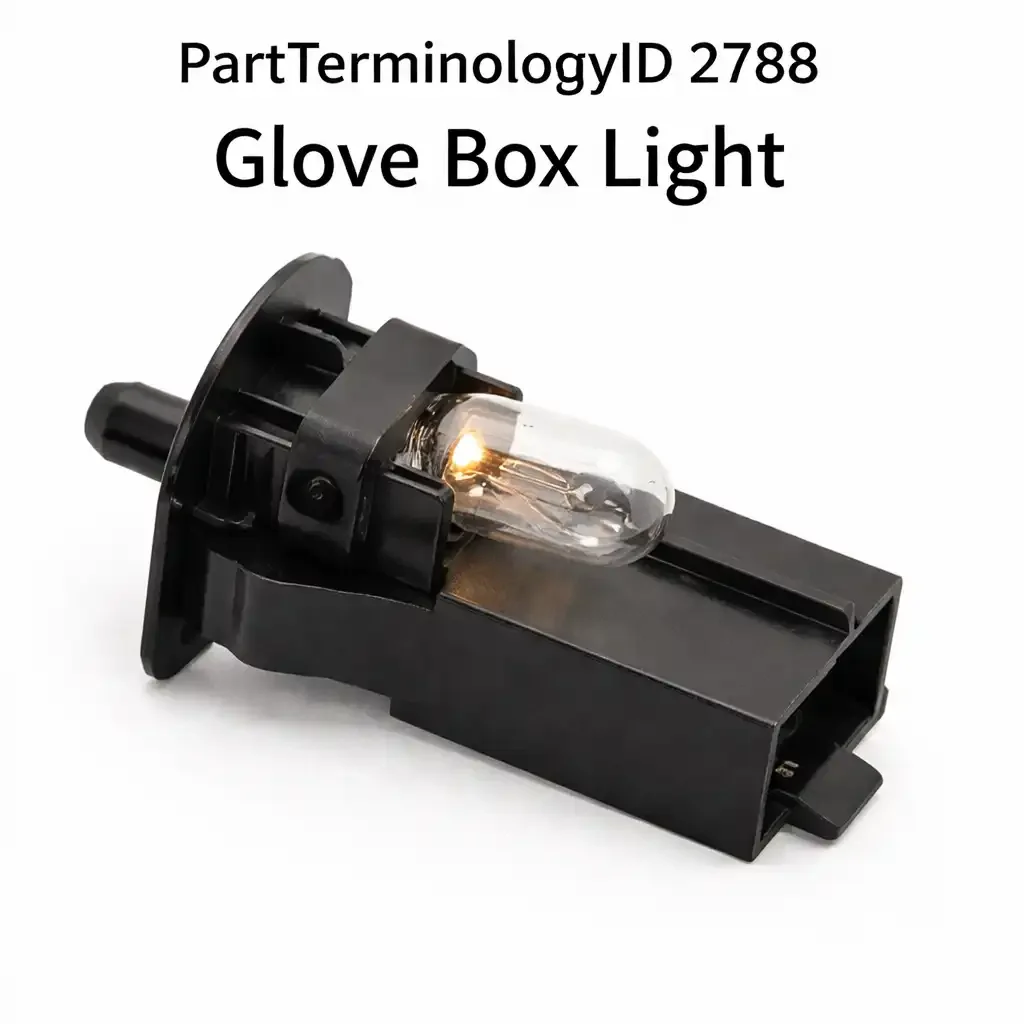
PartTerminologyID 2788, Glove Box Light, is the small bulb or LED assembly mounted inside the glove compartment that illuminates the interior of the glove box when the door is opened, allowing the driver and front passenger to locate stored items in low-light and nighttime conditions, typically activated by a plunger-type door switch that completes the bulb circuit when the glove box door releases the plunger on opening and breaks the circuit when the door closes and depresses the plunger. That definition covers the illumination and activation function correctly and leaves unresolved whether the replacement bulb base type matches the socket retaining mechanism in the specific glove box assembly, whether the activation circuit is a dedicated plunger switch or a connection to the general interior illumination circuit, whether the part covers the bulb alone or a complete socket-and-bulb assembly including the plunger switch, whether the wattage produces heat compatible with the enclosed plastic glove box cavity, whether the glove box housing has a socket of the round bulb type or the wedge type depending on the instrument panel assembly vintage, and whether a single bulb or a pair is required for adequate illumination across the full depth of the glove box interior.
It does not specify the bulb base type, the activation circuit architecture, whether the part includes the plunger switch, the wattage, the socket type, or the quantity required for full glove box coverage. A listing under PartTerminologyID 2788 that specifies only a vehicle application without bulb base type and activation circuit type cannot be evaluated by a buyer who has opened the glove box housing and is looking at a bare socket position with no bulb present, trying to determine from an unlabeled listing whether the socket accepts a wedge or a festoon before ordering.
For sellers, PartTerminologyID 2788 is the interior lighting PartTerminologyID where a single overlooked attribute, the activation circuit type, produces the most diagnostically confusing failure mode in the category. A glove box light that stays on after the door closes drains the battery overnight. A buyer who replaces the bulb without understanding that the always-on behavior comes from the activation circuit architecture rather than a bulb fault will return the new bulb as defective when it stays on after installation, not realizing the original also stayed on in the same conditions and the behavior is not a fault. The activation circuit type must be stated so the buyer can distinguish normal always-on interior-circuit behavior from an abnormal plunger switch failure before concluding the bulb is the cause of the battery drain.
What the Glove Box Light Does
Plunger switch activation and the enclosed cavity heat requirement
The glove box light plunger switch is a normally-open switch mounted in the glove box housing frame with a small cylindrical plunger that protrudes into the path of the closing door. When the glove box door is closed, it contacts the plunger and depresses it, holding the switch open and breaking the circuit to the bulb. When the door opens and the door surface moves away from the plunger, the plunger extends under its internal spring force, closing the switch and completing the circuit to illuminate the bulb. This is the same activation architecture used for refrigerator interior lights and is the simplest circuit design available for a door-activated interior lamp.
The enclosed plastic cavity of the glove box requires strict wattage discipline. A 5-watt incandescent in a glove box that is typically constructed of ABS plastic with a small internal volume will accumulate heat rapidly if the glove box door is left open for an extended period, particularly in a hot climate. The original wattage specification limits the bulb's heat output to what the plastic housing was designed to tolerate without discoloring or deforming. A higher-wattage replacement may not cause immediate damage but will accumulate heat faster in the closed cavity and may discolor the glove box housing over time. The wattage must match the original specification precisely for this application.
Interior circuit versus plunger switch activation and the battery drain distinction
On some vehicles, the glove box light is wired directly to the interior illumination circuit and is not controlled by a plunger switch. The bulb illuminates whenever the interior lights are on, regardless of whether the glove box is open or closed. This architecture is simpler to wire and eliminates the plunger switch as a failure point, but it means the glove box interior is illuminated even when the glove box is closed, which produces a faint glow visible through the glove box door gap in a dark interior. It also means the glove box light cannot be used as a diagnostic indicator of glove box door position.
On vehicles with this architecture, a buyer who experiences a battery drain and suspects the glove box light as the cause will find that replacing the bulb does not resolve the drain, because the drain occurs from the interior lighting circuit being left on rather than from a stuck plunger switch. The listing must state clearly whether the glove box light uses a plunger switch or connects to the interior lighting circuit, so the buyer can determine whether the battery drain symptom is related to the glove box light circuit or to a different circuit entirely.
Complete socket assembly versus bulb only and the plunger switch replacement
On many glove box designs, the bulb, socket, and plunger switch are a single integrated assembly mounted in the glove box housing. The plunger switch is the activation mechanism and the socket is the bulb holder, both in one molded plastic unit. A failed plunger switch that no longer opens when the door closes requires replacing the complete socket assembly rather than just the bulb, because the switch is not separately serviceable from the socket on these designs. A listing that covers only the bulb for an application where the plunger switch is integrated with the socket will be useless to a buyer whose plunger switch has failed and the bulb is intact.
The listing must distinguish whether the part covers the bulb only, the complete socket-and-switch assembly, or each separately. A buyer whose glove box light stays on after the door closes needs the plunger switch or complete socket assembly, not a bulb. A buyer whose glove box is dark needs the bulb, and replacing the complete socket assembly for a burned-out bulb is an unnecessarily expensive repair if the bulb is separately replaceable in the socket.
Why This Part Generates Returns
Buyers return glove box lights because the base type is a festoon and the socket accepts only a wedge, the part is a bulb only and the buyer's plunger switch has failed requiring a complete socket assembly replacement, the wattage is 5 watts and the original was 2 watts and the higher-wattage bulb discolors the plastic glove box liner after one week of normal use, the LED replacement is polarity-sensitive and the buyer installed it reversed producing no illumination then returning it as defective before checking polarity, the activation circuit is interior-illumination-connected and the buyer expected the glove box light to extinguish when the door closes but it remains on whenever interior lights are active, the plunger switch is included in the listing but the buyer needed the bulb only and the complete assembly will not fit the original socket position without modification, the vehicle has a dual-bulb glove box requiring two units and the package quantity is one, and the part covers the standard glove box assembly and the buyer has the illuminated glove box with courtesy lighting trim package which uses a larger housing with a different socket position.
Status in New Databases
PIES/PCdb: PartTerminologyID 2788, Glove Box Light
PIES 8.0 / PCdb 2.0: No change in PartTerminologyID or terminology label.
Top Return Scenarios
Scenario 1: "Plunger switch failed, bulb intact, buyer needed complete socket assembly not a bulb"
The buyer's glove box light stays on after the door closes. The plunger switch in the integrated socket assembly is stuck in the closed position. The bulb itself is functional. The listing covers a replacement bulb for the glove box light position. The buyer orders the bulb, installs it, and the light still stays on because the plunger switch in the original socket is the fault, not the bulb. The new bulb is returned and the buyer seeks a complete socket-and-switch assembly instead.
Prevention language: "Part type: [bulb only / complete socket and plunger switch assembly]. This listing covers [part type]. For a glove box light that stays on after the door closes, the plunger switch rather than the bulb is typically the fault. The complete socket assembly includes the plunger switch and replaces both the switch and the bulb socket in one unit. Order the complete assembly if the plunger switch is the fault."
Scenario 2: "Interior-circuit activation, glove box light stays on whenever interior lights are on, buyer assumes fault"
The vehicle's glove box light is wired to the interior illumination circuit with no plunger switch. The listing does not state the activation circuit type. The buyer installs a new bulb and the light remains on whenever the headlamps are switched on and the interior lights are active. The buyer concludes the new bulb is staying on due to a fault and returns it, not realizing the always-on behavior with interior lights is the normal design for this circuit architecture.
Prevention language: "Activation circuit: [plunger switch activated, extinguishes when glove box door closes / interior illumination circuit connected, illuminates whenever interior lights are on regardless of glove box door position]. This glove box light is [activation type]. On vehicles where the glove box light connects to the interior illumination circuit, the light will remain on whenever interior lights are active. This is normal behavior for this circuit design and is not a fault."
Scenario 3: "Over-wattage bulb discolors glove box plastic liner after one week"
The original glove box bulb is 2 watts. The replacement is 5 watts, which is the closest available option the buyer could find matching the base type. After one week, the plastic glove box liner directly above the bulb position shows a faint heat discoloration ring. The heat output of the 5-watt bulb at the top of the enclosed cavity exceeds the heat tolerance of the ABS liner at that proximity. The buyer returns the 5-watt bulb seeking the correct 2-watt specification.
Prevention language: "Wattage: [X] watts. The glove box light operates in an enclosed plastic cavity. Do not substitute a higher-wattage bulb than the original specification. A higher-wattage bulb generates more heat in the enclosed space and may discolor the plastic glove box liner over time. Match the original wattage exactly for this application."
Listing Requirements
PartTerminologyID: 2788
component: Glove Box Light
part type: bulb only, complete socket and plunger switch assembly (mandatory, in title)
bulb base type: wedge, festoon with length, or round base (mandatory, in title)
wattage in watts (mandatory)
voltage rating: 12V DC (mandatory)
bulb type: incandescent or LED (mandatory)
LED polarity: polarity-sensitive or polarity-independent for LED listings (mandatory)
activation circuit type: plunger switch or interior illumination circuit (mandatory)
plunger switch included: yes or no (mandatory)
quantity per package: note if dual-bulb glove box (mandatory)
OEM bulb number cross-reference where applicable (mandatory)
Catalog Checklist for ACES/PIES Teams
PartTerminologyID = 2788
require part type: bulb or complete assembly (mandatory)
require bulb base type in title (mandatory)
require wattage (mandatory)
require activation circuit type (mandatory)
require plunger switch inclusion status (mandatory)
require LED polarity note for LED listings (mandatory)
require quantity note for dual-bulb applications (mandatory)
prevent wattage substitution: over-wattage bulbs discolor the enclosed plastic cavity; wattage must be required and must match the original specification
prevent activation circuit type omission: always-on interior-circuit behavior returns as a bulb fault without the circuit type explanation; activation type must be stated
prevent part type ambiguity: a buyer with a failed plunger switch needs the complete assembly; a buyer with a burned-out bulb needs the bulb only; part type must be in the title
differentiate from Dome Light (PartTerminologyID 2772): the dome light provides overhead passenger compartment illumination; the glove box light illuminates the glove compartment interior; both are interior lamps but at different positions with different activation circuits and wattage requirements
differentiate from Ash Tray Light (PartTerminologyID 2740): similar small enclosed-cavity illumination circuit but different position, different socket type in most applications, and different activation architecture
FAQ (Buyer Language)
What does the glove box light do?
The glove box light illuminates the interior of the glove compartment when the door is opened, allowing the driver and passenger to locate stored items in darkness. It is typically activated by a plunger switch that completes the circuit when the door opens and breaks it when the door closes.
Why does my glove box light stay on with the door closed?
Either the plunger switch is stuck in the closed position and not opening the circuit when the door closes, the door is not making full contact with the plunger, or on vehicles wired to the interior illumination circuit rather than a plunger switch, the light is on by design whenever interior lights are active. Confirm the activation circuit type before diagnosing a switch fault.
Can I replace it with an LED?
Yes. Match the base type and wattage of the original. For polarity-sensitive LEDs, reverse the bulb if it does not illuminate on the first attempt. An LED replacement generates less heat in the enclosed glove box cavity than the original incandescent, which is a benefit in warm climates where heat accumulates in the closed glove box.
Cross-Sell Logic
Glove Box Plunger Switch: the activation switch that opens and closes the glove box light circuit on door-switch-activated systems; a failed plunger switch produces a light that stays on after the door closes and drains the battery; cross-sell alongside the bulb for buyers diagnosing a battery drain attributed to the glove box light
Dome Light (PartTerminologyID 2772): the overhead compartment lamp that shares the interior lighting circuit on vehicles where the glove box light is connected to the interior illumination rather than a plunger switch; buyers replacing interior lamps often replace both simultaneously
Interior Bulb Assortment Kit: for buyers performing a comprehensive interior lighting refresh covering all small bulb positions including the glove box, ash tray, clock, and console illumination circuits simultaneously
Final Take for PartTerminologyID 2788
Glove Box Light (PartTerminologyID 2788) is the interior lighting PartTerminologyID where the most consequential buyer error is not a fitment error but a diagnostic error: replacing the bulb when the plunger switch is the fault, then returning the new bulb when the light stays on after installation. The listing that prevents this return states the activation circuit type, distinguishes the bulb-only listing from the complete socket-and-switch assembly listing, and includes the battery drain note for buyers who are replacing the glove box light because the battery is going flat overnight.
State the part type in the title. State the bulb base type in the title. State the wattage. State the activation circuit type. State the plunger switch inclusion status. State the LED polarity for LED listings. State the quantity for dual-bulb applications. For PartTerminologyID 2788, part type, activation circuit type, and wattage are the three attributes that determine whether the replacement illuminates the glove box correctly on door open, extinguishes correctly on door close, and does not discolor the plastic cavity from excess heat in a low-wattage enclosed application.