
Written by Arthur Simitian | PartsAdvisory
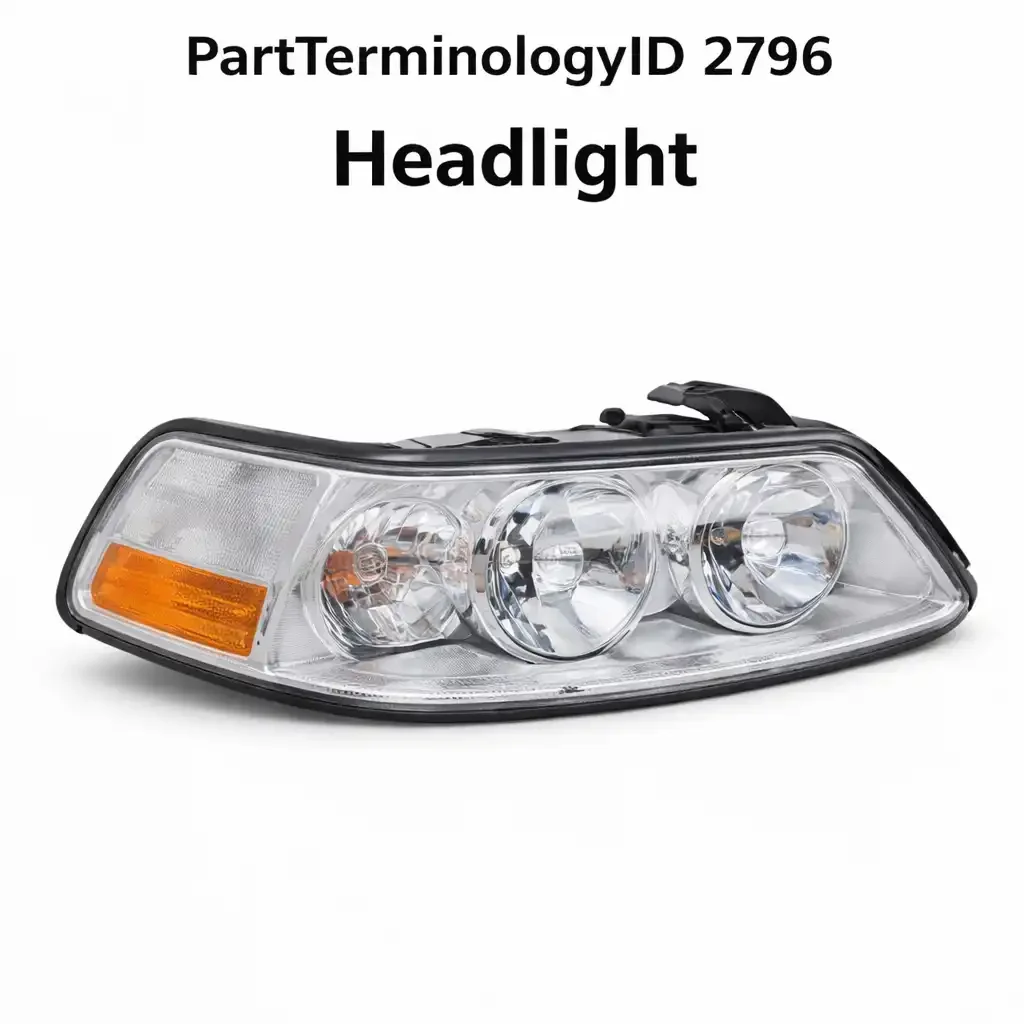
PartTerminologyID 2796, Headlight, is the primary forward-facing exterior lamp assembly that provides the driver with illumination of the road ahead during nighttime and reduced-visibility driving conditions, operating in a low beam mode that produces a controlled asymmetric cutoff pattern to minimize glare to oncoming drivers while maximizing forward road coverage, and a high beam mode that provides unrestricted maximum forward illumination for use when no oncoming traffic is present. That definition covers the illumination function correctly and leaves unresolved every question that determines whether the replacement part is a complete headlight assembly or a bulb only, whether the housing design is a projector type or a reflector type, whether the light source is halogen, HID high-intensity discharge, or LED, whether the assembly is the driver-side or passenger-side unit on a vehicle where the two use asymmetric body contour housings, whether the lens shape and contour match the vehicle's front fascia opening and the adjacent body panel lines, whether the assembly includes the daytime running light element, the turn signal element, and the parking light element that are integrated into some headlight assemblies, whether the wiring harness connector matches the vehicle's headlight circuit connectors for both the main beam and any integrated DRL or turn signal circuits, whether the assembly includes the ballast unit for HID applications, whether the aiming adjustment mechanism type and range match the original, whether the assembly meets FMVSS 108 photometric requirements and bears the required DOT certification markings, and whether the assembly requires a separate leveling motor or auto-leveling module for vehicles equipped with adaptive headlight leveling systems.
It does not specify any of these attributes. A listing under PartTerminologyID 2796 that states only year, make, and model without bulb type, housing design type, side designation, integrated function content, connector configuration, and DOT certification status cannot be evaluated by a technician replacing a driver-side headlight assembly cracked in a minor collision on a vehicle whose factory headlight assembly integrates the DRL, parking light, and turn signal functions into a single housing with four separate harness connectors, where the replacement must match all four connector positions and include the DRL LED element to avoid leaving the DRL circuit without a load after installation.
For sellers, PartTerminologyID 2796 carries the highest regulatory compliance consequence, the highest average transaction value, and the highest return complexity of any PartTerminologyID in the exterior lighting category. FMVSS 108 applies to the headlight as the primary regulated safety lamp on the vehicle. A non-compliant replacement headlight that produces excessive glare for oncoming drivers, or that fails to meet the minimum photometric output values at the specified test angles, creates direct safety risk and direct seller liability exposure. The DOT certification requirement is not advisory for this PartTerminologyID. It is mandatory, and every complete headlight assembly listing must state compliance status explicitly. A listing that omits DOT certification status implicitly accepts that a non-compliant assembly may be shipped and installed on a vehicle operated on public roads.
The additional complexity specific to PartTerminologyID 2796 is the integrated assembly content problem. Modern headlight assemblies are increasingly multi-function modules that combine the main headlight optics, the DRL element, the parking light position lamp, the turn signal lamp, and on some vehicles the cornering lamp, all in a single housing with a single set of mounting points and multiple harness connectors. A catalog entry that covers the headlight assembly without specifying which integrated functions are included will generate returns from buyers whose vehicle requires a DRL-integrated assembly and who receive an assembly without the DRL element, leaving the DRL circuit without a load and generating a BCM fault code for the missing DRL function.
What the Headlight Does
Low beam and high beam modes under FMVSS 108
The headlight's low beam produces an asymmetric cutoff beam pattern that illuminates the road surface ahead and to the right of the vehicle's forward centerline while sharply limiting light output above the cutoff line that would produce glare for oncoming drivers. The cutoff line in the low beam pattern is the most technically precise requirement in FMVSS 108 for headlamps: it must be positioned at a calibrated height relative to the road surface at a specified distance ahead of the vehicle, and the gradient between the illuminated zone below the cutoff and the dark zone above it must be steep enough to prevent significant light output at oncoming driver eye height while maintaining maximum road coverage below the cutoff.
The high beam produces a symmetric unrestricted forward pattern that fills the zone above the low beam cutoff with maximum output, providing the driver with illumination of objects at greater distances and at heights above the road surface that the low beam does not cover. FMVSS 108 specifies minimum photometric values for the high beam at test points across the forward hemisphere, ensuring adequate illumination at long range in all forward directions. A replacement headlight assembly must meet both the low beam cutoff gradient requirement and the high beam photometric minimums to be fully FMVSS 108 compliant, not merely one or the other.
Projector versus reflector housing design
The projector headlight housing uses an ellipsoidal reflector that collects the bulb's output and focuses it through a shield that creates the beam cutoff line before projecting the shaped beam through a convex projection lens. The projection lens is the small round or oval lens visible at the center of a projector headlight assembly. The reflector collects light efficiently from the bulb and the shield produces a precise cutoff line by blocking the upper portion of the focused beam. Projector assemblies produce sharper cutoff lines, more even beam patterns, and higher optical efficiency than reflector designs at the same wattage.
The reflector headlight housing uses a parabolic or multi-faceted reflector behind the bulb to direct the output forward through a patterned outer lens whose facets shape the beam pattern. The outer lens in a reflector assembly is the optically active element that distributes the light into the required pattern. Replacing a reflector assembly with a projector assembly at the same vehicle position is not possible without replacing the front fascia opening that the headlight occupies, because the projector assembly's outer lens shape and mounting footprint are different from the reflector assembly's outer lens. The two housing designs are not interchangeable at the same mounting position.
Light source types: halogen, HID, and LED
Halogen headlight assemblies use a tungsten filament bulb filled with a halogen gas mixture that allows higher filament temperature and brighter output than standard incandescent at the same wattage. Halogen bulbs produce warm white light with a color temperature of approximately 3,200 Kelvin, have a focused filament that is compatible with both reflector and projector housing designs, and are the most widely replaced headlight bulb type in the aftermarket because of their relatively short service life of 400 to 1,000 hours at full output.
HID high-intensity discharge headlight assemblies use a xenon arc discharge between two electrodes in a sealed quartz arc tube to produce light with a color temperature of 4,200 to 6,000 Kelvin and a luminous output approximately three times greater than a comparable halogen bulb at lower wattage. HID systems require a ballast unit that provides the high-voltage ignition pulse to start the arc and then regulates the arc current to maintain stable output. The ballast is a separate electrical component that may be mounted inside the headlight housing or in the engine compartment near the headlight. A complete HID headlight replacement must either include the ballast or confirm the original ballast can be reused.
LED headlight assemblies use high-power LED elements on thermally managed circuit boards to produce white light output with color temperatures typically in the 5,500 to 6,500 Kelvin range. LED assemblies produce longer service life than both halogen and HID, consume less power than HID, and generate less infrared heat output than halogen, which has implications for snow clearance in cold climates where halogen heat output melts snow accumulation on the lens and LED assemblies may not. LED headlight assemblies for OEM applications are integrated units where the LED elements and their thermal management are designed as part of the complete assembly. Replacing an LED headlight assembly requires an exact-match replacement that includes compatible LED elements, not a halogen or HID substitute.
Integrated assembly functions and harness connector requirements
The modern headlight assembly is frequently a multi-function module combining between two and six separate lighting functions in a single housing. The minimum integration on most current assemblies is the low beam, high beam, and parking light position lamp. Many assemblies additionally integrate the DRL element, the turn signal lamp, and the front side marker lamp. High-specification assemblies may also integrate the cornering lamp, an auto-leveling motor, and a rain and light sensor aperture. Each integrated function adds a circuit that requires a harness connector at the assembly's rear interface.
A replacement assembly that integrates fewer functions than the original will leave some of the original harness connectors unconnected after installation. An unconnected DRL circuit generates a BCM fault code for the missing DRL load. An unconnected turn signal circuit generates a fast-flash condition in the turn signal circuit because the reduced load from the missing bulb changes the relay's flash frequency. An unconnected auto-leveling motor connector leaves the leveling system without an actuator, generating a fault code and keeping the headlight at a fixed aim that may not comply with FMVSS 108 aim requirements. Every integrated function in the original assembly must be matched in the replacement to avoid generating fault codes and non-compliant lamp operation.
Auto-leveling systems and ballast compatibility
Vehicles with HID headlights are required by FMVSS 108 to include automatic headlight leveling systems that adjust the aim of the low beam downward when the rear of the vehicle is loaded, preventing the loaded vehicle's headlights from aiming above the calibrated cutoff position and blinding oncoming drivers. The auto-leveling system uses a leveling motor integrated into the headlight housing that adjusts the reflector or projector aim in response to a signal from the leveling control module. A replacement HID headlight assembly must include the leveling motor and must be compatible with the leveling control module's connector and command protocol.
For HID assemblies, the ballast compatibility is a specific technical requirement that affects whether the replacement assembly can be driven by the original ballast or whether a new ballast must be sourced with the assembly. Ballasts are matched to specific HID bulb types by wattage and arc gap, and a replacement assembly with a different HID bulb specification than the original requires a matched ballast. A listing that covers a replacement HID headlight assembly must state whether the ballast is included, whether the original ballast is compatible with the replacement assembly, and what the HID bulb type and wattage specification of the replacement assembly is.
Lens hazing, UV degradation, and the replacement trigger that is not a bulb fault
A significant portion of the headlight replacement buyer population is not replacing a cracked assembly or a failed bulb. They are replacing a hazed, yellowed, or fogged outer lens whose UV degradation has reduced light transmission to the point where the vehicle is failing a headlight output inspection or the driver can no longer see adequately at night. Polycarbonate outer lenses used on virtually all headlight assemblies produced after the mid-1990s are coated with a UV-resistant hard coat at the factory to slow surface oxidation. Over five to ten years of sun and weather exposure, the hard coat degrades and the polycarbonate surface oxidizes, turning amber-yellow and developing a microscopically rough surface texture that scatters the transmitted light rather than passing it cleanly through the lens.
The scattered light output from a heavily hazed lens can reduce total forward illumination by 40 to 80 percent compared to a new clear lens at the same bulb wattage. A vehicle with 80 percent light transmission loss through the headlight lens produces forward illumination comparable to a 20-watt halogen in a housing designed for a 55-watt bulb. At highway speed in darkness this is a significant safety deficit. FMVSS 108 minimum photometric requirements assume a new, clear lens. A hazed lens that has not been tested and found compliant with the original housing in its current condition is not meeting FMVSS 108 requirements even though the housing and bulb are otherwise intact.
The buyer replacing for lens hazing needs a complete assembly replacement or, where the outer lens is separately available, a lens replacement. The listing for PartTerminologyID 2796 in a complete assembly context should note that lens hazing is a valid replacement trigger independent of housing damage or bulb failure, and should include the lens clarity statement that confirms the replacement assembly's outer lens is clear and UV-coated to the original specification. A replacement assembly with a substandard UV coating will rehaze within two to three years rather than the original's five to ten, generating a repeat purchase cycle that the buyer will attribute to product quality rather than coating specification. The UV coating specification and the lens material quality are attributes that distinguish a long-service-life replacement from a short-cycle economy replacement, and a seller who includes these specifications in the listing captures the buyer who has already replaced a hazed lens with a low-quality assembly and is now replacing it again for the second time in four years.
Adaptive headlight systems and the aiming motor integration requirement
Beyond the auto-leveling systems required for HID assemblies, some vehicles are equipped with adaptive front headlight systems that steer the headlight beam horizontally in response to steering wheel input, pivoting the low beam pattern in the direction of an upcoming curve before the vehicle's path diverges from the current heading. These systems use a stepper motor integrated into the headlight housing that pivots the projector module on a horizontal axis in response to a signal from the adaptive lighting control module. The stepper motor is distinct from the vertical leveling motor used for load compensation and operates on a separate circuit with a different connector.
A replacement headlight assembly for an adaptive headlight application must include both the vertical leveling motor and the horizontal adaptive steering motor. The adaptive steering motor adds a third harness connector at the rear of the assembly beyond the standard headlight and leveling motor connectors. A replacement assembly without the adaptive motor leaves the horizontal steering circuit without an actuator, generating a fault code from the adaptive lighting module and locking the headlight aim in the fixed-forward position that eliminates the adaptive curve illumination function. On vehicles in markets where adaptive front headlight systems are a legal requirement for vehicles above a certain power or weight threshold, a non-adaptive replacement on an adaptive-equipped vehicle may also create a type approval non-compliance issue at the next periodic vehicle inspection.
Performance lighting upgrades: what is legal, what is not, and what the listing must say
A substantial portion of headlight buyers are not replacing a failed or damaged assembly. They are upgrading their vehicle's forward illumination for better nighttime visibility, a whiter output color, or a more modern appearance. The performance lighting buyer population breaks into three distinct groups whose legality status differs significantly and whose catalog needs are entirely different from each other.
The first group is the buyer upgrading from a standard halogen reflector assembly to an OEM-specification halogen projector assembly, either by installing the factory projector assembly from a higher trim level of the same vehicle or by installing a projector assembly from a later model year of the same platform. This is a legal upgrade because the replacement assembly is a DOT-certified unit tested as a complete assembly with its intended halogen light source. The beam pattern is FMVSS 108 compliant, the output is within the regulated range, and the installation is street legal. The listing for this type of upgrade must confirm the DOT certification of the replacement assembly and confirm the connector and mounting compatibility with the donor vehicle's harness and fascia.
The second group is the buyer installing a DOT-certified LED or HID headlight assembly designed as a complete system for their vehicle, either as an OEM option upgrade or as an aftermarket assembly that was engineered, tested, and certified as a complete unit. This is also legal and street-compliant because the assembly was tested as a system and carries DOT certification. The listing must state DOT certification clearly, confirm the assembly type is LED or HID as a complete system, and state whether the ballast and any required control modules are included.
The third group is the buyer installing HID or LED conversion bulbs into a halogen reflector housing, or installing non-DOT-certified LED headlight assemblies that were designed to a price point rather than an FMVSS 108 compliance standard. This modification is not FMVSS 108 compliant, is illegal on public roads in the United States, and creates direct liability exposure for both the installer and the seller who supplied the parts without adequate disclosure. HID and LED sources installed in halogen housings produce scatter, glare, and beam pattern distortion because the light source geometry does not match the focal point and reflector design of the halogen housing. The listing for any conversion kit or non-DOT-certified LED assembly must include an explicit statement that the product is for off-road or show use only and is not legal for installation on vehicles operated on public roads. A seller who omits this disclosure and a buyer who installs a non-compliant assembly on a public road vehicle has exposure at the next vehicle inspection and at any insurance investigation following an accident.
DOT certification: what the markings mean and why they matter for every listing
Every headlight assembly intended for street use on a vehicle operated on public roads in the United States must bear DOT certification markings on the lens or housing. These markings confirm that the assembly was tested to FMVSS 108 requirements as a complete unit and that the test results demonstrated compliance with every applicable requirement in the standard. The markings include the DOT symbol, the SAE function designation for each element in the assembly such as H for headlamp high beam, L for headlamp low beam, P for parking lamp, and T for turn signal, and a manufacturer or brand code registered with the National Highway Traffic Safety Administration.
The DOT marking is a self-certification by the manufacturer, meaning the manufacturer testing and certifying the assembly is responsible for the accuracy of the compliance claim. NHTSA does not pre-approve headlight assemblies before they enter the market. Instead, NHTSA conducts compliance testing of assemblies already in the market and pursues enforcement against manufacturers whose assemblies fail compliance testing. This means a headlight assembly with DOT markings has been certified by its manufacturer but has not necessarily been independently tested by NHTSA. The presence of DOT markings is a necessary but not sufficient indicator of genuine compliance. Assemblies from established manufacturers with documented testing programs provide a higher confidence of genuine compliance than assemblies with DOT markings applied without underlying test data.
For catalog teams, the practical implication is that DOT certification status must be verified from the manufacturer's documentation rather than assumed from the presence of DOT-looking markings on the lens. A listing that states DOT certified without confirming the certification documentation is relying on the markings alone. For high-volume headlight SKUs, the additional step of confirming that the manufacturer has actual FMVSS 108 test data for the assembly is worth the effort given the liability exposure associated with a non-compliant headlight assembly on a public road vehicle. State DOT certified in the listing only when the documentation confirms genuine tested compliance. State for off-road or show use only for all assemblies where documentation is absent or compliance testing has not been confirmed.
Cross-year headlight fitment: the cheapest facelift and what to verify before ordering
One of the most cost-effective ways to refresh the front-end appearance of an older vehicle is to install the headlight assembly from a later model year of the same platform, particularly when the manufacturer updated the headlight design at a mid-cycle refresh or a minor model year change while keeping the underlying mounting structure, harness connectors, and front fascia dimensions the same. This cross-year headlight swap is a legitimate and popular modification that gives an older vehicle the visual appearance of the refreshed model at the cost of the headlight assembly alone, sometimes combined with a grille replacement from the same later model year for a complete front-end visual update at a fraction of the cost of a full facelift or a new vehicle.
The most common platforms where this works reliably are those where the manufacturer carried the same front fascia mounting dimensions across multiple model years while changing only the headlight lens design and the DRL or turn signal element style within the same opening. On these platforms, the later-year headlight assembly drops into the same mounting clips, connects to the same harness connectors, and seals to the same fascia opening edges as the original earlier-year assembly. The visual result is the refreshed front-end appearance of the later model year on the earlier vehicle at the parts cost of the headlight assembly.
The verification checklist for a cross-year headlight swap is more detailed than for a same-year replacement and every point must be confirmed before ordering. The mounting tab positions and clip type must match between the donor year and the recipient year. The harness connector pin count and positions must match, because a mid-cycle refresh that added an integrated LED DRL to the headlight assembly also added a connector pin for the DRL circuit, and an earlier vehicle without a DRL circuit in the harness will have an unconnected pin after installation unless a DRL module or activation circuit is added. The outer lens contour must fit within the front fascia opening of the recipient year, which requires confirming that the fascia opening dimensions were not changed at the refresh even if the lens shape changed. The aiming adjustment mechanism must be accessible after installation in the recipient vehicle's engine compartment without interference from other components. And if the donor-year assembly includes an auto-leveling motor or an adaptive steering motor not present in the recipient year's wiring harness, those motor circuits will be unconnected and may generate fault codes from the BCM depending on whether the BCM monitors those circuits for load.
For sellers, the cross-year fitment opportunity is a category expansion beyond the standard replacement market. A buyer searching for a 2014 model headlight may be interested in a 2017 model headlight for the same platform if the seller's listing notes the cross-year compatibility and the verification checklist confirms the fitment. This is particularly valuable for platforms where the later-year assembly is a dramatic visual upgrade, such as a move from a reflector housing with a patterned lens to a clean projector assembly with an LED DRL halo, and the compatibility across the model year range on the same platform makes the upgrade accessible at replacement part prices rather than custom fabrication prices. The listing that captures this buyer states the compatible recipient model years alongside the primary application year, provides the connector and mounting confirmation for each compatible year, and notes the additional wiring required for any integrated functions not present in the earlier harness.
The grille combination upgrade deserves a specific note in the cross-sell section and in the listing description for platforms where grille and headlight design changed simultaneously at the refresh. On many platforms the facelift grille is designed with an opening shape calibrated to frame the updated headlight lens contour. Installing the refreshed headlight assembly without the matching grille may leave a visible gap or mismatch at the grille-to-headlight interface where the original grille's inner edge was designed to overlap the original headlight lens, not the updated one. For a clean result, the grille and headlight should be replaced together from the same donor model year. A listing that cross-sells the matching grille alongside the headlight assembly serves the buyer who wants the complete visual upgrade rather than the partial one, and reduces the return rate from buyers who discover the grille mismatch after installing the headlight alone.
Why This Part Generates Returns
Buyers return headlights because the driver-side assembly is delivered and the buyer's cracked assembly is on the passenger side, the assembly is a reflector design and the vehicle uses a projector design at the same position, the assembly is specified for a halogen light source and the vehicle has HID with a ballast that cannot drive the halogen assembly, the assembly does not include the DRL LED element and the vehicle's BCM generates a DRL circuit fault code after installation, the assembly does not include the integrated turn signal position and the turn signal relay produces a fast-flash fault after installation, the ballast is not included for an HID assembly and the buyer assumed it was, the auto-leveling motor connector is absent on the replacement and the leveling system generates a fault after installation, the assembly does not bear DOT markings and the vehicle fails an inspection, the lens contour does not match the front fascia opening and the assembly cannot be sealed flush against the body panel producing a water ingress path into the engine compartment, the connector configuration has three pins and the vehicle harness has four pins requiring a pigtail adapter, the assembly includes a smoked or tinted outer lens that does not produce white light output required by FMVSS 108, and the body style is a two-door coupe and the delivered assembly is the four-door sedan variant whose longer lens contour does not fit the shorter coupe fascia opening.
Status in New Databases
PIES/PCdb: PartTerminologyID 2796, Headlight
PIES 8.0 / PCdb 2.0: No change in PartTerminologyID or terminology label.
Top Return Scenarios
Scenario 1: "Reflector assembly for projector application, lens shape does not match fascia opening"
The vehicle has a projector headlight assembly with a small round projection lens visible at the center of the housing and a plain outer lens. The replacement is a reflector assembly with a patterned outer lens designed for a reflector housing. The outer lens contour of the reflector assembly is a different shape than the projector assembly and does not fit flush in the fascia headlight opening. The reflector assembly also uses a different bulb type at a different focal position, producing a beam pattern that does not meet the FMVSS 108 projector housing photometric requirements.
Prevention language: "Housing design: [projector / reflector]. This assembly uses a [design] housing. Projector and reflector headlight assemblies are not interchangeable at the same mounting position. The outer lens contour, bulb type, and beam pattern differ between designs. Verify the original assembly's housing design matches the replacement before ordering."
Scenario 2: "DRL element absent, BCM stores DRL circuit fault code after installation"
The original headlight assembly includes an integrated LED DRL strip along the upper housing that activates during daytime driving. The replacement assembly omits the DRL element. After installation, the BCM detects no load on the DRL circuit, stores a DRL circuit open fault code, and illuminates the exterior lighting warning lamp. The vehicle's DRL function is disabled. The buyer returns the assembly and requests the version with the integrated DRL element.
Prevention language: "Integrated functions: [low beam / high beam / parking light / DRL / turn signal / side marker]. This assembly includes [list of integrated functions]. Verify all integrated functions in the original assembly are present in the replacement. A missing DRL element will generate a BCM fault code for the DRL circuit on vehicles where the BCM monitors the DRL load."
Scenario 3: "HID ballast not included, buyer assumed complete assembly, HID circuit incomplete"
The buyer orders a replacement HID headlight assembly. The listing states "HID headlight assembly" without specifying whether the ballast is included. The ballast is not included. The buyer installs the housing and connects the original ballast but the ballast connector does not mate with the replacement assembly's HID bulb connector because the replacement uses a different HID bulb type than the original. The HID circuit is incomplete and the headlight does not illuminate.
Prevention language: "Ballast included: [yes / no, original ballast compatible / no, new ballast required, part number X]. HID bulb type: [D1S / D2S / D3S / D4S / other]. For HID headlight assemblies, verify whether the ballast is included and whether the original ballast is compatible with the replacement assembly's HID bulb type before ordering."
Scenario 4: "Auto-leveling motor absent, leveling system fault code, fixed aim non-compliant"
The original HID headlight assembly includes an integrated auto-leveling motor required by FMVSS 108 for HID headlamp systems. The replacement assembly does not include the leveling motor. After installation, the leveling control module detects no actuator response on the leveling motor circuit and stores a fault code. The headlight remains at the default fixed aim position, which on this vehicle is set higher than the FMVSS 108 calibrated aim to accommodate the leveling range. The fixed high aim produces excessive glare for oncoming drivers at normal vehicle loading.
Prevention language: "Auto-leveling motor: [included / not included]. FMVSS 108 requires HID headlamp systems to include automatic leveling. A replacement HID assembly without the leveling motor will generate a leveling system fault code and leave the headlight at a fixed aim that may not comply with FMVSS 108 aim requirements. Verify the replacement includes the leveling motor for HID applications."
Scenario 5: "Smoked outer lens, low beam output fails FMVSS 108 minimum photometric values at inspection"
The buyer purchases an aftermarket headlight assembly with a smoked tinted outer lens for cosmetic purposes. The smoked lens reduces total light output through the housing. At the annual vehicle safety inspection, the headlight output is measured at the FMVSS 108 test points and falls below the minimum candela values in the forward zones due to the tint's light absorption. The vehicle fails the inspection for insufficient headlight output. The buyer must replace the smoked assembly with a clear-lens certified assembly to pass reinspection.
Prevention language: "Lens clarity: [clear, FMVSS 108 compliant / smoked or tinted, not certified to FMVSS 108 photometric minimums, for show or off-road use only]. FMVSS 108 requires headlamps to meet minimum photometric output values. A smoked or tinted lens reduces light output below these minimums. Smoked headlight assemblies are not legal for street use on public roads and may fail a safety inspection for insufficient output."
Scenario 6: "Sedan lens contour delivered for coupe body style, lens overhangs fascia opening"
The vehicle is a two-door coupe. The listing covers the model name without distinguishing body style. The delivered assembly is the four-door sedan variant, which has a longer lens contour to fill the wider sedan fascia opening. The coupe's fascia headlight opening is 35mm narrower than the sedan's. The sedan assembly's lens overhangs the coupe fascia opening by 35mm on the outboard edge and cannot be seated in the mounting clips without cracking the fascia at the lens perimeter.
Prevention language: "Body style: [coupe / sedan / hatchback / convertible]. This assembly is designed for the [body style] front fascia. Vehicles sharing a model name across body styles use different headlight assemblies with different lens contours. Verify the body style before ordering. A sedan assembly installed in a coupe fascia will overhang the opening and cannot be sealed."
Scenario 7: "Passenger-side assembly delivered for driver-side replacement, mirror-image design cannot be installed on opposite side"
The buyer's driver-side headlight assembly is cracked from a minor collision with road debris. The listing covers both sides in a single listing without a side selector. The buyer orders one assembly assuming it will be the driver side based on the listing photograph, which shows the assembly from the front in an ambiguous view that does not clearly distinguish left from right. The delivered assembly is the passenger side. The passenger-side assembly is a mirror image of the driver-side and cannot be installed on the driver side without leaving the body panel gap on the wrong side of the housing.
Prevention language: "Side: [driver side / passenger side]. This assembly is the [side] unit. Driver-side and passenger-side headlight assemblies are mirror-image designs and are not interchangeable. Verify the side designation carefully before ordering. If replacing both headlights simultaneously, two assemblies must be ordered, one driver side and one passenger side."
Scenario 8: "Hazed lens replacement, substandard UV coating rehazes within 18 months"
The buyer replaces a heavily hazed driver-side headlight assembly with a low-cost aftermarket unit. The replacement assembly's outer lens is clear at installation and forward illumination is restored. Eighteen months after installation, the replacement lens begins to show surface oxidation because the UV-resistant hard coat applied at manufacture was below the original OEM coating specification in thickness and UV absorber concentration. The lens rehazes to the same appearance as the original within two years. The buyer returns the assembly under warranty claiming premature failure.
Prevention language: "Lens material: [polycarbonate with OEM-specification UV hard coat / polycarbonate with standard UV coat]. A replacement assembly with a substandard UV coating will rehaze significantly sooner than the original OEM assembly. Verify the UV coating specification when comparing assemblies at different price points. Assemblies at substantially lower price points than OEM frequently achieve that price through reduced coating specification, not equivalent optical quality."
Scenario 9: "Adaptive headlight motor absent, curve illumination disabled, adaptive lighting fault code stored"
The vehicle is equipped with an adaptive front headlight system that steers the low beam horizontally through curves. The original assembly includes both a vertical leveling motor and a horizontal adaptive steering motor with separate connectors for each. The replacement includes only the vertical leveling motor. After installation, the adaptive lighting control module detects no actuator on the horizontal steering circuit and stores a fault code. The headlight aim locks in the fixed-forward position and the driver loses the adaptive curve illumination function.
Prevention language: "Adaptive headlight motor: [included / not included]. Vertical leveling motor: [included / not included]. For vehicles equipped with adaptive front headlight systems, the replacement assembly must include both the vertical leveling motor and the horizontal adaptive steering motor. A missing adaptive motor generates a fault code and disables curve illumination. Verify the motor configuration before ordering for any vehicle equipped with adaptive or dynamic bending light headlamps."
Scenario 10: "Cross-year facelift upgrade, DRL connector unconnected, BCM stores DRL fault after installation"
The buyer installs a 2018 headlight assembly on a 2015 vehicle of the same platform for a facelift upgrade. The 2018 assembly includes an integrated LED DRL strip not present in the 2015 assembly. The 2015 vehicle's harness has no DRL circuit connector. The DRL connector on the 2018 assembly is left unconnected after installation. The BCM on the 2015 vehicle was programmed to expect no DRL circuit on this connector position and does not store a fault. However, the DRL strip does not illuminate during daytime operation, which was the buyer's primary visual motivation for the upgrade. The buyer returns the assembly expecting DRL function to be automatic, not realizing a separate DRL activation circuit must be added to the 2015 harness to power the DRL element in the 2018 assembly.
Prevention language: "Cross-year fitment note: This assembly includes an integrated LED DRL element. On vehicles produced before [year] that do not have a DRL activation circuit in the headlight harness, the DRL element will not illuminate without adding a DRL module or a direct activation circuit connection. Verify the recipient vehicle's harness connector configuration includes a DRL circuit before ordering if DRL function is required. A DRL module compatible with this application is available separately."
What to Include in the Listing
Core essentials
PartTerminologyID: 2796
component: Headlight
part type: complete assembly or bulb only (mandatory, in title)
side: driver side or passenger side (mandatory, in title)
body style where lens contour differs (mandatory)
housing design: projector or reflector (mandatory, in title for complete assemblies)
light source type: halogen, HID, or LED (mandatory, in title)
integrated functions list: low beam, high beam, DRL, parking light, turn signal, side marker, cornering lamp (mandatory)
ballast included: yes or no with original ballast compatibility note for HID (mandatory for HID)
auto-leveling motor included for HID assemblies (mandatory for HID)
HID bulb type: D1S, D2S, D3S, D4S for HID applications (mandatory for HID)
connector configuration: pin count and layout for each harness connector on the assembly (mandatory)
lens clarity: clear with FMVSS 108 compliance note or smoked with off-road use note (mandatory)
FMVSS 108 compliance status (mandatory)
DOT certification: yes or no with SAE headlamp markings (mandatory)
aiming adjustment mechanism type (mandatory)
cross-year fitment compatibility: list of recipient model years confirmed compatible with connector and mounting verification for each (mandatory for cross-year listings)
additional wiring required for cross-year upgrades: DRL module, ballast, leveling module (mandatory for cross-year listings)
grille compatibility note for facelift upgrades where grille and headlight changed simultaneously (recommended for cross-year listings)
performance upgrade type: OEM trim level upgrade, DOT-certified LED system, or off-road use only with compliance disclosure (mandatory for non-OEM-replacement listings)
adaptive headlight steering motor: included or not included for adaptive headlight applications (mandatory)
bulb type for halogen: H1, H3, H4, H7, H11, 9005, 9006 (mandatory for halogen)
OEM part number cross-reference (mandatory)
quantity per package (mandatory)
Fitment essentials
year/make/model/submodel/trim level/engine
body style where headlight lens contour differs
side designation in title
note for HID-equipped versus halogen-equipped trim levels within same model year
note for adaptive headlight equipped variants
note for DRL-equipped versus non-DRL variants
aiming requirement note: headlight aim must be verified after replacement
Image essentials
assembly shown from front with lens design and integrated function positions labeled
assembly shown from rear with all connector positions labeled and pin counts noted
DOT and SAE markings shown on lens or housing
driver-side and passenger-side shown separately with clear side designation
projector lens detail shown for projector assemblies
DRL element shown and labeled where integrated
ballast shown separately where included
Catalog Checklist for ACES/PIES Teams
PartTerminologyID = 2796
require side designation in title (mandatory)
require housing design: projector or reflector in title (mandatory)
require light source type in title (mandatory)
require integrated functions list (mandatory)
require FMVSS 108 compliance and DOT certification status (mandatory)
require lens clarity with compliance note for smoked (mandatory)
require ballast inclusion and compatibility note for HID (mandatory for HID)
require auto-leveling motor status for HID (mandatory for HID)
require HID bulb type for HID assemblies (mandatory for HID)
require connector pin count for each harness connector (mandatory)
require body style where lens contour differs (mandatory)
require aiming note in installation instructions (mandatory)
prevent side omission: driver and passenger assemblies are mirror images; side designation is mandatory in the title without exception
prevent housing design conflation: projector and reflector assemblies are not interchangeable; housing design must be in the title
prevent integrated function omission: a missing DRL or turn signal element generates BCM fault codes; all integrated functions must be listed
prevent smoked lens compliance omission: a smoked headlight assembly fails FMVSS 108 photometric minimums; all smoked assembly listings must carry the off-road use only note
prevent HID without ballast ambiguity: ballast inclusion must be explicitly stated; an HID assembly listing without ballast status generates returns from every buyer who assumes it is included
prevent HID without leveling motor: FMVSS 108 requires auto-leveling for HID; a replacement without the motor generates a fault code and produces non-compliant aim
flag halogen-in-HID housing as non-compliant: installing a halogen bulb in an HID housing is not FMVSS 108 compliant; the listing must not suggest halogen is an acceptable substitute for HID in an HID housing
flag UV coating specification: economy assemblies frequently achieve lower prices through reduced UV coating thickness; coating specification must be stated for complete assemblies to allow buyers to evaluate service life expectations
flag adaptive motor requirement: vehicles with adaptive or dynamic bending light headlamps require both leveling and steering motors; missing either motor generates a fault code; both must be confirmed present for adaptive applications
differentiate from Cornering Light (PartTerminologyID 2764): the cornering light is a supplemental lateral lamp activated during turns; the headlight is the primary forward illumination assembly; both are front exterior lamps but serve different regulatory and functional roles
differentiate from High Beam Indicator Light (PartTerminologyID 2800): the high beam indicator is an instrument cluster warning lamp indicating high beams are active; it is not a headlight component; the two share the word beam but have no physical overlap
FAQ (Buyer Language)
What federal standard governs headlight replacement?
FMVSS 108 governs all headlamps on vehicles sold in the United States, specifying minimum and maximum photometric output at a grid of test angles, the required low beam cutoff gradient, white light output, mounting height, aiming adjustment requirements, and DOT certification marking requirements. A replacement headlight assembly must meet all FMVSS 108 requirements and bear DOT certification markings to be legal for street use.
What is the difference between projector and reflector headlights?
A projector uses an ellipsoidal reflector and a convex projection lens to create a precise beam cutoff and even beam distribution. A reflector uses a parabolic or multi-faceted mirror with a patterned outer lens to shape the beam. The two designs are not interchangeable at the same mounting position because they use different housing geometries, outer lens shapes, and often different bulb types.
Can I install HID or LED bulbs in a halogen housing?
No. This is not FMVSS 108 compliant and is illegal on public roads. Halogen housings are designed for a filament light source at a specific focal point. HID and LED sources have different output geometries that produce a non-compliant beam pattern and excessive glare in a halogen housing. FMVSS 108 requires headlamp assemblies to be tested and certified as complete units with their intended light source.
Does the headlight need to be aimed after replacement?
Yes. Every headlight replacement requires aim verification after installation. FMVSS 108 requires an aiming adjustment mechanism. The low beam aim should be checked using a headlamp aiming screen or optical aimer at the cutoff position specified in the service manual. An unaimed replacement may produce excessive glare or inadequate forward illumination.
What is an integrated DRL headlight and does it need extra wiring?
An integrated DRL headlight includes a dedicated LED DRL element built into the housing. This element uses a separate circuit from the main headlight. A replacement with an integrated DRL requires connecting the DRL circuit harness. If the original assembly did not have an integrated DRL, installing a replacement with one requires adding the DRL activation circuit, which may require a DRL module or BCM programming.
Cross-Sell Logic
Headlight Bulb: for buyers replacing only the light source in an intact housing; when the assembly is not cracked or clouded, a bulb replacement avoids the cost and aiming requirement of a complete assembly swap
Headlight Ballast: for HID systems where the ballast is not included in the assembly listing; a failed ballast produces the same no-light symptom as a failed HID bulb; cross-sell as a diagnostic follow-up when a new HID bulb does not restore function
Headlight Aiming Service: the required post-installation procedure for any headlight assembly replacement; buyers who are not equipped to aim headlights themselves need a shop service after installation
Cornering Light (PartTerminologyID 2764): for vehicles where the cornering lamp is a separate assembly from the headlight; replacing the headlight assembly does not replace the cornering lamp on these vehicles
Front Grille: for cross-year facelift upgrades where the refreshed headlight and grille were redesigned together; installing the later-year headlight without the matching grille leaves a visible mismatch at the grille-to-headlight inner edge; list the compatible grille alongside every cross-year headlight listing where the grille design changed at the same refresh
DRL Module (PartTerminologyID 2894): for cross-year upgrades where the donor-year headlight includes an integrated DRL element not present in the recipient-year harness; the DRL module provides the activation circuit for the new DRL element without requiring BCM reprogramming on most applications
Daytime Running Light Module (PartTerminologyID 2894): the activation module required when upgrading to a DRL-integrated headlight assembly on a vehicle not originally equipped with DRL circuitry
Front Bumper Fascia: for collision damage cases where the headlight housing is cracked as part of a broader front-end impact; the fascia may require simultaneous replacement for a complete repair
Final Take for PartTerminologyID 2796
Headlight (PartTerminologyID 2796) is the highest-consequence PartTerminologyID in the exterior lighting series from a regulatory, safety, and return complexity standpoint. FMVSS 108 compliance is mandatory. DOT certification is mandatory. Side designation is mandatory. Housing design type is mandatory. Integrated function content is mandatory. Ballast inclusion status for HID is mandatory. Auto-leveling motor status for HID is mandatory. Aiming note in the installation instructions is mandatory. A listing that omits any one of these attributes creates a specific, predictable return scenario that the attribute's presence would have prevented.
State the side designation in the title. State the housing design in the title. State the light source type in the title. State all integrated functions. State FMVSS 108 compliance and DOT certification. State lens clarity with the smoked compliance note. State ballast inclusion and HID bulb type for HID assemblies. State the auto-leveling motor status for HID. State the connector pin count for each harness connector. State the body style where the lens contour differs. Include the aiming requirement in the installation instructions. For PartTerminologyID 2796, side designation, housing design, and integrated function content are the three attributes that determine whether the replacement mounts in the correct corner of the vehicle, produces the correct FMVSS 108 beam pattern for the original optical design, and connects to every circuit the original assembly served without generating BCM fault codes from missing lamp loads.