
Dome Light (PartTerminologyID 2772): Where Bulb Type, Lens Configuration, and Interior Position Determine Whether Overhead Interior Illumination Is Restored Correctly
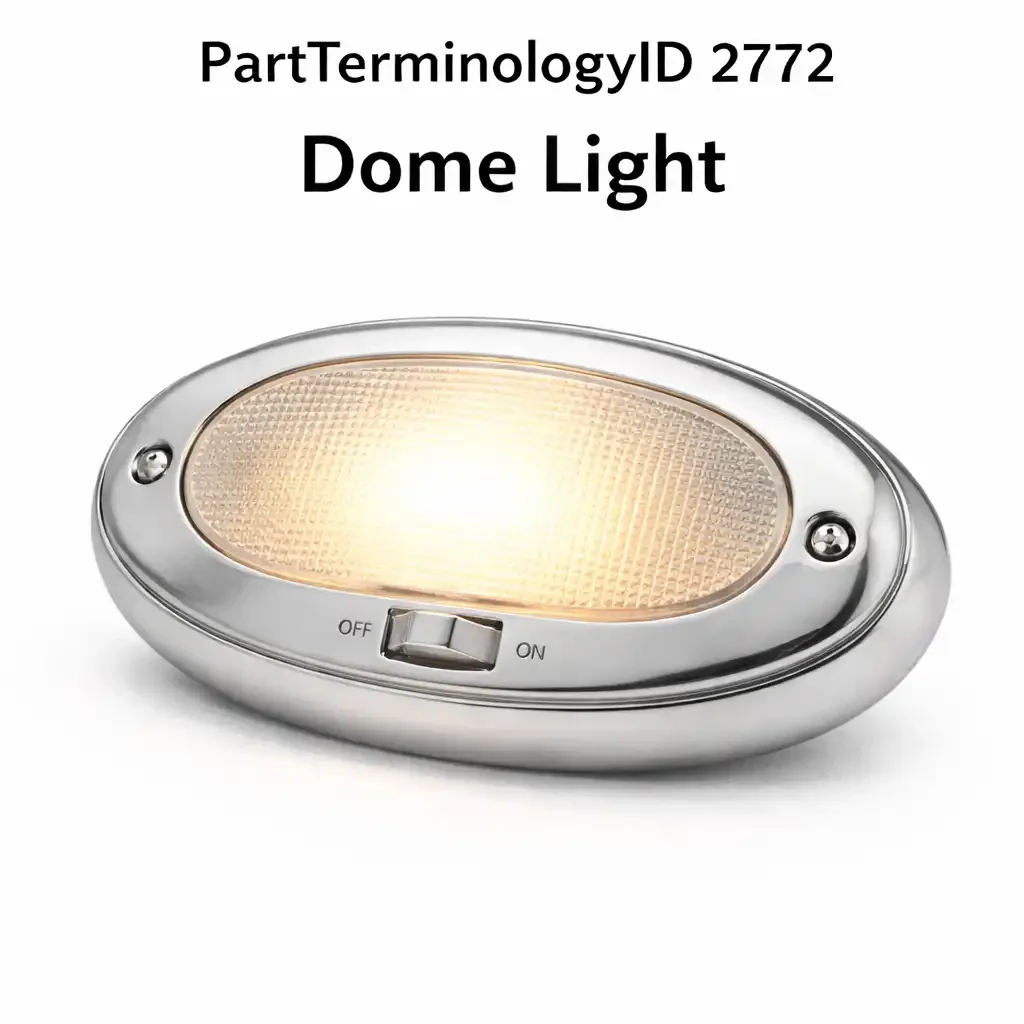
Written by Arthur Simitian | PartsAdvisory
PartTerminologyID 2772, Dome Light, is the overhead interior lamp assembly or bulb that illuminates the passenger compartment when a door is opened, when the driver activates it through an interior switch or touch contact, or during the BCM-controlled courtesy lighting sequence following ignition off, providing general overhead illumination for occupants entering, exiting, or locating items within the vehicle in low-light conditions. That definition covers the overhead interior illumination function correctly and leaves unresolved every question that determines whether the replacement part is a bulb only or a complete housing assembly, whether the housing configuration and lens shape match the headliner cutout and mounting clip pattern at the specific dome light position in the vehicle, whether the part covers the front dome light position or the rear dome light position on vehicles where front and rear positions use different assemblies with different sizes and mounting configurations, whether the assembly includes a manual on-off switch contact that the original assembly had, whether the lens diffuser type produces the original broad-coverage illumination pattern or a focused spot pattern that leaves areas of the passenger compartment underlit, whether the interior color of the housing matches the headliner color or requires painting, whether the activation circuit uses a door jamb switch ground path or a BCM-controlled output that requires a specific current load to confirm circuit continuity, and whether the assembly is designed for a vehicle with a sunroof or moonroof where the dome light housing is integrated into the sunroof control module assembly rather than being a standalone dome light unit.
It does not specify whether the part is a bulb or complete assembly, the interior position, the housing mounting clip configuration, whether a manual switch contact is included, the lens diffuser type, the housing interior color, the activation circuit type, the bulb base type, the wattage, the housing dimensions, or the sunroof console integration status. A listing under PartTerminologyID 2772 that specifies only year, make, and model without interior position and part type cannot be evaluated by a buyer replacing the rear dome light on a three-row SUV where the front and rear dome positions use different assemblies with different mounting clip configurations and different lens sizes.
For sellers, PartTerminologyID 2772 covers a wider buyer population than most other interior lighting PartTerminologyIDs because the dome light is the highest-visibility interior lamp in the vehicle, is activated every time a door opens, and its failure is immediately noticed by every occupant. The failure rate is correspondingly higher than for low-use interior lamps such as the ash tray or clock lights, and the replacement purchase is often made under time pressure because a non-functional dome light makes nighttime entry and exit from the vehicle inconvenient enough that most owners do not defer the repair. The listing quality required to capture this buyer population without generating returns is proportional to the number of dome light positions on the vehicle and the diversity of housing configurations across those positions.
The additional complexity specific to PartTerminologyID 2772 is the overhead console integration problem. On many modern vehicles, the front dome light is not a standalone lamp but a component of an overhead console module that also contains the sunroof controls, the compass display, the microphone for the hands-free phone system, and the HomeLink remote buttons. On these vehicles, a failing dome light bulb or LED element is in a module that cannot be disassembled without risk of damaging the surrounding electronic components, and a complete dome light replacement requires replacing the entire overhead console module. A listing that covers only the bulb for this application will be useless to the buyer who discovers the bulb is not separately accessible without console disassembly. The listing must identify whether the dome light is a standalone assembly or an overhead console component and state the replacement method accordingly.
What the Dome Light Does
Providing overhead passenger compartment illumination across activation modes
The dome light circuit typically operates in three distinct modes: door-activated, switch-activated, and BCM-controlled courtesy illumination. In door-activated mode, each door jamb switch grounds the dome light circuit through the door switch's normally-closed contact when the door is open, completing the circuit from the fused supply through the bulb to ground through the door switch. When all doors are closed, all door switches open, removing the ground path and extinguishing the dome light. In switch-activated mode, the driver uses a dedicated switch on the dome light housing or on the overhead console to hold the dome light on continuously regardless of door switch state, or to disable it so it does not activate when doors open.
In BCM-controlled courtesy lighting mode, present on most vehicles produced after the mid-1990s, the BCM monitors door switch inputs and controls the dome light through a relay or a direct driver circuit rather than through a direct door switch ground path. The BCM adds timed delay functions: the dome light illuminates immediately when a door opens, remains on for a calibrated period after the door closes, and then fades out or extinguishes abruptly depending on the BCM's programmed behavior. On these vehicles, the dome light load is driven by the BCM output rather than directly by the door switch, and the BCM monitors the load current to detect a burned-out bulb. An LED replacement that draws less current than the original incandescent may trigger the BCM's bulb monitoring threshold and store a fault code for the dome light circuit.
Front versus rear dome light positions and the assembly difference
Vehicles with more than one interior seating row typically have separate dome light assemblies at multiple ceiling positions: a front dome light above the front seat occupants, a rear dome light above the second row, and on three-row vehicles an additional third-row ceiling lamp. Each position serves the occupants of that row and may use a different housing size, a different lens shape, a different bulb base type, and a different mounting clip configuration than the assemblies at other positions. The front dome light on most vehicles is the larger and brighter of the two assemblies because it provides the primary entry and exit illumination for the most frequently used door positions.
A catalog that covers "Dome Light" for a vehicle without distinguishing front and rear positions will generate orders from buyers at every dome light position in the vehicle. The rear dome light buyer will receive the front dome light assembly, which is typically larger than the rear assembly and cannot be installed in the rear headliner cutout without modification. The front dome light buyer on a vehicle where the front assembly is integrated into the overhead console will receive a standalone dome light that does not match the mounting interface of the overhead console module. Front and rear dome light positions must be listed separately with explicit position designations for any vehicle where the two positions use different assemblies.
Lens diffuser type and illumination pattern coverage
The lens cover of the dome light assembly serves as both a cosmetic cover and a light diffuser that spreads the bulb's point-source output into a broad even pattern covering the passenger compartment below. A clear lens produces a focused center-bright pattern with rapid falloff toward the edges of the compartment. A frosted or ribbed diffuser lens produces a broader and more even distribution that reduces the center-bright hot spot and increases the illumination at the sides of the compartment. An opaque white lens with high-transmission characteristics produces the broadest and most even distribution but reduces total output compared to a clear lens with the same bulb.
A replacement assembly with a clear lens substituted for an original frosted diffuser lens will produce a noticeably different illumination pattern: the center of the compartment will be brighter and the door areas will be darker than with the original diffuser. Occupants who rely on the dome light for reading or locating items in the side door pockets will find the replacement less useful than the original. The lens type must be stated in the listing, and the replacement lens type must match the original diffuser specification for the specific assembly position.
Overhead console integration and module replacement scope
The front dome light on vehicles with a full overhead console is frequently not a discrete removable assembly but an integral component of the console module. The console module contains the sunroof switch panel, the interior mirror auto-dimming controls, the compass and temperature display, the HomeLink buttons, the front and rear reading light switches, and the dome light lens and socket, all in a single molded housing that clips to the headliner mounting points. Removing the dome light bulb requires removing the entire console module from the headliner, which requires unclipping the console from its mounting points and disconnecting multiple harness connectors before the dome light socket is accessible.
On some overhead console designs, the dome light socket is accessible through the lens cover without removing the console from the headliner, similar to a standalone dome light. On others, the socket is only accessible from the rear of the console module after full removal. The listing must state whether bulb access requires console removal or is achievable through the lens cover from below, because a buyer who expects a two-minute lens-pop bulb swap and discovers a 20-minute console removal procedure will return the part and seek a shop to complete the repair rather than doing it themselves.
Why This Part Generates Returns
Buyers return dome lights because the part is specified as a front dome light assembly and the buyer needed the rear assembly whose housing is 40mm smaller in both dimensions and uses a different clip pattern, the lens is clear and the original was a frosted diffuser producing a noticeably brighter center spot and darker door areas after installation, the assembly does not include a manual switch contact and the original had a three-position switch allowing off, door-activated, and always-on modes, the housing interior color is gray and the headliner is beige requiring painting before installation to avoid a visible color mismatch at the ceiling, the LED replacement draws 80 milliamperes and the BCM's dome light current monitor threshold requires a minimum of 150 milliamperes to confirm circuit continuity, the part is a standalone dome light assembly and the vehicle has an overhead console where the dome light is an integral module component not separately replaceable, the festoon bulb in a bulb-only listing is 39mm and the socket accepts only a 31mm festoon, the part covers the front dome light for the base trim level and the buyer has the premium trim with a sunroof whose dome light is integrated into the sunroof console with a different mounting footprint, the quantity is one assembly and the vehicle has twin dome lights at the front position side by side requiring two assemblies for a complete replacement, and the mounting clips are the push-in expanding type and the headliner has the bayonet-turn type requiring a different clip format.
Status in New Databases
PIES/PCdb: PartTerminologyID 2772, Dome Light
PIES 8.0 / PCdb 2.0: No change in PartTerminologyID or terminology label.
Top Return Scenarios
Scenario 1: "Front assembly received for rear position, housing 40mm oversize, does not fit headliner cutout"
The buyer needs to replace the rear dome light assembly on a four-door sedan. The listing covers the vehicle year, make, and model without distinguishing front and rear positions. The delivered assembly is the front dome light, which is 40mm wider and 25mm longer than the rear assembly. The front assembly does not fit the rear headliner cutout. The rear position requires the smaller assembly with a different clip pattern. The front assembly is returned unused.
Prevention language: "Interior position: [front / rear / third row]. This assembly is for the [position] dome light. Vehicles with multiple dome light positions use different assemblies at each position with different housing dimensions and clip configurations. Verify the position before ordering. Front and rear dome light assemblies are not interchangeable."
Scenario 2: "No manual switch contact, original had three-position switch, always-on mode lost after replacement"
The original dome light assembly has a three-position manual switch integrated into the lens housing: off, door-activated, and always-on. The replacement assembly has no switch; the dome light activates only from the door switch circuit. The buyer uses the always-on mode regularly when working in the vehicle. After installation, the always-on mode is no longer available. The buyer returns the switch-free assembly and requests the version with the integrated switch.
Prevention language: "Manual switch: [included, three-position off/door/on / included, two-position off/on / not included, door-activated only]. Verify the switch configuration matches the original assembly. A replacement without a manual switch does not provide the always-on or continuous-off modes available on assemblies with integrated switches."
Scenario 3: "LED triggers BCM dome light circuit fault, warning lamp illuminates after installation"
The BCM on this vehicle monitors dome light circuit current to detect a burned-out bulb. The original incandescent draws 210 milliamperes. The LED replacement draws 85 milliamperes. The BCM interprets 85 milliamperes as a partial circuit fault and stores a body control fault code, illuminating an interior lighting system warning. The BCM does not control the dome light through the fault condition, so the dome light continues to function, but the warning lamp remains on until the fault code is cleared and the BCM re-evaluates the circuit.
Prevention language: "BCM load monitoring compatibility: [compatible / may require load resistor on vehicles with BCM dome light current monitoring]. This LED draws [X] milliamperes. On vehicles where the BCM monitors dome light circuit current to detect burned-out bulbs, a load resistor wired in parallel with the LED may be required to restore the correct current draw and prevent a false interior lighting fault code."
Scenario 4: "Overhead console vehicle, standalone assembly does not match console mounting interface"
The vehicle has a full overhead console module containing the sunroof controls and dome light as an integrated unit. The listing covers the vehicle year and model without noting the overhead console integration. The delivered part is a standalone dome light assembly designed for a base-trim vehicle without the overhead console. The standalone assembly's mounting clips do not align with the overhead console's mounting points in the headliner. The standalone assembly cannot be installed without removing and discarding the overhead console module.
Prevention language: "Overhead console compatibility: [standalone dome light, no overhead console / integrated into overhead console module, console removal required for bulb access / integrated into overhead console, bulb accessible through lens cover without console removal]. This listing covers [configuration]. For vehicles with an overhead console, verify whether the dome light is accessible without console removal before ordering a standalone replacement assembly."
Scenario 5: "Festoon bulb 39mm in 31mm socket, physically cannot install"
The dome light socket accepts a 31mm festoon bulb. The listing states the correct vehicle application and bulb type as festoon without specifying the festoon length. The delivered bulb is a 39mm festoon. The 39mm festoon is 8mm longer than the socket's spring clip span. The bulb cannot be compressed into the socket without distorting the spring clips. The buyer returns the 39mm bulb and requests the 31mm variant.
Prevention language: "Festoon bulb length: [31mm / 36mm / 39mm / 42mm]. This listing covers a [length] festoon bulb. Festoon bulbs of different lengths are not interchangeable in sockets designed for a specific length. Verify the festoon length matches the socket spring clip span before ordering."
Scenario 6: "Housing color mismatch, gray assembly in beige headliner, visible at ceiling"
The vehicle has a beige headliner. The replacement dome light assembly housing is charcoal gray. The gray housing is visible at the ceiling against the beige headliner. The original assembly was beige to match the headliner. The buyer did not specify interior color because the listing did not include a color attribute and the product photography showed only the underside of the assembly without the housing color visible against a contrasting background.
Prevention language: "Housing interior color: [beige / gray / black / tan]. This assembly has a [color] housing. Verify the housing color matches the vehicle's headliner color before ordering. Interior dome light housings are visible at the ceiling and a color mismatch is noticeable. On vehicles offered with multiple interior color options, the dome light housing color corresponds to the interior trim color package."
What to Include in the Listing
Core essentials
PartTerminologyID: 2772
component: Dome Light
part type: bulb only or complete assembly (mandatory, in title)
interior position: front, rear, or third row (mandatory, in title)
housing interior color (mandatory for complete assembly listings)
lens diffuser type: clear, frosted, or ribbed (mandatory)
manual switch included: yes with switch configuration, or no (mandatory)
overhead console integration: standalone or console-integrated with access method (mandatory)
activation circuit type: door switch direct, BCM-controlled (mandatory)
BCM load monitoring compatibility for LED listings (mandatory)
bulb base type: festoon with length, wedge with size designation (mandatory)
bulb wattage (mandatory)
bulb type: incandescent or LED (mandatory)
festoon bulb length in mm for festoon applications (mandatory)
mounting clip type: push-in expanding or bayonet-turn (mandatory for assembly listings)
housing dimensions in mm for position-specific assemblies (mandatory)
quantity per package with note for twin dome light positions (mandatory)
OEM part number cross-reference (mandatory)
Fitment essentials
year/make/model/submodel/trim level
interior position designation: front, rear, third row
note for trim levels with overhead console versus standalone dome light
note for sunroof-equipped variants with console-integrated dome light
interior color designation matching trim packages
note for twin dome light positions requiring two assemblies
Image essentials
assembly shown from below with lens and switch contact visible
assembly shown from above with housing color and mounting clip positions labeled
housing color shown against a neutral background for accurate color representation
lens diffuser type clearly visible: clear versus frosted distinguishable in photography
switch contact shown in detail where manual switch is included
festoon bulb length labeled for bulb-only listings
Catalog Checklist for ACES/PIES Teams
PartTerminologyID = 2772
require part type: bulb or assembly (mandatory, in title)
require interior position: front, rear, third row (mandatory, in title)
require housing interior color for assembly listings (mandatory)
require lens diffuser type (mandatory)
require manual switch status (mandatory)
require overhead console integration status (mandatory)
require activation circuit type (mandatory)
require BCM load monitoring compatibility note for LED listings (mandatory)
require bulb base type with festoon length where applicable (mandatory)
require mounting clip type for assembly listings (mandatory)
require quantity note for twin dome light positions (mandatory)
prevent position omission: front and rear dome light assemblies differ in size and clip configuration; position must be in the title; a single listing for both positions will deliver the wrong assembly to every rear-position buyer
prevent overhead console conflation: standalone dome light assemblies are not compatible with overhead console mounting interfaces; console integration status must be required for all front dome light listings on vehicles produced after approximately 1995
prevent festoon length omission: festoon bulbs of different lengths are not interchangeable; length must be stated for all festoon base listings
prevent housing color omission: color mismatch is visible at the ceiling; housing color must be required for all complete assembly listings
flag BCM load monitoring as mandatory for all LED listings on post-2000 vehicles where BCM dome light monitoring is common
differentiate from Reading Light (PartTerminologyID 2820): the reading light is a focused directional lamp for individual occupant use; the dome light provides broad overhead compartment illumination; both are ceiling-mounted but serve different functions and typically use different housing designs
differentiate from Glove Box Light (PartTerminologyID 2788): the glove box light illuminates the glove compartment interior; the dome light illuminates the passenger compartment ceiling; both are interior lights but at different positions with different activation circuits
FAQ (Buyer Language)
What does the dome light do?
The dome light is the overhead ceiling lamp that illuminates the passenger compartment when a door opens, when activated manually through the dome light switch, or during the BCM courtesy lighting delay after ignition off. It provides general overhead illumination for entry, exit, and passenger compartment visibility in low-light conditions.
What is the difference between a dome light bulb and a dome light assembly?
The bulb is the lamp element within the housing. Replacing only the bulb requires opening the lens cover and pulling the bulb from the socket. The assembly is the complete housing with lens, diffuser, switch contact, and mounting hardware. Assembly replacement requires removing the housing from the headliner mounting clips and disconnecting the harness. The listing must state which it covers.
Why does the dome light stay on after the door closes?
On modern vehicles, a BCM-controlled courtesy delay intentionally keeps the dome light on for a calibrated period after the door closes. On older vehicles, a stuck door jamb switch or a switch set to the always-on position keeps the circuit grounded after the door closes. Confirm the dome light switch position before diagnosing a door switch or BCM fault.
Can I replace the dome light with an LED?
Yes on most vehicles. Match the base type and festoon length for festoon applications. On vehicles where the BCM monitors dome light circuit current, the lower LED current draw may trigger a false fault code. A load resistor in parallel with the LED restores the correct current if needed.
How do I access the dome light bulb?
On standalone dome lights, insert a trim tool into the lens edge gap and gently pry the snap-fit cover off. The bulb is in the socket behind the lens. On overhead console-integrated dome lights, the access method depends on the console design: some allow bulb access through the lens cover; others require removing the entire console module from the headliner first.
Cross-Sell Logic
Reading Light (PartTerminologyID 2820): the directional lamp for individual occupants typically mounted alongside the dome light in the front overhead area; buyers replacing the dome light often replace the reading lights simultaneously for a complete overhead lighting refresh
Door Jamb Switch: the switch that activates the dome light circuit when a door opens; a failed door jamb switch produces a dome light that does not activate on door open; cross-sell as a diagnostic follow-up when a new dome light bulb does not restore door-activated function
LED Interior Bulb Kit: for buyers replacing the dome light with an LED who want to convert all interior lamps to LED simultaneously; covers the dome light, reading lights, map lights, and courtesy lights in a single kit
Overhead Console: for vehicles where the dome light is integrated into the overhead console module; if the console housing is cracked or the surrounding electronic components in the console have failed, the complete overhead console module replacement is the correct repair scope
Load Resistor Kit: for LED dome light conversions on vehicles with BCM dome light current monitoring that produce false fault codes with LED replacements
Final Take for PartTerminologyID 2772
Dome Light (PartTerminologyID 2772) is the interior lighting PartTerminologyID with the most diverse assembly configuration across vehicle trim levels and model years in the category. The same vehicle model can have a standalone front dome light on the base trim, an overhead console-integrated dome light on the mid trim, and a sunroof-console-integrated dome light on the top trim, all covering the same model year in the same application table and all requiring different replacement approaches. A catalog that covers all three under a single listing with no trim level or equipment designation will deliver the wrong assembly to two out of three trim level buyers in every transaction.
State the part type in the title. State the interior position in the title. State the housing color. State the lens diffuser type. State the manual switch status. State the overhead console integration and access method. State the activation circuit type. State the BCM load monitoring compatibility for LED listings. State the bulb base type with festoon length. State the mounting clip type. State the quantity with a note for twin dome light positions. For PartTerminologyID 2772, interior position, overhead console integration status, and housing color are the three attributes that determine whether the replacement dome light fits the correct ceiling position, installs without requiring an unplanned console removal, and matches the headliner color that the occupants see every time they enter the vehicle.