
Cornering Light (PartTerminologyID 2764): Where Bulb Type, Housing Configuration, and Steering Activation Compatibility Determine Whether the Turn-Activated Illumination Covers the Intended Path
Written by Arthur Simitian | PartsAdvisory
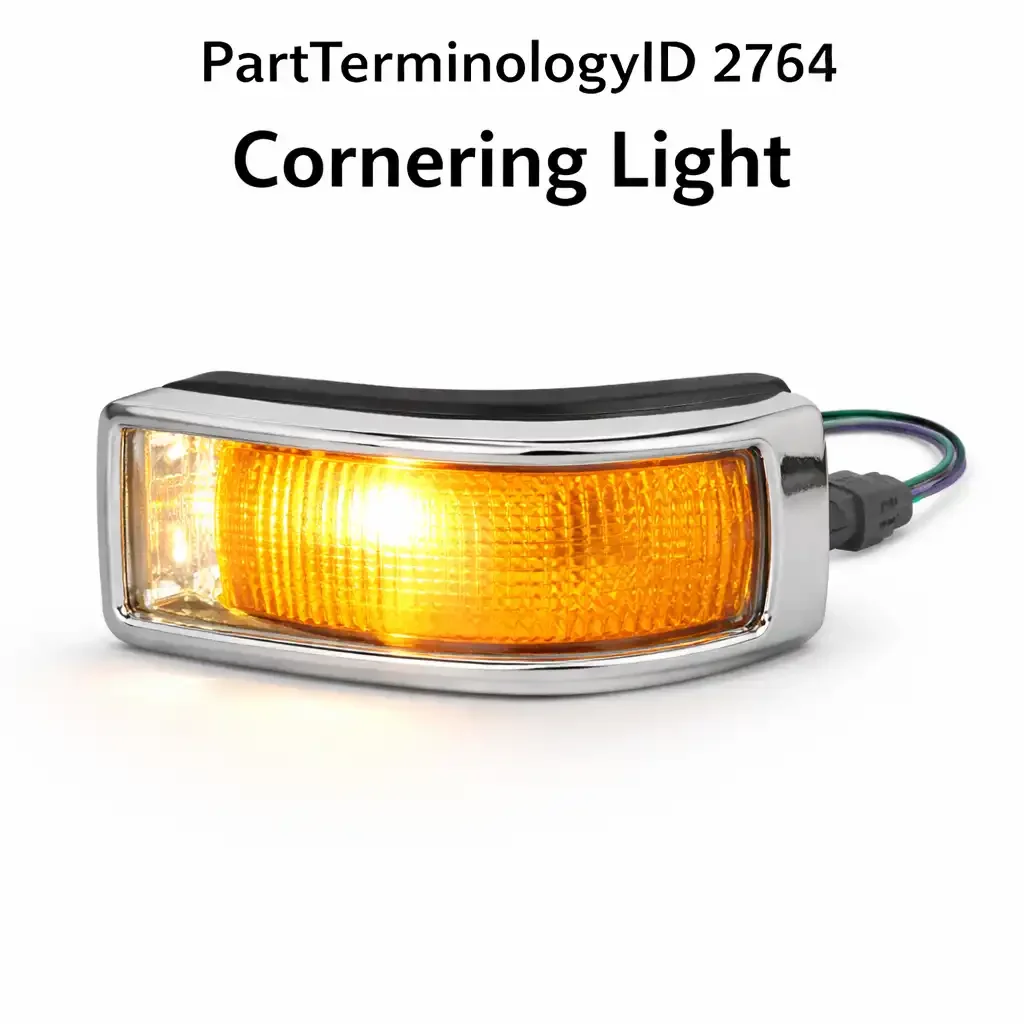
PartTerminologyID 2764, Cornering Light, is the supplemental forward-facing lamp mounted at the front corner of the vehicle that activates when the driver turns the steering wheel or engages the turn signal in the corresponding direction, projecting a beam aimed laterally into the area the vehicle is entering during a turning maneuver to fill the gap between the fixed forward headlight beam and the edge of the road, curb, or pedestrian path that the driver needs to see when making a low-speed turn in darkness. That definition covers the directional illumination function correctly and leaves unresolved every question that determines whether the replacement part is a bulb only or a complete housing assembly, whether the housing mounts in the correct position in the vehicle's front fascia or headlight assembly surround, whether the lens configuration and beam pattern match the original to produce the lateral coverage the system was designed for, whether the activation circuit interface matches the vehicle's steering angle sensor signal or turn signal circuit depending on the activation method the vehicle uses, whether the driver-side and passenger-side assemblies are mirror-image designs requiring separate part numbers, whether the lens is clear as required by FMVSS 108 for white cornering lamp output, whether the assembly bears the required DOT certification markings, and whether the housing connector type matches the vehicle's existing cornering light harness connector.
It does not specify whether the part is a bulb or a complete assembly, the mounting position in the front fascia or headlight surround, the beam pattern aim angle relative to the vehicle centerline, the activation circuit type, the driver-side versus passenger-side designation, the lens clarity, the DOT certification status, the housing connector type, the bulb base type for bulb-only listings, the wattage, or whether the assembly integrates with a combined front lighting module or is a standalone lamp. A listing under PartTerminologyID 2764 that specifies only year, make, and model without part type, side designation, and activation circuit compatibility cannot be evaluated by a technician replacing a cornering light assembly on a vehicle where the driver-side cornering light has been cracked by road debris and the passenger-side is intact, and where the replacement must match the activation circuit the vehicle uses to activate the cornering light from the steering angle sensor rather than the turn signal circuit.
For sellers, PartTerminologyID 2764 sits within a narrower buyer population than most other exterior lighting PartTerminologyIDs in this series because cornering lights were an option or a trim-level feature rather than standard equipment on many vehicles, and because their replacement market is concentrated on the specific model years and trim levels that included them. The fitment precision required is correspondingly higher because a buyer who specifically seeks a cornering light replacement has already confirmed the vehicle has the feature and is not making an exploratory purchase. A listing that omits the side designation or the activation circuit type will generate returns from this narrower but precisely motivated buyer population at a higher rate than a broadly applied PartTerminologyID whose buyer population includes exploratory and convenience purchases alongside replacement-driven orders.
The additional complexity specific to PartTerminologyID 2764 is the activation circuit architecture distinction between steering-angle-activated and turn-signal-activated systems, and between vehicles where the cornering light function is delivered by a standalone lamp assembly and vehicles where the cornering light is a programmable function of the adaptive front lighting system that rotates the headlight projector beam laterally rather than activating a separate lamp. On adaptive front lighting system vehicles, there is no separate cornering light assembly to replace under PartTerminologyID 2764. The cornering function is embedded in the headlight actuator mechanism covered under a different PartTerminologyID. A listing that covers the vehicle application for an adaptive front lighting system vehicle without noting this distinction will deliver a standalone cornering light assembly to a buyer whose vehicle has no mounting position for a standalone cornering lamp.
What the Cornering Light Does
Filling the lateral illumination gap during low-speed turns
The fixed headlight beam illuminates the road ahead in a pattern calibrated for straight-ahead driving at highway and urban speeds. At low speeds during parking maneuvers, driveway approaches, and intersection turns, the vehicle's path diverges significantly from the headlight beam's fixed aim. The area to the left or right of the headlight beam into which the vehicle is turning is in relative darkness compared to the forward-lit road surface. The cornering light's laterally aimed beam fills this gap by projecting white light 60 to 80 degrees to the side of the vehicle's forward centerline, illuminating the curb, sidewalk, parked vehicle, or pedestrian in the vehicle's turning path before the headlights rotate to face that direction as the vehicle completes the turn.
The benefit of cornering lights is most pronounced during nighttime low-speed maneuvers where the area immediately to the side of the vehicle's path is otherwise unlit. Parking in an unfamiliar area, turning into a narrow driveway, and navigating a complex intersection at night are all scenarios where the cornering light's lateral coverage improves the driver's ability to identify obstacles in the turning path before the headlights face them. A non-functional cornering light on a vehicle designed with them reduces this lateral visibility without producing any other symptom, making it a fault that many drivers do not notice until they encounter a situation where the missing illumination would have been useful.
Activation circuits: steering angle sensor versus turn signal
The two common activation architectures for cornering lights produce different behavior and have different implications for replacement part compatibility. In the turn-signal-activated architecture, the cornering light circuit is wired in parallel with the turn signal circuit on the corresponding side, with a relay or a direct connection that supplies continuous power to the cornering light whenever the turn signal is active. The cornering light illuminates continuously while the turn signal flashes, providing steady illumination into the turning path regardless of whether the steering wheel has moved. This architecture is simpler and less expensive to implement but activates the cornering light at highway speed when the driver signals a lane change, which is a situation where lateral illumination 60 degrees off-axis is not useful and where the cornering light's activation may distract other drivers.
In the steering-angle-activated architecture, a steering angle sensor monitors the steering wheel position and activates the cornering light only when the steering wheel is turned beyond a calibrated angle threshold, typically 45 to 90 degrees from center, in the corresponding direction. This architecture activates the cornering light only during actual turning maneuvers at low speed and prevents it from activating during highway lane changes. The replacement cornering light assembly in a steering-angle-activated system must connect to the activation circuit output from the cornering light control module or BCM, not to the turn signal circuit. A replacement assembly wired to the turn signal circuit on a steering-angle-activated vehicle will produce a cornering light that flashes with the turn signal rather than providing steady illumination during the turn.
Part type distinction: standalone assembly versus adaptive headlight function
Vehicles with adaptive front lighting systems, sometimes called dynamic bending lights or active cornering headlights, deliver the cornering illumination function by pivoting the headlight projector beam laterally in response to steering input rather than by activating a separate cornering light lamp. These systems rotate the headlight's low beam pattern up to 15 degrees in the steering direction, effectively moving the headlight illumination into the turning path. On these vehicles, the cornering function is not a separate lamp under PartTerminologyID 2764. It is a function of the headlight actuator and the adaptive lighting control module. The headlight assembly on an adaptive lighting vehicle may include a separate fixed cornering lamp in addition to the adaptive beam, or it may rely entirely on the adaptive beam rotation without a separate cornering lamp.
A catalog that applies PartTerminologyID 2764 to adaptive front lighting system vehicles without distinguishing whether the vehicle uses a standalone cornering lamp in addition to or instead of the adaptive beam will deliver a standalone cornering light assembly to buyers whose vehicles either have no mounting position for a standalone lamp or already have a functioning cornering lamp integrated into the headlight assembly that the adaptive system supplements. The application note must specify whether the vehicle uses a standalone cornering light, an adaptive headlight system without a standalone lamp, or both simultaneously.
Housing configuration, beam pattern, and DOT compliance
The cornering light housing contains a reflector and lens designed to produce the lateral beam pattern required by FMVSS 108 for cornering lamps. The reflector geometry determines the beam pattern shape, the aim angle relative to the vehicle centerline, and the distribution of luminous intensity across the pattern. A replacement housing with a different reflector geometry than the original will produce a different lateral coverage pattern, potentially leaving areas of the turning path illuminated at different intensity levels than the original design intended. For vehicles where the cornering light's beam pattern was designed to complement a specific headlight pattern, a replacement with a different beam pattern will leave gaps or overlaps in the combined front lighting coverage during turns.
FMVSS 108 specifies minimum and maximum photometric values at test angles from the cornering lamp axis for lamps installed as original equipment. A replacement assembly must meet these values to be compliant. The assembly must bear DOT certification markings confirming compliance. An assembly without DOT markings has not been tested to confirm compliance with the FMVSS 108 cornering lamp photometric requirements and is not certifiably legal for installation on a vehicle operated on public roads as a replacement for original equipment.
Why This Part Generates Returns
Buyers return cornering lights because the part is a complete assembly and the buyer needed only a bulb for a housing with an intact lens but a burned-out bulb, the driver-side assembly is delivered and the buyer's cracked housing is on the passenger side, the activation circuit connector is a two-pin turn-signal-parallel connector and the vehicle uses a four-pin steering-angle-sensor output connector requiring a different harness interface, the lens has a yellow tint and FMVSS 108 requires white output from the cornering lamp causing the vehicle to fail an inspection, the assembly is designed for a vehicle with a standalone cornering lamp and the buyer's vehicle has an adaptive front lighting system with no mounting position for a standalone cornering lamp, the mounting tab configuration does not match the front fascia's cornering lamp housing cavity and the assembly cannot be secured flush with the fascia surface, the assembly does not bear DOT markings and the buyer's jurisdiction requires certified replacement lamps, the beam pattern aim is calibrated for left-hand traffic and the vehicle is a right-hand-traffic domestic application, the bulb base type in a bulb-only listing is H3 and the vehicle's cornering light socket accepts only a 194 wedge base, and the assembly covers the sedan body style and the buyer has the wagon variant whose front fascia has a different cornering lamp housing pocket depth.
Status in New Databases
PIES/PCdb: PartTerminologyID 2764, Cornering Light
PIES 8.0 / PCdb 2.0: No change in PartTerminologyID or terminology label.
Top Return Scenarios
Scenario 1: "Assembly delivered, buyer needed bulb only, housing cannot be installed without fascia removal"
The buyer's cornering light housing is intact but the bulb has burned out. The listing title reads "Cornering Light" without specifying bulb or assembly. The delivered part is a complete housing assembly. Installing the complete assembly requires removing the front fascia or bumper cover to access the cornering light housing cavity mounting clips. The buyer needed only a bulb that could be accessed through the engine compartment or through a small access panel without fascia removal. The assembly is returned unused.
Prevention language: "Part type: [replacement bulb only / complete housing assembly]. This listing covers a [part type]. For a burned-out bulb in an intact housing, order the replacement bulb only. For a cracked or damaged housing, order the complete assembly. Installing a complete assembly requires access to the housing mounting clips, which on most vehicles requires partial or complete front fascia removal."
Scenario 2: "Turn-signal-wired replacement on steering-angle-activated vehicle, cornering light flashes instead of holding steady"
The vehicle uses a steering-angle-sensor activation circuit that provides steady power to the cornering light during a turn. The replacement assembly is wired for a turn-signal-parallel circuit and connects to the turn signal circuit output. After installation, the cornering light flashes with the turn signal instead of illuminating steadily during the turning maneuver. The flashing cornering light provides intermittent lateral illumination rather than steady coverage, reducing its effectiveness during slow parking maneuvers where the turn signal may be cancelled before the full turn is complete.
Prevention language: "Activation circuit: [turn-signal-parallel / steering-angle-sensor output / compatible with both]. This assembly is designed for [activation circuit type]. Verify the vehicle's cornering light activation circuit before ordering. A turn-signal-wired assembly installed on a steering-angle-activated system will flash with the turn signal rather than providing steady lateral illumination during the turning maneuver."
Scenario 3: "Adaptive front lighting vehicle, no mounting position for standalone cornering lamp assembly"
The buyer's vehicle has an adaptive front lighting system that pivots the headlight beam during turns. The front fascia has no cornering lamp housing cavity. The listing covers the vehicle year, make, and model without noting the adaptive lighting distinction. The delivered assembly has no installation point on the vehicle. The buyer discovers there is no cornering lamp housing in the fascia and no wiring harness for a standalone cornering lamp because the vehicle's cornering function is delivered by the adaptive headlight system.
Prevention language: "Applies to: [vehicles with standalone cornering lamp / vehicles with adaptive front lighting system / both]. This assembly is designed for vehicles equipped with a standalone cornering lamp housing in the front fascia. Vehicles with adaptive front lighting systems that deliver cornering illumination through headlight beam rotation do not use a separate cornering lamp assembly and this part does not apply. Verify the vehicle's front lighting system type before ordering."
Scenario 4: "Yellow-tinted lens, reverse lamp output fails FMVSS 108 white light requirement at inspection"
The replacement cornering light assembly uses a yellow-tinted lens. FMVSS 108 requires white light output from cornering lamps. The yellow lens produces amber-tinted output that does not meet the white light requirement. At the vehicle's annual safety inspection, the inspector notes the non-white cornering lamp output and fails the vehicle. The buyer must source a clear-lens replacement to restore compliance.
Prevention language: "Lens color: [clear / yellow / amber]. FMVSS 108 requires white light output from cornering lamps. A yellow or amber lens over the cornering light bulb does not produce compliant white output. Verify the lens is clear before purchasing a replacement assembly for street use on a vehicle originally equipped with cornering lights."
Scenario 5: "Connector is two-pin and vehicle harness is four-pin, wiring adapter required to complete installation"
The replacement assembly has a two-pin connector covering the power and ground circuits for the cornering light bulb. The vehicle's cornering light harness has a four-pin connector that also carries the steering angle sensor signal wire and a fault monitoring circuit wire in addition to the power and ground. The two-pin connector cannot mate with the four-pin housing. The buyer cannot complete the installation without a pigtail adapter that provides the four-pin housing mated to the two-pin assembly leads, which is not a standard available adapter for this application.
Prevention language: "Connector type: [two-pin power and ground / four-pin with activation signal and monitor circuits / OEM plug-in matching vehicle harness]. This assembly uses a [connector type] connector. Verify the connector matches the vehicle's cornering light harness connector before ordering. A connector with fewer pins than the vehicle harness requires an adapter that may not be commercially available for all applications."
Scenario 6: "Wagon body style ordered, sedan part received, housing pocket depth differs by 22mm"
The vehicle was produced as a sedan and a station wagon on the same platform. The wagon's front fascia has a cornering lamp housing pocket 22mm deeper than the sedan's pocket to accommodate the different body front structure. The listing covers the model name without distinguishing body style. The delivered assembly fits the sedan pocket depth. Installed in the wagon pocket, the assembly sits 22mm forward of the fascia surface and the lens perimeter does not seat flush with the fascia panel. The gap around the lens perimeter allows water and road debris ingress into the housing cavity.
Prevention language: "Body style: [sedan / wagon / coupe]. This assembly is designed for the [body style] front fascia configuration. Vehicles sharing a model name across multiple body styles use different cornering lamp assemblies with different housing depths. Verify the body style before ordering."
What to Include in the Listing
Core essentials
PartTerminologyID: 2764
component: Cornering Light
part type: bulb only or complete housing assembly (mandatory, in title)
side: driver side, passenger side, or fits both (mandatory for asymmetric assemblies, in title)
body style where front fascia geometry differs (mandatory)
activation circuit type: turn-signal-parallel, steering-angle-sensor, or both (mandatory)
lens color: clear or tinted with compliance note for non-clear (mandatory)
FMVSS 108 compliance and DOT certification status (mandatory for complete assemblies)
bulb base type for bulb-only and assembly listings (mandatory)
bulb wattage (mandatory)
connector type and pin count (mandatory for assembly listings)
mounting tab configuration (mandatory for assembly listings)
adaptive front lighting system applicability note (mandatory)
OEM part number cross-reference (mandatory)
quantity per package (mandatory)
Fitment essentials
year/make/model/submodel/trim level
note for trim levels equipped with cornering lights versus trim levels without
note for adaptive front lighting system variants within the same model year
driver-side versus passenger-side designation
body style where fascia geometry differs
activation circuit type per vehicle configuration
Image essentials
assembly shown from front with lens clarity visible and DOT markings labeled
assembly shown from rear with connector type and mounting tab positions labeled
driver-side and passenger-side shown separately with side designation labeled
beam pattern aim angle illustrated where product photography allows
bulb shown separately where included in assembly
Catalog Checklist for ACES/PIES Teams
PartTerminologyID = 2764
require part type: bulb or assembly (mandatory, in title)
require side designation (mandatory, in title)
require activation circuit type (mandatory)
require lens color with FMVSS 108 compliance note for non-clear lenses (mandatory)
require DOT certification status for complete assemblies (mandatory)
require bulb base type and wattage (mandatory)
require connector type and pin count for assembly listings (mandatory)
require body style where fascia geometry differs (mandatory)
prevent adaptive lighting system conflation: vehicles with adaptive front lighting systems have no standalone cornering lamp mounting position; all listings must include an adaptive system inapplicability note where relevant
prevent activation circuit type omission: a turn-signal-wired assembly on a steering-angle-activated vehicle produces flashing rather than steady lateral illumination; activation circuit must be required
prevent lens color omission: FMVSS 108 requires white cornering lamp output; a yellow or amber lens produces non-compliant output; lens color must be stated
prevent side omission: driver-side and passenger-side assemblies are mirror-image designs on most vehicles; side designation must be in the title
flag trim level specificity: cornering lights were option or trim-level equipment on most vehicles; the listing must note which trim levels include cornering lights and which do not, to prevent orders from vehicles not equipped with the feature
differentiate from Front Fog Light: both mount in the front bumper area but serve different functions, aim at different angles, and have different activation circuits; confirm correct PartTerminologyID before building
differentiate from Headlight (PartTerminologyID 2796): the headlight provides forward illumination regardless of steering; the cornering light provides lateral illumination during turns; both are exterior front lamps but at entirely different circuit positions and with different activation architectures
FAQ (Buyer Language)
What is a cornering light and how does it differ from a headlight?
A cornering light is a supplemental front-corner lamp that activates when turning, projecting light laterally into the area the vehicle is entering rather than straight ahead. A headlight illuminates the forward path regardless of steering position. The cornering light fills the gap between the fixed forward headlight beam and the curb or obstacle in the turning path that the headlights do not yet face during the early phase of a turn.
What activates the cornering light?
Either steering wheel angle input from a steering angle sensor when the wheel is turned beyond a calibrated threshold, turn signal engagement activating the corresponding side lamp in parallel with the turn signal circuit, or a combination of both depending on the vehicle design. The activation type determines the connector configuration and circuit interface the replacement must match.
Is the cornering light the same as the front fog light?
No. A fog light is forward-aimed and activates from a driver-operated switch in reduced-visibility conditions. A cornering light is side-aimed and activates automatically from steering or turn signal input during turning maneuvers. The two serve different functions, use different beam patterns, and mount at different positions even when both are located in the front bumper fascia.
Does a cornering light need DOT certification?
A complete replacement cornering light assembly must bear DOT certification markings confirming compliance with FMVSS 108 cornering lamp photometric requirements. An assembly without DOT markings has not been certified to meet these requirements and may not pass a safety inspection. Verify DOT markings before purchasing a replacement assembly for street use.
Why would the cornering light fail while the headlights work?
The cornering light operates on a separate circuit activated by the steering angle sensor signal or turn signal circuit, independent of the headlight circuit. A burned-out bulb, a failed socket, a failed steering angle sensor, or a wiring fault in the cornering light activation circuit can produce a non-functional cornering light without affecting the headlights. Confirm the activation signal is reaching the cornering light circuit before replacing the bulb.
Cross-Sell Logic
Headlight (PartTerminologyID 2796): the primary forward illumination assembly that the cornering light supplements; for vehicles where the cornering light is integrated into the headlight assembly surround, the headlight assembly is the natural companion listing
Steering Angle Sensor: the sensor that activates the cornering light on steering-angle-activated systems; a failed steering angle sensor produces a non-functional cornering light that cannot be resolved by bulb replacement; cross-sell as a diagnostic next step when a new cornering light bulb does not restore function on a steering-angle-activated system
Turn Signal Light (PartTerminologyID 2872): for vehicles where the cornering light activates in parallel with the turn signal; a simultaneous turn signal and cornering light failure suggests a shared circuit fault upstream of both lamps rather than individual bulb failures
Front Bumper Fascia: for vehicles where cornering light housing replacement requires front fascia removal; if the fascia is already damaged, replacing it simultaneously with the cornering light assembly eliminates a second removal event
Final Take for PartTerminologyID 2764
Cornering Light (PartTerminologyID 2764) is the PartTerminologyID in the exterior lighting series where the activation circuit architecture distinction between steering-angle-activated and turn-signal-activated systems produces the most specific compatibility requirement that is invisible from the outside of the lamp assembly. Two cornering light assemblies can look identical, have the same bulb base type, the same lens configuration, and the same mounting tab pattern, and yet produce completely different behavior after installation because one is wired for turn-signal-parallel activation and the other is wired for steering-angle-sensor output. The activation circuit type must be stated in the listing, and the installation instruction must confirm how the assembly connects to the vehicle's cornering light activation circuit, not just to the vehicle's general lighting harness.
State the part type in the title. State the side designation in the title. State the activation circuit type. State the lens color with FMVSS 108 compliance note. State the DOT certification status. State the bulb base type and wattage. State the connector type and pin count. State the body style where it affects fascia geometry. State the adaptive front lighting system inapplicability note. State the trim level applicability. For PartTerminologyID 2764, part type, activation circuit type, and side designation are the three attributes that determine whether the replacement cornering light activates correctly during turns, installs in the correct corner of the vehicle, and connects to the right circuit without producing flashing lateral illumination where steady coverage was designed.