
Written by Arthur Simitian | PartsAdvisory
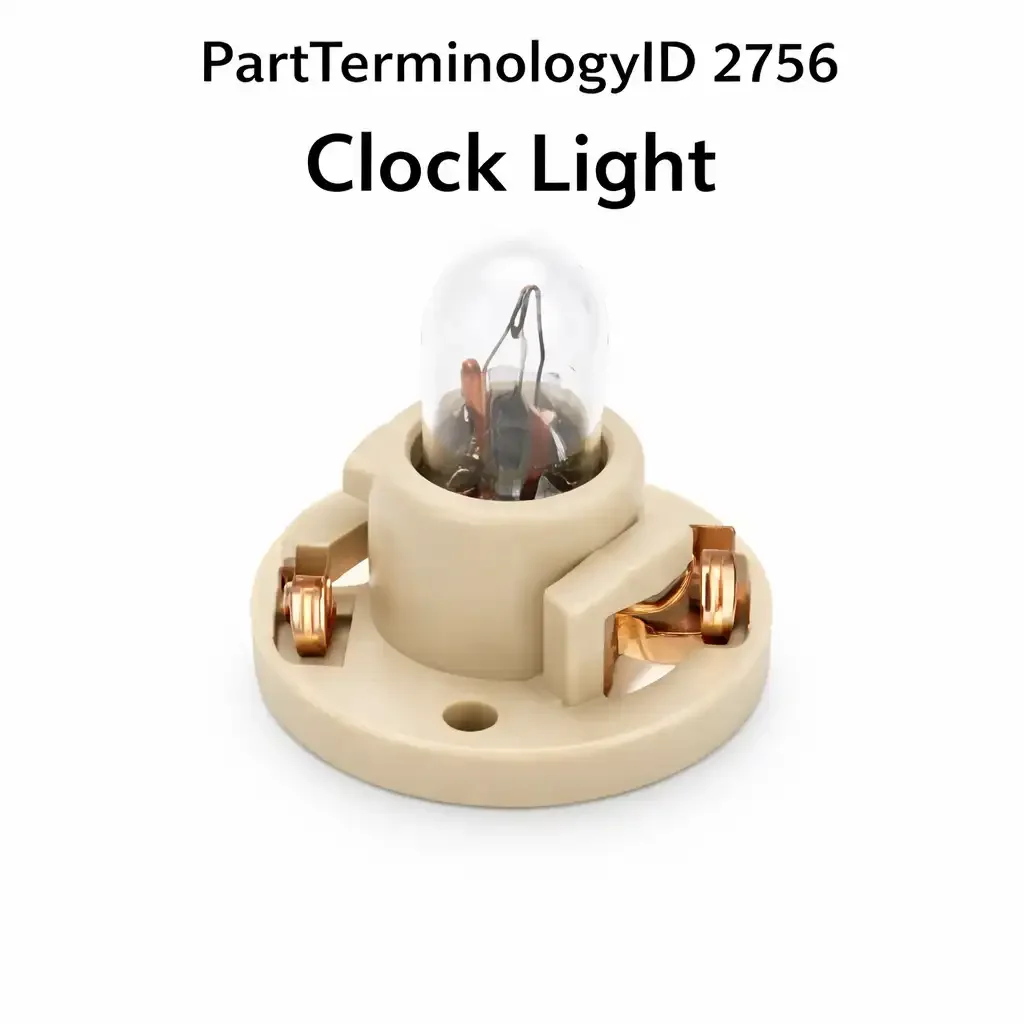
PartTerminologyID 2756, Clock Light, is the small bulb or LED element that illuminates the instrument panel clock display so the driver and passengers can read the time in low-light and nighttime conditions, typically connected to the interior illumination circuit and activated when the headlamps are switched on or when the ignition is active. That definition covers the illumination function correctly and leaves unresolved whether the replacement bulb base type matches the clock assembly's socket retaining mechanism, whether the lens color matches the clock display's color scheme and the surrounding instrument panel illumination, whether the wattage is consistent with the clock housing's heat tolerance for an enclosed small-cavity assembly, whether the replacement is designed for a discrete socket-mount bulb in the clock housing or an integral display element in a digital clock module that is not separately replaceable, whether the clock assembly is a standalone instrument panel unit or a clock integrated into the instrument cluster requiring cluster removal for bulb access, and whether the part covers the analog clock backlight or the digital clock display backlight on vehicles where the same model year offered both clock types depending on the option package.
It does not specify the bulb base type, the lens color, the wattage, whether the clock is analog or digital, whether the clock is a standalone panel unit or cluster-integrated, whether the bulb is accessible without cluster removal, or whether the digital clock display is a separate module type where no discrete backlight bulb exists. A listing under PartTerminologyID 2756 that specifies only a vehicle application without bulb base type and clock assembly type cannot be evaluated by a buyer who has removed the clock assembly from the instrument panel and is comparing the socket type against an unlabeled listing to determine whether the part fits before ordering.
For sellers, PartTerminologyID 2756 is the final PartTerminologyID in the interior lighting series covered in this run and the one with the most straightforward fitment logic of all the cluster and panel bulbs in the group. Like the ash tray light, the clock light's fitment is almost entirely determined by bulb base type and wattage, with lens color as the third critical attribute. The complexity that distinguishes it from the ash tray light is the analog-versus-digital clock assembly distinction and the standalone-versus-cluster-integrated position distinction, both of which affect the replacement method and the accessibility of the bulb socket rather than the bulb specification itself.
What the Clock Light Does
Backlighting the clock face in the instrument panel illumination circuit
The clock light bulb sits behind the clock face in the clock housing cavity, backlighting the clock face legend or numeral display so it is visible at night. On analog clocks, the bulb illuminates the entire clock face from behind through a translucent face panel. On early digital clocks that use a segmented LCD display with a backlight rather than a self-illuminating vacuum fluorescent display, the backlight bulb illuminates the LCD segments from behind. On vacuum fluorescent digital clocks, the display tube itself produces the illumination and there is no separate backlight bulb position.
The clock light circuit is typically wired in parallel with the instrument panel illumination circuit and dims when the driver uses the panel dimmer control. A clock light bulb that is significantly brighter than the surrounding panel illumination at the minimum dimmer setting will appear as a bright spot in the instrument panel at night when the driver has the rest of the panel dimmed to a comfortable level. The wattage must match the original to maintain consistent brightness response across the dimmer range.
Analog versus digital clock and the replaceable-bulb determination
The distinction between an analog clock and an early digital clock matters for PartTerminologyID 2756 because it determines whether a discrete replaceable bulb exists at the clock light position. Analog clocks and LCD-backlit digital clocks have a separate bulb that can be replaced without replacing the clock module. Vacuum fluorescent display clocks have an integral display tube that is the light source and that is not separable into a backlight bulb and a display element. Replacing a burned-out vacuum fluorescent clock display requires replacing the complete clock module, which is not covered by PartTerminologyID 2756.
On vehicles produced in the late 1980s through mid-1990s that offered both an analog clock and a digital vacuum fluorescent clock in the same model year depending on the trim level, the same year, make, and model application can include vehicles where PartTerminologyID 2756 correctly covers a replaceable bulb and vehicles where there is no replaceable bulb and the dark clock display indicates a failed display module. The listing must state the clock type it applies to and must include a note that vacuum fluorescent digital clock displays are not covered by a bulb replacement.
Standalone clock versus cluster-integrated clock and access requirements
The clock assembly's mounting position determines the access required to reach the bulb socket. A standalone clock mounted in the instrument panel center stack or console can typically be unclipped or unscrewed from the front of the panel without removing the instrument cluster, making bulb access relatively straightforward. A clock integrated into the instrument cluster face requires removing the instrument cluster from the dash to access the bulb socket from the rear of the cluster housing, which is a significantly more involved procedure requiring steering column shroud removal on most vehicles.
A buyer who orders a clock light bulb expecting standalone clock access and discovers the clock is cluster-integrated will face an unexpected cluster removal procedure that may be beyond their tools and skills. The listing must state the clock assembly position and the access method required for bulb replacement, so the buyer can assess the repair scope before committing to the purchase.
Why This Part Generates Returns
Buyers return clock lights because the base type is a T4.2 miniature wedge and the clock socket accepts only a T5 standard wedge, the lens color is green and the clock housing uses an amber backlight scheme producing a color mismatch at the clock face, the part is specified for an analog clock application and the vehicle has a vacuum fluorescent digital clock with no replaceable bulb, the clock is cluster-integrated and the buyer expected standalone access and cannot complete the repair without cluster removal, the LED replacement is polarity-sensitive and the buyer installed it in the wrong orientation and assumed defect before checking polarity, the wattage is 3 watts and the original was 1.4 watts producing a clock face that is noticeably brighter than the surrounding dimmed panel illumination at the minimum dimmer position, the part covers the standalone center stack clock and the buyer's vehicle has the optional trip computer module in that position with the clock relocated to the cluster where it uses a different bulb type, and the package quantity is one bulb and the clock housing has two sockets for dual backlight coverage requiring two bulbs for full brightness restoration.
Status in New Databases
PIES/PCdb: PartTerminologyID 2756, Clock Light
PIES 8.0 / PCdb 2.0: No change in PartTerminologyID or terminology label.
Top Return Scenarios
Scenario 1: "Vacuum fluorescent digital clock, no replaceable bulb, dark display indicates failed module"
The buyer has a dark digital clock display. The vehicle's clock is a vacuum fluorescent display type with no separate backlight bulb. The listing covers the vehicle year, make, and model without specifying analog versus digital clock type. The delivered bulb cannot be installed because no socket exists in the vacuum fluorescent clock assembly. The dark display indicates a failed display tube or clock module, not a burned-out bulb. The buyer returns the bulb and must source a replacement clock module instead.
Prevention language: "Applies to: [analog clock with backlight bulb / LCD digital clock with backlight bulb]. Does not apply to: vacuum fluorescent digital clock displays. On vehicles with vacuum fluorescent clock displays, the display element provides its own illumination and there is no separate backlight bulb. A dark vacuum fluorescent clock display indicates a failed display module requiring clock assembly replacement, not a bulb replacement. Verify the clock type before ordering."
Scenario 2: "Cluster-integrated clock, buyer expected standalone access, cluster removal required"
The buyer's vehicle has a clock integrated into the instrument cluster face. The listing covers the correct bulb specification without noting the cluster-integrated position. The buyer expects to unclip the clock from the center stack and access the socket from the front. After receiving the bulb, the buyer discovers the clock is in the instrument cluster and requires cluster removal from the dash. The repair scope exceeds the buyer's tools. The bulb is returned unused.
Prevention language: "Clock position: [standalone instrument panel center stack / integrated into instrument cluster]. Access method: [clock unclips from panel front, no cluster removal required / instrument cluster removal required to access clock bulb socket from cluster rear]. Verify the clock position and access method before ordering to confirm the repair is within the available tools and space."
Scenario 3: "Green lens bulb for amber clock scheme, clock face appears wrong color against amber panel"
The vehicle's instrument panel uses an amber illumination scheme throughout, including the clock face. The replacement bulb is a green-lens T5. After installation, the clock face illuminates green against the amber background of the surrounding panel. The color mismatch is immediately visible at night. The buyer returns the green-lens bulb and requests the amber-lens variant.
Prevention language: "Lens color: [amber / green / white / clear]. This bulb has a [color] lens. Verify the lens color matches the original clock backlight color and the surrounding instrument panel illumination scheme. A green-lens bulb installed in an amber-scheme clock produces a color mismatch visible at night that cannot be corrected without replacing the bulb with the correct lens color."
Listing Requirements
PartTerminologyID: 2756
component: Clock Light
bulb base type: T5 wedge, T4.2 miniature wedge, or festoon (mandatory, in title)
lens color: amber, green, white, or clear (mandatory, in title)
wattage in watts (mandatory)
voltage rating: 12V DC (mandatory)
bulb type: incandescent or LED (mandatory)
LED polarity: polarity-sensitive or polarity-independent for LED listings (mandatory)
clock type: analog or LCD digital (mandatory)
clock position: standalone panel or cluster-integrated (mandatory)
access method: standalone unclip or cluster removal required (mandatory)
quantity per package: note if clock housing has two sockets requiring two bulbs (mandatory)
OEM bulb number cross-reference where applicable (mandatory)
Catalog Checklist for ACES/PIES Teams
PartTerminologyID = 2756
require bulb base type in title (mandatory)
require lens color in title (mandatory)
require wattage (mandatory)
require clock type: analog or LCD digital (mandatory)
require clock position: standalone or cluster-integrated (mandatory)
require access method (mandatory)
require LED polarity note for LED listings (mandatory)
require quantity note for dual-socket clock housings (mandatory)
prevent vacuum fluorescent application: listings must explicitly exclude vacuum fluorescent clock applications; a note stating the listing does not apply to VFD clocks must be present for model years that offered both analog and VFD clock options
prevent lens color omission: a wrong-color clock backlight is visible at night against the surrounding panel illumination; lens color must be in the title
prevent access method omission: cluster-integrated clocks require cluster removal; this must be disclosed before purchase so buyers can assess repair scope
differentiate from Ash Tray Light (PartTerminologyID 2740): both are low-wattage panel bulbs but in different locations with different lens color requirements; confirm correct PartTerminologyID before building
differentiate from Automatic Transmission Indicator Light (PartTerminologyID 2744): the transmission indicator is a gear position display backlight; the clock light is a time display backlight; similar bulb types but different positions and potentially different lens colors
differentiate from Check Engine Light (PartTerminologyID 2753): the MIL is an OBD II regulated warning lamp with federal compliance dimensions; the clock light is a non-regulated convenience illumination circuit; they share similar bulb types on some vehicles but have entirely different compliance and functional requirements
FAQ (Buyer Language)
What does the clock light do?
The clock light is a small low-wattage bulb that backlights the instrument panel clock face so the time is readable in low-light and nighttime conditions. It is connected to the interior illumination circuit and activates with the headlamps or ignition. A burned-out clock light produces a dark clock face at night while the surrounding panel illumination remains active.
Can I replace it with an LED?
Yes, on analog and LCD digital clocks with discrete socket-mount bulbs. Match the base type and lens color of the original. Verify LED polarity before returning a non-illuminating LED as defective. On vacuum fluorescent digital clocks there is no separate bulb; the display element itself provides the illumination and cannot be replaced with a discrete LED bulb.
Why would the clock light fail while other interior lights work?
The clock light is in a dedicated socket within the clock assembly that is independent of the surrounding panel illumination. The socket can fail or the bulb can burn out without affecting any adjacent panel light. On vehicles where the clock is a separate assembly from the instrument cluster, the clock's internal wiring circuit can develop a fault independently of the cluster illumination circuit.
Cross-Sell Logic
Ash Tray Light (PartTerminologyID 2740): the most natural companion purchase for buyers refreshing multiple instrument panel and console bulbs in a single service event
Automatic Transmission Indicator Light (PartTerminologyID 2744): another low-wattage panel bulb replaced alongside the clock light in comprehensive interior lighting refresh procedures
Interior Bulb Assortment Kit: for buyers who want to replace all instrument panel and console illumination bulbs simultaneously rather than sourcing each position individually; the most efficient option for a complete interior lighting restoration on high-mileage vehicles
Clock Assembly: for buyers whose clock housing has failed beyond a bulb replacement, either from a cracked lens, a failed display module on digital clocks, or a failed clock mechanism on analog clocks; the bulb replacement is the first step and the clock assembly is the follow-up if the bulb replacement does not restore function
Final Take for PartTerminologyID 2756
Clock Light (PartTerminologyID 2756) is the final PartTerminologyID in this series and the one that closes the interior lighting subset with the same principle that opened the ash tray light: two attributes stated in the title resolve the fitment question for the majority of buyers, and every additional attribute stated in the description prevents a specific return scenario that omitting it would guarantee. Bulb base type in the title. Lens color in the title. Wattage in the description. Clock type in the description. Clock position and access method in the description. Vacuum fluorescent inapplicability noted explicitly. LED polarity stated for LED listings. Quantity noted for dual-socket housings.
The clock light is not a safety-critical circuit, not federally regulated, and not a multi-system component. It is a single small bulb whose only job is to make the time readable at night. A listing that states what it is in the title and what it does not cover in the description will serve its buyer correctly in every transaction. For PartTerminologyID 2756, bulb base type and lens color are the two attributes that determine whether the replacement illuminates the clock face in the correct color at the correct brightness without requiring a return, a second order, or a cluster removal that the buyer did not anticipate.