
Written by Arthur Simitian | PartsAdvisory
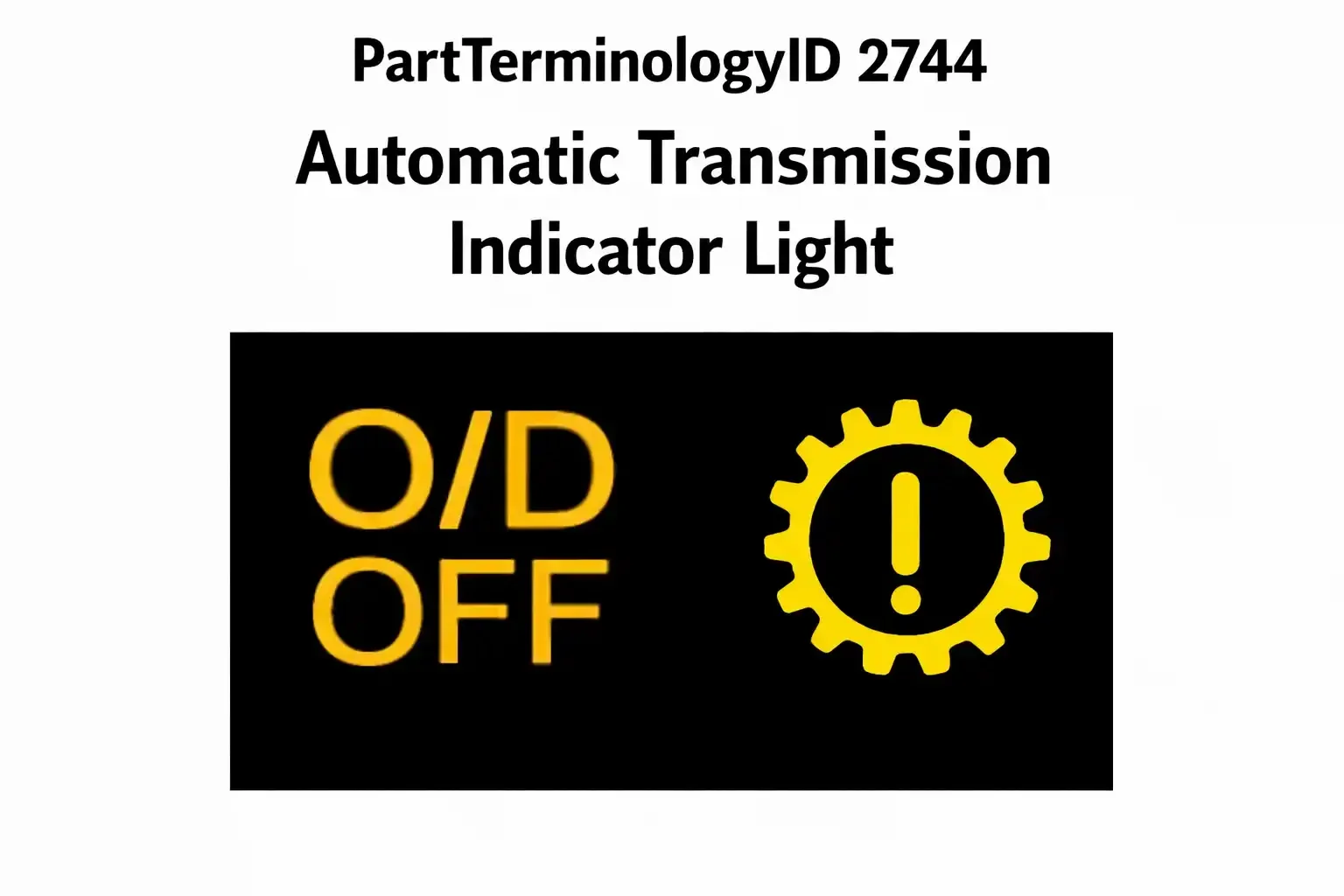
PartTerminologyID 2744, Automatic Transmission Indicator Light, is the bulb or LED assembly that illuminates the gear position display showing the current transmission selector position, typically the P, R, N, D, and lower gear position legend in the instrument cluster or on the center console shifter bezel, so the driver can read the selected gear range in low-light and nighttime operating conditions. That definition covers the illumination function correctly and leaves unresolved every question that determines whether the replacement bulb fits the socket in the specific instrument cluster or shifter bezel assembly, whether the lens color matches the original display's color scheme, whether the bulb base type is the correct format for the socket retaining mechanism, whether the wattage matches the original to maintain consistent brightness with adjacent cluster illumination, whether the part covers a replaceable discrete bulb or a circuit board component that requires cluster disassembly and soldering rather than a simple bulb pull-and-replace procedure, whether the indicator position is in the instrument cluster or on the center console shifter bezel, and whether the vehicle's cluster uses a printed circuit board with soldered LEDs or a socket-mount bulb that can be replaced without cluster disassembly.
It does not specify the bulb base type, the lens color, the wattage, the cluster or shifter position, whether the bulb is a socket-mount discrete component or a circuit board soldered element, the instrument cluster part number the bulb is designed for, the voltage rating, or the replacement method required. A listing under PartTerminologyID 2744 that specifies only a vehicle application without bulb base type, lens color, and cluster position cannot be evaluated by a buyer who has partially disassembled the instrument cluster and is looking at a burned-out T5 wedge bulb in an amber lens socket, unable to confirm from the listing whether the replacement matches both the base type and the lens color.
For sellers, PartTerminologyID 2744 carries a complexity beyond the ash tray light that it does not immediately appear to have: the lens color. The transmission indicator display on many vehicles uses a specific lens color, typically amber, green, or white, that matches the overall color scheme of the instrument cluster illumination. A replacement bulb with the correct base type and wattage but the wrong lens color will illuminate the gear position display in the wrong color, either washing out the gear position legend against the lens color or producing a visible color mismatch with the surrounding cluster lights that the driver notices immediately. The lens color must be stated explicitly, and the listing must distinguish between a clear bulb used behind a colored lens window and a pre-colored lens bulb that contains the color in the bulb lens itself.
What the Automatic Transmission Indicator Light Does
Backlighting the gear position legend in low-light conditions
The automatic transmission indicator light backlights the gear position legend panel that identifies the P, R, N, D, and lower gear selector positions so the driver can determine the current gear range without reading the legend in ambient light. On column-shift vehicles, the indicator is typically a backlit window in the instrument cluster's lower section, illuminated by a bulb behind a printed or screened legend panel. On floor-shift vehicles, the indicator is typically a backlit lens assembly on the center console shifter bezel, illuminated by a bulb positioned behind the gear position window in the bezel housing.
The illumination circuit for the transmission indicator is typically part of the instrument cluster illumination circuit, activated by switching on the headlamps or the ignition. On some vehicles the indicator is on an ignition-switched circuit and illuminates whenever the ignition is on regardless of headlamp state. The circuit connection determines whether the indicator is always lit when the engine is running, as on ignition-switched circuits, or only lit when the headlamps are on, as on headlamp-switched circuits. A replacement bulb's wattage determines the brightness relative to the surrounding cluster illumination on the shared circuit, and both must match the original to maintain consistent cluster illumination balance.
The cluster position and replacement method distinction
The transmission indicator light replacement method varies significantly across vehicle designs and model years, and it determines whether PartTerminologyID 2744 covers a simple bulb replacement or a cluster board repair. On vehicles with traditional instrument clusters using discrete socket-mount bulbs, the indicator bulb is a wedge or bayonet base lamp in a plastic socket that is twist-locked into the rear of the cluster housing. The cluster must be removed from the dash, or in some designs the bulb can be accessed from under the dash without cluster removal, but the bulb itself pulls from the socket without tools once the socket is accessed.
On vehicles with printed circuit board clusters, the indicator light is a surface-mount or through-hole LED soldered directly to the circuit board. Replacing this component requires removing the cluster, disassembling the cluster housing to access the circuit board, and desoldering and resoldering the LED at the correct board position. The listing must state clearly whether the part is a socket-mount bulb requiring only socket access, or a circuit board component requiring cluster disassembly and soldering. A buyer who orders expecting a plug-in bulb and receives a surface-mount LED that requires soldering will return the part because the repair scope is beyond their tools and skills.
Lens color and the cluster color scheme match
The lens color of the transmission indicator light is the color of light produced at the gear position display window. On vehicles where the cluster uses a warm amber illumination scheme, the indicator light uses an amber lens to match. On vehicles with a green or white cluster scheme, the indicator uses the corresponding color. Installing a clear or white bulb in an application that uses an amber lens produces a gear position display that appears white against the amber-tinted legend window, washing out the gear designation text and producing a visible color inconsistency with the surrounding amber cluster illumination.
The distinction between a colored-lens bulb and a clear bulb used behind a separately colored window in the cluster panel is a required catalog attribute. If the cluster housing has a colored filter window built into the legend panel, a clear bulb behind it will produce the correct color at the display face. If the cluster uses a clear window with a colored-lens bulb, removing the bulb's colored lens and replacing it with a clear bulb will produce a differently colored or uncolored display. The listing must state whether the color is in the bulb lens or in the cluster housing window, as the two are not interchangeable across cluster designs even when the base type and wattage match.
Why This Part Generates Returns
Buyers return transmission indicator lights because the lens color is amber and the replacement is clear, producing a white gear position display against the original amber cluster scheme, the base type is a T5 wedge and the replacement is a bayonet base that cannot be inserted into the wedge socket, the part is specified as a socket-mount bulb and the vehicle's cluster uses a soldered PCB LED requiring a circuit board component not a plug-in bulb, the wattage is 3 watts and the original was 1.4 watts producing a noticeably brighter indicator window than all adjacent cluster illumination, the indicator position is the instrument cluster and the buyer needed the center console shifter bezel indicator which has a different socket depth and lens window on this vehicle, the LED replacement is polarity-sensitive and the buyer installed it with reversed polarity producing no illumination then returning as defective, the replacement is designed for the column-shift cluster application and the vehicle is a floor-shift whose indicator is in the console bezel assembly which has a different mounting, and the listing cross-references the bulb to the correct vehicle but the vehicle was produced with two different cluster suppliers in the same model year and the socket configuration differs between the two supplier variants.
Status in New Databases
PIES/PCdb: PartTerminologyID 2744, Automatic Transmission Indicator Light
PIES 8.0 / PCdb 2.0: No change in PartTerminologyID or terminology label.
Top Return Scenarios
Scenario 1: "Clear bulb for amber application, gear display appears white against amber cluster"
The vehicle's instrument cluster uses an amber illumination scheme throughout. The original transmission indicator bulb is an amber-lens T5 wedge. The listing covers the vehicle application with the correct base type but states only the base type and wattage without the lens color. The delivered bulb is a clear-lens T5 wedge. The gear position display illuminates white against the amber filter window in the cluster panel. The white display is visually inconsistent with every other amber cluster indicator. The buyer returns the bulb requesting the amber-lens variant.
Prevention language: "Lens color: [amber / green / white / clear]. This bulb has a [color] lens. Verify the lens color matches the original bulb's lens color and the vehicle's instrument cluster color scheme. A clear-lens bulb installed behind an amber filter window will produce correct amber color at the display face. A clear-lens bulb in a clear-window application requires an amber-lens bulb to produce the original amber display color."
Scenario 2: "Socket-mount bulb listed for PCB LED application, buyer cannot install without soldering"
The vehicle has a printed circuit board instrument cluster where the transmission indicator is a surface-mount LED soldered to the board. The listing covers the vehicle application without specifying the replacement method and describes the part as a "replacement bulb." The buyer expects to pull a socket-mount bulb and insert the replacement. The delivered part is a discrete T5 wedge socket-mount bulb. The vehicle's cluster has no socket at the indicator position, only a solder pad on the PCB. The part cannot be installed without converting the PCB to a socket-mount design, which the buyer is not equipped to do.
Prevention language: "Replacement method: [socket-mount, no soldering required / PCB surface-mount LED, soldering required / PCB through-hole LED, soldering required]. This part requires [replacement method]. Verify the instrument cluster uses [socket-mount / PCB] construction before ordering. Printed circuit board clusters require desoldering the original LED and soldering the replacement to the circuit board. Socket-mount clusters accept a plug-in bulb without soldering."
Scenario 3: "Column-shift cluster part listed, vehicle is floor-shift with console bezel indicator"
The listing covers the vehicle year, make, and model without distinguishing between the column-shift and floor-shift indicator positions. The column-shift indicator is in the instrument cluster. The floor-shift indicator is in the center console shifter bezel. The buyer's vehicle is floor-shift. The delivered part fits the cluster indicator socket. The console shifter bezel indicator uses a different socket depth and a different lens housing geometry. The column-shift cluster part does not fit the floor-shift console application.
Prevention language: "Indicator position: [instrument cluster column-shift / center console floor-shift shifter bezel]. This part is designed for the [position] indicator. Vehicles available in both column-shift and floor-shift configurations use different indicator assemblies at different locations. Verify the transmission configuration and indicator mounting position before ordering."
Scenario 4: "Two cluster suppliers in same model year, socket configuration differs, bulb does not fit second supplier variant"
The vehicle was produced with two instrument cluster suppliers during the same model year, one from Supplier A and one from Supplier B. The indicator socket in the Supplier A cluster accepts a T5 wedge. The Supplier B cluster accepts a T4.2 miniature wedge. The listing covers the model year range without noting the cluster supplier distinction. Half the buyers in the model year receive a part that does not fit their cluster socket.
Prevention language: "Instrument cluster supplier: [Supplier A / Supplier B / applies to all]. This part fits [cluster designation]. For model years where multiple cluster suppliers were used, verify the cluster part number or supplier designation before ordering. Cluster supplier variants for the same model year may use different socket types at the transmission indicator position."
Listing Requirements
PartTerminologyID: 2744
component: Automatic Transmission Indicator Light
bulb base type: T5 wedge, T4.2 miniature wedge, bayonet, or PCB mount (mandatory, in title)
lens color: amber, green, white, or clear (mandatory, in title)
wattage in watts (mandatory)
voltage rating: 12V DC (mandatory)
bulb type: incandescent or LED (mandatory)
LED polarity: polarity-sensitive or polarity-independent for LED listings (mandatory)
replacement method: socket-mount or PCB solder (mandatory)
indicator position: instrument cluster or console shifter bezel (mandatory)
transmission configuration: column-shift or floor-shift (mandatory)
instrument cluster part number or supplier designation where multiple variants exist (mandatory)
quantity per package (mandatory)
OEM bulb number cross-reference where applicable (mandatory)
Catalog Checklist for ACES/PIES Teams
PartTerminologyID = 2744
require bulb base type in title (mandatory)
require lens color in title (mandatory)
require wattage (mandatory)
require replacement method: socket-mount or PCB (mandatory)
require indicator position: cluster or console bezel (mandatory)
require transmission configuration: column or floor shift (mandatory)
require LED polarity note for LED listings (mandatory)
prevent lens color omission: a clear bulb in an amber application produces visible color mismatch across the entire cluster; lens color must be in the title
prevent replacement method omission: a socket-mount bulb listed for a PCB application cannot be installed without cluster disassembly and soldering conversion; replacement method must be stated
prevent column versus floor shift conflation: two different indicator positions with different socket configurations; transmission configuration must be required
flag multi-supplier model years: cluster supplier variants in the same model year may use different socket types; catalog teams must research and note supplier variants when they exist
differentiate from gear position sensor: the indicator light is the illumination element; the gear position sensor detects the actual selector position; a dark display does not indicate a sensor fault; confirm the bulb before diagnosing the sensor
differentiate from Ash Tray Light (PartTerminologyID 2740): similar low-wattage interior bulb but different circuit, lens color requirement, and cluster position specificity; confirm the correct PartTerminologyID before building the listing
FAQ (Buyer Language)
What does the automatic transmission indicator light do?
It backlights the P, R, N, D gear position legend in the instrument cluster or center console shifter bezel so the driver can read the selected gear range in low-light and nighttime conditions. A failed indicator light produces a dark gear position display without affecting transmission operation or gear selection function.
What is the difference between the transmission indicator light and the gear position sensor?
The indicator light is the illumination bulb that backlights the gear display. The gear position sensor detects which gear the selector is in and communicates that to the cluster and ECM. A failed indicator light produces a dark display but the transmission operates normally. A failed sensor produces incorrect gear position readings and may affect transmission operation and engine start behavior.
Why would this light fail when surrounding cluster lights work?
The transmission indicator is typically on its own sub-circuit or socket within the cluster that can fail independently. On printed circuit board clusters, it is a soldered component at one board position that can fail at its solder joint without affecting the surrounding LED elements. On socket-mount clusters, the individual socket connection can fail or the bulb filament can burn out independently from the surrounding bulbs.
Can I replace it with an LED?
On socket-mount clusters, yes: a direct-fit LED in the same base type and lens color as the original installs without modification. Verify the LED is polarity-correct before assuming a non-illuminating LED is defective. On printed circuit board clusters, LED replacement requires soldering at the board position. On full LCD display clusters, the indicator is part of the display module and is not individually replaceable.
Cross-Sell Logic
Ash Tray Light (PartTerminologyID 2740): adjacent interior illumination circuit often replaced in the same interior lighting refresh service event; buyers replacing one low-wattage cluster or console bulb frequently replace all of them simultaneously
Clock Light (PartTerminologyID 2756): another low-wattage instrument panel illumination circuit; recommend alongside transmission indicator for comprehensive cluster lighting restoration
Instrument Cluster Bulb Assortment: for comprehensive cluster lighting restoration covering all socket-mount positions simultaneously rather than sourcing each bulb individually
Gear Position Sensor: for buyers whose transmission indicator display is dark and who have confirmed the indicator bulb is functional; a dark display with a working bulb indicates a sensor or wiring fault upstream of the indicator light
Final Take for PartTerminologyID 2744
Automatic Transmission Indicator Light (PartTerminologyID 2744) is the interior lighting PartTerminologyID where lens color is the most frequently omitted attribute and produces the most visible post-installation dissatisfaction. A gear position display illuminated in the wrong color is immediately obvious to the driver every time the interior lights are on. The buyer will return the part not because the horn does not work or the engine is running rough, but because the cluster simply looks wrong, and that cosmetic visibility makes the return rate for color mismatches higher than for almost any other interior bulb PartTerminologyID.
State the base type in the title. State the lens color in the title. State the wattage. State the replacement method. State the indicator position. State the transmission configuration. State LED polarity for LED listings. Flag multi-supplier model years. For PartTerminologyID 2744, bulb base type, lens color, and replacement method are the three attributes that determine whether the buyer receives a part that fits the socket, produces the correct display color, and can be installed with the tools and skills the buyer has available.