
Written by Arthur Simitian | PartsAdvisory
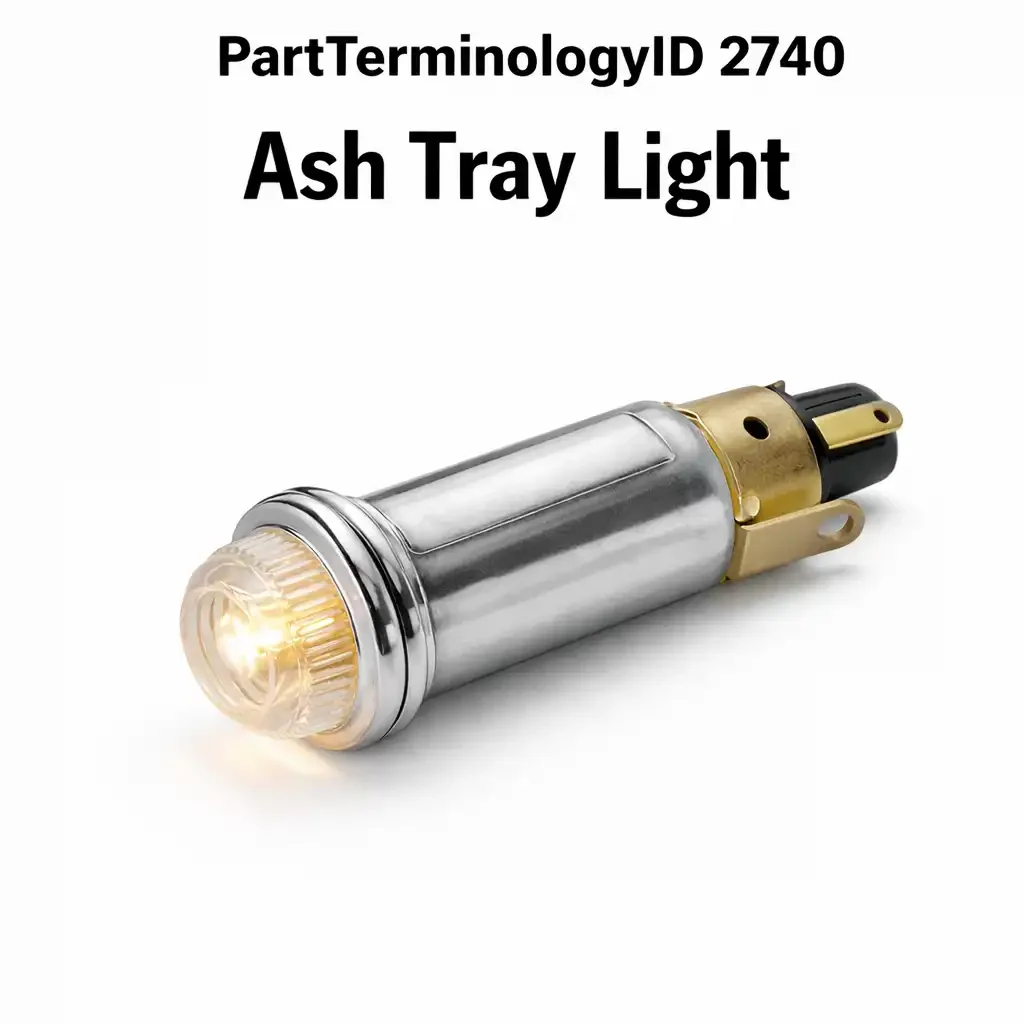
PartTerminologyID 2740, Ash Tray Light, is the small bulb and socket assembly that illuminates the interior of the vehicle's ash tray housing when the interior lighting circuit is active, allowing the occupants to locate and use the ash tray in low-light conditions. That definition covers the illumination function correctly and leaves unresolved every question that determines whether the replacement bulb fits the socket physically, whether the bulb base type matches the socket retaining mechanism, whether the bulb's wattage and color temperature are consistent with the surrounding instrument panel and console illumination so the ash tray light does not appear brighter or dimmer than adjacent panel lights, whether the voltage rating matches the vehicle's 12-volt system, whether the part covers the bulb only or the complete socket-and-bulb assembly, whether the assembly is sold for the center console ash tray position or the instrument panel ash tray position on vehicles with two ash tray locations, and whether an LED replacement is included or whether the listing covers only the original incandescent type.
It does not specify the bulb base type, the wattage, the color temperature, the voltage rating, the socket configuration, the mounting position, or whether the listing covers the bulb alone or a complete socket assembly. A listing under PartTerminologyID 2740 that specifies only a vehicle application without bulb base type and wattage cannot be evaluated by a buyer who has removed the original bulb and is holding it in hand, unable to confirm a match from the listing information alone.
For sellers, PartTerminologyID 2740 is the interior lighting PartTerminologyID with the narrowest buyer population and the most straightforward fitment requirement in the category. The ash tray light is not a safety-critical circuit, not a federally regulated output, and not a multi-system component. It is a single small bulb whose correct specification is almost entirely determined by the bulb base type and wattage. A listing that states the base type and wattage in the title resolves the buyer's fitment question immediately. A listing that omits both and relies only on year, make, and model generates a call or a return from any buyer whose vehicle was produced with an ash tray light socket that accepts more than one bulb base type across the model year range.
What the Ash Tray Light Does
Providing low-level interior illumination in the ash tray cavity
The ash tray light illuminates the interior of the ash tray drawer or the ash tray housing cavity when the vehicle's interior illumination circuit is energized, typically by switching the headlamps on or by opening a door. The bulb is a low-wattage lamp, typically 1 to 5 watts, that provides enough illumination to make the ash tray visible in a dark interior without producing enough heat to create a fire risk in the enclosed ash tray cavity where cigarette residue may be present.
The wattage is deliberately limited for heat management in the enclosed cavity. A higher-wattage replacement installed in an ash tray socket will illuminate the cavity more brightly than the original, appear inconsistent with the surrounding panel illumination, and generate more heat in the enclosed space than the ash tray housing was designed to dissipate. The wattage must match the original to maintain consistent illumination across the interior lighting system and to stay within the heat tolerance of the ash tray housing materials.
Bulb base types and the socket matching requirement
The ash tray light socket accepts one of several common low-wattage base types depending on the vehicle model and the ash tray housing design: a wedge base, which seats by friction in a tapered socket slot; a festoon base, which is a tube-form lamp that seats in spring clips at each end; or a bayonet base, which locks with a quarter-turn into a socket with retaining pins. Each base type seats in a socket designed exclusively for that type. A wedge base bulb cannot be installed in a festoon spring-clip socket, and a festoon bulb cannot be installed in a bayonet socket regardless of the voltage and wattage match.
The most common source of ash tray light return is a buyer who orders by wattage alone without specifying the base type, receives a bulb of the correct wattage in the wrong base type, and cannot install it in the socket. The base type must appear in the listing title, not only in a specifications table that requires the buyer to read below the fold.
Why This Part Generates Returns
Buyers return ash tray lights because the base type is a festoon and the socket accepts only wedge base bulbs, the wattage is 5 watts and the original was 2 watts producing a noticeably brighter ash tray than the surrounding instrument panel illumination, the bulb is incandescent and the buyer specifically needed an LED replacement for a vehicle where the original LED has failed and the buyer wants to match the LED color temperature of the surrounding panel lights, the voltage rating is 6 volts and the vehicle is a 12-volt system, the listing covers the center console ash tray position and the buyer needs the instrument panel ash tray position which has a different socket depth on this vehicle, the package contains one bulb and the vehicle has two ash tray sockets at the same position requiring two bulbs for a complete repair, and the LED replacement is polarity-sensitive and the buyer installed it with reversed polarity producing no illumination followed by a return.
Status in New Databases
PIES/PCdb: PartTerminologyID 2740, Ash Tray Light
PIES 8.0 / PCdb 2.0: No change in PartTerminologyID or terminology label.
Top Return Scenarios
Scenario 1: "Festoon bulb received for wedge socket, physically cannot install"
The buyer's ash tray socket accepts a wedge base T5 bulb. The listing states the wattage and voltage correctly but does not state the base type. The delivered bulb is a festoon type. The festoon tube cannot be seated in the wedge socket slot. The buyer returns the bulb without being able to complete the installation.
Prevention language: "Bulb base type: [T5 wedge / festoon / bayonet]. This listing covers a [base type] bulb. Verify the base type matches the socket in the ash tray housing before ordering. Wedge, festoon, and bayonet base types are not interchangeable regardless of wattage or voltage match."
Scenario 2: "LED polarity reversed, no illumination, buyer assumes defective part"
The buyer installs an LED replacement ash tray light. The LED is polarity-sensitive and is installed with the positive lead in the socket's negative terminal. The LED does not illuminate. The buyer assumes the LED is defective and returns it. The LED is fully functional but was installed with reversed polarity. The listing did not include a polarity note.
Prevention language: "LED polarity: [polarity-sensitive / polarity-independent]. This LED replacement is [polarity-sensitive]. If the LED does not illuminate after installation, reverse the bulb orientation in the socket and test again before concluding the part is defective. Polarity-sensitive LEDs will not illuminate if installed with the positive and negative leads reversed."
Scenario 3: "5-watt bulb in 2-watt application, ash tray noticeably brighter than panel illumination"
The buyer orders by vehicle application without specifying wattage. The delivered bulb is a 5-watt replacement that fits the socket physically but is 2.5 times the wattage of the original 2-watt bulb. The ash tray is noticeably brighter than every other instrument panel and console light. The buyer returns the bulb and requests the correct 2-watt original wattage replacement.
Prevention language: "Wattage: [X] watts. Color temperature: [X] K. This bulb is [X] watts, matching the original specification for consistent illumination with adjacent instrument panel and console lighting. Do not substitute a higher-wattage bulb to increase illumination brightness. Higher wattage produces inconsistent lighting relative to surrounding panel lights and generates more heat in the enclosed ash tray cavity."
Listing Requirements
PartTerminologyID: 2740
component: Ash Tray Light
bulb base type: T5 wedge, festoon, bayonet (mandatory, in title)
wattage in watts (mandatory, in title)
voltage rating: 12V DC (mandatory)
bulb type: incandescent or LED (mandatory)
color temperature in Kelvin for LED replacements (mandatory for LED)
LED polarity: polarity-sensitive or polarity-independent (mandatory for LED)
mounting position: center console ash tray or instrument panel ash tray (mandatory)
socket included: yes or no (mandatory)
quantity per package (mandatory)
OEM bulb number cross-reference where applicable (mandatory)
Catalog Checklist for ACES/PIES Teams
PartTerminologyID = 2740
require bulb base type in title (mandatory)
require wattage in title (mandatory)
require voltage rating (mandatory)
require bulb type: incandescent or LED (mandatory)
require LED polarity note for LED listings (mandatory)
require mounting position for vehicles with two ash tray locations (mandatory)
require quantity per package (mandatory)
prevent base-type omission: base type omission is the primary cause of ash tray light returns; it must appear in the title
prevent wattage omission: wattage determines heat output in the enclosed cavity and consistency with surrounding panel illumination; must be stated
prevent LED polarity omission: a polarity-sensitive LED installed incorrectly produces a no-light symptom that is indistinguishable from a defective part without a polarity note; must be stated for all LED listings
differentiate from Automatic Transmission Indicator Light (PartTerminologyID 2744) and Back Up Light (PartTerminologyID 2748): all three are interior or close-proximity lighting circuits but serve different functions and typically use different bulb types; confirm the correct PartTerminologyID before building the listing
FAQ (Buyer Language)
What is an ash tray light?
The ash tray light is a small low-wattage bulb that illuminates the ash tray cavity when the vehicle's interior lighting is active, allowing occupants to locate and use the ash tray in low-light conditions. It is typically a 1 to 5 watt wedge or festoon base lamp in a socket mounted in the ash tray housing or center console cavity.
Can I replace an ash tray light with an LED?
Yes, on most vehicles a direct-fit LED in the same base type as the original fits without modification, draws less current, produces less heat, and lasts significantly longer. Verify the LED is rated for 12-volt DC operation and note whether the LED is polarity-sensitive. A polarity-sensitive LED that does not illuminate after installation should be reversed in the socket before being returned as defective.
Why would an ash tray light need replacement?
Incandescent ash tray bulbs burn out from normal filament end of life after 500 to 2,000 operating hours. Vehicles where the ash tray light runs on the always-on interior lighting circuit accumulate hours faster. LED replacements do not burn out from filament failure but may fail from reverse polarity installation or from voltage transients in the interior lighting circuit.
Cross-Sell Logic
Automatic Transmission Indicator Light (PartTerminologyID 2744): an adjacent interior illumination circuit that uses a similar low-wattage bulb type; buyers replacing the ash tray light for a comprehensive interior lighting refresh will often replace the transmission indicator light in the same service event
Clock Light (PartTerminologyID 2756): another low-wattage interior panel illumination circuit often replaced alongside ash tray and console lighting in a complete interior bulb refresh
Interior Bulb Assortment Kit: for buyers performing a comprehensive interior lighting refresh across all console and panel positions simultaneously; covers the ash tray, transmission indicator, clock, and other low-wattage panel lights in a single purchase
Final Take for PartTerminologyID 2740
Ash Tray Light (PartTerminologyID 2740) is the simplest PartTerminologyID in the interior lighting series from a fitment complexity standpoint. The only attributes that determine a correct fitment are the bulb base type and the wattage. A listing that states both in the title resolves the buyer's fitment question before they read a single word of the listing description. A listing that omits both and relies on year, make, and model generates a base-type mismatch return from the first buyer whose vehicle was produced with a different socket type in the same model year range.
State the base type in the title. State the wattage in the title. State the voltage rating. State incandescent or LED. State LED polarity for LED listings. State the mounting position for vehicles with two ash tray locations. State the quantity per package. For PartTerminologyID 2740, bulb base type and wattage are the two attributes that determine whether the replacement illuminates the ash tray correctly and fits the socket without modification.