
Written by Arthur Simitian | PartsAdvisory
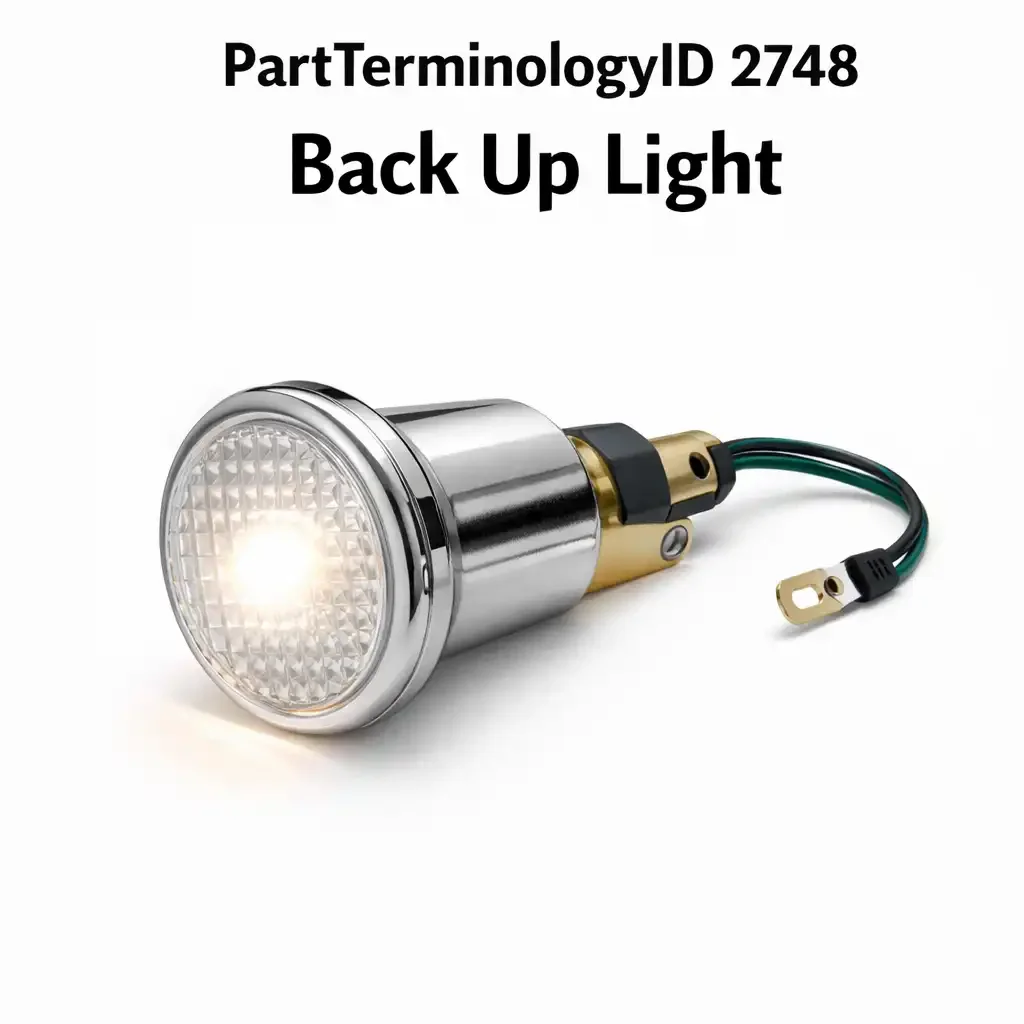
PartTerminologyID 2748, Back Up Light, is the lighting assembly or bulb that illuminates the area directly behind the vehicle when the transmission is shifted into reverse, providing the driver with rearward visibility during reversing maneuvers and signaling to pedestrians and other road users in the vehicle's path that the vehicle is moving or about to move backward. That definition covers the function correctly and leaves unresolved every question that determines whether the replacement part is a bulb only or a complete housing assembly, whether the housing configuration matches the vehicle's tail lamp assembly integration geometry, whether the lens is clear as required by FMVSS 108 for white reverse lamp output, whether the part covers the driver-side or passenger-side position on vehicles where the two positions use different assemblies, whether the assembly includes the reverse light circuit connector or requires the vehicle's harness connector to mate with a bare wire pigtail or a terminal block, whether the mounting tab configuration and spacing match the original housing's mounting points in the tail lamp cavity, whether the bulb base type in a bulb-only listing matches the socket in the vehicle's existing back up light housing, whether the photometric output of the assembly meets the minimum candela values specified in FMVSS 108 Table I for reverse lamps, and whether the assembly bears the required DOT and SAE reverse lamp certification markings.
It does not specify whether the part is a bulb or complete assembly, the housing mounting tab configuration, the lens clarity designation, the connector type or harness interface, the driver-side versus passenger-side designation for asymmetric assemblies, the photometric output certification, the DOT marking status, the bulb base type for bulb-only listings, the bulb wattage, the body color or chrome trim finish for integrated tail lamp assemblies, the housing material and UV resistance rating, or the quantity of assemblies per package. A listing under PartTerminologyID 2748 that specifies only year, make, and model without part type designation and side-specific fitment cannot be evaluated by a technician replacing a cracked back up light lens on the driver side of a vehicle where the driver-side and passenger-side assemblies are mirror-image asymmetric designs that cannot be swapped.
For sellers, PartTerminologyID 2748 sits at the intersection of two distinct buyer populations whose requirements are almost entirely different. The first population is replacing a failed bulb in an otherwise intact back up light housing and needs only the correct bulb base type and wattage. The second population is replacing a cracked or shattered housing assembly after a rear impact and needs the complete housing with the correct mounting configuration, connector interface, and DOT certification. A catalog that covers both populations under a single listing without clearly stating whether the part is a bulb or an assembly will generate returns from both populations: the bulb buyer receives an assembly they did not need and cannot install in the available space without removing the entire tail lamp, and the assembly buyer receives a bulb when they need a housing.
The additional complexity specific to PartTerminologyID 2748 among the exterior lighting PartTerminologyIDs is the FMVSS 108 federal compliance dimension. Unlike the ash tray light and transmission indicator light, which are interior illumination circuits with no federal minimum output requirement, the back up light is a federally regulated safety lamp whose minimum photometric output is specified in FMVSS 108 Table I. A replacement back up light assembly that produces less than the minimum candela values specified in the standard is non-compliant and exposes the seller to liability for any accident that occurs during a reversing maneuver where the sub-standard illumination contributed to a pedestrian or vehicle not seeing the reversing vehicle in time to avoid a collision. Every complete assembly listing under PartTerminologyID 2748 must state FMVSS 108 compliance and DOT certification status.
What the Back Up Light Does
Providing rearward illumination and reverse warning under FMVSS 108
The back up light activates automatically when the driver selects reverse gear, completing a circuit through the reverse lamp switch or the transmission range sensor that supplies power to the back up light bulb or LED assembly. The light performs two simultaneous functions: it illuminates the path behind the vehicle to give the driver visibility during the reversing maneuver, and it signals to anyone in the vehicle's rearward path that the vehicle is moving backward so they can clear the path.
FMVSS 108 specifies the photometric requirements for reverse lamps including the minimum luminous intensity at specified test angles from the lamp axis, the requirement for white light output, the requirement for the lamp to activate only in reverse gear, and the mounting height range within which the lamp must be positioned on the vehicle. A replacement assembly must meet all of these requirements to be compliant. The most frequently violated requirement in the aftermarket is the luminous intensity minimum: many low-cost replacement assemblies use a smaller reflector than the original or a lower-wattage bulb that produces adequate illumination for casual use but falls below the FMVSS 108 candela minimums at the required test angles.
The bulb versus assembly distinction and listing scope clarity
The back up light part population under PartTerminologyID 2748 includes three distinct product types that serve entirely different buyer needs and require entirely different installation procedures. The first is a replacement bulb, which is a drop-in bulb requiring only access to the socket behind the existing housing. The second is a complete replacement assembly, which includes the housing, lens, reflector, and socket and requires removing the original damaged housing from the vehicle's tail lamp cavity and installing the replacement in its place. The third is a combination lens and housing assembly without a bulb, which requires the buyer to transfer the original socket and bulb from the damaged housing to the replacement lens body.
Each of these three product types represents a different repair scenario, a different price point, and a different installation complexity. The listing must state the product type in the title and the first line of the description. A listing title that reads only "Back Up Light" without stating "bulb," "assembly," or "lens assembly" forces the buyer to read into the listing details to determine the product type, and any buyer who orders without reading those details will receive either more or less than they expected based on their individual interpretation of "back up light" as a category name.
Driver-side versus passenger-side and asymmetric housing geometry
On vehicles where the back up light is integrated into the tail lamp assembly rather than being a standalone lamp, the tail lamp assembly is typically a mirror-image asymmetric design: the driver-side assembly curves and mounts differently from the passenger-side assembly to conform to the vehicle's body contours at each corner. The back up light position within the tail lamp assembly differs between the driver-side and passenger-side housings because the lens segments are arranged differently on each side to produce the federally required illumination pattern relative to the vehicle centerline from both sides simultaneously.
A listing that covers a back up light assembly for a specific model year without specifying driver-side, passenger-side, or both will generate returns from buyers who assume the part covers both sides, buyers who order the correct side but receive the opposite side due to fulfillment errors on an ambiguous listing, and buyers who order both sides separately only to find the listing covers an assembly that fits both sides because the vehicle uses a symmetric back up light housing design. The side designation must be stated in the listing title for any asymmetric application, and must note when the design is symmetric and the same assembly covers both sides.
LED conversion, load sensing circuits, and false bulb-out warnings
Many late-model vehicles monitor the current draw of the back up light circuit to detect a burned-out bulb and alert the driver through a message center or warning lamp. The detection circuit compares the measured current draw against a threshold calibrated for the original incandescent bulb's wattage. An LED replacement bulb draws significantly less current than the incandescent it replaces, which the detection circuit interprets as a partial or complete bulb failure.
On vehicles with back up camera systems, the reverse light circuit often serves a dual function: it illuminates the back up area and it signals the back up camera module to activate when the camera module monitors the reverse light circuit voltage rather than a separate reverse gear signal from the BCM. An LED replacement that produces a lower forward voltage than the original incandescent may change the voltage threshold the camera module sees on the reverse light circuit, potentially causing a delay in camera activation or an intermittent camera display that appears at a different point in the reverse gear engagement sequence than the original incandescent produced. The listing must note whether the LED replacement is compatible with load-sensing reverse light circuits and camera activation circuits for vehicles where this is a known issue.
Why This Part Generates Returns
Buyers return back up lights because the part is a complete assembly and the buyer needed only a bulb for an intact housing, the part is a bulb only and the buyer needed a complete assembly to replace a shattered housing, the driver-side assembly is delivered and the buyer needed the passenger-side for the cracked assembly on the opposite corner, the lens has a smoked tint and the vehicle inspection station rejects the vehicle for a non-white reverse light output, the mounting tab configuration has three tabs and the original housing used two tabs in different positions so the replacement cannot be secured in the tail lamp cavity, the connector is a bare pigtail and the vehicle's harness uses a weather-pack connector requiring a pigtail adapter, the assembly does not bear DOT markings and the buyer's jurisdiction requires certified replacement lamps, the LED replacement triggers a bulb-out warning on the vehicle's message center from the lower current draw, the LED replacement delays back up camera activation because the forward voltage threshold differs from the original incandescent, and the assembly covers the same year and model but a different body style whose tail lamp cavity has a different depth that does not accommodate the replacement housing's depth dimension.
Status in New Databases
PIES/PCdb: PartTerminologyID 2748, Back Up Light
PIES 8.0 / PCdb 2.0: No change in PartTerminologyID or terminology label.
Top Return Scenarios
Scenario 1: "Assembly received, buyer needed only a bulb, housing cannot be installed in available space"
The buyer's back up light bulb has burned out in an intact housing. The listing title reads "Back Up Light" without specifying bulb or assembly. The buyer orders assuming a bulb replacement is standard for this PartTerminologyID. The delivered part is a complete lens and housing assembly. The buyer does not need a housing, does not have the time to remove the tail lamp assembly for a housing swap, and cannot use the delivered assembly as a drop-in repair for a burned-out bulb. The part is returned unused.
Prevention language: "Part type: [replacement bulb only / complete housing assembly / lens assembly without bulb]. This listing covers [part type]. For a burned-out bulb in an intact housing, order the replacement bulb only. For a cracked or damaged housing requiring complete assembly replacement, order the housing assembly. Verify the part type matches the repair needed before ordering."
Scenario 2: "Smoked lens assembly, reverse light output fails inspection for non-white light"
The buyer purchases a smoked tail lamp assembly that includes the back up light position. The smoked lens tints the back up light output from white to gray. At the annual vehicle safety inspection, the inspection station fails the vehicle for a non-compliant reverse lamp color. FMVSS 108 requires white reverse lamp output. The smoked lens produces tinted output that does not meet the white light requirement. The buyer must remove the smoked assembly and reinstall the original or a compliant clear-lens assembly to pass inspection.
Prevention language: "Lens clarity at back up light position: [clear / smoked / tinted]. FMVSS 108 requires white light output from the reverse lamp. A smoked or tinted lens over the back up light position does not produce compliant white output and may cause the vehicle to fail a safety inspection. For street-legal use, the back up light lens position must be clear. Smoked assemblies are intended for off-road or show use only where state and local regulations permit."
Scenario 3: "Driver-side delivered, buyer needed passenger-side, mirror-image geometry does not fit opposite corner"
The listing title states "Back Up Light Assembly" without specifying driver or passenger side. The buyer's passenger-side tail lamp assembly is cracked. The delivered assembly is the driver-side unit. The mirror-image geometry of the driver-side housing does not conform to the passenger-side tail lamp cavity. The mounting tabs are positioned for the driver-side corner contour. The housing cannot be installed on the passenger side without creating gaps at the body panel interface. The buyer returns the driver-side assembly and orders the passenger-side unit explicitly.
Prevention language: "Side: [driver side / passenger side / fits both sides]. This assembly is the [side] unit. Verify the side matches the damaged assembly before ordering. Driver-side and passenger-side tail lamp assemblies are mirror-image designs on most vehicles and are not interchangeable. If both sides require replacement, two assemblies must be ordered, one for each side."
Scenario 4: "LED triggers bulb-out warning on message center, buyer assumes LED is defective"
The buyer installs an LED back up light bulb to replace the burned-out incandescent. The LED illuminates correctly but the vehicle's message center displays a bulb-out warning for the reverse lamp circuit. The load-sensing circuit detects the LED's lower current draw as a failed bulb. The buyer assumes the LED is defective and returns it. The LED is fully functional. The issue is circuit incompatibility with the load-sensing system, not a defective LED.
Prevention language: "Load-sensing circuit compatibility: [compatible / may require load resistor on vehicles with bulb-out detection]. This LED replacement [is / may not be] compatible with vehicles that monitor reverse lamp circuit current to detect burned-out bulbs. On vehicles with load-sensing reverse light circuits, a load resistor wired in parallel with the LED may be required to restore the correct circuit current and eliminate the false bulb-out warning. Verify circuit compatibility before installation."
Scenario 5: "Mounting tab configuration differs, three-tab replacement in two-tab original cavity"
The original back up light housing uses two mounting tabs that engage slots in the tail lamp cavity. The replacement housing has three mounting tabs positioned differently. Two of the three tabs align with the original slots. The third tab has no corresponding slot and prevents the replacement from seating flush in the cavity. The housing rocks on the misaligned third tab and cannot be secured. The tail lamp cavity design does not accommodate a third tab without drilling an additional mounting slot.
Prevention language: "Mounting tab configuration: [tab count / tab positions relative to housing centerline]. Verify the mounting tab count and positions match the original housing before installation. A replacement housing with a different tab count or tab positions cannot be installed in the original tail lamp cavity without modification to the cavity mounting slots."
Scenario 6: "Assembly fits sedan body style, buyer has hatchback variant with deeper tail lamp cavity"
The vehicle was produced as a sedan and a hatchback on the same platform. The hatchback has a different tail lamp cavity depth because the rear body structure accommodates the hatchback opening with a different panel geometry. The listing covers the model year and model name without distinguishing body style. The delivered assembly fits the sedan cavity depth but is 18mm shallower than the hatchback cavity requires. Installed in the hatchback cavity, the assembly sits 18mm forward of the body surface, leaving a visible gap at the lens perimeter where it should be flush with the body panel.
Prevention language: "Body style: [sedan / hatchback / coupe / wagon]. This assembly is designed for the [body style] configuration. Verify the body style matches before ordering. Vehicles sharing a platform across multiple body styles typically use different tail lamp assemblies with different mounting depths and lens contours at each body style. Do not substitute a sedan assembly for a hatchback application or vice versa."
Scenario 7: "No DOT markings, jurisdiction requires certified replacement, vehicle fails inspection"
The buyer installs a low-cost replacement back up light assembly that was not tested and certified to FMVSS 108 requirements. The assembly has no DOT or SAE markings. At the annual vehicle safety inspection in the buyer's state, the inspection technician notes the absence of DOT markings on the reverse lamp assembly and fails the vehicle. The buyer must source a DOT-certified replacement assembly before the vehicle can pass inspection. The uncertified assembly is removed and returned.
Prevention language: "DOT certified: [yes / no]. FMVSS 108 compliance: [meets FMVSS 108 photometric requirements / not certified to FMVSS 108]. This assembly [is / is not] DOT certified for use on vehicles operated on public roads in the United States. A replacement back up light assembly without DOT certification markings may not pass a state safety inspection. Verify DOT certification status before purchasing a replacement assembly for street use."
Scenario 8: "LED delays back up camera activation, buyer cannot determine if camera or light is at fault"
The vehicle has a back up camera that activates when the camera module detects reverse light circuit voltage. The original incandescent back up bulb produces a forward voltage drop of 0.3 volts when activated. The LED replacement produces a forward voltage of 2.8 volts. The camera module's voltage detection threshold was calibrated for the incandescent's lower forward voltage. The LED's higher forward voltage is above the calibrated threshold and the camera module interprets the activation signal as a circuit anomaly, delaying camera display activation by 1.8 seconds after the vehicle is already moving backward. The buyer spends two weeks diagnosing the camera module before discovering the LED replacement is the root cause.
Prevention language: "Back up camera compatibility: [compatible / verify circuit architecture on vehicles with reverse-light-triggered camera activation]. On vehicles where the back up camera activates from the reverse light circuit voltage rather than a separate gear signal, an LED replacement with a different forward voltage than the original incandescent may alter the camera activation threshold. Verify camera activation behavior after LED installation before concluding the camera module has failed."
What to Include in the Listing
Core essentials
PartTerminologyID: 2748
component: Back Up Light
part type: bulb only, complete assembly, or lens assembly without bulb (mandatory, in title)
side: driver side, passenger side, or fits both (mandatory for asymmetric assemblies, in title)
body style where multiple body styles share the same model name (mandatory)
lens clarity at reverse lamp position: clear or smoked with off-road use note for smoked (mandatory)
FMVSS 108 compliance status (mandatory for complete assemblies)
DOT certification: yes or no (mandatory for complete assemblies)
SAE marking: reverse lamp designation (mandatory for complete assemblies)
bulb base type for bulb-only and assembly listings (mandatory)
bulb wattage (mandatory)
bulb type: incandescent or LED (mandatory)
LED load-sensing circuit compatibility for LED listings (mandatory)
back up camera circuit compatibility for LED listings on camera-equipped vehicles (mandatory)
mounting tab count and configuration (mandatory for assembly listings)
connector type: OEM plug-in, pigtail, or bare wire (mandatory for assembly listings)
housing material and UV resistance for assembly listings (mandatory)
body color or chrome finish for integrated tail lamp assemblies (mandatory)
quantity per package (mandatory)
OEM part number cross-reference (mandatory)
Fitment essentials
year/make/model/submodel
body style where tail lamp geometry differs by body style
driver-side versus passenger-side for asymmetric assemblies
note for vehicles with load-sensing reverse light circuits
note for vehicles with reverse-light-activated back up cameras
note for smoked assemblies: off-road and show use only, not FMVSS 108 compliant at reverse lamp position
OEM part number cross-reference
Image essentials
assembly shown from front face with lens clarity visible
assembly shown from rear with mounting tab positions and connector type labeled
DOT and SAE markings shown on lens surface
driver-side and passenger-side shown separately with side designation labeled
bulb shown separately where bulb is included in assembly
housing depth dimension labeled for body-style-specific assemblies
Catalog Checklist for ACES/PIES Teams
PartTerminologyID = 2748
require part type: bulb, assembly, or lens assembly (mandatory, in title)
require side designation for asymmetric assemblies (mandatory, in title)
require body style where geometry differs (mandatory)
require lens clarity designation (mandatory)
require FMVSS 108 compliance and DOT certification status for complete assemblies (mandatory)
require bulb base type and wattage (mandatory)
require LED load-sensing compatibility note for LED listings (mandatory)
require back up camera compatibility note for LED listings on camera-equipped applications (mandatory)
require mounting tab configuration for assembly listings (mandatory)
require connector type for assembly listings (mandatory)
prevent part type ambiguity: a listing titled only "Back Up Light" without bulb or assembly designation generates returns from both buyer populations; part type must be in the title
prevent smoked lens compliance omission: a smoked back up light assembly does not produce FMVSS 108 compliant white output; all smoked assembly listings must include the off-road use only compliance note
prevent side omission for asymmetric assemblies: driver-side and passenger-side tail lamp assemblies are mirror images and cannot be interchanged; side designation must be in the title
prevent body style conflation: sedan and hatchback assemblies on the same platform have different tail lamp cavity depths and contours; body style must be required where it affects fitment
flag LED load-sensing circuit and camera activation compatibility as mandatory notes for all LED listings on vehicles produced after approximately 2008 where these circuit architectures are common
differentiate from Check Engine Light (PartTerminologyID 2753): the check engine light is an instrument cluster warning indicator; the back up light is an exterior federally regulated safety lamp; the two serve entirely different functions and are in entirely different circuits
differentiate from Clock Light (PartTerminologyID 2756): the clock light is a low-wattage interior panel illumination lamp with no federal output requirement; the back up light is an exterior FMVSS 108 regulated lamp; the two should never be confused in catalog data
FAQ (Buyer Language)
What does the back up light do and is it federally required?
The back up light illuminates the area behind the vehicle when the transmission is in reverse, providing rearward visibility and warning nearby pedestrians the vehicle is moving backward. FMVSS 108 requires all passenger vehicles sold in the United States to be equipped with at least one white reverse lamp meeting specified minimum photometric output. A replacement assembly must meet FMVSS 108 requirements to be legal on public roads.
What lens color is required?
FMVSS 108 requires white light output from the reverse lamp. The lens at the back up light position must be clear or white-tinted. A smoked or colored lens produces non-white output that does not meet the federal requirement and may cause the vehicle to fail a safety inspection. Smoked tail lamp assemblies covering the back up light position are not legal for street use on public roads in the United States.
Can I replace the back up light with an LED?
A direct-fit LED in the same base type as the original can be installed in most back up light sockets. The LED must produce white output meeting FMVSS 108 minimums. On vehicles with load-sensing reverse light circuits, the lower LED current draw may trigger a false bulb-out warning. A load resistor wired in parallel with the LED can restore correct circuit current. On vehicles with reverse-light-activated back up cameras, verify camera activation behavior after LED installation.
What is the difference between a back up light bulb and assembly?
The bulb is the replaceable lamp that produces the light. The assembly is the complete housing including lens, reflector, and socket. For a burned-out bulb in an intact housing, order the bulb. For a cracked or damaged housing, order the complete assembly. The listing must state which it covers. A mismatch between what the listing covers and what the buyer needs is the most common return reason for this PartTerminologyID.
Does the back up light need to be DOT certified?
Complete replacement housing assemblies must bear DOT certification markings to confirm FMVSS 108 compliance. An assembly without DOT markings has not been certified to meet the minimum output requirements and may fail a safety inspection. Individual replacement bulbs do not require separate DOT certification as long as they are installed in a compliant housing. Verify DOT markings on any replacement housing assembly before installation on a street vehicle.
Cross-Sell Logic
Back Up Camera: for vehicles where the back up camera activation is tied to the reverse light circuit; an LED replacement that alters the circuit's activation voltage may affect camera behavior; the camera module should be tested after back up light bulb replacement on reverse-light-triggered camera systems
Tail Lamp Assembly: for rear impact damage cases where the back up light housing is cracked as part of a broader tail lamp assembly failure; the complete tail lamp assembly may need replacement rather than just the back up light housing if the surrounding tail lamp lenses are also cracked
Reverse Lamp Switch: the switch that activates the back up light circuit when the transmission enters reverse; a failed switch produces a no-reverse-light symptom identical to a failed bulb; confirm switch operation before replacing the bulb on a vehicle with no reverse light illumination
Load Resistor Kit: for LED back up light conversions on vehicles with load-sensing circuits that produce false bulb-out warnings with LED replacements; the resistor restores the correct circuit current draw without requiring reinstallation of the original incandescent
Wiring Repair Connector: for assembly replacements where the vehicle's harness connector is damaged and the replacement assembly's connector cannot be plugged into the damaged harness; a repair connector restores the harness to a serviceable condition without replacing the complete harness
Frame as "the back up light illuminates what is behind the vehicle when in reverse. The reverse lamp switch activates the circuit. The back up camera displays what the light illuminates. The tail lamp assembly contains the back up light housing. The bulb produces the output the housing directs. All are in the same reverse lighting pathway from the gear selector to the illuminated image on the camera display."
Final Take for PartTerminologyID 2748
Back Up Light (PartTerminologyID 2748) is the first PartTerminologyID in this series since PartTerminologyID 2668 where federal safety compliance is a required listing attribute rather than a technical specification detail. FMVSS 108 applies to the back up light as a regulated exterior safety lamp, and a non-compliant replacement assembly is not a listing quality problem. It is a liability problem for the seller when a vehicle with a sub-standard reverse lamp is involved in a reversing accident and the investigation traces the inadequate illumination to a replacement assembly that was never tested and certified to the federal minimum. DOT certification and FMVSS 108 compliance must be stated on every complete assembly listing, and the smoked lens compliance note must accompany every tinted assembly listing without exception.
State the part type in the title. State the side designation in the title for asymmetric assemblies. State the body style. State the lens clarity. State FMVSS 108 compliance and DOT certification for complete assemblies. State the bulb base type and wattage. State LED load-sensing compatibility. State back up camera compatibility for camera-equipped vehicles. State the mounting tab configuration. State the connector type. For PartTerminologyID 2748, part type, side designation, and FMVSS 108 compliance are the three attributes that determine whether the replacement provides correct reverse illumination, fits the tail lamp cavity at the correct corner of the vehicle, and meets the federal safety standard that makes it legal for use on a vehicle operated on public roads.