
Written by Arthur Simitian | PartsAdvisory
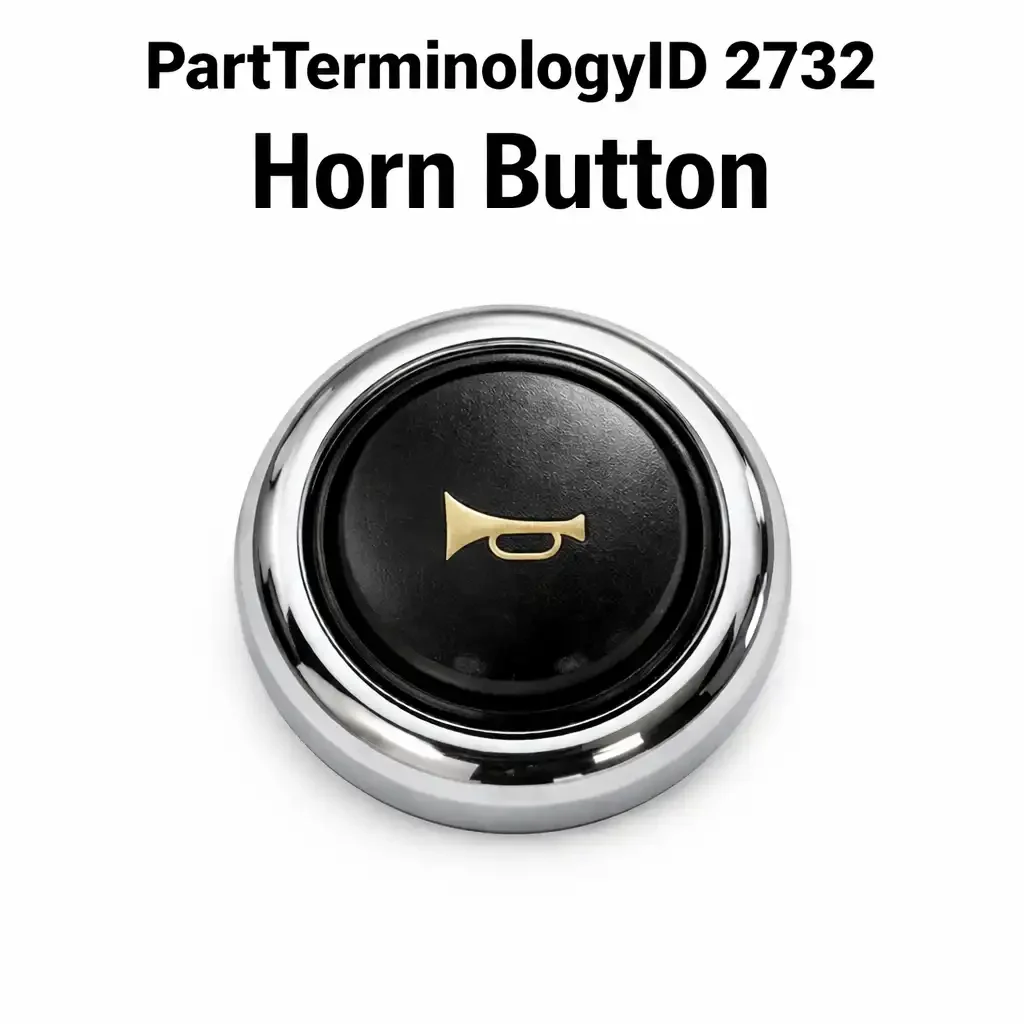
PartTerminologyID 2732, Horn Button, is the driver-operated switch assembly mounted in the center of the steering wheel that completes the horn activation circuit when pressed, typically by grounding the horn relay control circuit through a spring-loaded contact mechanism that closes when the driver applies pressure to the horn button pad, releasing when pressure is removed and the return spring opens the contact. That definition covers the switching function correctly and leaves unresolved every question that determines whether the replacement horn button mounts correctly to the specific steering wheel in the vehicle, whether the contact mechanism type matches the steering wheel's horn circuit architecture, whether the button is compatible with the airbag module installed behind or integrated with the horn button pad, whether the cover material and tear seam geometry match the original airbag deployment cover specification, whether the emblem or logo on the button face matches the vehicle's brand, whether the trim finish matches the steering wheel's interior color and material scheme, whether all mounting hardware is included or requires separate sourcing, and whether the horn button is a standalone contact pad or a complete center pad assembly that includes the airbag cover as an integrated component.
It does not specify the steering wheel application by part number or diameter, the contact mechanism type, whether the button is a standalone horn pad or an integrated airbag cover and horn assembly, the airbag module compatibility designation, the cover material and tear seam geometry for airbag deployment clearance, the emblem type and finish, the trim color and material, the mounting hardware configuration, whether mounting clips, screws, or retaining springs are included, the horn circuit ground path architecture, or the number of horn contact points the button covers. A listing under PartTerminologyID 2732 that specifies only year, make, and model without steering wheel part number compatibility and airbag integration status cannot be evaluated by a technician replacing a cracked horn button pad on a vehicle that has been fitted with an aftermarket steering wheel whose horn button interface differs from the OEM steering wheel the application table was built for.
For sellers, PartTerminologyID 2732 carries a safety dimension that no other PartTerminologyID in the steering category shares except the airbag module itself. On any vehicle equipped with a driver-side airbag, the horn button pad is physically the deployment cover for the airbag module. A replacement cover with a different material stiffness, a different tear seam depth, or a different deployment gap between the cover edge and the steering wheel hub casting will alter the airbag's inflation trajectory at the moment of deployment. The airbag is calibrated to deploy into the driver's torso through the cover at a specific force and at a specific angle relative to the steering wheel centerline. A cover that resists tearing at the designed force level will deflect the airbag and may direct the inflation energy toward the driver's face rather than the torso. Every listing under PartTerminologyID 2732 for an airbag-equipped application must include a compatibility statement confirming the replacement cover matches the original airbag module's deployment cover specification, and must include the airbag system disable procedure requirement in the installation instructions.
The additional complexity specific to PartTerminologyID 2732 is the aftermarket steering wheel compatibility problem. A significant portion of the buyer population for horn buttons is installing a replacement button on an aftermarket steering wheel that was fitted for performance or cosmetic reasons. Aftermarket steering wheels use a variety of horn button interface standards: a simple two-wire pigtail with a spring-loaded plunger contact, a single-wire ground contact through a center post, a plug-in connector that mates with the aftermarket wheel's hub adapter harness, or a proprietary interface unique to the aftermarket wheel manufacturer. An OEM horn button that fits the original steering wheel will not fit most aftermarket steering wheels, and an aftermarket horn button designed for a specific hub adapter will not fit the OEM steering wheel. The listing must state clearly whether the horn button is an OEM replacement for the original steering wheel or an aftermarket replacement designed for a specific aftermarket wheel or hub adapter interface.
What the Horn Button Does
Completing the horn activation circuit through the steering wheel center
The horn button's electrical function is to provide a momentary ground connection in the horn relay control circuit when pressed. The horn relay control circuit carries a small signal current from the fuse block through the clock spring connector to the horn button contact in the steering wheel center. When the driver presses the horn button, the spring-loaded contact in the button mechanism closes against the steering wheel's ground ring or contact plate, completing the circuit from the relay control terminal through the clock spring to the horn button contact and through the steering wheel hub and column to the chassis ground. The relay activates, energizes the horn, and the horn sounds for as long as the driver maintains pressure on the button.
The contact mechanism inside the horn button must open cleanly and completely when pressure is released to prevent the horn from activating continuously. A worn or corroded return spring, a contact surface coated with oxidation, or a contact geometry that does not return to the open position when the driver releases pressure will produce a horn that sounds without being pressed. A continuously sounding horn is both a safety distraction and, in many jurisdictions, a potential legal citation. The contact return mechanism's spring force, contact gap at rest, and surface plating are all required attributes for a horn button listing, not cosmetic details.
The airbag cover function and deployment geometry
On all modern vehicles with driver-side airbags, the horn button pad is not a separate component from the airbag deployment cover. They are the same physical component: a molded polymer cover that fits over the airbag module housing in the steering wheel center, is retained by snap clips or screws to the module housing or the steering wheel hub casting, and is designed to tear open along pre-formed seam lines when the airbag deploys. The driver presses the horn by pressing this cover, which deflects slightly and closes the horn contact behind it without breaking the retention clips that hold the cover in its sealed position over the airbag.
The tear seam geometry in the cover is a calibrated feature. The seams are molded to specific depths that require a specific force to rupture when the airbag inflates. Too shallow and the cover tears prematurely on a hard horn press or from cover flexing during normal driving over rough surfaces. Too deep and the cover resists the airbag inflation force and deflects the bag rather than tearing away cleanly. The material stiffness, tear seam depth, and cover thickness must all match the original specification for the specific airbag module installed in the vehicle. These parameters are not visible in a listing image and cannot be verified by a buyer from a photograph. The listing must state the airbag module compatibility by OEM part number cross-reference and must confirm that the replacement cover's deployment geometry has been verified against the original airbag module specification.
Mounting interface and retention hardware
The horn button mounts to the steering wheel center hub through one of three common retention methods: plastic snap clips that engage slots in the hub casting and require a trim removal tool to disengage without breaking, machine screws from the rear of the steering wheel hub that are only accessible after removing the steering wheel from the column, or spring-loaded retention posts that push into the hub center from the front and release by pressing inward while rotating. The replacement must use the same retention method as the original because the mounting interface is molded into both the horn button body and the steering wheel hub casting and cannot be changed without replacing both components.
The mounting hardware, whether snap clips, screws, or retention springs, must be included with the replacement horn button or individually specified as a required separate purchase. A horn button sold without the mounting clips for a snap-clip application requires the technician to reuse the original clips, which are often damaged during removal. A horn button sold with the wrong screw thread pitch for a rear-screw application cannot be installed without sourcing the correct screws separately. Hardware inclusion status must be stated explicitly in every listing for PartTerminologyID 2732.
Clock spring continuity and the horn circuit path through the column
The horn button contact in the steering wheel center connects to the horn relay control circuit through the clock spring, also called the spiral cable, in the steering column. The clock spring is a coiled flat conductor that allows the steering wheel to rotate while maintaining continuous electrical connection between the rotating steering wheel's horn button circuit and the stationary steering column wiring. A horn button replacement that places the contact in a different position relative to the steering wheel's clock spring contact ring will not make reliable contact with the clock spring circuit, producing a horn that activates only in certain steering wheel positions or not at all.
On vehicles where the horn button was replaced as part of a previous aftermarket steering wheel installation that used an incorrect adapter, the clock spring contact ring may have been bypassed by a direct wire connection from the horn button contact to the horn relay. A replacement horn button for this configuration must connect to the direct wire rather than relying on the clock spring contact path. The listing must identify whether the part is designed for OEM clock spring circuit contact or for a direct-wire bypass configuration, as the two are not interchangeable at installation.
Why This Part Generates Returns
Buyers return horn buttons because the mounting clip configuration differs from the original steering wheel and the replacement cannot be retained in the hub center without the clips spreading and releasing under normal driving vibration, the trim finish is leather-wrapped and the buyer's steering wheel is a smooth urethane producing a visible material mismatch at the center pad, the emblem logo is the correct brand but the wrong generation design and the buyer's vehicle uses the current generation emblem, the horn contact type is a two-post connector and the buyer's steering wheel uses a single-post spring contact requiring a different contact geometry inside the button, the part is specified for an airbag-equipped steering wheel and the buyer's vehicle has an aftermarket steering wheel without an airbag module, the cover material is too stiff and the airbag fault lamp illuminates after installation because the airbag module's cover pressure sensor detects a non-compliant cover, the hardware is not included and the original snap clips were broken during removal so the replacement cannot be secured, the diameter of the center pad is 2mm larger than the hub opening and the cover cannot seat flush with the steering wheel face, and the part covers the OEM steering wheel fitment but the buyer has an aftermarket steering wheel with a different horn button interface requiring a hub-adapter-specific part.
Status in New Databases
PIES/PCdb: PartTerminologyID 2732, Horn Button
PIES 8.0 / PCdb 2.0: No change in PartTerminologyID or terminology label.
Top Return Scenarios
Scenario 1: "Airbag cover stiffness mismatch triggers supplemental restraint system fault code"
The replacement horn button cover is a generic fit that covers the correct year, make, and model but was manufactured from a higher-durometer polymer than the original. The airbag module on this vehicle includes a cover compliance sensor that monitors the deflection force required to actuate the horn contact as a proxy for cover integrity. The stiffer replacement requires higher actuation force than the calibrated threshold. On the first horn press, the BCM logs a supplemental restraint system fault code indicating an out-of-range cover compliance reading. The airbag warning lamp illuminates and remains on. The dealer requires the original OEM cover to clear the fault.
Prevention language: "Airbag module compatibility: [OEM part number cross-reference]. This cover has been verified against the deployment geometry and cover compliance specification of airbag module [OEM part number]. Do not install a generic horn button cover on an airbag-equipped steering wheel without confirming material compliance with the specific airbag module installed. Cover stiffness outside the module's calibrated range may trigger a supplemental restraint system fault code."
Scenario 2: "Aftermarket steering wheel application, OEM button has no contact interface for aftermarket hub"
The buyer has an aftermarket steering wheel fitted with a hub adapter. The aftermarket hub adapter has a two-pin horn button connector on the front face of the adapter. The OEM horn button replacement listed for the vehicle year, make, and model uses the OEM steering wheel's spring contact ring rather than a two-pin connector. The OEM button physically fits the aftermarket wheel's center recess but does not connect to the adapter's two-pin horn circuit. The horn does not activate after installation.
Prevention language: "Application: [OEM steering wheel / aftermarket steering wheel with hub adapter]. This horn button is designed for the OEM steering wheel and uses the OEM clock spring contact circuit. For vehicles fitted with aftermarket steering wheels, verify the horn button interface matches the specific hub adapter's horn circuit connection type before ordering. OEM horn buttons are not compatible with hub adapter two-pin or direct-wire horn circuits."
Scenario 3: "Snap clips not included, original clips broken on removal, button cannot be secured"
The replacement horn button does not include mounting snap clips. The original snap clips broke during removal when the technician used a flat screwdriver rather than a trim removal tool. The replacement button is loose in the steering wheel hub center and rattles during driving. The buyer must source a separate hardware kit and wait for an additional shipping cycle before the installation can be completed. The button is returned as incomplete.
Prevention language: "Hardware included: [mounting snap clips / retention screws / retention springs / none, hardware must be sourced separately]. This listing [includes / does not include] the mounting hardware. Original snap clips are frequently broken during horn button removal. If the original clips are damaged, source the replacement hardware before beginning installation."
Scenario 4: "Horn activates continuously after installation, contact return spring insufficient"
The replacement horn button's internal return spring has a lower force rating than the original. The lighter spring does not reliably open the horn contact after pressure is released when the contact surfaces are new and have slightly higher adhesion than worn contacts. In cold weather, the lower spring force is insufficient to overcome the increased stiffness of the contact return mechanism at low temperature. The horn activates when the driver touches the steering wheel and does not stop until the driver presses and releases the horn button deliberately to break the contact adhesion. The vehicle cannot be driven safely with a continuously activating horn.
Prevention language: "Contact return spring force: [X] grams minimum. This horn button's return spring provides a minimum [X] grams of opening force at the contact rest position. Verify the return spring force is adequate for the vehicle's temperature operating range. A return spring with insufficient force at low ambient temperatures will produce continuous horn activation from contact adhesion at the closed position."
Scenario 5: "Wrong emblem generation, current-gen logo on pre-refresh vehicle, cosmetic mismatch"
The replacement horn button has the correct brand emblem but uses the current-generation logo design introduced at the mid-cycle refresh of the vehicle model. The buyer's vehicle is a pre-refresh build year. The new logo design is visually distinct from the pre-refresh logo in font weight and proportions. The emblem mismatch is visible to any observer comparing the horn button to the other brand emblems on the vehicle. The buyer returns the button for an exact-generation emblem match.
Prevention language: "Emblem: [brand / generation / build date range]. This horn button uses the [generation] emblem design applicable to [build date range]. For mid-cycle refresh model years, verify the emblem generation matches the specific vehicle build date. Emblem design changed at the [model year] refresh and early and late production vehicles in the same model year may require different emblem generations."
Scenario 6: "Part specified for airbag wheel, buyer has non-airbag steering wheel, airbag connector absent"
The application table includes the vehicle year, make, and model without noting that the vehicle was available with both airbag-equipped and non-airbag steering wheels in the same model year. The delivered horn button is the airbag-equipped variant with the full-size center pad and airbag module retention clips. The buyer's vehicle has the smaller non-airbag steering wheel center hub. The replacement cover is 22mm larger in diameter than the hub opening and cannot be installed. The buyer confirms the vehicle has a non-airbag steering wheel and requests the non-airbag horn button variant.
Prevention language: "Airbag equipped: [yes / no]. This horn button is designed for [airbag-equipped / non-airbag] steering wheels. For model years where the vehicle was available with both airbag and non-airbag steering wheel configurations, verify the steering wheel variant before ordering. Airbag and non-airbag horn button assemblies differ in center pad diameter and retention hardware and are not interchangeable."
What to Include in the Listing
Core essentials
PartTerminologyID: 2732
component: Horn Button
steering wheel application: OEM or aftermarket with specific wheel model (mandatory)
airbag equipped: yes or no (mandatory, in title for airbag applications)
airbag module compatibility: OEM airbag module part number cross-reference for airbag applications (mandatory)
contact mechanism type: spring ring, two-post connector, single-post plunger, or direct wire (mandatory)
cover material: urethane, leather, leather-wrapped, or hard plastic (mandatory)
cover diameter in mm (mandatory)
emblem type: brand name, logo design generation, and finish (mandatory)
trim color and finish (mandatory)
mounting retention type: snap clips, rear screws, or retention springs (mandatory)
hardware included: clip type and quantity, screw type, or none (mandatory)
deployment cover tear seam geometry: verified or not verified against airbag module specification (mandatory for airbag applications)
horn circuit path: clock spring contact or direct wire (mandatory)
OEM part number cross-reference (mandatory)
quantity: 1
Fitment essentials
year/make/model/submodel
steering wheel part number where multiple steering wheel variants exist in same model year
airbag versus non-airbag steering wheel designation
note for mid-cycle refresh emblem generation changes within a model year range
note for aftermarket steering wheel compatibility limitations
installation safety note: airbag system disable procedure required before removal on airbag-equipped applications
Image essentials
front face of horn button showing emblem, finish, and cover diameter
rear face showing contact mechanism type and mounting hardware positions
mounting clips or hardware shown separately with quantity labeled
tear seam lines shown on airbag cover variants with seam depth notation
contact mechanism shown in open and closed positions where product photography allows
OEM part number label shown on packaging
Catalog Checklist for ACES/PIES Teams
PartTerminologyID = 2732
require airbag equipped status (mandatory, first attribute after application)
require airbag module part number compatibility for airbag applications (mandatory)
require deployment cover tear seam geometry verification status for airbag applications (mandatory)
require contact mechanism type (mandatory)
require cover material and diameter (mandatory)
require emblem type and generation (mandatory)
require mounting retention type (mandatory)
require hardware inclusion status (mandatory)
require horn circuit path: clock spring or direct wire (mandatory)
prevent airbag application omission: a listing for an airbag-equipped vehicle must confirm airbag cover compliance; generic material covers installed on airbag wheels can produce airbag fault codes and may alter deployment trajectory; airbag compatibility must be stated and verified
prevent emblem generation omission: a model year range that crosses a mid-cycle refresh requires separate listings for pre-refresh and post-refresh emblem designs; a single listing covering both will produce cosmetic mismatch returns at either end of the model year range
prevent hardware omission: snap clips are frequently damaged on removal and cannot be reused; hardware inclusion must be stated; a listing that omits hardware status will generate incomplete installation returns whenever the original clips are broken
prevent aftermarket wheel conflation: OEM horn buttons are not compatible with aftermarket steering wheel hub adapter interfaces; the listing must state OEM steering wheel application and must include a note warning against ordering for aftermarket wheel applications
flag airbag disable requirement: every listing for an airbag-equipped application must include installation safety language requiring airbag system disable before removal; this is a required safety disclosure, not an optional installation note
differentiate from clock spring: the clock spring carries the horn signal from the rotating steering wheel to the stationary column wiring; a failed clock spring produces the same horn symptom as a failed horn button but requires a different repair; confirm clock spring continuity before concluding the horn button is the fault
differentiate from horn (the sound-producing component): the horn button is the switch; the horn is the actuator; replacing the button does not repair a failed horn that does not sound even when the relay activates
FAQ (Buyer Language)
What does the horn button do?
The horn button is the driver-activated switch in the steering wheel center that completes the horn circuit when pressed, grounding the horn relay control circuit through the clock spring and activating the relay. On airbag-equipped vehicles, the horn button pad is physically the airbag deployment cover and must be replaced with a part that maintains the airbag module's cover compliance specification and deployment geometry.
Is the horn button the same as the airbag cover?
On vehicles with driver airbags, the airbag module cover and the horn button are the same component. The cover serves as the horn activation surface and conceals the airbag module behind it. On older vehicles without airbags, the horn button is a discrete pad with no airbag function. In all airbag-equipped applications, replacing the horn button requires airbag system disabling procedures before removal.
What precautions are required when replacing a horn button on an airbag-equipped vehicle?
Disconnect the battery negative terminal and wait the manufacturer-specified time, typically one to three minutes, for the airbag system capacitor to discharge before touching any airbag circuit component. Never use a test light or powered probe on any airbag wiring. Removing the horn button or airbag cover without disabling the system risks triggering an inadvertent deployment that can cause serious injury.
Why would a horn button need to be replaced?
The four common reasons are a worn or corroded contact mechanism that no longer activates the horn on press, a stuck contact that causes the horn to sound without being pressed, a cracked or delaminated cover surface, and a steering wheel replacement that requires a horn button matching the new wheel's mounting interface and contact configuration.
Does the horn button affect airbag deployment?
The horn button itself does not affect the deployment threshold. However, the cover forms the airbag deployment path and must tear away cleanly at the calibrated force when the airbag deploys. A replacement cover with different material stiffness or tear seam geometry may resist or deflect the deployment, potentially altering the airbag's inflation trajectory. Use only a replacement verified against the original airbag module's deployment cover specification.
Cross-Sell Logic
Clock Spring: the spiral cable in the steering column that carries the horn circuit from the rotating steering wheel to the stationary harness; a failed clock spring produces the same intermittent horn symptom as a worn horn button contact; always test clock spring continuity before replacing the horn button to confirm the button is the fault
Steering Wheel: for buyers replacing the steering wheel for cosmetic or ergonomic reasons, the horn button is required to match the new steering wheel's center hub interface and contact configuration; list compatible horn buttons alongside steering wheel listings
Horn: the sound-producing actuator the horn button switch energizes; if the horn button tests correctly but the horn does not sound, the horn itself requires inspection; list the horn as a diagnostic next step whenever horn button is replaced without resolving the no-horn symptom
Horn Relay: the relay the horn button controls; a failed horn relay produces a no-horn symptom identical to a failed horn button; the relay should be tested before replacing the button when the horn has never activated intermittently and fails completely at once
Airbag Module: on airbag-equipped applications where the horn button cover is being replaced because it was damaged by an airbag deployment, the airbag module itself requires replacement after any deployment event regardless of the cover's condition
Frame as "the horn button switch activates the relay that energizes the horn. The clock spring carries the switch circuit from the rotating wheel to the stationary column. The horn relay controls the power to the horn. The horn produces the sound. All are in the same horn activation chain from the driver's press to the audible output."
Final Take for PartTerminologyID 2732
Horn Button (PartTerminologyID 2732) is the PartTerminologyID in the steering category where the safety consequence of an incorrect replacement is highest among all non-airbag PartTerminologyIDs because the part itself is the airbag deployment cover on every modern vehicle. A cover that does not match the airbag module's compliance specification may produce a supplemental restraint system fault code at best, or may alter the airbag's inflation trajectory at worst. Neither outcome is acceptable, and both are preventable by including the airbag module OEM part number cross-reference and the deployment cover compliance verification statement in every listing for an airbag-equipped application.
State the airbag equipped status in the title. State the airbag module part number compatibility. State the contact mechanism type. State the cover material and diameter. State the emblem type and generation. State the mounting retention type. State the hardware inclusion status. State the horn circuit path. State the aftermarket wheel compatibility limitation. Include the airbag disable safety note in the installation instructions. For PartTerminologyID 2732, airbag compatibility, contact mechanism type, and mounting hardware inclusion are the three attributes that determine whether the replacement horn button activates the horn correctly, fits the steering wheel center without modification, and maintains the airbag system's deployment geometry for the life of the vehicle.