
Written by Arthur Simitian | PartsAdvisory
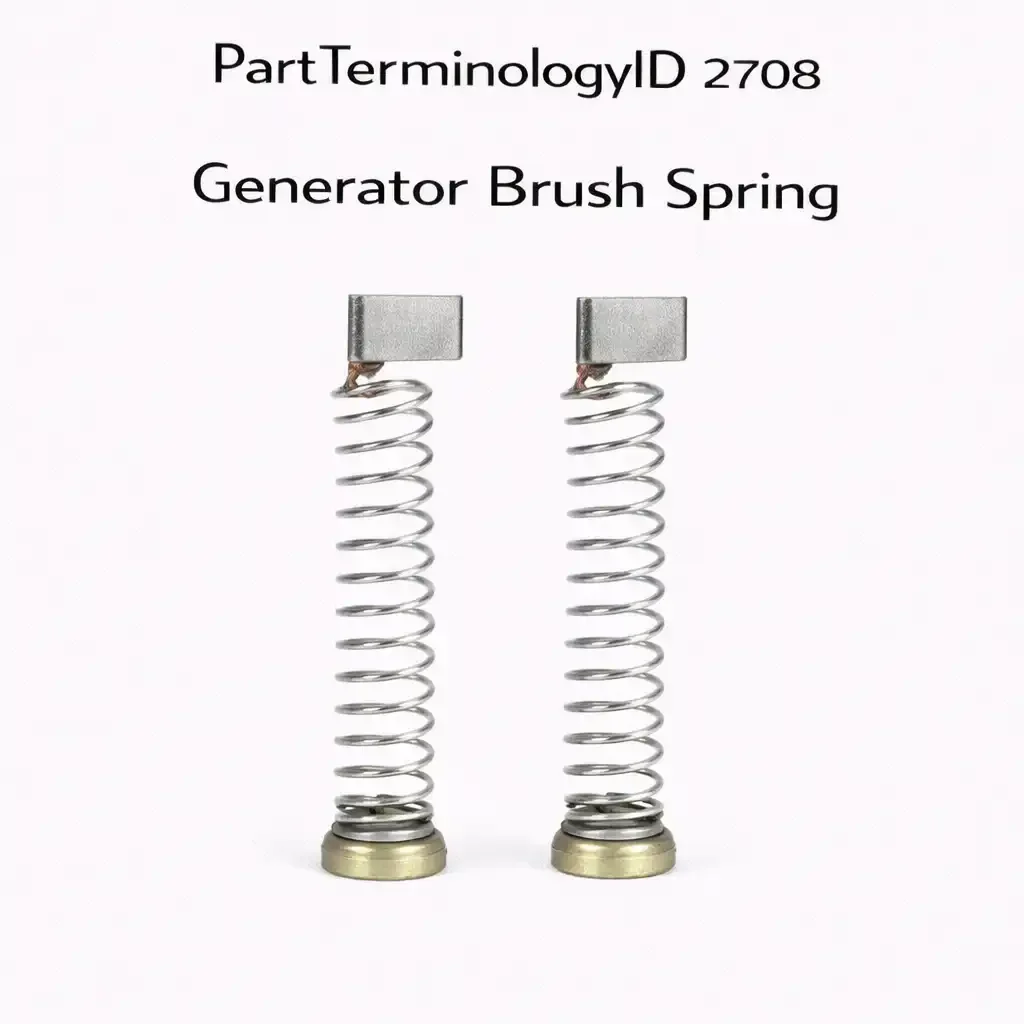
PartTerminologyID 2708, Generator Brush Spring, is the spring element in the brush holder assembly that maintains constant contact force between the carbon brush body and the rotating slip ring on the generator rotor shaft across the full range of brush wear from new installation length to the minimum replacement length, compensating for the decreasing brush length by extending proportionally to maintain the design contact pressure at the brush-to-slip-ring interface. That definition covers the function correctly and leaves unresolved the spring force at the new-brush seating position, the spring force at the minimum-brush-length seating position, the spring type whether compression coil, torsion, or leaf, the spring wire diameter, the spring free length and compressed length at both seating positions, the spring material and its resistance to thermal relaxation in the underhood operating temperature range, the spring outer diameter or width for dimensional fit in the brush holder pocket, and whether the spring is sold individually or as a matched set with the brush it is designed to load.
It does not specify the spring force at either the new-brush or worn-brush seating position, the spring type, the spring dimensions, the spring material and temperature resistance, or the generator application the spring is designed for. A listing under PartTerminologyID 2708 that specifies only a vehicle application without spring force and dimensional specifications cannot be confirmed as a correct replacement by a technician who needs to verify the spring force against the generator specification before removing the original spring from the brush holder.
For sellers, PartTerminologyID 2708 is frequently the misdiagnosed component in a charging system intermittent fault that presents identically to a brush at end of wear life. A spring that has relaxed below its minimum force specification allows the brush to lose contact with the slip ring at high generator speed and under vibration even when the brush body has substantial remaining length. The technician who replaces the brush without measuring the spring force installs a new brush into a holder with a relaxed spring, and the intermittent output fault continues. The buyer returns the brush as defective when the actual cause is an undiagnosed failed spring. A catalog that covers the brush spring as a separately identifiable serviceable component captures the repair that is otherwise misattributed to the brush.
What the Generator Brush Spring Does
Maintaining contact force from new installation to minimum brush length
The brush spring's force at any given brush position is determined by the spring's rate and the compression from the brush's installed length. As the brush wears shorter, the spring extends, reducing the compression force it applies to the brush. The spring rate must be designed so that even at the minimum brush length position the remaining spring force exceeds the minimum contact pressure required to maintain reliable slip ring contact at maximum generator speed. If the spring force at the minimum brush length position is below the minimum contact pressure, the brush will lift off the slip ring at high speed before reaching the wear indicator, producing the same intermittent-at-speed symptom as a brush at or past end of life.
A spring that has thermally relaxed from sustained underhood heat exposure produces the same symptom as a spring with an insufficient rate: the force at any given brush position is below the original specification, and the brush lifts off the slip ring at the speed and vibration level where the contact force drops below the minimum threshold. Thermal relaxation is progressive and produces a gradual decline in charging output reliability over months rather than a sudden failure, making it one of the more difficult charging system faults to diagnose without measuring spring force directly.
Why This Part Generates Returns
Buyers return generator brush springs because the spring force rating is higher than the original specification and the increased contact pressure accelerates brush wear and slip ring polishing beyond the original design life, the spring outer diameter is 0.5mm larger than the brush holder pocket and the spring binds rather than sliding freely, the spring free length is shorter than the original and the spring contacts the holder floor before the brush reaches the slip ring when a new-length brush is installed, the spring is a compression coil type and the original holder uses a torsion spring that engages the brush through a lever arm at the brush tail rather than through direct compression on the brush crown, and the generator application cross-reference is incorrect and the spring dimensions do not match the holder geometry of the generator installed in the vehicle.
Status in New Databases
PIES/PCdb: PartTerminologyID 2708, Generator Brush Spring
PIES 8.0 / PCdb 2.0: No change in PartTerminologyID or terminology label.
Top Return Scenarios
Scenario 1: "Stiffer spring than original, brush wear rate doubles within first 20,000 miles"
The original spring applies 180 grams of force at the new-brush seating position. The replacement spring applies 320 grams at the same position. The increased contact force increases the friction between the brush face and the slip ring surface proportionally, approximately doubling the brush wear rate. The new brush installed with the stiffer spring reaches minimum length in 20,000 miles rather than the expected 40,000 miles. The buyer returns the spring after the second brush replacement event and notes the accelerated wear timeline.
Prevention language: "Spring force at new-brush seating position: [X] grams. Spring force at minimum-brush seating position: [X] grams. Verify the spring force values match the generator specification. A spring with higher force than the original accelerates brush wear and slip ring polishing. A spring with lower force than the original allows brush lift-off at high generator speeds."
Scenario 2: "Compression coil spring for torsion spring application, spring does not engage brush correctly"
The original brush holder uses a torsion spring that applies force through a lever arm engaging a groove in the brush body's tail. The replacement is a compression coil spring that applies force to the brush crown directly. The compression spring does not engage the brush tail groove and cannot be positioned to load the brush correctly against the slip ring. The brush rests in the holder without spring contact and falls out when the holder is inverted during installation.
Prevention language: "Spring type: [compression coil / torsion / leaf]. This spring is a [type] design. Verify the spring type matches the original brush holder design. Compression coil, torsion, and leaf springs engage the brush through different contact geometries and are not interchangeable across holder designs."
Listing Requirements
PartTerminologyID: 2708
component: Generator Brush Spring
spring type: compression coil, torsion, or leaf (mandatory)
spring force at new-brush seating position in grams (mandatory)
spring force at minimum-brush seating position in grams (mandatory)
spring wire diameter in mm (mandatory)
spring free length in mm (mandatory)
spring outer diameter or width in mm (mandatory)
spring material and temperature rating (mandatory)
generator application cross-reference (mandatory)
quantity per package (mandatory)
OEM part number cross-reference where available (mandatory)
Catalog Checklist for ACES/PIES Teams
PartTerminologyID = 2708
require spring type (mandatory)
require spring force at both new-brush and minimum-brush seating positions (mandatory)
require spring outer diameter or width (mandatory)
require spring material and temperature rating (mandatory)
require generator application cross-reference (mandatory)
prevent spring force omission: a stiffer spring doubles brush wear rate; a relaxed spring produces brush lift-off at speed; both force values at both seating positions must be required
prevent spring type omission: compression, torsion, and leaf springs engage the brush through different geometries and are not interchangeable; type must be required
differentiate from Generator Brush (PartTerminologyID 2704): the brush is the wear element the spring loads; some brush assemblies include the spring and some do not; cross-reference must note whether the brush listing for this application includes the spring
FAQ (Buyer Language)
What does the generator brush spring do?
The brush spring maintains constant contact force between the carbon brush and the rotating slip ring across the full range of brush wear from new installation to the minimum replacement length. Without adequate spring force, the brush lifts off the slip ring under vibration and at high generator speeds, interrupting the field current and causing intermittent or absent charging output.
How do I know if the brush spring has failed rather than the brush?
If the brush body measures above the minimum replacement length but intermittent charging output persists, measure the spring force against the specification. A spring that has relaxed below minimum force allows brush lift-off at high speed even when the brush has adequate remaining length. Always measure spring force before concluding a new brush resolved the fault, or the intermittent output will continue after brush replacement.
Can I replace the spring without replacing the brush?
Yes, if the brush body has adequate remaining length. However since both components are accessed through the same brush holder removal procedure and both are inexpensive, replacing both simultaneously is recommended to avoid a repeat service event within a short interval when the brush reaches end of life.
Cross-Sell Logic
Generator Brush (PartTerminologyID 2704): always replace the brush and spring together when either is found to be at end of service life; both are accessed through the same procedure and both are consumed at related rates
Generator (PartTerminologyID 2700): the complete assembly; if spring relaxation has allowed brush lift-off for an extended period, inspect the slip ring surface for arc pitting before concluding brush and spring replacement will resolve the fault
Generator Bushing (PartTerminologyID 2712): the rotor shaft bearing accessed from the same generator rear housing; inspect when the brush holder is removed
Final Take for PartTerminologyID 2708
Generator Brush Spring (PartTerminologyID 2708) is the PartTerminologyID in the generator component series where the failure symptom is identical to a worn brush and the misdiagnosis rate is high because technicians replace the brush without measuring the spring force first. A spring that has relaxed to 60 percent of its original force produces intermittent charging output that continues after a new brush is installed because the new brush faces the same inadequate contact pressure the worn brush was experiencing. The correct diagnostic sequence is to measure spring force before replacing the brush, and the correct listing provides the spring force specification so the technician can make that measurement against a known target value.
State the spring type. State the spring force at both seating positions. State the spring dimensions. State the temperature rating. State the generator application cross-reference. For PartTerminologyID 2708, spring type and spring force at both new-brush and minimum-brush seating positions are the two attributes that determine whether the replacement spring maintains correct brush contact pressure across the full brush wear range or allows brush lift-off that produces the same intermittent output fault the brush replacement was supposed to resolve.