
Generator (PartTerminologyID 2700): Where Ampere Output Rating, Mounting Configuration, and Pulley Type Determine Whether the Charging System Keeps the Battery at Full Capacity
Written by Arthur Simitian | PartsAdvisory
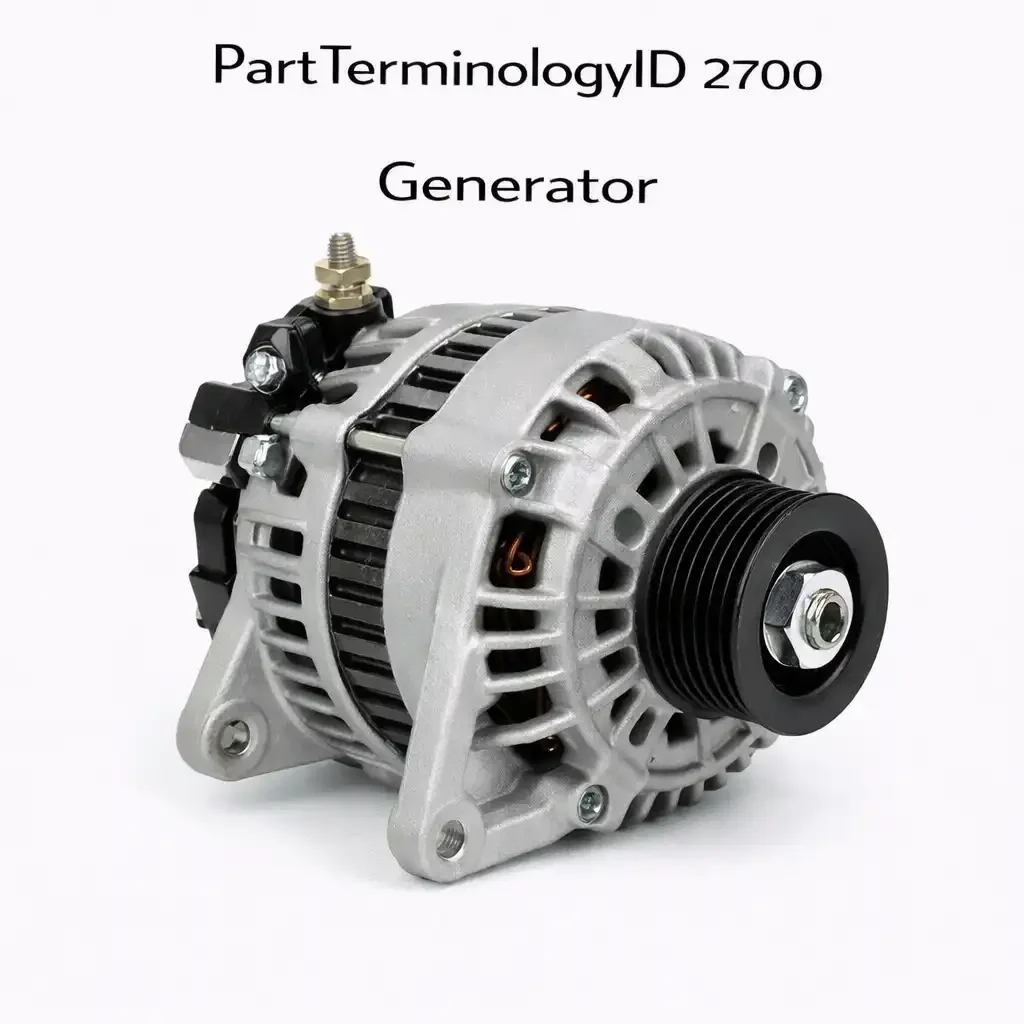
PartTerminologyID 2700, Generator, is the electromechanical assembly driven by the engine crankshaft through the accessory drive belt that converts rotational mechanical energy into direct current electrical energy, maintaining the vehicle's battery at full charge and supplying current to all electrical loads while the engine is operating. That definition covers the function correctly and leaves unresolved every question that determines whether the replacement generator produces the correct ampere output to meet the vehicle's maximum simultaneous electrical load demand, whether the mounting bracket configuration and ear positions match the engine block's generator mounting bosses, whether the pulley diameter and groove count match the accessory drive belt's rib count and the drive ratio required for adequate idle-speed output, whether the pulley type is a solid pulley or an overrunning alternator decoupler matching the original application, whether the output terminal stud size matches the vehicle's main battery charge cable lug, whether the voltage regulator connector type and pin count match the vehicle's harness, whether the regulator's voltage set point matches the vehicle's battery chemistry and management system, and whether the unit is new or remanufactured and what rebuild standard was applied.
It does not specify the ampere output rating, the mounting ear count and positions, the pulley diameter and groove count, whether the pulley is solid or an OAD overrunning decoupler, the output terminal stud diameter, the voltage regulator connector type and pin count, whether the voltage regulator communicates via LIN bus, the voltage set point, the case size, whether the unit is new or remanufactured, what components were replaced in a remanufactured unit, the rotation direction, or the test speed and temperature at which the rated output was measured. A listing under PartTerminologyID 2700 that specifies only year, make, and model without ampere rating, pulley type, and connector configuration cannot be evaluated by a technician on a vehicle that may have used multiple output variants across the model year depending on the installed option package.
For sellers, PartTerminologyID 2700 presents an output-variant selection problem that has no direct parallel in any other PartTerminologyID in this series. Many late-model vehicle platforms were produced with two or three different generator output ratings depending on the installed electrical options: a base-output generator for vehicles without high-draw options, and a high-output generator for towing packages, heated seats, high-output audio, and rear entertainment systems. The two generators may share the same mounting configuration, the same pulley, and the same connector, differing only in the rotor winding, stator winding, and diode bridge that together determine the output. A catalog that covers both variants under a single year, make, and model listing without distinguishing the original ampere rating will systematically deliver the base-output generator to buyers whose vehicles need the high-output variant, producing a charging system that cannot maintain battery voltage during sustained full-load operation.
The additional complexity specific to PartTerminologyID 2700 is the remanufactured-versus-new quality dimension that affects long-term reliability in ways invisible at installation. A new generator and a correctly remanufactured generator both test to the same output specification when installed. The difference emerges over 12 to 36 months as unreplaced wear components reach end of life. A generator whose brushes were not replaced will produce declining output as the brushes wear to the holder floor. A generator whose bearings were not replaced will produce increasing noise before shaft failure. Neither failure is detectable at installation, and both produce a warranty return attributed to a defective unit when the actual cause is an undisclosed inadequate rebuild standard.
What the Generator Does
Converting belt rotation to regulated DC output
The generator's rotor, a rotating electromagnet powered by a small field current from the voltage regulator, spins inside the stator winding assembly at a ratio determined by the generator pulley diameter relative to the crankshaft pulley diameter. The spinning magnetic field induces alternating current in the three-phase stator windings. The alternating current is rectified to direct current by six diodes in the internal bridge, two per phase, and delivered to the output terminal stud. The voltage regulator controls the field current to maintain output voltage between 13.5 and 14.8 volts across the full engine speed range regardless of the connected load.
The output ampere rating is determined by the stator winding conductor area, the rotor magnetic field strength, and the test rotational speed. A generator with heavier winding conductors produces more current at a given field strength and speed. Rated output is measured at a specific test speed, typically 6,000 RPM at the generator shaft, corresponding to approximately 1,500 to 2,000 engine RPM depending on the pulley ratio. At idle the generator shaft speed is typically 1,000 to 1,500 RPM, producing 50 to 60 percent of rated output. This idle-speed reduction is why the ampere rating must adequately exceed the vehicle's maximum simultaneous load: headlights, climate control, defroster, seat heaters, and entertainment system all active at idle must be supplied without drawing from the battery.
The pulley ratio and idle-speed output adequacy
The generator pulley diameter determines the speed ratio between the crankshaft and the generator shaft at every engine speed. A smaller generator pulley produces a higher generator shaft speed for a given engine speed, moving the idle operating point further up the generator's output curve and increasing idle-speed output. Many vehicles with high electrical load requirements use a smaller pulley than base-trim variants to increase idle-speed output without requiring a higher-rated generator stator and rotor, which is more expensive than changing the pulley ratio.
A replacement generator with a larger pulley than the original will produce lower idle-speed output than the original even if the rated amperage at 6,000 RPM is identical. The vehicle will charge correctly at highway speed but discharge the battery during extended low-speed or stop-and-go operation with all electrical accessories active. This symptom is difficult to diagnose because the charging voltage at highway speed tests correctly and the rated output tests correctly, but the practical idle-speed output is below the simultaneous load. The pulley diameter, groove count, and groove type must all match the original to preserve the correct drive ratio.
Voltage regulator compatibility and LIN bus battery management
The voltage regulator controls the generator's output voltage to match the battery's charging requirement. A standard flooded lead-acid battery charges correctly at 13.8 to 14.4 volts. An AGM battery requires a different absorption and float voltage profile. An EFB battery has an intermediate requirement. On many late-model vehicles, the voltage regulator communicates with the body control module or battery management module through a LIN bus circuit at the voltage regulator connector. The BCM monitors battery state of charge and temperature and adjusts the voltage set point in real time rather than using a fixed target.
A replacement generator with a fixed-voltage regulator installed on a vehicle that expects LIN bus communication will charge at a constant voltage that may overcharge an AGM battery during cold weather when the management system would normally reduce the charge voltage. The connector pin count at the voltage regulator circuit connector must match the original. A two-pin connector on a vehicle requiring a four-pin LIN bus connector produces a charging fault code and removes the battery management system's ability to optimize the charge voltage for the installed battery chemistry and temperature.
New versus remanufactured and rebuild standard disclosure
The new-versus-remanufactured distinction determines whether the installed unit has a fresh component life expectancy or an uncertain remaining life from the original core's history. A properly remanufactured generator replaces brushes, bearings, the rectifier diode bridge, and the voltage regulator as a minimum, plus any stator or rotor components that tested outside specification during rebuild inspection. A unit rebuilt to this standard has a service life comparable to new.
A generator cleaned, repainted, and tested without replacing wear components will produce correct output at installation and for a period thereafter, then fail when the original brushes wear to the holder floor, when the original bearings develop noise, or when the original diode bridge develops leakage. These failures produce gradual charging system decline over weeks before the generator is diagnosed as failed. The listing must state the rebuild standard: components replaced, test standard applied, and test conditions. A listing that states only "remanufactured" without specifying what was replaced cannot be evaluated for service life by a technician selecting a replacement for a customer who already experienced one premature charging system failure.
Why This Part Generates Returns
Buyers return generators because the ampere output is the base variant and the vehicle requires the high-output variant for a towing or high-electrical-load option package, the mounting ear configuration differs and one bolt hole position prevents seating against the engine block bracket, the pulley groove count does not match the accessory belt rib count and the belt cannot be installed, the pulley is solid and the original used an OAD decoupler producing immediate belt vibration noise, the output terminal stud is M8 and the vehicle main charge cable ring terminal is sized for M10, the voltage regulator connector is two-pin and the vehicle requires a four-pin LIN bus connector, the remanufactured unit's brushes were not replaced and output declines within eight months, the rotation direction is clockwise and the vehicle requires counterclockwise, the stated output rating was measured at a non-standard test speed producing a higher apparent rating than the unit delivers at the standard test condition, and the case size is incorrect and the generator physically clears the engine block on one side but contacts the accessory mounting bracket on the other.
Status in New Databases
PIES/PCdb: PartTerminologyID 2700, Generator
PIES 8.0 / PCdb 2.0: No change in PartTerminologyID or terminology label. Internal systems keyed to 2700 do not require remapping at the PIES 8.0 transition.
Top Return Scenarios
Scenario 1: "Base output variant, battery discharges at idle with full electrical load on tow-package vehicle"
The vehicle is a pickup truck with the factory tow package, requiring a 160-ampere generator to supply trailer lighting, trailer brake controller, and cab electrical loads simultaneously. The replacement listing covers the year, make, and model without distinguishing output variants. The delivered generator is the 120-ampere base variant. At highway speed the charging voltage is correct. At idle with the trailer connected, heater on maximum, headlights and trailer running lights active, the simultaneous load exceeds 120 amperes. The battery begins discharging at idle. After 45 minutes at a rest stop the battery is discharged below the cranking threshold.
Prevention language: "Ampere output rating: [X] amperes at 6,000 RPM. This generator is the [base / high-output] variant. Vehicles with the factory tow package or high-output electrical option require the [X]-ampere high-output variant. Verify the original generator's ampere rating from the generator body marking or vehicle documentation before ordering."
Scenario 2: "Pulley groove count mismatch, six-rib belt will not seat on seven-groove pulley"
The vehicle accessory drive belt is a six-rib serpentine belt. The replacement generator has a seven-groove pulley. The six-rib belt cannot seat in a seven-groove pulley and rides on the outer groove ridges without engaging the valleys, producing squealing and rapid belt wear. The installation cannot be completed without sourcing a correct pulley or generator.
Prevention language: "Pulley groove count: [X] grooves. Belt rib count required: [X]. Verify the pulley groove count matches the vehicle accessory drive belt rib count before installation. A pulley with a different groove count than the belt cannot be used without replacing either component."
Scenario 3: "Solid pulley on OAD application, belt vibration noise at engine resonance speed"
The original generator used an OAD overrunning decoupler pulley. The replacement is supplied with a solid pulley. The listing does not state pulley type. After installation, the accessory drive belt produces audible vibration noise between 800 and 1,200 RPM corresponding to the engine's torsional resonance band. The solid pulley transmits the full torsional irregularity to the belt that the OAD previously absorbed. The buyer returns the generator requesting an OAD-equipped replacement.
Prevention language: "Pulley type: [solid / OAD overrunning decoupler / OCA overrunning clutch]. This generator is supplied with a [type] pulley. For vehicles whose original generator used an OAD pulley, the replacement must use the same pulley type. Substituting a solid pulley on an OAD application produces belt vibration noise at resonance speeds that cannot be resolved without pulley replacement."
Scenario 4: "Two-pin regulator connector on LIN bus vehicle, BCM logs charging fault"
The vehicle's battery management system communicates with the voltage regulator through a four-pin LIN bus connector. The replacement has a two-pin connector. After installation the generator charges at a fixed 14.4 volts. The BCM logs a charging system communication fault and cannot provide temperature and state-of-charge adjusted voltage regulation. The AGM battery is overcharged at the fixed set point during cold weather operation.
Prevention language: "Voltage regulator connector: [X]-pin [connector type]. LIN bus communication: [included / not included]. Verify the connector pin count matches the vehicle harness. A two-pin connector on a vehicle requiring a four-pin LIN bus connector produces a charging fault code and incorrect battery management voltage regulation."
Scenario 5: "Remanufactured unit without brush replacement, output declines within eight months"
The replacement is a remanufactured unit. The listing states "remanufactured" without specifying components replaced. The brushes were not replaced during the rebuild. After eight months the brushes wear to the holder floor. The generator produces zero field current and zero output, a no-charge condition identical to the original failure. The buyer returns under warranty requesting a fully-rebuilt or new replacement.
Prevention language: "Condition: remanufactured. Components replaced: brushes [yes/no], bearings [yes/no], rectifier diode bridge [yes/no], voltage regulator [yes/no]. Verify brush replacement is confirmed before selecting a remanufactured unit for an application where the previous failure was brush-related."
Scenario 6: "Output terminal stud M8, vehicle main charge cable ring terminal sized for M10"
The vehicle main battery charge cable has a 10.5mm hole ring terminal sized for the original M10 output stud. The replacement has an M8 stud. The ring terminal slides onto the M8 stud but cannot be torqued to the required clamping force. The connection is physically loose and produces elevated contact resistance at the output terminal, limiting current delivery from the generator to the battery.
Prevention language: "Output terminal stud: [M6 / M8 / M10 / M12]. Verify the stud diameter matches the ring terminal hole of the vehicle main battery charge cable. A ring terminal sized for a larger stud will not make a secure connection on a smaller stud."
What to Include in the Listing
Core essentials
PartTerminologyID: 2700
component: Generator
ampere output rating at standard test conditions (mandatory, in title)
output test speed in RPM and test temperature (mandatory)
mounting ear count, positions, and hole dimensions (mandatory)
pivot versus fixed bracket type (mandatory)
pulley type: solid, OAD, or OCA (mandatory)
pulley diameter in mm (mandatory)
pulley groove count and rib profile (mandatory)
output terminal stud diameter (mandatory)
voltage regulator location: internal or external (mandatory)
voltage regulator connector type and pin count (mandatory)
LIN bus communication: included or not included (mandatory)
voltage set point in volts DC (mandatory)
rotation direction: clockwise or counterclockwise from pulley end (mandatory)
case size designation (mandatory)
condition: new or remanufactured (mandatory)
for remanufactured: component replacement list and test standard (mandatory)
OEM part number cross-reference (mandatory)
quantity: 1
Fitment essentials
year/make/model/submodel/engine
output variant: base or high-output with installed option package correlation
note for vehicles produced with multiple output variants in same model year
note for vehicles requiring LIN bus communication at voltage regulator connector
note for OAD pulley requirement with resonance speed range
OEM part number cross-reference for all output variants covered
Image essentials
generator from pulley end with groove count and pulley type labeled
generator from mounting side with ear positions and hole pattern labeled
voltage regulator connector shown with pin count labeled
output terminal stud shown with diameter labeled
ampere rating label on generator body
condition and rebuild standard shown on packaging for remanufactured units
OAD decoupler housing shown where OAD pulley is supplied
Catalog Checklist for ACES/PIES Teams
PartTerminologyID = 2700
require ampere output rating with test conditions (mandatory)
require mounting ear configuration with positions and hole dimensions (mandatory)
require pulley type: solid, OAD, or OCA (mandatory)
require pulley groove count and diameter (mandatory)
require output terminal stud diameter (mandatory)
require voltage regulator connector type and pin count (mandatory)
require LIN bus communication status (mandatory)
require condition with rebuild standard for remanufactured units (mandatory)
require rotation direction (mandatory)
prevent output variant conflation: base-output and high-output variants for the same model year must be listed separately with option package correlation; a single listing covering both variants will deliver the base unit to high-output applications
prevent OAD versus solid pulley omission: OAD substitution with solid produces belt resonance noise; pulley type must be required for every listing
prevent LIN bus connector omission: two-pin on four-pin LIN bus vehicle produces charging fault code; connector pin count must be required
prevent remanufactured rebuild standard omission: "remanufactured" without component list cannot be evaluated for service life; rebuild standard must be required for all remanufactured listings
flag output rating test condition disclosure: non-standard test speed produces misleading apparent ratings; test speed and temperature must be stated
differentiate from Generator Brush (2704), Brush Spring (2708), and Bushing (2712): these cover individual serviceable internal components; 2700 covers the complete assembly
FAQ (Buyer Language)
What does the generator do in the vehicle electrical system?
The generator converts mechanical energy from the engine crankshaft into direct current that maintains the battery at full charge and supplies current to all electrical loads while the engine runs. The voltage regulator maintains output between 13.5 and 14.8 volts DC. A failed generator allows the battery to discharge progressively until the vehicle loses electrical power and cannot start.
What does the ampere output rating mean?
The ampere output rating is the maximum current the generator delivers at a specified test speed, typically 6,000 RPM. At idle the output is typically 50 to 60 percent of the rated value. The rating must meet or exceed the vehicle's maximum simultaneous electrical load to prevent battery discharge during sustained low-speed operation with all accessories active. Towing packages and high-draw option vehicles require higher-rated generators than base-trim versions of the same model.
Can I install a higher-ampere generator?
On most vehicles a higher-output direct-fit replacement installs without modification. However the main battery cable, fusible link, and main fuse must be rated for the higher output. A 160-ampere generator on a vehicle wired for 90 amperes will overload the main battery cable at full output. Verify main circuit wiring capacity before upgrading the generator rating.
What is an OAD pulley?
An overrunning alternator decoupler incorporates a one-way clutch and torsional spring allowing the rotor to overrun the belt during engine deceleration, reducing belt vibration at the engine's torsional resonance frequencies and extending belt and tensioner life. An OAD cannot be substituted with a solid pulley on an OAD application without producing belt vibration noise. The pulley type must match the original.
What does remanufactured mean and how does it affect service life?
A properly remanufactured generator replaces brushes, bearings, the diode bridge, and the voltage regulator and tests to new-unit output specifications. A unit rebuilt without replacing all wear components will fail when the unreplaced parts reach end of life, typically within 6 to 18 months. Always verify what components were replaced before selecting a remanufactured unit for a service life-critical application.
Cross-Sell Logic
Generator Brush (PartTerminologyID 2704): the primary wear component; for vehicles where failure was confirmed as brush wear, a brush replacement may restore generator function without full generator replacement
Generator Brush Spring (PartTerminologyID 2708): a spring that has lost tension produces intermittent output identical to worn brush symptoms; inspect when replacing brushes
Generator Bushing (PartTerminologyID 2712): a failed bearing produces audible noise before shaft runout damages the stator winding; inspect when any bearing noise is present before complete generator failure
Fusible Link (PartTerminologyID 2692): if the generator failed from an overvoltage or reverse current event, the main fusible link in the alternator output circuit should be inspected and replaced before installing the new generator
Accessory Drive Belt: a glazed or cracked belt produces slippage on the generator pulley that limits actual generator speed and output; always replace the accessory drive belt when replacing the generator
Belt Tensioner: a worn tensioner produces belt tension fluctuations that accelerate OAD pulley wear; inspect and replace on high-mileage applications whenever the generator is replaced
Frame as "the generator produces the energy the battery stores and the electrical loads consume. The belt transfers mechanical energy from the crankshaft to the generator pulley. The fusible link protects the main output circuit. The brushes transfer field current that controls the output. All are in the same charging system pathway from the crankshaft to the battery terminal."
Final Take for PartTerminologyID 2700
Generator (PartTerminologyID 2700) is the PartTerminologyID in the charging system series where output-variant conflation within the same model year produces the highest rate of returns with a delayed symptom that is difficult to diagnose. A base-output generator installed on a high-output application charges correctly at highway speed and tests correctly on a standard charging system test. The failure only appears during sustained idle operation with full electrical load, which may not occur until the buyer is 200 miles from the repair shop on a winter highway drive with a trailer connected. By that point the installation labor is committed and the diagnostic trail begins with a discharged battery rather than the output rating discrepancy that caused it.
State the ampere output rating in the title. State the test conditions. State the mounting ear configuration. State the pulley type and groove count. State the output terminal stud diameter. State the voltage regulator connector pin count. State the LIN bus communication status. State the rotation direction. State the condition and rebuild standard. State the output variant correlation to the installed option package. For PartTerminologyID 2700, ampere output rating, pulley type, and LIN bus connector compatibility are the three attributes that determine whether the replacement generator restores correct charging function across the vehicle's full operating load range or produces a delayed battery discharge failure that appears hundreds of miles after installation is complete.