
Written by Arthur Simitian | PartsAdvisory
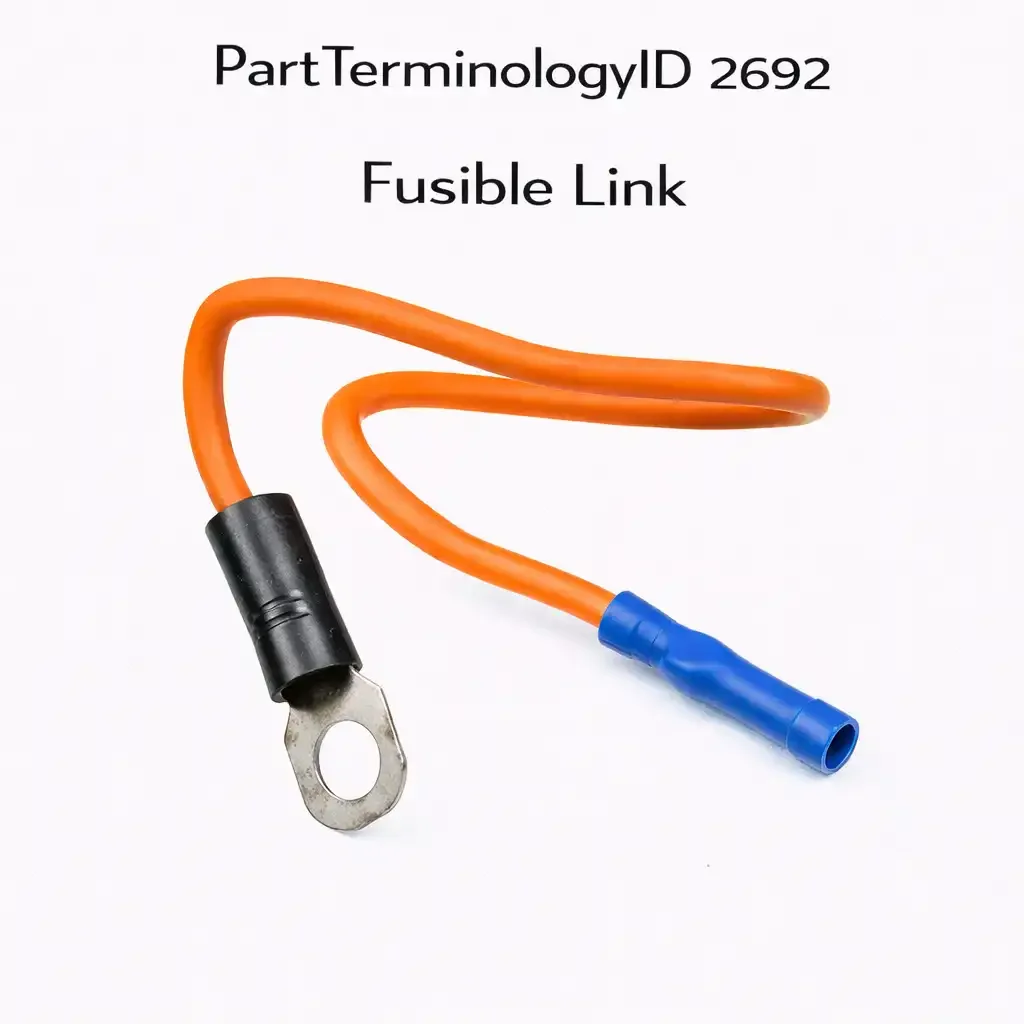
PartTerminologyID 2692, Fusible Link, is a short length of conductor rated four wire gauge numbers smaller than the circuit conductor it protects, positioned in the main battery feed circuit, alternator output wire, or other high-current primary conductor to provide overcurrent protection at a current threshold below the fault current that would damage the primary conductor, using the thermal melting of the undersized link conductor to interrupt the fault current before the primary wiring sustains heat damage. That definition covers the protection mechanism correctly and leaves unresolved every question that determines whether the replacement link uses the correct wire gauge for the protected conductor, whether the link's length matches the original installation routing without excess slack or insufficient reach between its termination points, whether the connector or terminal type at each end of the link matches the circuit's existing connections, whether the link's insulation material and temperature rating are adequate for the thermal environment at the installation location, whether the link's conductor material is the correct type for the application, whether the link is pre-terminated with the correct connector at each end or requires field termination, and whether the link is sold as an individual length or as part of a multi-link assembly that covers multiple circuit positions simultaneously.
It does not specify the wire gauge of the link conductor, the wire gauge of the protected circuit conductor, the link length, the connector or terminal type at each end, the insulation material and temperature rating, the conductor material, whether terminations are factory-installed or field-applied, whether the link is a standalone wire segment or a multi-link assembly, the circuit application the link is designed for, or the number of links per package. A listing under PartTerminologyID 2692 that specifies only a color code or a vehicle application without wire gauge, connector type, and insulation rating cannot be evaluated by a technician who needs to confirm the replacement protects the correct circuit at the correct current threshold before cutting the original link out of the wiring harness.
For sellers, PartTerminologyID 2692 occupies a specific position in the vehicle's electrical protection hierarchy that makes gauge accuracy more consequential than for any other wire-type component. The fusible link is the last line of protection for the primary battery and alternator circuits upstream of the fuse block. If the fusible link's gauge is heavier than the original, it will carry a fault current that the original link would have interrupted, allowing the fault to persist and potentially causing a fire in the primary battery cable. If the gauge is lighter than the original, it will blow during normal high-current events such as engine cold cranking, leaving the vehicle with a dead electrical system on the roadside rather than in a shop. Neither error is recoverable without a second repair event, and the heavier-gauge error carries a fire risk that the lighter-gauge error does not.
The additional complexity specific to PartTerminologyID 2692 is the insulation identification problem. Automotive fusible link wire uses a special high-temperature, non-self-extinguishing insulation that is specifically chosen to burn away cleanly when the conductor melts rather than sustaining a flame that could ignite adjacent wiring. Standard automotive wire insulation is self-extinguishing and will not burn away cleanly when used as a fusible link substitute. A replacement fusible link made from standard automotive wire of the correct gauge will appear identical to the original, will pass a continuity test, will carry normal operating current without issue, and will fail to protect the circuit correctly under a fault event because the insulation behavior under the fault thermal event is different from a proper fusible link insulation. The insulation type must be stated as a required attribute on every fusible link listing, and the listing must warn against using standard wire as a fusible link substitute.
What the Fusible Link Does
Protecting the primary battery circuit through conductor undersizing
The fusible link's protection mechanism is fundamentally different from a blade fuse or a circuit breaker. A blade fuse uses a calibrated element whose geometry is designed to melt at a specific current. A fusible link uses a short conductor segment that is undersized relative to the main circuit wire. Because the link conductor is four gauge numbers smaller than the main wire, it has approximately 40 to 50 percent of the main wire's current-carrying capacity. Under a fault current that exceeds this capacity, the link conductor heats and melts before the main circuit wire reaches its damage threshold. The protection is entirely passive: no switching element, no monitoring circuit, no threshold calibration required. The physics of conductor thermal rating do the work.
This passive protection mechanism is what makes fusible links suitable for the main battery and alternator circuits where active fuse elements would need to interrupt fault currents of hundreds of amperes at voltages that challenge standard fuse interrupting capacities. A fusible link melting under a hard fault simply opens the conductor gap as the link material vaporizes. There is no arc interruption requirement because the link conductor melts progressively from a distributed thermal event rather than from a localized arc. The fault energy is absorbed by the melting and vaporization of the link conductor and its insulation rather than by an arc-extinguishing mechanism in a fuse body. This makes the fusible link inherently capable of interrupting very high fault currents that would destroy a standard blade fuse body.
The four-gauge-number rule and its application to replacement selection
The standard for automotive fusible links is that the link conductor is four American Wire Gauge numbers smaller than the conductor it protects. Because the AWG scale is an inverse scale where larger numbers indicate smaller conductors, a four-gauge-number reduction from a 10-gauge main wire produces a 14-gauge fusible link. A four-gauge reduction from a 6-gauge main wire produces a 10-gauge fusible link. The link's current capacity at each gauge number can be verified from standard wire ampacity tables, and the protection threshold is the link's continuous ampacity at its installed temperature.
This four-gauge-number rule means the wire gauge of the protected conductor must be known to select the correct replacement link. A listing that states only the fusible link gauge without stating the protected conductor gauge it is designed for leaves the buyer to infer the protected conductor gauge, which requires knowing the four-gauge rule. Many buyers do not know this rule and will order a replacement link based on the original link's gauge alone, not realizing that a link of the same gauge installed in a different circuit position may be protecting a different conductor gauge than the original application. The listing must state both the link gauge and the application it is designed for, and must cross-reference the protected conductor gauge to prevent substitution errors.
Insulation material and the thermal behavior requirement
Fusible link insulation is a specially formulated material, typically a chloroprene or similar compound, that has three specific thermal properties required for correct fusible link function. First, it has a higher continuous temperature rating than standard PVC automotive wire insulation, allowing the link to carry its rated current in the high-temperature underhood environment without insulation degradation. Second, it has a specific softening and melting point that allows the insulation to contain the molten conductor for a brief period after the conductor melts, preventing the molten conductor from bridging the gap and re-establishing continuity. Third, it burns away in a controlled manner when exposed to the full fault energy of a melting conductor, rather than sustaining a flame that could propagate to adjacent insulation.
Standard PVC automotive wire insulation fails all three of these requirements for fusible link service. Its continuous temperature rating is lower than proper fusible link insulation, its melting behavior does not reliably contain the molten conductor, and it is self-extinguishing rather than burn-away, which means it may char and seal the gap left by the melted conductor rather than exposing the gap to allow circuit interruption verification. A replacement fusible link must use the correct insulation type, and the listing must state the insulation material designation or temperature rating as a minimum specification attribute.
Connector types and the termination requirement at each end
Fusible links connect to the main circuit wiring through one of four common termination types: eyelet or ring terminal at one end connecting to a battery post or alternator output stud, butt splice at one end connecting to the main circuit wire, blade connector at one end mating with a dedicated fusible link connector in the wiring harness, and snap-in housing connector at one end mating with a purpose-specific connector body at the junction box or main distribution point.
On vehicles that use a dedicated fusible link connector assembly, the link must snap into the correct housing to make the electrical connection to both the supply and load sides of the protected circuit. A replacement link with incorrect connector geometry will not mate with the housing, and the technician cannot complete the repair without either sourcing a correct connector or field-splicing the link into the circuit, which defeats the purpose of a purpose-designed fusible link assembly. On vehicles that use butt-splice fusible links, the splice must be made with the correct crimp connector for the wire gauges being joined, and the splice must be covered with adhesive-lined heat shrink tubing to prevent moisture ingress at the exposed conductor area.
Why This Part Generates Returns
Buyers return fusible links because the wire gauge is one or two numbers heavier than the original and the link carries a fault current the original would have interrupted, the wire gauge is one number lighter than the original and the link blows during cold cranking on a high-compression engine, the insulation is standard PVC automotive wire rather than proper fusible link insulation and the link fails to provide correct fault behavior under a thermal event, the connector type at one end does not match the circuit's existing connector and the link cannot be installed without cutting and re-terminating, the link length is too short to span the routing distance between the two termination points without pulling the conductor at the connection points under tension, the link length is excessively long and the excess slack creates a harness routing that positions the link near an exhaust component where the operating temperature exceeds the insulation rating, the link is a multi-circuit assembly covering three or four positions and the buyer needed only a single link replacement for one circuit, the link conductor material is aluminum rather than copper and the installation requires copper for compatibility with the existing copper terminal contacts, and the package quantity is one link and the buyer needed two to replace a multi-link fusible link assembly that protects both the battery feed and the alternator output simultaneously.
Status in New Databases
PIES/PCdb: PartTerminologyID 2692, Fusible Link
PIES 8.0 / PCdb 2.0: No change in PartTerminologyID or terminology label. Internal systems keyed to 2692 do not require remapping at the PIES 8.0 transition.
Top Return Scenarios
Scenario 1: "Link gauge two numbers heavier than original, fault current passes, main cable smokes"
The original link is 14-gauge protecting a 10-gauge battery feed. The replacement link sourced from a generic assortment is 12-gauge. The 12-gauge link has a higher current capacity than the 14-gauge original and will carry a sustained fault current at a level the original 14-gauge link would have interrupted. A chafed battery cable develops a partial short to the chassis producing 85 amperes of fault current. The 12-gauge replacement link carries 85 amperes without melting. The partial short heats the chafe point for 4 minutes before a full short develops and the 12-gauge link finally melts. The 4 minutes of sustained partial fault current has charred the battery cable insulation at the chafe point over a 3-inch length.
Prevention language: "Link wire gauge: [X] AWG. Protected conductor gauge: [X] AWG. This fusible link is [X] AWG, designed for use with [X] AWG protected conductors following the four-gauge-number protection rule. Install only the gauge specified. Installing a heavier gauge than the original will allow fault currents that the original link would have interrupted to pass continuously through the main battery circuit wiring."
Scenario 2: "Standard PVC wire substituted as fusible link, insulation chars and seals gap after conductor melts"
The technician cannot source a proper fusible link for the vehicle and substitutes a length of standard 14-gauge PVC-insulated automotive wire of the same gauge as the original link. The wire is installed in the same position. During a subsequent starter motor fault, the 14-gauge conductor melts as designed. The PVC insulation does not burn away. It chars and remains in place, partially sealing the gap left by the melted conductor. Two weeks later, a second short-to-chassis develops at a different location in the battery circuit. The charred PVC insulation has partially bridged the original gap with a resistive char path that allows 3 amperes to flow through the theoretically open circuit, slowly draining the battery overnight and producing a repeated dead-battery complaint that cannot be reproduced during shop testing because the drain disappears when the underhood temperature drops below the char's conductive threshold.
Prevention language: "Insulation type: [fusible link-grade chloroprene / XLPE / specify]. This fusible link uses [insulation type] insulation rated for [X] degrees Celsius continuous. Do not substitute standard PVC automotive wire as a fusible link replacement. Standard PVC insulation does not burn away correctly after the conductor melts and may char in a way that partially bridges the open circuit gap, producing a resistive path that prevents confirmed circuit interruption after the link has blown."
Scenario 3: "Link too short, tension on battery terminal lug produces intermittent open at terminal connection"
The replacement link is 4 inches long. The original was 6 inches. The routing between the battery positive terminal and the fusible link junction point in the harness requires 5.5 inches with a minimum 0.5-inch service loop. The 4-inch link is installed under tension between the two termination points with no service loop. Engine vibration transmitted through the battery and the harness transmits a cyclic pull force at the battery terminal ring terminal. After 8,000 miles, the ring terminal crimp begins to back out of the terminal lug under the repeated tension cycling, producing an intermittent open at the terminal that presents as a random no-start and random electrical loss during driving.
Prevention language: "Link length: [X] inches. Measure the routing distance between the two termination points before ordering. Add a minimum 1-inch service loop to the measured distance to determine the minimum required link length. A fusible link installed under tension without a service loop will transmit vibration forces directly to its terminal connections, producing progressive terminal loosening over time."
Scenario 4: "Connector type mismatch, snap-in housing does not accept replacement link blade"
The vehicle uses a purpose-specific fusible link housing that accepts a dedicated blade-style fusible link connector. The replacement link has a ring terminal at the housing end rather than the blade connector required by the housing. The ring terminal will not insert into the snap-in housing. The technician must field-splice the replacement link into the circuit using butt connectors, bypassing the snap-in housing entirely. The bypass splice is made with uninsulated butt connectors that are not waterproofed, and the exposed splice corrodes within one season in the underhood environment.
Prevention language: "Connector type at battery end: [ring terminal / blade connector / butt splice / snap-in housing blade]. Connector type at load end: [ring terminal / blade connector / butt splice / snap-in housing blade]. Verify the connector type at each end matches the vehicle's existing termination points before ordering. A fusible link with the wrong connector type at either end cannot be installed in the original circuit position without field modification that may compromise the installation's weatherproofing and service accessibility."
Scenario 5: "Multi-link assembly received, buyer needed single link, excess links have no application"
The vehicle requires replacement of one blown fusible link in the battery feed circuit. The listing covers a multi-circuit fusible link assembly protecting four circuits from a single housing: the battery feed, the alternator output, the ignition feed, and the main fuse block supply. The buyer needed only the battery feed link. The delivered assembly replaces all four links simultaneously. Three of the four replacement links are installed in circuits whose original links were functional and did not need replacement. The buyer returns the assembly and requests the individual link for the battery feed circuit only.
Prevention language: "Assembly type: [single link / multi-link assembly covering [X] circuits]. Circuits covered: [battery feed / alternator output / ignition feed / fuse block supply]. This [single link / assembly] covers [X] circuit position(s). For vehicles where only one circuit's fusible link has blown, verify whether this listing covers a single link or a complete multi-circuit assembly before ordering. Installing a multi-circuit assembly replaces all links in the assembly regardless of which individual links have failed."
Scenario 6: "Link blows on cold crank, buyer installs heavier gauge to stop nuisance blowing, fire develops"
The original 14-gauge fusible link protecting the 10-gauge battery feed blows during a cold start attempt on a high-compression diesel in cold weather. The cold crank current surge peaks at approximately 600 amperes before the starter engages and the engine turns. The 14-gauge link is rated for approximately 300 amperes of sustained fault current but blows during the 600-ampere cranking surge because the short-time overcurrent multiple is sufficient to heat the link conductor past its melting point in the 0.8 seconds of cranking. The buyer installs a 12-gauge link to stop the nuisance cold-crank blowing. The 12-gauge link survives cold cranking. One month later, a chafed battery cable produces a sustained 400-ampere hard short. The 12-gauge link carries 400 amperes without blowing. The battery cable insulation ignites at the chafe point.
Prevention language: "Never install a heavier gauge fusible link than the original specification to stop cold-crank nuisance blowing. A fusible link that blows during cold cranking indicates either a failing battery producing excessive cranking current demand, a failing starter drawing above-normal current, or a marginal link that has weakened from previous heat exposure. Diagnose the root cause of the cold-crank overcurrent before replacing the link. Installing a heavier gauge link removes protection from the main battery circuit and creates a fire risk under the fault current the original link was designed to interrupt."
What to Include in the Listing
Core essentials
PartTerminologyID: 2692
component: Fusible Link
link wire gauge in AWG (mandatory, in title)
protected conductor gauge in AWG (mandatory)
link length in inches (mandatory)
connector type at supply end: ring terminal, blade connector, butt splice, or snap-in housing blade (mandatory)
connector type at load end: ring terminal, blade connector, butt splice, or snap-in housing blade (mandatory)
ring terminal hole diameter in mm where ring terminal is present (mandatory)
insulation type: fusible link-grade chloroprene, XLPE, or equivalent (mandatory)
insulation temperature rating in degrees Celsius continuous (mandatory)
conductor material: copper or aluminum (mandatory)
assembly type: single link or multi-link assembly with circuit count (mandatory)
circuit application: battery feed, alternator output, ignition feed, fuse block supply (mandatory)
color code where applicable (mandatory)
package quantity: number of links (mandatory)
OEM part number cross-reference where available (mandatory)
Fitment essentials
year/make/model/submodel
engine type where link specification varies by engine
circuit position in the vehicle's main wiring diagram
note for multi-link assemblies covering the circuit positions included in the assembly
note warning against gauge substitution in either direction with consequences stated
note warning against standard wire substitution with insulation behavior explanation
Image essentials
link shown full length with gauge and length measurement reference
connector or terminal type shown at each end with dimension labels
insulation color and type markings shown on link body
multi-link assembly shown with all circuit positions labeled where applicable
OEM part number marking shown on link or packaging where present
Catalog Checklist for ACES/PIES Teams
PartTerminologyID = 2692
require link wire gauge in AWG (mandatory)
require protected conductor gauge in AWG (mandatory)
require link length in inches (mandatory)
require connector type at each end (mandatory)
require insulation type and temperature rating (mandatory)
require conductor material (mandatory)
require assembly type: single or multi-link (mandatory)
require circuit application designation (mandatory)
require package quantity (mandatory)
prevent gauge substitution in either direction: heavier gauge allows fault current to pass and creates fire risk; lighter gauge blows during normal cranking events; both the link gauge and the protected conductor gauge must be stated and must follow the four-gauge-number rule
prevent standard wire substitution: all listings must include explicit language prohibiting substitution of standard PVC automotive wire for fusible link wire; insulation type must be required and must be stated as fusible link-grade
prevent heavier-gauge substitution to stop nuisance blowing: this is the highest-consequence error for this PartTerminologyID; all listings must include explicit language prohibiting heavier-gauge substitution with fire risk stated as the consequence
flag multi-link assemblies: a buyer who needs one link and receives a complete assembly replaces functional links unnecessarily; assembly type must be stated prominently
flag cold-crank blowing as a diagnostic indicator: a link that blows on cold crank indicates a battery, starter, or cable fault rather than an undersized link; listings should direct buyers to diagnose the root cause before replacing with a heavier gauge
differentiate from multi-purpose fuse (PartTerminologyID 2676): the fusible link is a wire conductor segment; the multi-purpose fuse is a discrete replaceable element in a fuse block cavity; both provide overcurrent protection but at different circuit positions and current levels
differentiate from fuse holder (PartTerminologyID 2688): the fuse holder accepts a replaceable fuse element; the fusible link is itself the combined conductor and protection element, with no separate fuse to remove and replace
FAQ (Buyer Language)
What is a fusible link?
A fusible link is a short length of wire that is four gauge numbers smaller than the circuit conductor it protects. When fault current exceeds the link's current capacity, the link conductor melts and opens the circuit before the fault damages the main wiring. Fusible links protect the main battery feed circuits, alternator output wires, and other high-current conductors where standard blade fuse ratings are insufficient and where the available fault current exceeds standard fuse interrupting capacities.
How do I know if my fusible link has blown?
Gently tug the link at both ends. A blown link will stretch like a rubber band if the melted conductor is still inside the insulation, or will separate entirely if the insulation has also failed. A voltage test confirming battery voltage on the supply side and zero voltage on the load side with the circuit active is the definitive diagnosis. Visually inspect the insulation for bubbling, discoloration, or hardening as secondary indicators. The external insulation may show no visible damage even after the internal conductor has melted.
Can I replace a fusible link with a standard blade fuse?
Not reliably. Fusible links are used in circuit positions where the current level exceeds standard blade fuse ratings or where the available fault current exceeds standard fuse holder interrupting capacities. A replacement fusible link of the correct gauge is the correct repair. Do not substitute standard PVC automotive wire of the same gauge, because the insulation behavior under a fault thermal event differs from proper fusible link insulation in ways that compromise the protection function.
What wire gauge should I use to replace a fusible link?
Match the original link's wire gauge exactly. The fusible link gauge is selected by the vehicle manufacturer based on the protected conductor gauge, the maximum continuous current, and the maximum fault current at the link's location. Installing a heavier gauge than the original will allow fault currents the original link would have interrupted. Installing a lighter gauge will cause nuisance blowing during normal high-current events. Never install a different gauge than the original to solve a blowing problem without first diagnosing the root cause of the overcurrent.
Why does my fusible link keep blowing after replacement?
A link that blows repeatedly indicates a persistent fault in the protected circuit. The replacement is doing its job correctly. Replacing it again without diagnosing the fault will continue to blow links. Common causes include a chafed main battery cable shorting to the chassis, a failed alternator producing reverse current, and a shorted starter winding drawing excessive cranking current. Diagnose the protected circuit's fault before installing another replacement link.
Cross-Sell Logic
Multi-Purpose Fuse (PartTerminologyID 2676): the overcurrent protection elements in the fuse block that the fusible link's protected circuit supplies; if the fusible link has blown due to a fault in the main supply, the fuses in the downstream fuse block should be inspected for heat damage from the fault current event
Fuse Box (PartTerminologyID 2684): the electrical distribution center whose main supply is protected by the fusible link; if the fuse box received fault current before the fusible link blew, inspect the fuse box bus bar for heat damage before restoring power after the link replacement
Battery Cable: the main conductor the fusible link protects; a chafed or corroded battery cable is the most common cause of a blown fusible link on a vehicle without other electrical system faults; inspect the full length of the main battery cable before replacing the fusible link to confirm the fault has been corrected
Alternator: a failed alternator producing reverse current or excessive output voltage is a common cause of repeated fusible link blowing on the alternator output circuit; verify alternator output voltage before replacing the link in the alternator output position
Battery: a failed battery with a shorted cell can draw excessive current from the charging system and blow the fusible link in the main battery feed or alternator output circuit; test the battery before replacing the link on any charging system fault diagnosis
Frame as "the fusible link protects the primary conductor the battery feeds the fuse box through. The fuse box distributes the protected supply the fusible link guards. The battery cable carries the current the fusible link limits. The alternator produces the current the fusible link output protects. The fuses in the box protect the individual circuits the main supply feeds downstream of the link. All are in the same high-current supply pathway from the battery terminal to every load in the vehicle."
Final Take for PartTerminologyID 2692
Fusible Link (PartTerminologyID 2692) is the PartTerminologyID in the electrical protection series where the over-gauge substitution error carries the highest fire risk of any single specification error in the category. A heavier-gauge fusible link substituted to stop cold-crank nuisance blowing allows the fault current from a chafed main battery cable to flow continuously through the main circuit wiring without interruption. The fault current from a hard short to chassis in the main battery circuit can reach several hundred amperes. At that current, the main battery cable insulation will begin to smoke within seconds and ignite within minutes. The over-gauge substitution is the error that converts a nuisance blowing complaint into a vehicle fire, and every listing under PartTerminologyID 2692 must include explicit language making the fire consequence of this substitution clear before the buyer selects a replacement.
State the link gauge in the title. State the protected conductor gauge. State the link length. State the connector type at each end. State the insulation type and temperature rating. State the conductor material. State the assembly type. State the circuit application. State the over-gauge substitution warning with fire risk stated explicitly. State the standard wire substitution warning with insulation behavior explained. State the package quantity. For PartTerminologyID 2692, link wire gauge, insulation type, and the over-gauge substitution warning are the three elements that determine whether the replacement fusible link provides correct fault protection for the main battery circuit or removes that protection and creates a deferred fire risk in the vehicle's primary wiring.