
Fuse Holder (PartTerminologyID 2688): Where Fuse Type Compatibility, Current Rating, and Mounting Style Determine Whether the Added Circuit Has Reliable Overcurrent Protection
Written by Arthur Simitian | PartsAdvisory
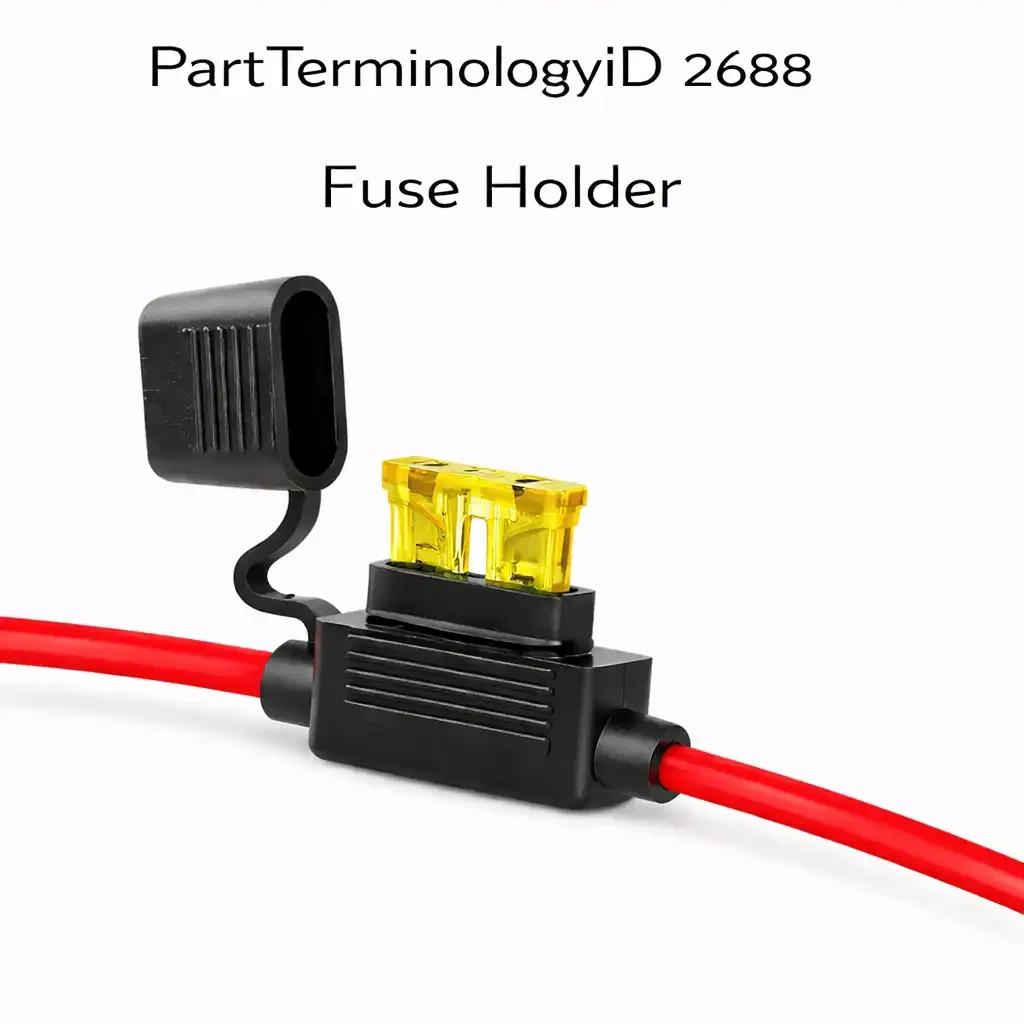
PartTerminologyID 2688, Fuse Holder, is the receptacle assembly that accepts a replaceable fuse and provides the electrical connection between the fuse element and the circuit wiring on both the supply and load sides of a protected circuit, typically used for added circuits that cannot be accommodated in the vehicle's existing fuse block, for individual circuit protection at an accessory installation location, or for replacement of a damaged fuse block cavity on a standalone basis. That definition covers the function correctly and leaves unresolved every question that determines whether the holder accepts the fuse type the buyer intends to use, whether the holder's continuous current rating meets or exceeds the protected circuit's maximum operating current, whether the mounting style matches the installation location, whether the lead wire gauge is adequate for the circuit's current without voltage drop across the holder leads, whether the holder is sealed against moisture for an exposed underhood or near-battery installation location, whether the holder's body dimensions fit the available space in the installation location, whether the holder accepts the fuse from the correct end for the installation orientation, and whether the holder includes a cover or cap that protects the fuse from accidental contact in a live circuit installation.
It does not specify the fuse type accepted, whether it is ATO standard blade, mini blade, maxi blade, ANL, MIDI, or glass tube, the continuous current rating of the holder body and contacts, the mounting style, whether inline with pre-attached leads or panel-mount with rear terminal connections, the lead wire gauge and lead length for inline designs, the terminal type for panel-mount designs, the holder body dimensions, whether a protective cap or cover is included, the contact spring material and plating, the body material and temperature rating, the sealing designation for the housing and lead wire entries, or whether the fuse is included or must be sourced separately. A listing under PartTerminologyID 2688 that specifies only a fuse type designation without current rating, mounting style, and lead gauge cannot be evaluated by an installer who needs to confirm the holder is rated for the circuit's continuous operating current before routing the wiring for the installation.
For sellers, PartTerminologyID 2688 is primarily an aftermarket addition and accessory installation PartTerminologyID rather than an OEM replacement PartTerminologyID. The majority of buyers ordering under 2688 are installing added circuits for aftermarket accessories: winches, auxiliary lighting, power inverters, audio amplifiers, refrigerators, and similar high-current accessories that were not part of the vehicle's original electrical design and therefore have no existing fuse block position available. This buyer population has a different risk profile from the OEM replacement buyer: they are selecting a fuse holder for a circuit whose current requirements they have calculated themselves, and they need the holder's current rating, lead gauge, and sealing to match their own installation design, not a vehicle-specific OEM specification. The listing must provide adequate technical specification to support this self-determined fitment evaluation without requiring a support inquiry.
The additional complexity specific to PartTerminologyID 2688 is the current-rating-versus-lead-gauge misalignment problem. A fuse holder may be rated at 30 amperes at the contact springs but pre-wired with 16-gauge leads that are rated for only 13 amperes of continuous current in a bundled wiring installation. The contact spring rating and the lead wire rating are two separate specifications that must both meet the circuit's current requirement. A buyer who reads the 30-ampere contact rating and routes 12-gauge wire from the load to the holder leads, then connects 16-gauge holder leads to the 12-gauge circuit wire, has created a current bottleneck at the holder leads. Under a 25-ampere continuous load, the 16-gauge leads will carry 25 amperes continuously, which is approximately twice their bundled ampacity, overheating the leads at their entry into the holder body and potentially melting the holder body material before the 30-ampere fuse blows. Both the contact rating and the lead gauge must be stated and must be consistent with each other at the circuit's expected continuous operating current.
What the Fuse Holder Does
Accepting the fuse and maintaining contact integrity under operating conditions
The fuse holder's primary mechanical function is to accept the fuse element and hold it in reliable electrical contact with both the supply and load circuit conductors under the thermal cycling, vibration, and current loading that the installation environment produces. The contact springs inside the holder cavity must exert sufficient force on the fuse blades or end caps to maintain a contact resistance below the threshold that generates significant heat at the contact interface under the circuit's maximum operating current. As established for fuse block contact springs, the target contact resistance for a fuse holder is below 5 milliohms per contact surface.
Contact integrity in a fuse holder is more vulnerable to degradation than in a fuse block because the fuse holder is installed in the circuit wiring rather than in a protected panel housing. Inline fuse holders are exposed to vibration transmitted directly through the circuit wiring, thermal cycling from underhood heat sources, and in many installations, moisture from rain and road spray if the installation routing takes the holder through an exposed area of the engine bay. Contact spring relaxation from vibration fatigue and moisture-induced oxidation at the contact surfaces are the two most common modes of elevated contact resistance in inline fuse holders over service time. The contact spring material and the surface plating specified for the holder determine its resistance to both failure modes.
Providing access for fuse inspection and replacement
The fuse holder's design must allow the fuse to be removed and inspected without tools and without disconnecting the circuit wiring. An inline fuse holder with a twist-off or snap-off cover allows the fuse to be removed by hand in the field. A panel-mount fuse holder allows the fuse to be removed from the front face of the panel without accessing the wiring behind the panel. A fuse holder that requires a tool to open, or that requires the wiring connections to be loosened to remove the fuse, adds enough friction to the fuse inspection process that many installations go uninspected after the initial installation, and blown fuses are replaced with random ampere ratings from the nearest available source rather than the correct rating for the circuit.
The holder's cover or cap also prevents accidental contact with the live fuse terminals during fuse inspection in a live circuit. A fuse holder installed in the positive supply lead between the battery and the load has live voltage on the supply-side terminal at all times, including when the fuse is removed. A holder without a cover or cap leaves the live supply-side terminal accessible to accidental contact during fuse replacement, creating a shock and short-circuit risk. For underhood and near-battery installations, a holder with a protective cap is a required safety feature, not an optional convenience feature, and the listing must state whether a cap is included.
Lead wire gauge and the voltage drop consequence
For inline fuse holders with pre-attached leads, the lead wire gauge determines both the ampacity of the holder leads and the voltage drop across the holder's contribution to the circuit path. A 30-ampere circuit using a fuse holder with 6-inch, 16-gauge leads will experience a voltage drop of approximately 0.15 volts across the leads at the rated current, which is negligible for most accessory applications. However, a 40-ampere circuit using the same 16-gauge leads will experience a voltage drop of approximately 0.23 volts, and the leads will operate above their ampacity, generating heat at the holder body.
The voltage drop consequence is most significant for circuits that power loads with minimum voltage requirements, such as 12-volt audio amplifiers that produce audible distortion below 11.5 volts, and motor loads that lose starting torque as supply voltage drops. An installation where the total voltage drop across all wiring and connection points, including the fuse holder leads, causes the load's supply voltage to fall below its minimum operating voltage produces a symptom that is often misdiagnosed as an underpowered battery or a failing alternator rather than a wire gauge problem at the fuse holder. The lead gauge must be specified as a required attribute in every inline fuse holder listing and must be matched to the circuit's current and the acceptable voltage drop budget for the load.
Mounting style and the installation location requirement
The three primary fuse holder mounting styles serve three distinct installation scenarios, and each must be matched to its installation location to function correctly over service life. An inline holder installed in a location where road spray reaches the holder body will corrode the fuse contacts and the lead wire crimps within one season unless the holder is a sealed design with waterproof lead entry grommets. A panel-mount holder installed in a dashboard hole must fit the panel hole diameter exactly and must have a mounting hardware configuration that secures it from the rear of the panel without requiring access after installation. A DIN-rail-mount or multi-position fuse block holder used in a custom electrical installation box must match the DIN rail width and have the correct terminal type for the output conductors.
The inline mounting style includes sub-variants that affect the installation: fixed-lead inline holders have leads pre-attached at both ends and are installed by splicing or crimping into the circuit wiring; quick-connect inline holders have blade or ring terminals at the ends that connect to the circuit wiring without splicing; and weatherproof inline holders add rubber gaskets and cap threads or locking covers to seal the fuse from moisture. The listing must specify which inline sub-variant is provided and must note the sealing designation, because a standard inline holder and a weatherproof inline holder of the same fuse type and current rating are not interchangeable for underhood or near-battery installations in wet environments.
Why This Part Generates Returns
Buyers return fuse holders because the fuse type accepted does not match the fuse the buyer intended to use and an ATO blade holder is received for a glass tube fuse application or a mini blade holder is received for a maxi blade high-current application, the holder's current rating is lower than the circuit's continuous operating current and the holder body overheats within the first extended operating session, the lead wire gauge is too light for the circuit's current and the leads overheat at the holder body entry points before the fuse blows, the holder is not sealed and the underhood installation location produces moisture corrosion at the fuse contacts within the first wet season, the lead length is too short to reach from the battery connection point to the installation location with the wire routing the installer planned, the panel-mount holder's body diameter does not match the panel hole the installer drilled based on the listed panel hole size, the holder does not include a protective cap and the installer requires one for a live-circuit installation near the battery, the fuse is not included and the buyer assumed it was, the holder body material has a temperature rating below the underhood ambient temperature at the intended installation location and the body softens under sustained high-temperature operation, and the holder is a fixed-lead inline design when the buyer needed a quick-connect terminal design for a serviceable installation that must be disconnected and reconnected during regular maintenance.
Status in New Databases
PIES/PCdb: PartTerminologyID 2688, Fuse Holder
PIES 8.0 / PCdb 2.0: No change in PartTerminologyID or terminology label. Internal systems keyed to 2688 do not require remapping at the PIES 8.0 transition.
Top Return Scenarios
Scenario 1: "Mini blade holder received for maxi blade 40-ampere winch circuit, fuse will not fit"
The buyer is installing a 40-ampere winch circuit and needs a fuse holder for a 40-ampere maxi blade fuse. The listing title states "blade fuse holder 40 amp" without specifying the fuse format. The delivered holder accepts mini blade fuses. A 40-ampere mini blade fuse does not exist in the standard mini blade format because the mini blade format is not produced above 30 amperes due to its current-carrying limitations. The 40-ampere fuse the buyer purchased separately does not fit the mini blade holder.
Prevention language: "Fuse type accepted: [ATO standard blade / mini blade / low-profile mini blade / maxi blade / ANL / MIDI / glass tube]. Fuse ampere range accepted: [X] to [X] amperes. This holder accepts [fuse type] fuses in the [X] to [X] ampere range. Mini blade fuse holders are not compatible with maxi blade fuses. For circuits above 30 amperes, a maxi blade, ANL, or MIDI fuse holder is required."
Scenario 2: "Holder rated 20 amperes, buyer installs 30-ampere fuse for audio amplifier, leads overheat"
The buyer purchases a fuse holder listed as "30 amp compatible" based on the ATO fuse format the holder accepts, which includes ATO fuses up to 30 amperes in that format. The holder body and leads are rated for 20 amperes continuous current. The buyer installs a 30-ampere fuse for a 25-ampere continuous draw audio amplifier circuit. Within 30 minutes of continuous amplifier operation, the holder body shows heat discoloration at the lead entry points. The 16-gauge holder leads are at 156 percent of their rated ampacity and are approaching the insulation softening temperature.
Prevention language: "Holder continuous current rating: [X] amperes. Lead wire gauge: [X] AWG. Lead wire ampacity: [X] amperes continuous. The holder's current rating is [X] amperes. This is the maximum continuous current the holder contacts and leads can carry without overheating. Do not install a fuse with a higher ampere rating than the holder's current rating. The fuse ampere rating and the circuit's maximum continuous current must both be at or below the holder's rated current."
Scenario 3: "Unsealed holder in underhood battery tray location, corrosion within first winter"
The buyer installs an unsealed inline ATO fuse holder in the engine bay near the battery tray for an auxiliary lighting circuit. The holder is positioned where it receives direct road spray deflected off the battery tray during wet weather. After one winter of road salt exposure, the fuse blade contact surfaces inside the holder show heavy oxidation deposits. The auxiliary lighting circuit develops an intermittent open fault as contact resistance increases. The holder is replaced under warranty claim as defective, but the failure was caused by installing an unsealed holder in a moisture-exposed location.
Prevention language: "Sealing: [unsealed / weatherproof with cap seal / IP67 waterproof]. This holder is [unsealed / weatherproof]. For underhood, near-battery, and other moisture-exposed installation locations, a weatherproof holder with a sealed cap and sealed lead wire entry grommets is required. An unsealed holder installed in a location that receives road spray or road salt will experience fuse contact corrosion within one to two seasons."
Scenario 4: "Lead length 6 inches, installer needed 18 inches to reach from battery to firewall grommet"
The buyer plans an installation where the fuse holder will be positioned 15 inches from the battery positive terminal with a 3-inch service loop on each side. The listing states "pre-wired leads" without specifying lead length. The delivered holder has 6-inch leads on each end. The buyer cannot position the holder 15 inches from the battery with 6-inch leads without the fuse end of the supply lead being only 3 inches from the battery terminal, placing the fuse too close to the terminal to allow the service loop required for vibration relief at the terminal connection. The holder is returned for a variant with longer leads.
Prevention language: "Lead length: [X] inches per side. Total wired length including holder body: [X] inches. Measure the distance from the power source connection point to the intended holder installation position before ordering. Add a minimum 3-inch service loop at each end for vibration relief. Verify the lead length is adequate for the planned routing before purchasing a fixed-lead holder."
Scenario 5: "Panel hole diameter 16mm, holder requires 20mm hole, panel must be re-drilled after purchase"
The buyer's control panel has a 16mm hole drilled for the fuse holder based on a listing image that showed what appeared to be a 16mm holder body. The listing does not state the panel hole diameter requirement. The delivered panel-mount holder requires a 20mm hole. The buyer must enlarge the panel hole with a stepped drill bit, which widens the hole but also removes the panel's anodized surface around the hole edge. The buyer returns the holder and notes the missing panel hole dimension in the listing was the cause.
Prevention language: "Required panel hole diameter: [X] mm. Panel thickness range: [X] to [X] mm. This panel-mount holder requires a [X] mm diameter hole in the mounting panel. Verify the panel hole diameter matches the holder's requirement before installation. Enlarging a previously drilled hole is possible but will remove the panel surface finish around the hole edge."
Scenario 6: "No protective cap, live terminal exposed during fuse replacement near battery"
The buyer installs an inline ATO fuse holder on the positive battery feed wire for a winch, 8 inches from the battery positive terminal. The holder has no protective cap. During a field fuse replacement after a winch overload, the buyer removes the fuse and inadvertently touches the live supply-side terminal inside the open holder with the replacement fuse's blade, producing a brief arc between the live terminal and the grounded fuse blade. The arc is minor but alarming in the field. The buyer returns the holder and notes the absence of a cap as a safety deficiency for a near-battery installation.
Prevention language: "Protective cap: [included / not included]. For installations within 24 inches of the battery positive terminal or any always-live positive supply conductor, a fuse holder with a protective cap over the fuse access opening is required. The supply-side terminal inside the holder remains live when the fuse is removed. Without a cap, the live terminal is accessible during fuse replacement and creates a short-circuit risk if the replacement fuse contacts the live terminal and the holder body simultaneously."
Scenario 7: "Fuse not included, buyer assumed standard inline practice includes fuse, circuit left unprotected"
The buyer assumes the inline fuse holder includes a fuse at the correct ampere rating for the described application. The holder is delivered without a fuse. The buyer installs the holder and routes all wiring before discovering no fuse is present. The buyer activates the circuit to test continuity before sourcing a fuse. The circuit has no protection during the test. A minor wiring error in the installation produces a partial short that draws 18 amperes through the unprotected circuit for 4 minutes before the buyer notices abnormal heat at a connector. No fire results but the connector is damaged.
Prevention language: "Fuse included: [yes, [X] ampere [fuse type] / no, holder only]. This listing covers the holder only. A fuse must be installed before activating the circuit. Do not test, activate, or energize a circuit with a fuse holder installed but no fuse seated. The holder provides no overcurrent protection without a correctly rated fuse in the cavity."
What to Include in the Listing
Core essentials
PartTerminologyID: 2688
component: Fuse Holder
fuse type accepted: ATO, mini blade, maxi blade, ANL, MIDI, glass tube (mandatory, in title)
fuse ampere range accepted: minimum to maximum in amperes (mandatory)
holder continuous current rating in amperes (mandatory, in title)
mounting style: inline fixed-lead, inline quick-connect, panel-mount, or DIN-rail (mandatory)
lead wire gauge for inline designs in AWG (mandatory)
lead wire ampacity in amperes continuous (mandatory)
lead length per side in inches for fixed-lead inline designs (mandatory)
terminal type for panel-mount and quick-connect designs (mandatory)
panel hole diameter for panel-mount designs in mm (mandatory)
panel thickness range for panel-mount designs in mm (mandatory)
sealing: unsealed, weatherproof cap seal, or IP rating (mandatory)
protective cap: included or not included (mandatory)
fuse included: yes with ampere rating or no (mandatory)
contact spring material and plating (mandatory)
body material and temperature rating in degrees Celsius (mandatory)
holder body length and diameter in mm (mandatory)
voltage rating in volts DC (mandatory)
OEM or aftermarket application designation (mandatory)
quantity: 1
Fitment essentials
intended application: OEM circuit replacement, aftermarket accessory installation, marine, RV, or commercial vehicle
recommended installation position: within 18 inches of power source for near-battery applications
note for underhood installations requiring weatherproof sealing
note for high-current applications above 30 amperes requiring maxi blade, ANL, or MIDI format
note for marine and RV applications requiring tinned copper contacts for salt air corrosion resistance
Image essentials
holder shown open with fuse cavity and contact springs visible
holder shown closed with protective cap seated
lead wire entry shown with gauge and length labeled for inline designs
panel-mount hole diameter dimension shown for panel-mount designs
sealing features shown including cap gasket and lead entry grommets where present
fuse shown inserted where fuse is included in the assembly
current rating and fuse type designation shown on holder body label where present
Catalog Checklist for ACES/PIES Teams
PartTerminologyID = 2688
require fuse type accepted as primary attribute (mandatory)
require holder continuous current rating separate from fuse ampere range (mandatory)
require lead wire gauge and ampacity for inline designs (mandatory)
require lead length for fixed-lead inline designs (mandatory)
require mounting style and sub-variant (mandatory)
require sealing designation (mandatory)
require protective cap status (mandatory)
require fuse inclusion status (mandatory)
require body temperature rating (mandatory)
prevent current-rating and lead-gauge misalignment: the holder's continuous current rating and lead wire ampacity must both meet the circuit's maximum operating current; a holder rated at 30 amperes with 16-gauge leads rated for 13 amperes is only good for 13 amperes in a bundled installation; both values must be stated and must be consistent
prevent fuse-type-only designation: stating only ATO or blade without specifying whether mini, standard, or maxi blade generates returns from buyers across all three formats; fuse type must specify the exact format
prevent sealing omission: an unsealed holder in an underhood application will fail from moisture corrosion within one season; sealing designation is a mandatory attribute for every listing
prevent protective cap omission: a near-battery installation without a protective cap presents a shock and arc risk during fuse replacement; cap inclusion must be stated for every listing
flag current rating versus lead gauge consistency as a mandatory editorial check: the two specifications must be verified to be consistent before the listing is published
flag ANL and MIDI fuse holders as separate sub-variants for high-current applications above 60 amperes: these formats are physically incompatible with blade fuse holders and serve different installation profiles
differentiate from multi-purpose fuse (PartTerminologyID 2676): the fuse holder is the receptacle; the fuse is the replaceable overcurrent element
differentiate from fuse block (PartTerminologyID 2680): the fuse block distributes power to multiple circuits from a common supply; the fuse holder provides a single-circuit fuse position for an added or accessory circuit
FAQ (Buyer Language)
What is a fuse holder?
A fuse holder is the receptacle that accepts a replaceable fuse and provides the electrical connection between the fuse and the circuit wiring on both sides of the protected circuit. It is used for added circuits that cannot be accommodated in the vehicle's existing fuse block, for accessory installations where a fuse block position is not available, and for replacement of damaged fuse block cavities on a standalone basis. The holder provides mechanical fuse retention, electrical contact, and in sealed designs, environmental protection against moisture at the fuse contact surfaces.
What is the difference between an inline fuse holder and a panel-mount fuse holder?
An inline fuse holder is installed in series within the circuit wiring between the power source and the load, with the fuse enclosed in a housing that connects to the circuit through pre-attached leads or crimp terminals at each end. A panel-mount fuse holder is secured through a hole in a panel or dashboard surface, with the fuse accessible from the front face and the circuit connections made from the rear. Use an inline holder when the fuse needs to be positioned along the wire run. Use a panel-mount holder when the fuse needs to be accessible from a control panel surface.
How close to the power source should a fuse holder be installed?
As close as practical, typically within 18 inches of the battery terminal or the primary power distribution point. The purpose is to protect the maximum length of the circuit wiring from fault current. Any wiring between the power source and the fuse is unprotected and can carry full fault current if a fault occurs in that segment. Locating the fuse holder close to the power source minimizes the length of unprotected wiring in the installation.
Can I use a fuse holder rated for a lower current than the fuse installed in it?
No. The holder's current rating is the maximum the holder contacts and leads can carry without overheating. If the fuse has a higher ampere rating than the holder's current rating, the holder will overheat during normal circuit operation when the circuit draws current at the fuse's rated level. The holder's current rating must equal or exceed the ampere rating of the fuse installed in it and must equal or exceed the circuit's maximum continuous operating current.
What causes a fuse holder to fail?
Fuse holders fail from thermal degradation at or above the current rating, moisture corrosion at an unsealed holder in an exposed location, vibration fatigue at the lead wire entry points, and contact spring deformation from incorrect fuse type insertion. All four modes produce elevated contact resistance that generates heat at the holder body, which accelerates the failure and may overheat the circuit before the fuse responds to the increased resistance as an overcurrent condition.
Cross-Sell Logic
Multi-Purpose Fuse (PartTerminologyID 2676): the overcurrent element that occupies the fuse holder; the fuse must be sourced separately for listings that do not include a fuse; specify the fuse type, ampere rating, and voltage rating that matches the circuit's requirements and the holder's accepted fuse format
Fuse Block (PartTerminologyID 2680): for installations that require protection for multiple added circuits; a fuse block provides multiple positions from a common supply and is more organized than multiple individual inline holders for three or more added circuits in the same installation
Ring Terminal and Butt Splice Connector: the circuit connection hardware required for inline fuse holder installations; the wire gauge of these terminals must match the holder lead gauge and the circuit conductor gauge for reliable connections at the splice points
Fusible Link (PartTerminologyID 2692): for circuits drawing above 60 amperes where a standard blade fuse holder is not rated for the current; a fusible link may be the appropriate protection method for high-current battery feed circuits where an ANL or MIDI fuse holder is not practical
Dielectric Grease: applied to the fuse blade contacts and the holder contact surfaces at installation to retard oxidation and extend contact integrity in moisture-exposed installations; recommended for all weatherproof inline holders installed in underhood or near-battery positions
Frame as "the fuse holder positions the fuse in the circuit the installer routes. The fuse protects the circuit the holder carries. The fuse block organizes multiple holders into a common distribution point for multi-circuit accessory installations. The fusible link protects the high-current supply the holder taps from. All are in the same overcurrent protection hierarchy from the battery to the accessory load."
Final Take for PartTerminologyID 2688
Fuse Holder (PartTerminologyID 2688) is the PartTerminologyID in the electrical protection series where current-rating and lead-gauge misalignment produces the most common deferred safety failure because the failure mode is not obvious at installation. A holder whose contacts are rated at 30 amperes but whose leads are rated at 13 amperes will pass a basic continuity test, will function correctly during light use, and will only reveal the mismatch when the circuit is operated at sustained high current for an extended period. By that point the installation is complete, the wiring is routed and secured, and the overheating occurs inside the holder body at the lead entry points where it is not visible from outside. Both the contact rating and the lead gauge must be stated, and both must be verified against the circuit's continuous operating current before the holder is specified for an installation.
State the fuse type in the title. State the holder current rating in the title. State the lead wire gauge and ampacity. State the lead length. State the mounting style and sub-variant. State the sealing designation. State the protective cap status. State the fuse inclusion status. State the body temperature rating. State the voltage rating. State the panel hole diameter for panel-mount designs. State the application note for near-battery installations requiring a cap. For PartTerminologyID 2688, fuse type, holder current rating, and lead wire gauge are the three attributes that determine whether the installed fuse holder provides reliable overcurrent protection at the circuit's operating current or creates a thermal hazard inside the holder body that is invisible until the wiring has already been damaged.