
Written by Arthur Simitian | PartsAdvisory
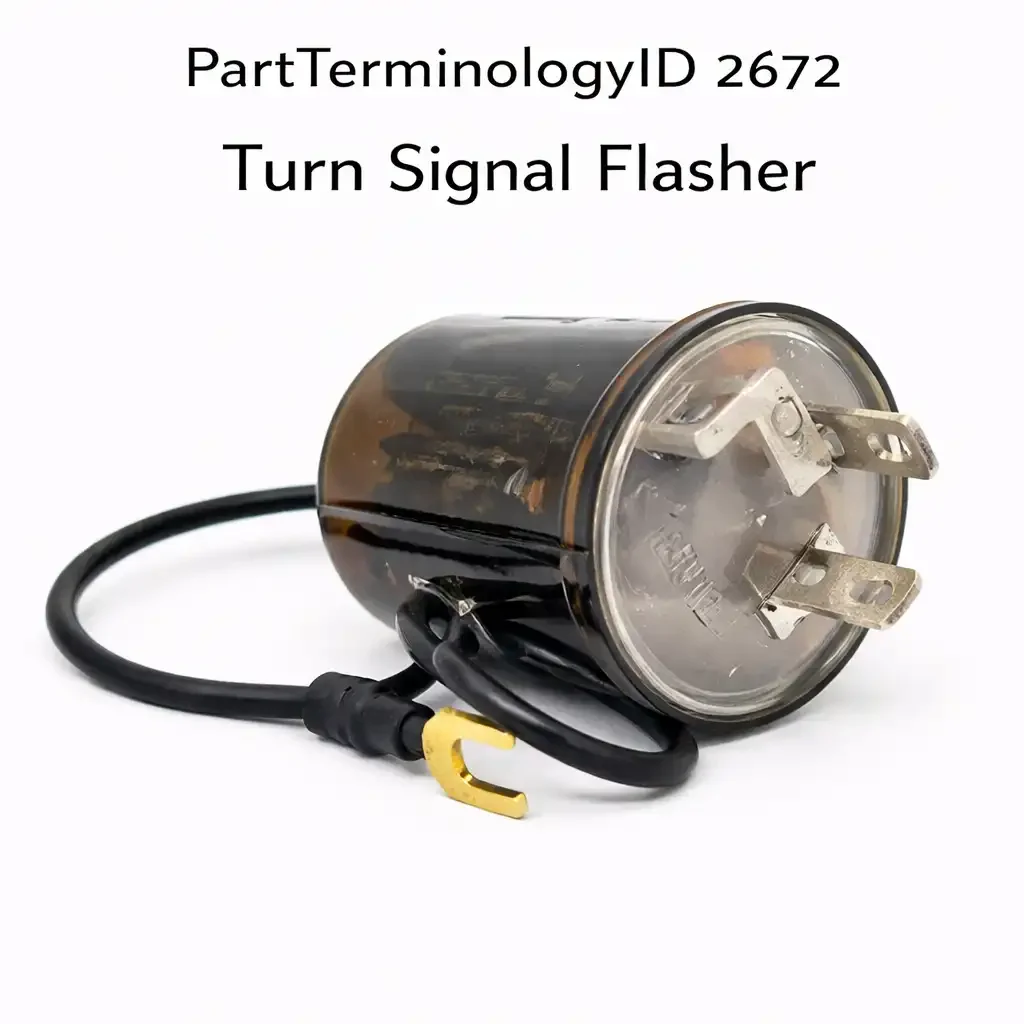
PartTerminologyID 2672, Turn Signal Flasher, is the relay unit that interrupts the circuit to the front and rear turn signal lamps on the driver-selected side at a regulated rate when the turn signal stalk is operated, producing the single-side alternating flash pattern that signals an intended direction change to other road users. That definition covers the function correctly and leaves unresolved every question that determines whether the replacement flasher produces a flash rate within the federally mandated 60 to 120 flashes-per-minute range at the vehicle's actual two-lamp load, whether it generates the correct fast-flash bulb-out indication when one lamp in the active circuit fails, whether its terminal count and terminal designations match the flasher socket in the fuse panel or instrument panel mounting location, whether its physical body dimensions fit the mounting socket without modification, whether it serves the turn signal function only or also serves the hazard warning function as a combined unit, whether it is compatible with LED turn signal bulbs or produces hyperflash from reduced current draw, whether it includes a pilot lamp terminal for the turn signal indicator lamps on the instrument cluster, and whether its internal timing architecture is a thermal bimetal element or an electronic circuit.
It does not specify the flash rate in flashes per minute at the rated two-lamp load, the maximum lamp load the flasher handles before the rate deviates from specification, whether the flasher produces a bulb-out fast-flash indication and how that indication is generated, the terminal count and terminal designations with their positions, whether the flasher type is thermal or electronic timer, whether it covers turn signal only or combined turn signal and hazard functions, the physical body diameter and length, the socket engagement type, the pilot lamp terminal current output, the operating voltage, or whether the unit is load-sensitive and will hyperflash with LED bulbs. A listing under PartTerminologyID 2672 that specifies only year, make, and model without terminal configuration, load rating, and flash rate cannot be evaluated by a technician replacing a flasher on a vehicle that may have been built with multiple flasher supplier variants across the production run.
For sellers, PartTerminologyID 2672 shares the federal compliance dimension established for PartTerminologyID 2668. Federal Motor Vehicle Safety Standard 108 governs both hazard warning and turn signal flash rates, and a turn signal flasher that produces an out-of-specification rate on the vehicle's actual lamp load is non-compliant for on-road use regardless of physical fit. The turn signal flasher differs from the hazard flasher in one critical operational respect: it is the component whose bulb-out detection function is the primary means by which the vehicle alerts the driver to a failed turn signal lamp. A turn signal flasher that does not produce a fast-flash bulb-out indication, or that produces a false fast-flash indication when all bulbs are intact, removes or undermines the driver's only automatic warning of a non-functional turn signal. This makes the bulb-out detection specification a required attribute for every listing under PartTerminologyID 2672, not an optional feature note.
The additional complexity specific to PartTerminologyID 2672 is the same combined-versus-separate architecture issue that applies to PartTerminologyID 2668, compounded by the bulb-out detection architecture difference between thermal and electronic flashers. A thermal flasher detects a burned-out bulb automatically because the missing bulb's current reduces the total load and accelerates the bimetal strip's cycle rate. An electronic timer flasher that uses a fixed-period oscillator produces the same flash rate regardless of bulb count and therefore does not produce a bulb-out fast-flash indication unless a separate current-monitoring circuit is added. An LED-compatible electronic flasher designed for LED bulb loads may produce a false bulb-out indication when mixed with incandescent bulbs because the current difference between an all-LED circuit and a one-incandescent-one-LED circuit triggers the monitoring threshold. Every one of these interactions must be anticipated in the listing attributes and addressed in the prevention language before a buyer orders for a vehicle with a mixed or LED bulb configuration.
What the Turn Signal Flasher Does
Interrupting the single-side circuit at a regulated rate
When the driver operates the turn signal stalk, the turn signal switch connects battery voltage to the turn signal flasher's input terminal. The flasher's internal switching element opens and closes the output circuit at intervals producing the specified flash rate, and the switched output is routed through the turn signal switch contacts to the front and rear lamps on the selected side. The instrument cluster turn signal indicator lamp on the same side is illuminated simultaneously with the exterior lamps through the pilot lamp terminal or through a tap on the lamp circuit, depending on the vehicle's wiring architecture.
The flash rate accuracy depends on the flasher's timing element matching the calibrated load. A thermal bimetal flasher calibrated for a two-lamp incandescent load produces the correct rate when two lamps of the specified wattage are connected. Adding a side repeater lamp, a mirror-mounted turn signal lamp, or a trailer turn signal to the circuit increases the load and slows the flash rate on a thermal flasher. Removing one lamp decreases the load and accelerates the rate, producing the fast-flash bulb-out indication. An electronic timer flasher using a fixed-period oscillator is not affected by load changes in either direction, maintaining the correct rate regardless of how many lamps are connected, but it therefore does not produce a bulb-out indication through rate change alone.
Bulb-out detection and the fast-flash indicator function
The turn signal flasher's bulb-out detection function is the primary automatic warning the vehicle provides to the driver when a turn signal lamp fails. On thermal flashers, bulb-out detection is inherent to the thermal timing mechanism: one lamp missing from the circuit reduces the current, which reduces the heat generated in the bimetal strip, which slows the strip's thermal cycling and produces a faster apparent flash rate because the strip spends less time in the heated-open state before cooling and closing again. The driver sees and hears the faster tick rate from the flasher relay and knows one lamp in the active circuit has failed.
On current-sensing electronic flashers, bulb-out detection is implemented by monitoring the total current through the output circuit against a threshold. When the current drops below the threshold corresponding to one missing lamp, the flasher switches to a high-rate output to alert the driver. The threshold current must be calibrated for the vehicle's specific lamp configuration: a flasher with a threshold set for two 27-watt lamps will not detect a missing lamp if the remaining lamp is an LED drawing 0.3 amperes, because the LED's current is below any meaningful threshold. Conversely, a flasher with a threshold set for LED bulbs may produce a false bulb-out indication when one LED and one incandescent lamp are in the circuit simultaneously, because the incandescent lamp's higher current pushes the total above the all-LED expected range.
The turn signal indicator lamp and pilot terminal function
The instrument cluster turn signal indicator lamp, which shows the driver which side is actively signaling, is powered either from a dedicated pilot terminal on the flasher or from a tap on the lamp output circuit. On vehicles that power the indicator from the flasher's pilot terminal, a flasher without a pilot terminal will produce functioning exterior turn signal lamps but no instrument cluster indicator, leaving the driver without confirmation of which side is signaling. On vehicles where the indicator is tapped directly off the lamp circuit, the indicator illuminates from the same switched voltage as the exterior lamps and a pilot terminal is not required.
The pilot terminal output is a low-current path, typically 50 to 200 milliamperes, that is always active when the flasher output is active regardless of the lamp circuit's load state. This means the indicator lamp on a pilot-terminal-powered vehicle illuminates correctly even if all exterior lamps in the turn signal circuit have failed, providing an indicator function that is independent of the lamp circuit's integrity. A flasher without a pilot terminal on a pilot-powered vehicle leaves the driver without the indicator on precisely those occasions when the exterior lamps are not functioning and the indicator's confirmation role is most critical.
The thermal-versus-electronic architecture and its listing consequences
The choice between a thermal bimetal flasher and an electronic timer flasher has downstream consequences for every other attribute in the listing. A thermal flasher is inherently load-sensitive: its flash rate, bulb-out detection, and LED compatibility are all determined by how much current flows through its bimetal element. An electronic flasher's flash rate is determined by its internal circuit, and bulb-out detection and LED compatibility are implemented by separate monitoring circuits that must be specified explicitly. A buyer who needs a replacement for a thermal flasher and receives an electronic timer flasher will find that the turn signal no longer produces a fast-flash bulb-out indication if the electronic unit does not include a current monitoring circuit, which is a loss of safety function that the buyer may not notice until a lamp fails during use.
The reverse substitution is equally problematic. A buyer who needs an LED-compatible electronic timer flasher and receives a thermal flasher will experience immediate hyperflash when LED bulbs are installed. The listing must state the flasher type as the primary technical attribute and must clearly indicate whether the unit includes a bulb-out detection circuit for electronic timer designs and whether the unit is load-sensitive for thermal designs. These two attributes together determine whether the replacement flasher preserves the full safety function of the original across all operating conditions the vehicle encounters.
Why This Part Generates Returns
Buyers return turn signal flashers because the function coverage is turn-signal-only and the vehicle uses a combined socket requiring both turn signal and hazard output from a single unit, the flasher is a thermal unit and the vehicle has LED turn signal bulbs producing immediate hyperflash, the terminal count matches but the terminal designations are reversed and incorrect circuit behavior results, the flasher is an electronic timer type without a current-monitoring circuit and the bulb-out fast-flash indication is absent after installation, the pilot lamp terminal is missing and the instrument cluster turn signal indicators do not illuminate, the flash rate is out of specification on the vehicle's actual lamp load because the flasher is calibrated for a different lamp wattage, the flasher body does not fit the mounting socket and the unit loosens under vibration, the operating voltage is 6 volts and the vehicle is a 12-volt system, the flasher produces a false bulb-out fast-flash with a mixed LED and incandescent lamp configuration because the current-monitoring threshold is set for an all-LED load, and the flasher is a combined unit installed in a vehicle with separate sockets producing turn signal circuit interference from the hazard output connecting to the wrong circuit path.
Status in New Databases
PIES/PCdb: PartTerminologyID 2672, Turn Signal Flasher
PIES 8.0 / PCdb 2.0: No change in PartTerminologyID or terminology label. Internal systems keyed to 2672 do not require remapping at the PIES 8.0 transition.
Top Return Scenarios
Scenario 1: "Turn-signal-only flasher in combined socket, hazard function absent after installation"
The vehicle uses a single combined flasher socket serving both the turn signal and hazard warning circuits. The replacement flasher covers turn signal function only and has no hazard output circuit. After installation, the turn signals operate correctly. The hazard warning switch produces no flashing at any corner because the hazard circuit's flasher output is absent. The buyer discovers the hazard failure two days after installation when attempting to use the hazard switch during a highway breakdown.
Prevention language: "Function coverage: [turn signal only / hazard only / combined turn signal and hazard]. This flasher covers [turn signal function only / both turn signal and hazard warning functions]. Verify the function coverage matches the original before installation. Installing a turn-signal-only flasher in a combined socket will disable the hazard warning system."
Scenario 2: "Thermal flasher on LED turn signal vehicle, hyperflash on both sides immediately"
The vehicle has LED turn signal bulbs at all four corners. The replacement is a thermal bimetal flasher calibrated for incandescent bulbs. On first use of the turn signal, both the left and right sides hyperflash at approximately 220 flashes per minute. The buyer returns the flasher and notes the hyperflash was immediate from the first stalk activation.
Prevention language: "LED compatible: [yes / no]. This flasher [is / is not] compatible with LED turn signal bulbs. Installing this flasher on a vehicle with LED turn signal bulbs will produce a hyperflash rate significantly above the federal maximum of 120 flashes per minute. For vehicles with LED turn signal bulbs, specify an LED-compatible fixed-timer flasher with a current monitoring circuit calibrated for LED load levels."
Scenario 3: "Electronic timer flasher without current monitoring, bulb-out fast-flash absent"
The replacement flasher is an electronic fixed-timer unit that produces a consistent flash rate regardless of load. The vehicle's original thermal flasher produced a fast-flash bulb-out indication when a lamp failed. After installing the replacement, a rear turn signal lamp burns out during the following week. The driver does not notice the failed lamp because the turn signal continues to flash at the normal rate with no fast-flash alert. The driver receives a traffic citation for a non-functional turn signal two weeks after the lamp failure.
Prevention language: "Bulb-out detection: [current monitoring circuit included / thermal rate-change / none]. This flasher [produces / does not produce] a fast-flash bulb-out indication when a lamp in the active circuit fails. For applications where the fast-flash bulb-out alert is a required safety function, verify the replacement flasher includes a current monitoring circuit that detects a missing lamp and switches to a high-rate output."
Scenario 4: "False bulb-out hyperflash with mixed LED and incandescent installation"
The vehicle has one LED turn signal lamp at the front and one incandescent lamp at the rear on each side, a mixed installation from a partial LED upgrade. The replacement LED-compatible flasher has a current monitoring threshold calibrated for an all-LED two-lamp load of approximately 0.6 amperes total. The mixed installation draws approximately 2.3 amperes total from the single incandescent lamp, which is above the monitoring threshold's expected all-LED range. The flasher interprets the elevated current as an anomaly and produces a continuous fast-flash pattern on both sides as a fault indication.
Prevention language: "Compatible lamp configuration: [all incandescent / all LED / mixed LED and incandescent]. Minimum load for normal flash rate: [X] amperes. Maximum load for normal flash rate: [X] amperes. Verify the total current draw of the connected lamp configuration falls within the flasher's normal operating load range. A flasher calibrated for an all-LED load will produce incorrect flash behavior when mixed with incandescent lamps whose higher current exceeds the calibrated range."
Scenario 5: "Terminal designations reversed, left turn signal activates right side lamps"
The original flasher has a three-terminal configuration with the L terminal on the left and the lamp output circuit assigned to left-side and right-side outputs through the turn signal switch. The replacement flasher has the same terminal designations but the L terminal on the right. The socket is non-polarized and the flasher is installed in the inverted orientation. The left turn signal stalk activates the right-side lamps and vice versa. The buyer returns the flasher and reports the left and right signals are crossed.
Prevention language: "Terminal designations and positions: B (battery): [position]. L (lamp): [position]. P (pilot): [position]. This flasher must be installed with the [B / L / P] terminal in the [top / left / right] position of the socket as viewed from the terminal face. A non-polarized socket will accept the flasher in multiple orientations. Verify the terminal positions before installation to prevent reversed circuit connections."
Scenario 6: "Pilot terminal absent, instrument cluster turn signal indicators do not illuminate"
The original flasher has three terminals including a pilot lamp terminal that powers both left and right turn signal indicator lamps on the instrument cluster. The replacement is a two-terminal unit with no pilot terminal. Both sides flash correctly at the exterior lamps. Neither instrument cluster indicator illuminates during turn signal operation. The buyer returns the flasher because driving without instrument cluster turn signal confirmation is considered unsafe, particularly in vehicles where the exterior lamps are not visible from the driver's position.
Prevention language: "Pilot lamp terminal: [included / not included]. Terminal count: [2 / 3]. A two-terminal replacement without a pilot lamp terminal will not illuminate the turn signal indicator lamps on the instrument cluster on vehicles that power the indicators from the flasher's pilot circuit. Verify whether the original flasher includes a pilot terminal before selecting a two-terminal replacement."
Scenario 7: "Flash rate out of specification, vehicle has side repeater lamps adding load beyond calibration"
The vehicle has front, rear, and side repeater turn signal lamps on each side, for a total of three lamps per side in the active circuit. The replacement flasher is calibrated for a standard two-lamp load. The three-lamp load per side exceeds the flasher's calibration range and produces a flash rate of 52 flashes per minute, below the federal minimum of 60. The vehicle fails a state safety inspection on turn signal flash rate.
Prevention language: "Calibration load: [X] lamps per side at [X] watts each. Load range for specification flash rate: [X] to [X] amperes per side. Vehicles with side repeater turn signal lamps, mirror-mounted turn signals, or trailer turn signals connected to the vehicle's turn signal circuit carry a higher per-side load than the standard two-lamp calibration. Verify the total per-side lamp load falls within the flasher's rated range."
Scenario 8: "Six-volt flasher installed on twelve-volt vehicle, no output"
The replacement flasher is a 6-volt unit packaged without a prominent voltage marking. The vehicle is a 12-volt system. The 12-volt supply overdrives the bimetal element's thermal design point and the strip remains in the open position permanently. No flash output is produced on either side. The buyer returns the flasher as defective. The 6-volt origin of the unit is identified on the underside of the body in small print that was not visible in the listing images.
Prevention language: "Operating voltage: [6V / 12V / 24V]. This flasher is designed for [6 / 12 / 24]-volt electrical systems. Verify the vehicle's electrical system voltage matches the flasher's rated voltage. A 6-volt flasher installed in a 12-volt system will not produce flash output and may fail immediately from thermal overstress on the bimetal element."
What to Include in the Listing
Core essentials
PartTerminologyID: 2672
component: Turn Signal Flasher
function coverage: turn signal only or combined turn signal and hazard (mandatory, in title)
flasher type: thermal bimetal or electronic timer (mandatory)
LED compatible: yes or no (mandatory)
bulb-out detection: thermal rate-change, current monitoring circuit, or none (mandatory)
operating voltage: 6V, 12V, or 24V (mandatory)
terminal count (mandatory)
terminal designations and positions: B, L, P, X, GND (mandatory for all terminals)
flash rate at rated load in flashes per minute (mandatory)
rated load per side in amperes (mandatory)
load range per side within which flash rate remains in specification (mandatory)
compatible lamp configuration: all incandescent, all LED, or mixed (mandatory)
pilot lamp terminal: included or not included (mandatory)
pilot lamp terminal current output in milliamperes where present (mandatory)
flasher body diameter in mm (mandatory)
flasher body length in mm (mandatory)
socket engagement type: round plug-in, blade terminal, or spade terminal (mandatory)
FMVSS 108 compliance statement (mandatory)
OEM part number cross-reference where available (mandatory)
quantity: 1
Fitment essentials
year/make/model/submodel
architecture type: separate turn signal socket or combined turn signal and hazard socket
mounting location: fuse panel socket, under-dash bracket, or instrument panel clip
note for vehicles with side repeater lamps or mirror-mounted turn signals that increase the per-side lamp load beyond the standard two-lamp calibration
note for vehicles produced during the transition from separate to combined flasher architecture
bulb type compatibility note for LED-equipped and mixed-bulb vehicles
OEM part number cross-reference for verification against existing flasher markings
Image essentials
flasher shown from the terminal face with all terminals labeled by designation and position
flasher body shown from the side with diameter and length measurement references
LED compatibility and bulb-out detection designations shown on packaging or body label
FMVSS 108 compliance marking shown where present
OEM part number marking shown on flasher body where present
Catalog Checklist for ACES/PIES Teams
PartTerminologyID = 2672
require function coverage: turn signal only or combined (mandatory)
require flasher type: thermal or electronic timer (mandatory)
require LED compatibility designation (mandatory)
require bulb-out detection type (mandatory)
require operating voltage (mandatory)
require terminal count and terminal designations with positions (mandatory)
require flash rate in flashes per minute at rated load (mandatory)
require rated load per side and load range (mandatory)
require compatible lamp configuration (mandatory)
require pilot lamp terminal status (mandatory)
require body dimensions (mandatory)
require FMVSS 108 compliance statement (mandatory)
prevent function coverage omission: a turn-signal-only flasher in a combined socket disables hazard warning; function coverage must be the first stated attribute
prevent LED compatibility omission: current-sensing flashers hyperflash with LED bulbs immediately; LED compatibility is a required attribute in the current LED-dominant replacement bulb market
prevent bulb-out detection omission: an electronic timer flasher without a current monitoring circuit removes the fast-flash bulb-out warning; bulb-out detection type must be stated on every electronic flasher listing
prevent mixed-bulb false hyperflash omission: LED-compatible flashers with current monitoring thresholds set for all-LED loads will false-hyperflash with mixed incandescent and LED configurations; compatible lamp configuration must be stated
flag FMVSS 108 compliance as a required attribute: a flasher that produces an out-of-specification rate on the vehicle's actual load is non-compliant for on-road use
differentiate from hazard warning flasher (PartTerminologyID 2668): the hazard flasher controls simultaneous four-corner flashing; the turn signal flasher controls single-side alternating flashing; on combined-socket vehicles both are served by a single unit listed under both PartTerminologyIDs with cross-reference
FAQ (Buyer Language)
What does the turn signal flasher do?
The turn signal flasher interrupts the circuit to the front and rear turn signal lamps on the activated side at a regulated rate when the driver operates the turn signal stalk. It produces the single-side alternating flash pattern that signals an intended turn or lane change to other road users. Federal Motor Vehicle Safety Standard 108 requires the flash rate to fall between 60 and 120 flashes per minute. A failed flasher produces no flashing, continuous lamp illumination on the active side, or an out-of-specification rate.
What is the difference between a turn signal flasher and a hazard warning flasher?
The turn signal flasher controls single-side alternating flashing when the turn signal stalk is operated. The hazard warning flasher controls simultaneous four-corner flashing when the hazard switch is activated. On vehicles with separate flasher sockets the two are distinct physical components. On most vehicles from the late 1990s onward a single combined unit serves both functions. A listing under PartTerminologyID 2672 must state whether the unit covers turn signal only or both functions to prevent a combined-socket buyer from disabling their hazard system.
Why does my turn signal hyperflash after installing LED bulbs?
Thermal and current-sensing electronic flashers calibrate their flash rate based on the current draw of the connected bulbs. LED replacement bulbs draw 80 to 95 percent less current than incandescent bulbs. The dramatically reduced current causes a thermal flasher to cycle faster than normal and causes a current-sensing flasher to interpret the low draw as a bulb-out condition, both producing a hyperflash rate far above the normal range. Replace the flasher with an LED-compatible fixed-timer unit to restore the correct rate with LED bulbs installed.
My turn signal flashes fast on one side only. Is the flasher faulty?
Fast flashing on one side only is almost always caused by a burned-out turn signal bulb on that side rather than a faulty flasher. The reduced current from a missing bulb causes a current-sensing flasher to increase its rate on that circuit. Inspect all turn signal bulbs on the fast-flashing side before replacing the flasher. If all bulbs are intact and the fast flash persists on one side only, a failing flasher with asymmetric output degradation may be the cause, but this is significantly less common than a burned-out lamp.
Can the turn signal flasher affect the hazard warning system?
On vehicles with a combined unit, replacing the turn signal flasher restores both functions simultaneously. On vehicles with separate sockets, the turn signal flasher has no direct effect on the hazard circuit. However, on some vehicles the turn signal and hazard circuits share wiring segments between the flasher sockets and the lamps, so a short in the turn signal path may produce symptoms in the hazard circuit. Confirm the hazard system functions correctly after any turn signal flasher replacement regardless of the vehicle's architecture type.
How do I identify the correct turn signal flasher for my vehicle?
Locate the original flasher and note the terminal count, terminal designations stamped on the body, the physical body diameter and length, and the operating voltage. Common designations are B for battery positive, L for lamp output, and P or X for pilot lamp. The terminal count, designations, body dimensions, and operating voltage together identify the correct replacement more reliably than year, make, and model alone. Also confirm whether the vehicle uses LED bulbs before ordering, as LED compatibility is a separate required attribute from the terminal configuration.
Cross-Sell Logic
Hazard Warning Flasher (PartTerminologyID 2668): the companion unit that controls four-corner hazard flashing; on separate-socket vehicles both units should be inspected when either is replaced, as they experience similar thermal stress and service life; on combined-socket vehicles a single replacement unit covers both PartTerminologyIDs
Turn Signal Bulbs: the load the flasher drives; LED turn signal bulbs require an LED-compatible flasher; if the flasher is being replaced due to LED-induced hyperflash, the bulbs and flasher must be addressed as a compatible pair
Turn Signal Switch: the driver-operated stalk that routes the flasher's output to the selected side; a failed turn signal switch that does not make full engagement on one side will produce an intermittent flash on that side that is misdiagnosed as a flasher failure; inspect the switch before replacing the flasher on single-side intermittent complaints
Fuse: the turn signal circuit is protected by a dedicated fuse; a blown fuse produces no turn signal operation and is the first item to verify before replacing the flasher
Body Control Module: on late-model vehicles where the BCM manages turn signal timing internally and outputs to the lamps directly, the BCM takes over the flasher function and no discrete flasher unit exists; confirm the vehicle uses a discrete flasher before ordering under PartTerminologyID 2672
Frame as "the turn signal flasher generates the timing signal the turn signal switch routes to the lamps. The hazard flasher generates the timing signal for simultaneous four-corner activation. The turn signal switch selects which side receives the flasher output. The bulbs convert the switched current into the visible signal. The BCM replaces the discrete flasher on late-model vehicles where timing is managed internally. All are in the same directional signaling pathway from the stalk to the road."
Final Take for PartTerminologyID 2672
Turn Signal Flasher (PartTerminologyID 2672) is the PartTerminologyID in the lighting control series where bulb-out detection architecture and LED compatibility together produce the highest rate of safety-function returns in the current market. A thermal flasher replaced with an electronic timer flasher without a current monitoring circuit removes the fast-flash bulb-out indication that is the driver's automatic warning of a non-functional turn signal. A thermal or current-sensing flasher replaced on a vehicle with LED bulbs produces immediate hyperflash that is at minimum annoying and at maximum a citation for an out-of-specification signal rate. Both failures are caused by a single omission in the listing: the flasher type and bulb-out detection architecture were not stated, and the buyer ordered without knowing whether the replacement preserved the original's safety detection function.
State the function coverage in the title: turn signal only or combined. State the flasher type: thermal or electronic timer. State the LED compatibility. State the bulb-out detection type. State the operating voltage. State the terminal count and designations with positions. State the flash rate at rated load and the per-side load range. State the compatible lamp configuration. State the pilot lamp terminal status. State the body dimensions. State the FMVSS 108 compliance. For PartTerminologyID 2672, flasher type, bulb-out detection architecture, and LED compatibility are the three attributes that determine whether the replacement flasher preserves the full turn signal safety function or generates a return because the driver discovered a missing safety feature during an actual lamp failure on the road.