
Written by Arthur Simitian | PartsAdvisory
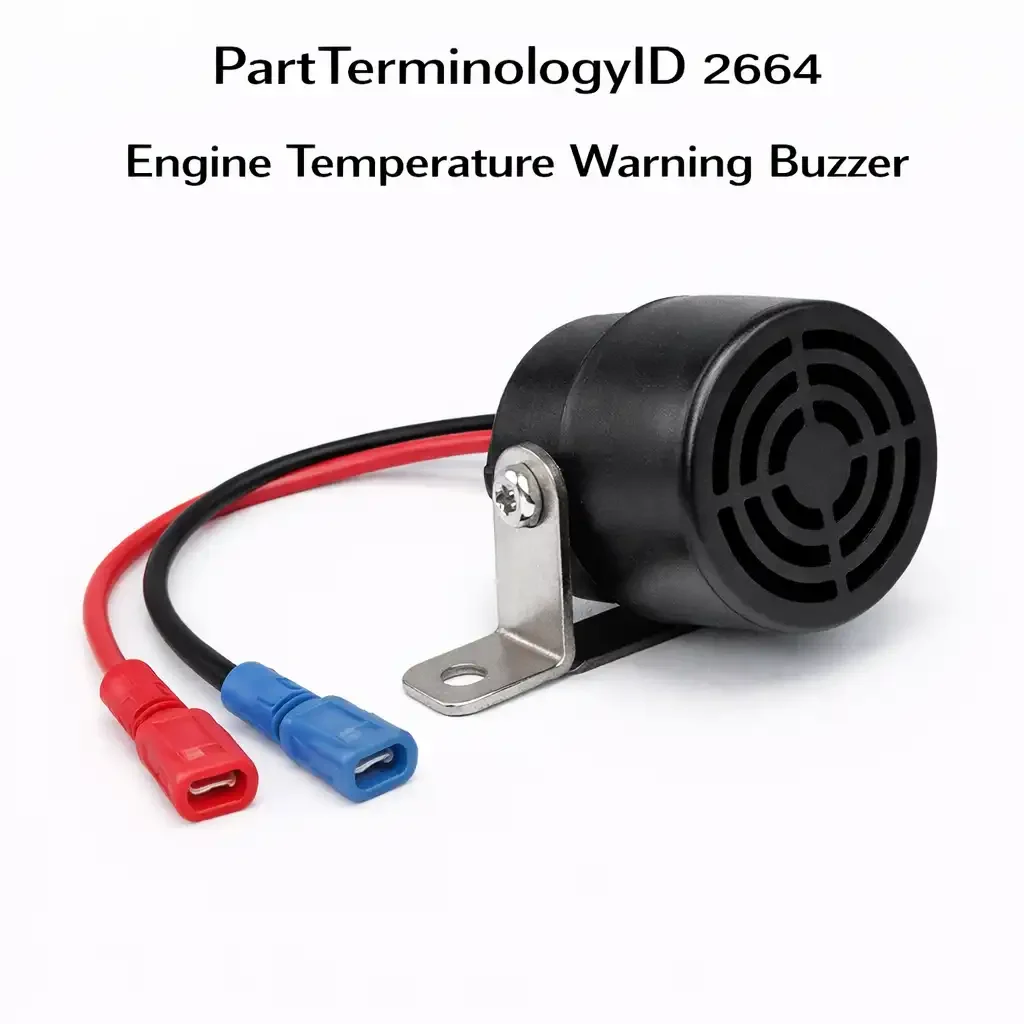
PartTerminologyID 2664, Engine Temperature Warning Buzzer, is the audible alert device that activates when the engine coolant temperature exceeds a threshold indicating risk of engine damage, supplementing the visual warning lamp on the instrument cluster with an audible signal that reaches the driver regardless of instrument panel attention. That definition covers the function correctly and leaves unresolved every question that determines whether the replacement buzzer activates at the same trigger voltage as the original, whether its sound output level is audible in the vehicle's cabin over road and engine noise at highway speed, whether it mounts in the original location without modification, whether the connector pin count and terminal type match the vehicle harness, whether it triggers from the same circuit input as the original, and whether it produces a continuous tone, an intermittent tone, or a pulsed alert pattern that matches driver expectation for the vehicle's warning system design.
It does not specify the trigger voltage threshold, the sound output level in decibels at one meter, the alert tone pattern, the connector pin count, the mounting configuration, the operating temperature range, or whether the buzzer is triggered by the instrument cluster warning lamp circuit, a dedicated ECM output, or a standalone coolant temperature switch. A listing that specifies only year, make, and model without trigger voltage, sound output, and circuit input type cannot be evaluated by a technician replacing a buzzer that the driver reports as inaudible or continuously sounding at normal operating temperature.
What the Engine Temperature Warning Buzzer Does
Activating on the overheat threshold signal
The buzzer receives a trigger signal from the engine temperature warning circuit when coolant temperature reaches the overheat threshold. On most applications this trigger is the same switched voltage that illuminates the temperature warning lamp: when the coolant temperature sensor signal reaches the threshold, the warning lamp circuit completes and the same voltage activates the buzzer simultaneously. The buzzer's internal trigger voltage threshold must match this circuit's activation voltage. A buzzer calibrated for a 12-volt trigger on a vehicle whose warning circuit activates at 7 volts through a current-limiting resistor will not activate at all, leaving the driver with a visual warning lamp and no audible alert.
Delivering an audible alert over cabin noise
The sound output level of the buzzer must be sufficient to reach the driver over the ambient noise level in the vehicle at the conditions most likely to produce an overheat event: highway speed with windows closed, climate control active, and radio on. A buzzer rated at 70 dB at one meter may be inaudible in a vehicle whose ambient cabin noise at highway speed reaches 72 to 75 dB. The original buzzer's sound output level was specified to exceed the vehicle's design ambient noise level with adequate margin. A replacement with a lower sound output rating than the original will be returned by buyers who report the warning as inaudible during the overheat event it was designed to signal.
Why This Part Generates Returns
Buyers return engine temperature warning buzzers because the trigger voltage threshold does not match the vehicle's warning circuit activation voltage and the buzzer either fails to activate or activates continuously at normal operating temperature, the sound output level is below the original and the warning is inaudible at highway speed, the alert tone pattern is continuous when the original produced an intermittent pulse that the driver associates with the warning system, the connector pin count differs from the vehicle harness and the connector does not mate, the mounting configuration does not fit the original bracket or panel location and the buzzer cannot be secured in the original position, and the buzzer is triggered by a dedicated coolant temperature switch circuit when the vehicle's system uses the instrument cluster warning lamp circuit as the trigger source.
Status in New Databases
PIES/PCdb: PartTerminologyID 2664, Engine Temperature Warning Buzzer
PIES 8.0 / PCdb 2.0: No change in PartTerminologyID or terminology label.
Top Return Scenarios
Scenario 1: "Buzzer activates continuously at normal operating temperature, incorrect trigger voltage threshold"
The replacement buzzer has a trigger threshold of 5 volts. The vehicle's warning lamp circuit produces a background voltage of 6 volts at the buzzer input during normal operation from a slight imbalance in the warning circuit resistor network. The buzzer activates immediately on ignition and sounds continuously regardless of coolant temperature. The buyer returns it as defective.
Prevention language: "Trigger voltage threshold: [X] volts minimum. This buzzer activates when the trigger input exceeds [X] volts. Verify the vehicle's warning circuit activation voltage matches the buzzer's trigger threshold before installation."
Scenario 2: "Sound output inaudible at highway speed, dB rating below vehicle cabin noise floor"
The replacement buzzer is rated at 68 dB at one meter. The vehicle's cabin noise at 70 mph with climate control active reaches 74 dB at the driver's ear. The buzzer activates correctly during an overheat event on a highway trip but the driver does not hear it and continues driving until the temperature gauge enters the red. The buyer returns the buzzer as inadequate for the application.
Prevention language: "Sound output: [X] dB at one meter. For highway-speed applications, verify the sound output level exceeds the vehicle's cabin noise floor at the driver's position with climate control and audio active. Minimum recommended output for highway applications is 85 dB at one meter."
What to Include in the Listing
PartTerminologyID: 2664
component: Engine Temperature Warning Buzzer
trigger voltage threshold in volts (mandatory)
trigger circuit source: warning lamp circuit, dedicated ECM output, or standalone coolant temperature switch (mandatory)
sound output level in dB at one meter (mandatory)
alert tone pattern: continuous, intermittent, or pulsed (mandatory)
connector pin count (mandatory)
terminal type and wire range in AWG (mandatory)
mounting configuration: bracket mount, snap-in, or adhesive (mandatory)
operating temperature range in degrees Celsius (mandatory)
current draw in milliamperes (mandatory)
OEM part number cross-reference where available (mandatory)
Catalog Checklist for ACES/PIES Teams
PartTerminologyID = 2664
require trigger voltage threshold (mandatory)
require trigger circuit source type (mandatory)
require sound output level in dB (mandatory)
require alert tone pattern (mandatory)
require connector pin count and circuit assignments (mandatory)
require mounting configuration (mandatory)
prevent trigger voltage omission: a buzzer with an incorrect threshold activates continuously or not at all; this is the highest-consequence specification failure for this PartTerminologyID
prevent sound output omission: an inaudible buzzer produces no driver benefit during an overheat event; dB rating must be stated and must exceed the vehicle's cabin noise floor
differentiate from engine temperature sensor: the sensor measures and reports coolant temperature; the buzzer produces the audible alert when that measurement exceeds the threshold
differentiate from temperature warning lamp: the lamp provides the visual alert; the buzzer provides the audible supplement; both serve the same warning trigger circuit on most applications
FAQ (Buyer Language)
What does the engine temperature warning buzzer do?
The engine temperature warning buzzer produces an audible alert when engine coolant temperature exceeds the overheat threshold. It supplements the visual warning lamp on the instrument cluster, ensuring the driver receives the overheat warning even when attention is not on the gauges. The buzzer activates from the same circuit that illuminates the temperature warning lamp on most vehicle applications.
How is the engine temperature warning buzzer triggered?
Most buzzers are triggered by the switched voltage that activates the temperature warning lamp on the instrument cluster. When the coolant temperature sensor signal reaches the overheat threshold, the warning lamp circuit completes and the same voltage activates the buzzer simultaneously. Some designs use a dedicated trigger circuit from the ECM or a standalone coolant temperature switch separate from the warning lamp circuit.
Why is my engine temperature warning buzzer sounding continuously at normal operating temperature?
A buzzer that sounds at normal operating temperature indicates the trigger circuit is active when it should not be. The most common causes are a failed coolant temperature sensor sending an out-of-range high signal, a short to ground in the warning lamp circuit keeping the warning active, or a replacement buzzer with a trigger voltage threshold that is too low for the vehicle's circuit. Verify the coolant temperature sensor output and the warning lamp circuit before replacing the buzzer a second time.
Cross-Sell Logic
Engine Coolant Temperature Sensor: the input device that triggers the warning circuit the buzzer monitors; a failed sensor that outputs an out-of-range signal will activate a correctly specified buzzer at normal operating temperature
Temperature Warning Lamp: the visual counterpart to the buzzer's audible alert; both serve the same trigger circuit on most applications and should be confirmed functional together
Thermostat: a stuck-open thermostat prevents the engine from reaching normal operating temperature; a stuck-closed thermostat accelerates overheating and is the most common mechanical cause of the overheat condition the buzzer is designed to warn against
Final Take for PartTerminologyID 2664
Engine Temperature Warning Buzzer (PartTerminologyID 2664) is the PartTerminologyID in the engine warning system series where trigger voltage mismatch and inadequate sound output together account for the two return drivers with the most significant safety consequences. A buzzer that activates continuously at normal operating temperature trains the driver to ignore it. A buzzer that is inaudible at highway speed provides no protection during the overheat event it exists to announce. Both failures are preventable by two attribute statements: trigger voltage threshold and sound output level in decibels. State both on every listing. For PartTerminologyID 2664, those two numbers determine whether the replacement buzzer functions as a safety device or as a nuisance that gets disconnected.