
Written by Arthur Simitian | PartsAdvisory
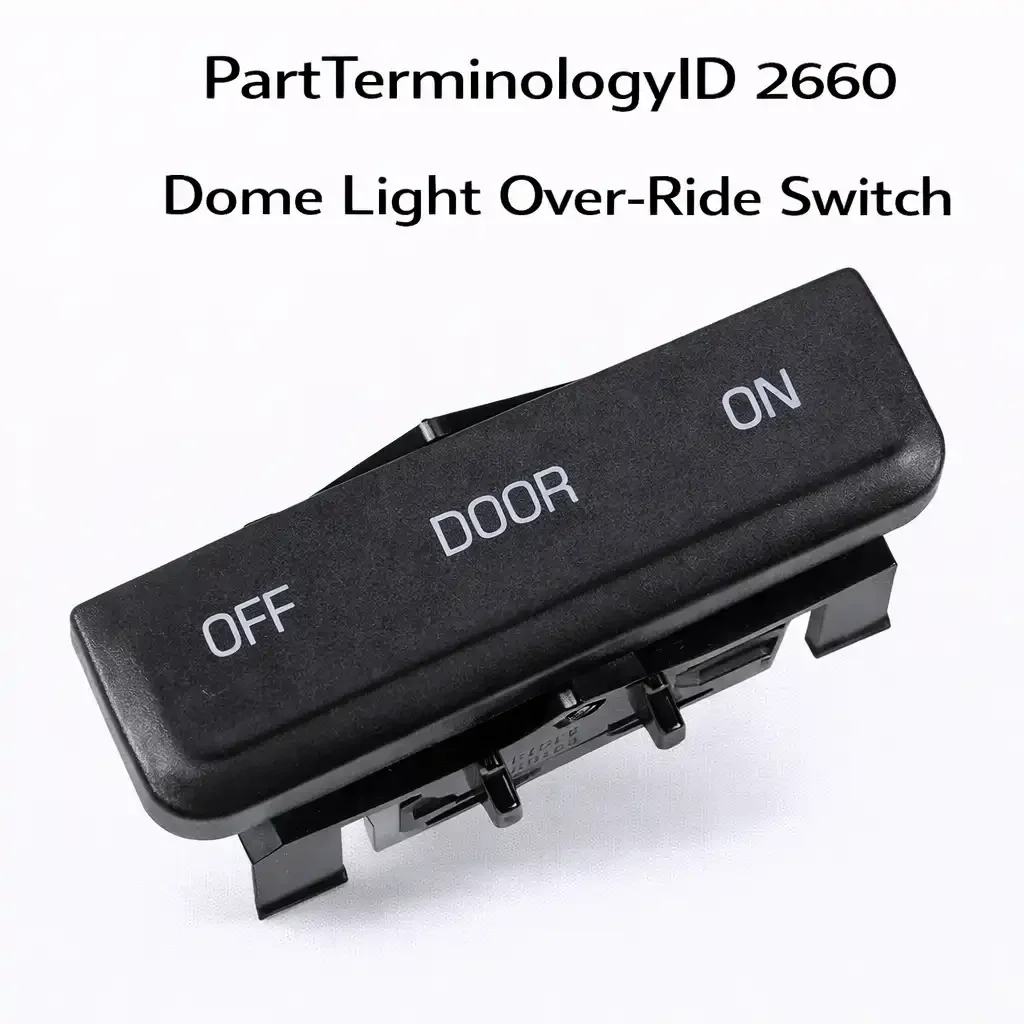
PartTerminologyID 2660, Dome Light Over-Ride Switch, is the driver-operated switch that disables the automatic door-activated interior lighting circuit, preventing the dome light and courtesy lights from illuminating when a door is opened regardless of the dome light switch's own position. That definition covers the function correctly and leaves unresolved every question that determines whether the replacement switch uses the same switching mechanism as the original, whether it has the same number of positions and the same circuit behavior at each position, whether the connector pin count and terminal type match the vehicle harness, whether the switch body and mounting tab geometry fit the instrument panel cutout or the headlight switch assembly cavity where the original is installed, whether the switch actuator type matches the original's design as a push-button, slide, or rocker, whether the switch illumination matches the original's backlit or non-illuminated specification, and whether the switch controls only the dome light circuit or also controls the courtesy light circuits at all door positions simultaneously.
It does not specify the switch type, whether it is a push-button, slide, or rocker design, the number of switch positions and the circuit state at each position, the connector pin count, the terminal type and wire range, the switch body dimensions and mounting tab geometry, whether the switch is backlit and if so the illumination color and the bulb or LED type used for backlighting, which interior lighting circuits the switch controls beyond the dome light itself, whether the switch is a standalone component or integrated into a multi-function panel assembly, the switch current rating, or whether the switch body is designed for snap-in panel mounting, screw mounting, or clip mounting. A listing under PartTerminologyID 2660 that specifies only year, make, and model without switch type, position count, and circuit coverage cannot be evaluated by a buyer who needs to confirm the replacement controls the correct circuits and mounts in the original location before ordering.
For sellers, PartTerminologyID 2660 presents a specific catalog challenge because the dome light over-ride function is handled differently across vehicle manufacturers, model lines, and production years. On many domestic full-size trucks and SUVs from the 1990s and 2000s, the over-ride switch is a dedicated push-button or slide switch on the instrument panel that interrupts the door jamb switch ground circuit for all doors simultaneously. On passenger cars from the same era, the over-ride function is often a third position on the dome light switch itself rather than a separate switch component. On late-model vehicles with body control module management of interior lighting, the over-ride function may be a soft switch input to the BCM rather than a hardwired circuit interrupt, changing the switch's role from a direct circuit interrupt to a signal input that requires the BCM to recognize the correct resistance or voltage from the switch contact combination. A listing that does not distinguish between these circuit architectures will be ordered by buyers across all three system types and will function correctly for only one of them.
What the Dome Light Over-Ride Switch Does
Interrupting the door jamb switch trigger circuit
In the most common circuit architecture for this function, the dome light over-ride switch is wired in series with the ground circuit that the door jamb switches complete when a door is opened. The door jamb switch at each door is a normally-open switch that closes when the door opens, completing a ground path that activates the dome light and courtesy light circuits through the body wiring. The dome light over-ride switch sits in series with this ground circuit path. When the over-ride switch is in the active position, the ground circuit is complete and the door jamb switches can activate the interior lights normally. When the over-ride switch is moved to the disable position, it opens the series ground circuit and prevents the door jamb switches from completing the activation path regardless of how many doors are open.
This series-ground circuit architecture means the over-ride switch carries only the low-current ground signal for the door jamb switch trigger circuit, not the full current of the dome light bulb. The switch current rating required is therefore relatively low, typically under 2 amperes for the trigger circuit on most passenger vehicle applications. A replacement switch with a lower current rating than the original is rarely a failure concern in this architecture, but a replacement that uses a different circuit topology, such as a switch designed to interrupt the positive supply side of the dome light circuit rather than the ground trigger circuit, will produce incorrect circuit behavior when installed in a ground-interrupt application even if the switch body and connector mate correctly.
BCM-managed interior lighting systems and signal input switches
On vehicles where the body control module manages all interior lighting functions, the dome light over-ride switch is not a hardwired circuit interrupt but a signal input that the BCM monitors. The switch provides a specific voltage or resistance value to a BCM input pin that the module interprets as an override command. The BCM then disables its interior lighting output circuits in response to that input, regardless of what the door jamb switches report. The switch in this architecture is functionally a two-state input device rather than a circuit interrupt device, and the BCM's programming determines what happens when the override input is detected.
A replacement switch for a BCM-managed application must produce the same signal output at each switch position as the original. If the original switch produces a ground signal at the BCM input pin in the override-active position, the replacement must also produce a ground signal at that pin in the same switch position. A replacement that produces an open circuit rather than a ground in the override-active position will not be recognized by the BCM as an override command and the dome light will continue to illuminate on door opening despite the switch being in the disable position. The signal output behavior at each switch position must be stated in the listing as a required attribute for BCM-managed lighting applications.
Position count and the three-position switch problem
The most common dome light over-ride switch is a two-position design: override active and override inactive. The dome light operates normally in the inactive position and is prevented from door-activating in the active position. Some vehicles, particularly domestic trucks and full-size SUVs with overhead console lighting controls, use a three-position switch that combines the dome light on-off function and the over-ride function in a single switch body. The three positions are typically door-activated, continuous on, and disabled. The continuous-on position illuminates the dome light regardless of door state. The door-activated position allows normal door-triggered illumination. The disabled position prevents dome light illumination regardless of door state or switch position.
A two-position replacement switch installed on a three-position circuit application will provide the override-active and override-inactive states but will not provide the continuous-on state that the original three-position switch offers. The buyer who uses the continuous-on state regularly will return the switch because the continuous-on function is absent. The position count must be stated as a required attribute and must match the original switch's position count exactly to provide equivalent circuit function coverage.
Why This Part Generates Returns
Buyers return dome light over-ride switches because the switch type does not match the original and a rocker switch is received for a push-button application or a slide switch is received for a rocker application and the actuator does not fit the panel cutout, the position count does not match and a two-position switch is received for a three-position application leaving the continuous-on function absent, the connector pin count differs from the vehicle harness and the connector does not mate, the switch body dimensions do not fit the instrument panel cutout and the mounting tabs do not engage the panel clips, the switch is not backlit and the original was backlit as part of the instrument panel illumination circuit causing the replacement location to be dark in the panel at night, the switch controls only the dome light circuit and the original controlled both the dome light and the door courtesy light circuits simultaneously leaving the courtesy lights unaffected by the replacement switch, the switch is designed for a BCM-managed signal input architecture and the vehicle uses a hardwired ground interrupt circuit producing incorrect circuit behavior, and the switch current rating is inadequate for a vehicle application where the dome light circuit is wired through the switch rather than through a relay triggered by the switch.
Status in New Databases
PIES/PCdb: PartTerminologyID 2660, Dome Light Over-Ride Switch
PIES 8.0 / PCdb 2.0: No change in PartTerminologyID or terminology label. Internal systems keyed to 2660 do not require remapping at the PIES 8.0 transition.
Top Return Scenarios
Scenario 1: "Two-position switch received for three-position application, continuous-on function absent"
The vehicle's original switch has three positions: disabled, door-activated, and continuous on. The replacement is a two-position switch covering disabled and door-activated only. The buyer installs the switch and uses the vehicle for two weeks before noticing the continuous-on position is missing. The buyer uses continuous-on regularly when loading cargo at night. The switch is returned because the original function set is not replicated.
Prevention language: "Switch positions: [2 / 3]. Position 1: [disabled]. Position 2: [door-activated]. Position 3 where present: [continuous on]. Verify the replacement switch provides the same number of positions as the original. A two-position replacement installed on a three-position circuit will not provide the continuous-on function present on the original."
Scenario 2: "Switch not backlit, panel illumination circuit incomplete, switch location dark at night"
The original switch has an integral backlight that connects to the instrument panel illumination circuit and illuminates the switch legend at night. The replacement switch has no backlighting. The buyer installs the switch and discovers the switch location is dark when the headlights are on and the instrument panel is illuminated. The unused backlight connector from the vehicle harness has no corresponding socket on the replacement. The switch is returned because the absence of backlighting is considered a safety inconvenience on a switch used in low-light conditions.
Prevention language: "Switch illumination: [backlit / non-illuminated]. Illumination circuit: [panel dimmer controlled / constant 12V]. Verify the illumination specification matches the original. A non-illuminated replacement installed in a backlit application will leave the switch location dark on the instrument panel when the headlights are on."
Scenario 3: "Switch controls dome light only, original controlled dome and courtesy lights, courtesy lights remain active"
The original switch disables both the dome light and the door courtesy lights at all four door positions when moved to the override-active state. The replacement switch interrupts only the dome light circuit. After installation, the door courtesy lights continue to illuminate when doors are opened even when the switch is in the override-active position. The buyer returns the switch because the courtesy light disable function, which was the primary reason for the purchase, is not provided by the replacement.
Prevention language: "Circuits controlled: [dome light only / dome light and door courtesy lights / dome light, courtesy lights, and cargo light]. Verify the replacement switch controls the same interior lighting circuits as the original. If the dome light override function on your vehicle also disables the door courtesy lights, confirm the replacement switch interrupts both circuits before ordering."
Scenario 4: "Switch body too narrow for panel cutout, mounting tabs do not engage panel clips, switch falls into dash"
The replacement switch body is 2mm narrower than the original and 3mm shorter in the mounting dimension. The panel cutout is sized for the original switch body. The replacement switch drops through the cutout without engaging the mounting clips on either side. The technician attempts to use foam tape to secure the switch in the cutout. The tape holds initially but releases within two weeks of summer heat cycling, and the switch drops into the instrument panel cavity and cannot be operated.
Prevention language: "Switch body width: [X] mm. Switch body height: [X] mm. Mounting tab center-to-center: [X] mm. Verify the switch body dimensions match the instrument panel cutout before installation. A switch body that is narrower than the cutout will not engage the panel mounting clips and cannot be reliably secured with adhesive substitutes in a high-temperature instrument panel environment."
What to Include in the Listing
Core essentials
PartTerminologyID: 2660
component: Dome Light Over-Ride Switch
switch type: push-button, slide, or rocker (mandatory, in title)
position count: 2 or 3 (mandatory)
position labels and circuit state at each position (mandatory)
circuits controlled: dome light only, dome light and courtesy lights, or dome light, courtesy lights, and cargo light (mandatory)
circuit architecture: hardwired ground interrupt or BCM signal input (mandatory)
connector pin count (mandatory)
terminal type and wire range in AWG (mandatory)
circuit assignments per pin (mandatory)
switch body width and height in mm (mandatory)
mounting tab center-to-center spacing in mm (mandatory)
mounting style: snap-in clip, screw mount, or integrated panel assembly (mandatory)
switch illumination: backlit or non-illuminated (mandatory)
illumination circuit: panel dimmer controlled or constant 12V (mandatory where backlit)
switch current rating in amperes (mandatory)
OEM part number cross-reference where available (mandatory)
quantity: 1
Fitment essentials
year/make/model/submodel
mounting location: instrument panel, headlight switch assembly, overhead console, or door jamb area
circuit architecture note for BCM-managed interior lighting systems
note for vehicles where the over-ride function is a position on the dome light switch rather than a standalone switch
OEM part number cross-reference to support buyer verification against the existing switch's part number marking
Image essentials
switch shown from the front face with position labels and actuator type visible
switch shown from the rear with connector and mounting tabs labeled
switch body dimensions shown with width and height measurement references
connector shown from the mating face with pin count and circuit assignments labeled
backlighting shown active where the switch is a backlit design
OEM part number marking shown on switch body where present
Catalog Checklist for ACES/PIES Teams
PartTerminologyID = 2660
require switch type: push-button, slide, or rocker (mandatory)
require position count and circuit state at each position (mandatory)
require circuits controlled beyond dome light: courtesy lights, cargo light (mandatory)
require circuit architecture: hardwired ground interrupt or BCM signal input (mandatory)
require connector pin count and circuit assignments (mandatory)
require switch body dimensions and mounting tab spacing (mandatory)
require switch illumination designation (mandatory)
require switch current rating (mandatory)
prevent position count omission: a two-position replacement on a three-position circuit application leaves the continuous-on function absent; position count must be required on every listing
prevent circuit coverage omission: a switch that controls only the dome light when the original controlled dome light and courtesy lights will not replicate the original function; circuits controlled must be stated for every listing
prevent illumination omission: a non-illuminated replacement in a backlit instrument panel application leaves the switch location dark at night; backlighting designation must be required on every listing
flag BCM-managed architecture: a hardwired switch installed in a BCM-managed signal input application will produce incorrect circuit behavior; circuit architecture must be stated and distinguished for every listing
flag standalone versus integrated panel assembly: some dome light over-ride switches are sold as part of a larger panel switch assembly; the listing must state whether the part is a standalone switch or requires the complete assembly to be replaced
differentiate from dome light switch: the dome light switch controls the on-off and door-activated states of the dome light directly; the over-ride switch disables the door-triggered activation circuit independently; on vehicles that combine both functions in a single multi-position switch body, both functions are covered by a single part but both must be described in the listing
differentiate from door jamb switch: the door jamb switch is the trigger that signals the dome light circuit when a door opens; the over-ride switch disables the circuit the door jamb switch completes; both are in the interior lighting activation pathway but serve different functions under different PartTerminologyIDs
FAQ (Buyer Language)
What does a dome light over-ride switch do?
The dome light over-ride switch allows the driver to disable the automatic door-activated interior lighting circuit. When the switch is in the override position, the dome light and courtesy lights will not illuminate when a door is opened, regardless of the dome light switch's own setting. This is used when interior illumination on door opening is undesirable, such as in surveillance, law enforcement, or personal privacy applications. On some vehicles the switch also disables door courtesy lights at all door positions simultaneously.
How many positions does a dome light over-ride switch have?
Most are two-position designs with an active override position and an inactive position that restores normal door-activated operation. Some three-position designs combine the override function with a continuous-on position in a single switch body, providing disabled, door-activated, and continuous-on states. The position count of the replacement must match the original exactly. A two-position replacement on a three-position circuit will not provide the continuous-on function and will be returned by buyers who use that state regularly.
Where is the dome light over-ride switch located?
The location varies by vehicle. On many domestic trucks and SUVs it is a dedicated push-button or slide switch on the instrument panel near the headlight controls. On some vehicles it is integrated into the dome light assembly as a secondary switch position. On others it is part of the overhead console lighting controls. The mounting location determines the switch body geometry and mounting tab configuration required for the replacement to fit the existing panel cutout without modification.
What is the difference between a dome light switch and a dome light over-ride switch?
The dome light switch controls whether the dome light is on, off, or set to illuminate automatically when a door opens. The dome light over-ride switch is a separate control that disables the door-activated trigger circuit, preventing the dome light and courtesy lights from responding to door opening events regardless of the dome light switch position. Some vehicles combine both functions in a single multi-position switch. Others use dedicated separate switches for each function.
My dome light stays on after the door is closed. Can a faulty over-ride switch cause this?
A dome light that stays on after the door closes is more commonly caused by a door jamb switch stuck in the open position than by a faulty over-ride switch. Check each door jamb switch by pressing it manually and confirming the dome light extinguishes. If all door jamb switches are functional and the dome light remains on, a failed over-ride switch that is stuck in the circuit-active position may be contributing. Replace the over-ride switch if it cannot be moved to the disable position or if the override function does not interrupt the dome light circuit when activated.
Cross-Sell Logic
Door Jamb Switch: the trigger component the over-ride switch disables; inspect all door jamb switches before replacing the over-ride switch when the presenting symptom is a dome light that stays on; a stuck door jamb switch is the more common cause of that symptom
Dome Light Switch: the primary on-off and door-activated control for the dome light; on vehicles where the dome light switch and the over-ride switch are separate components, both may require replacement if the interior lighting circuit has experienced a wiring fault or moisture damage at the switch panel
Body Control Module: on BCM-managed interior lighting systems, the module processes the override switch input; a BCM with a failed interior lighting input circuit will not respond to a new over-ride switch; confirm the BCM input circuit is functional before replacing the switch on late-model vehicles
Instrument Panel Switch Bezel: on vehicles where the over-ride switch mounts in a shared bezel with other panel switches, a cracked or discolored bezel may be replaced at the same service event
Frame as "the dome light over-ride switch disables the trigger circuit the door jamb switch completes. The door jamb switch detects the door state the over-ride switch masks. The dome light switch controls the output state the over-ride switch overrides. The BCM manages the logic that the switch inputs control on late-model vehicles. All are in the same interior lighting activation pathway from the door to the light."
Final Take for PartTerminologyID 2660
Dome Light Over-Ride Switch (PartTerminologyID 2660) is the PartTerminologyID in the interior lighting controls series where position count omission and circuit coverage ambiguity together account for the highest rate of returns relative to the component's low unit cost. A two-position switch delivered for a three-position application installs correctly, functions correctly for two of the three original states, and generates a return only when the buyer discovers the missing continuous-on function weeks after installation. A switch that controls only the dome light circuit when the original controlled dome light and courtesy lights simultaneously installs correctly, appears to function correctly at first use, and generates a return when the buyer notices the courtesy lights remain active during conditions where the original switch disabled everything. Both failures are traceable to two attributes that must be stated on every listing: position count and circuits controlled.
State the switch type in the title. State the position count and the circuit state at every position. State the circuits controlled beyond the dome light. State the circuit architecture: hardwired ground interrupt or BCM signal input. State the connector pin count and assignments. State the switch body dimensions and mounting tab spacing. State the illumination designation. State the current rating. State the OEM part number cross-reference. For PartTerminologyID 2660, position count, circuit coverage, and circuit architecture are the three attributes that determine whether the replacement switch replicates the original function completely or generates a return after the buyer has lived with the incomplete replacement long enough to notice what is missing.