
Turn Signal Repair Kit (PartTerminologyID 2656): Where Kit Contents, Terminal Type, and Connector Body Fit Determine Whether the Repair Holds Through the First Inspection
Written by Arthur Simitian | PartsAdvisory
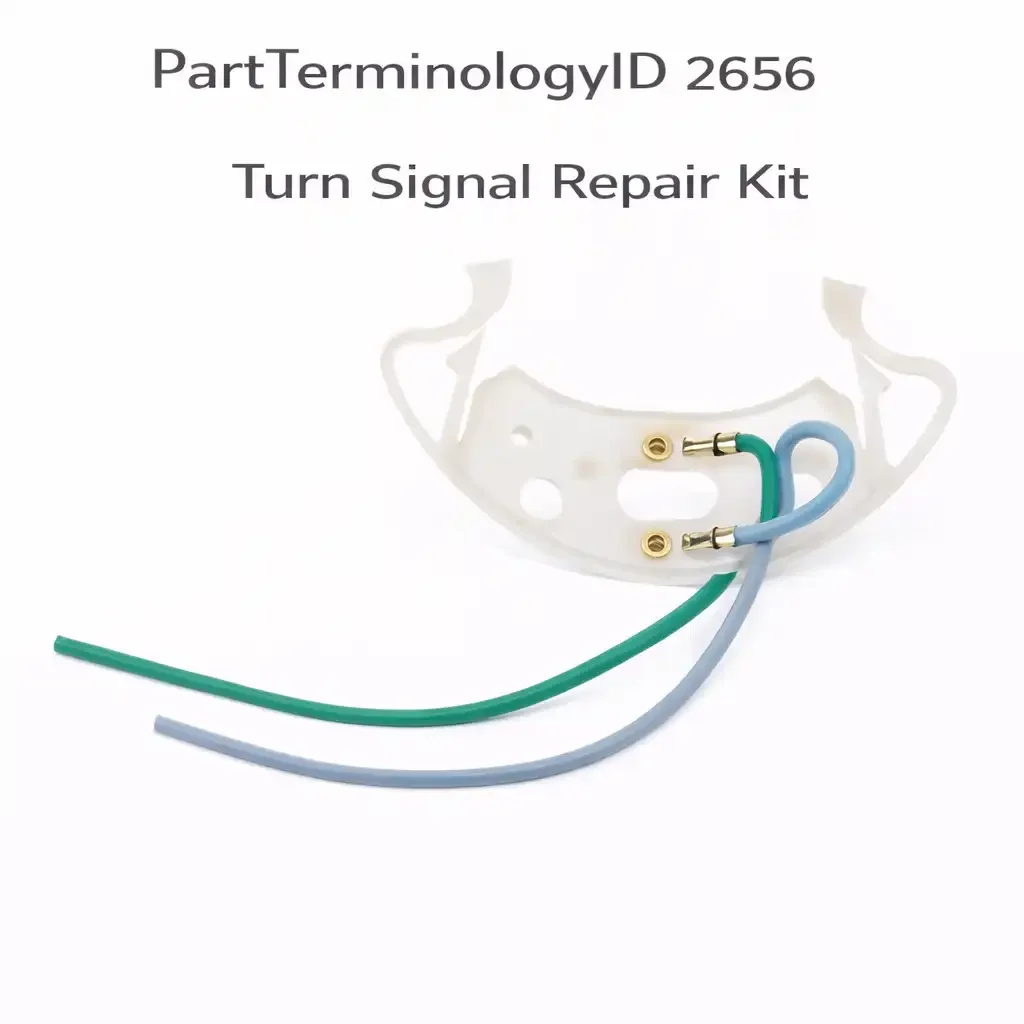
PartTerminologyID 2656, Turn Signal Repair Kit, is the assembly of connector body, terminals, bulb socket where applicable, and pre-wired leads required to restore the electrical connection at a damaged, heat-degraded, or corroded turn signal lamp circuit junction. That definition covers the component category correctly and leaves unresolved every question that determines whether the kit's connector body mates with the existing wiring harness connector or the lamp assembly housing, whether the kit's terminals accept the wire gauge of the vehicle's existing harness leads, whether the kit includes a bulb socket in the correct base designation for the turn signal bulb installed in the assembly, whether the kit carries all the circuits present at the connector position it is intended to replace, whether the pre-wired leads are long enough to reach the splice point in the harness with adequate service loop, whether the connector body and bulb socket are rated for the thermal load of the installed bulb wattage, and whether the kit's connector body is sealed against the moisture and road contamination the exterior lamp position receives throughout its service life.
It does not specify the connector body pin count, the connector body geometry, the locking tab position and style, the terminal type and wire range, whether the kit includes a bulb socket or only a harness-side connector, the bulb socket base designation where a socket is included, the bulb socket thermal rating in watts, whether the kit covers the front turn signal position, the rear turn signal position, or both, whether the connector carries only the turn signal circuit or also carries the brake light and running light circuits at a combined lamp position, the pre-wired lead length, the wire gauge of included leads, the connector body sealing designation, or the circuit count per position. A listing under PartTerminologyID 2656 that specifies only year, make, and model without kit contents, pin count, and position coverage cannot be evaluated by a technician who is holding a melted socket at the front turn signal position and needs to confirm the kit covers the repair before cutting the harness.
For sellers, PartTerminologyID 2656 is a repair-context listing rather than a direct replacement listing. The buyer is not replacing an assembly that has reached end of service life on a scheduled basis. The buyer has a specific damage condition, typically heat-melted socket contacts, corrosion-failed terminal crimps, or physical connector body damage from impact, and needs a kit that resolves that specific damage condition completely. The kit-completeness expectation is therefore higher for PartTerminologyID 2656 than for most other connector PartTerminologyIDs, because the buyer is cutting into the vehicle's existing harness to make the repair and cannot easily reverse the decision if the kit turns out to be missing a component. A technician who cuts the harness and then discovers the kit does not include the correct bulb socket base or that the pre-wired leads are two inches short cannot simply reconnect the original harness. The repair is committed at the moment the original connector is cut out.
The additional complexity specific to PartTerminologyID 2656 is the combined circuit position problem. On many vehicles, the rear lamp assembly serves multiple functions from a single connector: turn signal, brake light, and running light circuits all exit the lamp housing through one connector body. A repair kit sold as a turn signal repair kit for that position must carry all three circuits if the connector body is being replaced, not just the turn signal circuit. A two-pin kit installed at a three-circuit position will leave the brake light or running light circuit unconnected after the repair. The listing must specify the circuit count and the circuit assignments for every pin the kit carries, not just the turn signal function implied by the PartTerminologyID label.
What the Turn Signal Repair Kit Does
Restoring the electrical connection at a heat-damaged bulb socket
The most common failure mode addressed by a turn signal repair kit is heat damage at the bulb socket. Incandescent turn signal bulbs, particularly the 1157 and 3157 dual-filament types used in combined stop-and-turn rear lamp positions, operate at surface temperatures above 200 degrees Celsius at the bulb envelope during sustained turn signal operation. The plastic bulb socket housing in contact with the base of the bulb accumulates thermal load over the lamp assembly's service life. The accumulated heat degrades the socket's plastic housing, causing it to soften, deform, and ultimately melt at the contact points between the socket terminals and the bulb base contacts.
A melted socket produces progressive contact resistance at the bulb-to-socket interface. In the early stages of degradation, the socket contacts maintain continuity under the spring pressure of the terminal against the bulb base contact but at a higher resistance than a new socket. The higher resistance produces a voltage drop at the bulb that reduces brightness below the original design luminosity. As the socket degrades further, the contact becomes intermittent, producing a turn signal that flashes erratically or does not illuminate at all despite a functioning bulb. The turn signal repair kit's bulb socket must be rated for the full wattage of the bulb installed in the position, and the kit's listing must state the socket's watt rating so the buyer can confirm it is adequate before installation.
Replacing a corroded or physically damaged harness connector
The second failure mode addressed by a turn signal repair kit is corrosion or physical damage at the harness-side connector body. Exterior lamp positions, particularly front turn signal positions near the front bumper and rear lamp positions near the tail of the vehicle, receive direct road spray, road salt, and in collision scenarios, physical impact. A corroded harness connector at a front turn signal position is common on vehicles operated in road salt environments because the front lamp position is directly in the path of wheel spray carrying salt solution. A physically damaged connector from a minor front impact is the most common post-collision repair scenario for this PartTerminologyID.
The harness connector replacement portion of a turn signal repair kit must mate precisely with the lamp assembly's connector receptacle. The connector body geometry, pin count, locking tab position, and cavity spacing must all match the lamp assembly's receptacle exactly. A connector that mates partially but does not lock, or that inserts fully but allows the pins to back out under vibration, will produce intermittent turn signal operation that is difficult to trace because the connector appears visually engaged. The locking tab engagement depth on the replacement connector must match the original's, because a shallower engagement allows the connector to back out incrementally over road vibration cycles until the pin contacts disengage.
Carrying the full circuit set at combined lamp positions
At rear lamp positions on most North American vehicles, the turn signal circuit, the brake light circuit, and the running light circuit share a single connector body with separate pins for each function. The standard combined rear lamp connector carries three circuits on a minimum of three pins plus a ground return: turn signal and brake shared on one filament at combined stop-and-turn positions, running light on a second pin, and ground on a third. On vehicles that use separate filaments for the stop light and turn signal in a four-filament lamp, the connector carries four pins for the four functions plus the ground.
A turn signal repair kit installed at a combined lamp position must carry all circuits present at that position. The technician cutting the harness to install the repair kit is cutting all circuits in the harness bundle simultaneously. A kit with fewer pins than the original connector leaves one or more circuits unrepaired after the cut. The running light circuit, if left unrepaired, produces a vehicle with no tail lights in addition to a non-functional turn signal, which is a safety violation and a failed inspection regardless of whether the turn signal itself functions correctly after the repair. The circuit count of the repair kit is therefore a mandatory attribute that must exceed or match the circuit count at the position the kit is designed to repair.
Heat rating and LED compatibility at the bulb socket
The thermal rating of the bulb socket included in a turn signal repair kit determines which bulb types the repaired position can accommodate. A socket rated for 32 watts per filament is adequate for a standard 1157 dual-filament incandescent bulb. A socket rated for only 21 watts per filament will overheat and degrade at the same rate as the original socket when used with a 32-watt bulb, reproducing the failure within one to two seasons. The socket wattage rating must meet or exceed the installed bulb's filament wattage at every filament position in the socket.
LED turn signal bulb replacements draw significantly less current than their incandescent equivalents, typically 2 to 5 watts versus 21 to 32 watts for incandescent. A repair kit socket used with an LED replacement bulb will not experience the thermal degradation that caused the original socket to fail, because the LED's lower thermal output does not stress the socket housing. However, the LED bulb's lower current draw may trigger a hyperflash condition on vehicles where the turn signal flasher module monitors current draw to detect a burned-out bulb. If the kit includes a load resistor to simulate incandescent current draw for LED compatibility, the listing must state the load resistor's wattage and whether it is included in the kit or must be sourced separately.
Why This Part Generates Returns
Buyers return turn signal repair kits because the connector body pin count matches the original but the body geometry does not mate with the lamp assembly receptacle, the kit includes a harness connector but no bulb socket and the buyer's damage condition requires both, the bulb socket base designation does not match the bulb installed in the assembly and the bulb does not seat in the replacement socket, the socket wattage rating is below the installed bulb's filament wattage and the socket overheats within one season of installation, the kit carries only the turn signal circuit on a two-pin pigtail and the buyer's lamp position uses a combined connector with brake and running light circuits that are left unrepaired after the harness is cut, the pre-wired leads are too short to reach the splice point in the harness with a service loop and the technician discovers this after the original connector has been cut out, the terminal type is a push-in design and the buyer's harness repair requires crimp terminals for a structurally reliable splice in an exterior lamp position subject to vibration and thermal cycling, the connector body is unsealed and the front lamp position it is installed at receives direct road spray that corrodes the replacement connector within one season, and the kit covers the front turn signal position but the buyer's damage is at the rear position where a different connector body format is used.
Status in New Databases
PIES/PCdb: PartTerminologyID 2656, Turn Signal Repair Kit
PIES 8.0 / PCdb 2.0: No change in PartTerminologyID or terminology label. Internal systems keyed to 2656 do not require remapping at the PIES 8.0 transition.
Top Return Scenarios
Scenario 1: "Kit includes harness pigtail only, buyer needed bulb socket, original socket is melted"
The buyer's turn signal bulb socket has melted at the contact points from accumulated incandescent bulb heat. The buyer orders a turn signal repair kit. The kit includes a harness-side pigtail connector with pre-wired leads but no bulb socket. The listing stated "turn signal repair kit" without specifying that the bulb socket is not included. The buyer cannot complete the repair with the kit as received. The harness has not been cut yet, so the kit is returned without further damage.
Prevention language: "Kit contents: [harness pigtail connector only / bulb socket only / harness pigtail connector and bulb socket]. This kit [includes / does not include] a replacement bulb socket. If the damage at your turn signal position is at the bulb socket, verify this kit includes a replacement socket before ordering. A kit that includes only the harness pigtail connector will not address socket heat damage."
Scenario 2: "Two-pin kit installed at three-circuit rear lamp position, running lights absent after repair"
The buyer's rear left turn signal connector is corroded. The turn signal repair kit delivers a two-pin pigtail covering the turn signal circuit and the ground. The rear lamp position uses a three-circuit connector carrying turn signal, running light, and ground. The technician cuts the harness and installs the two-pin kit. The turn signal functions correctly after the repair. The running light circuit, which was in the same harness bundle, is now unrepaired and unterminated behind the splice. The vehicle fails its next state inspection because the left rear running light does not illuminate.
Prevention language: "Circuit count: [X] circuits. Pin assignments: Pin 1: [turn signal]. Pin 2: [running light / brake light]. Pin 3: [ground]. This kit carries [X] circuits. Verify the circuit count of the replacement kit matches the circuit count of the existing connector at the lamp position being repaired. Cutting the harness to install this kit will disconnect all circuits in the harness bundle simultaneously. A kit with fewer circuits than the original will leave one or more circuits unrepaired and unterminated after installation."
Scenario 3: "Bulb socket wattage rating below installed bulb, socket melts within first season"
The repair kit includes a bulb socket rated for 21 watts per filament. The vehicle's rear stop-and-turn position uses a 1157 dual-filament bulb with a 27-watt stop filament and a 8-watt tail filament. The 27-watt stop filament exceeds the socket's 21-watt rating. During the first summer of use, the stop filament thermal load degrades the socket's contact fingers at the same rate as the original socket. By late summer, the socket contacts are pitting and the brake light flickers under sustained braking events. The buyer returns the kit as defective, but the failure was a wattage rating mismatch.
Prevention language: "Bulb socket wattage rating: [X] watts per filament. Compatible bulb types: [1157 / 3157 / 7443 / other]. Verify the socket wattage rating meets or exceeds the wattage of every filament in the bulb installed at this position. Installing a socket with a lower wattage rating than the bulb's filament wattage will reproduce the original heat damage failure within one to two seasons."
Scenario 4: "Pre-wired leads too short, harness already cut, technician cannot complete repair"
The buyer's harness splice point is 14 inches from the lamp connector position due to a previous repair that shortened the harness. The repair kit's pre-wired leads are 8 inches long. The technician cuts the original connector out of the harness before measuring the lead length against the available harness length. With the original connector removed, the 8-inch leads fall 3 inches short of the splice point even without a service loop. The technician cannot complete the repair without sourcing additional lead wire. The kit is retained but the repair is delayed and additional materials are required.
Prevention language: "Pre-wired lead length: [X] inches. Measure the distance from the lamp connector position to the intended splice point in the harness before cutting the original connector. Verify the included lead length provides adequate reach with a minimum 3-inch service loop at the splice. Do not cut the original connector until the kit's lead length has been confirmed against the available harness length."
Scenario 5: "Front turn signal kit ordered, rear position uses different connector body, connector does not mate"
The vehicle uses the same connector body format at the front turn signal and the rear turn signal on most trim levels. On the buyer's specific trim, the rear lamp assembly uses a different connector body with a different locking tab position due to a revised lamp assembly introduced mid-production-year. The front turn signal repair kit delivered does not mate with the rear lamp assembly's revised connector body despite the listing covering the vehicle year, make, and model. The body width is correct but the locking tab is on the top of the connector rather than the side, and the lamp assembly's receptacle latch does not engage the replacement connector's tab position.
Prevention language: "Lamp position: [front turn signal / rear turn signal / front and rear]. Locking tab position: [top / side]. This kit is designed for the [front / rear] turn signal position. On some vehicle applications the front and rear turn signal positions use different connector body formats. Verify the lamp position and the locking tab position of the existing connector before ordering. A connector with the correct pin count but a different locking tab position will insert into the lamp assembly receptacle but will not lock, allowing the connector to back out under vibration."
Scenario 6: "Unsealed connector at front turn signal position, corrosion returns within one season"
The buyer's front turn signal connector failed from road salt corrosion. The replacement kit uses an unsealed connector body. After one winter season in a northern climate with heavy road salt use, the replacement connector shows the same corrosion at the pin contacts as the original. The turn signal again flickers intermittently on cold mornings when the corrosion layer resistance is highest. The buyer returns the kit as prematurely failed, but the failure is a sealing specification mismatch for a road-salt-exposed front lamp position.
Prevention language: "Connector body sealing: [unsealed / weatherproof with mating face gasket and wire entry grommets]. For front turn signal positions that receive direct road spray and road salt exposure, specify a weatherproof kit with sealed connector bodies on both the harness side and the lamp side. An unsealed replacement connector at a road-salt-exposed position will corrode at the pin contacts within one to two seasons and reproduce the original failure."
What to Include in the Listing
Core essentials
PartTerminologyID: 2656
component: Turn Signal Repair Kit
kit contents: harness pigtail only, bulb socket only, or harness pigtail and bulb socket (mandatory, in title or first line)
lamp position: front turn signal, rear turn signal, or front and rear (mandatory)
left side, right side, or universal (mandatory)
pin count on harness connector (mandatory)
circuit assignments per pin: turn signal, brake light, running light, ground (mandatory for all pins)
connector body width in mm (mandatory)
cavity spacing center-to-center in mm (mandatory)
locking tab position: top or side (mandatory)
terminal type: crimp or push-in (mandatory)
terminal wire range in AWG (mandatory)
bulb socket base designation where socket is included: 1157, 3157, 7443, etc. (mandatory)
bulb socket wattage rating per filament in watts (mandatory where socket is included)
LED compatibility designation where applicable (mandatory)
load resistor for LED hyperflash: included or not included (mandatory where LED compatible)
pre-wired lead length in inches (mandatory)
wire gauge of included leads (mandatory)
connector body sealing: unsealed or weatherproof (mandatory)
OEM part number cross-reference where available (mandatory)
quantity: 1
Fitment essentials
year/make/model/submodel
lamp position: front or rear, left or right
note for vehicles where front and rear positions use different connector formats
note for mid-production-year connector body revisions where earlier and later production vehicles use different connector formats within the same model year
combined circuit position note: state all circuits present at the connector position the kit is designed for
Image essentials
kit shown with all included components laid out and labeled
harness connector shown from the mating face with pin positions numbered and labeled by circuit
bulb socket shown with base designation and wattage rating visible where included
connector body locking tab shown with position and engagement direction labeled
pre-wired lead length shown with a measurement reference
connector sealing detail showing mating face gasket and wire entry grommets where present
Catalog Checklist for ACES/PIES Teams
PartTerminologyID = 2656
require kit contents statement: pigtail only, socket only, or pigtail and socket (mandatory)
require lamp position: front, rear, or front and rear (mandatory)
require pin count and circuit assignments for all pins (mandatory)
require connector body width and cavity spacing in mm (mandatory)
require locking tab position (mandatory)
require terminal wire range in AWG (mandatory)
require bulb socket base designation and wattage rating where socket is included (mandatory)
require pre-wired lead length (mandatory)
require connector body sealing designation (mandatory)
prevent kit-contents ambiguity: a listing that states "turn signal repair kit" without specifying whether a bulb socket is included will generate returns from buyers whose damage condition requires the socket; kit contents must be the first stated attribute
prevent circuit count omission: a kit installed at a combined circuit position that carries fewer circuits than the original connector will leave circuits unrepaired after the harness is cut; circuit count must match the position being repaired
prevent wattage rating omission: a socket with a lower wattage rating than the installed bulb will reproduce the original heat damage failure; wattage rating must be required on every listing that includes a bulb socket
prevent front-versus-rear ambiguity: many vehicles use different connector body formats at front and rear turn signal positions; lamp position must be stated as a required attribute on every listing
flag weatherproof sealing as mandatory for front lamp positions: front turn signal connectors receive direct road spray and road salt and will corrode within one to two seasons in a northern climate without weatherproof sealing
flag pre-wired lead length as a cut-committed attribute: once the technician cuts the original connector out of the harness, the repair is committed and a kit with insufficient lead length cannot be remedied without sourcing additional wire; lead length must be stated on every pre-wired kit listing
differentiate from turn signal switch: the turn signal switch is the driver-operated stalk or column-mounted control that inputs the turn signal command; the turn signal repair kit addresses the wiring connection at the lamp assembly; both are in the turn signal circuit but serve different functions under different PartTerminologyIDs
differentiate from turn signal flasher: the flasher module controls the on-off cycle rate of the turn signal; the repair kit addresses the connector at the lamp; a hyperflash condition caused by an LED bulb in a circuit calibrated for incandescent current draw requires a flasher replacement or a load resistor, not a repair kit
FAQ (Buyer Language)
What is included in a turn signal repair kit?
A turn signal repair kit includes the connector body, terminals, and pre-wired leads required to replace a damaged or corroded turn signal connector. Some kits include a replacement bulb socket for heat-damaged socket applications. Others include only the harness-side pigtail connector without a socket. Read the kit contents list carefully before ordering and verify the kit covers the specific damage condition at your turn signal position. If the socket is melted, the kit must include a replacement socket. If only the harness connector is damaged, a pigtail-only kit is sufficient.
How do I identify the correct turn signal repair kit for my vehicle?
Count the pins on the existing connector at the turn signal assembly and note the connector body shape, locking tab position, and the lamp position: front or rear, left or right. Also count the number of circuits in the harness at that position, because many rear lamp connectors carry the turn signal, brake light, and running light circuits together. The replacement kit must carry all circuits present at the position being repaired. Physical verification of the connector body dimensions and circuit count against the listing is the only reliable confirmation before cutting the harness.
Can I use a turn signal repair kit on a brake light or running light connector?
If the vehicle uses a combined rear lamp connector that carries the turn signal, brake light, and running light circuits together, the turn signal repair kit for that position must carry all three circuits. In that case, the kit effectively repairs the brake light and running light connections as well as the turn signal connection because all circuits pass through the same connector body. If your vehicle uses separate connectors for each circuit at the rear lamp position, a turn signal repair kit covers only the turn signal circuit.
What wire gauge should a turn signal repair kit use?
The wire gauge in a turn signal repair kit must match or exceed the gauge of the vehicle's existing turn signal harness leads. Most turn signal circuits use 18-gauge wire for the signal circuit and 16-gauge for the ground return on standard incandescent applications. Installing a repair kit with lighter gauge wire than the original increases resistance in the circuit and may trigger a hyperflash condition on vehicles where the flasher module monitors current draw to detect burned-out bulbs. Verify the wire gauge against the original harness before making the splice.
What causes turn signal connectors to fail?
The most common cause is heat damage at the bulb socket from incandescent bulb operating temperatures, which degrade the plastic socket housing and corrode the contact terminals over time. The second most common cause is moisture ingress at an unsealed connector body on exposed exterior lamp positions, which corrodes the pin contacts and produces high resistance. Physical damage from minor impact is the third most common cause. Identifying which failure mode applies to your connector determines whether the repair kit needs to include a replacement bulb socket, a sealed connector body, or both.
Does a turn signal repair kit include a bulb socket?
Some do and some do not. Repair kits that address heat damage include a replacement bulb socket as part of the kit. Kits that address harness connector damage only may include a pigtail connector without a socket. The listing must state whether a bulb socket is included, the socket base designation, and the wattage rating. Verify the socket base matches the bulb type installed in the assembly and that the wattage rating meets or exceeds the installed bulb's filament wattage before ordering.
Cross-Sell Logic
Turn Signal Bulb: the lamp the repaired socket and connector serve; inspect the bulb condition whenever the socket or connector is replaced; a bulb that has been operating through a high-resistance socket may have experienced voltage stress that has shortened its remaining service life
Turn Signal Flasher: the module that controls the flash rate; a hyperflash condition after installing LED bulbs in a circuit repaired with this kit requires a flasher module compatible with LED current draw rather than a second repair kit
Tail Light Assembly: on vehicles where the turn signal connector damage resulted from an impact that also cracked the lens or damaged the lamp housing, the assembly may require replacement rather than connector repair; inspect the lamp housing for structural damage before committing to a repair kit installation
Terminal Repair Kit: for applications where the connector body is intact but individual terminals are corroded; a terminal repair kit provides replacement terminals without requiring the full pigtail replacement and harness splice that a complete repair kit involves
Dielectric Grease: applied to the pin contacts and bulb base contacts at installation to prevent oxidation and extend the repaired connector's service life at an exterior lamp position with moisture exposure
Frame as "the turn signal repair kit restores the connection the harness delivers to the lamp. The bulb converts the current the connection carries into light. The flasher controls the on-off cycle the connection switches. The lamp assembly houses the socket the kit repairs. All are in the same turn signal circuit from the switch to the road."
Final Take for PartTerminologyID 2656
Turn Signal Repair Kit (PartTerminologyID 2656) is the PartTerminologyID in the lighting repair series where kit-contents ambiguity and circuit count omission together account for the highest rate of returns with committed-repair consequences. A buyer who discovers the kit does not include a bulb socket after ordering can return the kit before cutting the harness. A technician who discovers the kit carries fewer circuits than the combined lamp position after cutting the harness cannot reverse the cut. The difference between those two outcomes is whether the circuit count and kit contents were stated in the listing before the repair was committed. Both are preventable by attribute statements that cost nothing to add and eliminate the most damaging return scenarios for this PartTerminologyID.
State the kit contents in the first line: pigtail only, socket only, or pigtail and socket. State the lamp position: front or rear, left or right. State the pin count and the circuit assignment for every pin. State the bulb socket base designation and wattage rating where a socket is included. State the pre-wired lead length. State the terminal wire range. State the connector body sealing designation. State the locking tab position. State the combined circuit position warning directing buyers to verify the circuit count of the existing connector before ordering. For PartTerminologyID 2656, kit contents, circuit count, and socket wattage rating are the three attributes that determine whether the repair kit resolves the original damage condition completely on the first installation attempt.