
Cruise Control Valve (PartTerminologyID 2653): Where Valve Type, Port Count, and Vacuum Circuit Compatibility Determine Whether the Servo Receives the Correct Actuation Signal
Written by Arthur Simitian | PartsAdvisory
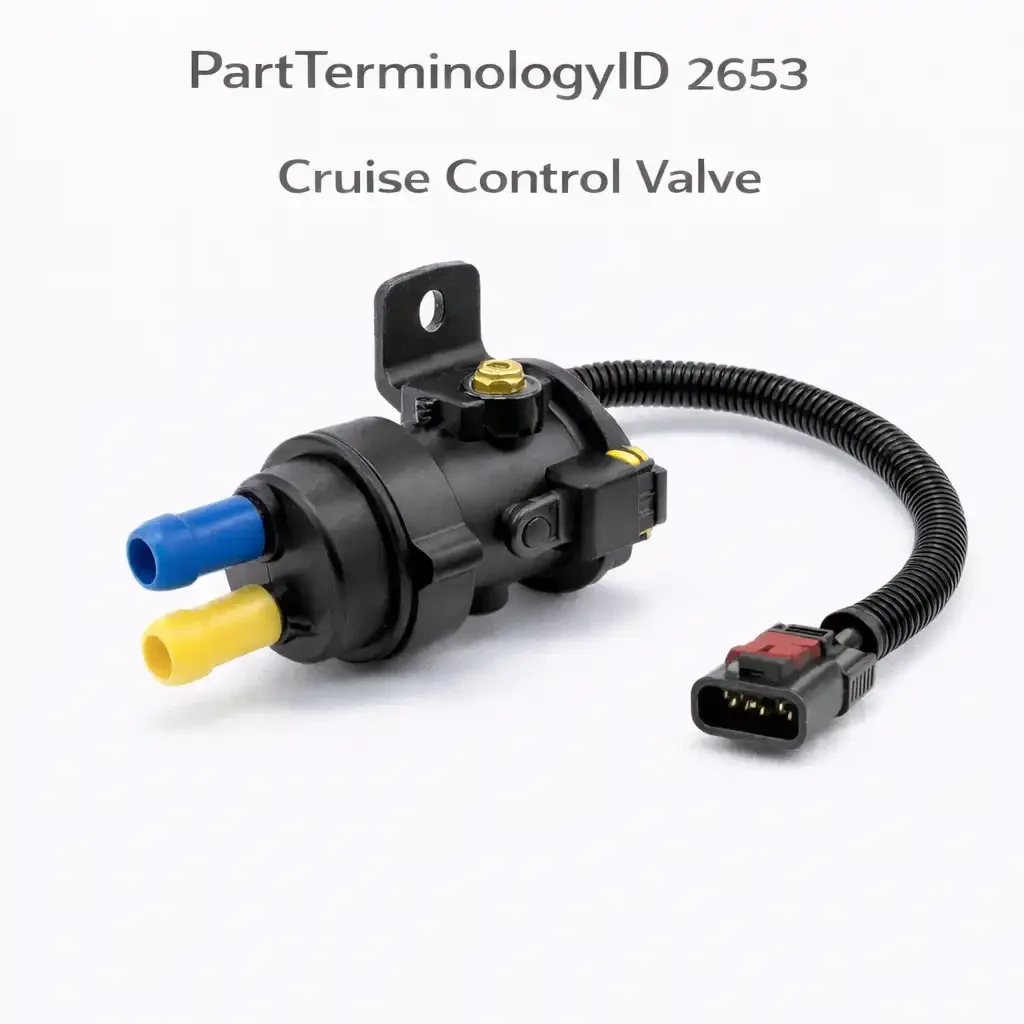
PartTerminologyID 2653, Cruise Control Valve, is the electrically operated solenoid valve assembly that directs vacuum from the intake manifold or vacuum reservoir to the cruise control servo diaphragm and controls the venting of that vacuum to atmosphere in response to commands from the cruise control module. That definition covers the function correctly and leaves unresolved every question that determines whether the replacement valve has the same port count as the original and can accept every vacuum hose in the vehicle's cruise control circuit, whether the solenoid coil resistance matches the drive circuit's current expectations, whether the connector pin count and terminal arrangement match the vehicle harness, whether the valve body mounting configuration aligns with the original bracket or mounting location, whether the valve's internal flow rate through the actuation and vent paths matches the servo diaphragm volume and the module's commanded response timing, and whether the valve includes the same safety dump circuit provision as the original for immediate throttle release on brake application.
It does not specify the valve type, whether it is a combined actuation-and-vent solenoid in a single body or two discrete solenoid valves operated independently by the module, the port count, the vacuum port assignments for each port, the solenoid coil resistance in ohms, the connector pin count and terminal type, the valve body mounting style, the vacuum port diameter and fitting type, the internal flow rate through each valve path at the operating vacuum differential, or whether the valve body is mounted separately from the servo or integrated into the servo housing as a combined assembly. A listing under PartTerminologyID 2653 that specifies only year, make, and model without valve type, port count, and solenoid resistance cannot be evaluated by a technician who has confirmed the servo is functional and is replacing the valve as the isolated fault component.
For sellers, PartTerminologyID 2653 is closely related to PartTerminologyID 2652, Cruise Control Servo, and the two are frequently confused in catalog data because some vehicle applications use a combined servo-and-valve assembly while others use separate components. A listing under 2653 that covers a combined assembly will generate returns from buyers who need only the valve and find they have received a complete servo assembly at a price higher than expected, and a listing under 2652 that covers only the servo on a vehicle whose servo and valve are separate will generate returns from buyers who install the servo and find the valve is still the failed component. Distinguishing clearly whether the valve is a standalone component or part of a combined assembly is the first attribute a 2653 listing must state.
What the Cruise Control Valve Does
Directing vacuum to the servo actuation chamber
When the cruise control module determines that vehicle speed is below the set speed and commands a throttle increase, it energizes the actuation solenoid in the cruise control valve. The energized solenoid opens the path between the vacuum supply port and the servo actuation port, applying intake manifold vacuum to the servo diaphragm chamber. The vacuum differential across the diaphragm moves it against the return spring, pulling the throttle cable toward the open throttle position. The module pulses the actuation solenoid at a duty cycle that controls how much vacuum is applied and therefore how far the diaphragm moves and how much throttle opening is commanded per control loop cycle.
The flow rate through the actuation path determines how quickly the servo diaphragm responds to a module command. A replacement valve with a smaller internal orifice than the original will restrict vacuum flow to the servo and slow the diaphragm's response, causing the control loop to lag behind the module's commanded position changes. The lag produces a speed hunting pattern where the system consistently undershoots and then overshoots the set speed because the servo is always slightly behind the module's current command. This flow-rate-induced hunting is indistinguishable from a servo diaphragm response problem without measuring the vacuum delivery rate at the servo port under a known duty cycle command from the module.
Venting the servo chamber for speed reduction and disengagement
When the module determines that vehicle speed is above the set speed or receives a disengagement command from the driver, it de-energizes the actuation solenoid and energizes the vent solenoid. The vent solenoid opens the servo actuation chamber to atmosphere through the vent port, collapsing the vacuum differential across the diaphragm and allowing the return spring to push the diaphragm back to its rest position. The throttle cable tension is released and the throttle closes toward idle at the rate the return spring force and the vent orifice flow rate allow.
A vent solenoid with a degraded seat that does not fully close when de-energized continuously bleeds atmosphere into the servo actuation chamber even while the actuation solenoid is energized. The actuation solenoid must work against this constant vacuum bleed, and the servo diaphragm settles at a lower vacuum differential than the module commanded, producing a throttle position that is consistently below the module's target. The system compensates by increasing the actuation solenoid duty cycle, which at its limit cannot overcome the vent leak, and the vehicle falls progressively below set speed on grades until the system disengages from underspeed. This failure mode is identical in symptoms to a leaking servo diaphragm and requires valve leak testing to isolate from a servo diaphragm failure.
The dump circuit and the brake application safety function
On cruise control systems that use a four-port valve, the fourth port is connected to the brake switch vacuum circuit or a clutch switch vacuum circuit. When the driver depresses the brake pedal, the brake switch routes vacuum to the dump port, which overrides both the actuation and vent solenoid states and vents the servo diaphragm chamber immediately regardless of the module's commanded position. This hardware dump function provides a throttle release that is independent of the module's response to the brake switch input signal, ensuring the throttle returns to idle even if the module experiences a processing delay or a software fault that prevents it from responding to the brake switch input through its normal control path.
A replacement valve that does not include a dump port on a vehicle whose original valve has a dump port eliminates this hardware safety function. The system will still disengage when the brake is applied because the module reads the brake switch signal through the electrical circuit and commands the vent solenoid electronically, but the hardware backup is absent. The time difference between hardware dump release and electronic vent release is typically less than 100 milliseconds under normal conditions, but grows significantly if the module is processing a high interrupt load or if the brake switch signal has a degraded edge due to contact wear. For this reason, the dump port count must be stated and confirmed before installation.
Why This Part Generates Returns
Buyers return cruise control valves because the port count does not match the vehicle's vacuum circuit and one vacuum hose has no corresponding port on the replacement, the valve is a combined servo-and-valve assembly when the buyer needed a standalone valve, the solenoid coil resistance does not match the module's drive circuit and the module cannot fully energize the solenoid at its calibrated current output, the connector pin count differs from the vehicle harness and the connector does not mate, the valve body mounting configuration does not align with the original bracket and the valve cannot be secured without modification, the vacuum port fitting diameter is smaller than the original hose internal diameter and the hose fits loosely over the port barb and admits vacuum leaks at the connection, the internal flow rate through the actuation path is lower than the original and the servo responds too slowly for the module's control timing, and the replacement valve does not include the dump port present on the original and the buyer is unwilling to install a valve that removes the hardware safety dump function.
Status in New Databases
PIES/PCdb: PartTerminologyID 2653, Cruise Control Valve
PIES 8.0 / PCdb 2.0: No change in PartTerminologyID or terminology label. Internal systems keyed to 2653 do not require remapping at the PIES 8.0 transition.
Top Return Scenarios
Scenario 1: "Combined servo-and-valve assembly delivered, buyer needed standalone valve only"
The vehicle's cruise control servo is functional. The valve solenoid has failed. The buyer orders a cruise control valve. The listing covers this vehicle application but the part is a combined servo-and-valve assembly. The buyer receives a complete servo unit at a significantly higher price than anticipated. The servo portion of the assembly is not needed and the buyer returns the complete assembly in favor of a standalone valve replacement.
Prevention language: "Component type: [standalone valve / combined servo-and-valve assembly]. This listing covers a [standalone solenoid valve only / complete servo assembly with integrated valve]. If your vehicle's servo and valve are separate components and only the valve has failed, verify this listing covers a standalone valve before ordering."
Scenario 2: "Three-port valve delivered for four-port application, dump circuit hose unconnected"
The original valve has four ports. The replacement has three. The listing does not state the port count. The technician installs the three-port valve and leaves the vehicle's dump circuit hose unconnected with a vacuum cap. The system operates correctly on initial testing. The technician notes the capped hose but does not flag it. The repair is completed and the vehicle is returned to the customer. Three weeks later the customer reports the cruise control does not disengage when the brakes are applied at highway speed, which triggers a safety complaint and a return.
Prevention language: "Vacuum port count: [2 / 3 / 4]. Port assignments: vacuum supply, servo actuation, vent, dump (where present). This valve has [X] vacuum ports. Verify the port count matches the number of vacuum hose connections in the vehicle's cruise control circuit. A four-port application includes a dump circuit connected to the brake switch vacuum supply that provides hardware throttle release independent of the module's electronic response. Do not install a valve with fewer ports than the original without confirming the dump circuit function is maintained."
Scenario 3: "Solenoid resistance out of range, module cannot fully energize valve, system engages weakly and hunts speed"
The replacement valve's actuation solenoid measures 28 ohms. The original measures 18 ohms. The module's solenoid driver circuit is calibrated to deliver 12 volts across an 18-ohm load, producing 667 milliamperes of solenoid current. Across the 28-ohm replacement, the same 12-volt drive produces only 429 milliamperes, which is below the replacement solenoid's minimum current for full magnetic core saturation. The valve opens partially rather than fully, restricting vacuum flow to the servo and causing the system to engage weakly and hunt continuously around the set speed.
Prevention language: "Actuation solenoid resistance: [X] ohms. Vent solenoid resistance: [X] ohms. Verify the solenoid resistance values match the original valve before installation. The cruise control module's solenoid driver circuit is calibrated for a specific solenoid resistance. A replacement with higher resistance than the original will receive insufficient drive current, preventing full solenoid actuation and restricting vacuum flow to the servo. A replacement with lower resistance than the original may exceed the driver circuit's current limit and trigger a driver fault in the module."
Scenario 4: "Vacuum port barb diameter undersized, hose fits loosely, vacuum leak at actuation port"
The vehicle's cruise control vacuum hoses have an internal diameter of 6mm. The replacement valve's port barbs have an outer diameter of 4.5mm. The hoses fit over the barbs loosely and are retained only by friction without the interference fit the original barb diameter provided. After one week of use, road vibration works one hose off the actuation port barb far enough to admit a vacuum leak at the connection. The servo receives less vacuum than commanded and the system loses the ability to hold speed against any road load. The valve is returned as defective, but the failure was caused by a port barb diameter mismatch.
Prevention language: "Vacuum port barb outer diameter: [X] mm. Verify the port barb outer diameter matches the internal diameter of the vehicle's cruise control vacuum hoses. A barb that is undersized for the hose internal diameter will not produce an interference fit and will allow the hose to loosen under vibration. Hose clamps are not a recommended substitute for a correctly sized barb-to-hose fit in a cruise control vacuum circuit."
What to Include in the Listing
Core essentials
PartTerminologyID: 2653
component: Cruise Control Valve
component type: standalone valve or combined servo-and-valve assembly (mandatory, in title)
vacuum port count: 2, 3, or 4 (mandatory)
vacuum port assignments: supply, actuation, vent, dump (mandatory for all ports)
vacuum port barb outer diameter in mm (mandatory)
actuation solenoid resistance in ohms (mandatory)
vent solenoid resistance in ohms (mandatory)
connector pin count (mandatory)
connector terminal type (mandatory)
circuit assignments per pin: actuation solenoid power, vent solenoid power, ground (mandatory)
valve body mounting style: bracket mount, inline hose mount, servo-integrated (mandatory)
mounting hardware dimensions where bracket-mounted (mandatory)
OEM part number cross-reference where available (mandatory)
quantity: 1
Fitment essentials
year/make/model/submodel
engine designation where valve specification varies by engine
standalone versus combined assembly designation where the same vehicle application uses both configurations across the production run
OEM part number cross-reference to support technician verification against the existing valve's part number marking
Image essentials
valve shown from all sides with vacuum ports numbered and labeled by function
electrical connector shown from the mating face with pin count and circuit assignments labeled
vacuum port barb shown with diameter measurement reference
mounting bracket or mounting interface shown with hardware dimensions
OEM part number label shown on valve body where present
Catalog Checklist for ACES/PIES Teams
PartTerminologyID = 2653
require component type: standalone valve or combined servo-and-valve assembly (mandatory)
require vacuum port count and port assignments (mandatory)
require vacuum port barb outer diameter in mm (mandatory)
require solenoid resistance in ohms for actuation and vent solenoids (mandatory)
require connector pin count and circuit assignments (mandatory)
require valve body mounting style (mandatory)
prevent port count omission: a valve with fewer ports than the original will leave one vacuum circuit unconnected; port count must be required on every listing
prevent combined-versus-standalone ambiguity: a listing that does not state whether the part is a standalone valve or a combined servo-and-valve assembly will generate returns from buyers who need only the valve and receive a complete servo assembly; this must be the first stated attribute on every listing
prevent solenoid resistance omission: a solenoid with out-of-range resistance will receive incorrect drive current from the module and produce partial valve actuation or driver circuit faults; resistance must be stated for both solenoids on every listing
flag dump port as a safety attribute: a replacement valve without a dump port on a four-port application removes the hardware throttle release safety function; dump port presence must be confirmed as a required attribute for all four-port applications
differentiate from cruise control servo (PartTerminologyID 2652): the servo is the mechanical actuator that moves the throttle cable; the valve controls the vacuum signal delivered to the servo; on vehicles where the two are separate components, both PartTerminologyIDs cover distinct parts that must be listed and diagnosed independently
differentiate from cruise control module: the module is the electronic control unit that energizes the valve solenoids; the valve is the electromechanical component that converts those electrical commands into vacuum circuit switching; a failed module that outputs incorrect solenoid commands will defeat a new valve in the same way it defeated the original
FAQ (Buyer Language)
What does the cruise control valve do?
The cruise control valve is an electrically operated solenoid valve that controls the flow of vacuum to the cruise control servo. When the cruise control module commands a speed increase, it energizes the valve to open the vacuum actuation port to the servo, pulling the throttle cable open. When the module commands a speed reduction or disengagement, it energizes the vent valve to release the servo diaphragm and allow the throttle to close. A failed valve produces either a no-engagement condition if the actuation solenoid fails to open, or a no-release condition if the vent solenoid fails to close.
How do I know how many ports my cruise control valve has?
Count the vacuum hose connections on the existing valve body. A two-port valve has one vacuum supply port and one servo actuation port. A three-port valve adds a vent port that opens the servo chamber to atmosphere when the vent solenoid is energized. A four-port valve adds a dump port connected to the brake switch vacuum circuit for immediate servo release when the brakes are applied. The port count on the replacement valve must match the number of vacuum hose connections in the vehicle's cruise control circuit exactly.
Can a leaking cruise control valve cause speed hunting?
Yes. A valve with a degraded solenoid seat that does not close fully allows a small vacuum leak between the actuation and vent ports. This continuously bleeds vacuum from the servo chamber, forcing the actuation solenoid to compensate by opening more frequently than the control loop anticipates. The result is a servo that oscillates around the commanded position, producing a speed hunting pattern of 2 to 4 mph. This is often misdiagnosed as a failing servo before the valve is tested for internal leakage.
What is the difference between the cruise control valve and the cruise control servo?
The cruise control valve is the solenoid-operated component that controls which vacuum circuit is connected to the servo at any given moment. The cruise control servo is the mechanical actuator that uses the vacuum the valve delivers to move the throttle cable. The valve controls the signal. The servo executes the movement. On some vehicles the valve is integrated into the servo body as a combined assembly. On others the valve is a separate component mounted remotely from the servo with vacuum hoses connecting the two.
My cruise control engages but immediately disengages. Is the valve faulty?
Immediate disengagement is more commonly caused by a brake switch that is stuck closed or misadjusted, which signals the module to disengage as soon as it engages. Check the brake switch adjustment and confirm the brake lights are not illuminated when the pedal is at rest before replacing the valve. If the brake switch is confirmed functional and the system still disengages immediately, a valve with a failed actuation solenoid that cannot hold vacuum against the servo diaphragm spring load may be the cause.
Cross-Sell Logic
Cruise Control Servo (PartTerminologyID 2652): the mechanical actuator the valve delivers vacuum to; on vehicles where the servo and valve are separate components, a vacuum leak symptom must be isolated to the valve or the servo before replacement; a leaking valve and a leaking servo produce identical symptoms and require individual component testing to distinguish
Cruise Control Module: the electronic control unit that energizes the valve solenoids; confirm the module is outputting correct solenoid drive signals before replacing the valve; a module with a failed solenoid driver output will defeat a new valve immediately
Cruise Control Vacuum Reservoir: the vacuum storage tank that supplies the valve; a leaking reservoir produces insufficient vacuum supply for the valve to deliver adequate actuation pressure to the servo, causing symptoms identical to a partially failed valve
Brake Switch: the input that activates the dump circuit on four-port valve applications; a failed brake switch that remains closed will prevent the cruise control system from engaging regardless of valve condition
Vacuum Hose: the connections between the valve ports and the servo, reservoir, and brake switch; cracked or collapsed vacuum hoses between the valve and the servo produce vacuum delivery failures that are identical in symptom to a failed valve and must be inspected before the valve is replaced
Frame as "the cruise control valve is the switching element between the vacuum source and the servo actuator. The vacuum reservoir stores the pressure the valve routes. The servo converts the vacuum the valve delivers into throttle movement. The module commands the switching sequence the valve executes. The brake switch activates the dump circuit the valve provides. All are in the same vacuum-operated speed control pathway."
Final Take for PartTerminologyID 2653
Cruise Control Valve (PartTerminologyID 2653) is the PartTerminologyID in the cruise control series where port count omission and combined-versus-standalone ambiguity together account for the highest rate of returns. A valve with fewer ports than the original leaves a vacuum circuit unconnected, and on a four-port application that unconnected circuit is the dump port whose absence removes a hardware safety function from the repaired system. A listing that does not distinguish between a standalone valve and a combined servo-and-valve assembly delivers the wrong component at the wrong price to a buyer who identified the valve as the specific failed component. Both outcomes are preventable by two attribute statements that cost nothing to add and eliminate the most consequential return drivers for this PartTerminologyID.
State the component type: standalone valve or combined assembly. State the port count and the function of every port. State the solenoid resistance for both solenoids. State the connector pin count and circuit assignments. State the port barb outer diameter. State the mounting style. State the OEM part number cross-reference. For PartTerminologyID 2653, component type, port count, and solenoid resistance are the three attributes that determine whether the replacement valve restores correct cruise control vacuum circuit function or generates a return with a safety concern attached to it.