
Written by Arthur Simitian | PartsAdvisory
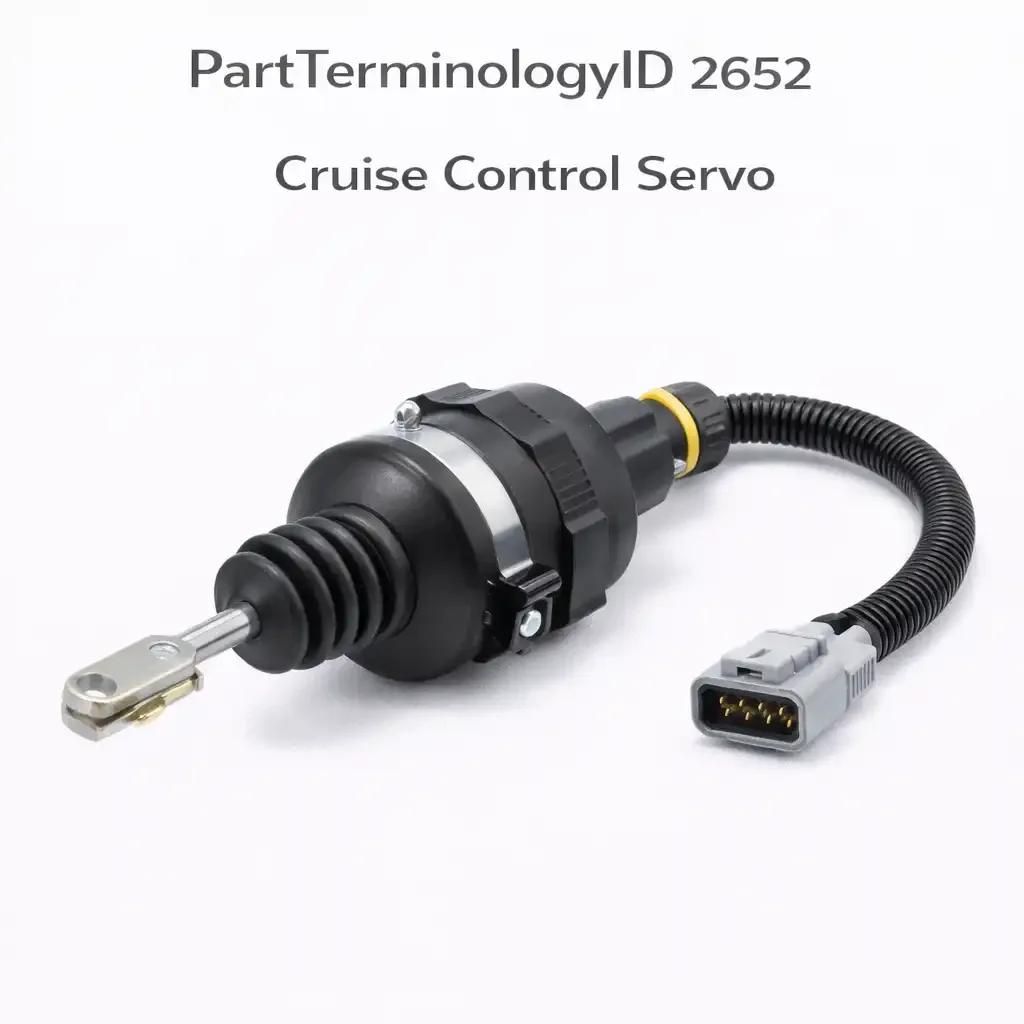
PartTerminologyID 2652, Cruise Control Servo, is the mechanical actuator in a cable-operated cruise control system that translates the cruise control module's electronic commands into physical throttle cable movement to maintain a driver-set vehicle speed against varying road load conditions. That definition covers the function correctly and leaves unresolved every question that determines whether the replacement servo uses the same actuation principle as the original, whether it pulls the throttle cable through the same travel distance as the original servo's calibrated range, whether it has the correct number of vacuum ports for the vehicle's cruise control vacuum circuit on vacuum-operated applications, whether its electrical connector matches the vehicle harness in pin count and terminal type, whether its mounting configuration aligns with the original bracket and hardware positions in the engine bay, whether its cable attachment geometry accepts the original throttle cable end fitting, and whether its internal control calibration produces the same throttle response characteristics as the original servo under closed-loop speed control.
It does not specify the actuation type, whether the servo uses engine vacuum applied through solenoid-controlled ports or an internal electric motor and gear train to move the throttle cable, the cable pull distance in millimeters from the rest position to the full-travel position, the number of vacuum ports and their function assignments on vacuum-operated designs, the connector pin count and terminal type on the electrical interface, the mounting bracket configuration and hardware dimensions, the cable drum diameter and the cable end fitting type accepted by the cable attachment mechanism, the internal calibration range and the speed holding accuracy the servo is designed to maintain, or the compatibility of the servo's control interface with the specific cruise control module fitted to the vehicle. A listing under PartTerminologyID 2652 that specifies only year, make, and model without actuation type, cable pull specification, and vacuum port count on vacuum applications cannot be evaluated by a technician who is replacing a servo on a vehicle with a persistent speed hunting or no-engagement fault and needs to confirm the replacement before removing the original.
For sellers, PartTerminologyID 2652 occupies a specific position in the cruise control system diagnostic pathway. The cruise control servo is rarely the first component replaced in a cruise control fault diagnosis. The typical diagnostic sequence begins with brake switch verification, then speed sensor verification, then module power and ground checks, and arrives at the servo only after the module has been confirmed to be commanding correctly but the throttle is not responding as expected. That sequence means the buyer ordering a servo replacement has usually already invested time and potentially parts in confirming the servo is the failed component. A listing that does not specify the actuation type and cable pull distance precisely produces a replacement that may be physically installed but produces incorrect throttle travel, which presents as a new and confusing symptom rather than a resolved fault.
The additional complexity specific to PartTerminologyID 2652 is the actuation type transition. The automotive industry shifted from vacuum-operated cruise control servos to electric cruise control servos over a period of roughly fifteen years from approximately 1995 to 2010, with different manufacturers transitioning at different model years. A vehicle produced during this transition period may have been manufactured with either a vacuum servo or an electric servo depending on the trim level, the engine option, or the model year within a generation. A listing that covers the correct year, make, and model but does not specify the actuation type will be ordered by buyers on both vacuum and electric servo applications, and the delivered servo will be correct for one and incompatible with the other.
What the Cruise Control Servo Does
Translating module commands into throttle cable movement
The cruise control servo's primary function is to move the throttle cable in response to commands from the cruise control module. When the driver sets a speed and engages cruise control, the module monitors the vehicle speed signal and compares it to the set speed continuously. When the vehicle speed drops below the set speed, the module commands the servo to increase its cable pull and open the throttle. When the vehicle speed rises above the set speed on a downgrade, the module commands the servo to reduce its cable pull and allow the throttle to close toward idle. The servo executes these commands at a rate and travel distance that determines how smoothly and accurately the system holds the set speed.
The accuracy of this closed-loop control depends on the servo's cable pull range matching the throttle cable travel required to move the throttle from the idle position to wide open throttle. If the servo's maximum cable pull is shorter than the full throttle cable travel, the servo cannot command wide open throttle and the vehicle will not achieve its maximum speed under cruise control. More practically, a servo with a cable pull that is 10 percent shorter than the original will be unable to maintain set speed on grades that require more than 90 percent throttle, causing the system to disengage or fall below set speed on moderate upgrades. A servo with a cable pull that is 10 percent longer than the original will pull the throttle past its mechanical stop at maximum travel, overstressing the return spring and potentially bending the throttle linkage if the over-travel occurs repeatedly.
Vacuum servo operation and the port count requirement
A vacuum-operated cruise control servo uses engine intake manifold vacuum, stored in a vacuum reservoir, to actuate a rubber diaphragm inside the servo body. The diaphragm is connected to the throttle cable drum through a mechanical linkage. When the cruise control module commands a speed increase, it energizes a solenoid valve that applies vacuum to the actuation port of the servo, drawing the diaphragm inward and pulling the throttle cable. When the module commands a speed reduction, it energizes a vent solenoid that opens the vent port to atmosphere, releasing the diaphragm and allowing the return spring to reduce cable tension.
The number of vacuum ports on the servo body must match the number of vacuum circuit connections in the vehicle's cruise control system. A two-port servo has one actuation port and one vent port. A three-port servo adds a dump port that is connected to the brake switch vacuum circuit or the clutch switch vacuum circuit. When the driver depresses the brake pedal or clutch pedal, vacuum is applied to the dump port, which instantly vents the servo diaphragm and releases the throttle cable regardless of the module's commanded position. This hardware safety override ensures the throttle returns to idle immediately when the driver intervenes, independent of the module's electronic response to the brake switch input. Installing a two-port servo on a three-port application eliminates this hardware dump circuit and relies entirely on the module's electronic response to the brake switch for throttle release, which introduces a time delay and a single-point failure mode that the original three-port design was intended to prevent.
Electric servo operation and the motor drive interface
An electric cruise control servo uses a small DC motor and a gear reduction assembly to rotate a cable drum and pull the throttle cable. The motor receives a pulse-width-modulated drive signal from the cruise control module through the electrical connector. The module varies the duty cycle of the drive signal to control the motor speed and position, moving the cable drum to the commanded position. A position feedback sensor, typically a potentiometer on the cable drum shaft, sends the actual drum position back to the module so the module can verify the servo is responding to its commands and make corrections if the measured position differs from the commanded position.
The connector pin count on an electric servo is higher than on a vacuum servo because the electric servo requires pins for motor drive positive, motor drive negative, position sensor power, position sensor ground, and position sensor signal, typically five pins total on most designs. A vacuum servo's connector carries only the solenoid valve circuits, typically two to four pins depending on the number of solenoids in the servo. A listing that does not specify the connector pin count and actuation type will be ordered by buyers who assume the connector configuration matches their existing servo, and the delivered part will not mate with the vehicle harness if the actuation type or pin count differs.
The cable attachment mechanism and end fitting compatibility
The throttle cable connects to the cruise control servo through a cable drum or a cable clamp on the servo's output mechanism. The cable end fitting, which is the terminal at the end of the throttle cable that engages the servo's cable attachment point, must match the servo's cable drum slot geometry or clamp design. Common cable end fitting types include a barrel end that drops into a slot in the cable drum, a ball end that seats in a socket on the drum, and a threaded end that uses a cable clamp with an adjustment nut. A servo that uses a ball-end socket will not accept a barrel-end cable, and a servo with a drum slot for a specific barrel diameter will not retain a cable with an undersized or oversized barrel.
The cable adjustment range is a related requirement. Every throttle cable installation requires a specific amount of cable freeplay between the servo drum and the throttle body pulley to prevent the cruise control servo from holding the throttle partially open when the system is disengaged. The servo's cable adjustment mechanism must provide enough adjustment range to set the correct freeplay for the vehicle's throttle cable routing. A servo with an insufficient adjustment range will force the technician to either accept incorrect cable tension or modify the cable routing, neither of which produces the correct idle behavior expected from a direct replacement.
Why This Part Generates Returns
Buyers return cruise control servos because the actuation type does not match the original and the delivered servo has no vacuum ports on a vacuum application or has vacuum ports on an electric application, the cable pull distance is shorter than the original and the system cannot hold set speed on grades above a moderate slope, the cable pull distance is longer than the original and the servo pulls the throttle past its mechanical stop at maximum travel, the vacuum port count does not match the vehicle's cruise control vacuum circuit and one port is left unconnected or one port in the vehicle circuit has no corresponding servo port, the connector pin count does not match the vehicle harness and the connector does not mate, the cable end fitting type does not match the existing throttle cable and the cable cannot be connected to the servo drum, the mounting bracket configuration does not align with the original mounting hardware and the servo cannot be secured without modification, the position feedback potentiometer on an electric servo has a different resistance range than the original and the module reads an out-of-range position signal and sets a fault code, and the servo's internal control calibration is designed for a different module variant and the system engages but hunts speed continuously because the servo's response rate does not match the module's command timing.
Status in New Databases
PIES/PCdb: PartTerminologyID 2652, Cruise Control Servo
PIES 8.0 / PCdb 2.0: No change in PartTerminologyID or terminology label. Internal systems keyed to 2652 do not require remapping at the PIES 8.0 transition.
Top Return Scenarios
Scenario 1: "Vacuum servo delivered for electric servo application, no vacuum source in engine bay"
The vehicle is a 2003 model year with an electric cruise control servo. The listing covers the correct year, make, and model but does not specify the actuation type. The delivered servo is a vacuum-operated unit. The vehicle's engine bay has no vacuum reservoir or vacuum hose routing for a cruise control servo. The electric connector on the vehicle harness has five pins and does not match the two-pin solenoid connector on the vacuum servo. The servo cannot be installed. It is returned immediately.
Prevention language: "Actuation type: [vacuum / electric]. This servo uses [vacuum from the intake manifold applied through solenoid valves / an internal DC motor and gear assembly] to move the throttle cable. Verify the actuation type of the original servo before ordering. Vacuum servos have rubber vacuum hose connections in addition to the electrical connector. Electric servos have only the electrical connector and throttle cable connection with no vacuum hoses."
Scenario 2: "Cable pull 8mm shorter than original, system cannot hold speed on Interstate grades"
The replacement servo is physically correct in actuation type, connector, and mounting. The cable pull distance is 42mm compared to the original's 50mm. The system engages and holds speed correctly on flat roads. On grades above approximately 4 percent, the servo reaches its maximum cable pull before achieving the throttle opening required to maintain set speed. The system disengages rather than exceeding its travel limit. The buyer reports the cruise control as defective on hills. The servo is returned, but the failure is a cable pull specification mismatch, not a servo defect.
Prevention language: "Cable pull distance: [X] mm from rest to maximum commanded position. Verify the cable pull specification matches the original servo before installation. A replacement with a shorter cable pull than the original will be unable to maintain set speed on grades that require more throttle opening than the servo's maximum travel permits. A replacement with a longer cable pull than the original may pull the throttle past its mechanical stop at maximum travel."
Scenario 3: "Two-port servo installed on three-port application, throttle does not release promptly on brake application"
The original servo has three vacuum ports. The replacement has two. The listing does not state the port count. The technician installs the two-port servo and leaves the vehicle's dump circuit vacuum hose unconnected. The system engages and holds speed correctly. When the driver applies the brakes, the throttle releases after a noticeable delay of approximately 0.4 seconds rather than the immediate release produced by the hardware dump circuit. The delay is caused by the module's electronic brake switch response being the sole throttle release mechanism without the hardware dump port. The buyer returns the servo and notes a safety concern with the delayed throttle release.
Prevention language: "Vacuum port count: [2 / 3]. Port assignments: [actuation port / vent port / dump port where present]. This servo has [2 / 3] vacuum ports. Verify the port count matches the number of vacuum hose connections in the vehicle's cruise control circuit. A three-port application uses the dump port to release the servo diaphragm immediately when the brake pedal is depressed, independent of the module's electronic response. Installing a two-port servo on a three-port application eliminates this hardware safety dump circuit."
Scenario 4: "Cable end fitting type mismatch, barrel-end cable will not seat in ball-end servo drum"
The vehicle's throttle cable has a 5mm barrel end fitting. The replacement servo's cable drum uses a ball-end socket designed for a 6mm ball end. The barrel end does not seat securely in the ball-end socket and pulls out under the first cruise control engagement event, leaving the throttle cable disconnected from the servo with the servo drum rotating freely. The buyer reports the cruise control as non-functional after installation. Inspection reveals the cable end has pulled free of the servo drum.
Prevention language: "Cable end fitting type: [barrel end / ball end / threaded clamp]. Cable end fitting dimension: [X] mm diameter. Verify the cable end fitting type and dimension of the existing throttle cable matches the servo's cable drum before installation. The cable end must seat securely in the drum's retention socket and must be confirmed to be fully engaged before completing the installation. A cable end that does not seat fully will pull free under the servo's operating load."
Scenario 5: "Mounting bracket configuration differs, servo cannot be secured, vibrates loose within 200 miles"
The replacement servo body dimensions and cable geometry are correct. The mounting bracket on the replacement servo has two mounting feet on a 60mm center-to-center spacing. The original servo's bracket has three mounting feet on a triangular pattern. The technician mounts the replacement using two of the three original mounting points, leaving the third unsupported. The servo is held by two bolts rather than three. After 200 miles of highway driving, the vibration from the two-point mount fatigues the throttle cable at the servo end and produces a frayed cable that delivers inconsistent cable tension.
Prevention language: "Mounting configuration: [number of mounting feet / bolt pattern dimensions / mounting foot center-to-center spacing in mm]. Verify the replacement servo's mounting configuration matches the original mounting bracket hardware in the engine bay. A servo mounted with fewer attachment points than the original will experience higher vibration loads at each attachment point, accelerating cable fatigue at the servo end fitting."
Scenario 6: "Position sensor resistance range out of spec, module sets fault code on first engagement"
The replacement electric servo is physically correct in all dimensions and mounts correctly. The position feedback potentiometer on the replacement has a resistance range of 0 to 5 kilohms. The original servo's potentiometer has a range of 0 to 2.5 kilohms. The cruise control module expects the position sensor to read between 0.5 and 2.0 kilohms across the full servo travel range. The replacement servo's sensor reads between 1.0 and 4.0 kilohms across the same travel range. The module reads the out-of-range high position signal as a sensor fault and sets a cruise control servo position sensor fault code on the first engagement, disabling the system.
Prevention language: "Position sensor type: [potentiometer / Hall effect]. Position sensor resistance range: [X] to [X] kilohms across full cable travel. For electric servo applications, verify the position sensor resistance range matches the original servo's specification. The cruise control module monitors the position sensor signal against calibrated limits and will disable the system and set a fault code if the sensor signal falls outside the expected range."
What to Include in the Listing
Core essentials
PartTerminologyID: 2652
component: Cruise Control Servo
actuation type: vacuum or electric (mandatory, in title)
cable pull distance in mm from rest to maximum position (mandatory)
vacuum port count: 2 or 3 (mandatory for vacuum servos)
vacuum port assignments: actuation, vent, dump (mandatory for vacuum servos)
electrical connector pin count (mandatory)
connector terminal type (mandatory)
circuit assignments per pin: motor drive positive, motor drive negative, position sensor power, position sensor ground, position sensor signal for electric; solenoid circuits for vacuum (mandatory)
cable end fitting type: barrel end, ball end, or threaded clamp (mandatory)
cable end fitting dimension in mm (mandatory)
cable adjustment range in mm (mandatory)
mounting configuration: number of mounting feet, bolt pattern, center-to-center spacing in mm (mandatory)
position sensor type and resistance range for electric servos (mandatory)
servo body dimensions: length, width, height in mm (mandatory)
OEM part number cross-reference where available (mandatory)
quantity: 1
Fitment essentials
year/make/model/submodel
engine designation where servo specification varies by engine
actuation type designation where the same vehicle application was produced with both vacuum and electric servos across the model year range
trim level where servo specification varies by trim
OEM part number cross-reference to support technician verification against the existing servo's part number label
note for vehicles produced during the vacuum-to-electric transition period where the replacement type must match the installed system type
Image essentials
servo shown from the front with cable drum, vacuum ports, and mounting feet labeled
cable drum shown in detail with cable end fitting acceptance socket type identified
vacuum ports shown with port count and function labels for vacuum servos
electrical connector shown from the mating face with pin count and circuit assignments labeled
mounting bracket shown with bolt pattern dimensions indicated
cable pull travel distance shown with a measurement reference
OEM part number label shown on servo body where present
Catalog Checklist for ACES/PIES Teams
PartTerminologyID = 2652
require actuation type: vacuum or electric as primary attribute (mandatory)
require cable pull distance in mm (mandatory)
require vacuum port count and port assignments for vacuum servos (mandatory)
require connector pin count (mandatory)
require cable end fitting type and dimension (mandatory)
require mounting configuration dimensions (mandatory)
require position sensor resistance range for electric servos (mandatory)
prevent actuation type omission: a listing that does not state vacuum or electric will be ordered by buyers on both system types; actuation type must be required on every listing as the primary differentiating attribute
prevent cable pull omission: a servo with a different cable pull than the original will produce either an inability to hold set speed on grades or a throttle over-travel condition; cable pull distance in mm must be required on every listing
prevent vacuum port count omission: a two-port servo installed on a three-port application eliminates the hardware dump circuit safety function; port count must be required on every vacuum servo listing
prevent cable end fitting ambiguity: barrel-end, ball-end, and threaded clamp fittings are not interchangeable; fitting type and dimension must be required attributes for all listings
flag the vacuum-to-electric transition period: vehicles produced from approximately 1995 to 2010 may have been fitted with either vacuum or electric servos depending on engine, trim, and model year; actuation type must be stated explicitly and the fitment note must flag the transition for catalog teams building year ranges
flag position sensor resistance range as mandatory for electric servos: a replacement with an out-of-range position sensor will set a fault code on first engagement and disable the system; resistance range must be stated and verified against the module's calibrated limits
differentiate from cruise control module: the module is the electronic control unit that processes speed input and outputs commands; the servo is the mechanical actuator that executes those commands; both are in the cruise control system but serve different functions under different PartTerminologyIDs
differentiate from throttle cable: the throttle cable connects the servo to the throttle body; the servo is the actuator that pulls the cable; both are required for a functional cruise control installation but are separate components; the cable end fitting type stated in the servo listing must match the existing throttle cable's terminal fitting
FAQ (Buyer Language)
What does a cruise control servo do?
The cruise control servo is the actuator that physically moves the throttle cable to maintain a set vehicle speed. On vacuum-operated systems the servo uses engine vacuum to move a diaphragm that pulls the throttle cable open. On electric systems a small DC motor and gear assembly pulls the throttle cable to the position commanded by the cruise control module. The module monitors the vehicle speed signal continuously and commands the servo to increase or decrease throttle opening until the measured speed matches the set speed.
How do I know if my vehicle uses a vacuum or electric cruise control servo?
A vacuum servo has one or more rubber vacuum hoses connected to it in addition to the throttle cable and an electrical connector. An electric servo has only the throttle cable connection and an electrical connector with no vacuum hoses. Most North American vehicles from the mid-1970s through the mid-2000s used vacuum-operated servos. Most vehicles from approximately 2000 onward use electric servo actuators. During the transition period, the same vehicle model may have been produced with either type depending on the engine and trim level, so physical inspection of the existing servo is the most reliable way to confirm the actuation type before ordering.
What is the cable pull specification and why does it matter?
The cable pull specification is the length of throttle cable travel the servo produces from its rest position to its maximum commanded position, expressed in millimeters. If the replacement servo's cable pull is shorter than the original, the servo cannot open the throttle to the full position the module commands, and the system will not maintain set speed on grades that require high throttle opening. If the cable pull is longer than the original, the servo may pull the throttle past its mechanical stop at maximum travel, which overstresses the throttle cable return spring and may hold the throttle open slightly past idle when the servo releases.
Can I use a cruise control servo with a different number of vacuum ports than the original?
No. The vacuum port count must match the vehicle's cruise control vacuum circuit. A three-port servo includes a dump port that releases the throttle immediately when the brake pedal is depressed, providing a hardware safety override independent of the module's electronic response. Installing a two-port servo on a three-port application eliminates this hardware dump circuit and produces a small but measurable delay in throttle release when the brakes are applied, because the module's electronic brake switch response becomes the sole release mechanism.
My cruise control holds speed but surges up and down by 2 to 3 mph. Is the servo faulty?
Speed surging is more commonly caused by a stretched or worn throttle cable than by a faulty servo. The cable develops slack over time and the slack produces a lag between the servo's commanded position and the actual throttle opening, causing the control loop to overshoot and hunt around the set speed. Inspect the throttle cable for fraying, kinking, and excessive slack before replacing the servo. If the cable is serviceable and surging persists, the servo's internal diaphragm may have a small vacuum leak that reduces holding force and allows the throttle to creep back under intake manifold vacuum.
What is the difference between a cruise control servo and a cruise control module?
The cruise control module is the electronic control unit that receives vehicle speed input, driver commands, and brake switch input, and outputs commands to the servo. The cruise control servo is the mechanical actuator that executes those commands by moving the throttle cable. A failed module produces symptoms of no engagement or no response to driver inputs. A failed servo produces symptoms of no throttle movement, incorrect throttle travel, or inability to hold speed against load variations despite correct module output commands. Confirm which component has failed by verifying the module's output signal before replacing the servo.
Cross-Sell Logic
Cruise Control Module: the electronic control unit that commands the servo; confirm the module is outputting correct commands before replacing the servo; a failed module that is not diagnosed before servo replacement will defeat the new servo in the same way it defeated the original
Throttle Cable: the mechanical link between the servo and the throttle body; inspect the throttle cable for fraying, kinking, and binding whenever the servo is replaced; a worn cable with excessive slack will produce speed hunting with a new servo and may be misdiagnosed as a defective replacement
Cruise Control Vacuum Reservoir: the storage tank that maintains vacuum supply to the servo independent of instantaneous intake manifold vacuum fluctuations; a leaking reservoir produces a vacuum servo that holds speed at light throttle but loses speed when the intake manifold vacuum drops under high load conditions
Brake Switch: the switch that signals the module and activates the hardware dump circuit on three-port vacuum servos when the brakes are applied; a failed brake switch that does not disengage cruise control is a safety fault that must be diagnosed before servo replacement; a new servo with a failed brake switch will produce a cruise control system that cannot be disengaged by the brake pedal
Speed Sensor: the vehicle speed input to the cruise control module; a failing speed sensor that produces an erratic speed signal causes the module to command rapid servo position changes that are misdiagnosed as a servo fault; verify the speed sensor signal quality before replacing the servo
Frame as "the cruise control servo executes the commands the module generates. The module reads the speed the sensor measures. The throttle cable transmits the movement the servo produces. The vacuum reservoir supplies the pressure the vacuum servo needs. The brake switch provides the disengagement signal the system requires for safety. All are in the same closed-loop speed control pathway."
Final Take for PartTerminologyID 2652
Cruise Control Servo (PartTerminologyID 2652) is the PartTerminologyID in the cruise control series where actuation type ambiguity and cable pull specification omission together account for the highest rate of returns with diagnostic consequences. A vacuum servo delivered for an electric application cannot be installed at all and returns immediately. A servo with the wrong cable pull distance installs correctly, engages correctly on flat roads, and fails to hold speed on grades, which presents as a system performance fault rather than an obvious specification mismatch, sending the technician back through the diagnostic process with a new servo installed that is not the correct part. Both outcomes are entirely preventable by attribute statements that specify the actuation type and the cable pull distance before the part is listed.
State the actuation type in the title. State the cable pull distance in millimeters. State the vacuum port count and port function assignments on vacuum applications. State the connector pin count and circuit assignments. State the cable end fitting type and dimension. State the mounting configuration bolt pattern. State the position sensor resistance range on electric applications. State the OEM part number cross-reference. State the note for vehicles produced during the vacuum-to-electric transition period where the replacement must match the installed system type. For PartTerminologyID 2652, actuation type, cable pull specification, and vacuum port count are the three attributes that determine whether the replacement servo restores the cruise control system to correct function on the first installation attempt.