
Written by Arthur Simitian | PartsAdvisory
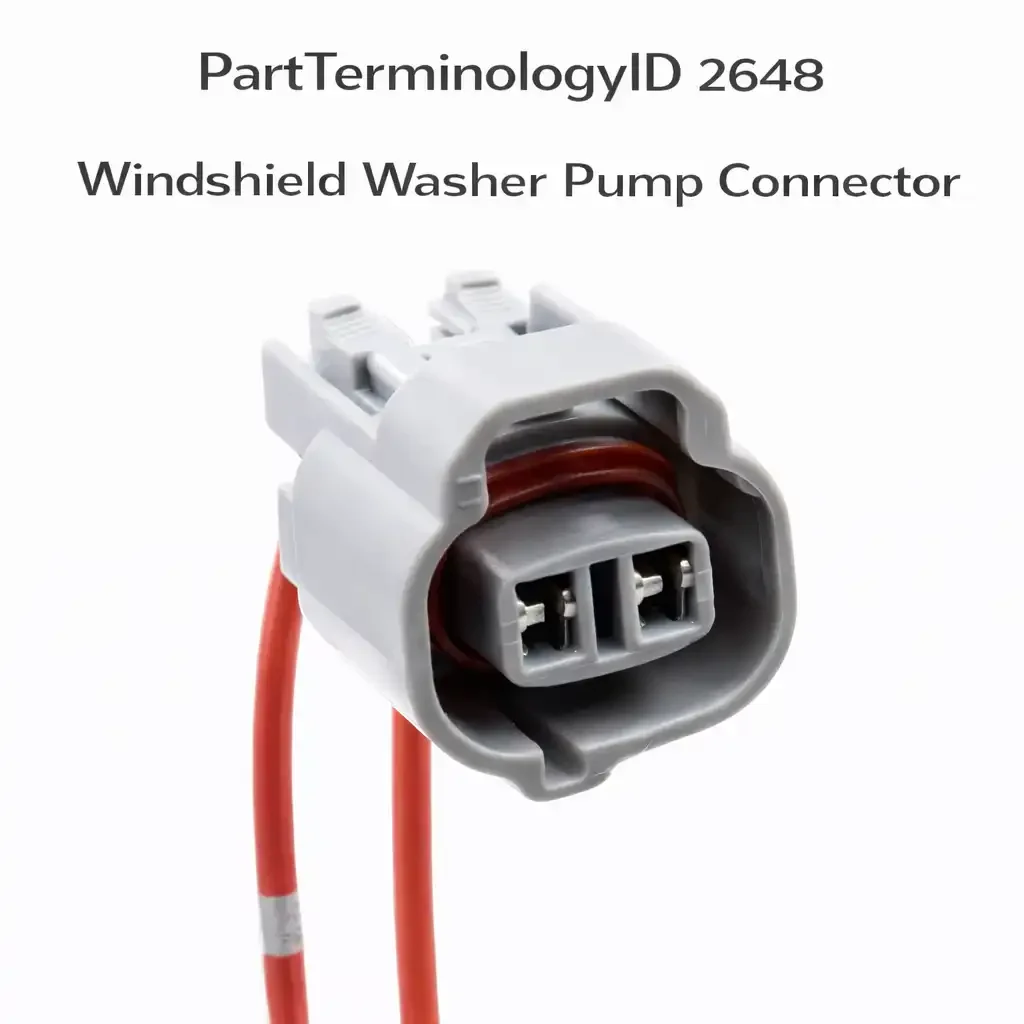
PartTerminologyID 2648, Windshield Washer Pump Connector, is the wiring harness plug that connects the vehicle's switched power and ground circuits to the windshield washer pump motor mounted on or adjacent to the washer fluid reservoir. That definition covers the component correctly and leaves unresolved every question that determines whether the replacement connector mates with the pump motor's receptacle, locks against the vibration and thermal cycling the engine bay produces, seats each terminal with enough contact force to maintain a low-resistance path through the switched power and ground circuits, accepts the wire gauge of the vehicle's existing harness leads without terminal deformation or inadequate crimp engagement, and resists the moisture, road spray, washer fluid overflow, and road salt that accumulate at the pump's mounting location at the base of the reservoir over the connector's service life.
It does not specify the pin count, the connector body shape or dimensions, the locking tab position, whether the locking tab is a top-lock or side-lock design, the terminal type, the terminal wire range in AWG, the circuit assignments for each pin, whether the connector includes a weatherproof seal at the mating face or grommet seals at the wire entry points, the wire lead length if pre-wired leads are included, the connector body material, the continuous operating temperature rating, whether the connector serves the front washer pump or the rear washer pump on vehicles with dual washer systems, or whether the connector includes a fluid level sensor circuit on three-pin designs in addition to the switched power and ground circuits. A listing under PartTerminologyID 2648 that specifies only year, make, and model without pin count, connector body geometry, and sealing designation cannot be evaluated by a technician holding a corroded connector at the base of a washer reservoir and trying to confirm the replacement before pulling the harness.
For sellers, PartTerminologyID 2648 sits at the lower end of the complexity spectrum for electrical connectors, but the returns it generates are disproportionate to that apparent simplicity for two reasons. First, the washer pump connector is one of the most moisture-exposed connectors on the vehicle, mounted at a location that accumulates standing water, road salt spray, and washer fluid contamination throughout the vehicle's service life. The corrosion failure rate at this connector is higher than at most other body electrical connectors of similar current rating because the mounting location combines water retention, chemical exposure from washer fluid, and road salt conductivity in a way that accelerates the electrochemical corrosion process at the pin contacts. Second, the two-pin connector format that serves the majority of washer pump applications is manufactured in a wide range of body configurations that share an identical pin count but are physically incompatible with each other. A buyer who orders by pin count alone will receive a connector that may not mate with the pump, and a buyer who orders by year, make, and model without verifying the body geometry against the listing may receive a connector that is correct for one variant of the vehicle but not the variant in front of them.
The additional complexity specific to PartTerminologyID 2648 is the front-versus-rear pump ambiguity on vehicles equipped with both a front windshield washer and a rear window washer. Many late-model vehicles route both the front and rear washer pump circuits through connectors of the same body format and terminal type, making the connectors visually indistinguishable at a glance. A listing that does not specify whether the connector serves the front pump, the rear pump, or both will generate returns from buyers who install a front-pump connector on a rear pump or who purchase a single connector expecting it to serve both positions.
What the Windshield Washer Pump Connector Does
Delivering switched power and ground to the pump motor
The windshield washer pump motor is a small DC motor that draws between 2 and 5 amperes depending on the pump design and the reservoir fluid level. When the driver activates the washer stalk, the body control module or a dedicated wiper relay closes the switched power circuit through the wiring harness to the pump motor connector. The switched power enters the connector on one pin, passes through the terminal contact to the pump motor's input terminal, energizes the motor, and the ground return path exits the pump motor through the second pin back to the vehicle chassis ground circuit.
The connector's electrical function is entirely dependent on maintaining low-resistance contact at both the switched power pin and the ground pin. A resistance increase at the switched power pin from corrosion or a degraded terminal reduces the voltage available at the pump motor's input terminal. A pump motor that receives 10.5 volts instead of 12.5 volts will produce lower impeller speed, lower fluid pressure, and reduced spray reach at the nozzles. The driver will notice reduced washer spray coverage before the pump fails entirely, and the symptom will be intermittent on cold mornings when the higher contact resistance of a cold corrosion layer is more pronounced than when the connector has thermally cycled and the contact oxide layer has fractured slightly under thermal expansion.
A resistance increase at the ground pin produces the same reduced motor performance but adds a second consequence specific to ground circuit failures: current sharing across alternate ground paths. If the pump motor's dedicated ground pin has high resistance, the motor will attempt to return current through any other available path to chassis ground, including through adjacent wiring or through the pump motor's mounting bracket if it is in contact with a grounded reservoir bracket. Alternate ground paths introduce noise into the circuits they share and can produce erratic operation of other components on the shared ground bus during washer activation events.
Carrying the fluid level sensor circuit on three-pin designs
A subset of windshield washer pump connectors serves applications where the washer reservoir includes an integrated low-fluid-level sensor. On these vehicles, the pump and the level sensor share the same connector body, which carries three circuits: switched power to the pump motor, ground for the pump motor and sensor circuit, and a signal return from the level sensor to the body control module. The level sensor is typically a reed switch or a float-actuated contact that closes when the fluid level drops below a threshold, sending a signal to the BCM that illuminates the low-washer-fluid warning lamp on the instrument cluster.
A two-pin connector installed on a three-pin pump application will leave the level sensor circuit unconnected. The washer pump will operate normally because the switched power and ground circuits are present, but the low-fluid warning lamp will not illuminate when the reservoir is empty, and the driver will have no warning before the reservoir runs dry. In dry climates where washer fluid refill is infrequent, a missing level sensor circuit produces no practical consequence beyond the absent warning light. In winter climates where washer fluid consumption is high and the reservoir empties quickly, a missing level sensor circuit removes the only automatic warning of an empty reservoir, which the driver will discover when the pump runs dry and delivers no fluid to the nozzles rather than when the warning light illuminates.
Resisting the washer pump's moisture and chemical environment
The windshield washer pump is mounted at the base of the washer fluid reservoir, which places the pump connector at one of the lowest and most moisture-exposed positions in the engine bay. Road spray thrown by the front wheels reaches this location directly. Rain and snow melt drain from the engine bay toward the front of the vehicle and pool at the reservoir base. Washer fluid that overflows when the reservoir is overfilled runs down the reservoir wall and contacts the connector body and wire entry points. Road salt in solution becomes an electrolyte that accelerates the galvanic corrosion process at any exposed metal surface in the connector, including the pin contacts, the terminal crimps, and the wire strands inside the insulation at the wire entry points.
A connector body without a weatherproof seal at the mating face admits moisture to the pin cavities through the gap between the plug and socket faces when the connector is mated. A connector without grommet seals at the wire entry points admits moisture along the wire insulation by capillary action, which draws the corrosive solution up the wire strands toward the terminal crimp. The corrosion that begins at the terminal crimp produces a high-resistance junction between the wire and the terminal that is not visible from outside the connector body and is not detectable without disassembling the connector and inspecting the individual terminals. This hidden corrosion at the crimp is the most common cause of intermittent washer pump operation failures in northern climates because the corroded crimp junction produces a resistance that varies with temperature and moisture level, generating a symptom pattern that appears to resolve itself and returns unpredictably.
The front-versus-rear pump distinction on dual washer system vehicles
Vehicles equipped with both a front windshield washer system and a rear window washer system typically use two separate pump motors mounted on the same reservoir or on separate reservoirs depending on the vehicle packaging. On vehicles with a single shared reservoir, both pumps are mounted at the base of the reservoir in close proximity, and their connectors are often the same body format with the same pin count and terminal type. The only reliable way to distinguish the front pump connector from the rear pump connector on these vehicles is by the color coding of the wires attached to the harness side of the connector or by the routing of the harness from each pump to the wiper module or BCM.
A listing that does not specify whether the connector is for the front pump, the rear pump, or both positions will generate returns from buyers on dual-washer-system vehicles who cannot determine which connector to order. On some vehicle applications, the front and rear pump connectors use a different body format despite sharing the same pin count, because the rear pump's connector was specified separately from the front pump's connector in the vehicle's wiring design. A listing that covers both positions without distinguishing between them will also generate returns from buyers who install the connector on the wrong pump and find that the other pump's connector is a different body format that the same replacement part does not serve.
Why This Part Generates Returns
Buyers return windshield washer pump connectors because the pin count matches the original but the connector body geometry does not mate with the pump's receptacle, the locking tab is on the opposite side from the original and the connector backs out of the pump receptacle under hood vibration, the connector is designed for the front washer pump and the buyer needed the rear washer pump connector on a dual-washer-system vehicle, the connector is a two-pin design and the buyer's pump uses a three-pin connector that includes a fluid level sensor circuit, the pre-wired leads are too short to reach the splice point in the harness with adequate service loop, the terminal wire range does not accept the buyer's harness wire gauge and the terminals cannot be crimped without deformation, the connector body is not weatherproof and the buyer's application requires sealing for a boat trailer or vehicle stored outdoors in a wet climate, the connector body material is not rated for the underhood temperature range of the buyer's turbocharged or performance application where the engine bay temperatures exceed the connector's continuous rating, and the terminal type is a push-in design rather than a crimp design and the buyer's harness repair requires a crimp terminal for a reliable splice.
Status in New Databases
PIES/PCdb: PartTerminologyID 2648, Windshield Washer Pump Connector
PIES 8.0 / PCdb 2.0: No change in PartTerminologyID or terminology label. Internal systems keyed to 2648 do not require remapping at the PIES 8.0 transition.
Top Return Scenarios
Scenario 1: "Same pin count, different body width, connector does not insert into pump receptacle"
The vehicle has a two-pin washer pump connector. The replacement connector is a two-pin design but the body is 3mm wider than the original and the cavity spacing is 6.35mm rather than the original's 5.08mm. The replacement does not insert into the pump's receptacle. The technician attempts to push it in and bends the pump's receptacle tabs. The connector is returned and the pump receptacle requires inspection for damage before a second replacement attempt.
Prevention language: "Connector body width: [X] mm. Cavity spacing center-to-center: [X] mm. Locking tab position: [top / side]. Verify connector body dimensions match the existing connector before installation. Many washer pump connectors share the same pin count but use different body widths and cavity spacings that make them physically incompatible. Do not force a connector that does not insert smoothly by hand."
Scenario 2: "Front pump connector ordered, vehicle has dual washer system, rear pump connector needed"
The buyer's vehicle has both a front and rear washer system sharing a single reservoir with two pump motors. The rear washer pump connector has failed. The buyer orders a windshield washer pump connector by year, make, and model. The listing covers the front pump position. The delivered connector mates with the front pump but not the rear pump, which uses a slightly different body format on this vehicle. The buyer installs the connector on the front pump by mistake and returns it when they discover the rear pump still does not work.
Prevention language: "Pump position: [front windshield / rear window / front and rear]. This connector is designed for the [front / rear] washer pump position. Vehicles with dual front and rear washer systems may use different connector bodies for each pump position. Verify the pump position before ordering. If your vehicle has both front and rear washer pumps, confirm which pump connector has failed before selecting the replacement."
Scenario 3: "Two-pin connector installed on three-pin pump, fluid level sensor circuit absent, no low-fluid warning"
The vehicle's washer pump uses a three-pin connector that carries switched power, ground, and a fluid level sensor signal. The buyer orders a two-pin replacement connector because the listing does not distinguish between two-pin and three-pin variants for the same vehicle application. The two-pin connector mates physically because the body format accommodates two of the three pins. The pump operates normally but the fluid level sensor pin is left unconnected. The driver receives no low-washer-fluid warning when the reservoir empties during winter use and runs the pump dry on a highway trip.
Prevention language: "Pin count: [2 / 3]. Circuit assignments: Pin 1: switched power to pump motor. Pin 2: ground. Pin 3 (where present): fluid level sensor signal return. This vehicle application is available with both a two-pin pump connector and a three-pin pump connector depending on whether the reservoir includes an integrated fluid level sensor. Verify the pin count of the existing connector on your vehicle before ordering. Installing a two-pin connector on a three-pin pump application will leave the fluid level sensor circuit unconnected and disable the low-washer-fluid warning lamp."
Scenario 4: "Unsealed connector on boat trailer wash-down application, pin contacts corrode within first season"
The buyer installs the replacement washer pump connector on a vehicle that is used to tow a boat trailer and is regularly driven through standing water during ramp access. The connector bodies are unsealed. During the first season, the connector is submerged in standing water at the boat ramp on multiple occasions. By end of season, the pin contacts inside the connector body show heavy corrosion from repeated wetting and drying with road salt residue. The washer pump fails to operate intermittently and then permanently. The connector is returned as defective, but the failure was caused by moisture ingress in an unsealed connector used in a submersion-adjacent application.
Prevention language: "Connector sealing: [unsealed / splash-resistant / weatherproof with mating face gasket and wire entry grommets]. For applications where the connector will be exposed to standing water, road salt spray, or washer fluid overflow, specify a weatherproof connector with a mating face gasket seal and grommet seals at all wire entry points. Unsealed connectors are adequate for normal engine bay splash exposure but will corrode at the pin contacts within one to two seasons in northern road salt climates or in ramp-access vehicle applications."
Scenario 5: "Pre-wired leads too short, splice made under tension, intermittent open circuit on cold starts"
The replacement connector includes 8-inch pre-wired leads. The vehicle's harness splice point is 12 inches from the pump connector position due to a previous harness repair that shortened the original leads. The technician makes the splice under tension using push-in splice connectors. During cold weather, the harness contracts and the tension on the splice pulls one push-in connector partially off its lead, producing an open circuit in the switched power lead on cold mornings that self-resolves as the engine bay warms. The intermittent no-spray condition on cold starts is misdiagnosed as a failing pump motor before the splice is located.
Prevention language: "Pre-wired lead length: [X] inches. Verify the included lead length is sufficient to reach the splice point in your harness with a minimum 3-inch service loop. Never splice under tension. Allow adequate slack at every splice to accommodate thermal contraction on cold starts. For applications where the original leads have been shortened by previous repairs, measure the distance from the pump connector to the intended splice point before ordering to confirm the included lead length is adequate."
Scenario 6: "Corroded terminal crimp inside connector body, intermittent pump operation, not visible without disassembly"
The vehicle presents with intermittent washer operation that is more frequent on cold mornings and resolves after the engine bay warms. The technician inspects the connector visually, finds no external corrosion on the connector body or at the mating face, and replaces the pump motor as the suspected failed component. The intermittent condition persists with the new pump. On the second inspection, the technician disassembles the connector and finds heavy corrosion at the terminal crimp inside the connector body where moisture has wicked up the wire strands from an unsealed wire entry point. The terminal crimp resistance is high enough to reduce pump motor voltage at cold temperatures when the corrosion layer is thickest.
Prevention language: "Wire entry sealing: [grommet seals included / unsealed wire entry]. Corrosion at the terminal crimp inside the connector body is the most common cause of intermittent washer pump operation in climates with road salt exposure. This corrosion is not visible from outside the connector and cannot be detected without terminal removal. When replacing a connector due to intermittent washer operation, inspect the terminal crimps inside the existing connector body for green or white corrosion before concluding the pump motor has failed. Replace both the connector and pump if crimp corrosion is present and the pump has been operating against elevated resistance for an extended period."
What to Include in the Listing
Core essentials
PartTerminologyID: 2648
component: Windshield Washer Pump Connector
pin count: 2-pin or 3-pin (mandatory, in title)
pump position: front windshield, rear window, or front and rear (mandatory)
connector body width in mm (mandatory)
cavity spacing center-to-center in mm (mandatory)
locking tab position: top or side (mandatory)
locking tab style: push-to-release or squeeze-release (mandatory)
terminal type: female socket or male pin (mandatory)
terminal wire range in AWG (mandatory)
circuit assignments per pin: switched power, ground, fluid level sensor signal (mandatory for all pins)
pre-wired leads: included or not included; if included, lead length in inches per lead (mandatory)
wire gauge of included leads (mandatory where leads are included)
connector body sealing: unsealed, splash-resistant, or weatherproof with mating face gasket and wire entry grommets (mandatory)
connector body material and continuous temperature rating in degrees Celsius (mandatory)
OEM connector part number cross-reference where available (mandatory)
quantity: 1
Fitment essentials
year/make/model/submodel
engine designation where connector specification varies by engine
front versus rear pump position where the vehicle has a dual washer system
two-pin versus three-pin variant designation where the same vehicle application uses both
note for vehicles where the reservoir includes an integrated fluid level sensor requiring the three-pin connector
OEM part number cross-reference to support technician verification against existing connector markings
Image essentials
connector shown from the mating face with pin cavities numbered and labeled by circuit assignment
connector shown from the side with locking tab position and engagement direction indicated
connector shown from the rear with wire entry points and grommet seal detail visible
connector shown mated with a representative pump receptacle confirming full engagement and locking tab click
pre-wired lead length shown with a measurement reference
OEM part number or connector identification marking shown on the connector body where present
Catalog Checklist for ACES/PIES Teams
PartTerminologyID = 2648
require pin count as primary attribute (mandatory)
require pump position: front, rear, or front and rear (mandatory)
require connector body width and cavity spacing in mm (mandatory)
require locking tab position and style (mandatory)
require circuit assignments per pin (mandatory)
require terminal wire range in AWG (mandatory)
require connector body sealing designation (mandatory)
require pre-wired lead length where leads are included (mandatory)
require connector body temperature rating in degrees Celsius (mandatory)
prevent pin-count-only fitment: a listing that states "2-pin washer pump connector" without body geometry will match multiple incompatible connector bodies; body width and cavity spacing must be required attributes on every listing
prevent front-versus-rear ambiguity: a listing that does not specify front or rear pump position on vehicles with dual washer systems will generate returns from buyers who install the connector on the wrong pump; pump position must be stated as a required attribute
prevent two-pin versus three-pin ambiguity: a listing that does not distinguish between two-pin and three-pin variants on vehicles where both exist will generate returns from buyers who receive a two-pin connector for a three-pin pump application; pin count and circuit assignments must be required attributes on every listing
flag weatherproof sealing as mandatory for northern climate applications: an unsealed connector at the washer pump mounting location will corrode at the terminal crimps within one to two seasons of road salt exposure; sealing designation must be stated for every listing
flag crimp corrosion as the primary hidden failure mode: intermittent washer pump operation in an existing installation is more often caused by corroded terminal crimps inside the connector body than by a failed pump motor; the listing should include an installation note directing buyers to inspect the terminal crimps before replacing the pump
differentiate from windshield washer pump: the pump is the electromechanical component that pressurizes the washer fluid; the connector is the wiring harness interface to the pump; both are in the washer system circuit but serve different functions under different PartTerminologyIDs
differentiate from wiper motor connector: the wiper motor connector serves the wiper motor drive circuit; the washer pump connector serves the washer pump motor; both are in the wiper and washer system ecosystem but are separate components with separate PartTerminologyIDs
FAQ (Buyer Language)
What does the windshield washer pump connector do?
The windshield washer pump connector is the wiring harness plug that delivers switched power and ground to the washer pump motor. When the driver activates the washer stalk, the body control module or wiper relay closes the switched power circuit through the connector to the pump motor, which pressurizes the washer fluid and delivers it to the spray nozzles. A failed or corroded connector in this circuit produces the same symptom as a failed pump motor: no washer fluid delivery when the stalk is activated.
How do I identify the correct windshield washer pump connector for my vehicle?
Count the pins on the existing connector at the pump and note the connector body shape, locking tab position, and wire gauge of the attached leads. Most windshield washer pump connectors are two-pin designs carrying switched power and ground, but some vehicles use a three-pin connector that adds a fluid level sensor circuit. The body geometry varies significantly across manufacturers and model years even within the same pin count. Physical verification of the connector body dimensions against the replacement listing is the only reliable confirmation before installation.
Can a faulty windshield washer pump connector cause the washer system to stop working?
Yes. A connector with corroded pin contacts, a damaged terminal, or a cracked connector body that allows moisture into the cavity will interrupt the switched power or ground circuit to the pump motor. Corrosion at the terminal crimp inside the connector body is particularly common because the crimp is inside the connector and is not visible from outside. A corroded crimp junction produces a resistance that reduces pump motor voltage and generates intermittent no-spray conditions, especially on cold mornings when the corrosion layer is thickest, before the pump fails entirely.
My replacement windshield washer pump connector has the same pin count but does not mate with the pump. What is wrong?
The connector body geometry does not match the pump's receptacle even though the pin count is the same. Windshield washer pump connectors are manufactured in multiple body configurations sharing a two-pin count, with different body widths, cavity spacings, and locking tab positions that make them physically incompatible despite identical pin counts. Compare the body width and cavity spacing of the replacement against the original before attempting insertion and do not force a connector that does not insert smoothly by hand.
Does the windshield washer pump connector need to be weatherproof?
Yes for most applications. The washer pump is mounted at or near the base of the washer fluid reservoir, where it receives direct road spray, standing water, washer fluid overflow, and road salt exposure. A connector without weatherproof sealing at the mating face and wire entry points will corrode at the pin contacts and at the terminal crimps within one to two seasons in northern climates with road salt exposure. Specify a connector with a mating face gasket seal and wire entry grommet seals for any vehicle driven year-round in a wet or salted road environment.
What is the difference between a windshield washer pump connector and a rear washer pump connector?
A windshield washer pump connector serves the front washer pump that supplies fluid to the front windshield nozzles. A rear washer pump connector serves the rear window washer pump on vehicles with rear wiper and washer systems. On many vehicles both pumps share the same reservoir but use separate pump motors with separate connectors. The two connectors may use the same body format, or they may differ depending on the vehicle manufacturer's design. Verify which pump position the connector is intended for before ordering, particularly on vehicles with dual front and rear washer systems.
Cross-Sell Logic
Windshield Washer Pump: the electromechanical component the connector plugs into; inspect the connector when replacing the pump, and inspect the pump when the connector shows heavy terminal corrosion that indicates the pump has been operating against elevated resistance for an extended period
Washer Fluid Reservoir: the tank that houses the pump motor and the fluid level sensor; a cracked reservoir that allows fluid to pool at the pump mounting location accelerates connector corrosion; inspect the reservoir for cracks when the connector shows washer fluid contamination
Wiper Motor Connector (PartTerminologyID adjacent): the wiring harness connector for the wiper motor drive circuit; on vehicles where the wiper motor and washer pump share a common underhood wiring loom, both connectors may show corrosion at the same service event
Terminal Repair Kit: for applications where the connector body is serviceable but individual terminals are corroded; a terminal repair kit provides replacement terminals in the correct type and wire range without requiring replacement of the full connector body and leads
Dielectric Grease: applied to the pin contacts at installation to prevent oxidation and extend the connector's service life in the high-moisture, high-salt environment at the washer pump mounting location
Frame as "the washer pump connector is the switched circuit interface between the vehicle's wiper control system and the pump motor. The pump motor pressurizes the fluid the reservoir holds. The reservoir houses the pump the connector powers. The terminal repair kit restores individual contacts the connector body would otherwise replace entirely. All are in the same washer system delivery pathway."
Final Take for PartTerminologyID 2648
Windshield Washer Pump Connector (PartTerminologyID 2648) is the PartTerminologyID in the wiper and washer series where connector body geometry ambiguity and moisture sealing omission together account for the highest rate of returns relative to the component's low unit cost. A connector that does not mate because the body width or cavity spacing differs from the original by two millimeters returns without causing additional damage but generates a return event for a component priced below ten dollars, which means the return cost exceeds the margin on multiple sales. A connector that mates correctly but lacks weatherproof sealing at the wire entry points will corrode at the terminal crimps within one to two seasons and generate a return disguised as a defective product claim rather than a specification failure. Both outcomes are entirely preventable by attribute statements that go beyond pin count to specify the body geometry, the sealing designation, the pump position, and the two-pin versus three-pin variant on applications where both exist.
State the pin count in the title. State the pump position: front, rear, or front and rear. State the body width and cavity spacing in millimeters. State the locking tab position and style. State the circuit assignment for every pin, including the fluid level sensor circuit on three-pin designs. State the terminal wire range. State the pre-wired lead length where leads are included. State the sealing designation and distinguish weatherproof from splash-resistant from unsealed. State the temperature rating. State the installation note directing the technician to inspect the terminal crimps inside the existing connector before concluding the pump motor has failed. For PartTerminologyID 2648, body geometry, sealing designation, and pump position are the three attributes that determine whether the replacement connector produces a functional washer system or generates a return that costs more to process than the part is worth.