
Written by Arthur Simitian | PartsAdvisory
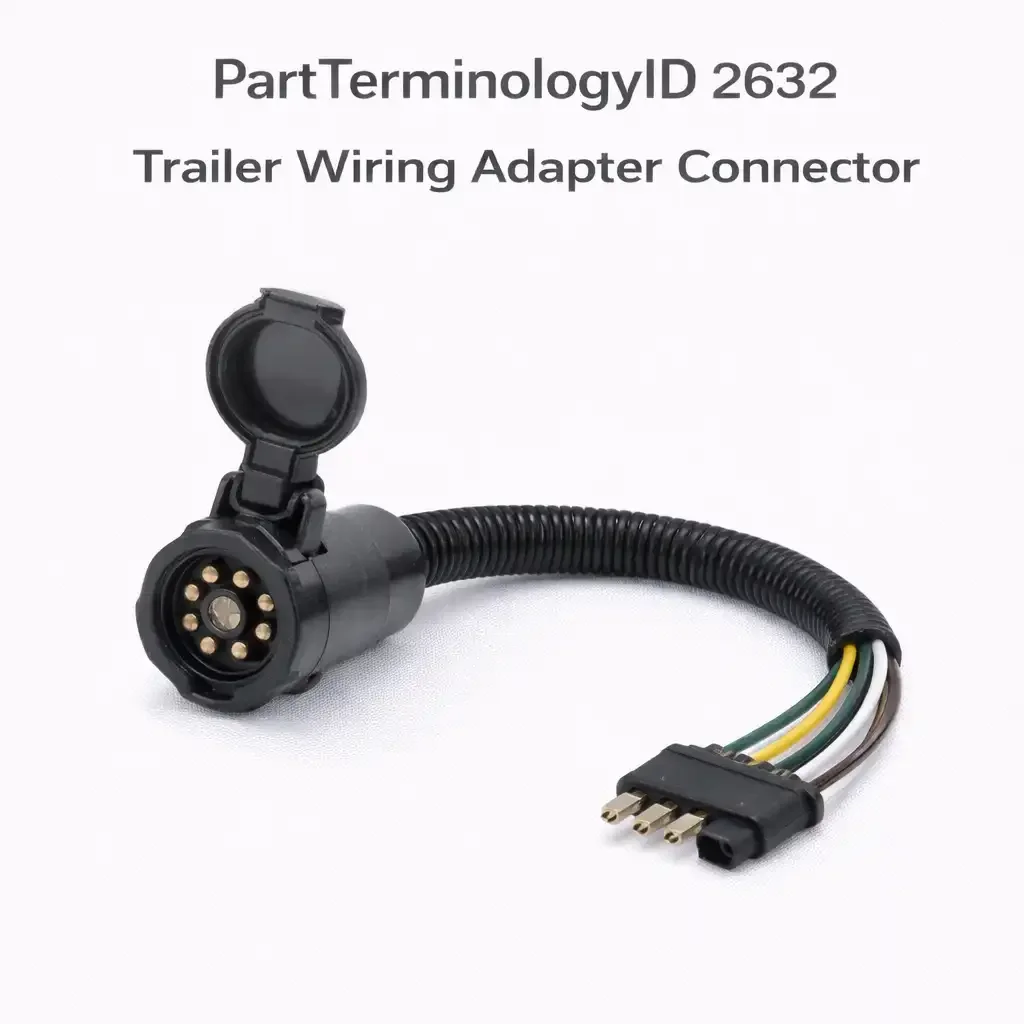
PartTerminologyID 2632, Trailer Wiring Adapter Connector, is the electrical interface component that converts the wiring connector format on the tow vehicle's harness to the connector format required by the trailer, or converts between two trailer connector standards when the trailer's plug and the vehicle's socket are incompatible. That definition covers the function correctly and leaves unresolved every question that determines whether the adapter physically mates with both connectors, routes each electrical function from its vehicle pin to the correct trailer pin, carries the current load of the trailer's brake lights, turn signals, running lights, and electric brakes without voltage drop, seals adequately against road moisture at the connector bodies, and supports the specific wiring functions the trailer requires without leaving mandatory circuits unmated.
It does not specify the vehicle-side connector format, the trailer-side connector format, whether it converts from a 4-flat to a 7-way round, from a 7-way round to a 6-way round, from a 5-flat to a 4-flat, or between any other combination of the dozens of connector formats in the North American and international towing markets. It does not specify the pin count on either side, the current rating per circuit, whether the brake output circuit passes a brake light signal through to the trailer or powers electric trailer brakes from a separate brake controller output, the wire gauge in the adapter's internal harness, the connector body material, the sealing standard, whether the connector uses weatherproof seals or relies on friction fit, the circuit protection on any output pin, or whether any function is combined or split across the adapter. A listing under PartTerminologyID 2632 that specifies only year, make, and model without both connector formats, the pin count on each side, and the function map cannot be evaluated by any buyer standing at the rear of a vehicle connected to a trailer with incompatible connectors.
For sellers, PartTerminologyID 2632 sits at the intersection of two product ecosystems that evolved independently: the tow vehicle aftermarket harness connector system, which standardized around the 4-flat and 7-way round formats for most North American passenger and light commercial vehicles, and the trailer industry connector system, which uses a broader range of formats across recreational trailers, horse trailers, utility trailers, boat trailers, and commercial semi-trailer applications. The adapter connector market exists because those two ecosystems were never fully synchronized and because a buyer who replaces a vehicle or acquires a new trailer frequently has a format mismatch that cannot be resolved by replacing the entire vehicle or trailer harness.
The additional complexity specific to PartTerminologyID 2632 is the function mapping argument. A connector format adapter that physically mates on both ends but maps the left turn signal pin to the right turn signal circuit, or routes the brake controller output to the running light circuit, produces a trailer with crossed turn signals or with brakes that apply when the running lights are activated. Both are safety violations. The physical fit at both ends confirms only that the adapter can be installed. The function map confirms whether the adapter produces correct lighting and braking behavior. The function map is not implied by the connector format names and must be stated explicitly for every circuit the adapter passes through.
What the Trailer Wiring Adapter Connector Does
Converting between vehicle harness and trailer harness connector formats
The primary function is to present the correct mechanical connector interface to the vehicle's harness plug on one end and the correct interface to the trailer's harness plug on the other, while routing each circuit from its vehicle-side pin to the corresponding circuit on the trailer side. The standard North American 4-flat connector carries four circuits: left turn and brake combined, right turn and brake combined, running lights, and ground. The 7-way round connector used on most full-size trucks carries seven circuits: left turn, right turn, brake lights, running lights, ground, battery positive, and electric brake controller output. Adapters between these two formats must correctly map the 4-flat's combined turn-and-brake circuit to the 7-way's separate circuits, which requires that the adapter be used only on vehicles with a combined turn-and-brake signal. That mapping constraint must be stated in the listing.
Supporting the trailer's required electrical functions
Trailers vary in their electrical requirements based on size, purpose, and equipment. A small utility trailer requires only four basic functions. A travel trailer or fifth wheel adds a separate brake controller output for electric trailer brakes and a battery positive circuit for battery charging, which require the 7-way or larger connector format on both sides. An adapter that omits a required trailer circuit because the vehicle-side connector does not carry that function will leave the trailer electrically incomplete. If the adapter does not connect the brake controller output to the corresponding trailer pin, the trailer's electric brakes will not receive a signal and will not apply whenever the tow vehicle brakes. That is a safety failure directly traceable to an adapter that did not support the trailer's full required circuit set.
Maintaining acceptable voltage drop across all trailer circuits
Trailer lighting regulations require brake and turn lights to illuminate at a brightness visible from a specified distance. An adapter connector with high-resistance pin contacts, undersized internal wire gauge, or corroded terminal bodies drops the voltage available at the trailer's lights below the design operating voltage. The most common voltage drop failure is corroded pin contacts that began as a clean connection but deteriorated from moisture ingress at an unsealed connector body over multiple towing seasons. A 4-flat to 7-way adapter used seasonally, disconnected and stored through winter, and reconnected each spring will experience moisture cycling at every unmated connector face if the bodies do not have positive weatherproof sealing. The resulting oxide layer adds resistance that increases with each season, producing trailer lights that dim progressively rather than failing suddenly.
The connector format taxonomy and the naming problem
The trailer connector market uses format names that are partially standardized by SAE J560 for the 7-way round commercial connector and partially standardized by industry convention for the 4-flat and 5-flat formats. The same connector can be referred to by multiple names: the 7-way RV blade connector is also called the 7-pin blade connector, the 7-flat connector, and the 7-way RV-style connector. The SAE J560 7-way round connector is mechanically incompatible with the 7-way RV blade connector despite having the same pin count. An adapter listed as "7-way to 7-way" without specifying whether the 7-way is J560 round or RV blade on each end will produce returns from buyers who connect the wrong format and find the connector will not mate. The listing must specify the exact connector format on both sides by pin count and body style.
Electric brake controller compatibility
Vehicles with an electric trailer brake controller output the brake signal on a dedicated pin in the 7-way connector. The brake controller output pin in the 7-way RV blade connector is the center pin by SAE convention. The brake controller output pin in the SAE J560 7-way round is pin 7 by J560 standard, which is in a different position. An adapter between a J560 vehicle harness and an RV trailer harness that does not correctly map the brake controller output pin will either produce no trailer brake response or apply a continuous brake signal, depending on which RV blade pin receives the incorrectly routed output. For sellers, this is the highest-consequence function mapping error in the adapter connector category because an unmated or incorrectly routed brake controller output eliminates trailer braking entirely on trailers that rely on electric brakes.
Why This Part Generates Returns
Buyers order the wrong trailer wiring adapter connector because the vehicle-side connector format is specified without the body style designation and the buyer receives a round connector when the vehicle harness requires a flat connector; the adapter's internal function map routes combined turn-and-brake signals correctly for one signal configuration and incorrectly for the other; the brake controller output pin is routed to an incorrect position; the adapter does not carry the battery-positive charging circuit because it was designed for lighting-only applications; the wire gauge is undersized for the trailer's total current load; the connector bodies are not environmentally sealed and corrode after a single winter storage season; the adapter cable length is insufficient for the tow vehicle's tongue length; and the adapter does not include a dedicated ground circuit and relies on the hitch ball as the ground return path, which produces phantom lighting events from current sharing across brake, turn, and running light circuits.
Status in New Databases
PIES/PCdb: PartTerminologyID 2632, Trailer Wiring Adapter Connector
PIES 8.0 / PCdb 2.0: No change in PartTerminologyID or terminology label. Internal systems keyed to 2632 do not require remapping at the PIES 8.0 transition.
Top Return Scenarios
Scenario 1: "7-way round to 7-way flat ordered, vehicle has RV blade, commercial J560 connector delivered"
The buyer's vehicle has a 7-way RV blade harness socket. The listing described the adapter as "7-way to 4-flat" without specifying the 7-way body style. The adapter delivered has a SAE J560 7-way round vehicle-side connector, which does not mate with the vehicle's RV blade socket. The adapter is returned immediately.
Prevention language: "Vehicle-side connector: 7-way RV blade (flat, non-J560). Trailer-side connector: 4-flat. This adapter is not compatible with SAE J560 7-way round commercial connectors. J560 round connectors have a circular body with a twist-lock engagement. RV blade connectors have a rectangular body with blade-style pins. Verify the vehicle harness connector body style before ordering."
Scenario 2: "Turn signals crossed, left trailer light activates on right turn"
The adapter mates correctly on both sides but the internal wiring reversed the left and right turn pin routing during manufacture. The buyer did not discover the crossed turn signals until a light check with a second person behind the trailer. The adapter was returned as defective.
Prevention language: "Function map: left turn and brake [vehicle pin A] to [trailer pin X]; right turn and brake [vehicle pin B] to [trailer pin Y]; running lights [vehicle pin C] to [trailer pin Z]; ground [vehicle pin D] to [trailer pin W]. Perform a light function check before towing. Verify left turn on the vehicle activates the left trailer indicator and right turn activates the right. Do not tow until turn signal polarity is confirmed."
Scenario 3: "Electric brake circuit absent, heavy trailer operated without trailer brakes"
The buyer has a vehicle with a 7-way RV blade socket and a travel trailer with electric brakes requiring the brake controller output on pin 7. The adapter purchased converts from a 4-flat vehicle socket to a 7-way trailer plug but does not carry a brake controller output circuit because it was designed for light-duty trailers. The buyer connected the trailer and towed it for a full day before noticing the brake controller display showed no trailer brake connection.
Prevention language: "Brake controller output circuit: [included / not included]. This adapter [does / does not] route a brake controller signal to the trailer connector. For trailers with electric brakes, verify this adapter includes and correctly routes the brake controller output pin before towing. Operating a trailer with electric brakes without a functional brake controller connection is a safety violation for trailers above the applicable gross vehicle weight rating."
Scenario 4: "Combined turn-and-brake vehicle signal, separate turn-and-brake adapter, left brake light always on"
The vehicle outputs a combined turn-and-brake signal on a single pin for each side. The adapter was designed for vehicles that output separate turn and brake signals. Connected to the vehicle's combined signal, the adapter's brake input pin receives a permanent signal, which the adapter interprets as a continuous brake input. The trailer's brake lights illuminate continuously regardless of whether the vehicle's brakes are applied.
Prevention language: "Vehicle wiring configuration compatibility: [combined turn and brake signal / separate turn and brake signals]. Most domestic and import passenger vehicles use a combined turn-and-brake signal. Most European vehicles and some heavy-duty trucks use separate signals. Verify your vehicle's wiring configuration before ordering. Installing an adapter designed for separate signals on a combined-signal vehicle will produce continuously illuminated trailer brake lights."
Scenario 5: "Voltage drop from corroded pins, trailer brake lights fail DOT visibility check after first winter"
The adapter was used through a full towing season then stored in an open truck bed. After winter, corrosion on the unsealed pin contacts had increased circuit resistance to the point that the trailer's brake light LEDs illuminated at approximately 60 percent brightness. The trailer failed the lighting inspection because the brake lights did not meet the minimum photometric output at the required distance.
Prevention language: "Connector sealing: [sealed / unsealed]. For applications where the adapter will be stored disconnected and exposed to weather between towing seasons, specify a sealed adapter with weatherproof connector bodies on both sides. Apply dielectric grease to all pin contacts before mating to prevent oxidation during storage intervals."
Scenario 6: "Adapter too short, cable under tension during turns, intermittent contact breaks in running light circuit"
The buyer's vehicle has a trailer hitch with a 24-inch receiver extension. The adapter's cable length is 12 inches, standard for factory tongue lengths. The adapter reaches the trailer plug socket but is under tension during turns and vibrates the connector bodies at both ends, producing intermittent contact breaks in the running light circuit during highway towing.
Prevention language: "Adapter cable length: [X] inches. For vehicles with receiver extensions or with the trailer harness socket mounted forward of the hitch ball, verify the adapter cable length spans the distance without tension. For extended-length applications, specify an adapter with a minimum 36-inch cable or use an extension harness."
Scenario 7: "No dedicated ground circuit, phantom illumination from hitch ball ground return path"
The adapter included circuits for left turn, right turn, and running lights, but did not include a dedicated ground wire. Under towing, the trailer's lighting circuits shared a high-resistance ground path through the hitch ball and coupler. Running light current seeking through the turn signal circuit produced phantom illumination of the turn signals when only the running lights were activated.
Prevention language: "Dedicated ground circuit: [included / not included]. Relying on the hitch ball and coupler as the ground return path introduces resistance that produces ground-induced phantom illumination. Specify an adapter with a dedicated four-conductor wiring configuration including a dedicated ground wire."
Scenario 8: "Undersized wire gauge, running light circuit drops below LED minimum operating voltage"
The trailer's running light circuit draws 8.5 amperes. The adapter's internal running light conductor is 18-gauge wire rated for a maximum of 7 amperes. At 8.5 amperes, the conductor produced a voltage drop of approximately 0.9 volts, reducing the trailer's running light supply voltage from 13.5 volts to 12.6 volts. The trailer's rearmost LED light bars operated at or below their minimum forward voltage threshold and produced inconsistent illumination.
Prevention language: "Wire gauge per circuit: [AWG] for running lights, [AWG] for turn and brake circuits, [AWG] for ground. Maximum continuous current rating per circuit: [X] amperes. For trailers with total running light loads above 6 amperes, verify the adapter's running light conductor gauge is sufficient. For trailers above 30 feet or with LED light bars, specify an adapter with 14-gauge or heavier running light conductors."
What to Include in the Listing
Core essentials
PartTerminologyID: 2632
component: Trailer Wiring Adapter Connector
vehicle-side connector format: flat, round, J560 round, RV blade, 4-flat, 5-flat, 6-way, 7-way (mandatory, in title)
trailer-side connector format: same designations (mandatory, in title)
pin count on each side (mandatory)
function map: which vehicle-side pin routes to which trailer-side pin for every circuit (mandatory)
brake controller output circuit: included or not included, with pin position on trailer-side connector (mandatory)
battery positive charging circuit: included or not included (mandatory)
vehicle wiring configuration compatibility: combined turn-and-brake or separate turn and brake signals (mandatory)
wire gauge per circuit (mandatory)
maximum current rating per circuit (mandatory)
connector body sealing: sealed with weatherproof gaskets or unsealed (mandatory)
adapter cable length in inches (mandatory)
dedicated ground circuit: included or not included (mandatory)
connector body material (mandatory)
SAE or applicable standard compliance where applicable (mandatory)
circuit protection: fused or unfused per circuit, fuse rating where applicable (mandatory)
quantity: 1
Fitment and dimensional essentials
year/make/model/submodel for vehicle-side connector compatibility
trailer type compatibility: utility, boat, RV/travel trailer, horse trailer, commercial
gross trailer weight rating for brake controller circuit applicability
adapter cable length in inches
vehicle-side and trailer-side connector body outer diameter or width in mm
connector engagement depth on both sides
Image essentials
vehicle-side connector from the front with pin positions numbered and labeled by function
trailer-side connector from the front with pin positions numbered and labeled by function
adapter cable in full with both connector bodies visible
connector body sealing detail showing weatherproof gasket where present
function map diagram showing vehicle pin to trailer pin routing for every circuit
adapter installed in a representative vehicle harness socket showing positive engagement
Catalog Checklist for ACES/PIES Teams
PartTerminologyID = 2632
require vehicle-side connector format with body style designation as primary attribute (mandatory)
require trailer-side connector format with body style designation (mandatory)
require pin count on each side (mandatory)
require function map for every circuit (mandatory)
require brake controller output circuit status: included or not included (mandatory)
require vehicle wiring configuration compatibility statement (mandatory)
require wire gauge per circuit (mandatory)
require connector sealing designation (mandatory)
require adapter cable length (mandatory)
require dedicated ground circuit statement (mandatory)
prevent format-only listings: stating "7-way to 4-flat" without specifying body style will produce returns from buyers who match pin count but not physical body format
prevent function map omission: an adapter that physically mates on both sides but maps circuits incorrectly produces a safety violation; the function map must be stated explicitly
prevent brake circuit omission: trailers above applicable GVWR require functional electric brakes; brake circuit status must be a required attribute, not inferred from connector format
differentiate from trailer wiring harness: the harness is the complete vehicle-to-connector wiring assembly; the adapter converts between two existing connector formats
differentiate from trailer connector socket: the socket is the fixed receptacle mounted on the vehicle; the adapter is a portable converter between two socket formats
flag combined versus separate turn-and-brake compatibility as the highest-consequence function mapping error for passenger vehicle applications: most domestic and import passenger vehicles use combined turn-and-brake signals; adapters designed for separate-signal vehicles will produce continuously illuminated brake lights on combined-signal vehicles
flag brake controller pin mapping as mandatory for all adapters that include a brake controller output circuit: the pin position differs between J560 round and RV blade 7-way formats
flag connector sealing as mandatory for adapters marketed for seasonal use: an unsealed adapter stored through one winter will produce progressive voltage drop that appears as a product quality failure
flag wire gauge as mandatory for adapters marketed for trailers with LED light bars: undersized conductors produce voltage drop failures that appear as LED quality failures
FAQ (Buyer Language)
How do I know which connector format my vehicle has?
Locate the vehicle's factory trailer harness connector at the rear of the vehicle, near the hitch receiver. Count the number of pins and note the connector body shape. Round connectors are circular with a center pin surrounded by outer pins. Flat connectors have a rectangular body with pins in a row. If the round connector has a twist-lock engagement, it is likely an SAE J560 commercial connector. If it uses straight push-in engagement, it is likely the RV-style connector. Your owner's manual will specify the factory trailer connector format for vehicles with a factory tow package.
What is the difference between a 7-way RV blade and a 7-way round (J560)?
The 7-way RV blade connector has a rectangular body with flat blade-style pins and uses straight push-in engagement. It is the standard on most North American full-size pickup trucks and SUVs with factory tow packages. The SAE J560 7-way round connector has a circular body with round pins and uses a twist-lock engagement. J560 is the standard on commercial vehicles and semi-trucks. The two formats have the same pin count but are physically incompatible and use different pin position assignments for the brake controller and auxiliary circuits.
My trailer has a 4-flat but I have a 7-way socket on my truck. Do I need an adapter?
Yes. You need a 7-way to 4-flat adapter that connects to your truck's 7-way socket and presents a 4-flat socket for your trailer's plug. The adapter will pass through the four circuits your trailer uses and leave the brake controller, battery positive, and reverse circuit connections unconnected on the trailer side. For most domestic full-size trucks, specify a 7-way RV blade to 4-flat adapter for combined turn-and-brake vehicle wiring.
My trailer lights are dim after installing the adapter. What is wrong?
Dim trailer lights after adapter installation indicate a voltage drop problem. The most common causes are corroded pin contacts at one or both connector bodies, undersized wire gauge in the adapter's internal harness, and a missing or high-resistance ground path. Apply dielectric grease to the adapter's pin contacts, reconnect, and recheck brightness. If brightness does not recover, measure the voltage at the trailer side of the adapter with the lights on and compare it to the vehicle harness voltage. A difference of more than 0.4 volts indicates a resistance problem in the adapter that requires replacement.
Do I need an adapter with a dedicated ground wire?
Yes. The hitch ball and coupler provide an incidental ground path, but ground resistance varies with corrosion, grease thickness, and coupler wear. A high-resistance hitch ground path causes current from multiple lighting circuits to share the return path, producing phantom illumination where running lights glow faintly when only the brake lights are activated. A dedicated ground wire eliminates this by providing a low-resistance direct connection between the vehicle and trailer ground circuits.
Can I use a 4-flat to 7-way adapter to add electric brake capability to my truck?
No. A 4-flat to 7-way adapter only converts the physical connector format. It cannot add a brake controller output circuit to a truck without a brake controller installed. If your truck does not have a brake controller, the brake controller output pin on the 7-way adapter side will have no signal. To add electric trailer brake capability, you need to install an electric trailer brake controller in the vehicle and route the brake controller output wire to the 7-way connector's brake output pin.
Cross-Sell Logic
Trailer Wiring Harness: the vehicle-side harness assembly that provides the tow vehicle's 4-flat or 7-way socket; if the vehicle does not have a factory tow harness, the adapter requires a harness to plug into
Trailer Connector Socket: the fixed receptacle mounted to the vehicle's hitch receiver; if the existing socket is corroded or physically damaged, the adapter will not mate reliably; replace the socket before the adapter if the socket body shows cracking or the engagement is loose
Electric Trailer Brake Controller: required on the tow vehicle if the trailer has electric brakes; the brake controller provides the output signal that the adapter routes to the trailer's brake pin; the adapter cannot substitute for a missing brake controller
Dielectric Grease: applied to the adapter's pin contacts at installation and at the beginning of each towing season to prevent oxidation and reduce contact resistance
Trailer Wiring Extension: for applications where the adapter's cable length is insufficient to span the distance between the vehicle harness socket and the trailer plug
Trailer Light Tester: used to verify correct circuit mapping and function assignment at the trailer connector before towing; confirms left turn, right turn, brake, running lights, and ground are correctly routed through the adapter
Frame as "the adapter connector bridges two connector formats so the vehicle harness can communicate with the trailer harness. The vehicle harness carries the signals the tow vehicle generates. The trailer connector socket receives the adapter on the vehicle side. The brake controller generates the brake signal the adapter routes to the trailer's brake circuit. All are in the same towing electrical communication pathway."
Final Take for PartTerminologyID 2632
Trailer Wiring Adapter Connector (PartTerminologyID 2632) is the PartTerminologyID in the towing electrical series where connector format body style ambiguity and function map omission together account for the highest rate of safety-consequential returns. A connector format adapter that physically mates on both ends but crosses the left and right turn signal circuits produces a trailer that signals turns in the wrong direction. An adapter that omits the brake controller circuit on a trailer that requires electric brakes eliminates trailer braking entirely. An adapter with corroded pin contacts from an unsealed connector body stored through a single winter produces progressive voltage drop that dims the trailer's brake lights below visibility thresholds without triggering any dashboard warning. All three outcomes are entirely preventable by attribute statements in the listing.
State both connector formats in the title with body style designations, not just pin counts. State the function map for every circuit. State the brake controller circuit status explicitly. State the vehicle wiring configuration compatibility for combined versus separate turn-and-brake signals. State the wire gauge per circuit. State the connector sealing designation. State the adapter cable length. State the dedicated ground circuit status. State the current rating per circuit. Direct the buyer to perform a complete light function check before towing. For PartTerminologyID 2632, connector format body style, function map completeness, and brake controller circuit routing are the three attributes that determine whether the trailer has lights that signal correctly and brakes that engage when the driver stops.