
Written by Arthur Simitian | PartsAdvisory
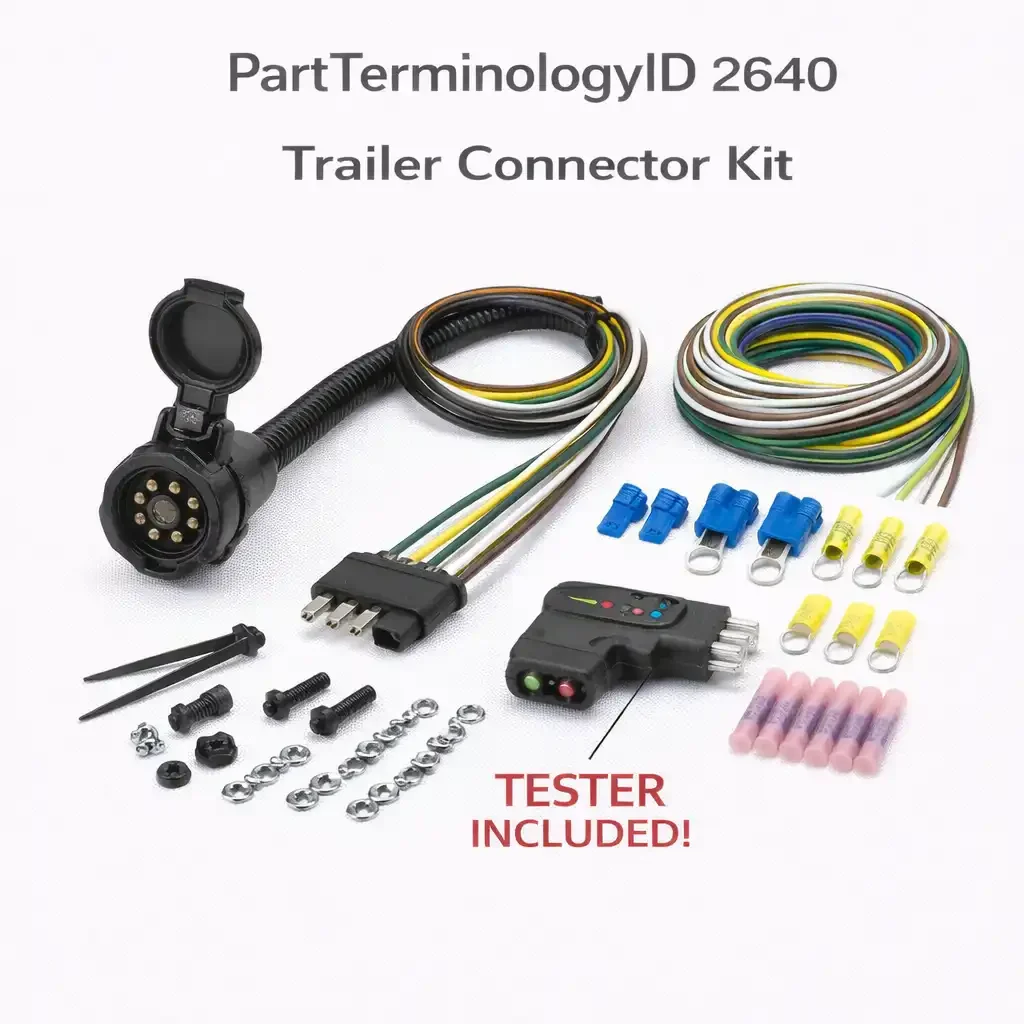
PartTerminologyID 2640, Trailer Connector Kit, is the assembly of plug, socket, terminals, and hardware that provides the mechanical and electrical connection point between a tow vehicle's wiring harness and a trailer's wiring harness. That definition covers the category correctly and leaves unresolved every question that determines whether the kit's plug mates with the existing vehicle socket or requires a socket replacement, whether the kit's connector format matches the trailer's existing wiring termination, whether the wire leads included in the kit are long enough to reach the mounting point and the circuit terminations, whether the wire gauge of the kit's included leads is appropriate for the current load the trailer's circuits will place on each conductor, whether the connector bodies are sealed against moisture at the mating faces and at the wire entry points, whether the terminal type is compatible with the pin housings and the conductor gauge, whether the kit includes all the hardware required to complete a secure mount, and whether the pin count and circuit assignments of the kit match both the trailer's wiring and the vehicle's output configuration.
It does not specify the connector format on the vehicle side, the connector format on the trailer side, the pin count, the circuit assignments, the wire gauge of any included leads, the lead length, whether the kit includes a plug only or both plug and socket, whether the included terminals are crimp type or solder type, whether the connector bodies include integrated strain relief at the wire entry points, whether the socket includes a mounting flange for surface mounting or a bracket for hitch-receiver mounting, whether the kit includes mounting screws or hardware, whether the plug cover or dust cap is included, whether the sealing gasket is part of the connector body or must be installed separately from a loose component in the kit, or whether the kit is designed for a combined turn-and-brake vehicle signal configuration or for a separate turn-and-brake configuration. A listing under PartTerminologyID 2640 that specifies only year, make, and model without the connector format, the pin count, the kit contents list, and the wire gauge of any included leads cannot be evaluated by a buyer who is standing at the front of a trailer with a damaged plug and needs to confirm the replacement before pulling the harness apart.
For sellers, PartTerminologyID 2640 is the installation-enabling entry point to the towing electrical category. A buyer who purchases a trailer connector kit is almost always doing one of four things: replacing a damaged plug on an existing trailer, replacing a damaged socket on an existing vehicle, installing a connector for the first time on a newly built or newly acquired trailer, or upgrading a trailer from one connector format to another to match a new tow vehicle. Each of those use cases has a different set of requirements for what the kit must include. The replacement buyer needs a connector body and terminals in the correct format. The first-time installation buyer needs a connector body, terminals, and pre-wired leads long enough to reach the circuit terminations. The format upgrade buyer needs to understand whether the new connector format supports all the circuits the trailer's equipment requires. A listing that does not distinguish between these use cases by specifying the kit contents precisely will generate returns from buyers who discover at installation that the kit is missing a socket, that the leads are six inches short, or that the terminal type does not accept the wire gauge already in the trailer's harness.
The additional complexity specific to PartTerminologyID 2640 compared to a simple connector replacement is the kit bundling argument. A trailer connector kit is sold as a complete installation solution. That framing creates a buyer expectation that the kit contains everything required to complete the installation without a separate trip to a hardware store or an electrical supply counter. When the kit omits a dust cap, ships with terminals that do not fit the wire gauge in the trailer, includes a socket with mounting holes on a different spacing than the trailer's existing mounting points, or ships with a plug body but no socket body when the buyer assumed both were included, the buyer cannot complete the installation and returns the kit. The kit-completeness expectation is a return driver that is entirely specific to PartTerminologyID 2640 and has no equivalent in listings for individual connectors, adapters, or wiring harnesses.
What the Trailer Connector Kit Does
Providing the plug-and-socket interface between vehicle and trailer wiring
The trailer connector kit's core function is to present a mechanically robust, electrically reliable, and environmentally protected connection point at the junction between the vehicle's wiring harness output and the trailer's wiring harness input. The plug, which is the male connector mounted on the trailer's wiring harness, carries the pin contacts that insert into the socket. The socket, which is the female connector mounted on the vehicle or on the tow bar, carries the pin cavities that receive the plug's contacts and maintain electrical engagement under vibration, thermal cycling, and the tension and compression forces that the trailer's coupler transmits to the wiring harness during towing.
The plug and socket must be mechanically matched to the same connector format. A 4-flat plug mates only with a 4-flat socket. A 7-way RV blade plug mates only with a 7-way RV blade socket. A SAE J560 plug mates only with a SAE J560 socket. A kit that ships with a plug in one format and a socket in a different format, or that ships with only a plug when the buyer's vehicle socket is a different format than the trailer plug being replaced, cannot produce a functional connection. The kit listing must state the connector format of both the plug and the socket included, and must distinguish clearly between kits that include both plug and socket and kits that include a plug only or a socket only.
Carrying the trailer's wiring circuits through a serviceable connection point
Every trailer wiring circuit that the vehicle outputs and the trailer requires must pass through the connector kit's pin contacts without resistance, voltage drop, or signal interruption that would impair the trailer's lighting or braking performance. The quality of the electrical path through the connector kit is determined by the pin contact material, the contact area between the pin and the cavity, the clamping force of the cavity spring on the pin, the resistance of the terminal crimps at the wire-to-pin junction, and the resistance added by any corrosion at the mating surfaces.
For the standard 4-flat trailer connector kit, the four circuits carried are the left turn and brake combined, the right turn and brake combined, the tail and running lights, and the ground return. Each circuit must carry its rated current without a voltage drop across the connector that exceeds the system's design tolerance. For trailer brake lights, which operate at a higher current than running lights and are required to meet minimum brightness thresholds under federal and state lighting regulations, the voltage drop across the connector is directly subtracted from the voltage available at the brake light bulb or LED array. A connector kit with poorly terminated crimps, undersized pin contacts, or corroded mating surfaces will produce brake lights that are dimmer than the vehicle's brake lights and may fall below the legal minimum brightness at the trailer's rear.
For the 7-way trailer connector kit, three additional circuits are added beyond the 4-flat set: the electric brake controller output, the battery positive circuit for trailer breakaway switch and battery charging, and the reverse light circuit. The electric brake controller output and the battery positive circuit carry higher sustained current than the lighting circuits and require heavier wire gauge and higher-rated pin contacts than the standard lighting circuits. A 7-way kit that uses the same wire gauge on all seven circuits without differentiating the higher-current circuits will produce either undersized conductors on the brake and battery circuits or oversized conductors on the lighting circuits, both of which create installation problems at different points in the circuit.
Protecting the connection from road contamination and moisture
The connector kit is mounted at the rear of the tow vehicle and the front of the trailer, in a location that receives direct exposure to road spray, mud, salt, and standing water during towing. When the vehicle and trailer are disconnected, the plug and socket face are exposed to ambient weather. A connector kit without environmental sealing at the mating face and at the wire entry points allows moisture and road contamination to reach the pin contacts during use and the open connector faces during storage, accelerating the pin contact corrosion that produces voltage drop and resistance-related lighting failures.
The sealing requirement for a trailer connector kit differs by application. Boat trailer connectors are the most demanding application because they are submerged at the launch ramp when the trailer rolls into the water at boat launch and retrieval. A boat trailer connector kit requires full submersion sealing at both the plug body and the socket body, with sealing at every wire entry point and at the mating face between the plug and socket when they are connected. A standard road trailer connector kit requires splash and spray resistance rather than submersion resistance, which is a lower sealing standard achievable with a rubber gasket at the mating face and a grommet seal at each wire entry point. An economy trailer connector kit with no sealing at either location will produce a functional connection in dry weather and a corroding connection within the first season of use in wet climates or winter road salt environments.
Supporting the full range of trailer connector formats and pin counts
Trailer connector kits are available in every connector format used in the North American and international towing markets. The 4-flat connector kit is the baseline format for small utility trailers, landscape trailers, and light cargo trailers that require only the four basic lighting circuits. The 5-flat connector kit adds a fifth circuit, typically a ground for a surge actuator on a hydraulic brake trailer or an accessory circuit for interior lighting. The 6-way round connector kit adds a brake controller output or a backup lights circuit to the 4-flat's four basic circuits, and is commonly found on boat trailers and horse trailers from the late 1990s and early 2000s that predate the broad adoption of the 7-way round. The 7-way RV blade connector kit is the current standard for travel trailers, fifth wheels, horse trailers, and any trailer equipped with electric brakes or requiring battery charging from the tow vehicle. The SAE J560 7-way round connector kit is the standard for commercial trailers, flatbeds, and semi-trailers that connect to commercial vehicles using the twist-lock J560 format.
Each connector format requires a kit designed for that format. The pin arrangements, pin diameters, pin spacings, and connector body geometries are different across formats in ways that make cross-format substitution physically impossible without modification. A buyer who orders a 7-way RV blade kit for an application that requires a SAE J560 kit will receive a kit that does not mate with the existing vehicle socket or the existing trailer plug. The listing must state the connector format precisely and must not rely on pin count alone to distinguish the format, because the 7-way RV blade and the SAE J560 have the same pin count but are physically incompatible.
Kit completeness and the installation expectation
The word "kit" in PartTerminologyID 2640 creates a specific buyer expectation that distinguishes this PartTerminologyID from individual connector components sold separately. A buyer purchasing a trailer connector kit expects to open the package and have every component required for a complete installation without sourcing additional parts. The minimum kit configuration for a complete installation includes the plug body, the socket body, the required number of terminals for all pins, the strain relief fittings or grommet seals at each wire entry point, a dust cap or protective cover for the socket face when the trailer is disconnected, and any mounting hardware required to secure the socket to the vehicle or mounting bracket.
Kits that include pre-wired leads on both the plug and the socket raise the buyer's installation expectation further: the buyer expects the leads to be long enough to reach the wiring termination points in their specific vehicle and trailer configuration. Lead length that is adequate for a factory hitch installation may be insufficient for an aftermarket receiver extension or for a trailer with a longer-than-standard tongue. A kit with 12-inch pre-wired leads ships inadequate for any installation where the vehicle harness socket is mounted more than 12 inches from the trailer's wiring termination point, which is a common scenario when the socket is mounted at the rear bumper and the trailer plug must reach the vehicle's receiver-mounted socket.
The wire gauge of pre-wired leads in a kit must match the circuit requirements, not the minimum acceptable gauge for the connector format's pin contact rating. A kit that ships with 18-gauge leads because the pin contacts are rated for 18-gauge wire will produce an installation where the leads are the limiting factor on circuit current capacity rather than the connector's pin contacts. For a standard 4-flat installation on a trailer with incandescent tail lights, 18-gauge may be adequate. For a 4-flat installation on a trailer with LED light bars totaling 8 amperes of running light current, 18-gauge wire will produce voltage drop that dims the LED arrays and may trigger the LED arrays' under-voltage protection circuits.
Vehicle wiring configuration compatibility: combined versus separate turn and brake signals
North American domestic and Japanese import vehicles built for the North American market use a combined turn-and-brake signal on a single circuit per side. The left turn signal and the left brake light share one conductor. The right turn signal and the right brake light share one conductor. The 4-flat connector kit is designed around this combined signal configuration: two pins carry the combined left and right turn-and-brake signals, one pin carries the running light circuit, and one pin carries the ground. When a 4-flat connector kit is installed on this type of vehicle, the combined turn-and-brake signal from the vehicle passes through to the trailer and activates both the turn signal function and the brake light function through the same trailer light fixture.
European vehicles and some heavy-duty North American commercial vehicles use separate turn signal circuits and separate brake circuits on individual conductors. A 5-flat or 6-way connector is commonly used on these vehicles to accommodate the additional circuit. A 4-flat connector kit installed on a European vehicle with separate turn and brake signals will only carry one of the two signals per side through the connector, because the 4-flat has only one pin per side and cannot carry both a turn and a brake signal simultaneously to separate trailer circuits. The listing for a trailer connector kit must state the vehicle signal configuration the kit is designed for, and must flag the incompatibility for buyers who are installing on European or commercial vehicles with separate turn-and-brake outputs.
This compatibility requirement is not limited to 4-flat kits. A 7-way trailer connector kit wired for a North American combined turn-and-brake vehicle will carry the combined signal on the left turn and right turn pins and leave the brake light pins unconnected from the vehicle side, because the vehicle does not output a separate brake signal. A buyer who installs a 7-way kit on a separate-signal vehicle and expects the brake light circuit to activate the trailer's electric brakes through the brake controller output pin will find that the kit does not produce the expected circuit mapping unless the installer bridges the brake signal from the vehicle's dedicated brake output to the correct pin in the connector body during installation.
Why This Part Generates Returns
Buyers return trailer connector kits because the connector format of the kit's plug does not match the vehicle socket the buyer assumed the kit would mate with, the kit includes only a plug when the buyer needed both plug and socket, the pre-wired leads are too short to reach the circuit termination points in the buyer's specific installation, the terminal crimp type does not accept the wire gauge in the trailer's existing harness and the buyer cannot connect the kit to the trailer's wiring without re-terminating the harness, the connector bodies are unsealed and the buyer's application requires submersion-rated sealing for a boat trailer, the mounting hardware included in the kit does not fit the vehicle's hitch receiver or trailer tongue mounting surface, the dust cap or plug cover is missing and the buyer considers it a required component for the application, the wire gauge of the included leads is undersized for the trailer's total current load and the buyer discovers this during a pre-installation review of the kit contents, the kit is designed for a combined turn-and-brake vehicle signal and the buyer's vehicle outputs separate turn and brake signals requiring a different connector format or a different wiring configuration, and the pin count of the kit does not support the number of circuits the buyer's trailer requires, specifically the electric brake circuit or the battery positive circuit that the buyer's travel trailer or horse trailer needs.
Status in New Databases
PIES/PCdb: PartTerminologyID 2640, Trailer Connector Kit
PIES 8.0 / PCdb 2.0: No change in PartTerminologyID or terminology label. Internal systems keyed to 2640 do not require remapping at the PIES 8.0 transition.
Top Return Scenarios
Scenario 1: "Kit includes plug only, buyer needed plug and socket, vehicle socket is corroded and requires replacement"
The buyer's vehicle has a corroded 7-way RV blade socket that no longer makes reliable contact with the trailer plug. The buyer orders a trailer connector kit to replace both the trailer plug and the vehicle socket. The kit received includes only a 7-way RV blade plug with pre-wired leads. The listing stated "trailer connector kit" with no clarification of which connector bodies were included. The buyer cannot replace the vehicle socket with the kit as received. The kit is returned as incomplete.
Prevention language: "Kit contents: [plug only / socket only / plug and socket]. This kit includes [a 7-way RV blade plug with 12-inch pre-wired leads / a 7-way RV blade socket with mounting flange / a 7-way RV blade plug and socket with 12-inch pre-wired leads on both]. If you need to replace the vehicle-side socket in addition to the trailer-side plug, verify that this kit includes both connector bodies before ordering."
Scenario 2: "Pre-wired leads too short for tongue length, harness cannot reach vehicle socket"
The buyer's trailer has a 36-inch tongue from the coupler to the front of the trailer body, where the existing wiring harness terminates. The trailer connector kit ships with a plug body and 18-inch pre-wired leads. The 18-inch leads are not long enough to route from the front of the trailer body along the tongue to the plug position near the coupler, which requires approximately 30 inches of lead with routing slack. The buyer cannot complete the installation without splicing additional wire into the leads, which the buyer considers an unacceptable modification for a kit sold as a complete installation solution. The kit is returned.
Prevention language: "Pre-wired lead length: [X] inches on plug, [X] inches on socket. The lead lengths provided are adequate for trailer tongue lengths up to approximately [X] inches from the harness termination point to the plug mounting position. For trailers with longer tongues or for installations requiring lead routing through the trailer frame, additional wire will be required to extend the leads to the circuit termination points. Measure the distance from the intended plug mounting position to the trailer's wiring harness termination points before ordering to confirm the included lead lengths are sufficient."
Scenario 3: "Terminal crimp type incompatible with trailer's existing wire gauge, harness cannot be connected"
The buyer's trailer has an existing wiring harness terminated in 14-gauge wire at the front of the trailer. The trailer connector kit includes terminals sized for 16-gauge to 18-gauge wire. The 14-gauge conductors in the trailer's harness do not fit into the terminal's wire barrel with enough engagement for a reliable crimp. The buyer attempts to crimp the larger wire into the smaller terminal and achieves an inadequate crimp that pulls out under hand tension. The kit is returned because the terminals are incompatible with the trailer's existing wiring.
Prevention language: "Terminal wire range: [minimum AWG] to [maximum AWG]. The terminals included in this kit are designed for wire in the [X] to [X] AWG range. If your trailer's existing wiring harness uses conductors outside this range, you will need to source compatible terminals separately or re-terminate the harness ends to a gauge within the terminal's specified range before installation. Verify your trailer's wire gauge before ordering."
Scenario 4: "Boat trailer application, unsealed kit, pin contacts corrode after first season of submersion use"
The buyer installs the trailer connector kit on a boat trailer that is submerged to the axles at the launch ramp twice per week during the summer season. The kit's connector bodies are splash-rated but not submersion-rated. The plug's wire entry points are sealed with a push-in grommet that admits water when the connector is submerged to a depth of 18 inches at the launch ramp. By mid-season, the pin contacts inside the plug body have developed a green oxide layer from repeated submersion and drying cycles. The trailer's running lights fail to illuminate reliably from resistance-induced voltage drop across the corroded pin contacts. The kit is returned at season's end as defective.
Prevention language: "Sealing rating: [splash-resistant / IP67 submersion-rated]. This kit [is / is not] rated for submersion applications. For boat trailer use where the connector will be submerged at the launch ramp, specify a kit with an IP67 submersion rating on both the plug and socket bodies, with submersion-rated seals at all wire entry points and at the mating face. A splash-rated kit will not maintain a sealed connection during submersion and will experience accelerated pin contact corrosion in boat trailer applications."
Scenario 5: "Mounting flange hole pattern does not match trailer tongue, socket cannot be mounted without drilling"
The buyer's trailer tongue has four pre-drilled mounting holes on a 2-inch by 2-inch bolt pattern that match the original socket's mounting flange. The replacement socket in the trailer connector kit has a mounting flange with a 2.5-inch by 2.5-inch bolt pattern. The buyer cannot use the kit's socket with the existing mounting holes and must drill new holes in the trailer tongue, which the buyer considers outside the scope of a standard replacement installation. The kit is returned with a note that the bolt pattern did not match.
Prevention language: "Socket mounting flange bolt pattern: [X]-inch by [X]-inch. Verify the socket mounting flange bolt pattern matches the existing mounting holes on your trailer tongue or hitch receiver mount before ordering. Common bolt patterns are [2-inch by 2-inch / 2.5-inch by 2.5-inch]. If your trailer does not have existing mounting holes, any bolt pattern can be used by drilling new holes, but a template is recommended to ensure the socket is centered and square on the mounting surface."
Scenario 6: "Kit wired for combined turn-and-brake signal, vehicle outputs separate signals, turn signals do not activate on trailer"
The buyer's vehicle is a European import that outputs separate left turn and left brake signals on two individual conductors, and separate right turn and right brake signals on two individual conductors. The trailer connector kit's plug is wired in the North American combined turn-and-brake configuration, with the left turn pin connected to the combined left turn and brake wire in the kit's pre-wired lead. The vehicle's wiring harness outputs the turn signal and the brake signal on separate pins, so only the brake signal from the vehicle reaches the connector's combined left turn-and-brake pin during braking events, and the turn signal has no output path through the connector. The trailer's turn signals do not activate when the driver uses the turn signal stalk.
Prevention language: "Vehicle signal configuration compatibility: [combined turn and brake / separate turn and brake]. This kit is wired for vehicles with a [combined / separate] turn-and-brake signal configuration. Most North American domestic and Japanese import vehicles use a combined turn-and-brake signal. Most European vehicles use separate turn and brake signals. Verify your vehicle's signal configuration before ordering. Installing a combined-signal kit on a separate-signal vehicle will result in non-functional trailer turn signals or non-functional trailer brake lights depending on which vehicle output the kit's pin is connected to."
Scenario 7: "4-flat kit installed on trailer with electric brakes, brake controller output circuit absent, trailer rolls without braking"
The buyer purchases a 4-flat trailer connector kit to replace a damaged connector on a horse trailer. The horse trailer has electric brakes on both axles. The 4-flat connector kit has no pin for a brake controller output circuit. The buyer connects the kit, and the horse trailer's electric brakes receive no signal from the vehicle's brake controller during the towing trip. The gross vehicle weight of the loaded horse trailer is above the threshold at which federal regulations require functional trailer brakes. The trailer is operated without braking for 60 miles before the driver notices the brake controller display shows no trailer brake connection.
Prevention language: "Connector format: 4-flat. This kit supports four circuits: left turn and brake, right turn and brake, running lights, and ground. It does not include a pin for an electric brake controller output or a battery positive circuit. For trailers equipped with electric brakes, a 7-way connector kit is required to carry the brake controller output signal. Do not install a 4-flat connector kit on a trailer with electric brakes. Operating a trailer with electric brakes without a functional brake controller connection is a safety violation and may be illegal under federal and state regulations for trailers above the applicable gross vehicle weight rating."
Scenario 8: "Dust cap missing from kit, socket debris contamination produces intermittent contact failures after first towing season"
The trailer connector kit includes a 7-way socket with mounting hardware but no dust cap for the socket face. The buyer installs the socket on the vehicle and notes the absence of a dust cap but assumes one is not required. Over the first towing season, the open socket face accumulates road debris including grit, dried mud, and fine metallic particles from road surface wear. By the following spring, two of the socket's pin cavities contain compressed debris that prevents the trailer plug from seating fully. The resulting partial engagement produces intermittent contact breaks in the running light and right brake circuits during towing. The kit is returned as defective, but the failure was caused by debris contamination in an unprotected socket.
Prevention language: "Dust cap or protective cover: [included / not included]. This kit [includes / does not include] a dust cap for the socket face. A dust cap is required for any socket that will be exposed to road debris when the trailer is not connected. Debris accumulation in an unprotected socket compresses into the pin cavities over multiple towing seasons and prevents full plug engagement, producing intermittent contact failures in the affected circuits. If a dust cap is not included in this kit, source a compatible cap in the same connector format before installation."
What to Include in the Listing
Core essentials
PartTerminologyID: 2640
component: Trailer Connector Kit
connector format: 4-flat, 5-flat, 6-way round, 7-way RV blade, SAE J560 7-way round, etc. (mandatory, in title)
pin count (mandatory)
kit contents: plug only, socket only, or plug and socket (mandatory, in title or first line of description)
pre-wired leads: included or not included; if included, lead length in inches on plug and socket separately (mandatory)
wire gauge of included leads, per circuit where circuits differ in gauge (mandatory)
terminal type: crimp or solder; crimp terminal wire range in AWG (mandatory)
connector body sealing: unsealed, splash-resistant, or IP67 submersion-rated (mandatory)
wire entry sealing: grommet seals, compression seals, or unsealed (mandatory)
dust cap or socket cover: included or not included (mandatory)
socket mounting style: surface flange, hitch receiver bracket, or trailer tongue mount (mandatory)
socket mounting flange bolt pattern dimensions in inches where applicable (mandatory)
mounting hardware: included or not included; hardware type if included (mandatory)
vehicle signal configuration compatibility: combined turn-and-brake or separate turn and brake (mandatory)
circuit assignments per pin: left turn and brake, right turn and brake, running lights, ground, brake controller output, battery positive, reverse lights (mandatory for all pins present)
maximum current rating per circuit (mandatory)
connector body material: thermoplastic, nylon, UV-stabilized ABS (mandatory)
pin contact material: tin-plated, nickel-plated, or gold-plated (mandatory)
SAE or applicable standard compliance where applicable (mandatory)
warranty duration (mandatory)
quantity: number of plugs and sockets included in kit
Fitment essentials
year/make/model/submodel for vehicle-side socket compatibility where the kit includes a vehicle-side socket
trailer type compatibility: utility trailer, boat trailer, RV/travel trailer, horse trailer, commercial semi-trailer
gross trailer weight rating applicability for kits with or without brake controller output circuit
note for European and commercial vehicles with separate turn-and-brake signal outputs
note for boat trailer applications requiring submersion-rated sealing on both plug and socket
note for trailers with electric brakes stating that a 4-flat kit does not support the brake controller output circuit
Dimensional essentials
plug body outer diameter or footprint dimensions in mm
socket body outer diameter or footprint dimensions in mm
socket mounting flange bolt pattern center-to-center dimensions in inches
socket mounting flange bolt diameter in mm
pre-wired lead length on plug in inches
pre-wired lead length on socket in inches
wire gauge per lead conductor in AWG
pin contact diameter in mm for all pin sizes present in the kit
Image essentials
plug and socket shown together unmated, with all kit components visible and labeled
plug face shown from the front with pin positions numbered and labeled by circuit function
socket face shown from the front with pin cavity positions numbered and labeled by circuit function
wire entry points shown on both plug and socket with sealing detail visible
socket mounting flange shown with bolt pattern dimensions indicated
dust cap shown installed on socket and removed from socket
all loose kit components shown in isolation: terminals, mounting screws, strain relief fittings, dust cap
plug and socket shown mated and locked with the engagement mechanism visible
pre-wired lead length shown with a ruler or measurement reference for scale
Catalog Checklist for ACES/PIES Teams
PartTerminologyID = 2640
require connector format with body style designation as primary attribute (mandatory)
require pin count (mandatory)
require kit contents statement: plug only, socket only, or plug and socket (mandatory)
require pre-wired lead length on plug and socket where leads are included (mandatory)
require wire gauge of included leads per circuit (mandatory)
require terminal wire range in AWG (mandatory)
require connector body sealing designation (mandatory)
require dust cap or socket cover status: included or not included (mandatory)
require socket mounting style and bolt pattern dimensions where a socket is included (mandatory)
require vehicle signal configuration compatibility statement (mandatory)
require circuit assignments per pin for all pins in the kit (mandatory)
require maximum current rating per circuit (mandatory)
prevent kit-contents ambiguity: a listing that states "trailer connector kit" without specifying whether the kit includes a plug, a socket, or both will generate returns from buyers who assumed a kit means both connector bodies; the kit contents must be stated explicitly in the title or the first line of the product description
prevent lead-length ambiguity: a listing that states pre-wired leads are included without specifying the lead length in inches will generate returns from buyers whose installation requires longer leads than the kit provides; lead length must be stated as a required attribute for all kits that include pre-wired leads
prevent terminal wire range omission: a buyer who cannot crimp the kit's terminals onto the trailer's existing wire gauge will return the kit as incompatible; terminal wire range must be stated for all kits that include terminals
prevent sealing omission for boat trailer applications: a listing that does not state the sealing rating will be ordered for boat trailer applications where submersion sealing is required; sealing must be stated for every listing, and submersion versus splash-rated must be distinguished
prevent 4-flat kits being ordered for trailers with electric brakes: the listing must state that the 4-flat format does not include a brake controller output circuit and must direct buyers with electric brakes to a 7-way kit
differentiate from trailer wiring adapter connector (PartTerminologyID 2632): the adapter connector converts between two existing connector formats; the connector kit provides the terminal connector bodies and hardware for a new installation or a connector body replacement
differentiate from trailer wiring harness: the trailer wiring harness is the complete pre-wired vehicle-side assembly from the tail light circuits to the connector socket; the connector kit is the plug, socket, terminals, and hardware for the connection point itself
flag combined versus separate turn-and-brake vehicle signal compatibility as a required attribute: this is the single highest-consequence wiring configuration error for passenger vehicle applications and must be stated on every listing
flag dust cap as a required kit component for vehicle-side socket installations: a socket without a dust cap will accumulate debris in the pin cavities during storage and produce intermittent contact failures; dust cap inclusion must be stated and kits without a dust cap must flag that a separate cap must be sourced
flag kit contents as the primary differentiator from individual connector components: the buyer purchasing a kit expects a complete installation solution; any component required for installation that is not included in the kit must be explicitly identified as not included so the buyer can source it separately before beginning the installation
FAQ (Buyer Language)
What is included in a trailer connector kit?
A trailer connector kit typically includes the plug that mounts on the trailer's wiring harness, the socket that mounts on the vehicle or the tow bar, the terminals required to connect the wiring to the pin contacts, and the hardware required to mount the socket. Some kits include pre-wired leads on both the plug and socket, which reduces the installation to a splice or screw-terminal connection to the existing wiring rather than requiring terminal crimping. Others include only the connector bodies and terminals, with the buyer supplying wire. Read the kit contents list in the listing before ordering and verify that every component required for your installation is included. The components most commonly missing from economy kits are the dust cap for the socket face and the strain relief fittings at the wire entry points.
How do I know which connector format my trailer and vehicle use?
Inspect the existing connectors at both ends of the towing connection. The trailer plug is the male connector at the front of the trailer's wiring harness. The vehicle socket is the female receptacle at the rear of the vehicle, typically near the hitch receiver. Count the pins and note the body shape. A 4-flat connector has four flat blade pins in a rectangular housing. A 7-way RV blade connector has seven blade-style pins in a round housing that uses a straight push-in engagement. A SAE J560 connector has seven round pins in a circular housing that uses a twist-lock engagement mechanism. Match the replacement kit to the format of both the trailer plug and the vehicle socket, and note whether they are the same format or different formats requiring an adapter connector.
Can I install a 7-way connector kit on a trailer that only has four wiring circuits?
Yes, but you will leave three of the seven pins unconnected on the trailer side unless you also run the additional wiring circuits the 7-way format supports. If you are upgrading from a 4-flat to a 7-way connector to match a new tow vehicle that has a 7-way socket, the connector kit provides the physical interface. You will need to separately run wiring for the electric brake controller output to the trailer's brake magnets, for the battery positive circuit to the trailer's breakaway battery and any onboard battery, and for the reverse lights if the trailer has backup lights. The three additional circuits are not provided by the connector kit alone and require additional wiring work beyond installing the kit.
What wire gauge should a trailer connector kit include or specify?
The minimum adequate wire gauge for a standard 4-flat trailer connector installation is 16-gauge for the turn, brake, and running light circuits and 14-gauge for the ground circuit. For 7-way installations with electric brakes and a battery charging circuit, 12-gauge wire is recommended for the brake controller output and battery positive leads, which carry higher sustained current than the lighting circuits. For trailers with total running light loads above 6 amperes from LED light bars or multiple marker lights, 14-gauge running light conductors provide adequate margin against voltage drop across the connector and the trailer's wiring. If the kit's included leads are lighter than these minimums for your trailer's circuit loads, supplement the leads with heavier wire before making the final circuit termination.
My trailer connector kit includes a socket for the vehicle but my vehicle already has a factory socket. Which one do I use?
Use the factory vehicle socket if it is in good condition. Inspect it for cracked housing, corroded pin cavities, and loose engagement with the trailer plug. If the factory socket mates firmly with a known-good plug and produces correct lighting function on all circuits, leave it in place and install only the trailer-side plug from the kit. The vehicle-side socket included in a trailer connector kit is intended for new installations where no factory socket exists, or for replacement when the factory socket is physically damaged or electrically unreliable. Installing a new vehicle-side socket alongside a functional factory socket creates a redundant connection point with no benefit.
Do trailer connector kits include weatherproof sealing?
Some do and some do not. Economy kits typically use unsealed connector bodies that rely on friction fit between the plug and socket for protection. Mid-grade kits include a rubber gasket at the mating face and a push-in grommet at each wire entry point, which provides splash resistance adequate for most road trailer applications. Submersion-rated kits use compression seals at both the mating face and all wire entry points and are rated to IP67 standards, which means they can be submerged to one meter for 30 minutes without water ingress. For boat trailers that roll into the water at the launch ramp, an IP67-rated kit is required. For horse trailers, cargo trailers, and utility trailers that are exposed to road spray and rain but not submerged, a splash-resistant kit is adequate. For year-round connected applications where the plug and socket remain mated continuously, even a minimally sealed kit will provide acceptable service life because the mating face is not exposed to weather.
What is the difference between a trailer connector kit and a trailer wiring harness?
A trailer connector kit provides the plug and socket connector bodies, terminals, and hardware at the connection point between the vehicle and the trailer. A trailer wiring harness is the complete pre-wired assembly that runs from the vehicle's tail light circuits through the vehicle chassis to the connector socket at the rear bumper or hitch receiver. A buyer who needs to replace a damaged trailer plug or a corroded vehicle socket needs a trailer connector kit. A buyer who needs to install towing wiring in a vehicle that has never had a tow package, or whose factory tow harness has been damaged from the connector socket back to the tail light T-harness, needs a trailer wiring harness. The connector kit terminates at the connection point. The harness provides the wiring path from the vehicle's light circuits to the connection point.
Cross-Sell Logic
Trailer Wiring Harness: the complete vehicle-side wiring assembly from the tail light T-harness to the connector socket; required when the vehicle has no factory towing wiring or when the vehicle-side wiring is damaged beyond the connector socket; the harness feeds the circuits that the connector kit terminates
Trailer Wiring Adapter Connector (PartTerminologyID 2632): required when the installed connector kit format does not match the vehicle socket format; the adapter bridges the two formats at the connection point without requiring replacement of either the vehicle harness or the trailer connector kit
Electric Trailer Brake Controller: required on the tow vehicle when the trailer has electric brakes and a 7-way connector kit is installed; the brake controller provides the output signal the kit's brake controller output pin carries to the trailer
Trailer Light Tester: used after installation to verify all circuits are correctly connected and functional before first towing; a 4-flat or 7-way tester with labeled indicator lights confirms left turn, right turn, brake lights, running lights, ground, and where applicable the brake controller output and battery positive circuits
Dielectric Grease: applied to the pin contacts at both the plug and socket faces at installation and at the beginning of each towing season to prevent oxidation and maintain low contact resistance at the mating surfaces
Trailer Wiring Extension: for installations where the pre-wired leads in the kit are insufficient to reach the circuit termination points; the extension adds additional lead length between the kit's pre-wired leads and the trailer or vehicle wiring
Hitch Receiver Bracket for Socket: for installations where the vehicle has a hitch receiver but no surface mounting point for the socket; the bracket mounts in the receiver and provides a flat mounting surface for the socket flange
Frame as "the connector kit provides the physical connection point. The vehicle harness carries the circuits from the vehicle to the connection point. The adapter connector bridges a format mismatch at the connection point. The brake controller generates the brake signal the kit's brake controller pin carries. The light tester verifies the kit's installation is correct before the trailer goes on the road. All are in the same towing electrical installation system."
Final Take for PartTerminologyID 2640
Trailer Connector Kit (PartTerminologyID 2640) is the PartTerminologyID in the towing electrical series where kit-completeness ambiguity and lead-length omission together account for the highest rate of returns that are not defective product returns but incomplete specification returns. The buyer who receives a kit with only a plug when they needed both plug and socket cannot complete the installation regardless of the kit's quality. The buyer who receives a kit with 18-inch pre-wired leads for a 36-inch tongue cannot complete the installation without additional materials. The buyer who receives a 4-flat kit for a trailer with electric brakes cannot produce a safe towing configuration regardless of how well the connector is installed. None of those returns are traceable to a product quality failure. All three are traceable to a listing that did not state the kit contents, the lead length, and the circuit support with enough precision for the buyer to evaluate fit before ordering.
State the connector format in the title with the body style designation. State the kit contents explicitly: plug only, socket only, or plug and socket. State the pre-wired lead length on both the plug and the socket where leads are included. State the wire gauge of every included lead. State the terminal wire range. State the sealing designation and distinguish submersion-rated from splash-resistant. State whether the dust cap is included. State the socket mounting bolt pattern. State the vehicle signal configuration compatibility. State the circuit assignments for every pin. State the maximum current rating per circuit. State clearly that 4-flat kits do not support electric brakes and that trailers with electric brakes require a 7-way kit. That is the same listing strategy as every other PartTerminologyID in this series: specific attributes at every level to become a listing buyers can act on without guessing. For PartTerminologyID 2640, kit contents completeness, lead length, and circuit support are the three attributes that determine whether the buyer can complete the installation on the first attempt with the components in the box.