
Speaker Connector (PartTerminologyID 2616):Location, Impedance, Amplifier Routing, and the Catalog Fields That Stop Audio System Returns
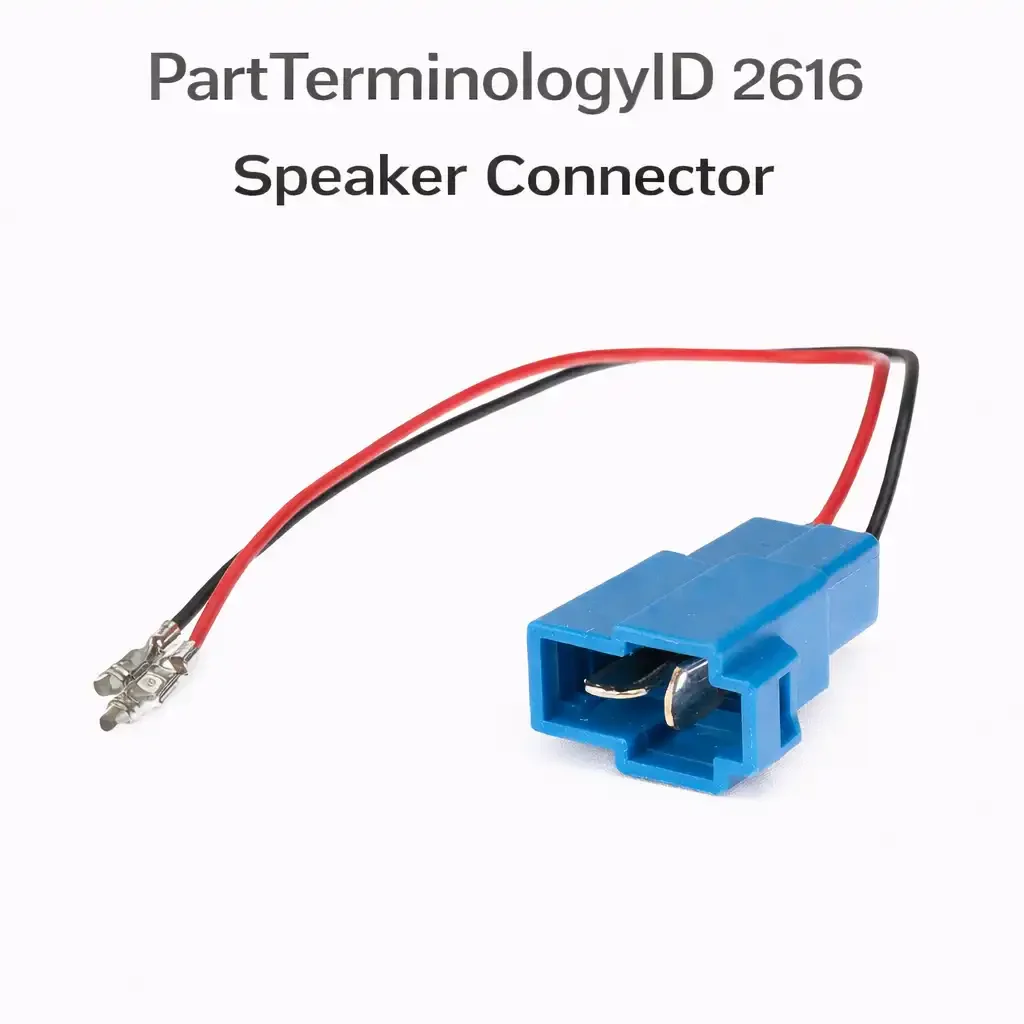
The speaker connector is one of the most location-specific electrical connectors in the vehicle. Every door, every pillar, every headliner position, and every rear deck location where a speaker is mounted has its own connector. On a vehicle with a full factory audio system, that may be eight, ten, or more distinct connector positions, each with its own pigtail length, wire gauge, and in some cases its own terminal design driven by the impedance or power handling requirements of the speaker at that location.
PartTerminologyID 2616 covers the connector at the speaker itself, the vehicle-side or speaker-side connection point that terminates the speaker wire at the speaker basket or speaker frame. This is distinct from the amplifier output connector, the radio harness connector, and the door harness connector, all of which carry speaker signals at different points in the audio signal path. PartTerminologyID 2616 is specifically the connector at the point where the wire meets the speaker.
The return rate in this category is driven by location confusion, terminal polarity errors, impedance mismatch on premium audio applications, and wire gauge errors on high-power applications. Each of these is a catalog field problem. This guide covers all of them.
PCdb Status for PartTerminologyID 2616
PartTerminologyID
◦ 2616 in both current PIES 7.2 / PCdb and future PIES 8.0 / PCdb 2.0. No change on migration.
Terminology Name
◦ Speaker Connector. No rename in PIES 8.0.
Category
◦ Body
SubCategory
◦ Audio
Status
◦ Active in both schema versions.
The Body / Audio placement is accurate. The speaker connector is an audio system component, and buyers sourcing it typically search from an audio installation or repair context, not a general electrical connector context. Catalog placement and search keyword coverage should reflect both the audio system category and the specific location (door speaker, rear deck speaker, tweeter) to capture the full buyer search pattern.
What the Speaker Connector Does and Why Location Is the Primary Field
The speaker connector terminates the speaker wire from the vehicle harness at the speaker terminal. It carries the audio output signal from the source, which may be the radio directly on base audio systems or the external amplifier on premium audio systems, to the speaker voice coil. The connector must maintain a low-resistance connection because any contact resistance in a speaker circuit causes signal loss and in high-power applications generates heat at the connection point.
Location is the primary catalog field for speaker connectors because the connector design, pigtail length, and wire gauge are all determined by where the speaker is mounted in the vehicle. A door woofer connector is a different part from a dash tweeter connector even on the same vehicle, platform, and model year. A rear deck connector is a different part from a pillar tweeter connector. The connector at each location has a specific pigtail length that corresponds to the harness routing distance at that position, and a wire gauge that corresponds to the power level of the speaker at that location.
Speaker connector catalog entries that do not specify location produce returns at every position where the buyer's location differs from what the listing implicitly assumed. A listing that says Speaker Connector, 2016 Toyota Camry without specifying front door, rear door, tweeter, or subwoofer position will generate returns from buyers at every location except the one the listing was built for, and none of those buyers will know which location the listing was built for because the listing never said.
LOCATION IS NOT OPTIONAL
Speaker connector location must appear in the listing title and item specifics on every listing. Front door left, front door right, rear door, dash tweeter, pillar tweeter, rear deck, rear quarter, and subwoofer enclosure are distinct catalog entries even on the same platform and model year. A connector that fits the front door will not necessarily have the correct pigtail length or wire gauge for the rear deck. Location is not a secondary detail. It is the primary differentiator in this category.
The Speaker Signal Path: Where PartTerminologyID 2616 Fits
Understanding where the speaker connector sits in the audio signal path clarifies the boundaries of PartTerminologyID 2616 and prevents catalog confusion with adjacent connectors in the same system.
Base Audio Signal Path
On base audio systems without an external amplifier, the audio signal travels from the radio head unit through the vehicle wiring harness directly to the speaker. The radio's internal amplifier drives the speaker, and the speaker connector at each location terminates the wiring harness at the speaker basket. The speaker connector on a base audio system carries a full-power audio signal from the radio's internal amplifier output stage, typically at four to twenty watts per channel depending on the head unit.
The connector for a base audio speaker position must handle the output impedance of the radio's amplifier stage as seen at the speaker. Domestic base audio systems typically wire speakers at a four-ohm load. The connector must present negligible contact resistance relative to that four-ohm load or signal quality degrades measurably.
Premium Audio Signal Path With External Amplifier
On premium audio systems with external amplifiers, the signal path between the radio and the speaker includes an amplifier stage that increases the power level substantially. The external amplifier may deliver fifty to over two hundred watts per channel to the speakers it drives. The speaker connector at each location on a premium audio system must handle the current associated with that power level, which is significantly higher than the current at the same location on a base audio system.
This current difference has direct catalog implications. Wire gauge must be appropriate for the power level at the speaker location. On premium audio applications, the wire gauge at the speaker connector may be sixteen or fourteen gauge for subwoofer positions with high-power dedicated amplifier channels. Factory Bose, JBL, and Harman Kardon systems may also use speakers with non-standard impedances matched to the specific amplifier output, making contact resistance at the connector proportionally more significant than on a standard four-ohm base audio application.
Amplified Subwoofer and Dedicated Bass Positions
The subwoofer speaker connector is a distinct catalog entry from the full-range speaker connector even in the same vehicle. The location is different, the wire gauge is heavier to handle the dedicated amplifier channel current, and in some cases the housing design is different. Listing the subwoofer connector without noting the position will produce wrong-gauge connectors at the subwoofer location on every order from a buyer who needed the full-range connector.
The Complete Variant Universe for PartTerminologyID 2616
1. Speaker Location
Speaker location is the first field in every speaker connector listing. The full location set for a modern vehicle with a comprehensive audio system includes:
• Front door woofer or full-range. The highest-volume speaker connector position in the aftermarket.
• Rear door woofer or full-range. Similar housing to front door connectors on many platforms but with different pigtail lengths.
• Dash or instrument panel speaker. Short-pigtail connector for midrange or tweeter positions at the instrument panel.
• A-pillar tweeter. Short-pigtail connector at the top of the door opening. Separate position from the door woofer on premium systems.
• C-pillar or D-pillar speaker. Rear pillar positions on sedans, SUVs, and minivans.
• Rear deck or package tray speaker. Full-range or woofer positions with longer pigtail lengths.
• Subwoofer enclosure. Heavier wire gauge matched to the dedicated amplifier channel.
• Center channel. Above the instrument panel or in the headliner on some premium audio systems.
Every position above is a distinct catalog entry. A buyer searching for a front door speaker connector on a specific platform who receives a rear deck connector will not have the correct pigtail length for the front door, even if the connector housing and terminal design are otherwise correct.
2. Terminal Count and Polarity
Speaker connectors are almost universally two-terminal: one positive and one negative. The terminal count is simple. The polarity alignment is not. Speaker polarity determines whether the speaker cone moves in the correct direction relative to the audio signal. Reversed polarity at a single speaker position does not prevent the speaker from producing sound, but it causes phase cancellation with adjacent speakers driven by the same signal, which produces audible coloration and reduced bass response at the listening position.
Most OEM speaker connectors use an asymmetric housing that prevents reversed polarity installation. When an aftermarket connector uses a symmetric housing, the buyer must verify polarity before splicing. Listings must note whether the housing is polarized or non-polarized.
• 2-terminal polarized housing. Standard on most modern OEM speaker connectors. The asymmetric body prevents incorrect polarity insertion.
• 2-terminal non-polarized housing. Present on some older designs and some aftermarket pigtail connectors. Polarity verification required during installation.
• 4-terminal connector. Present on some premium audio positions where a coaxial speaker carries a woofer and tweeter as a combined unit driven by separate amplifier channels. The connector carries two independent signal pairs. Must be identified separately from standard two-terminal connectors.
3. Connector Housing Profile
The connector housing must mate with the speaker basket terminal at that location. Speaker basket terminal designs vary across manufacturers, and the housing profile is matched to the specific basket terminal the OEM speaker used.
• Flat tab push-on terminal housing. The most common design for standard vehicle speakers. A housing with female flat-tab terminals that push onto male blade terminals on the speaker basket. Common on domestic applications with Molex-style or Delphi-style speaker connector families.
• Round pin housing. A round-pin connector used on some import speaker designs, particularly on Toyota and Honda premium audio positions. Not interchangeable with flat-tab housings at matching terminal counts.
• Retention-clip housing. A housing with an integral retention clip that locks over a feature on the speaker basket terminal block. Used on some GM and Ford premium audio positions where the speaker connector must resist vibration-induced loosening.
• Blade-and-socket housing. Some aftermarket speaker connectors and some European OEM designs use a blade-and-socket arrangement distinct from the standard flat-tab push-on design.
4. Wire Gauge and Current Capacity
Wire gauge at the speaker connector is determined by the power level at that speaker position. Base audio positions with a radio-driven amplifier stage typically use twenty or twenty-two gauge wire. Premium audio positions driven by an external amplifier require heavier gauge wire proportional to the power level.
• 22 AWG. Base audio dash tweeter and small speaker positions. Low power levels, short run lengths.
• 20 AWG. Base audio door and rear deck positions. Standard for radio-driven speaker circuits.
• 18 AWG. Mid-level power door and rear positions. Common on premium audio full-range speaker positions driven by modest external amplifier channels.
• 16 AWG. Higher-power premium audio positions. External amplifier channels of fifty watts and above.
• 14 AWG. High-power dedicated subwoofer positions. External amplifier channels of one hundred watts and above.
Wire gauge must be stated for every speaker connector listing. A buyer who installs a twenty-two gauge connector on a premium audio subwoofer position will have an undersized wire that heats under sustained amplifier drive, degrades the connection over time, and may produce audible distortion at high volume levels before the connection visibly fails.
5. Pigtail Length
Pigtail length is location-specific and must be stated for every speaker connector listing. The length required at each position is determined by the distance between the speaker mounting location and the nearest harness branch point for that circuit, plus enough additional length to make a clean splice outside the mounting cavity.
• Short, 3 to 5 inches. Dash tweeter and pillar positions where the harness branch is immediately adjacent to the speaker.
• Standard, 6 to 10 inches. Door speaker positions where the harness typically runs along the door card before reaching the speaker.
• Long, 12 to 18 inches. Rear deck and quarter panel positions where the harness must route from the rear shelf to the deck speaker cutout. Subwoofer positions where the dedicated cable runs from an enclosure to the amplifier rack.
Door speaker connectors and rear deck connectors for the same vehicle will require different pigtail lengths. A listing that covers both positions with a single pigtail length note will produce wrong-length connectors at one of those positions on every order.
6. OEM Connector Family
• Molex Mini-Fit or similar flat-tab domestic. Common on GM, Ford, and Chrysler base audio positions. Widely replicated by aftermarket pigtail suppliers.
• Delphi or Packard flat-tab. Used on GM premium audio positions. Similar to standard Molex but with Delphi-specific latch geometry.
• Sumitomo or Toyota-proprietary round-pin. Used on Toyota and Lexus premium audio positions. The round-pin housing is the primary differentiator from domestic flat-tab connectors.
• Honda or Acura Sumitomo. Honda-specific flat-tab or blade connector family. Differs from Toyota Sumitomo connectors in terminal design and housing geometry.
• Bosch or TE Connectivity. European OEM speaker connector families on BMW, Mercedes-Benz, and Volkswagen Group applications.
Base Audio vs. Premium Audio: The Structural Catalog Split
Base and premium audio speaker connectors for the same vehicle platform are different parts. This is the most consistently mishandled split in the speaker connector category, and it generates the highest share of returns because the listing fitment data correctly identifies the vehicle but the connector does not match the audio system installed in the buyer's vehicle.
Why the Split Exists
Premium audio speakers use different impedance ratings, power handling, and physical terminal designs than base audio speakers at the same location. The connector housing for a premium position must fit the premium speaker basket terminal. The wire gauge must handle the premium amplifier output. A single fitment row covering both audio configurations delivers the wrong connector to every buyer on the configuration the listing was not built for.
The split must appear as separate listings with the audio system named in the title. Name the specific premium system, Bose, JBL, Harman Kardon, or Mark Levinson, because buyers on premium vehicles know the system from the speaker grille badges. On platforms where the front and rear door Bose connectors also differ from each other, four listings may be necessary for a single model year: base front door, base rear door, Bose front door, Bose rear door.
THE BASE VS. PREMIUM SPLIT BY THE NUMBERS
A platform with base audio and Bose audio options, front and rear door speaker positions, and a subwoofer on the Bose system requires a minimum of five speaker connector listings: base front door, base rear door, Bose front door, Bose rear door, and Bose subwoofer. A single listing covering all speaker positions and both audio configurations will misship on four out of five order types. The split is not optional on these platforms.
Platform Notes for High-Volume Applications
GM Full-Size Truck and SUV Applications
GM full-size truck and SUV applications from the early 2000s onward require a base and Bose split at the door speaker positions, and a separate subwoofer listing for Bose-equipped models. The base audio door connector uses a standard Delphi flat-tab with twenty-gauge wire. The Bose door connector uses a different housing profile with heavier gauge appropriate for the Bose amplifier output. The Bose subwoofer connector requires a heavier gauge still. All three are distinct listings.
Ford F-Series and Explorer Applications
Ford F-Series and Explorer applications offer Sony premium audio on some trims, requiring a base and Sony split at each speaker position. Ford applications also changed speaker connector designs at the generation transition on several platforms. Verify that the production span in the fitment row uses a consistent connector design before grouping model years into a single listing.
Toyota Camry and Highlander Applications
Toyota Camry and Highlander applications from the 2012 onward generation use JBL premium audio on upper trims. JBL positions use a Sumitomo round-pin connector distinct from the Toyota flat-tab used on base audio positions. Listings must split at the JBL equipment line and note the Sumitomo round-pin housing. A single fitment row covering base and JBL will misship at every JBL or every base position depending on which the listing describes.
Honda Accord and Odyssey Applications
Honda Accord and Odyssey applications follow a similar base versus premium audio split pattern. The Honda generation change at the 2018 Accord introduced connector design changes at several speaker positions, creating both a generation boundary split and an audio level split. Both must be represented as separate listings.
BMW and Mercedes-Benz Applications
BMW and Mercedes-Benz applications use Bosch and TE Connectivity speaker connector families specific to European OEM designs. BMW Harman Kardon and Bowers and Wilkins positions use connector designs that differ from base audio positions on the same model. Mercedes-Benz Burmester follows the same pattern. Note OEM connector family by name and audio system level for each position.
What PartTerminologyID 2616 Does Not Cover
The speaker connector at the speaker basket is one of several connectors in the audio signal path. Listings that do not clearly define what is and is not covered will attract orders from buyers who need adjacent connectors in the same system.
• Amplifier output connector. The connector at the amplifier output stage that routes signals to the speaker harness. A different part from the speaker basket connector even though both carry speaker-level signals.
• Door harness speaker plug. The plug in the door harness that passes the speaker signal through the door jamb rubber boot from the body harness to the door card wiring. A mid-path connector distinct from the speaker basket termination.
• Radio speaker output connector. The connector at the back of the radio where the speaker output leaves the head unit. This is covered under the radio power harness or radio output connector and is not the speaker basket connector covered by PartTerminologyID 2616.
• Subwoofer amplifier input connector. On factory subwoofer systems, the connector at the amplifier input that receives the low-frequency signal from the radio or DSP. Distinct from the speaker connector at the subwoofer basket.
A one-sentence scope statement in every listing prevents buyers who need these adjacent connectors from ordering the speaker basket connector and returning it when it does not serve the connection point they needed.
Catalog Fields That Reduce Returns for PartTerminologyID 2616
Core Identification Fields
Speaker Location
◦ Front door, Rear door, Dash, A-pillar tweeter, C-pillar or D-pillar, Rear deck, Rear quarter, Subwoofer, or Center channel. Required in the title. The primary differentiator in this category.
Audio System Configuration
◦ Base audio or Premium audio with system name. Required in the title and item specifics. Separates base and premium connectors that list to the same vehicle.
Terminal Count
◦ 2-terminal standard, 2-terminal non-polarized, or 4-terminal coaxial. Required.
Housing Polarity
◦ Polarized housing (one-way mating only) or Non-polarized (polarity verification required). Required in item specifics.
Connector Housing Profile
◦ Flat-tab push-on, Round-pin, Retention-clip, or Blade-and-socket. Written description required.
OEM Connector Family
◦ Molex, Delphi, Sumitomo, Bosch, TE Connectivity, or other. Required on import and European applications.
Wire and Pigtail Fields
Wire Gauge
◦ State AWG. Required. Differentiates base audio gauge from premium audio gauge at the same speaker position.
Pigtail Length
◦ State in inches. Required. State separately for each position when multiple positions are covered.
Wire Colors
◦ Note positive and negative wire color convention when matching OE. Polarity verification reference for non-polarized connectors.
Scope and Compatibility Fields
Scope Statement
◦ Speaker basket connection only. Does not include door harness plug, amplifier output connector, or radio speaker output connector.
Compatibility Statement
◦ One sentence. Speaker location, audio system, housing profile, and wire gauge this connector fits. What it does not fit.
The Most Common Listing Mistakes for PartTerminologyID 2616
Mistake 1: Location Not Stated
A listing without a location note attracts orders from every speaker position on the vehicle. Front door, rear door, dash, pillar, and rear deck connectors may share the same terminal count and housing family but differ in pigtail length and wire gauge. Location is the title field that prevents every position-related return in this category.
Mistake 2: Base and Premium Audio Not Split
Base and premium audio connectors for the same vehicle, model year, and speaker position are different parts. A single fitment row covering both will produce wrong connectors on a significant share of every order. Separate listings required, named by the premium system when known.
Mistake 3: Wire Gauge Not Stated
A twenty-two gauge base audio connector ordered for a premium audio position with a high-output amplifier channel will heat under sustained drive. The buyer may not notice until after installation. Wire gauge in the listing lets the buyer verify against their application before ordering.
Mistake 4: Pigtail Length Not Stated or Single Length for Multiple Positions
A connector with the correct housing and gauge but a short pigtail forces a splice inside the door cavity where moisture and vibration degrade connections faster than outside the panel. State pigtail length in inches per position. Do not list a single length for all positions on a multi-position listing.
Mistake 5: Housing Polarity Not Noted on Non-Polarized Connectors
A non-polarized connector installed with reversed polarity causes phase cancellation that is audible but may be attributed to speaker quality rather than connector orientation. Note explicitly when the housing is non-polarized and polarity verification is required.
Mistake 6: Import Housing Profile Not Distinguished From Domestic
Toyota and Honda premium audio positions use Sumitomo round-pin connectors that are not interchangeable with domestic flat-tab connectors at matching wire gauges. A listing without the Sumitomo round-pin note will attract domestic flat-tab connector buyers for import applications. The connector family must be in the item specifics on all import and European application listings.
Mistake 7: Subwoofer Position Listed as Door Speaker
A subwoofer connector grouped with door speaker listings will ship a door-gauge connector to a subwoofer position on every relevant order. Subwoofer listings must note the position, the heavier wire gauge, and the premium audio system that includes the subwoofer.
Marketplace-Ready Listing Standards for PartTerminologyID 2616
Required Title Elements
Base audio front door application:
Speaker Connector, Front Door, Base Audio, 2-Terminal, 20 AWG
Premium Bose door application:
Speaker Connector, Front Door, Bose Audio, 2-Terminal, 18 AWG, Retention-Clip Housing
Toyota JBL front door application:
Speaker Connector, Front Door, JBL Audio, 2-Terminal, Sumitomo Round-Pin, 18 AWG
Subwoofer position on premium audio application:
Speaker Connector, Subwoofer Position, Bose Audio, 2-Terminal, 14 AWG
Required Bullet Points
• LOCATION: Front door, Rear door, Dash, Tweeter, Rear deck, Subwoofer, or specific position. Required on every listing.
• AUDIO SYSTEM: Base audio or Premium audio with system name. Required.
• TERMINALS: 2-terminal polarized, 2-terminal non-polarized, or 4-terminal.
• HOUSING POLARITY: Polarized (one-way mating) or Non-polarized (verify polarity during installation).
• HOUSING PROFILE: Flat-tab push-on, Round-pin, Retention-clip, or Blade-and-socket.
• OEM CONNECTOR FAMILY: Molex, Delphi, Sumitomo, or other. Required on import and European applications.
• WIRE GAUGE: State AWG. Required.
• PIGTAIL LENGTH: State in inches per position.
• SCOPE: Speaker basket connection only. Does not include door harness plug, amplifier output connector, or radio speaker output connector.
• COMPATIBILITY: One sentence. Location, audio system, housing, wire gauge, and what this connector does not fit.
Compatibility Statement Templates
TEMPLATE A: BASE AUDIO DOOR SPEAKER
Fits: Front door speaker basket connection, base audio system, 2-terminal polarized flat-tab housing, 20 AWG. Does not fit: Bose or premium audio door speaker positions (different housing profile and wire gauge). Does not fit: rear door, dash, or tweeter positions (different pigtail length). Verify speaker location and audio system before ordering.
TEMPLATE B: PREMIUM AUDIO DOOR SPEAKER
Fits: Front door speaker basket connection, Bose or premium audio system, 2-terminal retention-clip housing, 18 AWG. Does not fit: base audio door speaker positions. Does not include door harness plug connector or amplifier output connector. Verify vehicle is equipped with Bose or premium audio system before ordering.
TEMPLATE C: IMPORT PREMIUM AUDIO
Fits: Toyota or Honda front door speaker basket connection, JBL or premium audio system, 2-terminal Sumitomo round-pin housing, 18 AWG. Does not fit: base audio positions on same platform (different housing profile). Sumitomo round-pin housing required for import speaker basket terminal. Verify vehicle has JBL or premium audio system before ordering.
FAQ for Speaker Connector (PartTerminologyID 2616)
Do I need a different connector for each speaker position in my vehicle?
On most vehicles, yes. Door, dash, tweeter, rear deck, and subwoofer connectors are separate parts with different pigtail lengths and in some cases different wire gauges and housing profiles. On premium audio systems the subwoofer always requires a separate connector with heavier wire gauge. Verify the specific position you need before ordering.
My vehicle has factory Bose. Can I use the standard speaker connector?
No. The Bose connector uses a housing profile and wire gauge matched to the Bose speaker basket terminal and amplifier output power. The base audio connector uses a different housing and lower wire gauge that may be inadequate for the Bose amplifier. Always order the connector listed for your audio system configuration. The Bose badges on the speaker grilles confirm your system.
How do I know which wire is positive on a non-polarized connector?
Identify positive and negative by wire color before disconnecting the original connector. OEM speaker wiring typically uses a solid color for positive and the same color with a stripe for negative, or two distinct colors depending on the manufacturer. Note the colors before disconnecting. If the original was already removed, refer to a wiring diagram for your vehicle. Reversed polarity is audible as reduced bass and altered stereo imaging.
Can I use a higher gauge wire connector than the original for a speaker upgrade?
Moving to a heavier gauge than the original is generally acceptable. Moving to a lighter gauge at a high-power position is not, because the lighter wire will heat under sustained amplifier drive. When upgrading speakers with higher power handling, match the wire gauge to the power level of the amplifier channel driving that position.
Catalog Quality Checklist for PartTerminologyID 2616
1. State speaker location in the title. Front door, rear door, dash, tweeter, rear deck, subwoofer, or other. Required on every listing.
2. State audio system configuration in the title. Base audio or premium audio with system name. Required.
3. State terminal count. 2-terminal polarized, 2-terminal non-polarized, or 4-terminal.
4. Note housing polarity. Required on non-polarized connectors. State that polarity verification is required during installation.
5. Describe housing profile. Flat-tab, round-pin, retention-clip, or blade-and-socket.
6. Identify OEM connector family on import and European applications.
7. State wire gauge in AWG. Required. Differentiates base audio from premium audio at the same position.
8. Specify pigtail length in inches per position.
9. Note wire colors when matching OE convention.
10. Split base and premium audio applications into separate listings. Required on any platform available with both configurations.
11. Write a scope statement. Speaker basket connection only. List what is not included.
12. Write a compatibility statement. Location, audio system, housing, wire gauge, and what this connector does not fit.
Final Thoughts
The speaker connector category is large, location-specific, and split by audio system configuration at every position on every platform that offered both base and premium audio. That combination, many positions multiplied by two audio system tiers, produces a matrix of catalog entries that is wider than most teams expect when they first inventory their speaker connector catalog coverage.
The return pattern is consistent and traceable. Location missing from the listing, audio system not noted, wire gauge absent, pigtail length single-valued for a multi-position listing. Each of those missing fields is a return waiting to ship. Each one is also a one-line addition to the listing that prevents the return before the part leaves the warehouse.
Location in the title. Audio system in the title. Wire gauge in the bullets. Pigtail length per position. One scope sentence. One compatibility sentence. That is the complete catalog structure for PartTerminologyID 2616, and it applies to every speaker position on every platform in the catalog.