
Power Steering Pressure Sensor Connector (PartTerminologyID 2605):Sensor Types, Connector Variants, and the Catalog Fields That Prevent Returns
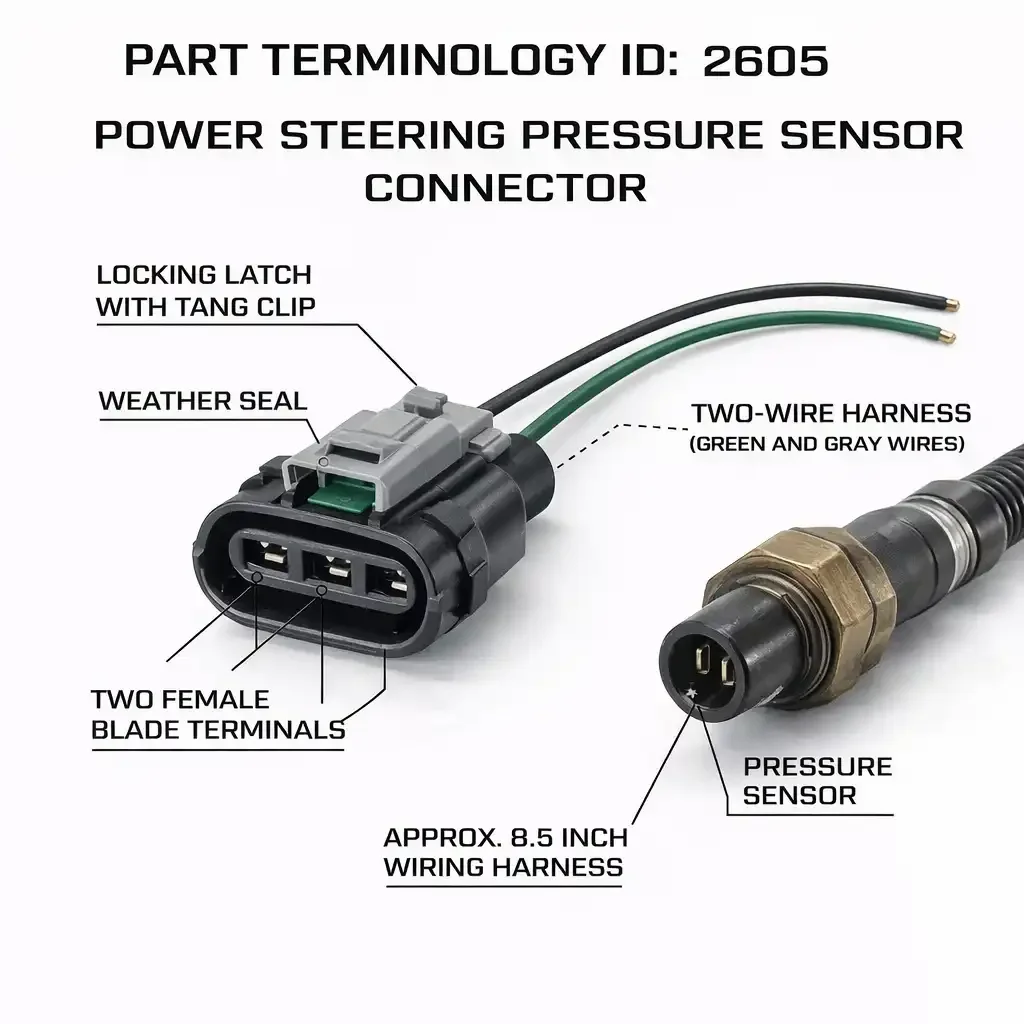
The Power Steering Pressure Sensor Connector is ordered when something has already gone wrong: a leaking hydraulic system has soaked the connector, heat has cracked the housing, or an idle quality complaint traced to a failed pressure signal has left the ECM unable to compensate for steering load. The repair is urgent and the assumption is that any connector listing for the right vehicle will fit.
That assumption fails often enough to generate a consistent return rate. The sensor design varies across platforms and within the same platform across production years. The connector varies with the sensor, and fitment data does not capture the sensor design that determines which connector is correct.
This guide covers PartTerminologyID 2605 in full: what the sensor does, where the variant complexity comes from, what catalog fields prevent returns, and what listing language gives buyers what they need.
PCdb Status for PartTerminologyID 2605
PartTerminologyID
◦ 2605 in both current PIES 7.2 / PCdb and future PIES 8.0 / PCdb 2.0. No change on migration.
Terminology Name
◦ Power Steering Pressure Sensor Connector. No rename in PIES 8.0.
Category
◦ Steering
SubCategory
◦ Power Steering
Status
◦ Active in both schema versions.
The Steering / Power Steering placement is accurate. Unlike the connectors covered earlier in this series, which sit under Engine, PartTerminologyID 2605 is classified under the steering system. The catalog implication is that sellers who organize inventory by system category need to ensure this connector appears in both steering searches and power steering pressure sensor searches, because buyers may enter either pathway depending on whether they start with the sensor or the connector in their search.
The terminology name precisely identifies the sensor this connector serves. It does not cover the connector for the power steering pump, the rack and pinion assembly, or the EPAS motor. Listings that appear under those adjacent searches without noting the sensor-specific function of this connector will generate returns from buyers who needed a different steering system connector.
What the Power Steering Pressure Sensor Does
The power steering pressure sensor is a transducer on the high-pressure side of the hydraulic steering system, typically at the pump outlet or on the high-pressure hose. It converts hydraulic line pressure into an electrical signal that the ECM reads to detect steering load.
The ECM uses this pressure signal to increase idle speed when steering load is detected. When the driver turns the wheel, hydraulic pressure rises, the sensor reports the increase to the ECM, and the ECM raises idle speed to compensate for the load the pump places on the engine. Without this compensation, full-lock maneuvers at low idle can stall the engine. On some applications the signal also influences transmission shift scheduling to prevent rough shifts during active steering.
When the connector fails from hydraulic fluid contamination, heat cycling, or physical damage, the ECM loses the pressure signal. The typical result is a rough or stalling idle during low-speed parking maneuvers and a stored diagnostic code for the pressure sensor circuit. The vehicle remains drivable but the idle quality complaint motivates a repair.
Why This Category Generates Returns
Sensor Design Varies by System Generation
The pressure sensor design tracks with power steering system revisions. When a manufacturer updated the pump or pressure circuit routing, the sensor bung design often changed, changing the connector required to mate with it. Fitment data captures year, make, model, and engine. It does not capture power steering system generation. A fitment row covering a production span that included a sensor design change will deliver the wrong connector to buyers on one side of that change.
Two-Terminal and Three-Terminal Variants Co-Exist on the Same Platforms
The pressure sensor circuit requires reference voltage and signal return, producing a two-terminal connector where signal return also serves as ground. Some designs add a dedicated ground terminal, producing a three-terminal connector. On platforms where both designs were used, both variants list to the same vehicle. A two-terminal connector on a three-terminal application leaves the ground disconnected and produces reading offset errors. Terminal count must be in the listing.
Hydraulic Fluid Contamination Creates Urgency
Pressure sensor connector failures are frequently caused by fluid leaking from a nearby hose fitting or pump seal. When the connector is soaked, the buyer is also managing a fluid leak before refilling the system. The repair is time-pressured. Buyers search by fitment and order without verifying connector design. When the connector arrives wrong, the delay compounds a repair that was already inconvenient. Catalog data that states terminal count and sensor type up front prevents this.
THE CORE CATALOG PROBLEM
The power steering pressure sensor connector is frequently ordered under time pressure by buyers dealing with a concurrent fluid leak. They search by vehicle and expect the fitment to be sufficient. When the sensor design changed mid-production run and the catalog does not note the split, the connector arrives wrong and the repair is delayed. Terminal count, sensor design note, and a plain-language compatibility statement are the three fields that prevent this.
The Complete Variant Universe for PartTerminologyID 2605
1. Terminal Count
Terminal count is the primary differentiator for power steering pressure sensor connectors and the field most commonly absent from aftermarket listings.
• 2-terminal. Reference voltage input and signal return. The signal return also serves as the sensor ground in this design. The most common configuration across domestic applications from the late 1980s through the mid-2000s.
• 3-terminal. Reference voltage, signal output, and dedicated ground. The dedicated ground eliminates potential ground offset errors that affect pressure reading accuracy. Present on applications where ECM signal accuracy requirements drove the addition of an isolated ground path.
Terminal count must appear in the listing title and item specifics. On platforms where the sensor design changed from two-terminal to three-terminal during the production run, a listing without terminal count will produce wrong-count shipments on every order that falls on the wrong side of that change.
2. Connector Body Shape and Sensor Body Interface
The connector housing must match the profile of the pressure sensor body at the mating point. Power steering pressure sensors are threaded or press-fit into the hydraulic circuit, and the connector must seat over the sensor electrical interface without interference from adjacent hydraulic fittings or brackets.
• Compact rectangular housing. The most common profile for domestic two and three-terminal applications. Short, flat housing with a push-tab primary latch. Common on GM, Ford, and Chrysler applications using Delphi or Packard connector families.
• Oval or rounded housing. Common on import applications including Toyota and Honda. The oval profile is a key differentiator from domestic rectangular housings at the same terminal count and must be noted in the title on import application listings.
• Square housing with locking collar. Present on some applications where the connector must resist rotation and back-out under hydraulic system vibration. The locking collar provides secondary retention independent of the primary latch.
• Threaded retention housing. Some pressure sensor connector designs use a threaded retention ring that screws onto the sensor body rather than using a push-tab latch. These are not interchangeable with latch-style connectors regardless of terminal count.
Housing shape must be described in words alongside product photographs. A face-on photograph shows terminal count and layout but does not communicate housing depth, latch type, or the profile that determines whether the connector clears adjacent hydraulic fittings. Written shape descriptions are more useful for buyers ordering while the vehicle is disassembled.
3. Wire Entry Angle
The power steering pressure sensor mounts in the hydraulic circuit at various locations depending on engine bay layout and system routing. The wire entry angle determines whether the harness can exit the connector and route away from the high-pressure hydraulic line without creating stress at the connector body or resting against a heat source.
• Straight entry. Wire bundle exits in line with the connector axis. Used where the harness runs directly away from the sensor in the direction the connector faces.
• 90-degree entry. Wire bundle exits perpendicular to the mating face. Used where the harness must route along the pump housing, reservoir, or firewall immediately after the connector.
Wire entry angle errors create bend stress at the connector body that is compounded by heat cycling and pump vibration. The connector mates correctly but fatigues at the stress point and fails prematurely.
4. Seal Type and Fluid Resistance
The connector sits adjacent to the hydraulic circuit. Fluid leaks from hose fittings and pump seals are common failure modes. The connector must resist hydraulic fluid contact, which is a more demanding sealing requirement than moisture resistance alone.
• Individual wire seals with peripheral face seal. Standard on most modern three-terminal applications. Prevents hydraulic fluid migration into the connector body from both the sensor side and the harness side.
• Wire seals only. Present on some two-terminal designs. Less effective against fluid ingress from the sensor face side if the sensor is mounted in a fluid-splash zone.
• Fluid-resistant housing material. Some connector housings for power steering applications use a housing material with higher resistance to petroleum-based fluids than standard nylon connectors. Note the housing material when the supplier data specifies it.
• Unsealed. Present on some older applications or applications mounted in lower-exposure locations. Note explicitly.
5. Pigtail Length and Wire Gauge
• Pigtail length. State in inches. Power steering pressure sensor pigtails are typically short because the sensor is within reach of a nearby harness branch from the engine wiring loom. Standard offerings are commonly 6 to 10 inches. State the actual measurement.
• Wire gauge. Pressure sensor circuits carry reference voltage and analog signal, both low-current signals. Wire gauge is typically 20 or 22 AWG. State gauge to allow buyers to verify circuit compatibility.
• Wire colors. Note when wire colors match OE convention. Technicians splicing the new pigtail into the existing harness use wire color as a verification step, particularly on two-terminal connectors where polarity matters for accurate signal output.
What PartTerminologyID 2605 Does Not Cover
The power steering pressure sensor connector is sometimes confused with adjacent components in the steering system. The listing must be explicit about what it serves because the adjacent parts are sometimes purchased in the same repair session.
Electric Power Steering Motor Connector
Vehicles with EPAS do not have a hydraulic pressure sensor. There is no hydraulic circuit. EPAS systems have connectors for the electric motor, torque sensor, and steering angle sensor, none of which are covered by PartTerminologyID 2605. One sentence in the listing confirming hydraulic power steering application prevents orders from EPAS vehicles entirely.
LOCATION MATTERS FOR THIS CATEGORY
State the mounting location of the sensor this connector serves in the listing description. High-pressure line, pump outlet, or steering gear inlet are the most common locations. This single note separates the pressure sensor connector from the pump electronics connector, the fluid level sensor connector, and the EPAS system connectors that buyers may encounter in the same search results.
Platform Notes for High-Volume Applications
GM Domestic Full-Size Trucks and SUVs
GM full-size truck and SUV applications on the C/K, Silverado, Sierra, Tahoe, and Suburban platforms from the late 1980s through the early 2000s use a two-terminal Delphi or Packard power steering pressure sensor connector. The sensor mounts at the power steering pump outlet on most of these applications. The connector is a compact rectangular design consistent with the general Delphi sensor connector family used for other engine management sensors on GM applications of this era.
The catalog challenge on GM full-size applications is the GMT400 to GMT800 generation boundary and the variable assist variants introduced on some GMT800 trims. Verify terminal count consistency across the full production span before using a single fitment entry. Split at the generation boundary if the sensor connector design changed.
Ford F-Series and Explorer Applications
Ford full-size truck and Explorer applications use a two-terminal connector through the early 2000s. The Ford connector family differs from GM Delphi in latch design and housing profile even at matching terminal count. Ford applications with optional variable assist steering on some trim levels may use a different sensor design from the standard assist applications on the same platform. Note trim level when the sensor design varies.
Toyota and Honda Import Applications
Toyota applications on the Camry, Highlander, 4Runner, and Tacoma use a two or three-terminal connector with an oval or rounded housing from the Sumitomo or Denso connector family. Honda applications on the Accord and Odyssey follow a similar oval housing pattern. Oval housing must appear in the title on all import application listings because domestic rectangular connectors at matching terminal counts will appear in the same search results and will not fit the import sensor body.
Chrysler LH and JS Platform Applications
Chrysler LH and JS platform applications including Dodge Intrepid and Chrysler 300M use a two-terminal Delphi-family connector at the power steering pump outlet. Terminal count and housing profile must be confirmed because some trim levels on these platforms used electronically variable power steering with a different sensor design from the standard assist applications.
Catalog Fields That Reduce Returns for PartTerminologyID 2605
Core Identification Fields
Sensor Type Confirmation
◦ Hydraulic power steering pressure sensor. Required. Separates from pump electronics, fluid level sensor, and EPAS connectors.
Terminal Count
◦ 2-terminal, 3-terminal, or 4-terminal. Required in title and item specifics.
Connector Body Shape
◦ Compact rectangular, Oval or rounded, Square with locking collar, or Threaded retention. Written description required.
Wire Entry Angle
◦ Straight or 90-degree.
OEM Connector Family
◦ Delphi, Packard, Sumitomo, Denso, or other. Required on import applications.
Sealing and Retention Fields
Seal Type
◦ Wire seals with face seal, Wire seals only, or Unsealed. Note fluid-resistant housing material when specified.
Wire and Pigtail Fields
Pigtail Length
◦ State in inches.
Wire Gauge
◦ State in AWG. Typically 20 or 22 AWG.
Wire Colors
◦ Note when matching OE convention.
Application and Compatibility Fields
Sensor Mounting Location
◦ Pump outlet, High-pressure line, or Steering gear inlet.
Steering System Type
◦ Hydraulic power steering. Note on any platform where EPAS was an available option.
Production Note
◦ Required when the sensor design changed during the model run.
Sensor Compatibility Statement
◦ One sentence. Sensor design and mounting location this connector fits. What it does not fit.
The Most Common Listing Mistakes for PartTerminologyID 2605
Mistake 1: Terminal Count Not Stated
Two-terminal and three-terminal pressure sensor connectors co-exist on overlapping vehicle applications. A listing without terminal count data sends the wrong variant to buyers on platforms that used both designs. Terminal count belongs in the title on every listing.
Mistake 2: Sensor Type Not Confirmed in Listing
A listing that says Power Steering Connector without specifying pressure sensor will attract orders from buyers who need the pump electronics connector, the fluid level sensor connector, or the EPAS system connector. One line confirming hydraulic pressure sensor and mounting location prevents every one of these cross-part returns.
Mistake 3: Oval Housing Not Called Out on Import Applications
Toyota and Honda applications require oval-housing connectors. Domestic rectangular connectors with matching terminal counts appear in the same search results and will not seat against the import sensor body. Oval housing must be in the title.
Mistake 4: Mid-Production Sensor Design Change Not Noted
A mid-generation power steering system revision that changed the sensor design creates a compatibility break fitment data does not capture. Split the fitment row at the production change date. A verify fitment disclaimer on a combined listing is not a substitute for an actual split.
Mistake 5: EPAS Applications Grouped With Hydraulic Applications
Platforms available with both hydraulic power steering and EPAS must have separate catalog entries for the hydraulic pressure sensor connector. An EPAS-equipped vehicle has no hydraulic pressure sensor. A buyer on an EPAS application who receives a hydraulic pressure sensor connector cannot use it. Note hydraulic power steering application explicitly on any platform where EPAS was an option.
Mistake 6: Pigtail Length Not Specified
Even a two-inch shortfall on a short pigtail can prevent a clean splice outside the contaminated zone near the leak. State length in inches on every listing.
Marketplace-Ready Listing Standards for PartTerminologyID 2605
Required Title Elements
Domestic two-terminal rectangular application:
Power Steering Pressure Sensor Connector, 2-Terminal, Rectangular Housing, Hydraulic PS
Toyota three-terminal oval housing application:
Power Steering Pressure Sensor Connector, 3-Terminal, Oval Housing, Fits Toyota Hydraulic PS
Application with EPAS availability note:
Power Steering Pressure Sensor Connector, 2-Terminal, Hydraulic Power Steering Only, Not EPAS
Required Bullet Points
• SENSOR TYPE: Hydraulic power steering pressure sensor. Required on every listing.
• MOUNTING LOCATION: Pump outlet, High-pressure line, or Steering gear inlet.
• TERMINALS: 2-terminal, 3-terminal, or 4-terminal. Required.
• HOUSING SHAPE: Compact rectangular, Oval, or Square with locking collar.
• WIRE ENTRY: Straight or 90-degree.
• SEAL TYPE: Wire seals with face seal, Wire seals only, or Unsealed. Note fluid-resistant housing when applicable.
• PIGTAIL LENGTH: State in inches.
• WIRE GAUGE: State in AWG.
• STEERING SYSTEM: Hydraulic power steering. Note if not compatible with EPAS applications.
• COMPATIBILITY NOTE: One sentence. Sensor design and mounting location this connector fits. What it does not fit.
Compatibility Statement Templates
TEMPLATE A: STANDARD DOMESTIC APPLICATION
Fits: 2-terminal hydraulic power steering pressure sensor at pump outlet. Compact rectangular Delphi-style housing. Does not fit: 3-terminal pressure sensor applications, power steering pump electronics connectors, fluid level sensor connectors, or EPAS system components. Verify terminal count and sensor mounting location before ordering.
TEMPLATE B: IMPORT OVAL HOUSING
Fits: Toyota or Honda hydraulic power steering pressure sensor with oval connector housing. Does not fit: domestic rectangular-housing connectors at same terminal count. Oval housing profile required for import sensor body. Confirm vehicle has hydraulic power steering, not EPAS, before ordering.
TEMPLATE C: EPAS EXCLUSION NOTE
This connector serves the hydraulic power steering pressure sensor. It is not compatible with electric power steering (EPAS) systems. Vehicles equipped with EPAS do not have a hydraulic pressure sensor. Verify your vehicle has hydraulic power steering before ordering.
FAQ for Power Steering Pressure Sensor Connector (PartTerminologyID 2605)
How do I know if my vehicle has a hydraulic power steering pressure sensor or an EPAS system?
A hydraulic power steering system has a fluid reservoir, a belt-driven pump, and high-pressure hoses running to the steering gear. If those are present, the vehicle may have a pressure sensor. An EPAS system has none of those components. The steering column has an electric motor attached instead. Vehicles with EPAS do not have a hydraulic pressure sensor.
My connector has the right terminal count but will not mate with the sensor. What is wrong?
The most common cause is a housing profile mismatch. Two connectors with identical terminal counts can have different housing depths, latch types, or body shapes that prevent correct engagement with the sensor head. This is most common when ordering domestic rectangular connectors for import oval-housing applications, or when the power steering system was updated mid-production and the sensor body profile changed. Compare the housing shape of your original connector to the replacement. If the profile or depth differs, the terminal count match is not sufficient for correct fitment.
The power steering fluid has soaked the connector and the wiring. Do I need to replace only the connector?
Power steering fluid wicks along wire insulation, and connectors replaced without addressing the contaminated section of the harness will fail again as residual fluid migrates to the new connection point. Inspect wire insulation back from the connector for discoloration or swelling. If contamination extends beyond the replacement pigtail length, the repair must include the contaminated harness section. Order a pigtail long enough to reach clean wire beyond the affected area.
Why does my idle quality complaint persist after replacing the pressure sensor connector?
If the connector was the cause, replacing it should restore the pressure signal and resolve ECM compensation. If the idle quality issue persists, check for a terminal not fully seated in the housing; a sensor also damaged by fluid contamination that needs replacement; a low-pressure condition from a failing pump or internal leak; or an unrelated idle quality cause that was coincident with the connector failure.
Catalog Quality Checklist for PartTerminologyID 2605
1. Confirm sensor type as hydraulic power steering pressure sensor in the listing description. This is the primary separator from pump electronics, level sensor, and EPAS connectors.
2. State sensor mounting location. Pump outlet, high-pressure line, or steering gear inlet.
3. State terminal count in the title and item specifics. 2-terminal, 3-terminal, or 4-terminal.
4. Describe housing shape in words. Import oval housing applications require the shape in the title.
5. Note wire entry angle. Straight or 90-degree.
6. Specify seal type. Note fluid-resistant housing material when applicable.
7. Specify pigtail length in inches. State in inches, not a size description.
8. State wire gauge in AWG.
9. Note steering system type. Hydraulic power steering. Flag any application where EPAS was an option to prevent EPAS buyers from ordering this connector.
10. Write a compatibility statement. Sensor design, mounting location, and what this connector does not fit.
11. Check for mid-production sensor design changes. Split the fitment row if the connector design changed and note the production range.
Final Thoughts
The catalog problem in this category is concentrated in a small set of well-defined areas: terminal count, sensor type confirmation, housing shape on import applications, and the hydraulic versus EPAS distinction. Each requires one field or one sentence in the listing.
The buyer is typically dealing with a fluid leak, a stalling engine, and a repair timeline that does not accommodate receiving the wrong part and waiting again. They search by vehicle, expect the fitment to be sufficient, and return without explanation when it is not. Terminal count, sensor type, housing shape, and one compatibility statement prevent all of that. Catalog it completely.