
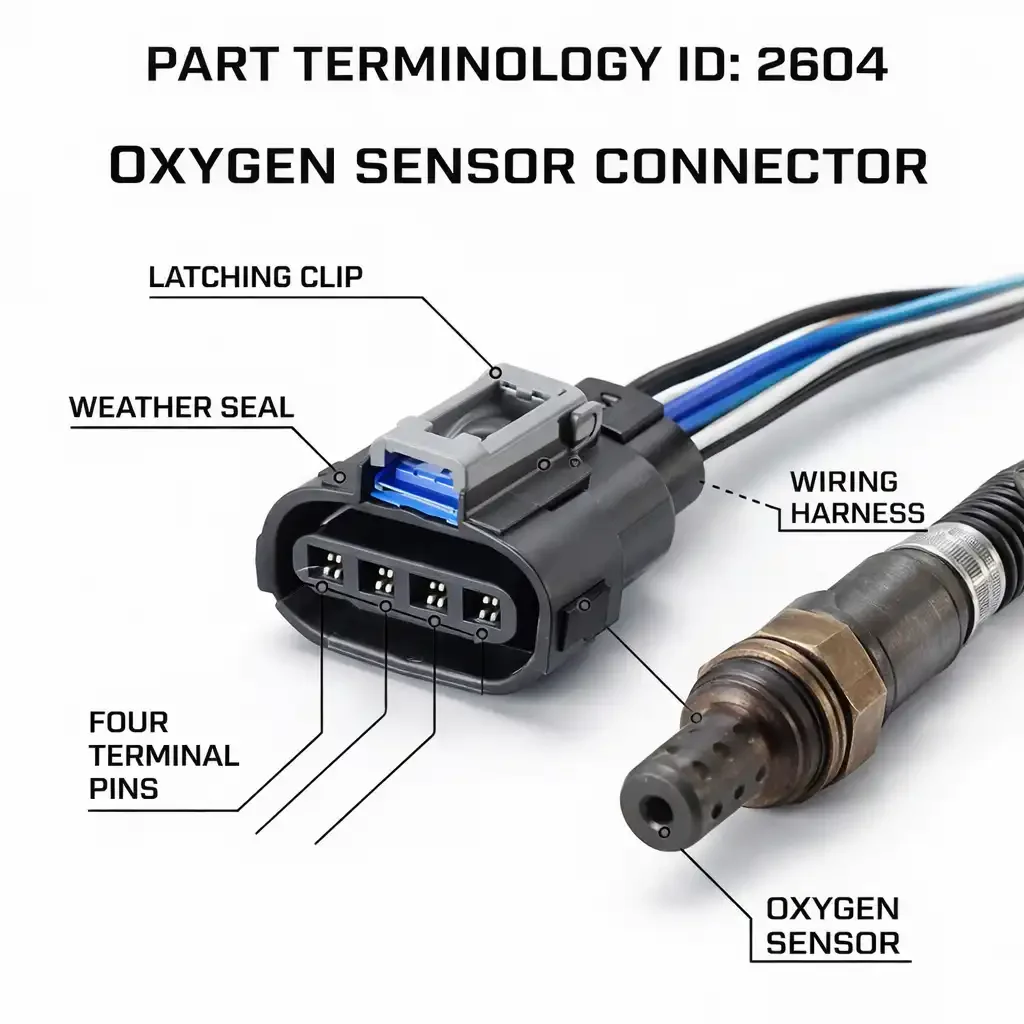
The oxygen sensor connector is one of the highest-volume electrical connector categories in the aftermarket. Every fuel-injected vehicle with a catalytic converter has at least one oxygen sensor, most have two or more, and every connector that fails from exhaust heat, oil contamination, or corrosion needs a replacement pigtail. On a V6 with upstream and downstream sensors on both banks, that is four connectors per vehicle, all in the exhaust heat zone, all subject to the same failure modes. Volume alone makes this a high-stakes catalog category.
What makes it genuinely difficult is that the oxygen sensor connector has more wire count variants than almost any other sensor connector in the aftermarket. The sensor technology changed significantly across the same vehicle platforms over a twenty-year span, moving from unheated one-wire designs to four-wire heated narrowband sensors to five and six-wire wideband AFR sensors. On many modern vehicles, the upstream and downstream sensor positions use different sensor technologies and therefore different connectors. And the most common buyer search behavior, looking up a connector by vehicle year, make, model, and bank position, does not capture the sensor generation that determines which connector will actually fit.
The return pattern is predictable. Buyer searches by vehicle and position. Receives a connector. The wire count does not match their sensor type, or the upstream connector arrives when they needed the downstream, or a narrowband housing appears for a wideband application. The listing said it fit the vehicle. The catalog never identified which generation of sensor was installed or which position the listing covered. That is the entire catalog problem for PartTerminologyID 2604, and this guide covers everything needed to solve it.
PCdb Status for PartTerminologyID 2604
PartTerminologyID
◦ 2604 in both current PIES 7.2 / PCdb and future PIES 8.0 / PCdb 2.0. No change on migration.
Terminology Name
◦ Oxygen Sensor Connector. No rename in PIES 8.0.
Category
◦ Engine
SubCategory
◦ Exhaust
Status
◦ Active in both schema versions.
Placement under Engine / Exhaust is accurate. The catalog challenge is that the terminology name covers three distinct sensor technologies: unheated narrowband, heated narrowband, and wideband AFR. All three mount in the exhaust stream. All three use pigtail connectors. All three fall under PartTerminologyID 2604. The technology type determines wire count, and wire count determines connector compatibility. That chain must be in the catalog data.
The Sensor Technology Map: Why Wire Count Alone Is Not Enough
The oxygen sensor connector category spans three fundamentally different sensor technologies, each with a distinct wire count and connector requirement. Cataloging all three under a single fitment row without noting sensor technology is the structural cause of most returns in this category.
Unheated Narrowband Sensor
The unheated narrowband sensor generates a voltage signal based on the oxygen differential between the exhaust stream and ambient air. It relies on exhaust heat alone to reach operating temperature, which delays accurate signal output on cold starts. On cold starts, the ECM operates in open-loop fuel control until the sensor warms up enough to produce a reliable signal, which can take several minutes on cold mornings. The connector for an unheated sensor carries only the signal circuit and, on two-wire designs, a dedicated signal ground. These connectors are older and simpler than heated designs but still sold in significant volume because unheated sensors remain in service on pre-OBD2 and early OBD2 vehicles, and the connectors fail from age and heat exposure regardless of sensor type.
• 1-wire unheated. Single signal terminal. Ground through the sensor body to the exhaust pipe. The oldest design. Pre-OBD1 and early OBD1 domestic and import applications.
• 2-wire unheated. Signal plus dedicated signal ground. Eliminates ground offset error from return through the exhaust. Common on late 1980s and early 1990s domestic applications.
Heated Narrowband Sensor
The heated narrowband sensor adds an internal resistive heater element that brings the sensor to operating temperature faster than exhaust heat alone. Faster warm-up means faster closed-loop fuel control. The heater circuit requires two additional wires beyond the signal circuit: heater power and heater ground. The four-wire heated narrowband connector is the highest-volume oxygen sensor connector in the aftermarket.
• 3-wire heated narrowband. Signal, heater power, heater ground. Signal ground returns through the sensor body. Common on some early heated sensor designs.
• 4-wire heated narrowband. Signal, dedicated signal ground, heater power, heater ground. The standard design on most OBD2-era domestic and import applications. The dominant connector in this category.
Three-wire and four-wire sensors are not interchangeable. A four-wire connector will not mate with a three-wire sensor body. A three-wire connector on a four-wire application leaves the signal ground terminal unconnected. Both produce sensor circuit faults. The wire count must be in the listing.
Wideband Air-Fuel Ratio Sensor
The wideband sensor produces a current signal proportional to the precise air-fuel ratio across a wide range above and below stoichiometry, rather than a simple rich-or-lean switching voltage. The ECM uses this precise measurement for more accurate fuel control and faster catalyst warm-up management. The wideband sensor requires five or six wires to carry the pump cell current, reference cell signal, and in some designs a calibration resistor circuit, in addition to the heater circuits.
• 5-wire wideband. Heater positive, heater ground, pump cell positive, pump cell negative or reference, and signal return. Standard on most Toyota and Honda upstream sensors from the early 2000s onward and on many domestic applications that adopted wideband technology in the 2000s.
• 6-wire wideband. Adds a calibration resistor circuit. Present on Bosch LSU 4.2 and some Bosch LSU 4.9 designs and on specific European applications.
A wideband connector cannot substitute for a narrowband connector, and vice versa. The circuits are different, the housings are different, and the ECM calibration for wideband operation is incompatible with a narrowband connector in the circuit. Wideband connectors must be identified as wideband or AFR sensor in every listing, not as oxygen sensor connectors with a different wire count.
THE SENSOR TECHNOLOGY HIERARCHY
Wire count follows technology tier. 1 to 2 wires: unheated narrowband. 3 to 4 wires: heated narrowband. 5 to 6 wires: wideband AFR sensor. Connectors from any one tier are physically and electrically incompatible with sensors from the other tiers. Fitment data that does not capture sensor technology type will produce cross-tier shipments on every platform that used multiple sensor generations across its production run.
Sensor Position: Upstream vs. Downstream and Why It Matters
Most modern vehicles with catalytic converters use at least two sensors per exhaust bank: one upstream of the converter for closed-loop fuel control, and one downstream to monitor converter efficiency. On a V6 with two banks, that is four sensor positions. On a V8 with two banks, four positions as well. The connector for each position may differ in pigtail length, and on platforms that use wideband upstream and narrowband downstream, in sensor technology type and wire count.
Mixed-Technology Applications: The Most Consequential Catalog Split
Toyota and Honda applications from the early 2000s onward, and some domestic applications from the mid-2000s, use wideband AFR sensors in the upstream position and heated narrowband sensors in the downstream position. This arrangement is present across a large number of high-volume applications. A Toyota V6 from 2004 onward may have three upstream wideband positions requiring five-wire Denso connectors and three downstream narrowband positions requiring four-wire Denso connectors.
A single fitment row covering all sensor positions on these applications will produce the wrong technology type on half of all orders. The upstream wideband and downstream narrowband positions must be separate listings, each with explicit position and sensor technology notes. This is the single most consequential catalog split in the oxygen sensor connector category. No other single fix reduces returns more on the affected applications.
Pigtail Length by Position
Pigtail length for oxygen sensor connectors varies more by position than for almost any other sensor connector in the aftermarket. The upstream sensor on the front bank of a transversely mounted V6 may need 8 inches of pigtail. The downstream sensor on the rear bank of the same engine, where the harness must route from the converter outlet at the back of the engine bay to the nearest harness branch under the dash, may need 20 inches. On longitudinally mounted V8 engines, the upstream and downstream positions have different routing distances depending on whether the catalytic converter is close-coupled to the manifold or positioned further back in the exhaust system.
Pigtail length also affects the quality of the repair. A technician repairing exhaust harness damage in the heat zone around the catalytic converter needs to position the splice point outside that zone, which requires enough pigtail length to reach clean wire outside the damaged area with margin to spare. A too-short pigtail forces the splice into or near the damaged zone, where the same thermal conditions that caused the original failure will affect the new splice.
Pigtail length must be stated by position when the lengths differ across positions on the same application. A listing that covers all sensor positions with a single pigtail length will produce too-short pigtails on the longer-run positions on every such order.
The Complete Variant Universe for PartTerminologyID 2604
1. Sensor Technology and Wire Count
These two fields together are the minimum unambiguous identifier for any oxygen sensor connector. Technology type alone does not separate three-wire from four-wire narrowband. Wire count alone does not prevent wideband connectors from being ordered for narrowband applications where counts coincidentally match.
• 1-wire unheated narrowband.
• 2-wire unheated narrowband.
• 3-wire heated narrowband.
• 4-wire heated narrowband. The most common in the aftermarket.
• 5-wire wideband AFR sensor.
• 6-wire wideband AFR sensor. Bosch and selected European applications.
2. Connector Body Shape
The connector housing must match the sensor body profile at the mating point. Oxygen sensor bodies vary across manufacturers, and the connector housing is designed for a specific sensor body geometry. Correct wire count with the wrong housing profile produces a connector that will not latch or will seat loosely.
• Compact rectangular housing. The most common profile for domestic four-wire narrowband applications. Used across GM, Ford, and Chrysler applications with Delphi or Packard connector families.
• Oval or elongated housing. Common on Denso and NGK sensor designs for Toyota and Honda applications. Not interchangeable with domestic rectangular housings at matching wire count.
• Bosch hex housing. A hexagonal or near-hexagonal profile specific to Bosch sensor connector families. Standard on European applications and Bosch wideband sensors.
• Round or cylindrical housing. Present on some older unheated designs and specific import applications.
• Heat-shielded housing. Higher thermal resistance material or integral heat shield. Required on sensors mounted very close to the exhaust manifold or turbocharger outlet.
3. OEM Sensor Family
Sensor family identifies the housing profile more precisely than shape description alone, and it gives professional buyers a verification reference they can check against the sensor physically installed in the vehicle.
• Bosch. Dominant on European applications. Narrowband four-wire and wideband five or six-wire. Hex housing profile.
• Denso. Primary supplier for Toyota and Honda. Narrowband four-wire with oval housing. Wideband five-wire with Denso-specific wideband housing.
• NTK or NGK. Appears on domestic and import applications. Similar to Denso profiles on import applications but with NTK-specific latch designs on some variants.
• Delphi or Packard. Primary domestic GM and Chrysler supplier. Compact rectangular four-wire housing.
• Ford-specific. Ford OEM sensor connector family with a Ford-specific latch design. Not interchangeable with GM Delphi connectors at matching wire count.
4. Wire Entry Angle
• Straight entry. Wire bundle exits in line with the connector axis. Standard on most domestic upstream sensor pigtails.
• 90-degree entry. Wire bundle exits perpendicular to the mating face. Common on downstream sensors where the harness must route along the floor pan or vehicle body immediately after the connector.
Heat damage to the oxygen sensor harness, which is the primary failure mode that brings buyers to this category, is frequently caused by a harness resting too close to the exhaust system. A replacement connector with the wrong wire entry angle may recreate the routing condition that caused the original failure.
5. Pigtail Length
• Short, 6 to 8 inches. Upstream sensors on accessible manifold positions.
• Standard, 10 to 14 inches. Most upstream and many downstream positions on domestic applications.
• Long, 16 to 24 inches. Downstream sensors on longer routing applications. Far bank sensors on transverse engines. Heat damage that extends further from the connector into the harness.
State pigtail length in inches on every listing. On applications where upstream and downstream positions require different lengths, state lengths separately by position.
6. Wire Gauge and Insulation Rating
• Wire gauge. Heater circuit wires typically 20 AWG. Signal and reference circuits typically 20 or 22 AWG. State gauge for heater and signal wires separately when they differ.
• Heat-resistant insulation. Cross-linked polyethylene or silicone insulation rated to 125 degrees Celsius or higher. Required for exhaust-zone pigtails. Note the rating when the supplier data provides it.
• Wire jacket. Braided metal or high-temperature fiber jacket for additional heat protection at the connector body. Note type and presence.
7. Seal Type and Secondary Lock
• Individual wire seals with peripheral face seal. Standard on all modern heated and wideband connectors. Required for any underbody exhaust location.
• IP67 rated. Note when present. Professional buyers in severe climate applications look for this rating specifically.
• Secondary lock type. Integral push-tab, squeeze-release, or secondary lock clip. Note whether included when the OE connector had one.
OEM Sensor Families and Platform Notes
Bosch Narrowband and Wideband Applications
Bosch is the dominant OEM oxygen sensor supplier across European applications and appears extensively on domestic vehicles as well. Bosch four-wire narrowband sensors use a compact hex-profile connector family that is recognizable to technicians working on BMW, Mercedes-Benz, Volkswagen Group, and many domestic OBD2 applications. Bosch wideband sensors, including the widely deployed LSU 4.9, use five or six wire connectors with a housing profile specific to the wideband sensor body geometry. The Bosch LSU 4.9 is one of the most commonly replaced wideband sensors in the entire aftermarket and one of the most frequently mislisted. Its five-wire connector with a Bosch-specific hex housing is regularly ordered by buyers on four-wire narrowband applications who see a five-wire count and assume it refers to an older or alternate narrowband design. The circuit map on the Bosch LSU 4.9 is fundamentally different from any narrowband connector regardless of wire count proximity, and the housing will not correctly seat on a narrowband sensor body. Listings for Bosch wideband connectors must state wideband AFR sensor and Bosch LSU housing in the title without exception.
Denso Applications: Toyota and Honda
Denso is the primary supplier for Toyota and Honda oxygen and wideband sensors. Denso narrowband sensors use four-wire connectors with an elongated oval housing. Denso wideband sensors, used upstream on most Toyota and Honda applications from the early 2000s onward, use a five-wire connector with a housing that differs from both the Denso narrowband and the Bosch wideband designs. These two Denso connector types are not interchangeable even at nearby wire counts.
The upstream wideband versus downstream narrowband arrangement on Toyota and Honda applications requires the catalog to have two separate listings per application: one for the upstream five-wire Denso wideband position and one for the downstream four-wire Denso narrowband position. This is the single most important catalog split for import oxygen sensor connector inventory. A single listing covering all positions will misship on half of all orders on these applications. The practical catalog structure for a Toyota V6 application from 2004 onward is three separate SKUs: the upstream wideband connector listing with an upstream position note, the downstream narrowband connector listing with a downstream position note, and optionally a pigtail length note for each that accounts for the longer routing distance on the rear bank downstream positions of a transversely mounted engine.
GM LS-Series V8 Applications
GM LS-series applications use four-wire heated narrowband sensors at all four sensor positions on most applications. The Delphi compact rectangular connector is consistent across all positions, which simplifies the catalog structure relative to import applications. The main catalog consideration for LS sensor connector listings is pigtail length by position. The downstream Bank 1 Sensor 2 position on rear-sump LS applications has a significantly longer harness routing path than the upstream positions. On some LS-engine applications where the catalytic converter is mounted in a forward position under the hood, the downstream sensor pigtail must route further than the standard offering covers, and a long pigtail of 18 to 24 inches is necessary for a clean splice outside the heat zone. Pigtail length must be stated by position, and the downstream listings should note the longer requirement explicitly. LS applications are also disproportionately represented in engine swap builds, where the vehicle the engine is installed in may not match any factory fitment row. Sellers who note compatibility by sensor part number range or Delphi connector family in addition to vehicle fitment reach swap customers that vehicle-only fitment data cannot serve.
Ford EcoBoost Turbocharged Applications
Ford EcoBoost applications introduced wideband upstream sensors on some variants, creating the same upstream wideband versus downstream narrowband split seen on Toyota and Honda applications. The additional consideration on turbocharged Ford applications is the wire insulation rating. The oxygen sensor on a turbocharged application sits in a higher-temperature environment than on a naturally aspirated engine. Listings for EcoBoost and other Ford turbocharged oxygen sensor connector applications should note the high-temperature insulation requirement and specify the insulation rating when the supplier data provides it.
Chrysler and Mopar Applications
Chrysler domestic applications generally follow the same Delphi connector family pattern used on GM applications for OBD2-era four-wire narrowband sensors. The Chrysler-specific consideration is the transition from narrowband to wideband technology, which occurred at different points on different Chrysler engine families. The 2.4-liter four-cylinder, 3.6-liter Pentastar V6, and 5.7-liter Hemi V8 each introduced wideband sensors on upstream positions at different model years during the 2000s and early 2010s. The catalog must identify these transition points because a post-transition Chrysler application with a wideband upstream sensor requires a five-wire connector that is not interchangeable with the four-wire connector used on the same engine family before the transition. Application data for Chrysler applications must note the sensor technology type by position and by production year for any engine family that underwent this transition.
European BMW, Mercedes-Benz, and Volkswagen Group
European applications use Bosch oxygen and wideband sensors extensively. Pre-2000 European applications are typically Bosch four-wire narrowband. Post-2000 upstream positions are commonly Bosch wideband. The Bosch wideband connector with its hex housing profile is specific to Bosch sensor applications and must not be listed as a generic five-wire wideband connector that could attract orders for Denso or NTK wideband applications. European listings must note the Bosch sensor family in the title and must separate upstream wideband and downstream narrowband positions where both exist on the application.
Catalog Fields That Reduce Returns for PartTerminologyID 2604
Core Identification Fields
Sensor Technology Type
◦ Unheated narrowband, Heated narrowband, or Wideband AFR sensor. Required in the title. Primary filter above wire count.
Wire Count
◦ 1, 2, 3, 4, 5, or 6 wires. Required in the title alongside technology type.
Connector Body Shape
◦ Compact rectangular, Oval or elongated, Bosch hex, Round, or Heat-shielded. Written description required.
OEM Sensor Family
◦ Bosch, Denso, NTK, Delphi, or other. Required on import and European applications.
Wire Entry Angle
◦ Straight or 90-degree. Required on downstream sensor listings.
Position and Application Fields
Sensor Position
◦ Upstream, Downstream, or Both if the same connector serves both. Required on any application where upstream and downstream use different technology types.
Upstream Wideband / Downstream Narrowband Note
◦ Required on any Toyota, Honda, or domestic application with mixed technology by position. Separate listings required for each position.
Pigtail Length by Position
◦ State in inches per position when lengths differ. Do not use one length for all positions on multi-position applications.
Wire, Seal, and Compatibility Fields
Wire Gauge
◦ State AWG for heater and signal circuits separately when they differ.
Insulation Rating
◦ Note maximum temperature rating on high-heat applications.
Seal Type
◦ Wire seals with face seal, or Unsealed. Note IP67 rating when applicable.
Secondary Lock
◦ Integral push-tab, squeeze-release, or clip included. Note when clip is present or absent vs. OE.
Sensor Compatibility Statement
◦ One sentence. Technology type, wire count, sensor family, and position this connector serves. What it does not fit.
The Most Common Listing Mistakes for PartTerminologyID 2604
Mistake 1: Sensor Technology Type Not Stated
Listing oxygen sensor connector, 4-wire without stating heated narrowband attracts orders from wideband applications where the buyer sees a four-wire count and assumes it matches their sensor. Stating heated narrowband or wideband AFR in the title eliminates these cross-technology orders entirely.
Mistake 2: Wideband Connector Listed as Heated Oxygen Sensor Connector
The wideband AFR sensor is not a narrowband oxygen sensor. Its connector is not a narrowband connector. When wideband connectors are listed under the generic label heated oxygen sensor connector without technology type, they attract orders from narrowband applications with matching wire counts. The result is a connector that may physically mate but is wired to an incompatible circuit map. Wideband must appear in the title.
Mistake 3: Upstream and Downstream Not Split on Mixed-Technology Applications
Toyota and Honda applications from the early 2000s onward, and some domestic applications from the mid-2000s, use wideband upstream and narrowband downstream. A single fitment row covering all positions will produce wrong technology type on half of all orders. Two separate listings, one for upstream wideband and one for downstream narrowband, is the only correct catalog structure for these applications.
Mistake 4: Pigtail Length Not Specified by Position
An upstream sensor connector and a downstream sensor connector for the same vehicle may require pigtail lengths that differ by eight inches or more. Stating one length for all positions produces too-short pigtails on the longer-run positions on every order. State length in inches by position when the positions have different routing distances.
Mistake 5: Bosch Wideband Not Identified as Bosch Wideband
The Bosch LSU 4.9 generates a disproportionate share of mislisted connector orders because its five-wire count is close to the four-wire narrowband count that most buyers are familiar with. The listing must state Bosch wideband AFR sensor and five-wire in the title. Omitting this attracts narrowband buyers on every order.
Mistake 6: OEM Sensor Family Not Identified on Import Applications
Denso, NTK, and Bosch connectors at the same wire count use different housing profiles. Omitting sensor family from import listings allows buyers to order domestic compact rectangular connectors for Denso oval-housing applications. The housing will not seat. Sensor family belongs in the item specifics on every import and European listing.
Mistake 7: Wire Insulation Rating Omitted on High-Heat Applications
Turbocharged and close-to-manifold applications require higher insulation ratings than standard. A standard-rated pigtail on a high-heat application will degrade faster than the OE harness. Note the insulation rating when the supplier data states it. This is a professional buyer verification point on high-heat applications.
Marketplace-Ready Listing Standards for PartTerminologyID 2604
Required Title Elements
Domestic four-wire heated narrowband:
Oxygen Sensor Connector, Heated Narrowband, 4-Wire, Compact Rectangular, Fits GM Delphi Sensor
Toyota upstream wideband:
Oxygen Sensor Connector, Wideband AFR, 5-Wire, Upstream, Fits Toyota Denso Wideband Sensor
Toyota downstream narrowband for same platform:
Oxygen Sensor Connector, Heated Narrowband, 4-Wire, Downstream, Fits Toyota Denso Narrowband Sensor
Bosch wideband:
Oxygen Sensor Connector, Wideband AFR, 5-Wire, Bosch LSU 4.9 Hex Housing
Required Bullet Points
• SENSOR TECHNOLOGY: Unheated narrowband, Heated narrowband, or Wideband AFR sensor. Required on every listing.
• WIRE COUNT: Exact number. 1, 2, 3, 4, 5, or 6 wires.
• HOUSING SHAPE: Compact rectangular, Oval, Bosch hex, Round, or Heat-shielded.
• OEM SENSOR FAMILY: Bosch, Denso, NTK, Delphi, or other. Required on import and European applications.
• POSITION: Upstream, Downstream, or Both. Required on any mixed-technology application.
• PIGTAIL LENGTH: State in inches per position when positions differ.
• WIRE ENTRY: Straight or 90-degree.
• WIRE GAUGE: AWG for heater and signal circuits.
• INSULATION RATING: Maximum temperature rating when applicable.
• SEAL TYPE: Wire seals with face seal or IP67 rating.
• SENSOR COMPATIBILITY: One sentence. Technology type, wire count, sensor family, and position this connector fits. What it does not.
Compatibility Statement Templates
TEMPLATE A: DOMESTIC FOUR-WIRE HEATED NARROWBAND
Fits: 4-wire heated narrowband oxygen sensor with compact rectangular Delphi-style housing. Does not fit: wideband AFR sensors (5-wire), unheated narrowband sensors (1-2 wire), or 3-wire heated sensors. Verify sensor is 4-wire heated narrowband before ordering.
TEMPLATE B: TOYOTA UPSTREAM WIDEBAND
Fits: Toyota upstream wideband AFR sensor, 5-wire Denso connector, upstream position only. Downstream sensors on the same application use a 4-wire heated narrowband connector. Order the downstream connector separately. Verify sensor position is upstream before ordering.
TEMPLATE C: BOSCH WIDEBAND
Fits: Bosch LSU 4.9 or LSU 4.2 wideband AFR sensor. 5-wire Bosch hex housing. Does not fit: 4-wire heated narrowband sensors or Denso and NTK wideband connectors at matching wire count. Verify sensor is Bosch wideband design before ordering.
FAQ for Oxygen Sensor Connector (PartTerminologyID 2604)
What is the difference between a narrowband and wideband oxygen sensor connector?
A narrowband sensor produces a switching voltage indicating rich or lean relative to stoichiometry. Its connector carries two to four wires for signal, signal ground, heater power, and heater ground. A wideband AFR sensor produces a current signal proportional to the precise air-fuel ratio across a wide measurement range and requires five or six wires to carry the additional pump cell and reference circuits. The two connector types are electrically incompatible. Installing a narrowband connector on a wideband application produces incorrect fuel control and an immediate fault code. Confirm sensor technology type before ordering.
My vehicle has four oxygen sensors. Do they all use the same connector?
On most domestic applications with four sensors, all four positions use the same four-wire heated narrowband connector and the only variable is pigtail length by position. On Toyota, Honda, and some domestic applications from the mid-2000s onward, the upstream sensors are wideband AFR with five-wire connectors and the downstream sensors are narrowband with four-wire connectors. On these applications the upstream and downstream positions require separate part numbers. Verify sensor technology type by position before ordering.
How do I confirm whether my sensor is narrowband or wideband?
Count the wires on the existing sensor pigtail. One or two wires is unheated narrowband. Three or four wires is heated narrowband. Five or six wires is wideband AFR. If you cannot access the wire count visually because the connector is too corroded or the pigtail is damaged past the point where individual wires can be counted, the part number printed or stamped on the sensor body can be cross-referenced against sensor manufacturer specifications online to confirm technology type. A third method is to check the ECM calibration documentation for your specific vehicle: any vehicle whose ECM is calibrated for wideband AFR closed-loop control will have a wideband sensor in the upstream position. If the ECM documentation shows only narrowband oxygen sensor control, all sensors on the vehicle are narrowband designs.
Does pigtail length matter if I can splice and extend the wiring?
Extending oxygen sensor wiring with splices adds connection points in a high-heat, high-vibration environment. Solder connections in particular become brittle from thermal cycling in the exhaust zone. The safer practice is to order a pigtail with sufficient length to reach the undamaged section of the original harness with a clean splice outside the heat zone. Measure the distance from the sensor to the end of the undamaged wire before ordering.
Why does my wideband sensor produce an erroneous reading after connector replacement?
The most common causes are a terminal not fully seated in the housing, causing intermittent contact on a pump cell circuit; an incorrect connector with the circuit map wired differently from the OE design at a matching wire count; or a missing calibration resistor circuit on six-wire Bosch applications where the calibration resistor is required for accurate sensor response. A less common but important cause is a connector built to a different wideband sensor family than the sensor installed in the vehicle. A five-wire connector designed for a Denso wideband sensor will not correctly serve a Bosch LSU 4.9 even though both have five wires, because the pump cell circuit assignments differ between sensor families. Verify full terminal seating, confirm the connector is specific to the Bosch LSU 4.9 or the relevant wideband sensor family by name, and use a six-wire connector on applications that specify a calibration resistor circuit.
Catalog Quality Checklist for PartTerminologyID 2604
1. State sensor technology type in the title. Unheated narrowband, Heated narrowband, or Wideband AFR sensor. No generic oxygen sensor connector without technology type.
2. State wire count in the title alongside technology type. Both fields together are the minimum unambiguous identifier.
3. Describe housing shape in words. Compact rectangular, Oval, Bosch hex, or Round.
4. Identify OEM sensor family on import and European applications. Prevents domestic connector substitution based on wire count alone.
5. Note sensor position. Upstream or Downstream. Required on any mixed-technology application.
6. Create separate listings for upstream wideband and downstream narrowband on Toyota, Honda, and mixed-technology domestic applications. This is the single most important catalog split in the category.
7. Specify pigtail length in inches by position when lengths differ across positions.
8. State wire gauge for heater and signal circuits.
9. Note wire insulation rating on high-heat and turbocharged applications.
10. Document seal type and secondary lock type. Note IP67 rating when applicable.
11. Write a sensor compatibility statement. Technology type, wire count, sensor family, position, and what the connector does not fit.
Final Thoughts
The oxygen sensor connector category is wide, high-volume, and driven by a technology split that most catalog systems handle poorly. The transition from unheated narrowband to heated narrowband to wideband AFR happened at different times on different platforms. The transition from narrowband to wideband often happened at the upstream position before the downstream position on the same vehicle. The sensor families from Bosch, Denso, NTK, and domestic suppliers use distinct housing profiles that are not interchangeable at matching wire counts.
Every return in this category traces to one of those three facts being absent from the listing. Sensor technology type answers the cross-technology returns. Upstream versus downstream position with sensor type per position answers the mixed-technology application returns. OEM sensor family answers the housing profile mismatch returns on import applications.
Three fields, a pigtail length per position, and one sentence of compatibility language. That is the investment required to move the return rate in this category to where it should be. In a category this large, every percentage point reduction in returns is meaningful. Catalog it completely.