
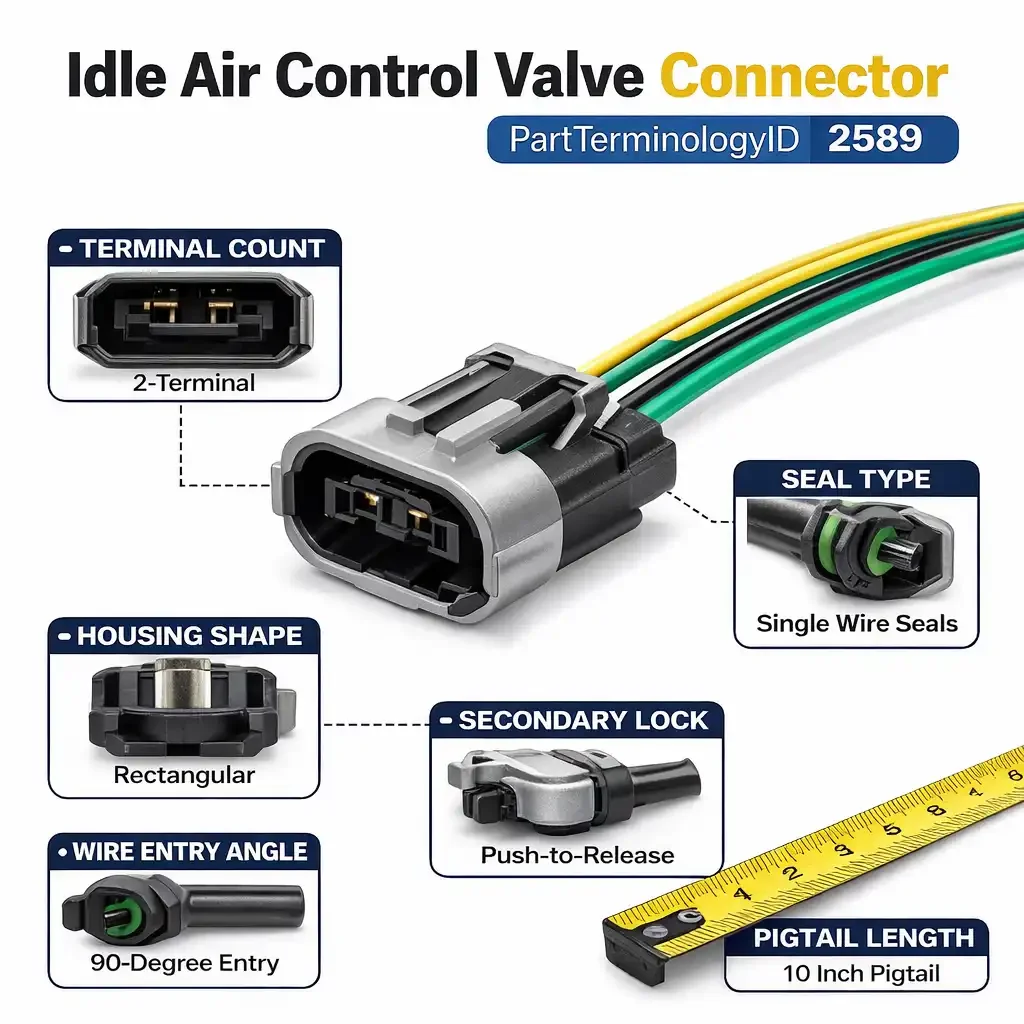
The Idle Air Control Valve Connector is a small part. It is also a reliable source of returns, misshipments, and frustrated customers who install it and then find out it does not mate with the valve on their specific engine.
That is the core problem with connector categories in the aftermarket. The part looks simple. The name sounds precise. Customers assume that if the terminology matches and the fitment says their vehicle, the connector will plug in. It will not, not unless the catalog data captures the terminal count, the connector body shape, the wire entry configuration, and the specific IAC valve design that connector is built to serve.
This guide covers PartTerminologyID 2589 in full. It explains what the part is, what variants exist in the market, what catalog fields actually matter, and what listing language prevents the returns that are otherwise inevitable in this category.
PCdb Status for PartTerminologyID 2589
A quick orientation on where this part sits in the current standards framework before getting into product variance.
PartTerminologyID
◦ 2589 in both current PIES 7.2 / PCdb and future PIES 8.0 / PCdb 2.0. No change on migration.
Terminology Name
◦ Idle Air Control Valve Connector. No rename in PIES 8.0.
Category
◦ Engine
SubCategory
◦ Fuel Delivery
Status
◦ Active in both schema versions.
The name is stable. The challenge is that the terminology name describes a function, not a physical configuration. Idle Air Control Valve Connector tells you what circuit the connector serves. It tells you nothing about how many terminals it has, what the connector body looks like, how the wires enter, or which of the several distinct IAC valve designs it mates with. That information has to come from the catalog data, and in most aftermarket listings it does not.
What the Idle Air Control Valve Connector Actually Is
The idle air control valve, commonly called the IAC valve, is a solenoid-controlled valve that the engine control module uses to regulate airflow bypassing the throttle plate at idle. By opening and closing a small air passage, the IAC valve allows the ECM to maintain a stable idle speed regardless of engine load, temperature, and accessory draw. When the air conditioning compressor engages, when the power steering pump loads up at low speed, or when a cold engine needs a fast idle, the IAC valve is doing the work of keeping the engine from stalling.
The IAC valve connector is the electrical pigtail that connects the vehicle wiring harness to the IAC valve solenoid. It terminates at the valve body with a molded connector housing, a set of terminals, a seal or O-ring where required, and wiring on the harness side that runs back to the ECM circuit.
When this connector fails, it usually fails because of heat exposure near the intake manifold, because of oil or coolant contamination that wicks up the wire bundle, or because of terminal corrosion from moisture intrusion over time. The failure mode is typically an idle quality complaint: rough idle, high idle, erratic idle speed, or a stored diagnostic code for the IAC circuit. The connector itself is often overlooked until the technician physically inspects the valve and finds a corroded or melted pigtail.
Because the connector is a wear item that fails independently of the valve itself, the aftermarket carries it as a standalone replacement. That is where the catalog challenge begins.
Why This Category Generates Returns
The IAC valve connector looks like a simple purchase. You look up the vehicle, you see a connector listed, you buy it. The return rate in this category suggests that the experience is not actually that simple.
There are three structural reasons why this part generates returns at a rate higher than its size and price would suggest.
Reason 1: Multiple IAC Valve Designs Exist on the Same Engine Family
IAC valve design changed across production runs, engine revisions, and platform updates. On the GM 3800 V6, for example, several distinct IAC valve designs were used across different model years and applications, and each valve design has a corresponding connector with a different terminal count, housing geometry, and wire entry angle. A connector that fits the early design will not mate with the late design. Both connectors list to the same engine. Year, make, and model does not separate them.
The same pattern appears across Chrysler 2.2 and 2.5 four-cylinder applications, Ford EFI engines of the late 1980s and 1990s, Toyota applications on the 22RE and related inline-four platforms, and many others. Platform fitment data groups these applications together. The connector data has to separate them by valve design, and most catalog entries do not.
Reason 2: The Connector Body Is Not Visible in Most Listing Photos
The dominant photo convention for electrical connectors shows the connector housing from the mating face, which tells the buyer about the terminal layout. What it rarely shows is the wire entry angle, the overall body profile, the secondary lock position, or the seal type. A buyer who has the broken connector in hand can compare terminal count but cannot compare body geometry from a single face-on photo.
This is why customers who order based on photo and fitment alone still return connectors. The terminal count matched. The fitment said correct. The body profile did not match the harness routing on their vehicle.
Reason 3: Customers Do Not Know the Valve Design They Have
Most customers ordering an IAC valve connector do not know the design designation of their valve. They know it is the IAC connector. They know their year, make, model, and engine. They do not know whether their engine has the two-terminal or three-terminal IAC design, or whether their valve has the rectangular housing or the round housing, or whether their connector uses a push-to-release secondary lock or a pull-tab release.
This is not a knowledge failure on the part of the customer. It is a catalog failure on the part of the seller. The listing is supposed to capture that information so the customer does not have to. When the listing does not capture it, the customer guesses. Guesses generate returns.
ROOT CAUSE SUMMARY
Most IAC connector returns come from one of three situations: the connector fits the vehicle but not the specific valve design on that engine, the terminal count is correct but the body geometry does not match, or the listing grouped multiple valve designs under one fitment row without noting the design distinction. All three are catalog problems, not product problems.
The Complete Variant Universe for PartTerminologyID 2589
Every dimension of variance in this category needs to be captured in catalog data. The following sections cover each one.
1. Terminal Count
This is the most basic differentiator and still the most commonly omitted field in connector listings. IAC valve connectors exist in two-terminal and three-terminal configurations. The two-terminal design is most common and serves a simple solenoid circuit with a power and ground signal. The three-terminal design appears on applications where the valve uses a more complex control signal, typically with a reference voltage, a signal, and a ground.
A two-terminal connector physically cannot mate with a three-terminal valve. There is no workaround. Terminal count must appear in the listing.
• 2-terminal. The most common configuration. Appears on a wide range of domestic and import applications through the 1990s and 2000s.
• 3-terminal. Less common. Specific to applications with a reference-voltage IAC circuit. Must be identified as distinct from two-terminal applications even when the vehicle fitment overlaps.
2. Connector Body Shape and Housing Profile
The connector housing geometry determines whether the connector will seat and lock against the valve body. Even if the terminal count matches, a connector with the wrong housing profile will not mate correctly, will not latch, or will sit loose against the valve and allow moisture intrusion.
The main housing profiles that appear in this category:
• Rectangular housing. Flat, roughly square or rectangular profile. Common on GM applications using the standard Multec or Packard connector family for fuel system components.
• Oval or rounded housing. An oval cross-section housing that fits IAC valves with a corresponding oval port. Common on several import applications.
• Round housing. A cylindrical housing, typically appearing on older domestic applications and some rotary-style IAC valve designs.
• Dual-leg or split housing. Two separate connector legs that snap into adjacent ports on the valve body. Less common but found on specific GM truck and van applications.
The housing profile should appear in the catalog data as a shape description, not just as a photograph. When a buyer is ordering a replacement on a disassembled engine, they may not have the original connector to compare visually. A written shape description is usable when the photograph is not.
3. Wire Entry Angle and Orientation
Wire entry angle is the direction the wire bundle exits the connector body relative to the mating face. This matters because the connector sits near the intake manifold, where harness routing is constrained by adjacent components. A straight-entry connector and a 90-degree-entry connector occupy different space envelopes even when the terminal layout and housing profile are identical.
• Straight entry. The wire bundle exits in line with the connector axis, pointing away from the mating face. Used where the harness runs parallel to the valve approach path.
• 90-degree entry. The wire bundle exits perpendicular to the mating face. Used where the harness must turn immediately after the connector to route along the manifold or head surface.
• 45-degree entry. Less common. Appears on specific applications where straight and 90-degree both create harness stress.
Many listings do not capture wire entry angle at all. The result is customers who receive a connector with the correct terminals and the correct housing but the wrong wire exit, forcing an awkward harness bend that cracks the connector or strains the terminals over time. Wire entry orientation belongs in the item specifics on every listing.
4. Seal Type and Weather Protection
IAC valve connectors live near a hot engine intake, exposed to heat cycling, oil vapor, and in many climates, road salt and moisture. The seal configuration determines the long-term reliability of the replacement connector and affects whether the connector matches the OE sealing specification for the application.
• Single wire seal. Each individual wire has its own rubber seal that compresses against the terminal cavity wall when the terminal is inserted. Standard on most late-model applications.
• Peripheral seal. A single seal ring around the entire connector body perimeter that seals against the valve housing face. Used on some applications instead of or in addition to individual wire seals.
• Unsealed connector. Some older or low-exposure applications use unsealed connectors. Replacing an unsealed connector with a sealed one is generally acceptable. Replacing a sealed connector with an unsealed one is not.
Seal type should be noted in the listing. Customers in high-humidity or high-salt environments specifically look for sealed connectors. If the replacement downgrades the sealing versus the OE design, that is a catalog note that belongs in the product description.
5. Secondary Lock Type
The secondary lock is the mechanical retention device that prevents the connector from backing out of the valve housing under vibration. Most modern connectors have a secondary lock. The type and release method affects installation and serviceability.
• Push-to-release secondary lock. A tab that must be depressed before the connector can be unlatched. Requires a tool or fingernail in tight spaces.
• Pull-tab release. A tab that is pulled outward to release the secondary lock before unlatching. More accessible in confined spaces.
• Slide lock. A sliding sleeve that locks over the primary latch. Common on several connector families used in fuel system applications.
• No secondary lock. Present on some older or lower-vibration applications. Worth noting because technicians who expect a secondary lock will look for one during installation.
6. Pigtail Length
The IAC valve connector is sold as a pigtail, meaning a connector housing with a short section of wire pre-attached. The pigtail length determines how much wire is available to splice into the existing harness. If the pigtail is too short, the technician cannot reach back far enough into the harness to make a clean splice outside the heat zone near the manifold.
• Short pigtail, typically 6 inches or less. Used for repairs where the original connector broke close to the valve and the harness wire is still long enough to reach.
• Standard pigtail, typically 8 to 12 inches. The most common aftermarket offering. Provides enough length for a clean splice on most applications.
• Long pigtail, over 12 inches. Used when the harness damage extends further back from the valve, or when the repair requires routing the new wire around an obstacle.
Pigtail length should appear in the product specifications as a measurement in inches. A technician planning a repair needs to know if the pigtail is long enough to reach the undamaged portion of the original harness before they open the box.
7. Wire Gauge
The wire gauge in the pigtail must match the circuit requirements of the IAC valve. Most IAC circuits operate at relatively low current, and the wire gauge in the original harness is selected to match that load. Mismatched wire gauge creates resistance differences that can affect IAC response and, in some cases, create a thermal mismatch that causes the splice to fail prematurely.
• 18 AWG. The most common gauge for IAC valve circuits on domestic and import applications.
• 20 AWG. Appears on some lower-current applications and some import platforms.
• 16 AWG. Less common. Found on applications where the IAC circuit is shared with other components or where circuit protection requires a heavier gauge.
Wire gauge should appear in the product specifications. It is rarely captured in aftermarket connector listings, but it matters to technicians who are paying attention to circuit integrity on a professional repair.
OEM Connector Families and What They Mean for Catalog Data
IAC valve connectors in the aftermarket are predominantly replacement pigtails built to match OEM connector families. Understanding which connector family a given application uses helps explain why certain catalog splits are necessary and why grouping applications by vehicle fitment alone is insufficient.
GM Multec and Packard Connector Family
General Motors used the Multec connector system extensively across fuel system components throughout the 1980s, 1990s, and into the 2000s. IAC valve connectors on GM applications in this era are typically two-terminal Multec connectors with a rectangular housing and a push-tab primary latch. The connector family is well-documented and widely replicated in the aftermarket.
The cataloging challenge on GM applications is that the same connector family was used across a very wide range of engine families and model years, but the IAC valve itself changed design at several points. The connector looks similar but the valve it mates with is different. A connector listed correctly for a 1991 Buick 3800 may not seat correctly against the revised IAC valve introduced on the same engine in 1994. Application data that only captures year, make, and model will group both applications under one fitment entry. The catalog must note the valve design change with a production date or VIN break.
Chrysler EFI Connector Family
Chrysler EFI applications from the late 1980s through the mid-1990s use a connector family with a rectangular housing and a slide-lock secondary retention. The two-terminal version is common on the 2.2 and 2.5 four-cylinder engines. These connectors are well-represented in the aftermarket but frequently listed without the secondary lock type, which causes confusion during installation when technicians cannot figure out why the connector does not feel locked in place.
Ford EEC Connector Family
Ford fuel system connectors from the EEC IV era use a connector family with distinctive rounded housing profiles and a friction-fit primary retention on some variants, with a proper latch on others. The IAC valve on Ford EFI applications of this era uses a two-terminal connector, but the connector housing profile differs from the GM Multec family in ways that are not obvious from terminal count alone and are easy to miss in a listing photo that only shows the mating face.
Toyota and Honda Import Applications
Import applications from Toyota and Honda in the 1990s and early 2000s often use connector designs with oval or rounded housings that differ significantly from domestic connector families. These connectors are frequently listed under generic import connector categories and are harder to source accurately than domestic connectors. Catalog data for these applications must capture the oval vs. rectangular housing distinction because the two will not interchange.
CATALOGING NOTE: CONNECTOR FAMILY
Noting the OEM connector family name in the product description, such as Multec 2-pin, Packard 2-way, or Delphi GT-150 series, gives professional buyers and technical catalogers a reference point they can verify independently. It is more specific than terminal count alone and more portable than a photo.
Catalog Fields That Reduce Returns for PartTerminologyID 2589
The following fields represent the minimum data set for accurate IAC valve connector listings. Each field maps to a specific return pattern when it is missing.
Core Identification Fields
Terminal Count
◦ 2-terminal or 3-terminal. Required on every listing. This is the most basic differentiator and the most commonly omitted field.
Connector Body Shape
◦ Rectangular, Oval, Round, or Dual-leg. Required. Use consistent terminology across the catalog.
Wire Entry Angle
◦ Straight, 90-degree, or 45-degree. Required. Omitting this causes installation complaints even when terminal count and housing match.
OEM Connector Family
◦ Note the connector family name when known: Multec, Packard, Bosch, Delphi, or other. Provides a verification reference for technical buyers.
Sealing and Retention Fields
Seal Type
◦ Single wire seal, Peripheral seal, or Unsealed. Note when the replacement provides equivalent or upgraded sealing vs. OE.
Secondary Lock Type
◦ Push-to-release, Pull-tab, Slide lock, or None. Prevents installation confusion in tight spaces where the technician cannot see the latch clearly.
Wire and Pigtail Fields
Pigtail Length
◦ State in inches. Do not use short, medium, or long as substitutes for a measurement.
Wire Gauge
◦ State in AWG. 18 AWG is most common. Confirm against the application specification.
Wire Color
◦ Note the wire colors if they match OE convention. Technicians splicing into an existing harness use wire color as a verification step.
Number of Wires
◦ Should match terminal count but confirm explicitly. Some pigtails carry an additional ground wire or shielding wire beyond the active terminals.
Application Notes Fields
IAC Valve Design Note
◦ When the same vehicle application uses multiple IAC valve designs, note the design this connector serves. Use production date, VIN range, or valve part number as the differentiator.
Valve Compatibility Statement
◦ A plain-language note identifying which IAC valve design the connector mates with. For example: Fits IAC valves with rectangular 2-pin housing. Does not fit round-housing IAC valve design.
Production Date or VIN Break
◦ Required when a mid-year or mid-generation design change split the application into two connector variants. Model year alone is not sufficient.
The Most Common Listing Mistakes for PartTerminologyID 2589
These are the specific patterns that generate returns, negative feedback, and fitment disputes in this category. Each one is preventable.
Mistake 1: Terminal Count Not Stated
A listing that says Idle Air Control Valve Connector with a fitment note and a photo but no terminal count will generate returns whenever a vehicle application uses both two-terminal and three-terminal IAC designs. The customer picks the connector that lists to their vehicle. Half the time they pick the wrong one. Terminal count belongs in the title and in the item specifics, not only in a photograph.
Mistake 2: Housing Shape Not Described in Words
A face-on photo of a connector shows the terminal layout but not the profile, depth, or secondary lock position. Customers who cannot see the connector they are trying to replace, because it has already been removed and discarded, cannot verify the housing match from a face-on photo. A written shape description solves this. Rectangular housing, 2-terminal, straight entry is more useful than a photo for a buyer doing a blind order.
Mistake 3: Multiple IAC Valve Designs Grouped Under One Fitment Row
This is the structural catalog problem that drives the highest percentage of returns in this category. When two distinct IAC valve connector designs both list to a 1993 to 1998 Chevrolet truck with a 5.7 liter V8, for example, a listing that does not separate them will send the wrong one approximately half the time. The correct approach is to split the fitment row at the production date or VIN where the valve design changed, and to note the design distinction in the application data.
Mistake 4: Wire Entry Angle Omitted
Straight entry and 90-degree entry connectors are cataloged as the same part on many listings because the terminal count and housing shape are identical. The customer installs the connector, finds that the wire bundle hits the intake manifold or a bracket at an angle that creates harness stress, and returns the part as incorrect. Wire entry angle is a small field with a large impact on installation outcomes.
Mistake 5: Pigtail Length Not Specified
A listing that says IAC valve connector pigtail without a length dimension leaves the buyer guessing. A technician who needs 10 inches of wire to reach the undamaged section of the original harness orders a part listed only as pigtail, receives a 6-inch version, and cannot complete the repair without ordering a second connector. Stating the length in inches on every pigtail listing eliminates this.
Mistake 6: No Valve Compatibility Statement
The most useful sentence on any IAC connector listing is a plain-language statement of which valve it fits and which it does not. For example: Fits Delphi-style 2-terminal rectangular IAC valve. Does not fit round-housing rotary IAC design. This statement does the work that connector family names and terminal counts alone cannot do. It gives the buyer a pass or fail check they can perform before purchasing.
Marketplace-Ready Listing Standards for PartTerminologyID 2589
Required Title Elements
A compliant title for this category should contain the part type, the terminal count, the wire entry angle if it differentiates from a common variant, and any key compatibility note that separates this listing from adjacent variants for the same application.
Example title for a standard two-terminal straight-entry IAC connector:
Idle Air Control Valve Connector, 2-Terminal, Straight Entry, Rectangular Housing, Fits Delphi Multec IAC Valve
Example title for a three-terminal 90-degree variant:
Idle Air Control Valve Connector, 3-Terminal, 90-Degree Entry, Oval Housing
The title does not need to carry all catalog data. It needs to carry enough differentiation that a buyer scanning multiple listings can identify whether this is the correct variant before clicking through.
Required Bullet Points
These bullets should appear on every IAC valve connector listing:
• TERMINALS: State the exact terminal count. 2-terminal or 3-terminal.
• HOUSING SHAPE: Rectangular, Oval, or Round. Describe the connector body shape in words, not only in photos.
• WIRE ENTRY: Straight, 90-degree, or 45-degree. State how the wire bundle exits the connector body.
• SEAL TYPE: Sealed with individual wire seals, peripheral seal, or unsealed.
• PIGTAIL LENGTH: State in inches.
• VALVE COMPATIBILITY: A plain sentence naming the IAC valve design this connector fits, and noting any common design it does not fit.
• WIRE GAUGE: State in AWG.
Valve Compatibility Statement Templates
Use one of these templates or write a custom version that is equally specific:
TEMPLATE A: SPECIFIC VALVE MATCH
Fits: Delphi/Multec-style 2-terminal rectangular IAC valve. Does not fit: round-housing rotary IAC designs or 3-terminal IAC valves. Verify valve design before ordering if vehicle application uses multiple IAC designs.
TEMPLATE B: DESIGN BREAK NOTE
Fits vehicles produced through [month/year] with the original rectangular 2-pin IAC design. For vehicles produced after [month/year] with the revised oval-housing IAC valve, order the alternate connector.
TEMPLATE C: GENERAL FITMENT NOTE
Compatible with 2-terminal straight-entry IAC valves on listed applications. Terminal count and housing shape are shown in product images. Verify against your original connector before installation.
Application Data Strategy for High-Return Applications
GM V6 and V8 Truck Applications
GM truck and van applications from the late 1980s through the early 2000s cover a very large number of vehicle fitment rows and use several different IAC valve designs across that span. The 3800 V6 applications and the 4.3, 5.0, 5.7, and 7.4 V8 applications all have documented connector design changes at various points in production. The application data must include a production date or build date qualifier on any fitment row where the connector design changed mid-generation. A note reading Fits through [date], see alternate listing for [date] forward is more useful than a generic verify fitment disclaimer.
Ford 5.0 and 5.8 V8 Applications
Ford EFI applications from the late 1980s EEC IV era have a specific connector housing profile that differs from GM connector families in ways that are not obvious from terminal count alone. Listings for these applications should note the Ford EEC connector family specifically, and should include a housing shape description because the rounded profile of the Ford connector is a key visual differentiator from the rectangular Multec-style connectors that appear for GM applications in the same search results.
Import Applications With Oval Housing
Toyota, Honda, and Nissan applications from the 1990s frequently use oval-housing IAC connectors that share a terminal count with domestic rectangular-housing connectors. These are not interchangeable. Listings for import applications with oval housings must call out the oval shape in the title and the item specifics, because a buyer who searches for an IAC connector and sees rectangular-housing options for their terminal count will purchase the wrong one without a clear shape differentiator in the listing.
Applications With Documented Mid-Year Design Changes
For any application where the IAC valve changed design during a production year or between closely spaced model years, the catalog must split the application. The split should be based on the earliest available data point: production date, VIN range, or the part number break between the two valve designs. A split listing with a clear date-based qualifier will reduce returns on these applications far more than a single listing with a verify fitment note.
FAQ for Idle Air Control Valve Connector (PartTerminologyID 2589)
Why does my connector have the right number of terminals but still not fit?
Terminal count is one dimension of connector compatibility, not the only one. A connector must also match the housing profile of the IAC valve, the wire entry angle, and the secondary lock design. Two connectors with identical terminal counts can be completely incompatible if the housing shape differs. Check the housing profile of your original connector and compare it to the replacement before attempting installation.
My vehicle fitment matches but the connector does not plug in. What happened?
The most likely cause is that your vehicle application uses two different IAC valve designs across its production run, and the connector you ordered is correct for one design but not for yours. This is a catalog data gap, not a defective part. Look for a production date break in the application notes, or contact the seller with the design designation or part number of your specific IAC valve to identify which connector variant you need.
Does it matter if I use a sealed connector to replace an unsealed one?
Generally, using a sealed connector where the OE design was unsealed is acceptable. The additional sealing provides better protection against moisture intrusion and is unlikely to cause any functional issue. The reverse is not recommended. Replacing a sealed connector with an unsealed one reduces the weather protection of the connection and can shorten the service life of the repair in high-moisture environments.
How much pigtail length do I need?
Plan for enough pigtail to reach the undamaged portion of the original harness wire, plus at least two inches of overlap for the splice connection. On most applications, a 10-inch pigtail is sufficient. If the damage extends further back from the connector along the harness, measure the distance from the valve to the end of the undamaged wire before ordering. A pigtail that is too short cannot be spliced cleanly and will result in a connection that sits in the heat zone near the manifold.
Can I repin an existing connector instead of replacing the pigtail?
In many cases, yes. If the connector housing is undamaged and only the terminals are corroded or damaged, repinning with replacement terminals is a valid repair. The pigtail replacement becomes necessary when the wire insulation is cracked or melted near the connector, when the connector housing is physically broken, or when terminal damage extends back into the wire rather than being limited to the terminal itself.
What does the IAC valve connector have to do with idle quality?
The IAC valve controls the amount of air bypassing the throttle plate at idle. When the ECM sends a signal to the IAC valve, the signal travels through the connector. A corroded or damaged connector introduces resistance into the circuit, which reduces the ECM ability to accurately control the valve position. The result is an idle quality complaint that can range from slightly rough idle to a full idle hunt or stall condition. Replacing the connector restores the circuit integrity and allows the ECM to control idle speed as designed.
Catalog Quality Checklist for PartTerminologyID 2589
Use this checklist before any IAC valve connector listing goes live. If any item cannot be answered from the product data available, the listing has a gap that will generate returns.
1. State terminal count in the title and item specifics. 2-terminal or 3-terminal. Do not leave it to the product photo.
2. Describe the housing shape in words. Rectangular, oval, or round. Do not rely solely on a face-on photograph.
3. Note wire entry angle. Straight, 90-degree, or 45-degree. This field prevents installation complaints on geometrically correct connectors.
4. Specify pigtail length in inches. Never use short, medium, or long as substitutes for a measurement.
5. State wire gauge in AWG. 18 AWG is most common. Confirm against the application specification.
6. Document seal type and secondary lock type. Both affect installation and serviceability in tight engine bay spaces.
7. Write a valve compatibility statement. Name the IAC valve design this connector fits and note any common design it does not fit.
8. Check for design breaks in the application. If the vehicle uses more than one IAC valve design across its production run, split the fitment row at the design change and note the date or VIN break.
Final Thoughts
The Idle Air Control Valve Connector is a low-cost part that carries more catalog complexity per dollar than almost anything else in the fuel delivery category. The complexity is not in the part itself. It is in the number of connector variants that serve superficially similar applications, and in the gap between what vehicle fitment data captures and what the customer actually needs to know before they buy.
Terminal count, housing shape, wire entry angle, pigtail length, and a plain-language valve compatibility statement are not premium data fields. They are the baseline. A listing without them is incomplete regardless of how accurate the fitment rows are.
Sellers who build this data into their listings at the SKU level, captured accurately for each connector variant rather than added as a generic disclaimer, will see measurable reductions in IAC connector returns. The investment is small. The return reduction is not.
Catalog it completely. The part is small enough that every return costs more than the margin. Make the listing do the work.