
Written by Arthur Simitian | PartsAdvisory
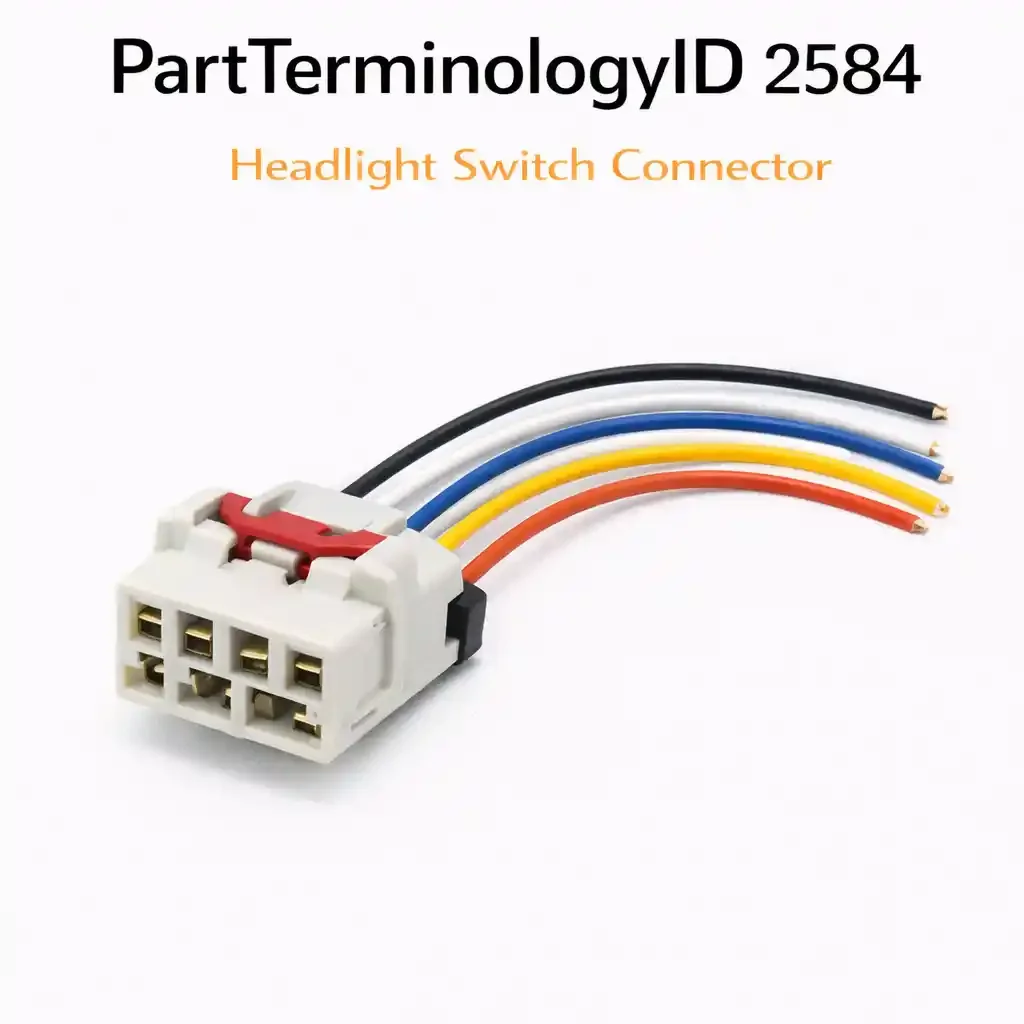
PartTerminologyID 2584, Headlight Switch Connector, is the wiring harness connector body that mates with the headlight switch assembly, providing the electrical interface between the vehicle's main lighting harness and the switch terminals that distribute battery power to the headlamp circuit, the parking lamp circuit, the instrument panel illumination circuit, and on applications with an integrated rheostat, the variable voltage output that dims dashboard lighting as the driver rotates the knob. That definition covers the function correctly. It does not specify the terminal count, which ranges from five to thirteen terminals depending on whether the switch controls only headlamps and parking lights or also integrates instrument dimming, dome light control, fog lamp activation, daytime running light circuits, and on body-control-module-governed architectures a resistance-multiplexed signal rather than direct circuit switching. It does not specify the current rating of the headlamp power and ground terminals, which on applications that route the full headlamp load current through the switch itself rather than through a relay must be rated for 15 to 30 amperes of continuous load from a four-lamp halogen system. It does not specify the circuit function at each terminal cavity, which on a seven-terminal application differs completely from a thirteen-terminal application even when the two connector bodies share an identical housing profile and latch geometry. It does not specify the switch generation, which on multifunction column stalk assemblies changed multiple times within single vehicle nameplates and produced connector bodies that mate physically but assign terminal functions differently. It does not specify whether the listing is a connector body only or a pigtail assembly. A listing under PartTerminologyID 2584 that provides vehicle year, make, and model without terminal count and circuit function assignment cannot be evaluated by any technician replacing a burned, melted, or mechanically damaged headlight switch connector whose original was destroyed in a thermal event that obliterated the terminal position markings.
For sellers, PartTerminologyID 2584 is the connector PartTerminologyID where the two most visible failure modes in field returns are thermal overload from inadequate current rating and phantom circuit failures from terminal position mismatches across switch generations. The thermal overload mode follows directly from the circuit architecture of applications that route headlamp load current through the switch itself. A vehicle with four 55-watt halogen headlamps draws approximately 18 amperes at 12 volts through the headlamp circuit. On a relay-controlled system, the switch carries only the relay coil activation current of 200 to 300 milliamps. On a direct-switched system, the switch and its connector carry the full 18-ampere headlamp load every mile driven at night. A connector terminal rated for 10 amperes continuous in a direct-switched 18-ampere circuit begins generating resistive heat on the first evening drive and accumulates thermal degradation on every subsequent night drive until the contact resistance at the terminal rises to the point of a melt event, proceeding exactly as described for the headlight socket connector at PartTerminologyID 2580 but at the switch end of the circuit rather than at the bulb end.
The generation mismatch failure mode is specific to multifunction column stalk switches and to headlight switch modules that were redesigned within a single vehicle platform's production run without changing the connector body's external profile. On these applications, the replacement connector physically seats correctly, the latch engages, and the technician confirms the repair visually. On the first drive with headlights on, some circuits work and others do not. The dome light activates continuously. The parking lights energize when the switch is in the headlamp-on position rather than the parking-lamp position. The instrument dimmer rheostat produces no response regardless of knob position. Each symptom corresponds to a terminal position transposition between generations: a terminal carrying the parking light feed in the earlier generation's cavity assignment now connects to the dome light circuit in the later generation's assignment. Prevention requires specifying the switch generation designation as a mandatory attribute in every PartTerminologyID 2584 listing, not only the vehicle year, because multiple generations often fall within the same model year range on the vehicle application table.
What the Headlight Switch Connector Does
Distributing battery power to multiple lighting circuits simultaneously
The headlight switch is not a single-circuit switch. Even on the simplest application, the headlight switch manages at minimum two separate power distribution circuits that activate in different combinations at different switch positions: the headlamp circuit that energizes front headlights and rear taillights, and the parking lamp circuit that energizes only the parking, side marker, and taillight circuits without the headlamps. On applications with instrument panel dimming, the switch also distributes a variable voltage output from an integrated rheostat to the instrument cluster lighting, which dims from full brightness to nearly off as the driver rotates the knob through its range. On applications with dome light control, the switch carries a third switched circuit that activates interior lighting when the switch is rotated to its leftmost position, independent of the headlight and parking lamp circuits.
The terminal count of the connector reflects the number of circuits the switch manages simultaneously. A five-terminal connector typically covers a battery power input, a headlamp output, a parking lamp output, an instrument illumination output, and a ground return. A seven-terminal connector typically adds a separate dome light circuit and may split the headlamp output into a controlled feed that goes to the dimmer switch downstream and a second feed that carries the battery input from the fuse panel on a separately routed circuit. A thirteen-terminal connector, documented on the Chrysler minivan application where the headlamp switch assembly integrates fog lamp control, automatic headlamp activation, and body control module communication, carries circuits at every position including resistance-value-encoded signals that the BCM reads to determine switch position rather than receiving direct switched power on individual wires. Installing a five-terminal pigtail on a thirteen-terminal switch leaves eight circuits unconnected, producing a no-function condition for every circuit whose terminal cavity was among the eight unconnected positions. Headlamps may function if the headlamp feed terminal happens to be among the five connected cavities. All other circuits will not.
Carrying headlamp load current on direct-switched applications
The headlight switch connector's most demanding electrical requirement is on direct-switched applications where the full headlamp load current travels from the battery through the switch contacts and switch connector to the dimmer switch downstream or directly to the headlamps. On these applications, common on vehicles produced before the widespread adoption of relay-isolated headlamp circuits in the late 1990s and 2000s, the switch contacts experience arc erosion on every switching event and the connector terminals carry the full continuous load current on every mile driven at night.
The GM full-size truck and large SUV platforms of the mid-1990s through early 2000s have documented histories of headlight switch connector thermal events caused by this architecture. The headlamp switch connector on these applications routes 15 to 20 amperes of continuous headlamp current through the switch housing and its connector terminals. When the switch contacts begin to arc from years of repeated switching events, the contact resistance at the switch terminals increases, producing heating at the terminal-connector interface. The softened connector body reduces terminal retention force, which increases contact resistance further, which accelerates heating in the runaway cycle that produces the burned connector the technician finds. The replacement connector's current rating is the specification that determines whether this cycle repeats after the repair. A replacement rated for 10 amperes installed in a direct-switched 20-ampere circuit reproduces the melt event within months of the first sustained nighttime driving season.
The current rating distinction between relay-controlled and direct-switched architectures cannot be inferred from the vehicle year, make, and model alone. Both architectures coexist across the same vehicle platform ranges in many cases, with relay-controlled headlamp circuits present on higher trim levels that added automatic headlamp control while lower trim levels retained the direct-switched architecture on the same model year. The connector body may be physically identical between trim levels while the current load differs by a factor of 100 between the relay coil circuit and the direct lamp current. The current rating of the headlamp power and ground terminals must be specified explicitly, with the notation that direct-switched applications require a minimum of 20 amperes and that relay-controlled applications where only the coil current passes through the switch can use 10-ampere-rated terminals.
The rheostat output and its role in circuit function assignment
The instrument panel dimming rheostat integrated into the headlight switch assembly adds a terminal function that operates differently from every other terminal in the connector body. Every standard lighting circuit terminal carries either a switched battery positive, an output to a lamp, or a chassis ground. The rheostat output terminal carries a voltage that varies continuously between approximately battery voltage and approximately zero as the driver rotates the rheostat from full bright to full dim. This variable voltage must connect to the correct terminal cavity in the instrument cluster's illumination input circuit to produce proportional dimming response.
On applications where the rheostat output terminal is transposed with a fixed switched-positive terminal because a generation mismatch shifted the cavity assignments, the instrument cluster illumination comes on at full brightness whenever the headlights are on and cannot be dimmed regardless of knob position. This is operationally annoying but not a safety fault, and many technicians who observe this symptom after a connector replacement assume the rheostat element inside the switch has failed rather than investigating the terminal position assignment in the connector body. On applications where the rheostat output terminal is transposed with a chassis ground terminal, the instrument cluster illumination circuit shorts to ground through the rheostat element whenever the headlights are switched on, blowing the instrument cluster illumination fuse and disabling all cluster lighting simultaneously. The fuse replacement does not resolve the fault because the misrouted terminal continues to apply the cluster illumination supply to the rheostat's ground-referenced output on every headlight activation.
Preventing both outcomes requires specifying the rheostat output terminal's cavity position number in the listing, confirming that the cavity position matches the switch assembly in the vehicle rather than the switch assembly from a different production period within the same model year range, and noting that this terminal function differs from every other terminal in the connector in that it carries a continuously variable voltage rather than a switched positive or a ground.
Switch Generation: The Specification That Prevents Phantom Circuit Failures
Vehicle manufacturers updated headlight switch designs multiple times within single platform production runs, typically when adding features such as daytime running lamp control, automatic headlamp leveling, fog lamp integration, or body control module communication. When the switch design changed, the connector body's external dimensions and latch geometry sometimes remained identical to the previous design's connector body while the terminal position assignments were rearranged or supplemented to accommodate the new circuit functions. The result is a connector body that physically mates with either generation's switch assembly but assigns terminal functions differently on each.
The late-1990s through mid-2000s GM full-size truck and SUV platform illustrates this pattern precisely. The platform used a similar headlight switch connector body profile across multiple model years, but the terminal count and circuit assignments changed when the platform transitioned from a carryover direct-control architecture to a BCM-integrated architecture in the early 2000s. A technician replacing a headlight switch connector on a 2001 Sierra with a pigtail cataloged for a 1998 Sierra receives a connector that seats correctly, locks correctly, and appears correct. When the headlights are turned on for the first time, the dome lamp activates. The instrument dimmer produces no response. The parking lamps activate in the headlamp-on position rather than in the parking-lamp-only position. Each symptom corresponds to the terminal position difference between the two generations. The vehicle year alone does not resolve the generation assignment: both years fall within a production range that shares the same external connector body profile, and the only reliable distinguishing attribute is the switch assembly's OEM part number or the platform's design change cutoff date.
The Chrysler minivan platform of the mid-2000s shows the same pattern at the thirteen-terminal scale. The headlamp switch on this platform integrates fog lamp control, daytime running lamp status, automatic headlamp on/off sensing, and BCM-communication resistance encoding in a thirteen-terminal connector assembly. An earlier five-terminal replacement from the pre-BCM-integration generation of the same nameplate will physically seat on the switch flange and engage the first five terminal cavities out of thirteen. The headlamps will function if those first five cavities include the headlamp feed. The fog lamps, automatic headlamp control, BCM communication, and instrument dimming will all fail because their cavities are among the eight that the five-terminal pigtail does not reach.
For sellers, the switch generation must appear in the listing as a mandatory secondary attribute whenever the vehicle application table spans a production range where the switch design changed. The generation designation, which is typically a part number suffix, a date-of-introduction code available from OEM service documentation, or the designation of the specific platform variant (pre-BCM integration versus BCM-integrated), enables the buyer to confirm before ordering that the pigtail's terminal assignments match the switch assembly in the vehicle rather than a switch assembly from a different production period that happens to share the same connector body profile.
Top Five Return Scenarios for PartTerminologyID 2584
Return Scenario 1: Five-terminal pigtail on a seven- or thirteen-terminal switch, multiple circuits non-functional after installation
The buyer selects a headlight switch connector based on vehicle year, make, and model. The listing does not specify the terminal count. The vehicle has an integrated fog lamp and daytime running lamp switch with a thirteen-terminal connector. The replacement five-terminal pigtail seats partially on the switch flange, engages the five terminal cavities aligned with its terminal bodies, and leaves eight cavities unconnected. The headlamps function because the headlamp feed terminal happens to be among the five connected positions. The parking lights, instrument dimmer, fog lamps, and daytime running lamp circuits do not function because their terminal cavities fall among the eight unconnected positions. The buyer concludes the switch assembly itself is defective, returns it, installs another switch of the same part number, and observes the same result because the connector pigtail, not the switch, is the fault. Prevention requires specifying the total terminal count as the first mandatory attribute in every PartTerminologyID 2584 listing, with the individual circuit function assignment at each cavity position specified as a mandatory secondary attribute.
Return Scenario 2: Replacement connector body only on a switch with burned terminals and heat-damaged pigtail wire from a direct-switched high-current melt event
The buyer replaces a burned headlight switch connector body on a direct-switched application where the melt event transferred heat back along the headlamp power wire approximately three inches behind the terminal face. The replacement connector body is installed with the existing wiring. The terminal contact faces are clean and the contact resistance is acceptable at installation. Within two months of nighttime driving, the heat-damaged conductor at the heat-affected zone on the original wire introduces increasing resistance in the headlamp power circuit, and the heating cycle resumes at the new connector body's terminal cavity from the wire side rather than the terminal face. The buyer returns the connector body as defective after the second melt event. Prevention requires offering the pigtail assembly as the primary recommendation for any headlight switch connector replacement following a confirmed thermal event, with explicit notation that the pigtail length must be sufficient to clear any heat-affected conductor on the original harness, which on severely burned applications may require a splice point six or more inches behind the original connector body position.
Return Scenario 3: Correct terminal count but wrong switch generation, dome light on continuously and instrument dimmer non-functional
The buyer selects a seven-terminal headlight switch pigtail for a mid-production GM full-size truck. The listing specifies the terminal count correctly but does not specify the switch generation. The pigtail is cataloged for the earlier generation of that terminal count but the vehicle has the later-generation switch assembly where the terminal position assignments were rearranged. The connector seats and latches. The headlamps, parking lights, and high-beam circuits all function. The instrument panel dimmer does not respond to knob rotation. The dome light activates when the switch is in the parking-lamp position rather than the dome-light-selector position. Both symptoms correspond to the rheostat output terminal being transposed with the dome light circuit terminal between the two generations in the applicable cavity positions. The buyer concludes the replacement switch assembly is defective rather than the connector. The second switch produces the same symptom pattern because the connector's generation mismatch is the fault in both cases. Prevention requires specifying the switch generation designation or the applicable OEM part number suffix as a mandatory secondary attribute on all listings where the production run contains a mid-cycle terminal assignment change.
Return Scenario 4: Ten-ampere-rated pigtail on a direct-switched 18-ampere headlamp application, progressive melt over first driving season
The buyer replaces a headlight switch connector on a direct-switched application. The replacement pigtail's terminal bodies are rated for 10 amperes continuous, which is the appropriate rating for relay-controlled headlamp circuits where the switch carries only the relay coil activation current. On this direct-switched application, the headlamp power terminal carries 18 amperes continuously during all nighttime driving. The terminals run 30 to 50 degrees Celsius above the connector body's ambient temperature on every nighttime drive because the contact resistance at 10-ampere-rated terminals is inadequate for the sustained 18-ampere load. Over the first driving season, the connector body softens at the headlamp power terminal cavity, the terminal retention force decreases, contact resistance rises, and the melt event reproduces the original failure. The buyer returns the replacement pigtail as defective after four months of service. Prevention requires specifying the current rating of the headlamp power and ground terminals as a mandatory attribute, distinguishing relay-controlled applications where 10 amperes is adequate from direct-switched applications where 20 to 30 amperes is required, and making this distinction visible in the listing description rather than buried in a technical specification table that most buyers do not read before ordering.
Return Scenario 5: Connector body only on a column stalk switch with a cracked mating latch boss from the original connector removal
The buyer replaces only the headlight switch connector body after the original's locking tab was broken during removal of the column shroud. The replacement connector body has an intact locking tab and the correct terminal count and generation assignment. After installation, the connector body seats but produces intermittent headlamp loss and partial circuit failures over bumps and vibration while driving. The technician rechecks the installation and confirms the connector body is correctly engaged. The fault is that the switch assembly's mating latch boss is cracked from the same mechanical event that broke the original connector body's locking tab. The replacement connector body cannot achieve full engagement force against the cracked latch boss, and the connector rocks under vibration just enough to intermittently break contact at one or more terminal positions. The connector body is correct. The switch assembly requires replacement. Prevention requires noting in the product description that headlight switch connector replacement should include an inspection of the switch assembly's mating latch boss and connector flange before ordering the connector body only, because the mechanical event that breaks a connector's locking tab often damages the mating surface on the switch body simultaneously, and a replacement connector body will produce intermittent failures on a switch assembly whose mating surface is cracked or deformed.
Specification Attributes Required for PartTerminologyID 2584 Listings
Terminal count: The total number of terminal cavities in the connector body, which must match the switch assembly's total terminal pin count exactly. Not the number of wires on the pigtail, which may be fewer than the total cavity count if some positions are unoccupied on certain trim configurations. The terminal count is the first mandatory attribute for preventing the partial-engagement failure that leaves multiple circuits unconnected.
Circuit function at each cavity position: The specific circuit each numbered cavity carries: headlamp power input from the battery or fuse panel, headlamp output to the dimmer switch or lamp circuit, parking lamp output, instrument dimmer rheostat output, dome light output, high-beam control feed, relay coil activation signal, BCM multiplexed signal, or any additional circuits present on the specific application. This attribute is mandatory for preventing the generation mismatch failure and the terminal transposition that produces phantom circuit failures after a physically correct installation.
Current rating of headlamp power and ground terminals: The continuous amperage rating of the headlamp circuit terminals, specified separately from the accessory and signal circuit terminals. 20 to 30 amperes minimum for direct-switched headlamp applications. 10 amperes acceptable for relay-controlled applications where only coil current passes through the switch. This distinction must appear in the listing because the connector bodies may be physically identical between relay-controlled and direct-switched applications on the same vehicle platform.
Switch generation designation: The design revision, part number suffix, or date-of-introduction range the connector is designed for, on all applications where a mid-production terminal assignment change occurred. This attribute enables the buyer to confirm the terminal assignments match the switch assembly in the vehicle before ordering, rather than discovering the mismatch after installation and testing.
Connector body housing series and latch design: The series designation identifying the external connector profile, latch geometry, and mating surface compatibility for the switch assembly's connector flange. Mandatory for preventing the physical-fit confirmation failure where a connector from an adjacent series appears to seat but does not achieve the full engagement depth required for reliable terminal contact under vibration.
Wire gauge per terminal on pigtail assemblies: Headlamp power and ground wires at 14-gauge minimum on direct-switched applications to provide adequate thermal mass for heat removal from the terminal junction in addition to adequate current capacity. Rheostat output and low-current accessory circuit wires at 18 gauge. Signal circuit wires at 18 to 20 gauge. Each wire gauge must be specified per terminal circuit, not as a single value for the entire pigtail assembly, because mixed gauges in a single pigtail are normal and correct on headlight switch applications.
Pigtail length: Minimum 12 inches for all headlight switch connector pigtail assemblies, to ensure the splice point falls inside the wiring harness loom and past any heat-affected zone on the original harness conductor following a thermal event at the original connector position.
Cross-Sell Logic
Headlight Switch Assembly: On applications where the connector failure was caused by a thermal event from arc erosion at the switch contacts on a direct-switched headlamp circuit, the switch contacts themselves have experienced the same resistive heating that damaged the connector. Replacing only the connector on a switch with eroded contacts restores the connector to new condition while leaving a high-resistance contact inside the switch that will begin heating the new connector's terminals from the switch side rather than the terminal face side. Both the connector and the switch assembly should be replaced at the same service event on any confirmed direct-switched thermal failure to prevent the heating cycle from resuming through a different path in the circuit.
Relay Harness Kit: On direct-switched headlamp applications where the switch carries 15 to 20 amperes of continuous load current and the failure pattern has produced two or more consecutive melt events, a relay harness kit resolves the root cause by routing the headlamp load current through a relay whose contacts handle the lamp current from a direct battery connection, while reducing the current passing through the switch to the relay coil activation level of 200 to 300 milliamps. The new switch and connector after a relay harness installation see a current load reduction of approximately 100 to 1. Frame as: installing a relay harness kit at the same service event as the connector and switch replacement eliminates the thermal environment that caused the original failure, rather than installing new components into a circuit architecture that will recreate the same failure on the next set of replacement parts.
Instrument Cluster Illumination Fuse: On applications where a terminal generation mismatch was installed and operated for any period with the rheostat output transposed with a ground or a battery positive, inspect the instrument cluster illumination fuse before concluding the connector installation resolved the symptom. If the fuse was blown during the period of mislabeled terminal operation, the cluster illumination will remain dark after the correct connector is installed until the fuse is replaced.
Final Take for PartTerminologyID 2584
Headlight Switch Connector (PartTerminologyID 2584) is the connector PartTerminologyID in this series where the terminal count variation is the widest in the entire catalog, ranging from five to thirteen terminals across applications, and where a physically correct seat and latch engagement provides zero assurance that the terminal function assignments match the switch assembly the connector is installed on. The thermal failure mode from direct-switched high current is shared with the headlight socket connector at PartTerminologyID 2580, but the generation mismatch failure mode is unique to 2584 among lighting connectors and produces symptom patterns that technicians systematically attribute to the switch assembly rather than the connector, generating replacement switch warranty returns that the switch assembly does not deserve.
State the terminal count as the first mandatory attribute. State the circuit function at each cavity position. State the current rating of the headlamp terminals with explicit distinction between direct-switched and relay-controlled architectures. State the switch generation designation on all applications with mid-production terminal assignment changes. State the wire gauge per headlamp circuit terminal on pigtail assemblies.
Those five attributes allow the buyer to select a connector that delivers the correct circuit function at each switch terminal position, survives the thermal environment of a direct-switched headlamp circuit through a full nighttime driving season, and does not produce the phantom partial-function failures that arrive as switch assembly returns on a switch the catalog team never should have suspected.