
Written by Arthur Simitian | PartsAdvisory
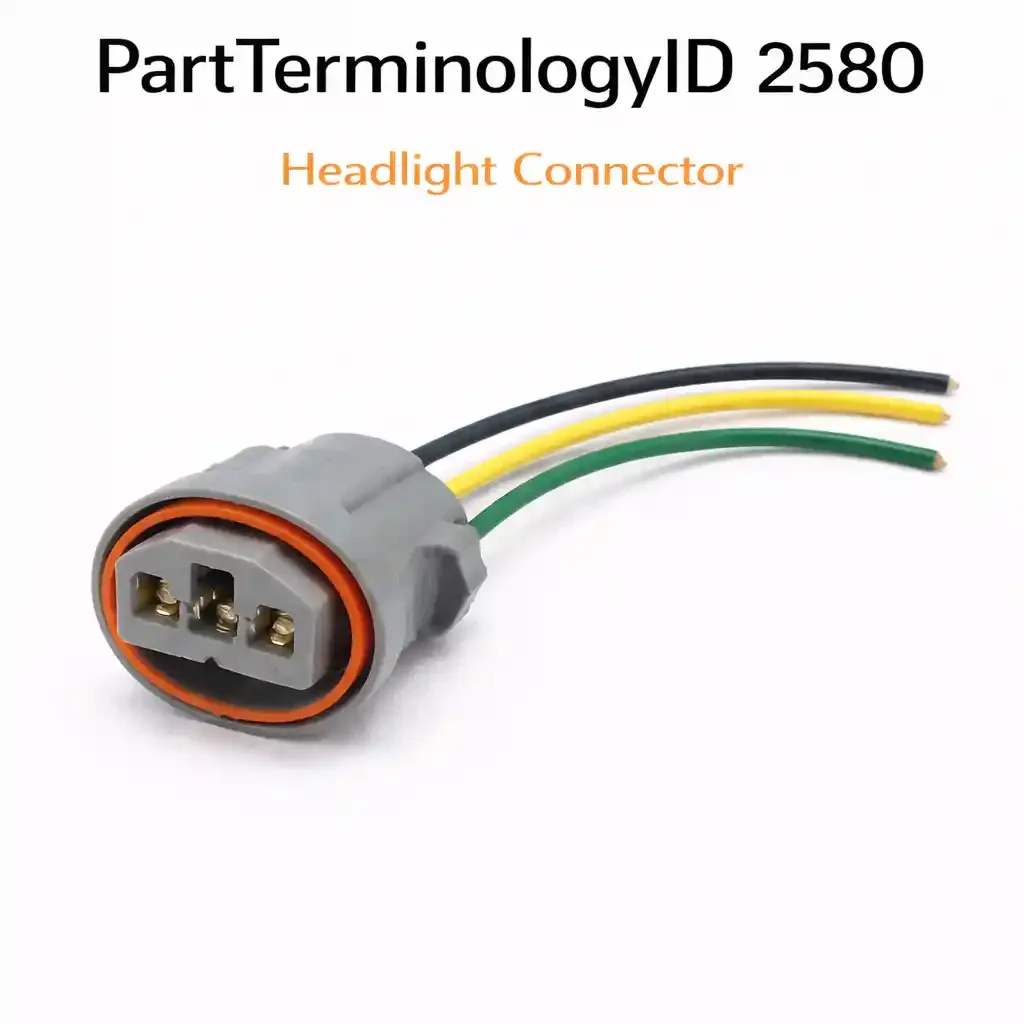
PartTerminologyID 2580, Headlight Connector, is the wiring harness connector body that mates with the headlight bulb base, providing the electrical interface between the vehicle's headlight wiring harness and the bulb's terminal pins, and on dual-filament applications simultaneously energizing whichever filament the lighting control switch has selected while holding the other filament's circuit at ground. That definition covers the function correctly. It does not specify the bulb type designation, which determines whether the connector body is a two-terminal single-filament design for H7, H11, 9005, or 9006 applications, or a three-terminal dual-filament design for H4 and 9003 applications where the third terminal is the shared chassis ground that completes whichever filament circuit the headlight switch has activated, the connector housing temperature rating, which is the single most consequential specification for a connector installed within approximately two inches of a halogen bulb operating at filament temperatures above 2,500 degrees Celsius and radiating heat into the connector body continuously whenever the headlights are on, the terminal material and plating, which determines the contact resistance at the bulb pin interface where the majority of resistive heating occurs in a connector that is failing toward a melt event, the switching architecture of the vehicle's headlight circuit, which on positive-switched systems routes a controlled positive voltage to the bulb terminal while the ground is a fixed chassis connection, but on negative-switched systems found on Toyota, Subaru, Mitsubishi, and other Japanese platforms routes a constant positive to the bulb while the headlight switch controls which ground circuit is activated, a distinction that determines the polarity sensitivity of the connector on LED conversion applications, the connector body housing series, the pigtail wire gauge relative to the bulb's rated wattage and operating current, and whether the listing covers the connector body only or a pigtail assembly. A listing under PartTerminologyID 2580 that provides vehicle year, make, and model without the bulb type designation cannot be evaluated by any technician replacing a melted, burned, or mechanically broken headlight connector at the headlight assembly where the connector operates at the highest thermal load of any lighting connector in the catalog.
For sellers, PartTerminologyID 2580 is the connector PartTerminologyID in this series with the most visible failure mode: the melted connector body. No technician misidentifies a headlight connector that has softened, distorted, or charred at the terminal face. The melt event is diagnostic in itself. A headlight connector fails by melting when the contact resistance at the terminal-to-bulb-pin interface rises to the point where the power dissipated by the resistance generates more heat than the connector body material can shed. At 5 amperes of current through a 55-watt halogen bulb, a contact resistance of 1 ohm generates 25 milliwatts, which is negligible. At 1 ohm of contact resistance and 5 amperes, this is accurate. But headlight connectors do not fail at 1 ohm. They fail after progressive corrosion, terminal fretting from vibration, or repeated thermal cycling loosens the terminal's grip on the bulb pin, raising contact resistance to 5 ohms, 10 ohms, or higher. At 5 ohms of contact resistance and 4.6 amperes through a 55-watt bulb at 12 volts, the power dissipated at the terminal is 105 milliwatts per terminal. That is not enough to melt a connector body in a single night. It is enough to raise the terminal temperature by 15 to 20 degrees Celsius above the already elevated ambient temperature inside a sealed headlight assembly enclosure, and to do so every time the headlights are on, for months, until the cumulative thermal degradation of the connector body softens the plastic housing and the terminal loses the mechanical constraint that held it against the bulb pin, the contact resistance rises further, and the heating rate accelerates into the runaway condition that produces the melted connector the technician finds.
The replacement connector's temperature rating and terminal material determine whether this cycle repeats. A replacement connector body rated for 85 degrees Celsius general underhood ambient temperature, installed at a bulb-adjacent location where the steady-state connector body temperature during night driving is already 90 to 100 degrees Celsius from radiant heat alone, begins its degradation on the first drive. A replacement connector body rated for 125 degrees Celsius minimum, with silver-plated or thicker copper-alloy terminals that maintain a lower contact resistance across a wider temperature range, restores the thermal margin that prevents the heating cycle from progressing to a melt event. The temperature rating of the replacement connector is not an upgrade specification. It is the baseline specification for survival in this operating environment.
What the Headlight Connector Does
Conducting continuous load current at the bulb's rated wattage
The headlight connector's primary function is continuous current conduction. Unlike sensors, switches, or control connectors elsewhere in the vehicle's wiring harness, the headlight connector carries the bulb's full operating current at all times the headlights are on. On a vehicle with H7 55-watt low-beam bulbs, the connector carries 4.6 amperes per bulb continuously. On a vehicle with 9005 65-watt high-beam bulbs, the connector carries 5.4 amperes. On an H4 dual-filament application with a 60-watt high beam and 55-watt low beam, the connector carries the active filament's current continuously while the inactive filament's terminal is held at the switching potential for that filament: either held at ground on a positive-switched system, or held at a constant positive on a negative-switched system.
These are not large currents by the standard of the fuel pump harness connector discussed in PartTerminologyID 2578, which can carry 15 amperes. But the headlight connector carries its 4 to 6 amperes in a thermal environment that no other connector in the vehicle occupies: within two inches of a halogen bulb that converts approximately 90 percent of its electrical input to heat, operating in an enclosed headlight assembly housing where that heat has limited paths for dissipation. The contact resistance requirement for the headlight connector is therefore more stringent than the contact resistance requirement for a fuel pump connector carrying three times the current in an open underhood environment, because the headlight connector's thermal environment multiplies the consequence of any given contact resistance value relative to ambient.
This is the reason headlight connectors melt and fuel pump connectors overheat by different mechanisms. The fuel pump connector overheats from high current through a connector body in a moderate thermal environment. The headlight connector melts from moderate current through a connector body in an extreme thermal environment, where the elevated ambient temperature inside the headlight assembly has already consumed the thermal margin that separates acceptable connector body temperature from the material's softening point. The replacement specification for the fuel pump connector is current rating. The replacement specification for the headlight connector is temperature rating.
The single-filament two-terminal design: H7, H11, 9005, 9006
Single-filament halogen bulbs, which include H7, H11 (and its electrical equivalents H8 and H9), 9005, and 9006, have two terminals on the bulb base: one power terminal and one ground terminal. The connector body for these applications has two terminal cavities in a housing profile specific to each bulb family. H7 and H11 look superficially similar but have different base profiles, different terminal pitch and spacing, and different locking tab geometry. A connector body designed for H11 will not engage the H7 bulb base correctly, and vice versa. The H11 and 9006 also look superficially similar but differ in the distance between their two terminal pins: closer together on H11, farther apart on 9006. H11 and 9006 connectors are not interchangeable despite being found in adjacent positions on the vehicle application lookup table.
The 9005 and 9006 are the dominant American-market single-filament pair, with 9005 used for high beam and 9006 used for low beam on vehicles that use separate bulbs for each function. Both are two-terminal single-filament designs with similar base profiles but different physical configurations that prevent cross-installation at the bulb. Their connectors, however, share similar pigtail body designs in many aftermarket pigtail kits, and terminal count alone does not prevent a 9005 connector from being offered on a 9006 application or vice versa. The bulb type designation, not just the terminal count, must be specified.
The dual-filament three-terminal design: H4 and 9003
H4 and 9003 are designations for the same dual-filament halogen bulb: 9003 is the SAE/North American designation and H4 is the ECE/international designation, and they share the same physical base, the same three-terminal connector profile, and the same 60-watt high beam and 55-watt low beam wattage ratings. The three terminals are the high-beam filament, the low-beam filament, and the shared chassis ground. The connector body has three terminal cavities at positions corresponding to these three functions.
On a standard positive-switched headlight system, the headlight switch routes a controlled 12-volt positive to whichever filament is selected while the ground terminal provides the return path for that filament's current. On a negative-switched headlight system, the wiring architecture is inverted: a constant 12-volt positive is supplied to both filament terminals simultaneously, and the headlight switch controls which of the two ground circuits is activated. When the low-beam ground circuit is activated, current flows through the low-beam filament and returns through the active ground path. The high-beam filament also has positive voltage at its terminal, but with no ground circuit activated for it, no current flows through it. When the high-beam switch is activated, the high-beam ground circuit is activated and the low-beam ground circuit is deactivated.
For a halogen H4 bulb, the polarity of the terminal assignment is irrelevant: the tungsten filament conducts current in either direction. A negative-switched vehicle can use the same connector body as a positive-switched vehicle because the halogen bulb does not distinguish between a switched positive and a switched ground at its terminal. This is why H4 and 9003 connectors do not specify switching architecture: the connector body works on both systems. The switching architecture specification becomes critical only when the owner replaces a halogen bulb with an H4 LED bulb, because LED emitters are polarity-sensitive. An H4 LED installed in a negative-switched vehicle receives constant positive at both filament terminals, which is the reverse of what the LED driver circuit expects. The LED does not illuminate correctly, the high and low beam functions may be swapped or non-functional, and the LED may be damaged. This is not a connector fault; it is a vehicle circuit architecture fault that requires a relay harness conversion to operate the LED correctly. The headlight connector listing that specifies switching architecture enables the buyer to identify this situation before purchasing, rather than discovering it after installation.
Housing Temperature Rating: The Specification That Determines Connector Survival
The connector body material's continuous-use temperature rating defines the maximum ambient temperature at which the connector body retains its dimensional stability, locking tab integrity, and terminal retention force over the connector's service life. When the connector body temperature exceeds the material's rated continuous-use temperature, the plastic softens progressively, the terminal cavities begin to deform, the terminal retention force that holds the terminal face against the bulb pin decreases, contact resistance rises because the terminal is no longer pressed with consistent force against the pin, resistive heating at the terminal increases, and the connector body temperature rises further in the runaway cycle that ends with a melted socket.
Standard general-purpose underhood connector body materials rated for 85 to 105 degrees Celsius continuous use are adequate for the majority of the vehicle's wiring harness locations, where the connector operates in underhood ambient air temperatures of 80 to 90 degrees Celsius on a hot day with the engine at operating temperature. They are not adequate for the headlight connector. The headlight assembly's interior environment during night driving on a warm day combines underhood ambient heat from the engine with radiant heat from the halogen bulb itself. The connector body, located at the rear of the headlight assembly within inches of the bulb's quartz envelope, experiences steady-state temperatures of 90 to 110 degrees Celsius during normal operation with a correctly functioning connector at OEM bulb wattage. The thermal margin between the connector body's operating temperature and an 85-degree-Celsius-rated material's softening point is, at best, zero on a hot night with both headlights running at full duty cycle on a vehicle with poor underhood ventilation.
A connector body rated for 125 degrees Celsius continuous use has a 15 to 35 degree Celsius margin above the connector's expected operating temperature in this environment. A connector body rated for 150 degrees Celsius has a margin of 40 to 60 degrees Celsius. Either rating is appropriate for a replacement headlight connector. An 85-degree-Celsius-rated replacement body is inappropriate regardless of whether it physically mates with the application's bulb base, because it will begin degrading from the first extended driving event.
This specification is the primary reason that headlight connector replacement events produce repeat failures. A technician replaces a melted headlight connector with the physically correct replacement available at the local parts counter. The replacement seats correctly, the headlight works on the test drive. Six to twelve months later the connector is melted again. The repeat failure is not caused by a flaw in the replacement installation or an electrical fault in the headlight circuit. It is caused by installing a connector body with an inadequate temperature rating into a thermal environment that the replacement's material cannot survive. The rating must appear in the catalog listing as a mandatory specification, not as a premium feature.
Terminal material and contact resistance at operating temperature
The terminal's material composition and plating determine the contact resistance at the terminal-to-bulb-pin interface across the connector's operating temperature range. Tin-plated copper terminals, which are the standard in general-purpose connector applications, perform adequately at room temperature but exhibit increasing contact resistance as the junction temperature rises. At the headlight connector's operating temperature of 90 to 110 degrees Celsius, a tin-plated terminal's contact resistance can be two to three times higher than its room-temperature value, which is the condition that initiates the resistive heating cycle that progresses to a melt event.
Silver-plated terminals maintain substantially more stable contact resistance across the temperature range relevant to headlight connector operation. Silver plating is visible on the terminal face as a brighter, slightly reflective contact surface compared to the matte tin plating on standard terminals. The specific recommendation documented in service literature for the Ford H11 headlight connector repair, which specifies silver-plated terminals and 14-gauge wire, exists precisely because the H11 bulb's contact design generates sufficient junction temperature to accelerate tin-plated terminal degradation on that application. The silver-plated terminal specification is not unique to Ford: it applies to any application where the combination of bulb wattage, connector body proximity to the bulb, and headlight assembly thermal environment pushes the terminal junction temperature into the range where tin plating's contact resistance becomes unstable.
The Wire Gauge and the OEM Under-Engineering Problem
The OEM headlight connector on many production vehicles from the 1990s and 2000s uses 18-gauge or 20-gauge wire in the headlight pigtail. Standard Motor Products' technical literature documents that the OEM wire gauge on these applications is "too small, typically 20 gauge, to handle the current drawn by the headlight bulbs," and that the original equipment under-engineering on these applications is the primary cause of the melted connector failure pattern that technicians see as a repeat service event across multiple makes and models.
The physics of why 18-gauge or 20-gauge wire contributes to connector melt events is not primarily that the wire itself overheats: 20-gauge wire has a resistance of approximately 33 milliohms per foot, and at 5 amperes carries a power loss of approximately 8 milliwatts per foot, which is insufficient to heat the wire insulation meaningfully on a 12-inch pigtail. The wire gauge's contribution to connector failure is thermal: thicker-gauge wire acts as a heat sink for the terminal, conducting heat away from the terminal junction and down the wire where it can dissipate into the harness loom. An 18-gauge or 20-gauge wire attached to a terminal operating at 100 degrees Celsius conducts less heat away from the terminal per unit time than a 14-gauge or 12-gauge wire attached to the same terminal at the same temperature. The terminal runs hotter for a given contact resistance when the wire gauge is inadequate than it does when the wire gauge provides adequate thermal mass for heat removal.
This means that the wire gauge specification for a headlight pigtail replacement interacts with the temperature rating of the connector body and the terminal material: a 125-degree-Celsius-rated connector body with silver-plated terminals and 14-gauge pigtail wire has substantially greater durability in this environment than the same connector body rated for 125 degrees Celsius with tin-plated terminals and 18-gauge wire. The catalog listing that specifies the pigtail wire gauge, in addition to the housing temperature rating and the terminal material, enables the buyer to select the replacement that addresses all three variables simultaneously rather than replacing the connector body alone while leaving the wire gauge and terminal material inadequate for the thermal environment.
Top Five Return Scenarios for PartTerminologyID 2580
Return Scenario 1: H11 connector body on an H11B application, or H11 on a 9006 application, based on visual similarity
The buyer selects a headlight connector based on the terminal count (two terminals, two-prong single-filament design) and the general visual profile, without identifying the specific bulb type designation. The H11 and H11B share no physical interchangeability despite their similar names: H11B uses a different base profile with a locking tab oriented differently from the H11, and the connector body for each will not seat correctly on the other's bulb base. Similarly, H11 and 9006 share a two-terminal single-filament design but differ in terminal pin spacing, and the connector designed for one will not engage the other's pins at the correct contact force. The buyer receives a connector that seats partially, wobbles in the headlight housing, and produces an intermittent contact that reproduces the lighting failure that prompted the replacement. Prevention requires specifying the bulb type designation, not just the terminal count, as the first mandatory attribute in every PartTerminologyID 2580 listing.
Return Scenario 2: 85-degree-Celsius-rated replacement connector body in a headlight assembly with a history of melt events
The buyer replaces a melted headlight connector with the available replacement at the local counter. The replacement physically seats on the application's bulb base. The headlight operates normally on the test drive and for the first three to six months of service. When the connector melts again, the buyer concludes that the failure is caused by an electrical fault in the vehicle's wiring and begins replacing the headlight relay and fuse, neither of which is the cause. The cause is a connector body rated for 85 degrees Celsius continuous use operating in a steady-state thermal environment of 100 degrees Celsius at the connector body. Prevention requires specifying the housing temperature rating as a mandatory attribute, with a minimum of 125 degrees Celsius for all headlight connector applications, and noting in the product description that a repeat melt event after replacement indicates a temperature rating failure rather than a wiring fault.
Return Scenario 3: Three-terminal H4 connector installed on a two-terminal H7 or H11 application
The buyer replaces a headlight connector on a vehicle with H7 single-filament low-beam bulbs. The listing does not specify the bulb type designation. The buyer selects a three-terminal H4 connector because H4 connectors are the most commonly stocked replacement and the three-terminal body physically contacts the H7 bulb base in a way that does not immediately signal a mismatch. The H4 connector's three terminals do not align with the H7 bulb's two terminal pins. One terminal cavity engages one bulb pin, the second terminal cavity engages no bulb pin or contacts the bulb's outer housing rather than the signal pin, and the third cavity is empty. The headlight may illuminate dimly from the partial contact, fail to illuminate at all, or illuminate only on one beam setting. The buyer returns the connector as defective because the headlight does not work after installation. Prevention requires specifying the bulb type designation in the title and primary attribute, so that the H4 and H7 application split is immediately visible without reading the vehicle fitment table.
Return Scenario 4: Connector body only on a pigtail with OEM 20-gauge wire and heat-damaged insulation at the original terminal junction
The buyer replaces a melted headlight connector body on an application where the melt event transferred heat back along the OEM 20-gauge pigtail wire approximately three to four inches behind the terminal face, degrading the wire insulation and partially oxidizing the copper conductor strands at the heat-affected zone. The new connector body is installed with the existing OEM wire pigtail. The terminal contact faces are clean and the contact resistance is within specification at installation. Within two to three months, the oxidized conductor strands at the heat-affected zone on the OEM wire increase the circuit resistance at that point, producing resistive heating that enters the new connector body's terminal cavity from the wire side rather than from the bulb pin contact face. The connector body temperature rises and the melt event recurs. The buyer returns the connector body as defective because the failure recurred after a correct installation using the original pigtail. Prevention requires offering the pigtail assembly as the primary recommendation whenever the replacement is for a confirmed melt event, specifying 14-gauge minimum wire and a minimum 12-inch pigtail length, so that the splice point is past any heat-affected conductor on the original wiring. The 12-inch pigtail length specification also provides thermal benefit: more wire mass behind the terminal provides greater heat-sink capacity, which is why published service guidance specifically instructs technicians not to shorten replacement headlight pigtail wires.
Return Scenario 5: Correct connector body on an LED-converted H4 application with a negative-switched vehicle circuit, producing swapped or non-functional beams
The buyer replaces a headlight connector on a Toyota or Subaru application that was previously converted to H4 LED bulbs. The replacement H4 three-terminal connector is physically correct for the application and seats correctly on the LED bulb's base. After installation, the low beam does not illuminate, the high beam illuminates when the switch is in the low-beam position, or neither function works correctly. The buyer returns the connector as defective. The connector is not defective. The vehicle uses a negative-switched headlight circuit in which the headlight switch controls ground activation rather than positive switching. The halogen H4 bulb the previous owner removed was polarity-insensitive and operated correctly on either switching architecture. The H4 LED replacement is polarity-sensitive and requires the standard positive-switched connection convention to operate correctly. The connector body cannot resolve this mismatch. Prevention requires specifying the vehicle's switching architecture in the listing and noting that H4 LED conversions on negative-switched Toyota, Subaru, Mitsubishi, and similar applications require a relay harness conversion in addition to the connector replacement, and that the connector itself is not the source of the beam function error.
Specification Attributes Required for PartTerminologyID 2580 Listings
Bulb type designation: The specific bulb family the connector is designed for: H4/9003, H7, H11, H11B, 9005, 9006, or equivalent. This is the primary attribute distinguishing connector profiles that are not physically interchangeable, and it must appear in the listing title and first attribute position, not only in the vehicle fitment table.
Terminal count: Two terminals for single-filament applications (H7, H11, 9005, 9006). Three terminals for dual-filament applications (H4/9003). The terminal count must match the bulb base's terminal pin count precisely.
Terminal position assignment: High beam, low beam, and ground on H4/9003. Power and ground on single-filament applications. Mandatory for preventing the terminal transposition that produces swapped or absent beam functions.
Housing temperature rating: Minimum 125 degrees Celsius continuous use for all headlight connector applications. 150 degrees Celsius preferred for applications with a documented history of repeat melt events. This specification must appear in the listing as a primary attribute, not as a note or feature descriptor.
Terminal material and plating: Silver-plated terminals for applications with a documented history of terminal-face overheating and melt events. Tin-plated terminals are acceptable only in conjunction with an adequately rated connector body and adequate pigtail wire gauge.
Connector body housing series: The series designation identifying the physical connector family, terminal pitch, locking tab geometry, and mating profile for the specific bulb base design.
Wire gauge per terminal on pigtail assemblies: 14-gauge minimum for all headlight power and ground circuits on pigtail assemblies. 18-gauge is insufficient for the thermal environment even when the connector body temperature rating is adequate. The pigtail length must be specified as a minimum value, not a maximum: a longer pigtail provides more heat-sink mass and must not be shortened by the installer.
Switching architecture notation where applicable: Positive-switched or negative-switched notation on H4/9003 applications to enable the buyer to identify LED conversion compatibility requirements before purchasing.
Cross-Sell Logic
Headlight Bulb: When a headlight connector melts, it is rarely an isolated “plastic-only” failure. The heat that deforms the connector body also cooks the metal-to-metal interface between the bulb pins and the terminal tangs inside the connector. Even if the bulb still turns on, its terminal pins were sitting in the same high-temperature zone that caused the original failure. That exposure can leave the pin faces with light pitting, discoloration, or a thin oxide layer that you may not notice by eye but that matters electrically.
Here is why that matters on the next install. A new connector has clean terminals with a specific spring tension and contact geometry. If you push that new terminal onto an aged, heat-stressed bulb pin, the contact can start its life with higher-than-expected resistance. Resistance at the interface creates heat, heat increases resistance, and the cycle repeats. This is one of the most common reasons you see a “repeat melt” event after what looks like a technically correct connector replacement. The installer did the connector right, but the bulb pins were already compromised, so the new connector was forced to carry current across a degraded mating surface.
Replacing the bulb during the same service event solves this at the source. A new bulb provides clean, uniform pin faces that match the new connector’s terminal design, which restores the low-resistance contact the circuit needs. It also reduces variability. The technician does not have to gamble on cleaning techniques, sanding, or “it looks fine,” which are inconsistent and can remove plating or change the pin profile. In practical terms, a bulb replacement is a low-cost add that protects the new connector, reduces comeback risk, and increases customer trust because the repair feels complete instead of partial.
From a catalog and merchandising standpoint, this cross-sell should be presented as a reliability step, not an upsell. The logic is simple: if heat was high enough to melt the connector, the bulb pins were exposed to the same environment, and the safest way to reset the contact interface is to replace both mating components at once. This is especially important on higher wattage halogen circuits, older vehicles with higher harness resistance, and any application where the connector shows browning, brittle insulation, or evidence of arcing at the terminal entry points.
Headlight Assembly: On applications where the melt event was severe enough to deposit carbonized plastic debris inside the headlight assembly housing or to distort the reflector mounting in the vicinity of the connector access port, inspect the interior of the assembly for contamination before installing the new connector and bulb. Carbon deposits on the reflector surface reduce light output and cannot be cleaned without disassembling the sealed assembly. If the assembly is damaged internally, replacement is warranted at the same service event rather than installing a new connector and bulb into a compromised housing.
Relay Harness Kit: On applications where the OEM headlight circuit routes the full bulb current through the lighting control stalk switch contacts, rather than routing stalk switch output through a relay that handles the bulb current, the stalk switch contacts carry the same 4 to 6 amperes that the connector carries. Switch contact wear from repeated high-current switching produces the same progressive resistance increase that degrades the connector terminal. A relay harness kit inserts a relay between the headlight switch and the bulb, routing the switch output through a low-current relay coil circuit while the relay contacts handle the bulb current from a direct battery connection. This reduces the current load on the switch contacts to the relay coil's 200 milliamp activation current, eliminating switch contact wear as a contributor to the voltage drop and resistive heating cycle. Frame as: "If you are installing a replacement headlight connector on an application with a history of repeated melt events, and the vehicle routes headlight current through the lighting stalk switch rather than through a relay, the relay harness kit should be installed at the same time. The connector can only survive in this environment if the total circuit resistance from the fuse to the bulb is low. A degraded switch contact upstream of the connector contributes resistance that the new connector will inherit and will accelerate the same failure."
Final Take for PartTerminologyID 2580
Headlight Connector (PartTerminologyID 2580) is the connector PartTerminologyID in this series with the most physically obvious failure mode, the most documented repeat failure pattern, and the most specific, actionable replacement specification that prevents the repeat failure from recurring. No other PartTerminologyID in this catalog generates more service events from a single root cause: an inadequate connector body temperature rating installed in a thermal environment that exceeds the material's continuous-use rating within the first season of service.
The bulb type designation is the attribute that prevents the H11 connector from being installed on an H11B bulb, the H11 connector from being installed on a 9006 bulb, and the H4 three-terminal connector from being installed on an H7 two-terminal application. The housing temperature rating is the attribute that prevents the repeat melt event that converts a technically correct connector replacement into a warranty return six months after installation. The terminal material specification is the attribute that prevents the contact resistance escalation that initiates the heating cycle even when the connector body temperature rating is adequate. The pigtail wire gauge specification is the attribute that determines whether the wire behind the terminal acts as a heat sink or as thermal insulation that concentrates heat at the terminal junction.
State the bulb type designation as the first mandatory attribute in the listing title. State the housing temperature rating as a primary specification with a minimum of 125 degrees Celsius. State the terminal material. State the pigtail wire gauge as 14-gauge minimum for all headlight applications. Include the note that pigtail wire should not be shortened by the installer because the full wire length provides thermal benefit in addition to reach. Include the note for H4/9003 applications whether the application uses a positive-switched or negative-switched headlight circuit for buyers converting to LED.
Those are the specification attributes that allow the buyer to select a replacement that survives the headlight assembly's thermal environment, restores full filament voltage, and does not return to the shelf in six months with a melt pattern identical to the connector it replaced.