
Fuel Pump Harness Connector (PartTerminologyID 2578): Terminal Count, Current Rating, Fuel Vapor Sealing, and Sender Circuit Integration
Written by Arthur Simitian | PartsAdvisory
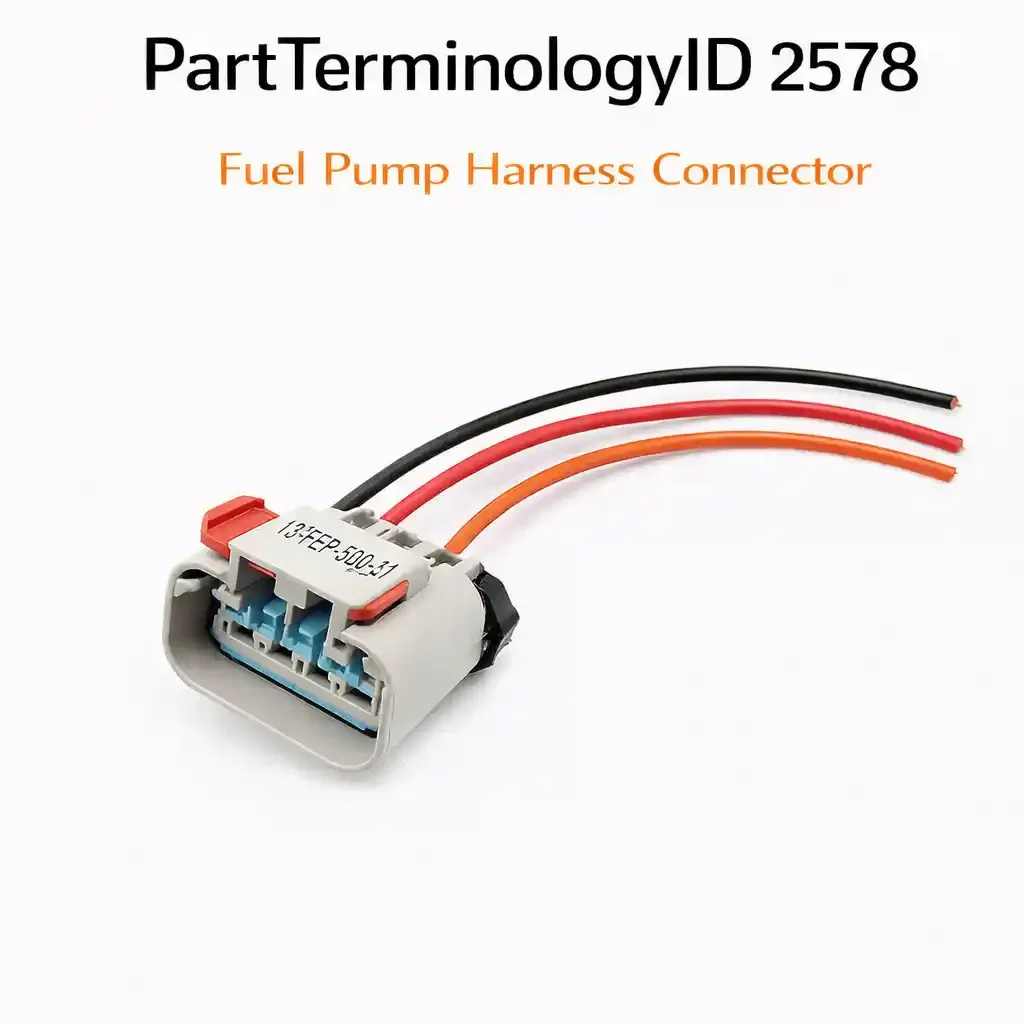
PartTerminologyID 2578, Fuel Pump Harness Connector, is the wiring harness connector body that mates with the fuel pump module assembly, providing the electrical interface between the vehicle's main wiring harness and the in-tank fuel pump motor terminals, and on most applications from the mid-1980s onward also the fuel level sender circuit that drives the instrument cluster fuel gauge. That definition covers the function correctly. It does not specify the terminal count, which is two terminals on older designs where a separate connector handles the fuel level sender and the pump motor receives only a power supply and a ground return, three or four terminals on the dominant combined design where the pump power, pump ground, fuel level sender signal, and on many applications a sender reference or second sender ground occupy a single connector body, five or six terminals on applications with dual sending units, an evaporative emissions pressure sensor, or a fuel pump control module signal integrated into the tank assembly connector, the current rating of the power and ground terminals appropriate to the pump motor's continuous operating amperage, which on a stock replacement in-tank pump is typically 4 to 8 amperes at operating voltage but can reach 12 to 15 amperes at cold start on a low battery with high-resistance fuel, the fuel vapor sealing design of the connector body and terminal seals, which must exclude fuel vapor permeation from the tank access area that causes terminal oxidation distinct from external moisture corrosion, the connector body housing series, the pigtail wire gauge appropriate to the pump current load and the sender signal circuit's different gauge requirement, and whether the listing covers the connector body only or a pigtail assembly. A listing under PartTerminologyID 2578 that provides vehicle year, make, and model without the terminal count and the circuit function assignment at each position cannot be evaluated by any technician replacing a burned, corroded, or mechanically damaged fuel pump connector at the tank access panel, frame-rail pump location, or in-tank module flange that is the connector's operating environment.
For sellers, PartTerminologyID 2578 is the connector PartTerminologyID in this series where two separate, independent failure modes produce two completely different customer complaints that are both attributable to the same connector. Failure at the power or ground terminals, which carry the pump motor's continuous operating current, produces a no-start or stalling complaint: the engine cranks but does not fire, or runs normally until the pump loses voltage under load and fuel pressure drops below the injector opening threshold. Failure at the fuel level sender signal terminal, which carries a millivolt-level variable resistance signal from the float arm potentiometer to the instrument cluster, produces a fuel gauge complaint: the gauge reads empty on a full tank, pegs full regardless of level, fluctuates erratically, or drops to zero at operating temperature when thermal expansion opens a marginal terminal contact. A technician diagnosing a no-start will test the pump power circuit and, if the power terminal contact is degraded, may replace the fuel pump before identifying the connector as the cause. A technician diagnosing a fuel gauge complaint will test the sender resistance and, if the sender signal terminal contact is intermittent, may replace the fuel pump assembly with integrated sender before identifying the connector as the cause. Both failure modes result in a correct component being replaced into a defective connector that reproduces the fault immediately after installation.
The additional complexity specific to PartTerminologyID 2578 is the combined circuit architecture present on virtually all applications from approximately 1986 onward, where a single connector body carries circuits with fundamentally different electrical characteristics in adjacent terminal cavities. The pump power terminal carries up to 15 amperes of intermittent high-current load and must maintain a contact resistance below 0.1 ohms to avoid voltage drop that degrades pump performance. The sender signal terminal adjacent to it carries a variable resistance signal between approximately 20 and 180 ohms total sender resistance, where any contact resistance added by the connector terminal adds directly to the apparent sender resistance and shifts the fuel gauge reading. A connector with 5 ohms of contact resistance at the sender terminal will cause the gauge to read lower than actual across the entire range. On an empty-cold sender resistance of 180 ohms, 5 additional ohms is a 2.7 percent error, barely perceptible. On a full-hot sender resistance of 20 ohms, the same 5-ohm contact resistance represents a 25 percent error, reading substantially below the actual fuel level. This asymmetric error, worse at full tank than at empty tank, causes the owner to believe the gauge is inaccurate when the tank is full and the car was just fueled, while the gauge appears approximately correct when the tank is nearly empty.
For sellers, the listing under this PartTerminologyID is only useful if it specifies the terminal count, the circuit function at each cavity position, the current rating of the power and ground terminals, the fuel vapor sealing design of the connector body and terminal seals, the connector body housing series, the wire gauge per terminal distinguishing the pump circuit gauge from the sender circuit gauge, and whether the listing is a connector body only or a pigtail assembly. Without those attributes, the listing enables the terminal count mismatch that produces a connector that physically seats but leaves the sender circuit unconnected on a two-terminal replacement installed on a four-terminal application, the current rating mismatch that produces pump undervoltage at high load when a signal-rated connector is installed on the pump power circuit, and the fuel vapor permeation failure where a connector body without adequate vapor sealing develops progressive terminal oxidation from the inside out within a single season of tank access area exposure.
What the Fuel Pump Harness Connector Does
Delivering pump motor current on the power and ground terminals
The in-tank electric fuel pump is a DC brush motor drawing current continuously whenever the ignition is on and the engine is running. Unlike sensor connectors elsewhere in the vehicle that carry reference voltages and signal currents measured in milliamps, the fuel pump power and ground terminals carry the full motor operating current: typically 4 to 6 amperes at steady-state cruising on a modern returnless fuel system, rising to 8 to 12 amperes during the initial prime cycle when the pump builds system pressure from zero against a cold, high-viscosity fuel column. On performance applications or vehicles with degraded in-tank filters, operating current can exceed 15 amperes.
The connector's power terminal must maintain a contact resistance low enough that the voltage drop across the terminal does not meaningfully reduce the voltage reaching the pump motor. Voltage drop across a terminal is the product of the terminal's contact resistance and the current flowing through it: a 0.5-ohm contact resistance at 8 amperes of pump current produces 4 volts of drop, reducing a 12-volt supply to 8 volts at the pump motor. A pump designed to operate at 12 volts and produce 58 PSI of fuel pressure at that voltage will produce substantially less pressure at 8 volts, and the pressure deficit will manifest as fuel starvation under load, hesitation during acceleration, and ultimately a stalling condition that the PCM logs as a lean condition rather than as an electrical fault, because no fault code exists for pump undervoltage at the connector.
The voltage drop test under operating load is the diagnostic that distinguishes a failing connector from a failing pump motor. A technician who tests pump voltage with a DVOM during the ignition prime cycle, when the pump runs for one to three seconds at idle before the engine starts, will observe the supply voltage at the connector terminal. If voltage is present and normal during the prime cycle but the engine develops fuel starvation symptoms at highway speed or under high load, the connector terminal's contact resistance is acceptable at low current but produces excessive voltage drop at the higher current drawn during sustained maximum pump demand. The connector is the failure, not the pump.
Transmitting the sender signal on the combined circuit design
The fuel level sender is a potentiometer with a float arm that rises and falls with fuel level, varying the sender's resistance between a fully empty value and a fully full value. On the dominant domestic design, the sender resistance at empty is approximately 0 to 20 ohms and at full is approximately 88 to 90 ohms on older GM applications, and reversed on some import and later domestic applications where 0 ohms corresponds to full and 180 ohms to empty. The instrument cluster reads the voltage at the sender signal wire, which forms a voltage divider with a reference resistor inside the cluster, and converts this voltage to a gauge pointer position.
The sender signal terminal in the fuel pump harness connector carries this variable resistance signal. Unlike the pump power terminal where contact resistance adds to a milliohm-target circuit carrying amperes, the sender signal terminal's contact resistance adds to a circuit whose total end-to-end resistance varies between 0 and 180 ohms. Contact resistance at this terminal is, as described above, a proportionally larger error at the low-resistance end of the sender range, which corresponds to a full tank. This is the reason fuel gauge inaccuracy on a full tank after a connector repair or replacement is almost always a connector contact resistance problem rather than a sender problem: the error is largest precisely where the sender resistance is smallest, at full.
On applications with dual sending units, typically vehicles with saddle-shaped tanks or extended-range applications, the connector body carries two sender signal circuits in addition to the pump power and ground, bringing the terminal count to five or six. On these applications a two-sender connector installed with the sender position assignment transposed will cause the gauge to read the rear tank sender while the pump is drawing from the front tank, producing a gauge reading that does not correspond to the fuel available to the pump and allowing the driver to run out of fuel while the gauge indicates a non-empty tank.
The fuel vapor environment and its effect on terminal integrity
The fuel pump harness connector operates in an environment defined by constant fuel vapor exposure at the tank access panel, under-seat, or trunk floor location. Fuel vapors permeate plastic materials at a rate determined by the material's fuel vapor permeation resistance, and accumulate in the enclosed space around the connector body. Vapor molecules that penetrate connector body seals or travel along wire insulation to the terminal cavity deposit hydrocarbon residue on the terminal contact faces that is distinct from external moisture corrosion and produces a different failure pattern.
External moisture corrosion, the green or white oxide deposit that technicians observe on corroded terminals in underhood locations, is electrochemical oxidation of the copper or tin plating on the terminal face from water and dissolved salts. Fuel vapor contamination of terminal faces is a hydrocarbon film that increases the terminal interface's dielectric properties, adding a thin insulating layer between mating contact surfaces. Unlike oxide corrosion, which is visible and accumulates progressively in a corrosive environment, hydrocarbon film is invisible and may only manifest as elevated contact resistance detectable by a milliohm-level resistance measurement at the terminal faces. The symptom pattern is an intermittent no-start or fuel gauge inaccuracy that clears when the connector is disconnected and reconnected, because the reconnection action mechanically wipes the terminal contact faces and temporarily removes the hydrocarbon film.
Connector bodies rated for fuel vapor exposure use housing materials with low fuel vapor permeation coefficients and terminal seals designed to exclude vapor ingress. The sealing design is a mandatory specification for fuel pump harness connectors because the alternative, a connector body with generic underhood permeation ratings, will develop hydrocarbon film contamination at the terminal faces within one to two years of service in the tank access area environment. The symptom, an intermittent no-start that clears on connector disconnection and reconnection, is one of the most diagnostically challenging failure patterns in the fuel system, and the fuel pump is almost always replaced before the connector is identified, because the symptom appears to confirm pump failure.
The Pump Current Load and Wire Gauge: Why They Travel Together
The pump power and ground wire gauge and the sender signal wire gauge in a combined-circuit pigtail are different because the circuits they serve have fundamentally different current requirements. The pump power and ground wires must carry 8 to 15 amperes with a total circuit resistance low enough to maintain the pump's design operating voltage. Standard specifications for pump power and ground wires in OEM applications range from 12 gauge to 14 gauge depending on the harness run length from the relay to the pump connector. Pigtail assemblies that use 18-gauge wire on the pump power terminal, which is appropriate for sensor signal circuits elsewhere in the harness, will produce 0.6 to 1.0 volts of voltage drop along the wire at 8 amperes of pump current on a 12-inch pigtail, in addition to any drop at the terminal contact faces. The pump receives 11 to 11.4 volts instead of 12.5 volts. The pump runs, the engine starts, and the car is driveable, but fuel pressure is slightly below specification and the pump runs hotter than designed because it is working harder to maintain pressure against the reduced input voltage.
The sender signal wires in the same pigtail can be 18 gauge or even 20 gauge because the current in the sender circuit is measured in milliamps, not amperes. The sender signal wire gauge has no meaningful effect on gauge accuracy within the resistance values relevant to a pigtail length. However, the insulation temperature rating of the sender signal wire must be adequate for the tank access area's thermal environment, which on rear-engine or rear-exhaust vehicles can reach temperatures that exceed the capabilities of general-purpose 60-degree Celsius PVC insulation.
A catalog listing that specifies a single wire gauge for the entire pigtail, rather than per-terminal gauges, allows the buyer to receive a pigtail where the pump power and ground wires are sized for signal current, not pump motor current. The buyer installs the pigtail, the pump operates, and the fault that develops over months of service as the undersized pump power wire progressively heats and its resistance increases is indistinguishable from a failing pump relay or a failing pump motor.
Top Five Return Scenarios for PartTerminologyID 2578
Return Scenario 1: Two-terminal pump-only connector installed on a combined four-terminal pump-and-sender application
The buyer selects a fuel pump harness connector based on vehicle year, make, and model. The listing does not specify whether the connector covers a pump-only circuit or the combined pump-and-sender circuit. The vehicle's tank assembly uses a single four-terminal connector for both the pump motor and the integral fuel level sender. The two-terminal connector seats partially on the four-terminal pump flange, engaging the two pump motor terminals while leaving the two sender terminals exposed. The pump operates normally. The fuel gauge does not move from the empty position because the sender signal terminal has no mating connector contact. The buyer attributes the fuel gauge failure to the new pump assembly's sender, returns the pump, installs another pump assembly, observes the same gauge failure, and returns the connector as defective without identifying the terminal count mismatch. Prevention requires specifying the total terminal count and the circuit function at each cavity position as mandatory attributes in every PartTerminologyID 2578 listing.
Return Scenario 2: Connector without fuel vapor sealing in the tank access area environment
The buyer replaces the fuel pump harness connector on a vehicle where the original connector was physically broken during a pump replacement. The replacement connector body is a general-purpose underhood connector with no specific fuel vapor permeation resistance rating. The pump operates normally on installation and for the first three to six months of service. As hydrocarbon film accumulates on the power and ground terminal contact faces from vapor permeation through the connector body and along the wire seals, the contact resistance at the power terminal increases incrementally. The buyer observes intermittent hard starts and stalling at operating temperature, suspects the fuel pump, replaces the pump, and the symptom clears because the new pump's higher initial current draw temporarily wipes the terminal contact faces during installation. The symptom returns within two to four months. The buyer returns the second pump as defective. Prevention requires specifying the fuel vapor sealing design as a mandatory attribute, and noting in the listing that the connector is rated for the tank access area fuel vapor environment.
Return Scenario 3: Undersized pump power wire on a pigtail with uniform sender-circuit gauge throughout
The buyer replaces the fuel pump pigtail assembly. The listing specifies 18-gauge wire, which the buyer interprets as correct because 18-gauge is standard for sensor and signal circuits throughout the vehicle. The pigtail's 18-gauge pump power wire produces approximately 0.8 volts of additional voltage drop at operating pump current on a 15-inch pigtail run, in addition to the relay contact resistance and the harness run resistance upstream. The pump receives 10.5 to 11 volts at operating temperature and sustains fuel pressure within the acceptable range at idle and light load. At highway speed and under sustained high load, the pump draws maximum current, the voltage at the pump drops to 9.5 to 10 volts, and fuel pressure drops below the minimum threshold for the application, producing a fuel starvation stumble at wide-open throttle that the owner attributes to the pump. The pump is replaced, the new pump is installed into the same undersized pigtail, and the symptom reproduces within the first full-throttle acceleration event. Prevention requires specifying the wire gauge per terminal, with pump power and ground circuits explicitly called out as 12-gauge or 14-gauge minimum on standard applications.
Return Scenario 4: Sender circuit terminal position transposed on a four-terminal pigtail
The buyer replaces a burned fuel pump pigtail assembly. The original pigtail was destroyed and the terminal position assignment cannot be read from the damaged housing. The replacement pigtail is installed with the sender signal terminal connected to the sender ground position on the pump flange and the sender ground wire connected to the sender signal position. The pump operates normally. The fuel gauge reads full regardless of actual fuel level because the sender ground wire is now connected to the sender signal input at the instrument cluster, providing a near-zero resistance path from the signal input to ground. The cluster interprets zero resistance as the full tank indication. The owner drives with a fuel gauge permanently pegged at full and runs out of fuel. Prevention requires specifying the terminal position assignment by cavity number and circuit function in the pigtail listing, and publishing a wiring diagram reference showing signal, ground, pump power, and pump ground cavity positions.
Return Scenario 5: Connector body only on a pump power wire with heat-damaged insulation at the original crimp
The buyer replaces a burned connector body on an application where the terminal overheating event that destroyed the connector body also transferred heat back along the pump power wire to the crimp junction approximately two inches behind the original connector face. The new connector body is installed with the existing wire pigtail. The pump power terminal's new contact faces are clean and the terminal contact resistance is within specification. Within three to five heat cycles after installation, the heat-damaged insulation at the crimp two inches back develops micro-cracks that allow moisture and fuel vapor to wick into the copper conductor strands at the crimp, producing a high-resistance junction that reproduces the voltage drop at the pump power circuit. The buyer returns the connector body as defective because the symptom recurred after a correct installation. Prevention requires offering the pigtail assembly as the primary recommendation for any fuel pump connector replacement where the original failure was a terminal burn, with a minimum 12-inch pigtail length to ensure the splice point is past any heat-affected conductor at the original connector location.
Specification Attributes Required for PartTerminologyID 2578 Listings
Terminal count: Two terminals for pump-only circuits on older or simplified applications. Three or four terminals on combined pump-and-sender applications, which constitute the dominant design from approximately 1986 onward. Five or six terminals on dual-sender or integrated pressure sensor applications. The terminal count must match the pump module flange's total terminal count, not just the subset of terminals the buyer intends to use.
Circuit function at each cavity position: Pump power supply, pump ground return, sender signal, sender reference or ground, and any additional circuits. Mandatory for preventing the terminal transposition fault where the pump operates but the sender circuit is reversed, incorrect, or absent.
Current rating of pump power and ground terminals: The continuous amperage rating of the power and ground terminal bodies. Minimum 15 amperes for standard replacement in-tank pump applications to accommodate cold-start and high-load peaks without terminal overheating.
Fuel vapor sealing: Whether the connector body and terminal seals are specifically rated for fuel vapor permeation resistance appropriate to the tank access area environment. A generic underhood permeation rating is not adequate for this environment.
Connector body housing series: The series designation identifying the physical connector family, terminal pitch, latch geometry, and mating profile for the specific pump module flange design.
Wire gauge per terminal: Pump power and ground terminals require 12 to 14-gauge wire minimum. Sender signal and reference terminals require 18-gauge minimum. Both gauges must be specified independently in the listing; a single aggregate gauge specification is insufficient and enables the undersized pump wire failure.
Wire insulation temperature rating: Must be rated for the thermal environment at the tank access location, including under-seat and trunk floor locations on vehicles where exhaust routing produces elevated floor panel temperatures.
Pigtail length: Minimum 12 inches for applications where a terminal overheating event may have heat-affected the original conductor behind the connector body, and to allow a splice point past any visible heat damage.
Cross-Sell Logic
Fuel Pump Module Assembly: Before replacing the connector, perform a voltage drop test across the pump power and ground terminals under operating load with the engine running at highway simulation RPM. A voltage drop of more than 0.5 volts total across both terminals combined indicates connector resistance is degrading pump performance. A drop of less than 0.5 volts with confirmed pump stalling symptoms under load points to the pump motor rather than the connector. Installing a new pump module into a connector with elevated contact resistance will reproduce the stalling symptom on the new pump at the same load condition that triggered the fault on the original pump.
Fuel Level Sender: If the fuel gauge symptom persists after connector replacement, back-probe the sender signal terminal at the new connector with the pump module connected and measure the resistance from the signal terminal to the sender ground terminal with varying fuel levels. Resistance should track smoothly between the sender's empty and full resistance values as the float arm is moved. A fixed resistance regardless of float position confirms sender failure rather than a remaining connector contact issue. A smoothly varying resistance with a consistent offset above or below specification confirms the sender calibration is correct and the gauge error has been resolved by the connector replacement.
Fuel Pump Relay: On applications where the connector burn event was caused by sustained overcurrent rather than simple corrosion, inspect the fuel pump relay contacts for arcing damage and carbon deposits on the contact faces. A relay with degraded contacts adds resistance to the pump power circuit upstream of the connector, compounding the total circuit resistance even after the connector is replaced. Replacing the relay at the same service event restores the full relay contact current capacity and prevents the combined resistance of a marginal relay and a new connector from reproducing the undervoltage condition that initially degraded the original connector.
Frame as: "The fuel pump connector is the one connector in the catalog that carries serious motor current in the same body as a millivolt fuel gauge signal. Both circuits have to work. If the power terminal has elevated contact resistance, the pump gets low voltage under load and the engine stalls at highway speed. If the sender terminal has elevated contact resistance, the gauge reads wrong when the tank is full and correct when it is empty. Both of those failure modes result in the technician replacing the pump or the sender rather than the connector. The fuel vapor sealing matters because the tank access area is not like the rest of the underhood environment: fuel vapor permeation leaves a film on the terminal contact faces that looks clean but tests as elevated resistance and clears temporarily every time the connector is disconnected and reconnected."
Final Take for PartTerminologyID 2578
Fuel Pump Harness Connector (PartTerminologyID 2578) is the connector PartTerminologyID in this series that combines the highest current load of any sensor or switch connector with a milliamp-level gauge signal in adjacent terminal cavities, and operates in a fuel vapor environment that produces a unique terminal contamination mode absent from every other connector in the catalog. No other PartTerminologyID in this series requires the buyer to verify both a motor current rating and a gauge signal accuracy requirement from the same connector body, and no other PartTerminologyID operates in an environment where invisible vapor-phase contamination produces an intermittent fault that clears on reconnection and leads to repeated pump replacement before the connector is identified.
The terminal count is the attribute that prevents the pump-only connector from being installed on a combined pump-and-sender application, leaving the gauge circuit unconnected. The circuit function assignment is the attribute that prevents the sender signal and sender ground transposition that causes the gauge to read full permanently. The current rating of the power and ground terminals is the attribute that prevents the voltage drop that stalls the engine at full load. The fuel vapor sealing design is the attribute that prevents the progressive hydrocarbon film contamination that produces the intermittent no-start that always gets attributed to the pump. The per-terminal wire gauge specification is the attribute that prevents the undersized pump wire from adding a fixed voltage drop to the circuit that degrades pump pressure under sustained high demand without setting any fault code.
State the terminal count as the first mandatory attribute. State the circuit function at each cavity position. State the current rating of the power and ground terminals explicitly in amperes. State the fuel vapor sealing design. State the wire gauge per terminal, distinguishing pump circuit from sender circuit. State the pigtail length. Include the voltage drop test procedure in the product description as a diagnostic reference for technicians replacing the connector after a confirmed no-start or fuel starvation complaint, so that they can verify the connector is the cause before ordering the pump and verify after installation that the replacement has restored full voltage at the pump terminals under operating load.
Those are the specification attributes that allow the buyer to select a connector with the current capacity and sealing integrity the fuel pump circuit requires, and allow the replacement to restore full pump voltage, full fuel pressure, and accurate gauge indication on the first drive cycle after installation.