
Written by Arthur Simitian | PartsAdvisory
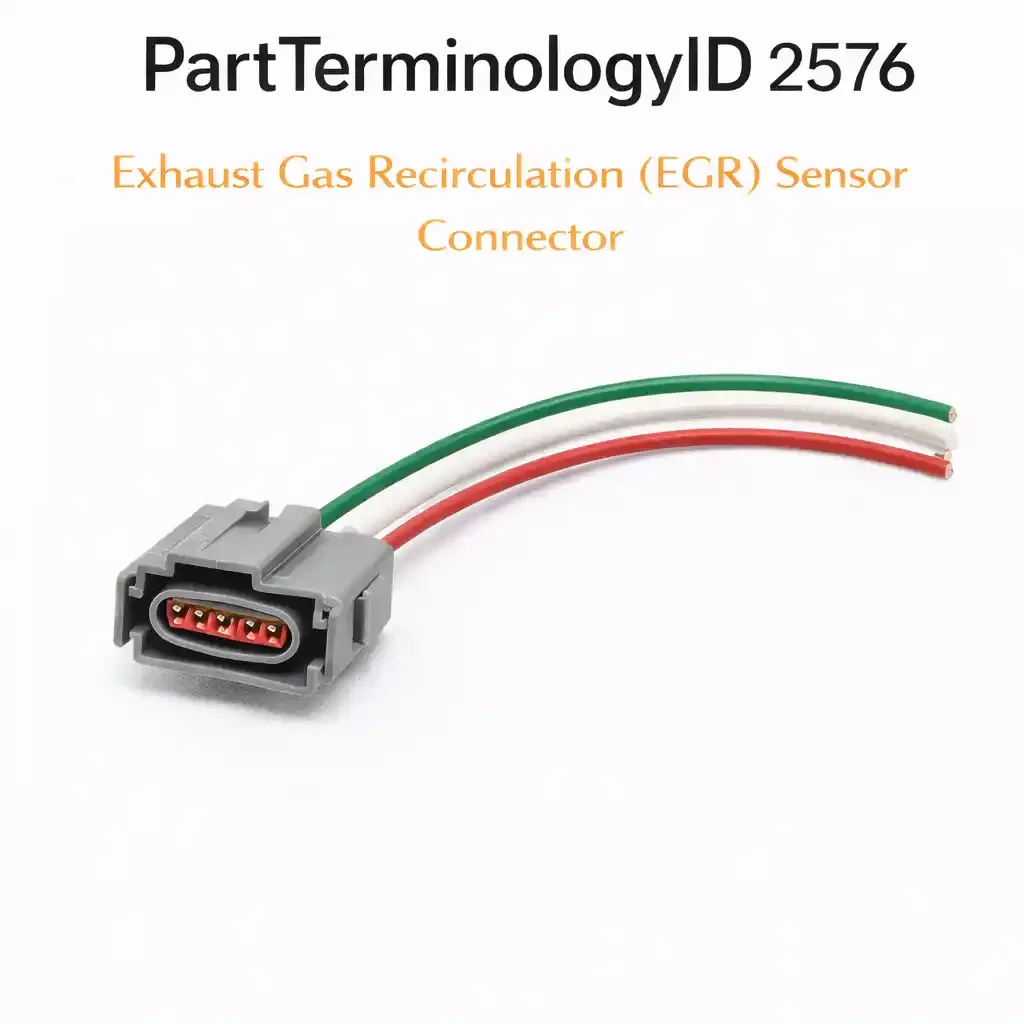
PartTerminologyID 2576, Exhaust Gas Recirculation (EGR) Sensor Connector, is the wiring harness connector body that mates with the EGR sensor, providing the electrical interface between the powertrain control module and the sensor terminals that carry the signal the PCM uses to verify that the EGR valve is opening, closing, and flowing exhaust gas at the commanded rate. That definition covers the function correctly. It does not specify the sensor function type, which distinguishes pintle position sensors that measure how far the EGR valve's mechanical stem has traveled from its closed seat and carry a three-terminal circuit consisting of a 5-volt reference, a signal return, and a sensor ground, from differential pressure feedback sensors that measure the pressure difference across an orifice in the EGR passage and determine actual exhaust gas flow rate rather than valve mechanical position, also using a three-terminal circuit on most applications but with different connector body profiles and different mounting locations than pintle position sensors, the terminal count, the connector body housing series appropriate to the sensor type and mounting location, the thermal resistance rating of the connector body given the EGR sensor's proximity to the exhaust system and the EGR valve body, the carbon contamination resistance of the connector body sealing design given the tendency of exhaust gas carbon deposits to migrate into underhood connectors adjacent to the EGR circuit, the pigtail wire gauge and length, and whether the listing covers the connector body only or a pigtail assembly. A listing under PartTerminologyID 2576 that provides vehicle year, make, and model without the sensor function type and connector housing series cannot be evaluated by any technician replacing a heat-cracked, carbon-contaminated, or physically damaged EGR sensor connector at the valve body, the intake manifold, or the firewall-adjacent mounting location where these sensors operate.
For sellers, PartTerminologyID 2576 is the connector PartTerminologyID in this series where the PCM's ability to enforce OBD-II emissions compliance is most directly dependent on connector signal integrity. The EGR sensor is the feedback element that closes the loop between what the PCM commands the EGR valve to do and what the valve actually does. When the PCM commands the EGR valve to open to a specific position or allow a specific flow rate, it reads the sensor's feedback signal to confirm compliance. If the connector adds contact resistance that shifts the sensor's output voltage, the PCM reads a valve position or flow rate that does not match the actual state of the valve. The PCM may compensate by adjusting its EGR command, pushing the valve further open than the correct position while believing it is at the correct position, which produces either excess EGR flow causing rough idle and stalling at light load, or the PCM may detect the discrepancy between commanded and reported state and set a range or performance fault code. A connector with an open-circuit terminal produces a signal voltage at the extreme of the sensor's output range, which the PCM interprets as a valve fully closed when it may be partially open, or as a sensor circuit fault setting P0405 on first key-on.
The additional complexity specific to PartTerminologyID 2576 is the sensor function type distinction between pintle position sensors and differential pressure feedback sensors. Both types use three-terminal connector bodies on the majority of applications. Both operate on a 5-volt reference supply from the PCM. Both return a voltage signal that increases with increasing valve opening or increasing exhaust gas flow. But pintle position sensors mount directly on the EGR valve body at the stem, while differential pressure sensors mount at a remote location connected to the EGR passage by two rubber pressure hoses, often on the intake manifold, on the firewall, or on a bracket adjacent to the EGR valve. The connector body profiles for these two sensor types are different because they mate with different sensor body housings, and the connector body housing series in the application table must distinguish between them even when both sensor types appear in the same vehicle application table on platforms that used both types across production years. Selecting the pintle position sensor connector for a differential pressure sensor application produces a connector body that will not seat on the remote-mount sensor body, and the mismatch is immediately obvious. Selecting the connector from the wrong production year within the same sensor type but from a different housing series generation is the less obvious mismatch, producing a connector that seats partially and develops intermittent contact at operating temperature.
For sellers, the listing under this PartTerminologyID is only useful if it specifies the sensor function type as pintle position sensor or differential pressure sensor, the terminal count, the connector body housing series, the thermal resistance rating of the connector body in degrees Celsius given the exhaust-adjacent operating environment, the carbon contamination sealing design, the wire gauge, and whether the listing is a connector body only or a pigtail assembly. Without those attributes, the listing enables the sensor function type mismatch that prevents connector seating, the housing series generation mismatch that produces intermittent contact at operating temperature, and the thermal failure that produces the same P0405 circuit low fault code as sensor failure, leading technicians to replace a functioning sensor into a connector that reproduces the fault immediately.
What the EGR Sensor Connector Does
Carrying the 5-volt reference and position signal on pintle position sensor designs
The pintle position sensor is a linear potentiometer or Hall-effect device mounted on the top of the EGR valve body, mechanically coupled to the valve's pintle stem. As the PCM commands the valve to open, the actuator drives the pintle downward against the valve seat spring, and the sensor's internal wiper or Hall-effect element tracks this linear displacement and produces a proportional output voltage. The PCM supplies a regulated 5-volt reference voltage to one terminal, the sensor returns a signal voltage proportional to pintle position through a second terminal, and a dedicated sensor ground connects to the third terminal.
At the fully closed position, the sensor's output voltage is typically in the range of 0.3 to 0.8 volts. At full open, the output voltage rises to approximately 4.5 to 4.8 volts. The PCM compares the commanded pintle position against the reported position in a closed control loop, adjusting the actuator drive signal until the sensor reports the commanded position. Contact resistance at the connector's reference terminal reduces the reference voltage delivered to the sensor, which compresses the sensor's output range because the output voltage is ratiometric to the reference supply. A 0.5-volt drop in reference voltage due to contact resistance at the reference terminal shifts the sensor's full-open output from 4.5 volts to approximately 4.1 volts, which the PCM interprets as a valve that cannot reach full open. The PCM may compensate by increasing the actuator drive, which over time stresses the actuator mechanism and causes accelerated wear at the valve stem and seat.
Contact resistance at the signal terminal adds to the sensor's output resistance in series with the PCM's internal signal impedance, producing a voltage divider error that shifts the reported position lower than actual at all points in the valve travel range. The PCM reads a consistently under-reporting sensor and compensates by pushing the valve toward a more open position than necessary, producing elevated EGR flow at light load and the rough idle and stumble on deceleration that are the characteristic drivability symptoms of excess EGR flow, without setting any fault code because the sensor is producing a valid signal in the acceptable voltage range, merely one that is offset from actual by the connector's contact resistance contribution.
Carrying the pressure differential signal on DPFE sensor designs
The differential pressure feedback EGR sensor, used most prominently on Ford applications from the mid-1990s through the mid-2000s and on some other domestic and import platforms, measures actual exhaust gas flow through the EGR passage rather than valve mechanical position. The sensor mounts remotely from the EGR valve, connected by two rubber pressure hoses to taps on the EGR passage on either side of a calibrated orifice. Exhaust gas flowing through the passage creates a pressure drop across the orifice: the upstream side is at higher pressure than the downstream side, and the magnitude of this pressure difference is proportional to the flow rate. The DPFE sensor converts this pressure differential into a voltage signal using a piezo-resistive pressure element, producing an output that rises from a low reference voltage at zero flow to progressively higher voltages as EGR flow increases.
The connector body for DPFE sensors mates with a sensor housing that is physically distinct from pintle position sensor housings, typically a compact rectangular block with two hose connection ports and a three-terminal electrical connector on one face. The connector body profile, terminal pitch, and latch geometry are different from pintle position sensor connectors even when the terminal count is the same. The remote mounting location away from the EGR valve body means the DPFE connector does not experience the direct valve body heat that pintle position sensor connectors endure, but the connector is still positioned in the engine compartment's high-temperature zone adjacent to the exhaust system and intake manifold, and the pressure hose connections are vulnerable to heat cracking and exhaust gas condensate contamination that can migrate into the connector body if the hose connections degrade and allow condensate to travel along the hose interior to the connector face.
On later Ford applications and some other platforms, the DPFE sensor design evolved, and the connector body geometry changed between generations even on the same engine family. The two-hose remote DPFE design transitioned to a single-hose or manifold-integrated design on some later applications, and the connector body changed correspondingly. An application table entry that specifies vehicle year, make, and model without the sensor generation designation will not capture this within-model evolution, allowing a connector from the two-hose generation to be selected for a single-hose generation application.
The EGR Environment: Carbon, Heat, and Condensate
The EGR sensor connector's operating environment is defined by three contamination sources that do not affect most other sensor connectors in the engine management system: exhaust-derived carbon deposits, elevated thermal cycling from exhaust-adjacent proximity, and exhaust gas condensate from the EGR passage.
Carbon deposits are the defining characteristic of the EGR system's operating environment. Exhaust gas recirculated through the EGR passage carries particulate carbon, unburned hydrocarbon residue, and water vapor from the combustion products. Carbon deposits accumulate on EGR valve internals, EGR passage walls, and on the outer surfaces of components adjacent to the EGR circuit. On applications where the EGR sensor mounts directly on the valve body, carbon deposits from the valve body's exterior surfaces can migrate into the connector body at the mating interface if the connector body does not maintain positive environmental sealing at the mating face. Carbon accumulation on the terminal contact faces increases contact resistance incrementally, producing the offset contact resistance error described above, without any visible indication at a casual inspection because the carbon film on the terminal face is thin and the terminal appears clean to the eye.
The thermal environment at the EGR valve body is one of the most demanding in the engine compartment for connector bodies. On gasoline engines, the EGR valve mounts on or adjacent to the exhaust manifold or the cylinder head, where sustained exhaust gas temperatures during normal operation can exceed 400 degrees Fahrenheit at the valve body surface. The connector body mounted on the valve's sensor port must withstand not only the ambient underhood temperature but the conducted heat from the valve body through the connector mating interface. Connector bodies rated for 105 degrees Celsius continuous operation, which is adequate for general underhood ambient locations, are marginal for valve body mounting on gasoline engines and inadequate for diesel applications where EGR gas temperatures are substantially higher due to the diesel cycle's higher exhaust temperatures. The minimum connector body temperature rating for EGR sensor connectors in valve-body-mounted locations on gasoline engines is 125 degrees Celsius, and 150 degrees Celsius for diesel applications.
Condensate from the EGR passage is the third contamination source. Exhaust gas contains water vapor from the combustion of hydrogen in the fuel. As the EGR system cycles between hot operation and cold shutdown, exhaust gas condensate forms in the EGR passages and in the pressure hoses connected to remote-mount sensors. On pintle position sensors, condensate can accumulate at the base of the valve body and wick into the connector body at the lower terminal seal if the terminal seal is not maintained. On DPFE sensors, condensate migrates through the pressure hoses toward the sensor body and, if hose connections degrade, may reach the connector body face. Connector bodies without full terminal sealing in the EGR environment will develop progressive terminal corrosion from this condensate exposure on applications with high EGR duty cycles such as city driving with frequent stop-and-go deceleration EGR activation.
Top Five Return Scenarios for PartTerminologyID 2576
Return Scenario 1: Pintle position sensor connector installed on a DPFE sensor application
The buyer selects a three-terminal EGR sensor connector based on terminal count. The vehicle uses a Ford DPFE differential pressure feedback sensor mounted remotely on the intake manifold. The pintle position sensor connector body profile does not match the DPFE sensor body's mating geometry, and the connector will not seat fully on the DPFE sensor housing. The buyer attempts to force the connector and either damages the DPFE sensor body's connector port or bends the terminal bodies, then returns the connector as incorrectly sized. Prevention requires specifying sensor function type as the first mandatory labeled attribute, with pintle position sensor connector and DPFE sensor connector as separate listings that share a terminal count but differ in housing profile, even when both appear in the same vehicle model's application range across different production years.
Return Scenario 2: Connector body rated for general underhood ambient on an exhaust-adjacent valve-body location
The buyer replaces a cracked EGR sensor connector on a V8 gasoline application where the EGR valve mounts directly on the exhaust crossover between the cylinder banks. The replacement connector body is rated for 105 degrees Celsius ambient, appropriate for a sensor mounted on the intake manifold or firewall but not for a sensor mounted on a valve body that conducts exhaust heat at 200 degrees Celsius or higher through its housing. The connector installs correctly, seats, and latches. Within four to six weeks of normal operation, the sustained thermal load at the valve body softens the connector body, relaxing the terminal retention tangs and allowing terminal contact force to drop. P0404 range and performance codes appear during hot operation, followed eventually by P0405 circuit low as terminal contact fails. The buyer returns the connector as defective. Prevention requires specifying the thermal resistance rating as a mandatory attribute, with a minimum 125-degree Celsius rating for gasoline valve-body locations and 150-degree Celsius for diesel applications.
Return Scenario 3: Connector body only on carbon-contaminated pigtail wiring at the valve stem
The buyer replaces the EGR sensor connector body on a high-mileage application where the original connector was cracked by thermal stress. The pigtail wiring from the original connector back to the harness junction has accumulated carbon deposits in the wire loom and in the wire insulation surface from the valve body environment over 80,000 or more miles. The new connector body seats correctly and the terminal contacts are clean. Within two to three heat cycles, the carbon-contaminated wiring's insulation, which has become brittle from thermal cycling, develops micro-cracks at the connector crimp location that allow carbon-laden condensate to wick into the crimp junction. Contact resistance climbs progressively over the following weeks, reproducing P0404 range codes. The buyer returns the connector as defective. Prevention requires offering the pigtail assembly as the primary recommendation for EGR sensor connector replacements where the vehicle has significant mileage or where carbon accumulation is visible on the valve body. The pigtail should provide a minimum 12-inch length to allow splicing past the carbon-affected wiring in the valve body vicinity.
Return Scenario 4: DPFE sensor connector from wrong generation on a within-model DPFE design change
The buyer replaces the DPFE sensor connector on a Ford application from a model year where the DPFE sensor design transitioned from the two-hose remote mount design to the updated single-hose or manifold-integrated design. The application table returns the connector for the vehicle year, make, and model without specifying the sensor generation. The two-hose connector seats 2 to 3 millimeters short of full engagement on the single-hose sensor body's updated connector port geometry. The terminal contact faces make partial contact at the reduced engagement depth. P0401 insufficient flow codes appear after several weeks of partial contact degradation, and the technician attributes the code to the DPFE sensor itself rather than the connector mating geometry. A new DPFE sensor is ordered and installed into the same incorrectly specified connector, reproducing P0401 within days. The buyer returns both the connector and the sensor. Prevention requires specifying the sensor generation designation alongside vehicle year, make, and model in application tables for platforms where the DPFE sensor design changed within the production run.
Return Scenario 5: Terminal transposition on a three-terminal EGR position sensor connector
The buyer replaces the EGR pintle position sensor connector on an application where the original connector body was destroyed and the terminal position assignment cannot be read from the housing. The replacement connector seats on the sensor body. On first key-on after installation, P0405 circuit low is set immediately. The technician back-probes the terminals and finds the sensor's signal output terminal connected to the PCM's sensor ground circuit, which grounds the signal terminal directly through the PCM's low-impedance ground and pulls the signal voltage to near zero, producing the minimum-voltage circuit low condition the P0405 threshold requires. The 5-volt reference is connected to the signal input terminal of the PCM, applying the reference voltage to the PCM's analog input, and the designated reference supply terminal is unconnected. The buyer returns the connector as defective without identifying the terminal transposition. Prevention requires specifying the terminal position assignment by cavity designation, with the reference voltage supply, signal return, and ground positions explicitly labeled, and publishing a wiring diagram reference in the product listing.
Specification Attributes Required for PartTerminologyID 2576 Listings
Sensor function type: Pintle position sensor (measures valve mechanical travel, mounts on valve body) or differential pressure feedback sensor (measures EGR flow rate, mounts remotely with pressure hose connections). Determines connector body profile, mounting location, and thermal environment. Must be the first labeled attribute in the listing.
Terminal count: Three terminals on the standard PCM-input configuration: 5-volt reference supply, signal return, and sensor ground. Higher terminal counts on integrated EGR valve assemblies where the sensor and actuator share a single multi-cavity connector body.
Connector body housing series: The series designation identifying the physical connector family, terminal pitch, latch geometry, and mating profile. Required to distinguish connector body generations on the same sensor type where housing profile changed between production years on a shared platform.
Sensor generation designation: For DPFE sensor applications where the sensor design changed within the production run of a given vehicle model, the generation designation prevents within-model cross-generation connector mismatch that produces partial seating and intermittent contact.
Thermal resistance rating: Minimum 125 degrees Celsius for pintle position sensor connectors at gasoline valve-body locations. Minimum 150 degrees Celsius for diesel applications. Standard 105-degree-Celsius underhood ambient ratings are not adequate for direct valve-body mounting.
Carbon contamination sealing: Whether the connector body provides positive terminal sealing at the mating face to prevent carbon deposit migration into the terminal cavity from the valve body environment. Relevant for pintle position sensor connectors mounted in direct proximity to the valve body exterior surfaces.
Wire gauge: 18 gauge for standard three-terminal position and pressure sensor signal circuits. The signal circuits carry only milliamp-level reference and sensor currents, so 18-gauge wire is appropriate for the electrical load, but the wire insulation temperature rating must match or exceed the connector body's temperature rating for the application's thermal environment.
Pigtail length: Minimum 12 inches per terminal for valve-body-mounted pintle position sensor applications where the harness connection point is remote from the valve body and carbon-affected wiring adjacent to the valve may require trimming before splicing.
Cross-Sell Logic
EGR Valve Position Sensor: Before attributing P0405 or P0406 fault codes to the connector, back-probe the reference terminal at the sensor connector while the ignition is on and confirm 4.8 to 5.2 volts at the reference supply. Then confirm signal voltage at the signal terminal with the valve in the known closed position: should read 0.3 to 0.8 volts for most pintle position sensors. If reference voltage is correct and signal voltage is zero or below 0.3 volts with the valve confirmed closed, the sensor's internal wiper has likely failed rather than the connector. Installing a new sensor into a connector with elevated contact resistance will reproduce the offset signal error on the new sensor immediately.
EGR Valve: Carbon deposits on the EGR valve pintle and seat are the most common cause of EGR system fault codes and are frequently misattributed to the sensor connector. Before replacing the connector, verify that the EGR valve pintle moves freely when commanded by the PCM. A valve with a pintle stuck open by carbon deposits will produce EGR flow at idle and light load, causing rough idle and stalling, with sensor feedback reporting an open valve position because the pintle cannot close. Cleaning or replacing the valve as a companion item to the connector replacement prevents the scenario where the new connector restores signal integrity but the valve's carbon-stuck pintle continues to produce the flow-related fault codes.
DPFE Pressure Hoses: On Ford and other DPFE sensor applications, the rubber pressure hoses connecting the DPFE sensor to the EGR passage tap points are a companion failure item. Hoses that have cracked, softened, or collapsed from heat cycling allow exhaust gas pressure leaks that cause the DPFE sensor to read lower differential pressure than actual EGR flow produces, setting P0401 insufficient flow codes. Replacing hoses and connector together at the same service event prevents the situation where a new connector restores electrical integrity but degraded hoses reproduce the P0401 code because the sensor is not receiving accurate pressure signals.
Frame as: "The EGR sensor is how the PCM confirms that the EGR valve did what it was told. If the connector adds contact resistance to the position or pressure signal, the PCM reads a valve position that's off from actual, and it either compensates by pushing the valve further open than needed, causing rough idle and stumble, or it sets a range or performance fault code. The sensor function type distinction between a pintle position connector and a DPFE connector matters immediately: the two connector bodies look similar but will not mate across applications. And the thermal rating matters at every EGR sensor location because the connector is operating in exhaust-adjacent heat that destroys connector bodies designed for general underhood ambient."
Final Take for PartTerminologyID 2576
Exhaust Gas Recirculation (EGR) Sensor Connector (PartTerminologyID 2576) is the connector PartTerminologyID in this series that sits at the intersection of emissions compliance, drivability, and OBD-II readiness monitor completion. EGR fault codes prevent OBD-II readiness monitors from completing, which disqualifies the vehicle from emissions testing in states with I/M programs. A connector fault that produces a P0401, P0404, P0405, or P0406 code is not a drivability inconvenience that can be deferred; it is an emissions compliance fault that prevents registration renewal in a significant portion of the domestic vehicle population.
The sensor function type distinction between pintle position and DPFE sensors is the attribute that prevents the connector body profile mismatch that produces an immediately non-seating connector. The thermal resistance rating is the attribute that prevents the progressive connector body softening that produces intermittent EGR codes as the application's thermal load exceeds the connector's rating. The sensor generation designation for DPFE applications is the attribute that prevents the partial-seating cross-generation mismatch. The terminal position assignment specification is the attribute that prevents the three-terminal transposition that sets P0405 on first key-on with a correctly installed connector.
State the sensor function type as the primary labeled attribute. State the connector body housing series and generation designation for DPFE applications where the design changed within the model's production run. State the thermal resistance rating with the specific minimum for valve-body gasoline locations and diesel locations distinguished. State the terminal count and position assignment. State the pigtail wire gauge and length, noting that the insulation temperature rating must match the connector body's thermal rating for the application. Include the EGR valve and DPFE pressure hose cross-sell note where the companion failure items are likely to reproduce fault codes after a connector-only replacement.
Those are the specification attributes that allow the buyer to select the correct connector for the sensor function type, confirm its thermal suitability for the mounting location, and allow the replacement to restore closed-loop EGR control and OBD-II readiness monitor completion on the first drive cycle after installation.