
Headlight Dimmer Connector (PartTerminologyID 2572) Current Rating, Switch Type, and Circuit Architecture
Written by Arthur Simitian | PartsAdvisory
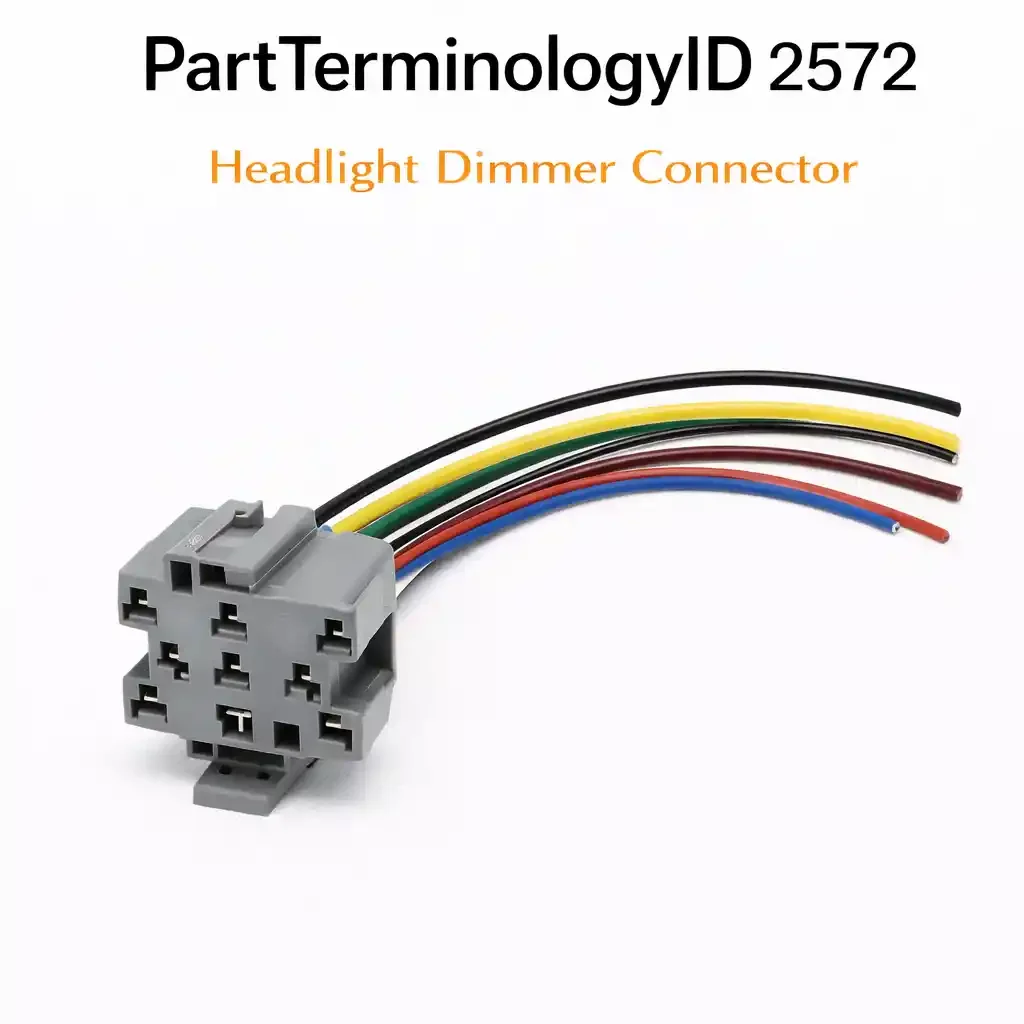
PartTerminologyID 2572, Headlight Dimmer Connector, is the wiring harness connector body that mates with the headlight dimmer switch, providing the electrical interface between the vehicle's headlight power circuit and the switch terminals that direct battery-voltage current to either the low-beam or high-beam headlamp filaments. That definition covers the function correctly. It does not specify the terminal count, which is three terminals on the dominant direct-switched architecture used on domestic vehicles from the postwar era through the mid-1990s where the connector carries full headlamp load current on a power-in terminal and two power-out terminals, one for low beam and one for high beam, the switch type, distinguishing floor-mounted mechanical toggle switches used on domestic vehicles through the late 1980s from column-stalk multifunction switches used on most domestic and import vehicles from the 1980s onward where the dimmer function is integrated into a combination switch that also handles turn signals, lane-change flash, and on some applications wipers and cruise control, the current rating of the connector body and terminals appropriate to the circuit architecture, which in a direct-switched halogen system may carry 10 to 25 amperes of sustained headlamp load current through the switch connector, the connector body housing series designation, the pigtail wire gauge appropriate to the current load, and whether the listing covers the connector body only or a pigtail assembly. A listing under PartTerminologyID 2572 that provides vehicle year, make, and model without the switch type, the terminal count, and the current rating cannot be evaluated by any technician replacing a heat-melted, contact-burned, or physically cracked headlight dimmer connector at the floor mounting location, the steering column lower shroud, or the multifunction switch harness junction.
For sellers, PartTerminologyID 2572 is the connector PartTerminologyID in this series where thermal failure from current overload is the dominant failure mode rather than signal circuit degradation. Most connectors in a modern engine management system carry milliamp-level reference voltages or low-current sensor signals where contact resistance accumulation degrades signal quality gradually over time. The headlight dimmer connector on a direct-switched architecture carries full headlamp load current continuously whenever the headlights are on, which on a four-headlamp sealed-beam or dual-halogen system operating at 55 watts per low-beam bulb represents approximately 8 to 10 amperes per lamp, 16 to 20 amperes total for a two-lamp low-beam circuit, through a connector body and terminals that in many OEM applications were specified for the original 45-watt sealed-beam headlamp loads of the 1960s and 1970s. When owners upgrade to 55-watt or higher halogen replacements without upgrading the wiring and connector, or when contact resistance accumulates from decades of oxidation and vibration at the floor-mount location, the combination of higher current and elevated contact resistance produces resistive heating at the connector body that melts the housing, carbonizes the terminal contact faces, and in the most advanced cases melts the wire insulation back several inches from the connector and produces a partial short-circuit condition that can ignite wiring harness material.
The additional complexity specific to PartTerminologyID 2572 is the circuit architecture distinction. A direct-switched headlight system routes full headlamp current through the headlight switch, through the wiring harness to the dimmer switch connector, and from the dimmer switch to the headlamp bulbs. Every connector in this path carries full load current. A relay-switched headlight system routes full headlamp current directly from a fused power source to the headlamp bulbs through relay contacts, and routes only the low-current relay activation signal through the headlight switch, the dimmer switch, and their connectors. The dimmer switch connector in a relay-switched system carries a few hundred milliamps of relay coil activation current rather than 10 to 20 amperes of headlamp load current. A connector body rated for relay-switched signal currents installed on a direct-switched application will appear to function correctly on initial installation and will fail thermally within weeks or months of use as the sustained load current heats the undersized terminal bodies and connector housing progressively. A connector body with terminal bodies sized for direct-switched load current installed on a relay-switched application is overspecified but harmless.
For sellers, the listing under this PartTerminologyID is only useful if it specifies the switch type as floor-mounted or column-stalk multifunction, the terminal count and position assignment, the current rating appropriate to direct-switched or relay-switched circuit architecture, the connector body housing series, the wire gauge per terminal, and whether the listing is a connector body only or a pigtail assembly. Without those attributes, the listing enables the current overload failure where a signal-rated connector is installed on a direct-switched headlamp circuit, the terminal transposition failure where a three-terminal connector seats fully but routes the power-in circuit to a power-out terminal position, and the housing incompatibility failure where a connector from a different multifunction switch generation seats partially and produces intermittent contact at the high-beam or low-beam output terminal.
What the Headlight Dimmer Connector Does
Directing full load current on the dominant three-terminal direct-switched design
The headlight dimmer switch is a single-pole double-throw mechanical switch. One terminal receives battery-voltage power from the headlight switch whenever the headlights are on. The switch mechanism routes this power to one of two output terminals: the low-beam output, which carries current to all low-beam filaments, or the high-beam output, which carries current to all high-beam filaments. On a floor-mounted switch, the driver's foot depresses the switch body to toggle between low and high beam. On a column-stalk switch, the driver moves the stalk forward or operates a dedicated button to toggle between beams. On both designs the electrical function is identical: one power-in terminal and two power-out terminals, with the switch mechanism determining which output terminal is energized at any moment.
The connector body mates with the switch body and carries all three of these circuits. On floor-mounted designs, the connector is typically a simple blade-terminal open-face connector with three separate blade terminals that plug into matching receptacles on the switch body, or a molded connector housing that captures all three terminals in a single body that locks onto the switch. On column-stalk multifunction switch designs, the dimmer function's three circuits are typically integrated into a larger connector that also carries the turn signal, hazard, and other multifunction circuits, with the dimmer terminals occupying three of the total cavity positions in a seven, nine, or more terminal connector body.
The current the connector must carry is determined by the headlamp wattage and the number of lamps in the low-beam and high-beam circuits. On a system with two 55-watt low-beam halogen bulbs operating at 14.4 volts charging voltage, each low-beam bulb draws approximately 3.8 amperes, and the total low-beam current through the power-in terminal and the low-beam output terminal is approximately 7.6 amperes. On a four-headlamp system with dual low beams, the total low-beam load through the dimmer connector's low-beam output terminal approaches 15 amperes. The high-beam circuit on dual high-beam systems with 65-watt high-beam filaments draws up to 9 amperes per bulb, with total high-beam loads of 18 amperes on four-lamp systems. These are continuous sustained loads maintained for the duration of night driving, which distinguishes the headlight dimmer connector's thermal environment from connectors in intermittent-duty circuits where load current flows only during a brief switching event.
The thermal consequences of contact resistance at load current
At the currents the direct-switched headlight dimmer connector carries, the relationship between contact resistance and heat generation is not linear. Heat generated at a connector terminal is proportional to the square of the current multiplied by the contact resistance: P = I squared times R. At 15 amperes of low-beam load current, a contact resistance increase of 1 ohm at the low-beam output terminal produces 225 milliwatts of heating, which is a modest warm elevation above ambient. A contact resistance increase of 2 ohms at 15 amperes produces 450 milliwatts. A contact resistance increase of 5 ohms, which is well within the range achievable by oxidized or corroded blade terminals on a decades-old floor-mount connector in an underflooring moisture environment, produces approximately 1,125 milliwatts of sustained heating at the connector body. At that heat generation rate, a connector body rated for 85 degrees Celsius ambient temperature in a below-floor location that already experiences elevated temperature from the exhaust system above will soften within hours of continuous operation, deforming the terminal cavities, accelerating contact force loss, and initiating the positive feedback cycle where reduced contact force increases contact resistance, which increases heat generation, which further softens the connector body.
The practical symptom is a dimmer switch connector that appears normal when cold but produces dim headlights, flickering at sustained speed, or complete loss of one beam mode after extended night driving. The headlamps return to normal brightness when the vehicle is parked and the connector cools. Technicians who diagnose this symptom by checking the headlamps on a cold start and finding normal operation will not reproduce the fault and may replace the headlamp bulbs or the dimmer switch before identifying the connector as the heat-degraded component.
Floor-mounted versus column-stalk switch connector profiles
The floor-mounted headlight dimmer switch connector and the column-stalk multifunction switch connector serve the same electrical function in the headlight dimmer circuit but have different physical requirements, different mounting environments, and different failure modes.
The floor-mounted switch sits on the floor panel or the firewall below the driver's feet, where it is exposed to water intrusion from wet footwear and floor mats, road spray entering through the firewall, and in colder climates the salt and chloride contamination carried in by snow-covered boots. The connector body at a floor-mounted switch must resist moisture ingress to prevent terminal oxidation and corrosion from the underfloor environment. Floor-mounted switch connectors on domestic vehicles from the 1950s through the 1980s were typically open-face blade terminal designs with no environmental sealing, relying on the switch body's mounting position and the floor panel's general protection to exclude moisture. These designs are the primary source of the high-resistance terminal failure described above, because the open terminal faces are directly exposed to the underflooring environment through the connector body without any seal to impede moisture and chloride ingress.
The column-stalk multifunction switch connector mounts inside the steering column shroud, which provides physical protection from direct water exposure but concentrates the connector in an enclosed space adjacent to the steering column that retains heat from the column's electrical components. Column-stalk switch connectors are exposed to thermal cycling from cold starts through operating temperature across thousands of cycles, and the connector body material must maintain dimensional stability through that thermal range to preserve terminal contact force. On column-stalk connectors integrated into multifunction switch housings, the headlight dimmer terminals share a connector body with turn signal, hazard, and other circuits, and failure of any one terminal's contact through thermal or corrosion damage may produce symptoms in an unrelated circuit that the technician does not initially associate with the headlight dimmer circuit.
The Circuit Architecture Argument: Direct-Switched Versus Relay-Controlled
The single most consequential specification decision for PartTerminologyID 2572 listings is whether the vehicle's headlight circuit routes full load current through the dimmer switch and its connector, or uses relays to carry the load current directly to the headlamps while routing only the low-current relay activation signal through the switch.
On most domestic vehicles from the postwar era through the 1990s, the headlight circuit was direct-switched: the headlight switch supplied battery-voltage power to the dimmer switch, and the dimmer switch routed that power directly to the headlamp bulbs. This architecture is simple and uses fewer components, but it means every connector in the headlight circuit, including the dimmer connector, must carry the full headlamp load current. OEM connector specifications for these systems were determined when the standard headlamp was a 45-watt sealed-beam unit drawing approximately 3 amperes per lamp. The connectors worked at that specification. When halogen sealed beams and halogen capsule headlamps became widespread at 55 watts per bulb, the current through the same connector bodies increased by approximately 20 percent. When owners install 65-watt or 100-watt aftermarket halogen bulbs, the current increases to the point where the original OEM connector specification is substantially exceeded on a continuous basis.
On later domestic applications and on most import applications from the 1980s onward, the headlight circuit uses relays mounted near the headlamps, with the headlight switch and dimmer switch operating only the relay coil activation circuits. The relay coil draws typically 150 to 250 milliamps. The dimmer switch connector on a relay-switched system never sees headlamp load current; it carries only the coil activation signal. Connector bodies on relay-switched systems can be substantially lighter in construction than connectors on direct-switched systems because the current load they must carry is two orders of magnitude smaller.
A catalog listing that does not specify the circuit architecture leaves the buyer to select a connector by terminal count and housing profile match alone. A three-terminal connector from a relay-switched import application and a three-terminal connector from a direct-switched domestic application may share identical terminal counts, similar housing profiles, and even similar connector body dimensions. The relay-switched connector's terminal bodies are typically lighter-gauge stampings designed for sub-ampere coil activation currents. Installed on a direct-switched system, those terminal bodies will not sustain the load current without progressive heating and failure. There is no visible indication of this mismatch at installation: the connector seats, latches, and the headlamps operate normally. The thermal failure develops over weeks or months of accumulated night driving time.
Top Five Return Scenarios for PartTerminologyID 2572
Return Scenario 1: Relay-switched connector installed on a direct-switched headlamp circuit
The buyer selects a connector by terminal count and housing profile match. The vehicle application table indicates the connector fits the vehicle, but the listing does not specify whether the application is direct-switched or relay-switched. The vehicle is a 1975 to 1985 domestic application with a direct-switched four-lamp headlamp system. The connector supplied is from a relay-switched application with lighter terminal bodies. The connector installs, seats, and latches. The headlamps operate normally for the first several weeks of service. As contact resistance accumulates from slight terminal fit variation and thermal cycling, heat generation at the power-in terminal increases until the connector body softens and the terminal retention geometry distorts. The buyer returns the connector after the headlamp dimming symptom reproduces and the connector body is found visibly deformed. Prevention requires specifying circuit architecture, direct-switched or relay-controlled, as a mandatory labeled field in the listing, and specifying the current rating of the connector body and terminal bodies in amperes.
Return Scenario 2: Connector body only on a floor-mount switch with corroded pigtail wiring
The buyer replaces a cracked or melted connector body at the floor-mounted dimmer switch. The connector body installs correctly. Within one to three months, the symptom returns: one beam mode operates intermittently or fails completely. The fault is not in the new connector body but in the pigtail wiring between the original connector position and the main harness junction, where the wire conductors have accumulated oxidation and resistance from the same moisture and chloride exposure that degraded the original connector body. The buyer returns the connector body as non-functional. Prevention requires offering pigtail assemblies as the primary recommendation for floor-mount dimmer connector replacements, with a minimum 12-inch pigtail length to allow splicing past the moisture-affected wiring adjacent to the floor-mount switch location. The connector body only option should be described as appropriate only for cases where the existing pigtail wiring has been inspected under insulation and confirmed free of conductor oxidation.
Return Scenario 3: Terminal position transposition on a three-terminal floor-mount connector
The buyer replaces the floor-mount dimmer switch connector on a vehicle where the original connector was destroyed and the terminal position assignment cannot be read from the original housing. The replacement connector seats on the switch body. On first use after installation, the high-beam mode produces low-beam illumination and the low-beam mode either produces no illumination or activates the high-beam filaments. The terminal position for the power-in circuit has been connected to the low-beam output cavity, routing the power-in current through the low-beam circuit independently of the switch mechanism's contact position. The buyer returns the connector as incorrectly manufactured. Prevention requires specifying the terminal position assignment by cavity designation on three-terminal floor-mount connectors, with a wiring diagram reference in the product listing showing the power-in, low-beam output, and high-beam output positions, and cross-referencing the terminal assignment to the switch body pin positions.
Return Scenario 4: Connector housing from an incompatible multifunction switch generation
The buyer replaces the headlight dimmer connector in the steering column multifunction switch harness. The vehicle application table returns a connector match based on vehicle year, make, and model. The connector supplied is from a multifunction switch housing series that changed between model years on the same platform, with the same three dimmer circuit terminals but a different connector body outer geometry that seats 2 to 3 millimeters short of full engagement on the switch body. The terminal contact faces make partial contact at 70 to 80 percent of the designed contact area. The headlamps appear to operate normally initially. After several weeks of column vibration and thermal cycling, the partial contact develops intermittent continuity in the high-beam circuit, producing a symptom the technician identifies as a failing multifunction switch rather than a connector fitment issue. Prevention requires specifying the switch housing series generation as a mandatory attribute when the connector body geometry changed between production years on a shared platform, not relying on vehicle year, make, and model matching alone.
Return Scenario 5: Undersized wire gauge on pigtail for direct-switched application
The buyer replaces the floor-mount dimmer switch connector pigtail on a four-lamp direct-switched system. The pigtail connector body is correctly rated for load current and the terminal bodies are appropriately sized. The pigtail wires, however, are 18-gauge conductors specified for the signal-current relay-switched application the pigtail was originally designed for, not for the direct-switched load current application it is being installed on. The headlamps operate normally initially. As the 18-gauge conductors carry 15 to 18 amperes of sustained load current, the wires heat progressively, the insulation discolors and begins to crack at the splice location, and in the final stage the splice insulation melts and contacts adjacent wiring. The buyer returns the pigtail for defect without identifying the wire gauge mismatch. Prevention requires specifying the pigtail wire gauge per terminal explicitly, with the correct gauge for direct-switched applications being 14 gauge for the power-in circuit and 14 to 16 gauge for each power-out circuit on systems with two or more headlamp bulbs per beam mode.
Specification Attributes Required for PartTerminologyID 2572 Listings
Switch type: Floor-mounted mechanical toggle or column-stalk multifunction switch integration. This determines the connector body profile, the mounting environment, and the sealing requirements.
Circuit architecture: Direct-switched (full headlamp load current through connector) or relay-controlled (low-current coil activation signal only). This is the attribute that determines the current rating requirement and distinguishes connectors that look similar but have fundamentally different load capacity specifications.
Terminal count: Three terminals on the standard direct-switched floor-mount or column-stalk dimmer function: power-in, low-beam output, high-beam output. Higher terminal counts on multifunction switch connectors where the dimmer terminals are integrated with turn signal, hazard, and other circuits.
Current rating: The continuous current rating of the connector body and terminal bodies in amperes, appropriate to the circuit architecture. Minimum 20 amperes for direct-switched four-lamp halogen systems. Signal-current ratings are insufficient for direct-switched applications.
Terminal position assignment: The power-in, low-beam output, and high-beam output cavity designations by position number or letter, referenced to the switch body pin layout. Mandatory for floor-mount connectors where the switch body pin positions are not self-evident from the connector body keying geometry.
Connector body housing series designation: The series identifier for floor-mount blade terminal connectors and for multifunction switch connector families, necessary to distinguish between connector body generations on the same platform.
Wire gauge per terminal: 14 gauge minimum for power-in and power-out terminals on direct-switched applications with dual halogen headlamp bulbs per beam mode. 18 gauge sufficient for relay-switched coil activation circuits.
Pigtail length: Minimum 12 inches per terminal for floor-mount applications where the harness connection point is remote from the switch mounting location and moisture-affected wiring adjacent to the switch may require trimming before splicing.
Environmental sealing: Whether the connector body provides terminal sealing appropriate to the floor-mount underflooring environment where moisture and road salt are active contamination sources.
Cross-Sell Logic
Headlight Dimmer Switch: Before replacing the connector, verify that the switch body's blade terminals or pin terminals show no evidence of arcing damage, carbon deposits, or deformed contact faces from the same thermal event that damaged the connector. A switch body with arced contact faces will reproduce elevated contact resistance immediately after installation of a new connector. Replace the switch body and the connector together when the connector shows evidence of thermal failure.
Headlight Relay Kit: For direct-switched applications where the connector thermal failure is attributable to sustained load current rather than incidental damage, a relay kit that offloads the headlamp current from the switch and connector circuit eliminates the root cause of connector thermal failure. The relay kit routes full headlamp current from a fused battery source directly to the headlamps, using the existing switch and dimmer circuit only to activate the relay coils at milliamp-level current. After relay installation, the dimmer switch connector carries coil activation current only and will not experience the thermal loading that caused the original failure.
Headlight Wiring Pigtail Repair Kit: For column-stalk multifunction switch connectors where individual terminal bodies have failed while the connector housing remains serviceable, a terminal repair kit that provides replacement terminal bodies and a terminal removal tool allows re-termination of individual circuit positions without replacing the full connector assembly. Appropriate when only one of the dimmer function terminals has failed while the remaining multifunction switch circuits in the shared connector body are in serviceable condition.
Frame as: "The headlight dimmer connector is the only connector in most people's cars that carries full headlamp current continuously through the contact faces all night, every night the lights are on. On a direct-switched four-lamp system that can be 15 to 20 amps through the connector body. Original connectors were sized for 45-watt sealed beams. Most cars now have 55-watt halogens or higher. The connector that came with the car is already marginal; an aftermarket connector that wasn't spec'd for load current is going to heat up, melt, and take the wiring with it. The current rating matters here more than it does on any other connector in this series."
Final Take for PartTerminologyID 2572
Headlight Dimmer Connector (PartTerminologyID 2572) is the connector PartTerminologyID in this series where the dominant failure mode is thermal overload from sustained current rather than signal degradation from contact resistance. The distinction separates this PartTerminologyID from virtually every other connector in an engine management or body electrical catalog, where the concern is contact resistance adding ohms to a millivolt-level signal. At the headlight dimmer connector on a direct-switched system, contact resistance adds ohms to a 15 to 20 ampere load circuit, and the heat generated by that resistance accumulation is the mechanism that melts housings, ignites insulation, and produces the underdash or underfloor fire risk that is the most severe consequence of connector specification error in this category.
The circuit architecture distinction between direct-switched and relay-controlled is the attribute that determines whether a given connector body is appropriate for the application or undersized by two orders of magnitude in current capacity. The switch type distinction between floor-mounted and column-stalk determines the connector body profile, the environmental sealing requirement, and the failure mode pattern. The current rating specification is the attribute that prevents the thermal overload failure. The wire gauge specification is the attribute that prevents the pigtail from becoming the heat source on the first night of extended driving after installation.
State the switch type as the first labeled attribute. State the circuit architecture, direct-switched or relay-controlled, as a mandatory field immediately following. State the current rating in amperes appropriate to that architecture. State the terminal count and position assignment. State the connector body housing series. State the wire gauge per terminal and the pigtail length. Include a note for direct-switched applications that relay kit cross-sell eliminates the root cause of thermal connector failure on systems where OEM wiring has already shown heat damage at the switch location.
Those are the specification attributes that allow the buyer to select a connector body with the current capacity the application requires and avoid the thermal failure that is, in this PartTerminologyID more than any other, a safety consequence rather than a drivability inconvenience.