
Engine Crankshaft Position Sensor Connector (PartTerminologyID 2568) Sensor Type, Terminal Count, and Reluctor Wheel Match
Written by Arthur Simitian | PartsAdvisory
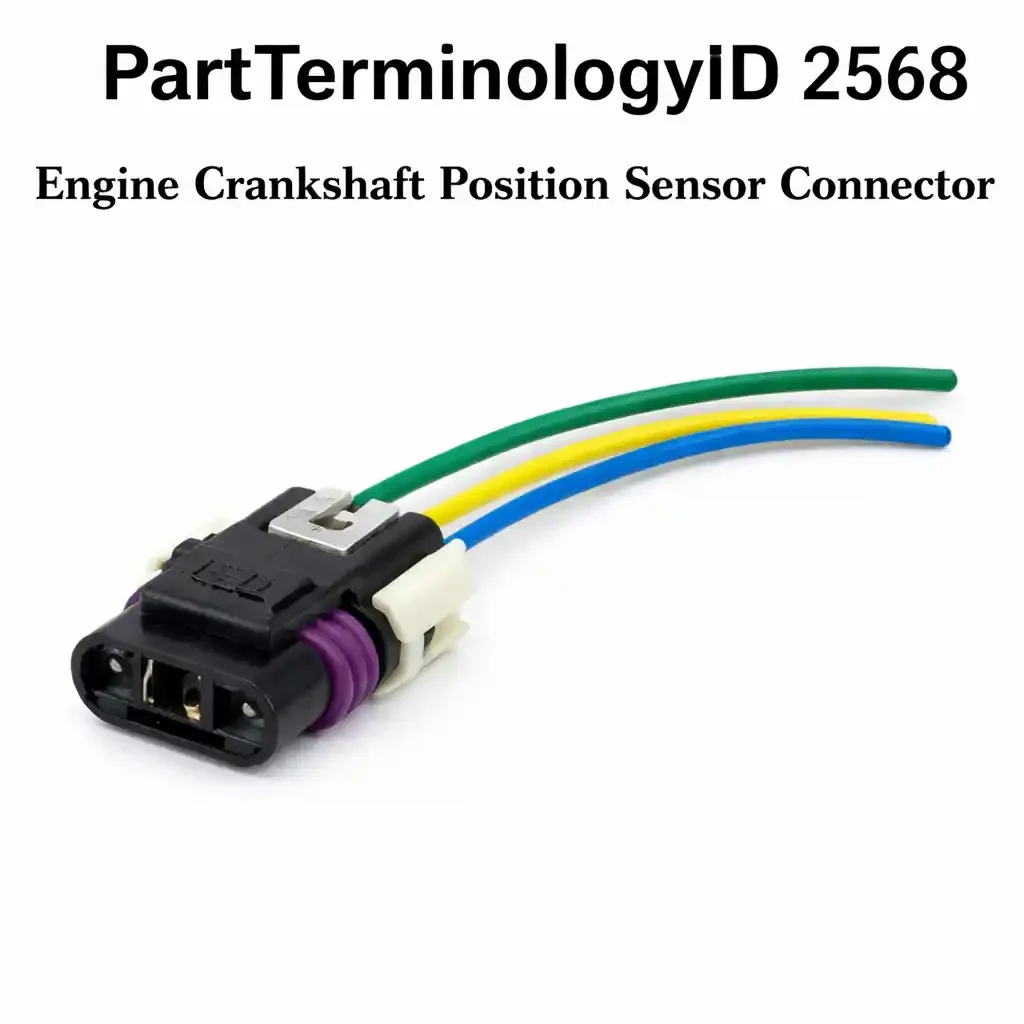
PartTerminologyID 2568, Engine Crankshaft Position Sensor Connector, is the wiring harness connector body that mates with the crankshaft position sensor, providing the electrical interface between the powertrain control module and the sensor terminals that carry the signal the PCM uses to determine crankshaft speed and position. That definition covers the function correctly. It does not specify the terminal count, which is two terminals on inductive variable reluctance sensor designs used on older domestic and import engines from the late 1970s through mid-1990s where the sensor generates its own alternating current signal through electromagnetic induction and requires no external power supply, or three terminals on Hall-effect sensor designs used on virtually all OBD-II and most late-model OBD-I applications where the PCM supplies a regulated reference voltage, a dedicated ground, and monitors a digital square wave signal through a third circuit, the connector body housing series designation, the sensor technology type distinguishing variable reluctance inductive sensors from Hall-effect digital sensors because these two sensor types are electrically incompatible and require different connector bodies, different reference voltage circuits, and produce signals the PCM cannot interpret interchangeably, the reluctor wheel tooth count matched to the sensor, which on GM LS-family engines distinguishes 24-tooth Gen III applications requiring a 12-volt reference from 58-tooth Gen IV applications requiring a 5-volt reference on a physically similar connector body, the pigtail wire gauge and length, and whether the listing covers the connector body only or a pigtail assembly. A listing under PartTerminologyID 2568 that provides vehicle year, make, and model without the terminal count, the sensor technology type, and the connector housing series cannot be evaluated by any technician replacing a heat-damaged, oil-contaminated, or physically broken CKP sensor connector at the engine block, bellhousing, or timing cover mounting location that is the sensor's operating environment.
For sellers, PartTerminologyID 2568 is the connector PartTerminologyID in this series where a complete connector failure produces the most immediate and severe drivability consequence of any engine management sensor connector in the catalog: a no-start condition. The ECM or PCM uses the CKP sensor signal as the foundational input for ignition timing, fuel injection sequencing, and cylinder misfire detection. Without a valid CKP signal, most PCMs will not authorize fuel delivery or ignition at all, because firing injectors or coils without confirmed crankshaft position creates the risk of backfire, mechanical damage, and uncontrolled combustion. The result is an engine that cranks with normal starter speed, draws battery current normally, and shows no mechanical symptoms, but refuses to start because the PCM has no confirmation of where the crankshaft is in its rotation. A connector with an intermittent open circuit produces a stall condition at operating temperature when thermal expansion causes a marginal terminal connection to open, followed by a hot restart failure that resolves after the connector cools, a symptom pattern that drives technicians through sensor replacement, fuel system testing, and ignition coil diagnosis before the connector is identified as the source. Neither the no-start condition from a complete connector failure nor the hot stall condition from an intermittent terminal fault is unique to the CKP sensor connector, but the consequence of each fault is the complete loss of engine operation rather than degraded performance with continued driveability.
The additional complexity specific to PartTerminologyID 2568 is the sensor technology argument and, within Hall-effect applications, the reference voltage argument. A variable reluctance sensor generates its own signal voltage through electromagnetic induction as reluctor wheel teeth pass the sensor's magnetic tip, producing an analog sine wave whose amplitude and frequency increase with crankshaft speed. This sensor requires no external power supply and uses two terminals, one for the signal and one for signal ground. A Hall-effect sensor contains an integrated circuit that requires a stable external reference voltage to operate its internal comparator, and produces a digital square wave output that switches cleanly between zero volts and the reference voltage regardless of crankshaft speed, including at very low speeds during cranking. This sensor requires three terminals for reference supply, ground, and signal. Connecting a three-terminal Hall-effect connector to a two-terminal variable reluctance sensor leaves one terminal without a mating pin and cannot seat fully. Connecting a two-terminal variable reluctance connector to a three-terminal Hall-effect sensor leaves the reference voltage terminal unconnected, and the sensor produces no output signal because its internal comparator has no power supply.
For sellers, the listing under this PartTerminologyID is only useful if it specifies the sensor technology type as either variable reluctance or Hall-effect, the terminal count corresponding to that technology, the connector body housing series, the reference voltage for Hall-effect sensors where the application distinguishes between 12-volt and 5-volt designs, the reluctor wheel tooth count for applications where the connector body is shared between generations using different tooth counts and different reference voltages, the wire gauge, and whether the listing is a connector body only or a pigtail assembly. Without those attributes, the listing enables the technology mismatch that produces a no-start with no fault code because the connector physically cannot seat, the reference voltage mismatch on LS-family engines where the 24x and 58x connectors share similar housing profiles but supply different reference voltages, and the intermittent terminal contact fault that produces a hot stall condition the technician cannot reproduce on a cold engine during shop diagnosis.
What the Engine Crankshaft Position Sensor Connector Does
Carrying the inductive signal on two-terminal variable reluctance designs
On engines built through the mid-1990s, and continuing on some diesel and heavy-duty applications into the present day, the crankshaft position sensor is a variable reluctance inductive pickup, also called a magnetic reluctance sensor or VRS sensor. The sensor body contains a permanent magnet and a fine wire coil wrapped around a soft iron core. As the teeth of the reluctor wheel on the crankshaft rotate past the sensor tip, the changing magnetic flux through the coil induces an alternating voltage across the coil terminals. When a reluctor tooth approaches the sensor tip, the magnetic flux increases and the coil voltage rises. When the tooth passes and the gap between teeth faces the sensor tip, the magnetic flux decreases and the coil voltage falls. The PCM reads this alternating waveform and determines crankshaft speed from the frequency of the signal, with each tooth passage producing one complete waveform cycle, and determines crankshaft position by counting tooth passages from the reference gap where one or more teeth are missing from the reluctor wheel.
The two-terminal connector carries this self-generated analog signal across the harness to the PCM. Because the VRS sensor generates its own voltage, the connector does not carry a reference supply, and terminal polarity matters: reversing the two terminals inverts the signal waveform, which most PCMs read without triggering a fault code because the waveform amplitude and frequency are unchanged, but the signal polarity mismatch may cause subtle timing errors on some applications that do not use separate cam sensor phasing. The connector body must maintain firm terminal contact because the VRS signal voltage varies directly with crankshaft speed. At idle, signal amplitude is typically in the range of 0.5 to 2 volts alternating current. During cranking, when the crankshaft spins at 100 to 200 RPM, signal amplitude is at its lowest point in the operating range. Any increase in contact resistance at this connector reduces signal amplitude during cranking, which is the moment the PCM needs the strongest possible signal to identify the reference gap and authorize fuel and ignition. A connector with degraded terminal contact that allows normal operation at idle and driving speed may fail to provide sufficient signal amplitude during the slow cranking rotation immediately after cold start on a low battery, producing a no-start condition that clears once the battery is fully charged and cranking speed recovers.
Carrying the reference voltage, ground, and signal on three-terminal Hall-effect designs
On OBD-II applications from approximately 1996 onward, and on many OBD-I fuel-injected domestic applications from the early 1990s, the crankshaft position sensor is a Hall-effect integrated circuit device. The Hall-effect sensor uses the voltage produced across a semiconductor material when a magnetic field passes perpendicular to a current flow through the material. The sensor contains a permanent magnet, a Hall-effect chip, and an internal signal conditioning circuit that converts the raw Hall voltage into a clean digital square wave. Because the internal circuit requires a stable operating voltage to produce a consistent output, the PCM supplies a regulated reference voltage, typically 5 volts on OBD-II applications, and monitors the signal through a third dedicated circuit that switches between zero volts and the reference voltage as reluctor teeth and gaps pass the sensor tip.
The three-terminal connector carries these three circuits: the reference voltage supply from PCM to sensor, the signal ground from sensor to PCM sensor ground, and the digital signal from sensor to PCM signal input. Terminal polarity and assignment are critical because swapping any two of the three terminals produces a different fault mode. Swapping the reference supply and signal terminals applies the full reference voltage to the PCM's signal input terminal while depriving the sensor of its power supply, causing the PCM to read a continuous high signal rather than a pulsing square wave, which it interprets as a maximum-frequency input and may produce a very high or stuck tachometer reading before setting a CKP fault code. Swapping the ground and signal terminals applies the sensor signal to the PCM's ground monitoring input while grounding the PCM's signal input, which grounds the input terminal directly and typically sets a circuit low fault code on the first key-on. The connector body's terminal position locking and connector body keying are the physical prevention against these transpositions, which is why the connector housing series designation is a required specification: different housing series use different terminal position assignments, and a connector body from a different housing series in the same terminal count category may accept the sensor body physically while presenting the terminals in transposed positions.
The CKP signal as the engine's primary operating authorization
The crankshaft position sensor signal is the foundational input for engine operation on all modern PCM-managed engines. The PCM uses the CKP signal for ignition timing, determining when to fire each coil for the correct cylinder relative to the crankshaft's position in its rotation. The PCM uses the CKP signal for fuel injection sequencing on sequential multiport injection systems, determining the firing order injection timing relative to each cylinder's intake valve opening. The PCM uses the CKP signal for engine speed calculation, the tachometer reading that feeds shift point logic in the transmission control module, stability control reference speed in the ABS module, and idle speed control in the throttle position control system. The PCM uses the CKP signal for cylinder misfire detection under OBD-II requirements, monitoring crankshaft deceleration between successive tooth pulses to identify the reduced torque output of a misfiring cylinder. On applications with variable valve timing, the PCM uses the CKP signal in combination with the camshaft position sensor signal to calculate cam-to-crank correlation and control the VVT actuator.
A connector fault that interrupts the CKP signal entirely does not produce degraded performance with continued driveability. It produces an engine that will not start, because the PCM will not authorize fuel injection or ignition without CKP signal confirmation. On some applications the PCM can use the camshaft position sensor signal to estimate crankshaft position and allow limited operation, typically at reduced power and with fault codes set, but this fallback mode is not universally implemented. On most domestic applications, complete loss of the CKP signal from connector failure produces a crank-no-start condition with P0335 stored in PCM memory and the check engine light illuminated after the first failed start attempt.
The Sensor Technology Mismatch: What Happens When VRS and Hall-Effect Connectors Are Confused
The most consequential connector selection error for PartTerminologyID 2568 is a mismatch between the sensor technology type and the connector terminal count. This error is most common in two scenarios: technicians replacing the connector on older vehicles that have had the original sensor updated or modified, and catalog listings that specify terminal count without specifying sensor technology type, allowing buyers to select by terminal count alone without recognizing that a two-terminal VRS connector and a two-terminal Hall-effect connector of the same housing series are not electrically equivalent.
A two-terminal Hall-effect sensor exists on some applications. These sensors are self-biased Hall-effect devices that use the vehicle's ground and the signal line to operate without a separate reference supply, producing a current-modulated output rather than a voltage-switched output. A two-terminal VRS connector installed on a two-terminal Hall-effect sensor produces no obvious physical mismatch: the connector seats and locks. The PCM receives a signal that switches between two states. On some PCMs the sensor will appear to function, and the fault condition may not manifest until the vehicle is operated under specific load or temperature conditions. This is the failure mode the terminal count specification alone cannot prevent and the sensor technology type specification can.
On the GM LS-family engines specifically, the technology mismatch takes the form of a reference voltage mismatch rather than a terminal count mismatch. Gen III LS engines (LS1, LS6, some early LS2 applications) use a 24-tooth reluctor wheel and a CKP sensor that operates on a 12-volt reference supply. Gen IV LS engines (LS2 with 58-tooth wheel, LS3, LS7, Vortec 4.8, 5.3, and 6.0 trucks from approximately 2006 onward) use a 58-tooth reluctor wheel and a CKP sensor that operates on a 5-volt reference supply. Both sensor types use a three-terminal Hall-effect connector with similar housing profile geometry. The connector tab geometry differs between the 24x and 58x versions to prevent physical interchange, but the tab difference is small and in practice connectors from different generations have been physically modified to seat on the wrong sensor. Installing a 12-volt-reference connector on a 5-volt-reference sensor applies 12 volts to a circuit rated for 5 volts, which will immediately damage the sensor's internal Hall-effect IC. Installing a 5-volt-reference connector on a 12-volt-reference sensor starves the sensor's reference supply, producing a weak or absent signal and a no-start or rough-running condition without immediately damaging the sensor. The reluctor wheel tooth count must match the sensor, the sensor must match the reference voltage the harness supplies at the connector, and the connector housing series must match the sensor body's mating profile.
The Connector's Operating Environment and Heat Resistance Requirements
The CKP sensor mounts in one of the harshest thermal locations in the engine compartment. On most domestic applications the sensor body threads or bolts directly into the engine block above the oil pan rail, below the exhaust manifold on V-configuration engines, and adjacent to the starter motor on many applications, placing the connector face in a location that receives radiant heat from the exhaust system, conducted heat through the block, and convective heat from the starter during extended cranking. On some applications including several GM V8 and V6 families, the sensor mounts at the rear of the block near the bellhousing, where it receives additional heat from the transmission converter housing.
The connector body must be rated for the sustained operating temperature at this location. The minimum connector body temperature rating for CKP sensor connectors on most domestic applications is 125 degrees Celsius, which is the sustained temperature rating for connectors in direct engine block contact environments. On applications where the connector mounts adjacent to the exhaust manifold or in the bellhousing tunnel, a 150-degree Celsius rating is appropriate. Connector bodies rated for underhood ambient temperatures of 85 to 105 degrees Celsius are not adequate for block-mounted sensor applications and will soften progressively under sustained thermal load, allowing the terminal retention tangs to relax, the connector body geometry to distort, and the latching clip to lose retention force. The result is progressive terminal contact degradation that begins at the highest operating temperatures and produces the hot stall and hot no-start symptom pattern where the vehicle fails to start or stalls after reaching operating temperature but starts normally on a cold engine.
The connector must also provide adequate protection against oil contamination. The engine block environment at the CKP sensor mounting location receives oil mist from crankcase ventilation, oil splash from the rotating assembly, and in many cases oil seepage from the front or rear main seal or valve cover gaskets on higher-mileage engines. A connector body that does not maintain positive terminal sealing against oil penetration allows oil to wick into the terminal cavity, coat the mating contact faces, and increase contact resistance progressively through oxidation and contamination accumulation. On Hall-effect sensors, oil contamination of the reference voltage terminal adds series resistance to the reference supply, causing the sensor's internal reference monitor to detect a low reference condition on some applications and suppress sensor output entirely at the temperature where oil viscosity drops and wicking rate increases.
Top Five Return Scenarios for PartTerminologyID 2568
Return Scenario 1: Hall-effect three-terminal connector installed on a variable reluctance two-terminal sensor
The buyer selects a three-terminal connector for a vehicle listed as requiring three terminals, but the vehicle's CKP sensor is an inductive variable reluctance design that uses two terminals, with the listing's three-terminal specification reflecting a generation of the model that used a Hall-effect sensor. The connector will not seat because the third terminal cavity has no mating pin in the two-terminal sensor. The buyer attempts to force the connector and damages either the sensor body or the connector housing, then returns the connector as defective. Prevention requires specifying sensor technology type, VRS or Hall-effect, as a mandatory attribute alongside terminal count, and structuring application tables by sensor technology generation when a given vehicle model used both technologies across its production run.
Return Scenario 2: Connector body only on thermally degraded factory wiring with cracked insulation
The buyer replaces a melted or cracked connector body at the CKP sensor after a high-temperature event, but the pigtail wiring back to the harness main connector has also sustained heat damage with stiff, cracked insulation and oxidized copper conductors. The connector body only installation restores the terminal mating geometry and the connector seats correctly. Within one to three heat cycles after installation, the compromised wire develops an open circuit or high resistance at a crimp or conductor break point one to three inches behind the new connector body, reproducing the P0335 fault code and the no-start symptom the buyer believed the connector replacement had resolved. The buyer returns the connector body as non-functional. Prevention requires offering the pigtail assembly option as the primary recommendation for CKP connector replacements in high-heat block environments, with the connector body only option appropriately described as suitable only for cases where the wiring has been inspected and confirmed undamaged. The pigtail should include a minimum of 12 inches of wire per terminal to allow a clean splice past any heat-affected wiring near the sensor mounting location.
Return Scenario 3: 24x connector on 58x sensor at GM LS engine application
The buyer replaces a CKP sensor connector on a GM LS-platform vehicle and selects a connector based on vehicle year, make, and model matching in the application table, but the vehicle has undergone an engine swap that replaced the original Gen III engine with a Gen IV engine or vice versa, or the original engine's reluctor wheel has been replaced with a different tooth count during a rebuild. The connector from the application table matches the original vehicle specification but not the installed engine. On a 24x-to-58x direction, the 12-volt reference in the 24x connector damages the 5-volt-rated Hall-effect IC in the 58x sensor immediately on first key-on, and the sensor must be replaced along with the correct connector. The buyer returns the connector for fitment mismatch and the failed sensor as a separate warranty claim. Prevention requires including reluctor wheel tooth count, 24x or 58x, as a mandatory labeled attribute in LS-platform application listings, with a note that engine swap applications must verify the installed engine's reluctor specification rather than relying on the vehicle's original factory specification.
Return Scenario 4: Connector body temperature rating insufficient for bellhousing-adjacent mounting location
The buyer replaces a CKP sensor connector on a rear-mount block application adjacent to the transmission bellhousing and starter, selecting a connector body with an 85-degree Celsius temperature rating appropriate for general underhood ambient locations. The connector installs correctly, seats fully, and the vehicle starts and operates normally during a brief post-installation test. Over the following two to four weeks of normal operation, the sustained thermal load at the bellhousing location softens the connector body, allowing the terminal retention lances to relax from the terminal bodies and the connector body geometry to distort slightly at the latch. The terminal contact force decreases as the connector body softens, and P0335 or P0339 intermittent fault codes appear during hot operation, followed by the connector unseating progressively until contact is lost entirely. The buyer returns the connector as defective because the installation was correct and the connector functioned initially. Prevention requires specifying the minimum 125-degree Celsius temperature rating for all block-mount CKP connector applications, with 150-degree Celsius ratings specified for applications where the sensor mounts adjacent to the exhaust manifold or in the bellhousing tunnel.
Return Scenario 5: Terminal count match on a shared housing series with transposed terminal positions between applications
The buyer selects a three-terminal CKP connector pigtail that matches the connector housing profile and terminal count for the application, but the pigtail's terminal position assignment places the reference voltage wire at position A, the signal at position B, and the ground at position C, while the application requires reference at position C, signal at position A, and ground at position B. The connector seats fully and latches, the locking tab engages, and visually the installation appears correct. At first key-on, the PCM applies its 5-volt reference to the position it expects to see the signal, effectively grounding the sensor's internal circuit through the PCM's signal input, while the reference supply terminal receives the sensor's signal output. The PCM sets a CKP circuit fault on the first crank attempt and the engine does not start. The buyer assumes the connector is defective, removes it, and discovers that the terminal position assignments differ from the application's wiring diagram. Prevention requires specifying the terminal position assignment by cavity letter at each pigtail position, publishing a wiring diagram reference image in the product listing, and structuring application tables by connector housing series and terminal position assignment rather than by vehicle year, make, and model alone, which does not capture within-model variation in terminal assignment that occurs between model years on shared platforms.
Specification Attributes Required for PartTerminologyID 2568 Listings
Sensor technology type: Variable reluctance inductive (VRS) or Hall-effect digital. This is the attribute that determines terminal count, reference voltage requirement, and signal type. It must appear as a labeled field visible to the buyer before the vehicle application table, not inferred from terminal count alone.
Terminal count: Two terminals for VRS applications, three terminals for Hall-effect applications. Must match the sensor body's mating terminal count, not the harness-side terminal count if the two differ due to previous non-standard repair.
Reference voltage for Hall-effect applications: 5 volts for OBD-II standard applications, 12 volts for GM Gen III LS (24x) applications and some earlier OBD-I applications. This attribute prevents the reference voltage mismatch that damages the sensor's internal IC on first key-on.
Reluctor wheel tooth count for GM LS applications: 24x for Gen III applications (LS1, LS6, early LS2), 58x for Gen IV applications (late LS2, LS3, LS7, 4.8, 5.3, 6.0, 6.2 truck variants). This attribute prevents the cross-generation connector application that produces either sensor damage (12 volts on a 5-volt sensor) or a no-start (5 volts on a 12-volt sensor).
Connector body housing series designation: The series designation that identifies the physical connector family, terminal pitch, latch style, and terminal position assignment. Two connectors with identical terminal counts may belong to different housing series with different terminal position assignments.
Terminal position assignment: The reference, signal, and ground position for each cavity by letter or number, with reference to the sensor-side or harness-side perspective clearly stated. For pigtail assemblies, wire color at each terminal position must be specified.
Connector body temperature rating: Minimum 125 degrees Celsius for block-mount applications in standard underhood locations, 150 degrees Celsius for exhaust-adjacent or bellhousing-tunnel mounting locations.
Oil sealing: Whether the connector body provides oil-resistant terminal seals for block-mount applications in the crankshaft main journal region.
Wire gauge: 18 gauge for standard Hall-effect signal circuits, 16 gauge for reference voltage and ground circuits on high-load applications, with the gauge specified per terminal on three-terminal pigtail assemblies.
Pigtail length: Minimum 12 inches per terminal for block-mount and bellhousing-adjacent applications where the harness connection point is remote from the sensor mounting location.
Cross-Sell Logic
Engine Crankshaft Position Sensor: Before attributing P0335 to the connector, confirm signal output with the connector reinstalled by back-probing the signal terminal while cranking. A VRS sensor should produce an alternating voltage signal at cranking speed; a Hall-effect sensor should produce a square wave switching between zero and the reference voltage. No signal with correct reference voltage present at the supply terminal and correct ground continuity confirmed on the ground terminal indicates a failed sensor, not a failed connector. Replacing the sensor into a connector with degraded terminals will reproduce the intermittent P0335 condition on the new sensor.
Crankshaft Position Sensor Pigtail Repair Kit: For applications where the connector body is damaged but the terminal contacts and wiring are in serviceable condition, a pigtail repair kit that includes replacement terminal bodies and seals allows re-termination of the existing wires rather than a full connector-to-splice replacement. Appropriate for applications where the wiring back to the main harness has been inspected and confirmed free of heat damage, oil soaking, or conductor corrosion.
Engine Camshaft Position Sensor Connector (adjacent PartTerminologyID): On many applications the CKP and CMP sensor connectors are replaced at the same service event because both sensors share the same block-mount thermal environment, use connectors from the same housing series family, and are accessed through the same engine underbody service position. Inspect the camshaft position sensor connector for the same heat damage and oil contamination patterns when the crankshaft position sensor connector is replaced.
Electrical Contact Cleaner and Dielectric Grease: For connector body only replacements where the terminal contact faces show early-stage surface oxidation from oil mist exposure, contact cleaner applied to the terminal mating faces before reassembly displaces oil film and residual oxidation. Dielectric grease applied to the terminal faces before mating slows future oil and moisture contamination accumulation at the block-mount location. Do not apply dielectric grease inside the terminal contact zone on VRS applications where signal voltage amplitude is already at its lower limit during slow cranking, because any added contact interface film will increase effective contact resistance and may reduce signal amplitude below the PCM's detection threshold.
Frame as: "The CKP sensor tells the PCM where the crankshaft is in its rotation hundreds of times per second. That number is what the PCM uses to fire the coils, open the injectors, and watch for misfires. If the connector fails completely, the engine cranks and will not start. If the connector fails intermittently, the engine stalls at the worst possible moment and may not restart until the connector cools down. The sensor technology type, the terminal count, and the reference voltage all have to match. Getting the terminal count right but the sensor technology wrong means the connector either will not seat or will seat incorrectly and produce no signal. Getting both right but the reference voltage wrong on an LS-family engine means the sensor is damaged on the first key cycle."
Final Take for PartTerminologyID 2568
Engine Crankshaft Position Sensor Connector (PartTerminologyID 2568) is the connector PartTerminologyID in this series with the lowest fault tolerance for incorrect specification. Where other connector PartTerminologyIDs in this series produce degraded performance with continued driveability when the wrong connector is installed, PartTerminologyID 2568 produces either a complete no-start on first engine operation or an immediate sensor component failure that requires replacing the sensor along with the connector. There is no intermediate operating condition, no fault-code-only outcome without drivability consequence, and no gradual onset that allows the fault to be identified and corrected before the vehicle becomes immobile.
The sensor technology type distinction between variable reluctance and Hall-effect is the attribute that prevents the terminal count match on an incompatible sensor type. The reference voltage specification is the attribute that prevents the sensor IC damage on GM LS-platform cross-generation installations. The connector body temperature rating is the attribute that prevents the progressive terminal retention loss in the block-mount bellhousing thermal environment. The terminal position assignment specification is the attribute that prevents the correctly-seated incorrectly-wired connector that produces a circuit fault code on first key-on without any visual indication that the connector is in the wrong position.
State the sensor technology type as the first mandatory labeled attribute, before vehicle application, before terminal count, and before any other specification. State the terminal count consistent with that technology type. State the reference voltage for Hall-effect applications, including the 24x or 58x reluctor wheel designation for GM LS-platform applications where that designation determines the reference voltage and connector locating tab geometry. State the connector body housing series and the terminal position assignment by cavity designation. State the temperature rating appropriate to the sensor's mounting location category, distinguishing standard block-mount from exhaust-adjacent and bellhousing-tunnel locations. State the pigtail wire gauge per terminal and the pigtail length. Include a note that engine swap applications must verify the installed engine's sensor technology type and reluctor wheel tooth count independently of the vehicle's original factory specification.
Those are the specification attributes that allow the buyer to select the correct connector with confidence and allow the replacement to restore full CKP signal integrity from the first crank cycle, which is the operating moment that determines whether the engine starts or remains stationary.