
Written by Arthur Simitian | PartsAdvisory
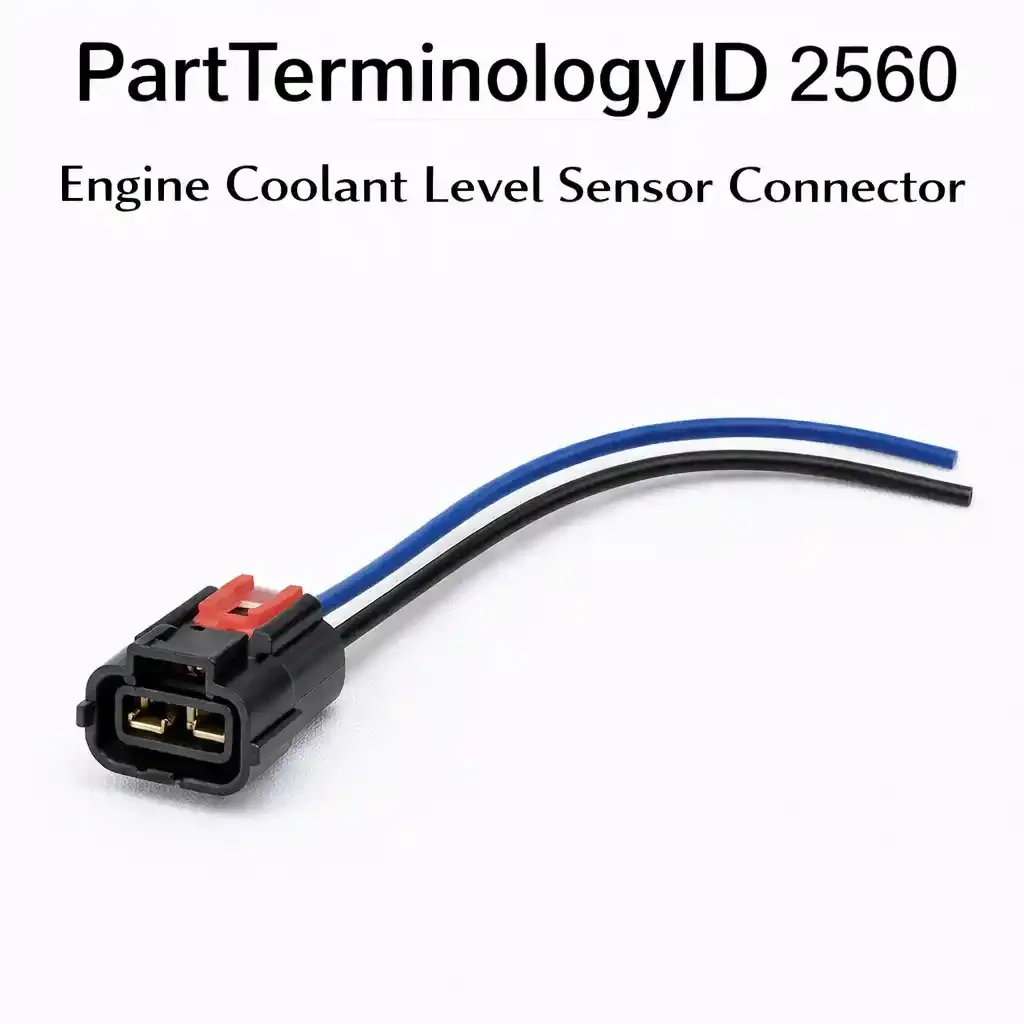
PartTerminologyID 2560, Engine Coolant Level Sensor Connector, is the wiring harness connector body that mates with the coolant level sensor mounted in or on the coolant expansion tank, surge tank, or radiator overflow reservoir, providing the electrical interface between the vehicle's instrument cluster warning circuit or ECM coolant level monitoring input and the sensor terminals that carry the signal indicating whether coolant is present at or above the sensor's detection point. That definition covers the function correctly. It does not specify the terminal count, which is two terminals on the dominant float-type reed switch design used on passenger vehicles where the sensor is a simple switch that either completes or opens a ground circuit, or three terminals on ECM-integrated conductivity probe and analog sensor designs used on diesel trucks and heavy-duty commercial vehicles where the ECM supplies a 5-volt reference voltage, monitors a signal return, and uses a dedicated circuit ground, the connector body housing series designation, the sensor logic type, whether the sensor is normally open with the circuit opening on low-coolant to illuminate the warning lamp through a pull-up resistor, or normally closed with the circuit closing on low-coolant to ground the warning lamp directly, the coolant contact rating of the connector body and terminal materials for sensors mounted inside the expansion tank where the connector face is exposed to hot pressurized coolant, the expansion tank or surge tank model designation as the primary fitment attribute, the pigtail wire length and gauge, and whether the listing covers the connector body only or a pigtail assembly. A listing under PartTerminologyID 2560 that provides vehicle year, make, and model without the terminal count, the sensor logic type, and the expansion tank designation cannot be evaluated by any technician replacing a cracked, corroded, or coolant-contaminated coolant level sensor connector and confirming the replacement before draining the cooling system to access the sensor mounting point.
For sellers, PartTerminologyID 2560 is the connector PartTerminologyID in this series where the consequence of a connector fault is uniquely asymmetric: one failure mode produces a persistent false low-coolant warning that the driver can observe and act on, and the opposite failure mode, a connector fault that mimics a full coolant level, prevents the warning system from alerting the driver to actual coolant loss, allowing the engine to continue operating without coolant level protection until overheating occurs. A connector with a broken terminal, an open-circuit wire, or a corroded contact on a normally-open reed switch design will leave the sensor circuit permanently open, which the warning system interprets as low coolant, producing a persistent false warning that the driver and technician attribute to a failed sensor. A connector with an intermittent connection on a normally-closed conductivity probe design will leave the signal circuit intermittently open, which the ECM interprets as low coolant only when the connection drops, but a connector fault that holds the signal circuit in the closed position by creating a conductive path between the signal terminal and ground within the connector body will tell the ECM that coolant is always present regardless of the actual level in the expansion tank, silently disabling the low-coolant warning. These two failure modes, one obvious, one invisible, are determined by the sensor logic type, and the sensor logic type must be stated in every listing under this PartTerminologyID because the same connector body profile may be used on both normally-open and normally-closed sensor designs across different vehicle applications.
For sellers, the listing under this PartTerminologyID is only useful if it specifies the expansion tank or surge tank designation as the primary fitment attribute, the terminal count, the sensor logic type, the coolant contact rating for in-tank sensor applications, the connector body housing series, the wire gauge and pigtail length, and whether the listing is a connector body only or a pigtail assembly. Without those attributes, the listing enables the sensor logic type mismatch that produces a permanently illuminated false warning, the coolant contact material failure that dissolves the connector body seals inside the expansion tank, and the terminal count mismatch that leaves a 5-volt reference terminal unconnected on a three-wire ECM-integrated sensor.
What the Engine Coolant Level Sensor Connector Does
Completing the low-coolant warning circuit on two-terminal reed switch designs
On passenger vehicles from the 1980s onward, the coolant level sensor is a magnetically activated reed switch mounted at the base or side of the plastic coolant expansion tank. A permanent magnet is attached to a float that rides on the coolant surface. When coolant is at or above the sensor's detection height, the float holds the magnet in proximity to the reed switch, keeping the switch contacts in their normal operating position. When coolant drops below the detection height, the float falls, moving the magnet away from the reed switch and changing the switch contact state. The connector carries two wires: a signal wire from the instrument cluster or PCM warning circuit, and a ground wire or a return circuit to the instrument cluster. No reference voltage is supplied to the sensor because the reed switch generates no signal independently, it either completes or opens the circuit between the two terminals.
The two-terminal reed switch design is the dominant configuration on light-duty passenger vehicles including BMW, GM, Ford, Honda, Toyota, and Volkswagen expansion tank applications. On most of these designs, the reed switch is sealed inside an air cavity at the bottom of the expansion tank, isolated from direct coolant contact by the tank's plastic body. The connector mates with two terminals on the exterior of the tank's sensor port, which is exposed to ambient underhood conditions rather than coolant. On these applications, the connector body material does not require coolant immersion rating because the connector face is never submerged. On designs where the sensor threads into the tank wall from the outside and the terminal face protrudes into the underhood environment, standard underhood temperature and moisture resistance is sufficient.
Carrying the 5-volt reference, signal, and ground on three-terminal ECM-integrated designs
On diesel trucks, heavy-duty commercial vehicles, and some late-model gasoline engines with fully integrated HVAC and powertrain ECMs, the coolant level sensor is a three-terminal device that receives a 5-volt reference voltage from the ECM, returns a signal voltage whose level depends on whether the sensor's conductive probe tips are immersed in coolant or exposed to air, and uses a dedicated signal ground circuit. The ECM monitors the signal voltage continuously and compares it to calibrated thresholds to determine coolant presence, coolant level trend, and sensor circuit integrity. On conductivity probe designs, the two probe tips use the coolant itself as a conductive medium between them: when coolant is present and covers both tips, current flows from the reference terminal through the coolant to the signal return terminal, producing a measurable voltage at the signal input. When coolant is absent, the circuit between the probe tips is open, the signal voltage drops toward ground, and the ECM interprets the voltage below threshold as low coolant.
On three-terminal designs, the terminal count and circuit assignment are non-negotiable: the 5-volt reference, signal return, and ground must each seat at the correct terminal position or the ECM will receive an out-of-range signal on first key-on and set a sensor circuit fault code rather than a low-coolant warning. A connector with two terminal cavities on a three-terminal sensor will leave one terminal cavity unmated, and depending on which terminal is unconnected, reference, signal, or ground, the ECM will interpret the missing voltage as either a continuous low-coolant condition or a sensor circuit fault, producing fault codes that cannot be diagnosed without identifying the terminal count mismatch at the connector.
The sensor logic type argument: normally open versus normally closed
The sensor logic type determines whether a connector fault produces a false warning or disables the warning silently, and it also determines whether a replacement connector with a corroded or conductive body creates a dangerous condition or merely an annoying one.
On normally-open reed switch designs, the reed switch contacts are open when no magnet is present (low coolant). The instrument cluster warning circuit holds the signal wire at a reference voltage through a pull-up resistor. When the switch is open, the signal wire stays at the pull-up voltage, and the PCM or cluster interprets this as low coolant, illuminating the warning lamp. When the switch closes (coolant present, float up, magnet near reed), the signal wire is pulled to ground through the switch, extinguishing the warning. On this design, a broken connector wire or corroded terminal that creates an open circuit in the harness is indistinguishable from an open reed switch, producing a persistent false low-coolant warning that drives the technician to replace the sensor. A connector body that develops internal contamination or a conductive film between the two terminal cavities will short the signal wire to ground, which the PCM interprets as the switch closed, the full-coolant state, regardless of actual coolant level. This is the silent failure mode on normally-open designs: a connector that shorts its two terminals to each other tells the PCM coolant is always present.
On normally-closed designs used on some conductivity probe applications, the logic is inverted. The connector must carry the signal circuit faithfully in both states for the ECM to detect both normal coolant presence and low-coolant conditions. An open connector fault on these designs also produces a false alarm, but the specific fault code and the diagnostic procedure differ from the normally-open design. State the sensor logic type in the listing so the technician can predict which connector fault produces which symptom before installing the replacement.
Why the expansion tank designation is the primary fitment attribute
The coolant level sensor connector's physical profile, terminal pitch, connector body external dimensions, locking mechanism, and wire exit geometry, is determined by the sensor's terminal arrangement on the expansion tank or surge tank, not by the vehicle year, make, and model directly. The same vehicle model may use expansion tanks from different suppliers across its production run, or may use different tank designs for different engine or market variants, each with a different sensor terminal arrangement. A connector listed for a vehicle year, make, and model without the expansion tank designation cannot be confirmed correct if the vehicle has been fitted with an aftermarket expansion tank, a dealer-replacement tank from a different supplier than the original, or an expansion tank from a different model year that was used as a substitute during a repair.
On heavy-duty diesel applications, the coolant level sensor connector is specified at the surge tank and engine control system level, not at the vehicle level. A Cummins ISX surge tank uses a different sensor and connector than a Detroit DD15 surge tank, and both may be installed in the same truck body across a fleet.
The Specifications That Determine Correct Engine Coolant Level Sensor Connector Fitment
Terminal count: two or three
Two terminals for reed switch and simple float-switch designs. Three terminals for ECM-integrated conductivity probe and analog voltage output designs. The terminal count is the first specification to determine because a two-terminal connector on a three-terminal sensor leaves one terminal cavity empty, and a three-terminal connector on a two-terminal sensor has a third cavity that may physically prevent full seating on the sensor's two-terminal housing. State the terminal count and the circuit assignment at each position.
Sensor logic type: normally open or normally closed
Normally open reed switch: switch open equals low coolant, switch closed equals coolant present. A harness open-circuit fault mimics low coolant (false warning). A harness short between the two signal wires mimics coolant present (silent failure, no warning on actual low coolant). Normally closed: reverse logic with corresponding failure mode directions. On three-terminal ECM designs, state whether the signal output is a voltage-present-when-submerged or voltage-absent-when-submerged conductivity probe, because these two sub-types produce different diagnostic symptoms when the connector is faulty. State the sensor logic type in the listing as a mandatory attribute.
Expansion tank or surge tank designation
The primary fitment attribute. The connector body profile is matched to the sensor terminal geometry on the specific expansion tank model. An expansion tank model designation includes the tank part number or OEM supplier designation and the sensor port geometry. Do not rely on vehicle year, make, and model as the primary fitment attribute. State the expansion tank designation and the OEM part number or aftermarket tank designation alongside the vehicle application.
Coolant contact rating of connector body and terminal materials
On sensors whose connector face is exposed to coolant, sensors that thread through the tank wall from inside, or sensors on pressurized surge tank ports where coolant can reach the connector face during pressure cycling, the connector body material and the terminal seals must be rated for continuous contact with hot pressurized ethylene glycol or OAT coolant at the maximum cooling system pressure. Standard underhood-rated connector body materials that are not specifically validated for coolant immersion will swell, crack, or delaminate at the terminal seals when coolant contacts them, allowing coolant to enter the terminal cavities and corrode the terminal contact faces. The result is the same progressive resistance increase at the signal terminal that appears in oil-contaminated sensor connectors, but driven by coolant electrolyte rather than oil, and progressing faster because pressurized coolant is a more aggressive electrolyte than ambient oil vapor.
On sensors mounted outside the tank whose connector face is exposed only to underhood ambient, coolant contact rating is not required, and the connector body only needs standard underhood temperature and moisture resistance.
Connector body temperature rating
The expansion tank or surge tank location places the connector in the underhood thermal environment, typically within 100 to 200mm of the coolant hose connections and occasionally adjacent to the upper radiator hose or heater core supply hose. Sustained ambient temperatures at the sensor connector location can reach 100 to 115 degrees Celsius on vehicles where the expansion tank is mounted close to the engine. A connector body rated below 105 degrees Celsius will not maintain its terminal retention geometry at this location over the vehicle's full service life. State the connector body temperature rating.
Wire gauge and pigtail length
On two-terminal reed switch designs, the signal wire typically carries milliampere-level currents, only the current drawn through the pull-up resistor and the reed switch contacts, so 20 to 22-gauge wire is standard and adequate. On three-terminal ECM-integrated designs, the reference supply wire carries the current of the conductivity probe circuit, which may be higher depending on the probe's resistance when submerged; 18-gauge wire is appropriate for these applications. Pigtail length must reach from the expansion tank sensor port to the harness junction without tension. On tanks mounted at the engine bay corner near the firewall or strut tower, the pigtail may need 12 to 18 inches of length. State the wire gauge at each terminal position and the total pigtail length.
Status in New Databases
PIES/PCdb: PartTerminologyID 2560, Engine Coolant Level Sensor Connector
PIES 8.0 / PCdb 2.0: No change
Top Return Scenarios
Scenario 1: "Three-terminal connector installed on two-terminal reed switch sensor, third cavity blocks sensor seating, connector rocked on two terminals, intermittent circuit open, persistent false low-coolant warning"
The listing specified a coolant level sensor connector by vehicle year, make, and model without stating the terminal count. The vehicle has a two-terminal normally-open reed switch sensor on a GM plastic expansion tank. The replacement connector is a three-terminal housing from a heavy-duty truck application that appeared in the cross-reference for this vehicle based on a housing series match that did not account for the terminal count difference. The third terminal cavity on the replacement connector housing interfered with a locating boss on the two-terminal sensor port, preventing the connector from seating flush. The connector seated at approximately 70 percent of designed engagement depth, with the two active terminals making intermittent contact across the exposed contact faces. Engine vibration cycled the connector between partial and open contact, producing an intermittent open circuit that illuminated the low-coolant warning lamp on rough road surfaces and extinguished it on smooth roads. The sensor was replaced twice before the connector's terminal count mismatch was identified.
Prevention language: "Terminal count: [2-terminal reed switch / 3-terminal ECM-integrated probe]. The two-terminal reed switch design used on this expansion tank requires a 2-terminal connector. A 3-terminal connector housing will not seat flush on a 2-terminal sensor port. Confirm the terminal count on the original sensor and connector before ordering. The terminal count is visible on the sensor port face: two terminal pins indicates a 2-terminal design, three pins indicates a 3-terminal ECM-integrated design. These two connector types are not interchangeable."
Scenario 2: "Replacement connector body not coolant-contact rated, sensor mounts through tank wall, connector face exposed to pressurized coolant, terminal seals swell and delaminate within 18 months"
The listing specified a coolant level sensor connector pigtail by vehicle year, make, and model without stating the coolant contact rating. The sensor on this application threads through the expansion tank wall from the coolant side, with the sensor body seated inside the tank and the terminal face protruding through the tank wall. During pressure cycling as the cooling system heats and cools, pressurized coolant contacts the connector face and the terminal seal perimeter at each pressure cycle peak. The replacement connector body uses a standard underhood-rated nylon housing and a foam perimeter seal not validated for coolant immersion. Over 18 months of pressure cycling, the coolant swelled the foam seal, allowed coolant to enter the terminal cavity area, and deposited a green electrolytic film on both terminal contact faces. The signal wire terminal developed 4.2 ohms of contact resistance from the corrosion film. The PCM interpreted the signal voltage drop as an intermittent low-coolant condition and set a coolant level sensor circuit fault code alongside the warning lamp illumination.
Prevention language: "Coolant contact rating: [required, connector face exposed to pressurized coolant / not required, connector face in underhood ambient only]. On this sensor application, the connector face contacts pressurized engine coolant during cooling system pressure cycling. The connector body material and terminal seals must be rated for continuous contact with hot ethylene glycol or OAT coolant at the cooling system's maximum operating pressure. A standard underhood connector body with foam sealing at the terminal face will allow coolant to reach the terminal contact surfaces and produce progressive contact resistance increase that presents as an intermittent low-coolant fault code."
Scenario 3: "Sensor logic type not stated in listing, normally-open connector replacement used on normally-closed design application, symptom direction inverted, technician cannot correlate test results to fault condition"
The listing specified a coolant level sensor connector without stating the sensor logic type. The vehicle's three-terminal ECM-integrated conductivity probe sensor uses a normally-closed signal design: when the probe tips are submerged in coolant, the conductivity between the tips holds the signal terminal at a low voltage near ground; when the probe tips are exposed to air on low coolant, the signal terminal rises toward the 5-volt reference through an internal pull-up. The technician sourced a replacement connector pigtail listed for a normally-open three-terminal design that routes the signal wire to a different terminal position than the normally-closed design. When the new pigtail was installed with the terminal color-coding from the replacement rather than the original, the reference and signal wires were transposed. The ECM received reference voltage on the signal input and signal voltage on the reference output, placing both circuits out of range simultaneously. The ECM set fault codes for both the signal circuit and the reference circuit, which the technician interpreted as ECM damage rather than a transposed connector.
Prevention language: "Sensor logic type: [normally open, open circuit equals low coolant / normally closed, closed circuit equals low coolant / three-terminal ECM probe, 5V reference, signal return, ground]. The sensor logic type determines circuit assignment at each terminal position and predicts which fault condition a connector wiring error will produce. On this application, transposing the reference and signal wires places both ECM input channels out of range simultaneously, setting reference circuit and signal circuit fault codes that present as ECM damage rather than a connector wiring error. Confirm the sensor logic type and circuit assignment at each terminal position before installing the replacement pigtail."
Scenario 4: "Connector body only sourced, original pigtail signal wire corroded at connector entry from coolant vapor condensation on wire insulation over 12 years, corrosion continues into new connector through splice within 8 months"
The original coolant level sensor connector body had cracked at the wire entry from repeated thermal cycling adjacent to the expansion tank. The buyer sourced a connector body only and retained the original pigtail wires. The original signal wire insulation at the connector entry showed white crystalline deposits at the insulation surface, coolant mineral deposits from condensation of coolant vapor on the wire as it passed through the expansion tank's thermal plume. The technician did not recognize the deposits as mineral contamination evidence and spliced the new connector body terminals onto the original wires 15mm behind the original connector. Over the following 8 months, the mineral deposit zone in the original wire extended through the splice point by capillary action along the wire strand bundle, reaching the new terminal contact faces and depositing an insulating mineral film that increased signal circuit resistance to 6.8 ohms. The low-coolant warning lamp illuminated intermittently during cold starts, when the high mineral deposit concentration and low ambient temperature combined to maximize the resistive barrier at the terminal interface.
Prevention language: "Listing type: [connector body only / pigtail assembly with [X] inches of new wire]. If the original pigtail wire shows white or greenish crystalline mineral deposits on the insulation surface at the connector entry, caused by coolant vapor condensation on the wire adjacent to the expansion tank, source a pigtail assembly long enough to place the splice point beyond the mineral-contaminated section of the original harness. Coolant mineral deposits wick along wire strand bundles by capillary action and will reproduce the terminal contamination in a new connector body if the splice is made within the contaminated wire section."
Scenario 5: "Aftermarket expansion tank installed after original tank failure, aftermarket tank uses different sensor port geometry than OEM, OEM connector profile does not seat on aftermarket sensor"
The vehicle's original expansion tank cracked and was replaced with an aftermarket unit. The aftermarket tank uses a sensor port profile from a different OEM supplier than the original tank's sensor port. The sensor port on the aftermarket tank has a different external body width, a different terminal pitch of 7.2mm versus the OEM's 6.0mm, and a different locking tab position. The OEM replacement connector listed for this vehicle by year, make, and model is matched to the OEM expansion tank's sensor port geometry. The OEM connector would not seat on the aftermarket tank's sensor port, the narrower OEM terminal pitch produced terminal misalignment of 1.2mm per terminal, preventing terminal engagement below 50 percent of designed depth. The low-coolant warning lamp stayed illuminated permanently because the partial terminal engagement left the circuit in the open state continuously.
Prevention language: "Expansion tank designation: [OEM tank part number / aftermarket tank manufacturer and model]. The connector body profile is matched to the sensor port geometry of the specific expansion tank model, not to the vehicle year, make, and model. If the original expansion tank has been replaced with an aftermarket unit, the aftermarket tank's sensor port geometry may differ from the OEM tank. Identify the expansion tank manufacturer and model currently installed in the vehicle and confirm the sensor port geometry before sourcing the replacement connector. Sourcing a connector matched to the OEM expansion tank when an aftermarket tank is installed will produce a terminal pitch mismatch that prevents full connector seating."
What to Include in the Listing
Core essentials
PartTerminologyID: 2560
Component: Engine Coolant Level Sensor Connector
Expansion tank or surge tank designation (mandatory, primary fitment attribute, OEM part number or aftermarket manufacturer and model)
Terminal count: 2 or 3 (mandatory)
Circuit assignment at each terminal position: signal and ground for 2-terminal; 5-volt reference, signal return, and ground for 3-terminal (mandatory)
Sensor logic type: normally open or normally closed (mandatory); on 3-terminal designs, specify whether signal voltage is present when submerged or absent when submerged
Coolant contact rating: required or not required, based on whether the connector face contacts coolant (mandatory)
Connector body housing series designation (mandatory)
Connector body temperature rating in degrees Celsius (mandatory)
Wire gauge at each terminal position (mandatory)
Pigtail wire length in inches and millimeters (mandatory)
Pigtail or connector body only (mandatory)
Quantity: 1
Fitment essentials
Expansion tank designation as primary fitment attribute
Vehicle year, make, model, submodel as secondary fitment attribute
Engine designation where expansion tank or sensor design differs by engine within the same vehicle
Aftermarket expansion tank fitment note where the connector profile differs from OEM
Production date range where an expansion tank model transition exists within a vehicle model year
Dimensional essentials
Connector body overall length in mm
Connector body width in mm
Terminal pitch in mm
Connector body external profile dimensions at sensor port mating face in mm
Wire exit angle in degrees
Image essentials
Connector from the terminal-entry face showing the terminal count and cavity arrangement with circuit assignment labeled at each position
Connector shown mated to the expansion tank sensor port with the locking mechanism engaged, demonstrating the profile match
Two-terminal and three-terminal connectors shown side by side where both types appear in vehicle application ranges sharing the same housing series
Coolant-contaminated original connector shown alongside undamaged replacement to illustrate the mineral deposit pattern at the terminal entry and the seal delamination visible at the connector face
Pigtail shown full length with wire gauge and length callout, and signal wire labeled separately for polarity-critical three-terminal designs
Catalog Checklist for ACES/PIES Teams
PartTerminologyID = 2560
Require expansion tank or surge tank designation as primary fitment attribute (mandatory, vehicle application alone does not resolve connector profile when aftermarket tanks are common in this failure category)
Require terminal count (mandatory)
Require sensor logic type (mandatory, this is the specification that determines whether a connector fault produces an obvious false warning or a silent failure that disables engine protection)
Require coolant contact rating (mandatory, in-tank sensor applications require coolant-immersion-rated materials that standard underhood connectors do not provide)
Require connector body temperature rating (mandatory)
Require wire gauge per terminal position (mandatory)
Differentiate from engine coolant temperature sensor connector: the coolant temperature sensor measures coolant temperature via a thermistor and carries a resistance-based signal; the coolant level sensor detects coolant presence via a float switch or conductivity probe and carries a binary or threshold voltage signal; the two sensors are often mounted in proximity on the expansion tank or thermostat housing but serve different ECM input circuits with different connector housings and different terminal counts
Differentiate from coolant expansion tank: the expansion tank is the plastic fluid reservoir; the sensor connector is the harness interface to the sensor mounted on or in the tank; a faulty connector does not require tank replacement if the tank is confirmed undamaged; the connector and the tank are separate line items under separate PartTerminologyIDs
Flag sensor logic type as mandatory: this is the specification that distinguishes between two failure modes with opposite safety consequences, a normally-open connector fault that produces an obvious persistent false warning versus a connector fault on a normally-open design that mimics the full-coolant state and silently disables the warning
Flag coolant contact rating as mandatory: standard underhood connector body materials not rated for coolant immersion will delaminate at the terminal seals on in-tank sensor applications within one to two service seasons, producing progressive coolant contamination at the terminal faces that presents as sensor failure rather than connector material specification error
Flag expansion tank designation as mandatory primary attribute: aftermarket expansion tanks with different sensor port geometry than OEM tanks are common in this failure category because tank failure often precedes sensor connector failure; the technician who replaced the tank before addressing the connector is the typical buyer, and this buyer's vehicle no longer matches the OEM expansion tank designation
FAQ (Buyer Language)
How do I know if my coolant level sensor uses a normally-open or normally-closed circuit?
The simplest test is to unplug the connector from the sensor and observe the warning lamp with the key on. If the low-coolant warning lamp illuminates when you unplug the connector, the sensor uses a normally-open circuit design, the warning circuit pulls the signal wire high through a pull-up resistor, and unplugging the sensor creates the same open circuit that low coolant would create. If the warning lamp goes out or does not change when you unplug the connector, the design uses a normally-closed or actively switched circuit. You can also test by momentarily shorting the two wires on the harness side of the connector with a small jumper: on a normally-open design, shorting the harness wires simulates the closed switch (full coolant) and should extinguish the warning lamp. If shorting the wires illuminates the lamp, the design is normally closed.
My coolant level warning lamp is on but the coolant level is correct. Could the connector be the cause?
Yes, and this is the most common presentation for a failed coolant level sensor connector on normally-open reed switch designs. A connector with a corroded terminal, a broken wire at the connector entry, or a cracked body that separates the terminal from its wire creates an open circuit in the signal path. On a normally-open reed switch design, an open circuit anywhere between the sensor and the instrument cluster produces the same signal as a low-coolant condition: the warning lamp illuminates. Before replacing the sensor, inspect the connector body for cracks at the terminal entry, pull gently on the pigtail wires to check for broken wires at the crimp, and measure the connector's contact resistance with a multimeter by back-probing the terminal faces. A reading above 0.5 ohms indicates contact degradation requiring connector replacement before sensor replacement.
What is the risk of a coolant level sensor connector fault that shows no warning?
On normally-open designs, a connector fault that creates a short circuit between the two signal terminals, from coolant mineral contamination inside the connector body, from a pinched wire touching ground, or from a conductive film bridging the terminal cavity gap, tells the warning circuit that the reed switch is permanently closed. The instrument cluster sees the switch as permanently closed regardless of actual coolant level. If coolant subsequently drops below the sensor's detection height, the float falls, the reed switch opens, but the external short circuit in the connector prevents the warning circuit from detecting the switch opening. The low-coolant warning lamp will not illuminate. The driver has no indication of coolant loss until engine overheating symptoms appear. This is the silent failure mode for this PartTerminologyID and it represents an engine protection failure, not merely an inconvenience.
My expansion tank was replaced six months ago with an aftermarket unit. The original connector no longer fits the new sensor. What should I look for?
The aftermarket expansion tank uses a sensor port with different geometry than the OEM tank. You need a connector matched to the aftermarket tank's sensor port, not to the vehicle's original specification. Locate the aftermarket tank's manufacturer and model number, typically on a label on the tank body or in the installation instructions, and use that designation to identify the correct connector. Measure the terminal pitch (the center-to-center distance between the sensor's terminal pins), the pin diameter, and the external body width of the sensor port. Provide these dimensions to the connector supplier to identify the matching housing series. A connector matched to the OEM expansion tank that does not seat on the aftermarket tank's sensor port cannot be used safely even with force, because the terminal misalignment from a pitch difference will prevent reliable contact at the terminal interface.
Cross-Sell Logic
Coolant Level Sensor: If the connector was cracked or broken and the sensor terminals have been exposed to coolant vapor or direct coolant contact for an extended period, measure the sensor's terminal-to-terminal resistance with the connector removed and a magnet applied to simulate full coolant state. On a two-terminal normally-open reed switch, a properly functioning sensor should show near-zero ohms when a magnet is held against the sensor body. A reading above 2 ohms indicates contact degradation within the sensor itself requiring sensor replacement alongside the connector.
Engine Coolant Expansion Tank: A cracked or failed expansion tank is the most common reason the sensor connector is accessed in the first place. If the tank was recently replaced with an aftermarket unit and the connector no longer fits, the connector fitment issue is an aftermarket tank compatibility problem. Confirm the tank and connector fitment together before ordering either component separately.
Coolant Temperature Sensor: Mounted in proximity to the coolant level sensor on many expansion tank designs, the coolant temperature sensor uses a similar connector housing series on some applications. A technician accessing one sensor connector should inspect the adjacent temperature sensor connector at the same service event for corrosion or cracking.
Coolant, Engine: On vehicles where the low-coolant warning has been illuminated for an extended period and the cause is confirmed as a connector fault rather than actual coolant loss, inspect the coolant condition for contamination from extended low coolant level operation that may have introduced air into the system and degraded the coolant's corrosion inhibitor package.
Frame as: "The sensor watches the coolant level. The connector connects the sensor to the warning circuit. If the connector is broken, the warning either stays on permanently or stays off permanently, and only one of those two outcomes protects the engine."
Final Take for PartTerminologyID 2560
Engine Coolant Level Sensor Connector (PartTerminologyID 2560) is the connector PartTerminologyID in this series where the consequence of a specification error is asymmetric: one failure mode is obvious and annoying, and the opposite failure mode is invisible and engine-damaging. A connector fault that opens the signal circuit on a normally-open reed switch design illuminates the low-coolant warning permanently, producing a false alarm that drives sensor replacement and diagnostic effort but does not harm the engine. A connector fault that shorts the signal circuit to ground on the same normally-open design silently disables the warning system, allowing actual coolant loss to proceed without any driver indication until engine temperature rises to the point where coolant loss becomes evident through other means.
This asymmetry makes the sensor logic type the most safety-critical specification attribute for PartTerminologyID 2560, more critical than the terminal count, the housing series, or the pigtail length, because it determines which failure mode a connector specification error or a connector fault produces. A technician who knows the sensor logic type knows which connector faults are safe-to-drive false warnings and which are engine-protection failures. A catalog listing that does not state the sensor logic type removes that knowledge from the diagnostic chain and from the replacement decision.
State the expansion tank designation as the primary fitment attribute. State the terminal count. State the sensor logic type. State whether the connector face requires coolant contact rating. State the connector body temperature rating. State the wire gauge and pigtail length. Include the aftermarket expansion tank fitment note for vehicles where tank replacement is the common prior repair. Include the sensor logic type test procedure in the listing's additional notes so the buyer can confirm the design before ordering. That is the listing architecture that prevents the false-warning failure, the silent engine-protection failure, and the connector-to-sensor mismatch that drives repeat sensor replacements before the connector is identified as the component at fault.