
Written by Arthur Simitian | PartsAdvisory
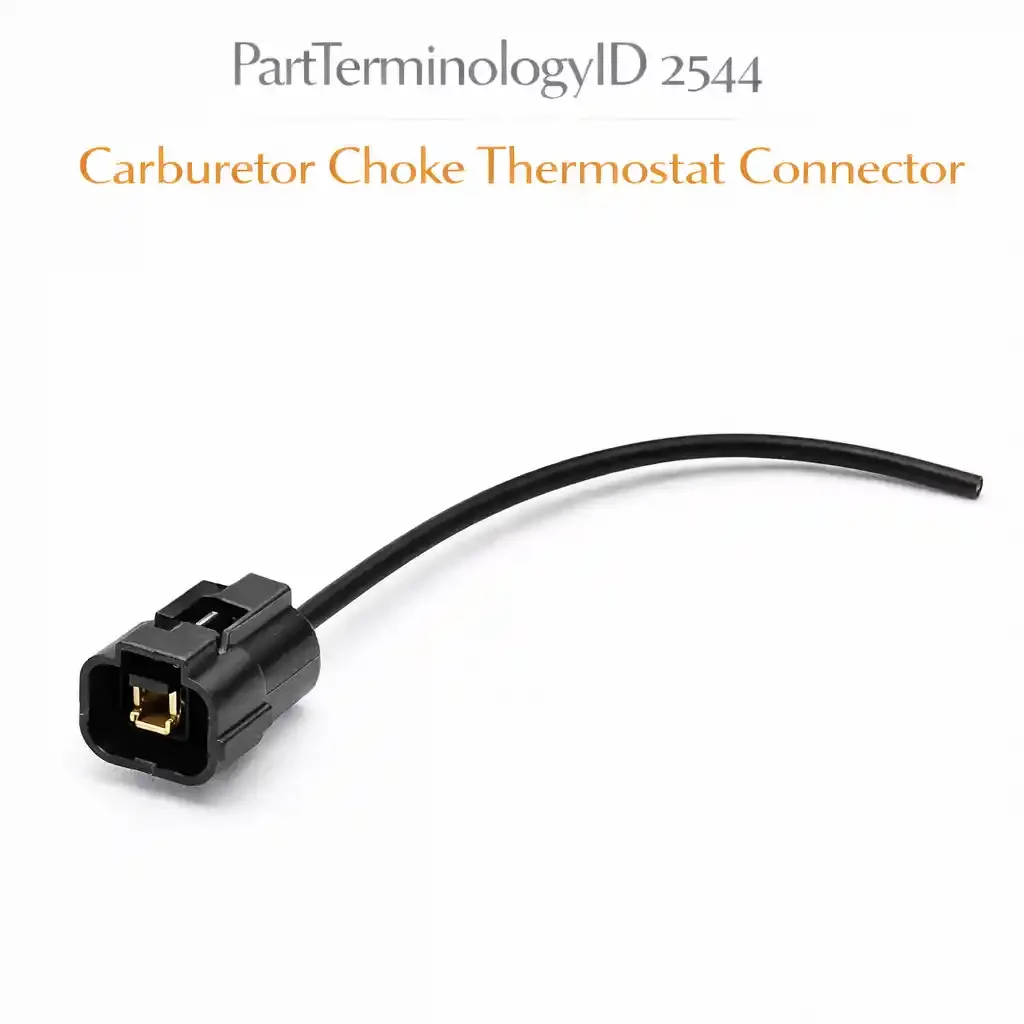
PartTerminologyID 2544, Carburetor Choke Thermostat Connector, is the wiring harness connector body that mates with the electric choke thermostat on a carbureted engine, providing the electrical interface between the vehicle's ignition-activated power supply circuit and the choke thermostat's heating element terminal. That definition covers the function correctly. It does not specify the terminal count, which is one terminal on the dominant OEM design where the choke heating element grounds through the choke spring and carburetor body to the engine block rather than through a dedicated ground wire, or two terminals on aftermarket all-electric choke assemblies that require a separate ground wire because the choke cap makes no reliable ground contact through its mounting, the connector body housing profile, whether the connector uses an L-shaped bayonet terminal receiver matched to the GM Rochester family of choke thermostats or a blade terminal receiver matched to Ford and aftermarket choke assemblies, the voltage specification for the choke heating element, whether the thermostat is designed for the 6 to 7 volts delivered from the alternator stator terminal used on OEM Ford and early GM electric-assist choke applications or the full 12 volts required by aftermarket Holley, Edelbrock, and Quick Fuel all-electric choke assemblies, the carburetor model designation the connector is matched to, the pigtail wire gauge and length, and whether the listing covers the connector body only or a pigtail assembly. A listing under PartTerminologyID 2544 that provides vehicle year, make, and model without the terminal count, the choke thermostat voltage specification, and the carburetor model designation cannot be evaluated by anyone replacing a broken, melted, or missing choke thermostat connector on a carbureted engine and confirming the replacement before removing the air cleaner and accessing the choke cap.
For sellers, PartTerminologyID 2544 is unique in this connector series because it serves a component category found exclusively on carbureted vehicles produced before fuel injection became universal, roughly pre-1990 for domestic applications, with some carbureted applications extending into the mid-1990s on trucks and off-road equipment. The buyer population for this PartTerminologyID is concentrated in vehicle restoration, classic car maintenance, and carbureted engine rebuilding. The dominant failure mode is not the connector's terminal current handling capacity or its environmental sealing, as with sensor connectors, but its voltage compatibility with the choke heating element design and its physical terminal profile compatibility with the specific carburetor model's choke thermostat terminal geometry. A connector with the wrong terminal profile will not seat on the choke thermostat terminal even if the wire gauge, voltage rating, and pigtail length are all correct. A connector sourced for a 12-volt aftermarket choke application and connected to a 6-to-7-volt stator supply will result in a choke that opens slowly or incompletely in warm ambient conditions, causing a rich mixture and rough idle that the technician attributes to the choke thermostat itself rather than to the voltage mismatch at the connector's power supply source.
For sellers, the listing under this PartTerminologyID is only useful if it specifies the terminal count, the terminal profile matched to the specific carburetor family, the voltage specification for the choke heating element, the pigtail wire gauge and length, and the carburetor model designation as the primary fitment attribute. Without those attributes, the listing produces the voltage mismatch failure that keeps the choke closed too long on cold mornings, or the terminal profile mismatch that prevents the connector from seating on the thermostat terminal at all.
What the Carburetor Choke Thermostat Connector Does
Delivering heating current to the choke thermostat bimetal coil
The electric choke thermostat contains a bimetal coil whose temperature determines the choke plate position during cold engine warm-up. The bimetal coil is wrapped around a resistive heating element that receives electrical power through the connector. As the heating element warms the bimetal coil, the coil relaxes and allows the choke plate to open progressively, leaning the mixture as the engine warms. On OEM electric-assist choke designs used by GM on Rochester carburetors and by Ford on Motorcraft carburetors from the early 1970s through the mid-1980s, the electric heating element works in conjunction with hot air ducted from the exhaust manifold heat stove, so the electrical contribution is supplemental rather than sole. On all-electric aftermarket choke assemblies used on Holley, Edelbrock, and Quick Fuel carburetors, the electrical heating element is the sole heat source and must deliver sufficient power to open the choke reliably within 2 to 4 minutes of cold start at ambient temperatures above approximately 50 degrees Fahrenheit.
The connector's role in this circuit is straightforward: it must deliver the supply voltage to the heating element terminal with minimal voltage drop from contact resistance, and on two-terminal designs it must provide a reliable ground return path through the dedicated ground wire. On one-terminal OEM designs, the ground return path runs through the choke spring's metal contact with the choke lever, through the carburetor body, through the carburetor mounting studs, and into the intake manifold to ground. Any corrosion or paint contamination in that ground path produces the same symptom as a high-resistance supply connection: a slow-opening or non-opening choke.
The voltage specification argument: 6-to-7 volts versus 12 volts
The most consequential invisible specification for PartTerminologyID 2544 is not the connector itself but the voltage at which the connector's power supply wire is sourced. OEM Ford and early GM electric-assist choke thermostats are designed to operate on 6 to 7 volts delivered from the alternator stator terminal, which produces approximately 6.99 volts at the three-phase winding junction when the alternator is generating. This sub-battery voltage was intentional: it ensured the choke heating element only received power when the alternator was actually spinning (engine running), not when the ignition key was left on with the engine off, and it slowed choke opening in very cold ambient temperatures where faster opening would produce a too-lean mixture. The OEM connector for these applications routes a single wire from the stator terminal to the choke thermostat terminal.
Aftermarket all-electric choke assemblies on Holley, Edelbrock, and Quick Fuel carburetors require full 12-volt switched ignition power. At 6 to 7 volts, these assemblies heat their bimetal coils too slowly to open the choke reliably within the expected warm-up period, because their heating elements are sized for 12-volt operation. The symptom is a choke that remains closed or only partially open for an extended period on warm days when the engine does not need enrichment, producing a rich condition, black smoke, fouled spark plugs, and poor fuel economy after warm-up. The listing must state whether the connector is intended for a 6-to-7-volt stator-sourced OEM application or a 12-volt switched-source aftermarket application, because the connector body itself is not voltage-sensitive but the behavior of the choke thermostat is entirely dependent on the supply voltage delivered through it.
Why the choke thermostat connector is a heat and fuel vapor environment component
The choke thermostat is mounted on the choke cover at the top of the carburetor body, placing the connector in direct proximity to the carburetor's fuel passages and float bowl. Engine heat radiates upward from the intake manifold and carburetor body. Fuel vapors rise from the carburetor vent and accelerator pump circuit. The connector body must resist softening from sustained heat exposure at the carburetor top surface, which can reach 80 to 100 degrees Celsius during sustained low-speed operation after a hot soak. The connector must also resist fuel vapor exposure that can degrade some plastic compounds and cause swelling or brittleness in connector body materials not rated for hydrocarbon exposure.
Wire insulation at the choke connector is exposed to the same fuel vapor environment. On vehicles where the connector is positioned directly over the carburetor float bowl vent, fuel vapor condensation on the wire insulation can accelerate insulation brittleness over time. A pigtail replacement that uses wire with insulation rated for fuel vapor and heat exposure at the carburetor location is preferred over a generic 18-gauge wire pigtail whose insulation rating may not account for the hydrocarbon exposure at the carburetor mounting height.
The Specifications That Determine Correct Carburetor Choke Thermostat Connector Fitment
Terminal count: one or two
One terminal for OEM electric-assist choke designs where the choke thermostat grounds through the choke spring and carburetor body. Two terminals for aftermarket all-electric choke assemblies that require a dedicated ground wire. The terminal count is visible on the original connector and on the choke thermostat cap itself: a single terminal blade or L-tab indicates a one-wire design; two terminal tabs indicate a two-wire design requiring both a power supply wire and a dedicated ground wire. State the terminal count explicitly. Do not rely on vehicle year, make, and model to resolve this attribute, because the same carburetor model was offered in both OEM electric-assist and aftermarket all-electric configurations across the same production years.
Terminal profile: L-shaped bayonet or blade
The GM Rochester Quadrajet, Dualjet, and Varajet choke thermostats use an L-shaped terminal tab that requires a locking bayonet-style connector that slides over the L-tab and locks with a quarter-turn or a positive latch. The Ford Motorcraft and many aftermarket choke thermostats use a flat blade terminal that accepts a standard push-on female blade connector. These two profiles are not interchangeable. A blade connector will not lock onto an L-shaped terminal. An L-shaped bayonet receiver will not engage a flat blade terminal. The terminal profile is the physical fitment attribute that determines whether the connector can seat and lock on the thermostat terminal at all, independent of wire gauge, voltage, or pigtail length. State the terminal profile for every listing under this PartTerminologyID.
Carburetor model designation
The primary fitment attribute. The terminal profile, the terminal count, and the correct voltage specification are all defined at the carburetor model level. A Rochester Quadrajet connector is not interchangeable with a Motorcraft 2100 connector even if both are one-terminal designs, because the terminal profiles differ. A connector listed by vehicle application without the carburetor model designation cannot be evaluated by a buyer who has replaced the original carburetor with an aftermarket unit that may use a different choke cap design than the OEM carburetor.
Voltage specification of the choke heating element
State as 6-to-7-volt stator source or 12-volt switched source. This is a power supply specification, not a connector specification, but it is inseparable from the connector listing because the pigtail wire's source determines the choke opening rate. Include a note in the listing stating the correct power supply source for the specific carburetor and choke assembly: alternator stator terminal for OEM Ford and early GM electric-assist designs, switched ignition 12-volt source for aftermarket all-electric designs.
Pigtail wire gauge and length
18-gauge wire is standard for OEM one-wire choke connector pigtails on passenger vehicle applications, where the heating element draws approximately 2 to 3 amperes at 7 volts or 1 to 2 amperes at 12 volts. The pigtail length must reach from the choke thermostat terminal to the power supply connection point without tension on the connector body. OEM GM pigtails from the choke connector to the oil pressure switch power routing are typically 12 inches. Aftermarket all-electric choke pigtails routed to a switched ignition source at the firewall may require 18 to 24 inches. State the pigtail length and wire gauge for every pigtail listing.
Status in New Databases
PIES/PCdb: PartTerminologyID 2544, Carburetor Choke Thermostat Connector
PIES 8.0 / PCdb 2.0: No change
Top Return Scenarios
Scenario 1: "L-shaped bayonet connector ordered for flat-blade Motorcraft choke thermostat, terminal profile mismatch, connector would not seat"
The listing specified a carburetor choke thermostat connector by vehicle year, make, and model without stating the terminal profile. The vehicle has a Ford Motorcraft 2100 two-barrel carburetor with a flat-blade single-terminal choke thermostat. The replacement connector is a GM Rochester L-shaped bayonet receiver designed for the Quadrajet's L-tab terminal. The bayonet receiver bore is oriented for a quarter-turn lock onto an L-tab. The Motorcraft flat blade terminal has no L geometry for the bayonet to engage. The connector would not seat on the choke thermostat terminal under any orientation.
Prevention language: "Terminal profile: [L-shaped bayonet receiver for GM Rochester Quadrajet, Dualjet, Varajet / flat blade push-on for Ford Motorcraft and aftermarket]. The choke thermostat terminal geometry is carburetor-model-specific. A Rochester L-shaped bayonet connector will not seat on a flat-blade Motorcraft terminal. A flat-blade push-on connector will not lock onto a Rochester L-tab terminal. Confirm the terminal profile on the original connector and the choke thermostat before ordering."
Scenario 2: "12-volt connector pigtail installed but sourced from alternator stator terminal, choke never fully opens on warm days, rich condition and fouled plugs"
The listing specified a choke thermostat connector for an Edelbrock 1406 600-cfm carburetor without stating the voltage specification or the correct power supply source. The buyer connected the new pigtail to the alternator stator terminal, which was the available connection point on the vehicle from the original OEM electric-assist choke wiring. The Edelbrock 1406's all-electric choke heating element is rated for 12-volt operation. At 6.5 to 7 volts from the stator terminal, the heating element delivered less than half its rated wattage to the bimetal coil. On days above 60 degrees Fahrenheit, the choke remained partially closed for 8 to 12 minutes rather than the expected 2 to 3 minutes, producing a rich mixture, stumbling acceleration, and black exhaust smoke during warm-up. The buyer attributed the symptom to a faulty Edelbrock choke thermostat and replaced it twice before identifying the voltage supply mismatch.
Prevention language: "Voltage specification: [6-to-7 volt alternator stator source for OEM Ford and GM electric-assist choke / 12-volt switched ignition source for aftermarket all-electric choke]. The choke heating element wattage is set at the design voltage. Connecting a 12-volt all-electric choke to a 6-to-7-volt stator source delivers less than half the rated heating power, causing extended warm-up enrichment on mild days. Connect aftermarket all-electric choke pigtails to a switched 12-volt ignition source, not to the alternator stator terminal."
Scenario 3: "Connector body only sourced, original pigtail wire insulation fuel-vapor-brittle at carburetor mounting height, wire cracks at splice within one season"
The original choke thermostat connector body was cracked from heat cycling. The buyer sourced a connector body only and retained the original pigtail wire, which had 14 years of fuel vapor exposure at the carburetor mounting location. The wire insulation appeared intact visually but had become stiff and micro-cracked from sustained hydrocarbon exposure. The technician transferred the original terminal into the new connector body and restored the electrical connection. Within one driving season, the insulation at the connector entry cracked through to the conductor from a combination of engine vibration and thermal cycling, producing an intermittent open circuit that caused the choke to fail to open on cold starts and set a rough-running complaint.
Prevention language: "Listing type: [connector body only / pigtail assembly with [X] inches of new wire, fuel-and-heat-rated insulation]. On vehicles where the choke connector has been in service for more than 10 years at the carburetor mounting location, inspect the pigtail wire insulation for stiffness, surface cracking, or discoloration from fuel vapor and heat exposure before sourcing a connector body only. Fuel-vapor-degraded insulation will crack at vibration stress points within one season of continued service. Source a pigtail assembly that replaces the full wire run from connector to power supply connection."
Scenario 4: "Two-terminal connector installed on one-terminal OEM Rochester Quadrajet choke thermostat, second terminal cavity blocks thermostat cap from seating flush, choke cover leaks"
The listing specified a choke thermostat connector by carburetor model without distinguishing between the one-terminal OEM Rochester design and the two-terminal aftermarket all-electric design. The replacement connector is a two-terminal housing designed for an aftermarket all-electric choke cap with two terminal tabs. The original Rochester Quadrajet choke thermostat has a single L-tab terminal and a smooth plastic cap body. The second terminal cavity on the two-terminal replacement connector positioned a metal retaining clip against the smooth cap body, preventing the connector from seating flush against the thermostat cap and leaving a 2mm gap at the cap face. The gap allowed the connector to rock on the L-tab terminal under engine vibration, producing intermittent electrical contact and an intermittent choke opening fault.
Prevention language: "Terminal count: [1-terminal for OEM Rochester Quadrajet, Dualjet, Varajet / 2-terminal for aftermarket all-electric choke assemblies]. The OEM Rochester choke thermostat has one L-tab terminal. Aftermarket all-electric choke caps have two terminal tabs. A two-terminal connector will not seat flush on a one-terminal OEM Rochester thermostat. Verify the terminal count on the original choke thermostat cap before ordering."
What to Include in the Listing
Core essentials
PartTerminologyID: 2544
Component: Carburetor Choke Thermostat Connector
Terminal count: 1 or 2 (mandatory)
Terminal profile: L-shaped bayonet receiver or flat blade push-on (mandatory)
Carburetor model designation (mandatory, primary fitment attribute)
Choke thermostat voltage specification: 6-to-7-volt stator source or 12-volt switched source (mandatory)
Power supply source note: alternator stator terminal or switched ignition 12-volt source (mandatory)
Pigtail wire gauge (mandatory)
Pigtail wire length in inches (mandatory)
Wire insulation rating: fuel-vapor-rated and heat-rated (mandatory)
Pigtail or connector body only (mandatory)
Quantity: 1
Fitment essentials
Year/make/model/submodel
Carburetor model designation as primary fitment attribute above vehicle application
Choke type: OEM electric-assist or aftermarket all-electric as secondary fitment attribute
Engine displacement where carburetor model differs by engine size within the same vehicle
Image essentials
Connector from the terminal-entry side showing the bayonet receiver profile or flat-blade push-on geometry with the terminal profile labeled
Connector shown mated to the choke thermostat terminal it is designed for, with the locking engagement visible
Full pigtail assembly shown with wire length callout and power supply connection end labeled
OEM one-terminal connector and aftermarket two-terminal connector shown side by side where both types exist in the carburetor model range
Catalog Checklist for ACES/PIES Teams
PartTerminologyID = 2544
Require carburetor model designation as primary fitment attribute (mandatory)
Require terminal count (mandatory)
Require terminal profile: L-shaped bayonet or flat blade (mandatory)
Require choke thermostat voltage specification (mandatory)
Require power supply source note (mandatory)
Require pigtail wire gauge and length (mandatory)
Differentiate from carburetor choke thermostat (the thermostat is the bimetal coil assembly that controls choke plate position; the connector is the harness interface to the thermostat's heating element terminal; a cracked or missing connector does not require thermostat replacement if the thermostat bimetal coil and heating element are confirmed functional; the connector and the thermostat are separate line items under separate PartTerminologyIDs)
Differentiate from choke pull-off or choke vacuum break connector: the choke thermostat connector carries electrical power to the heating element that opens the choke thermally; the choke pull-off or vacuum break is a pneumatic actuator that opens the choke partially on initial start using manifold vacuum; they are separate components with separate connectors serving different choke opening mechanisms
Flag terminal profile as mandatory: the L-shaped bayonet and flat-blade profiles are not interchangeable; this is the specification that determines whether the connector can physically seat on the thermostat terminal before any other attribute is evaluated
Flag voltage specification as mandatory: the choke heating element's opening rate is entirely determined by the supply voltage delivered through the connector; connecting an aftermarket 12-volt choke to a 6-to-7-volt stator source produces a slow-opening choke fault that presents as a thermostat failure rather than a connector sourcing error
FAQ (Buyer Language)
How do I determine whether my carburetor choke thermostat needs a one-terminal or two-terminal connector?
Look at the choke thermostat cap on the carburetor. If you see a single L-shaped metal tab or a single blade terminal protruding from the cap face, you need a one-terminal connector. If you see two terminal tabs on the cap face, you need a two-terminal connector. The one-terminal design is standard on OEM GM Rochester carburetors and on OEM Ford Motorcraft carburetors. The two-terminal design is more common on aftermarket all-electric choke assemblies from Holley, Edelbrock, and Quick Fuel, where the second terminal provides a dedicated ground because the choke cap housing makes no reliable ground contact through the carburetor body.
My electric choke stays closed for a long time after the engine warms up. Is the connector the problem?
It may be. Check the supply voltage at the connector terminal with the engine running using a digital voltmeter. If you measure 6 to 7 volts and your carburetor has an aftermarket all-electric choke that requires 12 volts, the connector is sourced from the wrong power supply point, likely the alternator stator terminal rather than a switched 12-volt ignition source. Rerouting the pigtail to a proper switched 12-volt source will restore the correct heating rate without replacing the choke thermostat. If you measure 12 volts and the choke still opens slowly or incompletely, the thermostat bimetal coil or heating element itself may be at fault.
What is the correct power supply source for my aftermarket electric choke?
For aftermarket all-electric choke assemblies from Holley, Edelbrock, and Quick Fuel, connect the choke supply wire to a switched 12-volt ignition source that is active when the ignition key is in the Run position but not when the key is off or in the Accessory position. Do not connect to the ignition coil positive terminal, as the choke heating element will draw current that reduces coil voltage and causes ignition misfires. Do not connect to an unswitched battery terminal, as the choke will receive power with the key off and remain in the fully open position when the engine is next cold-started. Common correct sources include a switched fuse block terminal, a wiper motor circuit, or an oil pressure switch in series with the supply wire so the choke only heats while the engine is running.
Cross-Sell Logic
Carburetor Choke Thermostat: If the connector was missing or broken for an extended period and the choke thermostat heating element received no power, the bimetal coil may have operated exclusively on exhaust manifold hot air, which on OEM electric-assist designs produces slower choke opening than the combined electric-assist design intended. Confirm thermostat function after connector restoration.
Choke Pull-Off / Vacuum Break: The choke pull-off is the pneumatic component that cracks the choke plate open immediately on engine start before the thermostat has time to heat. If the pull-off vacuum line is missing or deteriorated, the choke will remain fully closed on initial start even with a correctly functioning thermostat and connector, producing a rich stall condition that is often misattributed to the thermostat or connector.
Carburetor Rebuild Kit: On vehicles where the choke thermostat connector has been missing or non-functional for an extended period, the carburetor may have accumulated fuel varnish deposits from repeated rich-start conditions and incomplete warm-up enrichment. A carburetor rebuild kit addresses the internal fuel circuit contamination that results from sustained operation with a non-functional choke system.
Frame as "the connector gets voltage to the heating element. The heating element warms the bimetal coil. The bimetal coil opens the choke. If the voltage is wrong or the connector won't seat, none of the rest matters regardless of how good the thermostat is."
Final Take for PartTerminologyID 2544
Carburetor Choke Thermostat Connector (PartTerminologyID 2544) is the connector PartTerminologyID in this series that serves an exclusively legacy application category, carbureted engines, while simultaneously presenting a voltage specification argument that is invisible at the connector body level but entirely determines whether the choke system opens at the correct rate after a cold start. The terminal profile mismatch is the immediate physical failure: a bayonet receiver on a flat-blade terminal or vice versa prevents seating and makes the mismatch obvious within seconds of installation. The voltage supply mismatch is the invisible functional failure: the connector seats correctly, locks correctly, and appears installed correctly, but the choke thermostat heats at less than half its rated rate because the supply voltage is from the stator terminal rather than a switched 12-volt source, producing a rich condition on warm mornings that the buyer attributes to a faulty thermostat and addresses by replacing it rather than by rerouting the power supply wire.
State the carburetor model designation in the primary fitment attribute position. State the terminal count. State the terminal profile. State the voltage specification and the correct power supply source. State the pigtail wire gauge and length with insulation rated for fuel vapor and heat exposure. That is the specification set that allows the buyer to confirm fitment before removing the air cleaner and attempting installation. For PartTerminologyID 2544, the terminal profile and the voltage specification are the two attributes that determine whether the replacement connector restores correct choke warm-up behavior or reproduces the slow-opening choke complaint in a pattern that consumes replacement thermostats before the power supply source is identified as the root cause.