
Barometric Pressure Sensor Connector (PartTerminologyID 2532): Why Three-Terminal Layout, Seal Type, and Pigtail Length Prevent BARO Signal Faults
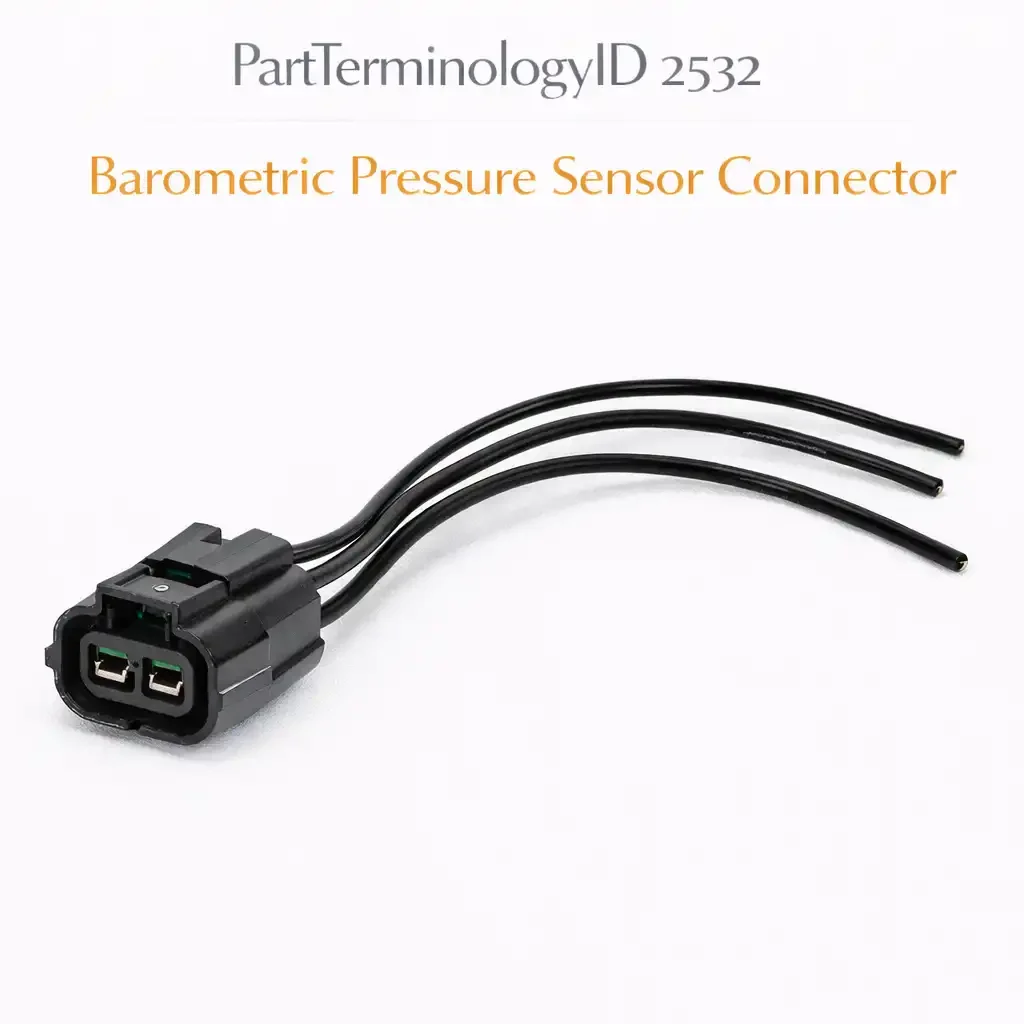
Written by Arthur Simitian | PartsAdvisory
PartTerminologyID 2532, Barometric Pressure Sensor Connector, is the wiring harness connector body that mates with the barometric pressure sensor, also called the BARO sensor or ambient pressure sensor, providing the electrical interface between the engine control harness and the sensor terminals that carry the 5-volt reference supply from the ECM, the pressure-proportional analog voltage signal from the sensor's piezoresistive element back to the ECM, and the signal ground return, allowing the ECM to calculate ambient atmospheric pressure for altitude compensation of fuel delivery, boost pressure targeting on turbocharged engines, and exhaust gas recirculation control. That definition covers the function correctly. It does not specify the terminal count, which is almost always three for a reference-voltage, signal, and ground design but may vary on sensors integrated with additional pressure or temperature measurement functions, the connector body housing series designation, the seal type, whether the connector uses individual wire seals and a body-side seal for sensors mounted in exposed under-hood locations or is unsealed for sensors mounted inside the ECM housing where the sensor is protected from direct moisture exposure, the terminal pin material and plating, the connector lock type, the wire entry direction, the connector body temperature rating, whether the listing covers a connector body only or a pigtail assembly with pre-installed terminals and wire, or whether the BARO sensor on the specific vehicle is a standalone component with its own dedicated connector or is integrated into the MAP sensor housing and shares the MAP sensor connector covered under a different PartTerminologyID. A listing under PartTerminologyID 2532 that provides vehicle year, make, and model without the terminal count, the seal type, the connector housing designation, and the standalone-versus-integrated sensor clarification cannot be evaluated by any technician who has confirmed the connector as the failed component in a P0107 to P0109 or P2226 to P2228 barometric pressure sensor circuit fault.
For sellers, PartTerminologyID 2532 serves a narrow buyer population compared to the alternator connector (2528) or the battery cable (2500) because BARO sensor connector failures are less common than connector failures in higher-current or higher-heat circuit positions. The BARO sensor connector fails most often from moisture intrusion in sensors mounted in exposed engine bay locations, from physical breakage during ECM or intake manifold service where the sensor connector is routed close to components that require removal, and from pushed-back terminals from a previous connector extraction performed without the correct terminal release tool. The buyer has almost always confirmed the fault code before arriving at this PartTerminologyID and has verified through a voltage measurement that the signal circuit has an open or high-resistance fault traceable to the connector rather than to the sensor element or the ECM reference circuit.
The additional complexity specific to PartTerminologyID 2532 compared to the IAT sensor connector (2524) is the standalone-versus-integrated sensor argument. The IAT sensor is almost always a standalone component with its own dedicated connector. The BARO sensor on many modern engines is not a standalone component at all: it is integrated into the MAP sensor housing, and the combined sensor uses the MAP sensor connector covered under the MAP sensor's own PartTerminologyID. On these vehicles, PartTerminologyID 2532 does not apply because there is no separate BARO sensor connector to replace. A technician who searches for a BARO sensor connector on a vehicle where the BARO function is integrated into the MAP sensor will find that no separate connector exists and that the MAP sensor connector is the correct component. The listing must identify whether it covers a standalone BARO sensor connector or must include a note directing buyers with integrated MAP-BARO sensors to the MAP sensor connector PartTerminologyID.
For sellers, the listing is only useful if it specifies the terminal count, the seal type, the standalone-versus-integrated sensor clarification, the connector housing designation, and whether the listing is a connector body only or a pigtail assembly. Without those five attributes, the listing cannot serve the technician who needs to confirm that a standalone BARO sensor exists on their vehicle before ordering the connector.
What the Barometric Pressure Sensor Connector Does
Maintaining the three-wire reference-signal-ground circuit integrity
The BARO sensor connector carries three circuits simultaneously: the 5-volt reference voltage from the ECM to the sensor, the pressure-proportional voltage signal from the sensor back to the ECM, and the signal ground return from the sensor to the ECM ground plane. All three must be intact and low-resistance for the ECM to receive an accurate barometric pressure reading.
A fault in the reference voltage terminal produces a P2228 low BARO sensor voltage code because the sensor receives less than the design 5 volts and outputs a signal proportional to the reduced reference rather than to the actual pressure. A fault in the signal terminal produces a P0107 low input or P0108 high input code depending on the direction of the fault. A fault in the ground return terminal produces a floating signal ground that shifts the entire signal voltage range unpredictably, producing rationality failures that may not generate a specific BARO code but affect fuel trim and boost target calculations in ways that are difficult to trace to a ground connection fault.
The connector's terminal contact resistance must be below 50 milliohms at each of the three positions to maintain signal accuracy within the ECM's 5-millivolt resolution for pressure calculations. A contact resistance of 200 milliohms on the reference terminal reduces the ECM's 5-volt reference to approximately 4.99 volts at the sensor, an error too small to set a code but sufficient to shift the pressure reading by approximately 0.2 kilopascals at altitude, producing a small but measurable fuel trim offset at high-altitude driving conditions.
Seal type at the BARO sensor location
The BARO sensor mounting location varies significantly between vehicle designs. On some engines the BARO sensor is mounted on the intake manifold, shielded from direct moisture exposure by the manifold itself. On others it is mounted on the firewall or the chassis in a location exposed to road splash and pressure washing. On some designs it is mounted inside the ECM housing, fully protected from external moisture.
The seal type of the connector must match the mounting environment. An unsealed connector in a road-splash exposed location will allow moisture to reach the terminal contacts and produce a ground fault from condensate bridging between the signal terminal and the ground terminal, generating a P0108 high-voltage code from the elevated effective signal ground. A fully sealed connector in an ECM-interior location is unnecessary and may make the connector bulkier than the mounting clearance permits.
The pigtail argument for a three-wire low-current connector
The BARO sensor connector carries only three low-current signal wires, none of which carries more than a few milliamperes. The pigtail assembly for a three-wire connector is a simple construction: three wires of the correct gauge, typically 20 AWG to 22 AWG for ECM signal circuits, with new terminals pre-installed in the replacement connector body and a pigtail length of 150 to 250mm to allow the splice to fall in accessible harness wire beyond any damage at the original connector body.
The pigtail is the preferred replacement form when the original terminals are corroded from moisture intrusion, because transferring corroded original terminals into a new connector body reproduces the same contact resistance fault that caused the original diagnostic trouble code. For a three-wire signal connector, the pigtail cost premium over a connector body only is small relative to the labor cost of a repeat diagnostic event from transferred corroded terminals.
The Specifications That Determine Correct Fitment
Terminal count and circuit assignment
Three terminals for standard reference-signal-ground designs. Additional terminals for integrated sensors. State the count and assign each position to its circuit.
Standalone versus integrated BARO sensor clarification
Whether the vehicle has a standalone BARO sensor with its own connector or an integrated MAP-BARO sensor that uses the MAP sensor connector. State explicitly and cross-reference the MAP sensor connector PartTerminologyID for integrated applications.
Connector housing designation
The OEM or aftermarket connector housing series. Primary cross-reference attribute for technician sourcing.
Seal type
Unsealed, body-side sealed, or fully sealed with individual wire seals. Must match the original for the specific mounting location environment.
Lock type
Friction, primary latch, or primary with secondary CPA.
Wire entry direction
Inline or right-angle.
Pigtail or connector body only
State explicitly. For pigtail assemblies, state wire length in mm and wire gauge at each position.
Connector body temperature rating
In degrees Celsius. Relevant for sensors mounted near the exhaust manifold or turbocharger on some engine configurations.
Status in New Databases
PIES/PCdb: PartTerminologyID 2532, Barometric Pressure Sensor Connector
PIES 8.0 / PCdb 2.0: No change
Top Return Scenarios
Scenario 1: "Standalone connector ordered, vehicle has integrated MAP-BARO sensor, no separate BARO connector exists on vehicle"
The listing specified a barometric pressure sensor connector by vehicle year, make, and model without stating whether the BARO sensor on that vehicle is standalone or integrated. The vehicle has a combined MAP and BARO sensor in a single housing using the MAP sensor connector. There is no separate BARO sensor connector on this vehicle. The buyer received the standalone BARO connector and could not locate the corresponding sensor connection point on the engine.
Prevention language: "Sensor configuration: [standalone BARO sensor with dedicated connector / integrated MAP-BARO sensor using MAP sensor connector]. This listing covers the [standalone] BARO sensor connector. Verify your vehicle has a standalone barometric pressure sensor before ordering. On vehicles with an integrated MAP-BARO sensor, the barometric pressure function shares the MAP sensor connector. No separate BARO sensor connector is present on those vehicles. If your vehicle has an integrated MAP-BARO sensor, source the MAP sensor connector under the MAP sensor PartTerminologyID."
Scenario 2: "Unsealed connector, road-splash mounting location, ground terminal moisture bridge, P0108 high-voltage fault"
The replacement connector is unsealed. The original connector used individual wire seals. The BARO sensor on this vehicle is mounted on the lower firewall in a location exposed to road splash during wet weather. Within two months of installation, condensate had entered the unsealed connector through the wire entry gaps and bridged the signal and ground terminals. The bridging resistance, approximately 8,000 ohms, raised the effective signal ground voltage at the sensor output, causing the ECM to read a higher-than-actual barometric pressure and generating a P0108 high-voltage code.
Prevention language: "Seal type: individual wire seals with body-side seal. The BARO sensor on this vehicle is mounted in a road-splash exposed location. The replacement connector must use individual wire seals at each terminal entry and a body-side seal at the mating face to exclude moisture from the terminal contact zone. An unsealed replacement connector in this mounting location will allow condensate to bridge the terminal contacts, producing a signal ground fault that generates P0107 or P0108 codes without any visible connector damage."
Scenario 3: "Corroded terminals transferred to new connector body, contact resistance on reference terminal, P2228 at high altitude"
The buyer sourced a connector body only. The original three terminals were corroded from moisture intrusion. The corroded terminals were transferred to the new connector body. The contact resistance on the reference voltage terminal from the corroded terminal face reduced the 5-volt reference to 4.91 volts at the sensor. At sea level the ECM's rationality window accepted the slightly low reference and no code was set. At 2,400 meters altitude during a mountain drive, the BARO sensor output fell into the P2228 low-voltage range because the reduced reference voltage combined with the genuine low-pressure reading pushed the signal below the ECM's minimum threshold.
Prevention language: "Listing type: [connector body only / pigtail assembly with 200mm of new wire and new terminals]. If the original terminals show any corrosion on the contact faces, specify the pigtail assembly rather than the connector body only. Transferring corroded terminals to a new connector body preserves the contact resistance that produced the original fault. For a three-wire low-current signal connector, the pigtail assembly cost premium over the connector body only is small relative to the labor cost of a repeat diagnostic event from sub-threshold contact resistance at altitude."
What to Include in the Listing
Core essentials
PartTerminologyID: 2532
component: Barometric Pressure Sensor Connector
standalone versus integrated MAP-BARO sensor clarification (mandatory)
terminal count (mandatory)
circuit assignment at each position: reference, signal, ground (mandatory)
connector body housing series designation (mandatory)
seal type: unsealed, body-side sealed, or fully sealed with wire seals (mandatory)
mounting location environment note: shielded, road-splash exposed, or ECM-interior (mandatory)
lock type (mandatory)
wire entry direction (mandatory)
connector body temperature rating in degrees Celsius (mandatory)
pigtail or connector body only (mandatory)
pigtail wire length in mm and gauge for pigtail assemblies (mandatory)
quantity: 1
Catalog Checklist for ACES/PIES Teams
PartTerminologyID = 2532
require standalone versus integrated MAP-BARO sensor designation (mandatory)
require terminal count with circuit assignment (mandatory)
require seal type matched to mounting environment (mandatory)
require connector housing designation (mandatory)
require pigtail versus connector body only designation (mandatory)
differentiate from MAP sensor connector: the MAP sensor connector carries the manifold absolute pressure signal; on vehicles with a combined MAP-BARO sensor, both the manifold pressure and barometric pressure functions share the MAP sensor connector; PartTerminologyID 2532 covers only standalone BARO sensor connectors; for integrated MAP-BARO sensors, the MAP sensor connector PartTerminologyID is the correct listing
differentiate from IAT sensor connector (PartTerminologyID 2524): the IAT connector carries a resistive NTC thermistor signal; the BARO connector carries a ratiometric pressure-proportional voltage signal; both are three-wire reference-signal-ground designs but the signal type and the fault code range differ; they are not interchangeable even when the connector bodies appear dimensionally similar
flag standalone versus integrated distinction as mandatory: a technician who orders a standalone BARO connector for a vehicle with an integrated MAP-BARO sensor will be unable to locate the connection point on the engine; this is the most consistently generated return for this PartTerminologyID and is entirely preventable by one clarification statement
flag seal type as mandatory: the BARO sensor mounting location varies from fully protected ECM-interior to fully exposed road-splash positions across vehicle designs; the seal type must match the specific mounting environment, not the seal type most common for the vehicle platform
Final Take for PartTerminologyID 2532
Barometric Pressure Sensor Connector (PartTerminologyID 2532) is the sensor connector PartTerminologyID where the standalone-versus-integrated distinction is the first question the listing must answer before any dimensional or seal specification is relevant: if the vehicle has an integrated MAP-BARO sensor, there is no PartTerminologyID 2532 connector on that vehicle and the entire listing is irrelevant to the buyer's repair. State that distinction first. Then state the seal type matched to the mounting environment. Then state the pigtail designation so the buyer with corroded original terminals can source new terminals with the new connector body rather than reproducing the contact resistance fault.
State the standalone clarification. State the terminal count with circuit assignments. State the housing designation. State the seal type with the mounting environment note. State the lock type and wire entry direction. State the temperature rating. State the pigtail designation with wire length and gauge. That is the same listing strategy as every other PartTerminologyID in this series: specific attributes at every level to become a listing buyers can act on without guessing. For PartTerminologyID 2532, the standalone-versus-integrated clarification is the attribute that determines whether the listing serves the buyer's repair at all.