
Written by Arthur Simitian | PartsAdvisory
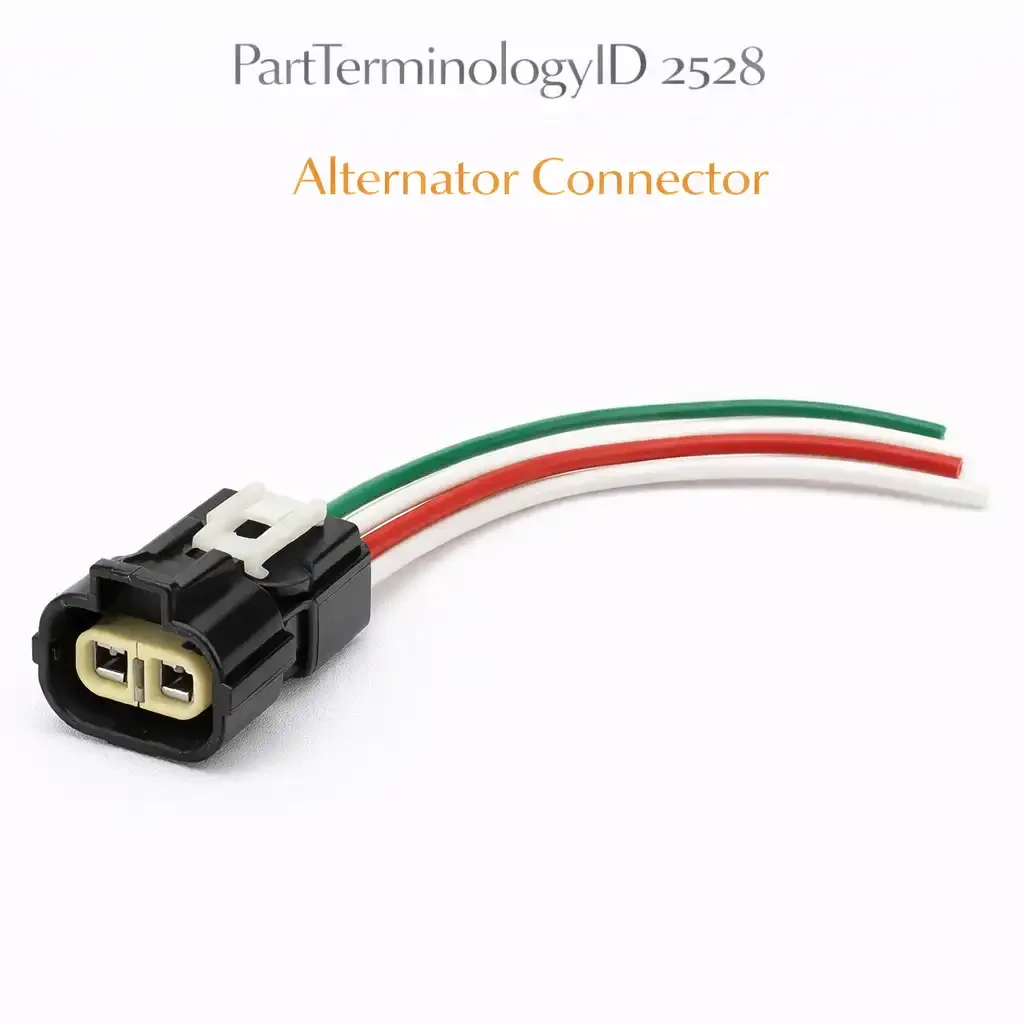
PartTerminologyID 2528, Alternator Connector, is the wiring harness connector body that mates with the alternator's regulator interface, providing the electrical interface between the vehicle's charge system harness and the alternator terminals that carry the charge warning light excitation signal, the voltage sensing signal, the field current control signal, the battery temperature compensation signal, and the smart charging communication bus signal depending on the alternator design and the vehicle's charging system architecture. That definition covers the function correctly. It does not specify the terminal count, which ranges from two terminals on a simple external-regulator alternator to seven or more on a modern smart charging alternator with a LIN-bus communication terminal, the connector body housing series designation, the terminal pin gauge and current rating for each circuit position, the seal type, whether the connector uses individual wire seals and a body-side seal for under-hood moisture exclusion or is unsealed for enclosed alternator housings, the connector lock type, whether it uses a friction lock, a primary latch, or a primary with secondary connector position assurance, the wire entry direction, the smart charging protocol compatibility, whether the connector is designed for a LIN-bus alternator, a GM L-terminal alternator, a Ford FET switching alternator, or a conventional fixed-voltage alternator, the alternator model designation the connector is matched to, the mating alternator terminal gender and pitch, the connector body temperature rating for proximity to the alternator's own heat output and the engine bay ambient, or whether the listing covers the connector body only or a pigtail assembly with pre-installed terminals and wire. A listing under PartTerminologyID 2528 that provides vehicle year, make, and model without the terminal count, the smart charging protocol, the connector housing designation, and the alternator model designation cannot be evaluated by any technician who has a heat-damaged or broken alternator connector and is confirming the replacement before accessing the alternator in the engine bay.
For sellers, PartTerminologyID 2528 occupies the intersection of two specification arguments that have already been developed separately in this series: the smart charging system protocol argument from the alternator post (2412) and the connector heat rating and terminal current argument from the HVAC relay connector post (2516). The alternator connector must satisfy both simultaneously. It must carry the communication signal for the specific smart charging protocol used by the vehicle's charging system, and it must carry the field current control signal at the current rating required by the alternator's field winding without producing heat damage at the terminal contact faces. A connector that satisfies the protocol requirement but uses undersized terminals for the field current will melt its housing at the field current terminal. A connector that has adequately rated terminals but carries the wrong smart charging protocol wiring will prevent the ECM from controlling the alternator's output voltage, setting fault code P0620 and preventing the charging system from operating correctly.
The additional complexity specific to PartTerminologyID 2528 compared to the air charge temperature sensor connector (2524) is the protocol compatibility argument. The IAT sensor connector carries a resistive signal whose integrity is determined by contact resistance alone. The alternator connector on a smart charging vehicle carries a digital communication signal whose integrity is determined by the signal protocol, the termination resistance, and the wiring topology of the LIN-bus or equivalent communication system. A connector that provides a correct physical interface but routes the LIN-bus wire to the wrong terminal position relative to the alternator's LIN terminal will connect the communication bus to an incorrect alternator terminal, producing either no communication or corrupted communication that sets a fault code and prevents smart charging operation. The terminal position map for the LIN-bus terminal is as critical as the physical connector fit.
For sellers, the listing under this PartTerminologyID is only useful if it specifies the terminal count, the alternator model designation, the smart charging protocol compatibility, the connector housing designation, the terminal current rating for the field circuit position, and whether the listing is a connector body only or a pigtail assembly. Without those six attributes, the listing cannot prevent the protocol mismatch that disables smart charging, the terminal position error that routes the LIN signal incorrectly, or the thermal failure from undersized field circuit terminals.
What the Alternator Connector Does
Carrying the field current control signal
On all alternator designs, the connector carries the field current control signal between the voltage regulator, which may be internal to the alternator or external in older designs, and the harness circuits that supply or control the field current. On a conventional fixed-voltage alternator with an internal regulator, the connector typically carries the charge warning light excitation wire to pin 1 and the voltage sense wire to pin 2, with some designs adding a battery temperature sensor signal or an external voltage set point wire. The field current itself flows internally within the alternator and does not pass through the external connector.
On alternators with externally controlled regulators or with regulators that receive a duty-cycle signal from the ECM, the field current control signal is a pulse-width modulated square wave that commands the regulator to increase or decrease field current to achieve the target charging voltage. This signal passes through the connector at low current but at a frequency that requires the connector's terminal contact resistance to be consistent across temperature cycles to avoid signal distortion.
Carrying the LIN-bus or equivalent smart charging communication signal
On vehicles with LIN-bus smart charging, the alternator connector carries a single-wire LIN-bus communication terminal that allows the ECM or the body control module to command the alternator's target output voltage in real time. The LIN-bus signal is a single-wire half-duplex protocol at 10.4 or 19.2 kilobits per second. It requires a termination resistance at the alternator end, which is typically provided by the voltage regulator's internal LIN transceiver, and a pull-up resistance at the master node, which is typically provided by the ECM.
The LIN-bus terminal in the alternator connector must be connected to the LIN-bus line in the harness with no additional series resistance from poor terminal contact. A contact resistance of even a few ohms on the LIN-bus terminal can cause the voltage level at the alternator end of the bus to fall below the LIN protocol's low-level threshold during the dominant phase of the signal, producing intermittent communication failures that set P0620 or equivalent charging system fault codes without any visible connector damage.
Why the alternator connector is a high-heat environment component
The alternator generates heat from its own operation: stator copper losses, rectifier diode losses, and field winding resistance together produce 100 to 200 watts of heat dissipated through the alternator housing and rear bearing plate. The connector mates at the rear of the alternator housing, directly adjacent to the rectifier bridge heat sink and the voltage regulator, which are the hottest components in the alternator assembly during high-output operation.
Under-hood ambient temperatures at the alternator location on many engines exceed 100 degrees Celsius during sustained operation. The connector body and its terminal contact materials must withstand this continuous elevated ambient without softening, shrinking, or producing contact relaxation that reduces the spring force of the terminal pins against the alternator's connector blades. A connector body rated for 85 degrees Celsius in an ambient that regularly reaches 110 degrees Celsius will soften at the terminal cavities, allowing the terminals to shift position and produce intermittent contact under vibration.
Pigtail assembly for heat-damaged connector replacement
When the alternator connector has been heat-damaged to the point where the terminal pins have deformed from the softened housing, the harness wires immediately behind the connector may also show insulation discoloration or brittleness from the elevated temperature at the connector body. A pigtail assembly that includes 200 to 300mm of new wire allows the technician to cut the harness behind the heat-affected zone and splice the pigtail to fresh harness wire rather than splicing a new connector body to wire that has degraded insulation. The pigtail wire gauge must match the original harness wire gauge for each circuit position.
The listing must state whether it is a connector body only or a pigtail assembly, the pigtail wire length in mm, and the wire gauge at each circuit position for pigtail designs. On smart charging alternator pigtails, the LIN-bus wire gauge must match the original to maintain the bus impedance characteristics.
The Specifications That Determine Correct Alternator Connector Fitment
Terminal count and circuit assignment
Two terminals for simple excitation-and-sense designs. Three terminals for designs adding a battery temperature compensation input. Four or more terminals for externally controlled regulators and smart charging designs adding a PWM control terminal, a LIN-bus terminal, or both. State the count and the circuit assignment at each position.
Alternator model designation
The primary fitment attribute. The terminal count, the terminal pitch, the connector body profile, and the smart charging protocol are all defined at the alternator model level.
Smart charging protocol
Conventional fixed-voltage, LIN-bus, GM L-terminal, Ford FET switching, or Chrysler TIPM. State the protocol explicitly. A connector wired for a LIN-bus alternator cannot be substituted for a connector wired for a GM L-terminal alternator even if the terminal counts are identical, because the circuit assignment at the communication terminal differs between protocols.
Terminal current rating at the field circuit position
In amperes continuous. For alternators with an external field current path through the connector, the field circuit terminal must be rated for the maximum field current of the specific alternator output variant.
Connector body temperature rating
In degrees Celsius continuous ambient. Must exceed the maximum ambient temperature at the alternator connector location for the specific engine and vehicle configuration.
Seal type
Individual wire seals with body-side seal for under-hood mounting. Unsealed only for enclosed alternator housings where the connector is protected from direct moisture exposure.
Lock type
Friction, primary latch, or primary with secondary CPA. State the CPA type for designs with secondary locks.
Wire entry direction
Inline or right-angle. Must match the harness routing at the alternator connector location.
Pigtail or connector body only
State explicitly. For pigtail assemblies, state the wire length and the wire gauge at each terminal position.
Status in New Databases
PIES/PCdb: PartTerminologyID 2528, Alternator Connector
PIES 8.0 / PCdb 2.0: No change
Top Return Scenarios
Scenario 1: "LIN-bus connector installed on GM L-terminal alternator, communication terminal position incorrect, P0620 from first start"
The listing specified an alternator connector by vehicle year, make, and model without stating the smart charging protocol. The vehicle has a GM L-terminal charging system. The replacement connector is wired for a LIN-bus alternator with the communication terminal at pin position 3. The GM L-terminal alternator uses pin position 3 for the voltage sense return rather than for a communication bus. The L-terminal function, which is the charge warning light control output from the regulator, is connected to a LIN-bus circuit in the harness that provides no useful signal to the L-terminal input. The charging system set P0620 from the first start and the battery warning light remained illuminated.
Prevention language: "Smart charging protocol: [LIN-bus / GM L-terminal / Ford FET switching / conventional fixed-voltage]. Alternator connector terminal assignments are protocol-specific. A LIN-bus connector and a GM L-terminal connector with the same terminal count have different circuit assignments at the communication or control terminal position. Verify the smart charging protocol for your vehicle's alternator before ordering. Installing a connector with the wrong protocol wiring will connect the communication terminal to an incorrect alternator pin and will set P0620 or equivalent charging fault codes from the first start."
Scenario 2: "Field circuit terminal undersized for high-output alternator, terminal melted at 12,000 miles"
The replacement connector is built for the standard 120-ampere alternator variant. The vehicle has the 160-ampere high-output alternator. On the high-output variant, the field current path passes through the connector and the field circuit terminal carries up to 8 amperes continuously. The standard variant connector uses a terminal rated for 5 amperes at that position. At 8 amperes of continuous field current, the terminal contact face operated at a temperature above its rated limit. At 12,000 miles the terminal had melted partially into the connector body and the contact resistance had increased to the point where the voltage at the regulator field input was 0.8 volts below the harness supply, causing the regulator to operate the field winding below its design current and reducing alternator output by approximately 12 percent.
Prevention language: "Alternator output variant: [120A standard / 160A high-output]. Field circuit terminal current rating: [X] amperes continuous. The terminal current rating at the field circuit position must match the maximum field current of the specific alternator output variant. A standard-output connector installed on a high-output alternator will have an undersized field circuit terminal that overheats at the alternator's maximum field current, producing progressive contact resistance increase and alternator output reduction before the terminal melts."
Scenario 3: "Connector body temperature rating 85 Celsius, alternator location ambient 115 Celsius, housing softened within 8 months"
The replacement connector body is rated for 85 degrees Celsius continuous ambient. The alternator on this engine is mounted directly below the exhaust manifold with the connector face pointing upward toward the manifold. The ambient temperature at the connector location during sustained highway operation reaches 115 degrees Celsius. Within 8 months, the connector body had softened at the terminal cavities, allowing the terminal pins to shift 1 to 2mm laterally within the cavity. The shifted terminals made intermittent contact with the alternator blades under engine vibration, producing an intermittent charge warning light.
Prevention language: "Connector body temperature rating: [X] degrees Celsius continuous ambient. Verify the temperature rating exceeds the maximum ambient temperature at the alternator connector location for your engine configuration. For engines where the alternator is mounted near the exhaust manifold, specify a connector body rated for at least 125 degrees Celsius continuous ambient. A connector body that softens at the installation ambient will allow terminal pins to shift laterally within the cavities, producing intermittent contact under vibration."
Scenario 4: "Connector body only, harness wires heat-degraded behind original connector, new connector spliced to brittle insulation, insulation cracks within 500 miles"
The original connector was heat-damaged and the buyer sourced a connector body only. The harness wires immediately behind the original connector had insulation that was brittle from sustained heat exposure at the alternator location. The technician cut the harness 20mm behind the original connector and spliced the new connector body terminals to the cut harness wires. Within 500 miles, the brittle insulation at the splice points had cracked from engine vibration, exposing bare conductor at three of the four circuit positions. The bare conductors contacted each other and shorted two charging system signals, setting multiple fault codes.
Prevention language: "Listing type: [connector body only / pigtail assembly with [X]mm of new wire at each circuit position]. If the alternator connector has been heat-damaged, inspect the harness wire insulation for a minimum of [200]mm behind the original connector before sourcing a connector body only. Brittle or discolored insulation in the heat-affected zone requires a pigtail assembly that allows the splice to be made in fresh, undamaged harness wire beyond the heat-affected zone."
Scenario 5: "Three-terminal connector sent for four-terminal smart charging alternator, LIN-bus terminal position not present, smart charging disabled"
The listing specified an alternator connector by alternator model without distinguishing between the standard and smart charging variants of the same alternator family. The standard variant uses a three-terminal connector for excitation, sense, and field control. The smart charging variant adds a fourth terminal for the LIN-bus communication signal. The three-terminal replacement connector was physically similar to the four-terminal original but had no cavity for the LIN-bus terminal. The LIN-bus wire from the harness had no terminal connection point. The smart charging system was disabled and the alternator reverted to a fixed output voltage, setting P0620 and reducing fuel economy from the loss of regenerative braking charging optimization on this hybrid application.
Prevention language: "Terminal count: [3 terminals, standard alternator / 4 terminals, smart charging alternator with LIN-bus]. The standard and smart charging variants of this alternator use different connector bodies with different terminal counts. The smart charging variant requires the fourth terminal for the LIN-bus communication signal that enables variable voltage charging and regenerative braking integration. Verify the terminal count on the original connector before ordering. A three-terminal connector on a four-terminal smart charging alternator leaves the LIN-bus wire unconnected and disables all smart charging functions."
What to Include in the Listing
Core essentials
PartTerminologyID: 2528
component: Alternator Connector
alternator model designation (mandatory, primary fitment attribute)
alternator output variant: standard or high-output with amperage rating (mandatory)
terminal count (mandatory)
circuit assignment at each terminal position (mandatory)
smart charging protocol: LIN-bus, GM L-terminal, Ford FET switching, conventional, or other (mandatory)
field circuit terminal current rating in amperes (mandatory)
connector body housing series designation (mandatory)
connector body temperature rating in degrees Celsius (mandatory)
seal type: individual wire seals with body-side seal or unsealed (mandatory)
lock type: friction, primary latch, or primary with CPA (mandatory)
wire entry direction: inline or right-angle (mandatory)
mating alternator terminal gender and pitch (mandatory)
pigtail or connector body only (mandatory)
pigtail wire length in mm and wire gauge per circuit position for pigtail assemblies (mandatory)
quantity: 1
Fitment essentials
year/make/model/submodel
alternator model designation as primary fitment attribute above vehicle application
alternator output variant as secondary fitment attribute
engine designation where alternator specification varies by engine
Dimensional essentials
connector body overall length in mm
connector body width in mm
connector body depth in mm
terminal pitch in mm
terminal cavity depth in mm
Image essentials
connector from the mating face showing terminal count and cavity arrangement with each position labeled by circuit assignment
connector from the wire entry side showing seal type and wire entry direction
pigtail assembly shown full length with wire gauge and length callout for each circuit position
heat-damaged original shown alongside undamaged replacement to illustrate the housing degradation that brings buyers to this PartTerminologyID
LIN-bus terminal position highlighted separately for smart charging connector listings
Catalog Checklist for ACES/PIES Teams
PartTerminologyID = 2528
require alternator model designation as primary fitment attribute (mandatory)
require alternator output variant (mandatory)
require terminal count (mandatory)
require circuit assignment map by terminal position (mandatory)
require smart charging protocol (mandatory)
require field circuit terminal current rating (mandatory)
require connector body temperature rating (mandatory)
require seal type (mandatory)
require pigtail versus connector body only designation (mandatory)
differentiate from alternator (PartTerminologyID 2412): the alternator is the complete generating assembly; the connector is the harness interface to the alternator's regulator terminals; a damaged connector does not require alternator replacement if the alternator output is confirmed serviceable; the connector and the alternator are separate components under separate PartTerminologyIDs
differentiate from alternator brush holder (PartTerminologyID 2420): the brush holder is an internal alternator component; the connector is the external harness interface; both are replaced when the alternator is rebuilt but are separate components when the alternator is in service and only the external connector is damaged
differentiate from battery cable (PartTerminologyID 2500): the battery cable carries the full alternator output current from the B+ output stud to the battery; the alternator connector carries the low-current regulator control signals; the B+ output stud is not part of the PartTerminologyID 2528 connector and is addressed separately
flag smart charging protocol as mandatory: a protocol mismatch at the alternator connector disables smart charging from the first start and sets P0620 without any visible connector damage; the protocol is the specification that prevents the most consequential invisible fitment error in this PartTerminologyID
flag field circuit terminal current rating as mandatory for high-output alternator applications: an undersized terminal at the field circuit position on a high-output alternator produces progressive overheating that reduces alternator output before it melts the terminal; the current rating prevents this failure mode at the specification stage
flag connector body temperature rating as mandatory: the alternator connector operates in the highest-ambient-temperature harness location in the engine bay; a connector rated below the actual ambient will soften and produce intermittent terminal contact that presents as an alternator performance fault rather than a connector specification error
FAQ (Buyer Language)
How do I identify the smart charging protocol used by my alternator?
The most reliable method is to identify the alternator model from the alternator nameplate and cross-reference the model to the OE smart charging specification. If the nameplate is not accessible, inspect the alternator connector terminal count: a two-terminal connector indicates a conventional fixed-voltage alternator; a three-terminal connector typically indicates an alternator with excitation, voltage sense, and a field control or temperature compensation signal; a four-terminal or higher connector on a post-2005 domestic or European vehicle typically indicates a smart charging alternator. Confirm the specific protocol by scanning the vehicle with a compatible scan tool and checking whether the charging system module has LIN-bus, L-terminal, or FET switching parameters in its calibration.
Can I use a pigtail assembly if my original harness wires are undamaged?
Yes. A pigtail assembly is always acceptable as a replacement for a connector body only, regardless of the harness wire condition. The splice joint in a correctly made pigtail installation has negligible resistance and does not affect signal integrity on any of the alternator connector circuits. The pigtail is preferred when the original connector was heat-damaged because it allows the splice to be placed in confirmed undamaged wire beyond the heat-affected zone. If the original harness wires are confirmed undamaged and undegraded for at least 200mm behind the connector, a connector body only is an acceptable alternative that preserves the full original harness wire length.
My alternator connector melted. Do I need to replace the alternator too?
Not necessarily. Confirm the alternator's output voltage and current capacity with a charging system test before replacing the alternator. If the alternator output is within specification and the charging fault code clears after connector replacement, the alternator is serviceable. The connector melt is typically caused by one of three conditions: sustained high field current from a high-output alternator variant through an undersized terminal, contact resistance from a corroded terminal that focused heat at the contact face, or an elevated ambient temperature above the connector body's rated limit. Identify and address the cause before installing the replacement connector to prevent a repeat failure.
What is the difference between the alternator connector and the alternator output cable?
The alternator connector at PartTerminologyID 2528 interfaces the harness to the alternator's regulator control terminals. It carries low-current signals: the charge warning light excitation, the voltage sense, the smart charging communication bus, and in some designs the field current control. The alternator output cable, addressed in the battery cable post (PartTerminologyID 2500), connects the alternator's B+ output stud to the battery and carries the full alternator output current, typically 80 to 200 amperes. The two connections are on different parts of the alternator housing and serve completely different electrical functions. A damaged alternator connector does not affect the output cable connection, and vice versa.
Cross-Sell Logic
Alternator (PartTerminologyID 2412: if the connector heat damage was caused by excessive field current from an alternator with a failed regulator, the alternator requires inspection and regulator replacement before a new connector is installed)
Alternator Brush Set (PartTerminologyID 2424: if the alternator is being inspected following a connector failure, the brush set is evaluated at the same access event)
Battery Cable (PartTerminologyID 2500: the alternator output cable is inspected at the same service event as the alternator connector; heat damage to the connector should prompt inspection of the output cable insulation for proximity heat effects)
Battery (PartTerminologyID 2476: a charging system fault from a damaged alternator connector that has gone unresolved may have allowed the battery to remain in a chronically undercharged state; battery state of health should be confirmed after connector replacement and smart charging restoration)
Wiring Repair Kit: for splice connections required during pigtail installation, a heat-shrink splice connector kit sized for the specific wire gauge at each pigtail circuit position ensures a watertight, low-resistance splice joint
Frame as "the connector carries the signals that tell the alternator what voltage to produce. The alternator produces the voltage. The output cable delivers it to the battery. The battery stores it. The charging system works when every link in that chain is intact and correctly specified."
Final Take for PartTerminologyID 2528
Alternator Connector (PartTerminologyID 2528) is the connector PartTerminologyID in this series where the smart charging protocol is the attribute that produces the most consequential invisible fitment error: a protocol-mismatched connector that seats correctly, locks correctly, and appears installed correctly, but routes the LIN-bus wire to the wrong alternator terminal and disables smart charging from the first start. The fault code appears, the battery light illuminates, and the connector appears undamaged. No other connector PartTerminologyID in the series has an equivalent invisible functional mismatch that requires protocol knowledge rather than dimensional knowledge to diagnose and prevent.
State the alternator model designation in the primary fitment attribute position. State the terminal count. State the circuit assignment at each position. State the smart charging protocol. State the field circuit terminal current rating. State the connector body temperature rating. State the seal type. State the pigtail versus connector body designation. Include the protocol mismatch note and the heat-affected harness inspection note. That is the same listing strategy as every other PartTerminologyID in this series: specific attributes at every level to become a listing buyers can act on without guessing. For PartTerminologyID 2528, the protocol and the temperature rating are the two attributes that determine whether the replacement connector restores the charging system to full function or silently disables it in ways that require a scan tool rather than a visual inspection to diagnose.