
Written by Arthur Simitian | PartsAdvisory
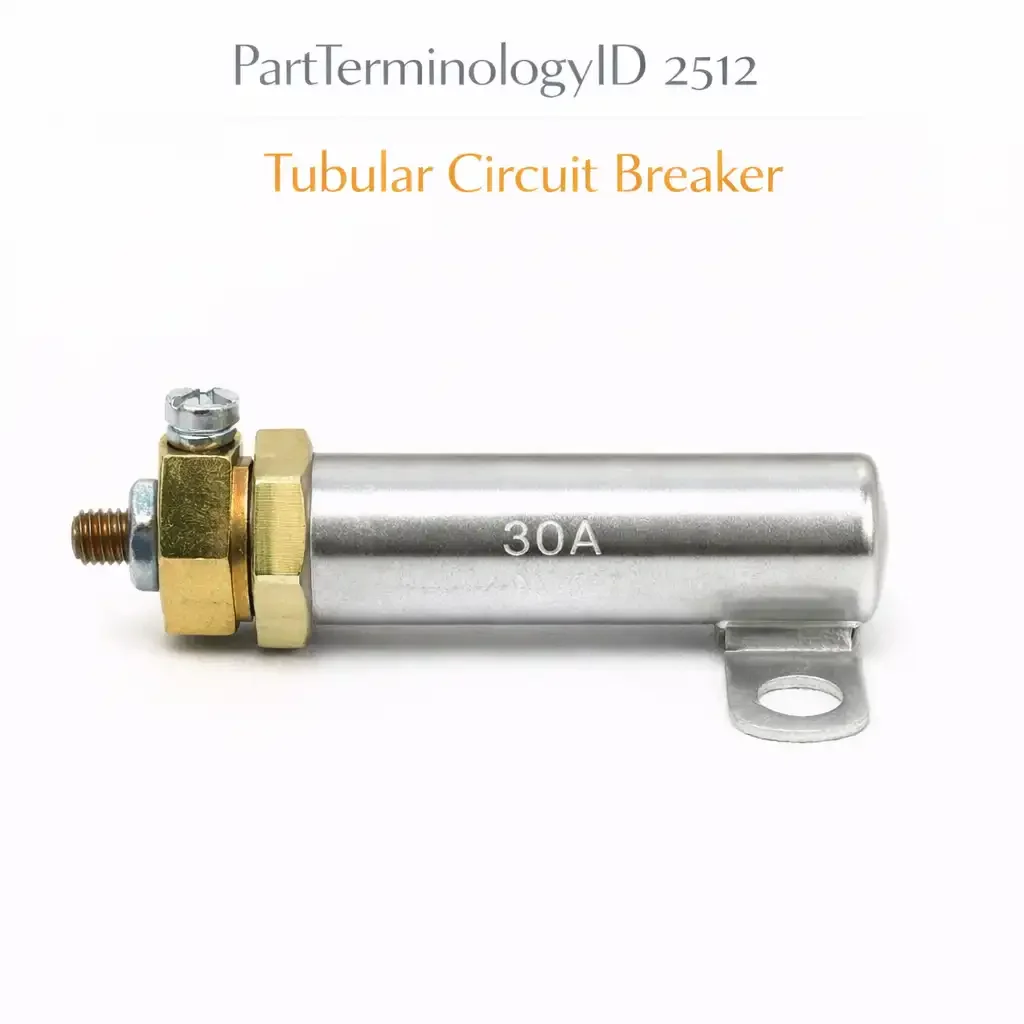
PartTerminologyID 2512, Tubular Circuit Breaker, is a cylindrical resettable overcurrent protection device designed to install in a tubular in-line fuse or breaker holder, providing the same trip-and-reset function as a panel-mount circuit breaker (PartTerminologyID 2504) but in a form factor matched to tubular holders that accept glass tube or ceramic tube dimensions from legacy and current in-line fuse holder designs. That definition covers the function correctly and establishes the critical distinction from PartTerminologyID 2504: the tubular circuit breaker's form factor is the cylindrical tube rather than the blade, screw-mount, or flat-body panel configurations covered by 2504, and the primary fitment attributes are the tube body diameter, the tube body length, and the end cap type, all of which must match the specific tubular holder the breaker installs into. It does not specify the ampere rating, the reset type, whether it is type I automatic, type II modified resetting, or type III manual, the tube body outer diameter in millimeters, the tube body length, the end cap type, whether the end caps are flat metal caps, conical brass caps, or screw-type caps, the end cap outer diameter, the contact material at the end cap faces, the voltage rating, the trip time characteristic, or whether the tube body is glass, ceramic, or polymer. A listing under PartTerminologyID 2512 that provides an ampere rating without the tube body diameter, the tube body length, and the end cap type cannot be evaluated by any technician who has removed the original tubular breaker from its holder and is confirming the replacement dimensions before sourcing it.
For sellers, PartTerminologyID 2512 serves a buyer population that spans two distinct application categories. The first is the classic vehicle and vintage accessory application where tubular in-line fuse holders from the mid-twentieth century used glass tube fuses in AGC, MDL, or SFE form factors, and where a resettable tubular circuit breaker in the same form factor is a practical upgrade over a replaceable glass tube fuse for circuits that experience frequent overcurrent events from mechanical loads. The second is the modern upfitter and fleet application where tubular inline holders are used for auxiliary circuits added to commercial and work vehicles, where a resettable breaker avoids repeated fuse replacement on a circuit that trips from predictable load transients. Both buyer categories search primarily by form factor and ampere rating, and the listing must serve dimension-first search behavior in the same way as the generator bearing posts (2488 and 2492).
The additional complexity specific to PartTerminologyID 2512 compared to 2504 is the holder compatibility argument. A panel-mount breaker installs in a panel where the mounting configuration is defined by the panel design and the breaker either fits or does not. A tubular circuit breaker installs in a holder where the tube body diameter and length must match the holder's internal bore and depth, and where the end cap outer diameter must contact the holder's end terminals cleanly to provide a low-resistance electrical connection. A tube that is 0.5mm undersize in body diameter will rattle in the holder and make intermittent contact. A tube that is 1mm too long will not allow the holder cover to close. End caps that are 1mm smaller than the holder terminal contact face will reduce the contact area and increase the junction resistance.
For sellers, the listing under this PartTerminologyID is only useful if it specifies the ampere rating, the reset type, the tube body outer diameter, the tube body length, the end cap type and outer diameter, the voltage rating, and the contact material. Without those seven attributes, the listing cannot serve a buyer who has removed the original tubular breaker and is matching the replacement to the existing holder.
What the Tubular Circuit Breaker Does
Performing the same protection function in a cylindrical form factor
The tubular circuit breaker operates on the same bimetallic element principle as the panel-mount circuit breaker: overcurrent heats the element, the element deflects, the contacts separate, and the circuit is interrupted. The reset behavior follows the same type I, II, and III distinctions established in the circuit breaker post (2504). The only functional distinction between the tubular and panel-mount designs is the form factor: the tubular design places all of these mechanisms inside a cylindrical tube body that installs in a tubular holder rather than in a panel slot.
The tubular form factor is a legacy of the glass tube fuse format that dominated automotive and accessory circuit protection from the 1930s through the 1970s and remains common in aftermarket upfitter and specialty accessory applications. The most common tubular fuse form factors in the automotive aftermarket are the AGC at 6.35mm diameter by 31.75mm length, the MDL at 6.35mm diameter by 31.75mm length with a slow-blow characteristic, and the SFE series at various lengths and diameters. A tubular circuit breaker that replaces a glass tube fuse in an existing holder must match the diameter and length of the original fuse form factor.
The holder compatibility problem in detail
A tubular holder is a spring-loaded or screw-cap device that grips the tube body at the cylindrical surface and makes electrical contact at the end caps. The holder's internal bore diameter determines the maximum tube body diameter. The holder's internal depth determines the maximum tube body length. The holder's end terminal contact geometry determines whether the end cap type provides adequate contact area.
The most common holder compatibility failure is installing a correct-diameter but overlong tube in a holder where the cover cannot close fully, leaving the end cap of the tube in partial contact with the holder terminal rather than in full face contact. A partial contact produces a resistance at the terminal junction that generates heat at the contact face during current flow, eventually oxidizing the contact surfaces and increasing the resistance further until the junction fails as an open circuit or as an intermittent connection under vibration.
The second most common failure is installing a correct-length but undersize-diameter tube in a spring-contact holder where the spring tension is designed to grip a specific tube diameter. A tube 0.5mm undersize in diameter will not be gripped with adequate force by the holder springs, and the tube will rattle and make intermittent contact during vehicle vibration.
Glass tube fuse versus tubular circuit breaker as a form factor upgrade
A buyer who is replacing a glass tube fuse with a tubular circuit breaker in an existing holder must confirm that the holder's contact design is compatible with the circuit breaker's end cap type. Glass tube fuse holders that use blade-spring contacts at the end cap positions are compatible with flat-cap tubular breakers of the same diameter and length. Holders that use screw caps require a screw-cap tube design. A flat-cap tubular breaker in a screw-cap holder will not be retained by the screw cap and will not make reliable electrical contact.
The buyer should also confirm that the reset type of the tubular circuit breaker matches the application requirement. A type I automatic resetting tubular breaker installed as an upgrade over a replaceable glass tube fuse on a circuit that previously required the deliberate action of replacing the fuse to restore power changes the fault response behavior of the circuit: the circuit now restores itself automatically rather than requiring intervention. On some circuits this is the intended benefit of the upgrade. On others it converts a safe fault response into a potentially hazardous one.
The Specifications That Determine Correct Fitment
Ampere rating
In amperes. Must be appropriate for the maximum normal circuit current with the 125 to 150 percent margin established in the circuit breaker post (2504).
Reset type
Type I automatic, Type II modified resetting, or Type III manual. State the type and note the behavior change from the glass tube fuse it replaces where the buyer is performing a fuse-to-breaker upgrade.
Tube body outer diameter
In millimeters to two decimal places. The most critical holder compatibility dimension. Common automotive tubular diameters are 6.35mm (AGC/MDL form factor) and various SFE-series diameters.
Tube body length
In millimeters. Must not exceed the holder's internal depth. State the length to one decimal place.
End cap type
Flat metal cap, conical brass cap, or screw-type cap. Must match the holder's contact design.
End cap outer diameter
In millimeters. Must contact the full face of the holder's terminal contact for minimum junction resistance.
Voltage rating
12V or 24V. Identical consequence to the panel-mount circuit breaker: a 12V rated tubular breaker in a 24V holder position will sustain accelerated contact arc erosion.
Contact material
Tin-plated, silver-plated, or bare copper end cap contact faces. Silver-plated contacts provide the lowest junction resistance and the best resistance to oxidation.
Status in New Databases
PIES/PCdb: PartTerminologyID 2512, Tubular Circuit Breaker
PIES 8.0 / PCdb 2.0: No change
Top Return Scenarios
Scenario 1: "Tube body length 1mm overlong, holder cover will not close, end cap in partial contact with holder terminal"
The replacement tubular breaker is 32.75mm in length. The holder internal depth accommodates a maximum of 31.75mm. The holder cover contacts the tube end cap before fully closing, leaving the end cap in partial contact with the holder terminal face. The partial contact produced elevated junction resistance that caused the end cap to heat and oxidize within 200 miles of installation.
Prevention language: "Tube body length: [X.X]mm. Verify the tube body length does not exceed your holder's internal depth before ordering. A tube that is longer than the holder's internal depth will prevent the holder cover from closing fully, leaving the end cap in partial contact with the holder terminal. Partial contact at the end cap produces elevated junction resistance, contact heating, and progressive oxidation that will cause the connection to fail as an open circuit or as an intermittent contact under vibration."
Scenario 2: "Tube diameter 0.5mm undersize, holder spring grip inadequate, intermittent contact under vibration"
The replacement tubular breaker has a body diameter of 5.85mm. The holder is designed for the standard 6.35mm AGC form factor with spring contacts calibrated for 6.35mm grip. The 0.5mm undersize tube is not gripped firmly by the holder springs. During normal driving vibration, the tube oscillates axially within the holder, producing intermittent contact at the end caps and generating a no-power fault code on the protected circuit that clears when the holder is pressed firmly by hand.
Prevention language: "Tube body outer diameter: [X.XX]mm. This breaker is sized for holders designed for the [AGC / MDL / SFE-X] form factor at [X.XX]mm tube diameter. A tube that is more than 0.2mm undersize in diameter will not be gripped firmly by spring-contact holders and will produce intermittent contact under vehicle vibration. Verify the tube outer diameter matches your holder's specified tube diameter before ordering."
Scenario 3: "Flat-cap breaker in screw-cap holder, tube not retained, fell out of holder within 30 miles"
The holder uses screw caps that thread onto the tube body to retain the tube and make electrical contact at the end cap face. The replacement tubular breaker has flat metal end caps with no thread. The screw cap of the holder has no surface on the flat-cap breaker to grip and thread onto. The holder accepted the flat-cap tube but did not retain it. Within 30 miles, the tube vibrated out of the holder and the circuit lost power permanently.
Prevention language: "End cap type: [flat metal cap / conical brass cap / screw-type threaded cap]. Verify the end cap type matches your holder's retention and contact design before ordering. Flat-cap tubes require spring-contact or blade-contact holders that grip the tube body. Screw-cap tubes require holders with threaded caps that engage the tube end cap profile. A flat-cap tube in a screw-cap holder will not be retained and will fall out of the holder under vibration."
What to Include in the Listing
Core essentials
PartTerminologyID: 2512
component: Tubular Circuit Breaker
ampere rating (mandatory, in title)
reset type: Type I, II, or III (mandatory, in title)
tube body outer diameter in mm to two decimal places (mandatory)
tube body length in mm to one decimal place (mandatory)
end cap type: flat, conical, or screw (mandatory)
end cap outer diameter in mm (mandatory)
voltage rating (mandatory)
contact material at end cap faces (mandatory)
equivalent fuse form factor designation where applicable: AGC, MDL, SFE (mandatory where the breaker replaces a glass tube fuse in an existing holder)
fuse-to-breaker upgrade note stating the reset behavior change from a replaced glass tube fuse (mandatory for upgrade applications)
quantity: 1
Catalog Checklist for ACES/PIES Teams
PartTerminologyID = 2512
require ampere rating and reset type in title (mandatory)
require tube body outer diameter to two decimal places (mandatory)
require tube body length to one decimal place (mandatory)
require end cap type and outer diameter (mandatory)
require voltage rating (mandatory)
require equivalent fuse form factor designation for holder compatibility confirmation (mandatory)
differentiate from circuit breaker (PartTerminologyID 2504): the panel-mount circuit breaker installs in a fuse or breaker panel; the tubular circuit breaker installs in a tubular inline holder; both perform the same overcurrent protection and reset function but in different physical form factors; the mounting configuration, not the function, is what distinguishes the two PartTerminologyIDs
differentiate from fuse: the glass tube fuse in the same form factor is a single-use device that must be replaced after tripping; the tubular circuit breaker is resettable; the tubular breaker is a direct form factor upgrade over the glass tube fuse in the same holder when the reset type consequence is understood and accepted for the application
flag tube body length as the most common holder compatibility failure: a tube that is 1mm overlong prevents the holder cover from closing and produces the partial-contact heating failure without any visible installation problem; the length must be verified against the holder internal depth before ordering
Final Take for PartTerminologyID 2512
Tubular Circuit Breaker (PartTerminologyID 2512) is the circuit breaker PartTerminologyID where the tube body diameter and length are the primary specification attributes and where the end cap type is the attribute that determines whether the tube is retained in the holder at all. A flat-cap tube in a screw-cap holder exits the vehicle within 30 miles. A tube 1mm overlong produces a partial-contact failure that looks like a failing breaker but is a holder fit error. A tube 0.5mm undersize in diameter produces an intermittent fault that clears when the holder is pressed by hand.
State the ampere rating and reset type in the title. State the tube body outer diameter to two decimal places. State the tube body length to one decimal place. State the end cap type. State the end cap outer diameter. State the voltage rating. State the equivalent fuse form factor where the breaker replaces a glass tube fuse. Include the fuse-to-breaker reset behavior note for upgrade applications. That is the same listing strategy as every other PartTerminologyID in this series applied to a cylindrical form factor where three dimensions and one end cap designation determine whether the breaker fits the holder correctly enough to protect the circuit reliably.