
Written by Arthur Simitian | PartsAdvisory
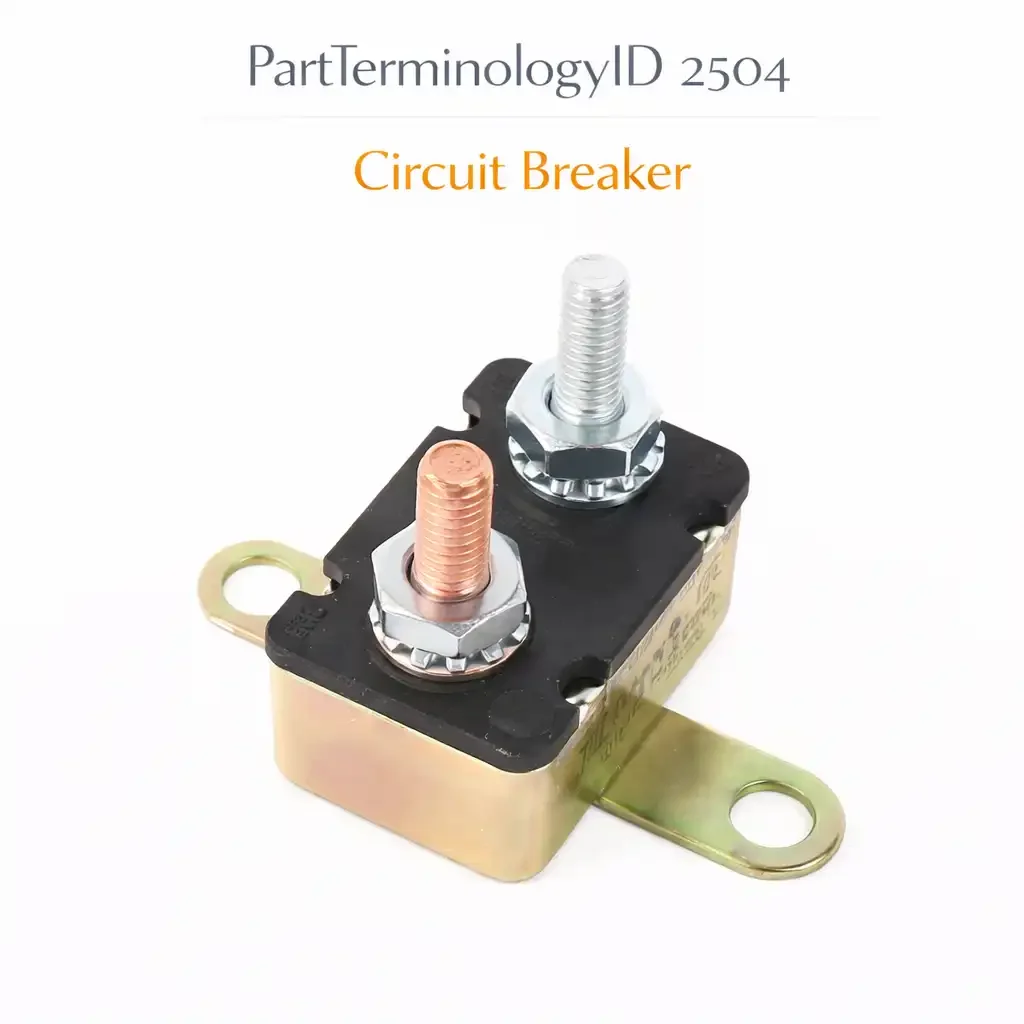
PartTerminologyID 2504, Circuit Breaker, is the resettable overcurrent protection device that interrupts current flow in a vehicle electrical circuit when the current exceeds the device's rated ampere limit, protecting the wiring, the connectors, and the load device from thermal damage caused by sustained overcurrent from a short circuit, a ground fault, or a mechanically overloaded motor load, and that resets automatically or manually after the fault is cleared rather than requiring replacement like a fuse. That definition covers the function correctly and leaves unresolved every question that determines whether the replacement circuit breaker fits the mounting position, provides the correct current rating for the protected circuit, resets at the correct temperature and time characteristic for the application, and is of the correct type for the operational requirement of the system it protects. It does not specify the ampere rating, the reset type, whether the breaker is a type I automatic resetting breaker, a type II modified resetting breaker, or a type III manual resetting breaker, the mounting configuration, whether the breaker mounts in a blade fuse panel, a screw-mount panel, a push-in panel, or is an inline breaker in the circuit wiring, the terminal type, whether terminals are blade, screw, stud, or push-on, the terminal spacing and pitch for panel-mount designs, the body dimensions, the voltage rating, whether the breaker is rated for 12-volt systems only or for 24-volt commercial applications, the trip time characteristic at the rated overcurrent level, the ambient temperature derating behavior, the contact material, the vibration resistance rating, or whether the breaker includes an indicator light that illuminates when the breaker has tripped. A listing under PartTerminologyID 2504 that provides only an ampere rating without the reset type, the mounting configuration, and the terminal specification cannot be evaluated by any technician who has confirmed the circuit breaker position that needs replacement and is confirming the replacement before removing the original.
For sellers, PartTerminologyID 2504 covers a wide range of vehicle electrical protection applications spanning from a 5-ampere panel-mount breaker protecting a low-current accessory circuit to a 200-ampere inline breaker protecting the main alternator charge cable. The ampere rating spans four decades of current, the reset types span three distinct operational behaviors, and the mounting configurations span at least five distinct panel and inline designs. A listing that is adequately specified for a 30-ampere blade-panel-mount type I breaker is completely inadequate for a 100-ampere screw-mount type III manual reset breaker even if both list the same vehicle application. The specification depth must match the application complexity.
The additional complexity specific to PartTerminologyID 2504 compared to a fuse listing is the reset type argument. A fuse is either intact or open circuit. A circuit breaker has three operationally distinct reset behaviors that determine what happens after a trip event, and the choice of reset type is not arbitrary: it is determined by the operational requirement of the protected circuit and by the consequences of automatic reset versus manual reset in the specific application. A type I automatic resetting breaker in a wiper motor circuit that is locked by ice will cycle on and off continuously, heating the wiring on each cycle, until the fault is cleared. A type III manual resetting breaker in the same circuit will trip once and remain open until the technician identifies and clears the fault before resetting the breaker. The reset type is a safety specification, not a preference.
For sellers, the listing under this PartTerminologyID is only useful if it specifies the ampere rating, the reset type, the mounting configuration, the terminal type and spacing, the voltage rating, and the body dimensions. Without those six attribute categories, the listing cannot prevent the reset type mismatch that changes the system's fault response behavior, the ampere rating mismatch that either nuisance-trips on normal circuit current or fails to protect the wiring from sustained overcurrent, or the mounting configuration mismatch that leaves the replacement incompatible with the panel or inline holder it must fit.
What the Circuit Breaker Does
Interrupting overcurrent to protect wiring and load devices
When the current through a circuit breaker exceeds its rated ampere limit, the bimetallic element inside the breaker heats and deflects, separating the contacts and interrupting the current. The time required to trip is inversely proportional to the overcurrent magnitude: a moderate overcurrent of 150 percent of the rated current may take several minutes to trip, while a large overcurrent of 1,000 percent will trip almost instantaneously. This inverse time characteristic allows the protected circuit to sustain brief current transients, such as motor starting currents, without tripping while still providing protection against sustained overcurrents that would overheat the wiring.
The trip characteristic of the specific breaker model must be matched to the load it protects. A circuit breaker that trips too quickly will nuisance-trip on the normal motor starting current of the protected device. A circuit breaker that trips too slowly allows the wiring to sustain thermal damage during the delay interval before the contacts separate. The trip time characteristic at 200 percent of rated current is the most useful single specification for evaluating whether a circuit breaker is correctly matched to a specific application.
Type I: Automatic resetting
A type I circuit breaker resets automatically after the bimetallic element cools following a trip event. If the fault that caused the trip is still present when the element cools, the breaker will conduct current again, heat again, trip again, and cycle in this on-off pattern continuously until either the fault is cleared or the breaker is removed from the circuit. The cycling behavior is the diagnostic signature of a type I breaker under a sustained fault: the protected circuit or device operates intermittently, appearing to function between trip cycles and failing on the next cycle, which can make diagnosis of the underlying fault difficult.
Type I breakers are appropriate for circuits where automatic recovery is desirable, such as power window circuits where the window motor may be temporarily overloaded by ice or debris and recovers once the obstruction clears, or horn circuits where the horn is expected to function again after the operator releases the button. Type I breakers are not appropriate for circuits where a sustained fault could cause a fire or where the automatic recovery from a trip cycle could restart a hazardous condition.
Type II: Modified resetting
A type II circuit breaker, also called a modified resetting or cycling breaker, resets automatically like a type I but has a modified bimetallic element that limits the number of reset cycles per unit time and reduces the duty cycle of the on-off cycling compared to a type I breaker. This limits the cumulative heating in the wiring during a sustained fault. Type II breakers are used in applications where some automatic recovery capability is desirable but the continuous cycling of a type I breaker would overheat the wiring or the load device before the fault is identified.
Type III: Manual resetting
A type III circuit breaker trips on overcurrent and remains open until an external reset action is applied, typically pressing a button on the breaker body or operating a toggle. The circuit remains interrupted regardless of whether the fault has cleared, requiring the technician to identify and correct the fault before the circuit can be restored. Type III breakers are used in high-current applications where a single trip event should alert the operator or technician to a fault condition rather than automatically restoring power, and in safety-critical circuits where automatic restart could be hazardous.
A type III breaker in a main power distribution position, such as protecting the main alternator charge cable or the battery main fuse position, ensures that an overcurrent event that trips the breaker requires deliberate manual intervention to restore power, preventing the vehicle from being returned to service with an unresolved fault in the primary power circuit.
The ampere rating and the nuisance trip versus underprotection tradeoff
The ampere rating of the circuit breaker must be selected to carry the maximum normal operating current of the protected circuit without tripping while providing adequate protection against fault currents. The standard practice is to rate the breaker at 125 to 150 percent of the circuit's maximum continuous current to provide a margin above the normal operating current while still tripping before the wiring insulation reaches its damage temperature.
A breaker rated too low relative to the normal circuit current will nuisance-trip during normal peak loads, such as motor starting. A breaker rated too high relative to the wiring's ampacity will allow the wiring to sustain damage before the breaker trips. For a circuit with a maximum continuous current of 20 amperes in 14 AWG wiring rated for 15 amperes continuous, a 25-ampere breaker would be appropriate. A 40-ampere breaker in the same position would allow the 14 AWG wiring to overheat before tripping.
Panel mount versus inline mount
Panel-mount circuit breakers are designed to install in a fuse or breaker panel, either in a blade-type slot identical to a blade fuse, in a screw-mount position with terminal studs, or in a push-in position with a proprietary panel body. The panel mounting determines the body dimensions, the terminal type and spacing, and the method of securing the breaker in the panel.
Inline circuit breakers are installed directly in the circuit wiring rather than in a panel, connected by ring or spade terminals at each end of the breaker body. Inline breakers are used for high-current applications such as alternator charge cables, winch circuits, and upfitter auxiliary power circuits where the current level exceeds the rating of standard panel-mount breaker positions, or where no panel position is available for the circuit.
The mounting type must match the installation position. A panel-mount breaker cannot be installed in an inline position without a panel bracket or adapter, and an inline breaker cannot be installed in a fuse panel position without modification.
Why This Part Generates Returns
Buyers order the wrong circuit breaker because:
the reset type is not specified and a type I automatic resetting breaker is installed where a type III manual reset is required for safety, or the reverse
the ampere rating is one standard increment below or above the correct rating, causing nuisance trips on normal peak load current or allowing wiring overheat before the trip threshold is reached
the mounting configuration is not specified and a panel-mount blade breaker is ordered for a screw-mount position
the terminal spacing for a panel-mount breaker does not match the panel contact spacing, preventing the breaker from seating in the panel
the voltage rating is 12 volts and the application is a 24-volt commercial vehicle circuit where a 12-volt breaker will be damaged by the higher voltage
the body height exceeds the panel cover clearance and the panel cover cannot be fully closed over the installed breaker
the trip time characteristic at 200 percent overcurrent is too fast for the motor starting current of the protected device, producing nuisance trips every time the motor is started
the ambient temperature derating is not considered and the breaker installed in a high-temperature location trips below its rated current under normal operating conditions
Status in New Databases
PIES/PCdb: PartTerminologyID 2504, Circuit Breaker
PIES 8.0 / PCdb 2.0: No change
Top Return Scenarios
Scenario 1: "Type I automatic resetting installed where type III manual required, wiring overheated during sustained fault cycling"
The circuit breaker protects the main feed to an aftermarket winch. The winch motor stalled against a load beyond its rating. A type I automatic resetting breaker was installed because the listing did not specify the reset type. The breaker cycled on and off continuously as the stalled motor drew locked-rotor current on each reset cycle. After approximately 90 seconds of cycling, the wiring between the battery and the winch motor reached its insulation damage temperature and the insulation melted at the cable bend nearest the winch housing.
Prevention language: "Reset type: [Type I automatic / Type II modified resetting / Type III manual resetting]. For high-current motor applications such as winches, anchor windlasses, and hydraulic pump motors, Type III manual resetting is required. A Type I automatic resetting breaker in a stalled motor circuit will cycle continuously, allowing the wiring to sustain cumulative thermal damage before the fault is identified. Specify Type III manual resetting for any application where a single sustained fault should interrupt power and require deliberate operator intervention to restore."
Scenario 2: "Ampere rating one increment high, wiring sustained thermal damage before trip"
The replaced breaker is rated 40 amperes. The protected circuit uses 16 AWG wiring rated for 13 amperes continuous, and the maximum normal circuit current is 11 amperes. The correct breaker for this circuit is 15 amperes. The 40-ampere breaker did not trip during a wiring ground fault that sustained 28 amperes through the 16 AWG wire for 6 minutes before a secondary protection device interrupted the fault. The 16 AWG wiring was damaged along a 300mm section nearest the fault point.
Prevention language: "Ampere rating: [X] amperes. Verify the breaker ampere rating is 125 to 150 percent of the maximum continuous circuit current and does not exceed the ampacity of the smallest wire gauge in the protected circuit. A breaker rated above the wiring's ampacity will not trip before the wiring sustains thermal damage from a sustained overcurrent fault. Match the breaker rating to the wiring, not to the maximum fault current the load device can produce."
Scenario 3: "Panel terminal spacing 0.25 inches, replacement breaker terminal spacing 0.20 inches, breaker rocks in panel and makes intermittent contact"
The panel uses a 0.25-inch terminal spacing for its blade contacts. The replacement breaker has a 0.20-inch terminal spacing, which is the most common spacing for automotive blade-type circuit breakers but not the correct spacing for this specific panel design. The undersized breaker seated in the panel but rocked laterally, making intermittent contact with one panel blade on each cycle of engine vibration. The protected circuit produced an intermittent fault code from the repeated power interruptions.
Prevention language: "Terminal type: blade. Terminal spacing: [X.XX] inches. Verify the terminal spacing matches your panel's blade contact spacing before ordering. Blade-type circuit breaker terminal spacings are not universally standardized across all vehicle panel designs. An incorrect terminal spacing will allow the breaker to seat in the panel but rock under vibration, producing intermittent contact and intermittent faults in the protected circuit."
Scenario 4: "12-volt breaker in 24-volt commercial vehicle circuit, contact arc damage, breaker failed open within 500 miles"
The replacement breaker is rated for 12-volt systems. The vehicle is a commercial truck with a 24-volt electrical system. At 24 volts, the arc energy when the contacts separate on a trip event is substantially higher than at 12 volts. The 12-volt breaker's contact material and contact gap are not rated for 24-volt arc interruption. Within 500 miles, repeated trip-and-reset cycles had eroded the contact faces from arc damage, increasing contact resistance and eventually welding the contacts in the open position.
Prevention language: "Voltage rating: [12V / 24V / 12-24V universal]. Verify the voltage rating matches your vehicle's electrical system voltage before ordering. A breaker rated for 12-volt systems has a contact gap and contact material designed for 12-volt arc interruption. In a 24-volt system, the contact arc energy is four times higher than in a 12-volt system for the same fault current. A 12-volt rated breaker in a 24-volt circuit will sustain accelerated contact erosion on every trip-and-reset cycle and will fail prematurely."
Scenario 5: "Ambient temperature derating not considered, breaker installed near exhaust, trips at 70 percent of rated current"
The replacement breaker is rated 20 amperes at 25 degrees Celsius ambient. It is installed in a panel positioned near the engine exhaust manifold where the ambient temperature regularly reaches 85 degrees Celsius during normal operation. The breaker's bimetallic element, already heated by the ambient temperature, trips at approximately 14 amperes in this environment, which is 70 percent of its rated current. The protected circuit, which draws up to 17 amperes during peak operation, trips the breaker on every high-demand event.
Prevention language: "Ampere rating: [X] amperes at 25 degrees Celsius ambient. Circuit breaker ratings are specified at 25 degrees Celsius ambient. At elevated ambient temperatures, the effective trip current decreases because the bimetallic element is already partially heated by the ambient before any circuit current flows. In a 85-degree Celsius ambient environment, this breaker may trip at approximately [X] amperes. For high-temperature mounting locations, specify a breaker with a higher ampere rating to compensate for the derating, or relocate the breaker to a cooler position."
What to Include in the Listing
Core essentials
PartTerminologyID: 2504
component: Circuit Breaker
ampere rating (mandatory, in title)
reset type: Type I automatic, Type II modified resetting, or Type III manual (mandatory, in title)
mounting configuration: panel blade-mount, panel screw-mount, panel push-in, or inline (mandatory)
terminal type: blade, screw, stud, ring lug, or spade (mandatory)
terminal spacing in inches or mm for panel-mount designs (mandatory)
body dimensions: length, width, height in mm (mandatory)
voltage rating: 12V, 24V, or 12-24V (mandatory)
trip time characteristic at 200 percent of rated current in seconds (mandatory)
ambient temperature derating note (mandatory)
contact material (mandatory)
indicator light: included or not included (mandatory)
vibration resistance rating where available (mandatory)
quantity: 1
Fitment essentials
vehicle year/make/model/submodel for direct OE replacement applications
circuit designation where the breaker protects a specific named circuit
panel designation where the breaker installs in a specific named panel position
upfitter or fleet application note where the breaker protects an auxiliary or aftermarket circuit
Dimensional essentials
body length in mm
body width in mm
body height in mm
terminal spacing in inches or mm
panel cutout dimensions for flush-mount designs
mounting stud diameter for stud-mount designs
Image essentials
breaker from the front showing the reset type designation and the ampere rating label
breaker from the terminal side showing terminal type and spacing
body height shown clearly for applications with panel cover clearance constraints
type III manual reset button or toggle shown clearly to distinguish from type I and type II designs
inline breaker shown with ring or spade terminal ends and overall body length callout
breaker installed in its correct panel position or inline application to show mounting method
Catalog Checklist for ACES/PIES Teams
PartTerminologyID = 2504
require ampere rating in title and attribute field (mandatory)
require reset type in title and attribute field (mandatory)
require mounting configuration (mandatory)
require terminal type and spacing (mandatory)
require voltage rating (mandatory)
require body dimensions (mandatory)
require trip time characteristic at 200 percent of rated current (mandatory)
require ambient temperature derating note (mandatory)
differentiate from fuse (PartTerminologyID varies): a fuse is a single-use overcurrent device that must be replaced after tripping; a circuit breaker is resettable and does not require replacement after a trip event unless the breaker itself has been damaged by an overcurrent event; the choice between fuse and circuit breaker protection is an application design decision, not a substitution option; a circuit breaker listing must not be substituted for a fuse listing without confirming the protected circuit was designed for breaker protection
differentiate from fusible link (PartTerminologyID varies): a fusible link is a length of smaller-gauge wire in series with the circuit that melts as a fuse element on an overcurrent event; it is a single-use device like a fuse; a circuit breaker is resettable; fusible links are used in main power feed applications where a high-energy fault must be interrupted irreversibly; a circuit breaker in the same position provides resettable protection but may allow repetitive fault cycling that a fusible link would terminate on the first event
differentiate from relay: a relay is a switching device that connects or disconnects a circuit in response to a control signal; it does not provide overcurrent protection; a relay and a circuit breaker serve different functions in the same circuit; some panel positions accept either a relay or a circuit breaker in the same physical slot, but they perform different circuit functions
flag reset type as mandatory in title: the reset type is the most consequential single attribute for the safety behavior of the circuit breaker in a fault condition; a type I automatic breaker and a type III manual breaker of the same ampere rating in the same panel position will produce completely different system behavior on a fault event; the reset type must be stated in the listing title, not only in the attributes
flag voltage rating as mandatory: a 12-volt breaker in a 24-volt application suffers accelerated contact erosion on every trip cycle and will fail open prematurely; commercial vehicle applications must confirm the voltage rating before ordering
flag terminal spacing as mandatory for panel-mount designs: a breaker that seats in the panel but does not make full contact with the panel blades from incorrect terminal spacing produces intermittent faults that are not immediately attributable to the breaker; the terminal spacing must be verified against the panel specification before ordering
FAQ (Buyer Language)
How do I choose between a Type I, Type II, and Type III circuit breaker?
The reset type is determined by the operational requirement of the protected circuit and the safety consequence of automatic versus manual reset. If the protected circuit should recover automatically after a temporary overcurrent such as a window motor temporarily stalled by ice, specify Type I automatic. If the circuit should recover automatically but with a limited duty cycle during sustained fault conditions to reduce wiring stress, specify Type II modified resetting. If the circuit should remain interrupted after a trip until an operator or technician identifies and clears the fault before restoring power, specify Type III manual. For any circuit where automatic restart from a fault condition could be hazardous, such as high-current motor circuits, main power feeds, or circuits where the tripped state should be a visible diagnostic indicator, specify Type III.
Can I replace a fuse with a circuit breaker of the same ampere rating?
Only if the circuit was originally designed to accept a circuit breaker in that position. Some panels accept both fuses and circuit breakers in the same blade slot at the same ampere rating. If the position accepts a blade fuse and a blade circuit breaker interchangeably, the substitution is straightforward. If the original protection is a fusible link or a cartridge fuse, the mounting configuration is different and a circuit breaker cannot be directly substituted without an adapter or a circuit modification. More importantly, if the original circuit uses a fuse rather than a breaker, there may be a design reason: a fuse terminates an overcurrent fault irreversibly and prevents the circuit from being restored without a deliberate replacement action, which for some circuits is the intended safety behavior.
My circuit breaker keeps tripping on the same circuit. Should I replace it with a higher-rated breaker?
No. A circuit breaker that repeatedly trips is performing its protection function. The repeated tripping indicates that the circuit is drawing more current than the breaker's rating, which means either the breaker is correctly rated and the circuit has a fault, or the breaker is underrated for the circuit's normal peak current and is nuisance-tripping. Confirm the maximum normal current of the protected circuit by measuring the current during peak operation before replacing the breaker with a higher rating. Replacing a correctly rated breaker with a higher rating to stop the tripping removes the overcurrent protection from the circuit without correcting the underlying fault, which will allow the wiring to sustain thermal damage on the next fault event.
What is the difference between a panel-mount and an inline circuit breaker?
A panel-mount circuit breaker installs in a fuse or breaker panel at a designated position, with the panel providing the physical mounting and the electrical connection through the panel's blade contacts or screw terminals. An inline circuit breaker installs directly in the circuit wiring, connected by ring or spade terminals at each end of the breaker body, without requiring a panel position. Inline breakers are used for high-current circuits above the rating of standard panel positions, for circuits added to the vehicle after the original panel was fully populated, and for upfitter auxiliary circuits in commercial or fleet vehicles. The mounting type is determined by the installation position, not by the ampere rating: both panel-mount and inline breakers are available across a wide range of current ratings.
Cross-Sell Logic
Fuse (the fuse protects the same circuit category as the circuit breaker; for applications where the original protection was a fuse and the buyer is considering upgrading to a resettable circuit breaker, note the reset type implications and the mounting compatibility requirements)
Fusible Link (the fusible link is the single-use high-energy fault protection device for main power feed applications; cross-reference alongside high-current inline circuit breakers for buyers who are deciding between fusible link protection and resettable breaker protection for a main power feed)
Relay (relays and circuit breakers frequently share the same panel positions in automotive fuse and relay boxes; cross-reference relay listings for buyers who need to populate adjacent positions in the same panel)
Wiring Harness Repair Kit (a circuit breaker replaced after a fault event should prompt inspection of the wiring in the protected circuit; a wiring repair kit is the concurrent purchase for a circuit that has sustained insulation damage from an overcurrent event before the breaker tripped)
Battery Cable (PartTerminologyID 2500: inline circuit breakers protecting the main alternator charge cable or the main battery cable are evaluated at the same service event as the cable itself)
Frame as "the circuit breaker protects the wiring that carries the current to the load. The reset type determines what happens after the fault. The ampere rating determines when protection activates. The wiring gauge determines how much protection the circuit needs. The mounting configuration determines where the protection lives in the circuit."
Final Take for PartTerminologyID 2504
Circuit Breaker (PartTerminologyID 2504) is the overcurrent protection PartTerminologyID where the reset type in the listing title is the single attribute that most directly determines the safety behavior of the vehicle's electrical system during a fault event, and where omitting it allows a type I automatic resetting breaker to be installed in a type III manual reset position, converting a circuit that should remain interrupted on a fault into one that cycles repeatedly and heats the wiring on every reset cycle. That consequence is not a fitment error detectable at installation: the breaker seats correctly, the circuit functions normally, and the safety mismatch is only revealed when a fault occurs and the breaker resets automatically into a condition it should have held open.
State the ampere rating in the title. State the reset type in the title. State the mounting configuration. State the terminal type and spacing. State the voltage rating. State the body dimensions. State the trip time characteristic. Include the ambient temperature derating note. That is the same listing strategy as every other PartTerminologyID in this series: specific attributes at every level to become a listing buyers can act on without guessing. For PartTerminologyID 2504, the reset type and the voltage rating are the two attributes that determine whether the protection device performs its safety function correctly or silently fails to perform it in the conditions that matter most.