
Starter Cable (PartTerminologyID 2501): Where Gauge, Solenoid Terminal Type, and Routed Length Determine Cranking Voltage
Written by Arthur Simitian | PartsAdvisory
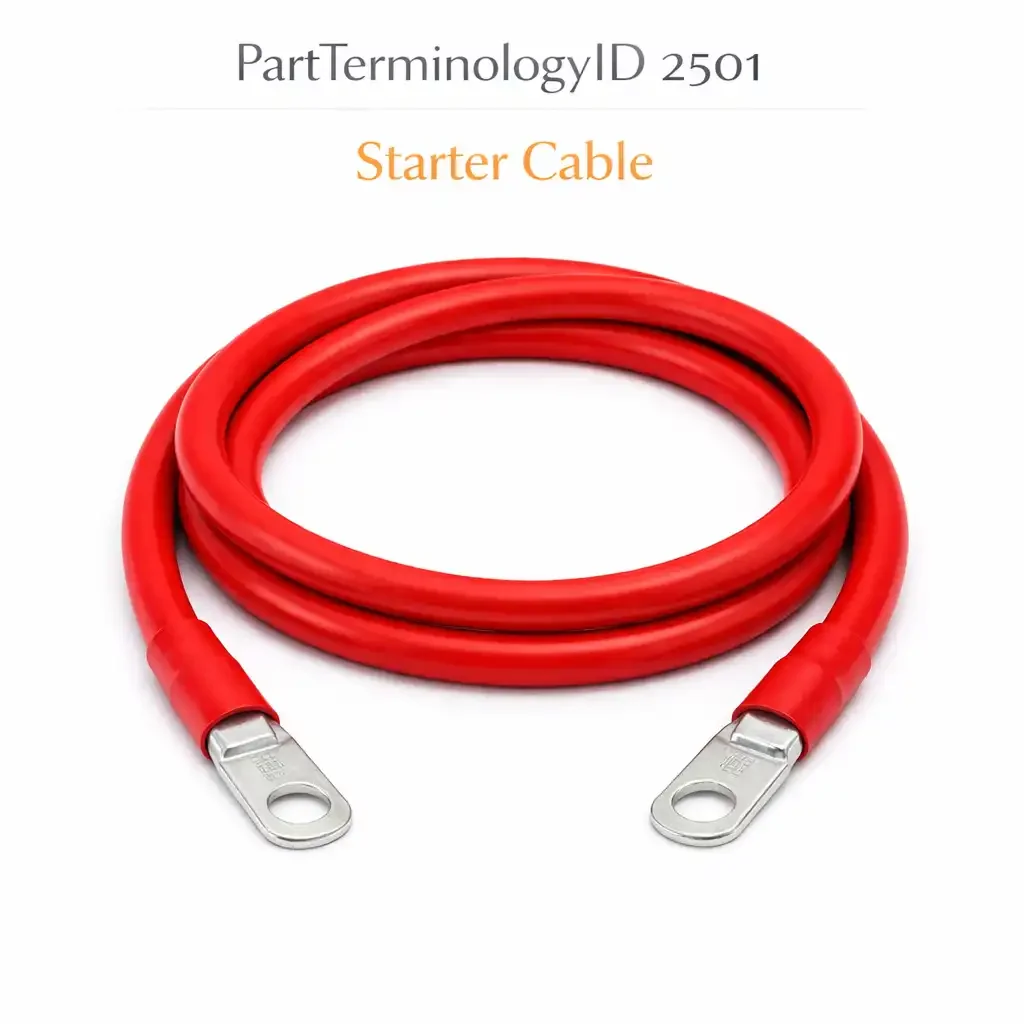
PartTerminologyID 2501, Starter Cable, is the heavy-gauge insulated conductor that carries cranking current from the battery positive terminal or from the starter relay output terminal to the main terminal on the starter motor solenoid, delivering the high-ampere supply required to operate the starter motor during engine cranking events. That definition covers the function correctly and distinguishes PartTerminologyID 2501 from PartTerminologyID 2500 in one critical way: the starter cable is the specific cable segment that connects to the starter motor solenoid main terminal, whereas the battery cable post (2500) addresses the broader battery cable system including the positive cranking cable, the negative ground cable, and the alternator charge cable as a group. A listing under PartTerminologyID 2501 that provides vehicle year, make, and model without the wire gauge, the overall routed length, the solenoid terminal type and stud diameter, the battery end terminal type and bore diameter, and the conductor material cannot be evaluated by any technician who has removed the original starter cable and is confirming the replacement before threading the new cable through the engine bay routing path.
For sellers, PartTerminologyID 2501 occupies a more specific position in the cranking circuit cable hierarchy than PartTerminologyID 2500. Where the battery cable listing may cover the complete cable set from battery to starter to ground, the starter cable listing covers only the cable segment that terminates at the starter solenoid. This distinction matters in two catalog scenarios. The first is a vehicle where the battery-to-starter cable run is divided by a fusible link, a main fuse, or a relay into two segments: the battery-to-relay segment and the relay-to-starter segment. The relay-to-starter segment is the starter cable under PartTerminologyID 2501. The second is a vehicle where the battery-to-starter positive cable is a single uninterrupted run that is listed under both 2500 and 2501 depending on the catalog implementation. A seller must understand which catalog scenario applies to the vehicle application before deciding which PartTerminologyID to use for the listing.
The additional complexity specific to PartTerminologyID 2501 compared to 2500 is the solenoid terminal argument. The starter solenoid main terminal is the highest-current single connection point in the vehicle's electrical system, carrying the full cranking current during every starting event. The terminal connection quality at the solenoid stud determines the contact resistance at the most critical junction in the cranking circuit. A ring lug that does not fully contact the flat face of the solenoid stud from an undersized inner diameter, a lug that is overtorqued and cracked at the crimp, or a lug that has oxidized at the contact face without visible external corrosion produces a resistance at this junction that reduces the effective cranking voltage at the starter motor below the minimum for reliable starting.
For sellers, the listing under this PartTerminologyID is only useful if it specifies the wire gauge in both AWG and metric cross-section, the routed cable length, the solenoid terminal type and stud diameter clearance, the battery end terminal type and bore diameter, the conductor material, and the routing configuration for pre-formed cables. Without those six attributes, the listing cannot serve the technician who is replacing a damaged or corroded starter cable and needs dimensional confirmation before routing the replacement through the engine bay.
What the Starter Cable Does
Delivering cranking voltage to the solenoid main terminal
The starter cable's primary function is to deliver the battery voltage minus the cable's own voltage drop to the solenoid main terminal during cranking. Every milliohm of resistance in the starter cable produces a voltage drop equal to the cranking current multiplied by the resistance. At 300 amperes of cranking current, a cable resistance of 3 milliohms produces a 0.9-volt drop across the cable alone. A cable with 5 milliohms of resistance at the same current produces a 1.5-volt drop, reducing the available starter voltage from 12 volts at the battery to 10.5 volts at the solenoid terminal before accounting for any battery internal resistance or ground circuit resistance.
The starter motor's torque output is proportional to the square of the voltage applied to its terminals. A reduction from 12 volts to 10.5 volts at the starter terminals reduces the available cranking torque by approximately 23 percent. In cold weather, where the battery's internal resistance is elevated and the engine oil is thicker, this torque reduction is the difference between a reliable start and a slow crank that fails to fire.
The solenoid main terminal and its connection integrity
The starter solenoid serves two functions: it engages the starter drive pinion with the ring gear through the plunger mechanism, and it closes the main electrical contacts that connect the battery cable to the starter motor armature. The main terminal on the solenoid housing is the external connection point for the battery cable or starter cable. It is typically a threaded stud of 8mm, 10mm, or 12mm diameter depending on the starter model and the vehicle application.
The ring lug on the starter cable must fit over this stud with adequate clearance to seat flat against the solenoid terminal face without rocking or tilting. A lug with an inner diameter too close to the stud diameter will be difficult to install over the stud, particularly if the stud threads are corroded, and may not seat flat if the lug is forced over the stud at an angle. A lug with an inner diameter too large relative to the stud diameter will contact the stud at a small arc rather than across its full inner circumference, reducing the effective contact area and increasing junction resistance.
The correct lug inner diameter is typically 1 to 2mm larger than the stud outer diameter, providing installation clearance while maintaining adequate contact face area between the lug face and the solenoid terminal mounting surface. The listing must state the solenoid stud diameter the lug is designed to accommodate.
Routing from relay to starter versus battery to starter
On vehicles with a starter relay or a fusible link between the battery and the starter, the starter cable under PartTerminologyID 2501 runs from the relay output terminal or the fusible link output to the solenoid main terminal. This cable segment is typically shorter than the complete battery-to-starter run and is routed in the lower engine bay near the starter motor rather than across the full engine bay from the battery location.
On vehicles without an intermediate relay or fusible link, the single cable from battery positive to solenoid main terminal may be listed under either PartTerminologyID 2500 or 2501 depending on the catalog. The listing must state which configuration it covers: relay-to-starter segment only, or complete battery-to-starter run. A technician replacing only the corroded relay-to-starter segment who receives a complete battery-to-starter cable will have excess cable length, incorrectly positioned bends in a pre-formed cable, and a terminal at one end that does not match the relay output terminal.
The heat environment at the starter motor location
The starter motor is mounted at the bottom of the engine, close to the exhaust manifold on many engine configurations. The starter cable routed to the solenoid main terminal passes through a heat environment that exceeds the ambient under-hood temperature by a substantial margin on some engine and exhaust configurations. A cable insulated with standard PVC rated to 80 degrees Celsius may soften, deform, and eventually crack in a routing path that regularly reaches 100 to 120 degrees Celsius from exhaust proximity.
The cable insulation material and temperature rating must match the thermal environment of the specific routing path. For applications where the starter cable routes near the exhaust manifold or the turbocharger, a cable with XLPE or silicone insulation rated to 125 degrees Celsius or higher is the correct specification. The listing must state the insulation material and its temperature rating.
Diagnosing a starter cable fault before ordering the replacement
The voltage drop test is the correct diagnostic tool for confirming a starter cable fault before ordering a replacement. Connect a voltmeter from the battery positive terminal to the solenoid main terminal stud and crank the engine for three seconds. A voltage drop above 0.5 volts across the positive cable run during cranking indicates excessive cable resistance from corrosion, undersized gauge, or a high-resistance terminal connection. Repeat the measurement from the battery negative terminal to the engine block ground stud: a voltage drop above 0.3 volts across the ground circuit indicates that the ground return path, not the starter cable, is the source of the cranking resistance.
Performing this test before ordering the replacement cable confirms that the cable is the fault source and also confirms which segment is at fault on vehicles with a starter relay. Measure the voltage drop across the battery-to-relay segment and the relay-to-solenoid segment separately to identify which segment requires replacement. A technician who replaces the relay-to-solenoid segment and discovers the battery-to-relay segment has the same corrosion will need a second order. Measuring both segments during the diagnostic avoids the second visit.
The second pre-order diagnostic is the conductor inspection cut. As established in the battery cable post (2500), cut the cable 25mm back from the corroded terminal before committing to a terminal-only repair. If the exposed conductor strands show any green oxide or discoloration beyond the terminal crimp zone, the complete cable requires replacement. On a starter cable, where the solenoid end of the cable is in the hottest and most moisture-exposed position in the engine bay, internal corrosion progressing beyond the terminal crimp is more common than in cables routed in the cooler upper engine bay.
The Specifications That Determine Correct Starter Cable Fitment
Wire gauge in AWG and metric cross-section
As established in the battery cable post (2500), the gauge must be stated in both AWG and metric square millimeters to prevent system-mismatch ordering errors. For starter cable applications, common gauges are 4 AWG (21mm²), 2 AWG (33mm²), 1/0 AWG (53mm²), and 2/0 AWG (67mm²). The correct gauge depends on the starter motor's maximum cranking current, the cable length, and the acceptable voltage drop budget for the cranking circuit.
Conductor material
Pure stranded copper or copper-clad aluminum. As established in the battery cable post (2500), copper-clad aluminum performs at approximately 40 to 50 percent of the current capacity of pure copper at the same AWG gauge. Copper-clad aluminum must not be listed without explicit material disclosure.
Overall routed length
In millimeters. For pre-formed cables, the stated length includes the arc length of molded bends and the actual straight-run portion is shorter than the overall length. Technicians must measure the routed path in the vehicle rather than the straight-line distance.
Cable configuration
Whether the cable covers the relay-to-starter segment only or the complete battery-to-starter run. State the configuration explicitly.
Solenoid terminal type and stud clearance
Ring lug inner diameter at the solenoid end in millimeters. Common solenoid stud diameters are 8mm, 10mm, and 12mm. State the stud diameter the lug is designed for and the lug inner diameter.
Battery or relay end terminal type and bore
Top-post clamp, side-post bolt, ring lug, or spade terminal at the battery or relay end. Inner diameter or bore at this terminal in millimeters.
Insulation material and temperature rating
PVC, XLPE, or silicone. Temperature rating in degrees Celsius. For exhaust-proximity routing, minimum 125 degrees Celsius.
Pre-formed or universal
Pre-formed with fixed routing bends matched to the OE cable path, or universal straight cable requiring field forming and terminal installation.
Status in New Databases
PIES/PCdb: PartTerminologyID 2501, Starter Cable
PIES 8.0 / PCdb 2.0: No change
Top Return Scenarios
Scenario 1: "Relay-to-starter segment needed, complete battery-to-starter cable received, bends and length wrong"
The vehicle has a starter relay mounted on the inner fender. The failed cable runs from the relay output terminal to the solenoid main terminal, approximately 600mm routed length. The listing specified a starter cable by vehicle year, make, and model without stating the cable configuration. The complete battery-to-starter cable arrived, 1,400mm in overall length with bends configured for routing from the battery location across the full engine bay. The bends and length are wrong for the relay-to-starter segment.
Prevention language: "Cable configuration: [relay-to-starter segment, [X]mm routed length / complete battery-to-starter run, [X]mm routed length]. This vehicle has a starter relay that divides the cranking circuit. The starter cable under this listing is the [relay-to-starter] segment only. Verify the cable configuration before ordering. The relay-to-starter segment and the complete battery-to-starter run are different lengths with different terminal configurations at the relay or battery end."
Scenario 2: "Ring lug inner diameter 8mm, solenoid stud is 10mm, lug will not fit over stud"
The replacement starter cable has a ring lug at the solenoid end with an 8mm inner diameter. The starter motor solenoid main stud is 10mm. The lug cannot be installed over the 10mm stud. The cable was returned as the wrong part.
Prevention language: "Solenoid end terminal: ring lug, inner diameter [X]mm, designed for solenoid stud diameter [X]mm. Common solenoid stud diameters are 8mm, 10mm, and 12mm depending on the starter model. Verify the stud diameter on your starter solenoid main terminal before ordering. A ring lug with an inner diameter smaller than the stud diameter cannot be installed without modifying the lug or the stud."
Scenario 3: "PVC insulation, exhaust proximity routing, insulation cracked within 18 months"
The replacement cable uses PVC insulation rated to 80 degrees Celsius. The routing path runs within 50mm of the exhaust manifold on this engine. The under-hood temperature at this routing position regularly reaches 105 degrees Celsius during sustained highway operation. Within 18 months, the PVC insulation had softened, deformed against the adjacent metal bracket, and cracked at the contact point. The exposed conductor contacted the bracket, blowing the main fuse.
Prevention language: "Insulation material: [PVC, rated to 80 degrees Celsius / XLPE, rated to 125 degrees Celsius / silicone, rated to 180 degrees Celsius]. Verify the insulation temperature rating is adequate for the cable's routing environment. The starter cable routing path on this engine passes within [X]mm of the exhaust manifold. PVC-insulated cable is not adequate for routing positions that regularly exceed 80 degrees Celsius. Specify XLPE or silicone insulation for exhaust-proximity routing."
Scenario 4: "Gauge correct, conductor is copper-clad aluminum, slow crank after cable replacement in cold weather"
The replacement starter cable is labeled 2 AWG but uses copper-clad aluminum conductors. The listing stated 2 AWG without specifying the conductor material. At minus 20 Celsius the engine required 420 amperes to crank. The copper-clad aluminum cable at 2 AWG has an effective current capacity equivalent to approximately 4 AWG pure copper. The voltage drop across the cable at 420 amperes was 2.1 volts, leaving 9.9 volts at the solenoid terminal. The engine cranked slowly and failed to start on the first attempt.
Prevention language: "Conductor material: [pure stranded copper / copper-clad aluminum]. Gauge: 2 AWG (approximately 33mm² pure copper cross-section). Copper-clad aluminum conductors of the same AWG gauge have approximately 40 to 50 percent lower current capacity than pure copper. A 2 AWG copper-clad aluminum cable performs at approximately the level of a 4 AWG pure copper cable at cranking current. Specify pure stranded copper for reliable cold weather starting."
Scenario 5: "Pre-formed cable, overall length includes bend arc, straight run 150mm short of solenoid terminal"
The pre-formed replacement cable has an overall length of 800mm including the arc length of two 90-degree bends. The technician measured the straight-line distance from the relay to the starter as 650mm and assumed the 800mm cable had adequate slack. The straight-run portions of the cable sum to 620mm. The routed path from relay to starter requires 770mm of straight run with the two bends navigating around the engine block. The cable is 150mm short of the solenoid terminal.
Prevention language: "Pre-formed cable: overall length [X]mm includes arc length of [X] bends. Measure the routed path from the relay output terminal to the starter solenoid terminal following the actual routing path through the engine bay. Do not use the straight-line distance. Add 75mm of slack to the measured routed length before confirming cable fit. The arc length of each 90-degree bend in this cable is approximately [X]mm."
Scenario 6: "Solenoid stud threads corroded, ring lug forced over stud at angle, lug seated tilted, contact area reduced, intermittent no-start under vibration"
The solenoid stud had light thread corrosion from road splash exposure. The ring lug inner diameter was the correct size for the stud but the corroded threads prevented smooth insertion. The technician forced the lug over the corroded stud at a slight angle. The lug seated with one edge of the lug face contacting the solenoid terminal surface and the opposite edge raised approximately 1.5mm. The effective contact area between the lug face and the solenoid terminal was approximately 30 percent of the lug face area. Under engine vibration, the tilted lug rocked on the partial contact face, producing an intermittent high-resistance connection that caused a no-start on cold mornings when the cranking current demand was highest.
Prevention language: "Before installing the ring lug on the solenoid stud, chase the stud threads with the correct die or clean them with a wire brush until the lug slides over the stud smoothly by hand. A lug forced over corroded threads will not seat flat against the solenoid terminal face. A tilted lug with partial face contact produces a high-resistance junction that causes intermittent no-start under vibration. The lug must seat flat with full face contact before the retaining nut is torqued."
What to Include in the Listing
Core essentials
PartTerminologyID: 2501
component: Starter Cable
cable configuration: relay-to-starter segment or complete battery-to-starter run (mandatory, in title where configuration varies by vehicle)
wire gauge in AWG with metric cross-section equivalent in mm² (mandatory)
conductor material: pure stranded copper or copper-clad aluminum (mandatory)
overall routed length in mm (mandatory)
pre-formed or universal (mandatory)
routing measurement note for pre-formed cables (mandatory)
solenoid end terminal type: ring lug (mandatory)
solenoid end ring lug inner diameter in mm (mandatory)
solenoid stud diameter the lug is designed for in mm (mandatory)
battery or relay end terminal type (mandatory)
battery or relay end terminal bore or inner diameter in mm (mandatory)
insulation material: PVC, XLPE, or silicone (mandatory)
insulation temperature rating in degrees Celsius (mandatory)
insulation color (mandatory)
routing environment note for exhaust-proximity applications (mandatory where applicable)
included hardware: protective boot, terminal bolt (mandatory)
quantity: 1
Catalog Checklist for ACES/PIES Teams
PartTerminologyID = 2501
require cable configuration: relay-to-starter segment or complete run (mandatory)
require wire gauge in both AWG and metric mm² (mandatory)
require conductor material (mandatory)
require overall routed length (mandatory)
require solenoid end ring lug inner diameter and solenoid stud diameter (mandatory)
require battery or relay end terminal specification (mandatory)
require insulation material and temperature rating (mandatory)
require pre-formed versus universal designation (mandatory)
differentiate from battery cable (PartTerminologyID 2500): the battery cable post covers the complete battery cable system including positive, negative, and charge cables; the starter cable post covers only the cable segment that terminates at the starter solenoid main terminal; a vehicle with a starter relay has two cable segments in the cranking circuit positive path that may be listed under different PartTerminologyIDs; the listing must state which segment it covers
differentiate from switch-to-starter cable (PartTerminologyID 2502): the switch-to-starter cable carries the low-current control signal from the ignition switch or ECM relay to the solenoid S terminal; it is a small-gauge wire carrying 5 to 40 amperes at most; the starter cable carries the full cranking current of 150 to 800 amperes to the solenoid M or B+ terminal; the two cables are on different terminals of the same solenoid housing and are not interchangeable
flag conductor material as mandatory: copper-clad aluminum at the solenoid terminal is the highest-resistance junction in the cranking circuit when the lug is undersized or corroded; material disclosure is required
flag solenoid stud diameter as mandatory: the ring lug inner diameter and the solenoid stud diameter are the most consistently mismatched dimensional pair in starter cable returns; both must be stated
flag voltage drop diagnostic note as mandatory installation guidance: a technician who replaces the relay-to-solenoid segment without testing the battery-to-relay segment may complete the repair and return for a second order when the adjacent segment fails within the same service interval; the diagnostic note prevents the second visit
FAQ (Buyer Language)
How do I identify whether my vehicle has a starter relay in the cranking circuit?
Locate the fuse and relay box in the engine bay, typically on the inner fender or the firewall. Look for a relay labeled starter relay or ST relay. If a starter relay is present, the cranking circuit has two cable segments: from the battery to the relay input and from the relay output to the solenoid. The cable from the relay output to the solenoid is the starter cable under PartTerminologyID 2501. If no starter relay is present, the single battery-to-solenoid cable is the starter cable. Confirm by tracing the heavy-gauge cable from the battery positive terminal: if it goes to an intermediate relay before reaching the solenoid, your vehicle has a relay in the cranking circuit.
How do I measure the solenoid stud diameter to confirm the ring lug will fit?
With the original cable disconnected and the solenoid stud exposed, measure the stud outer diameter at the smooth unthreaded section with a caliper. Common stud diameters are 8mm, 10mm, and 12mm. Compare this measurement to the ring lug inner diameter stated in the listing. The lug inner diameter should be 1 to 2mm larger than the stud outer diameter for correct installation clearance. A lug inner diameter equal to or smaller than the stud outer diameter will not fit over the stud without forcing.
Can I use a larger gauge starter cable than the original to improve cold weather starting?
Yes, with the constraint that the terminals at both ends must be sized for the larger cable conductor. A cable upgrade from 4 AWG to 2 AWG reduces the cable resistance by approximately 35 percent, which reduces the voltage drop at cranking current proportionally. The terminal lugs at the solenoid end and the battery or relay end must be crimped or swaged for the larger conductor cross-section. Do not install oversized cable conductors in terminals sized for the original gauge: an undersized terminal with an oversized conductor will have inadequate crimp contact area and elevated resistance at the crimp junction, partially offsetting the resistance reduction from the larger conductor.
My starter cable insulation is cracked but the conductor appears intact. Should I replace the cable or can I tape the cracked section?
Replace the cable. Cracked insulation in a starter cable routing environment is a symptom of thermal degradation of the insulation material, which means the insulation has been operating above its rated temperature. The cracking will continue to propagate regardless of tape or heat shrink applied over the cracked section. The underlying conductor may also have accelerated oxidation in the cracked zone from moisture ingress through the cracked insulation. Tape and heat shrink are temporary measures that do not restore the insulation's original temperature rating or moisture resistance. Specify a replacement cable with insulation rated for the actual temperature of the routing environment.
How do I confirm the voltage drop test indicates the starter cable is the fault source?
Connect a voltmeter from the battery positive terminal to the solenoid main terminal stud and crank the engine for three seconds. A reading above 0.5 volts indicates excessive cable resistance in the positive cranking path. Then connect the voltmeter from the battery negative terminal to the engine block ground stud and repeat the crank. A reading above 0.3 volts indicates the ground return path is the primary fault source rather than the positive cable. If both measurements are within limits but the engine still cranks slowly, the battery's CCA capacity is more likely the cause. Confirm with a conductance tester before ordering any cable replacement.
Cross-Sell Logic
Battery (PartTerminologyID 2476: a starter cable replaced due to heat damage near the exhaust should prompt battery inspection; a battery that has been repeatedly discharged from slow cranking events caused by an underperforming cable may have reduced capacity from sulfation)
Starter Motor (a starter cable that has been running with elevated resistance from internal corrosion may have caused starter brush wear from the elevated current during low-voltage cranking; inspect the starter at the same service event)
Starter Relay (if the vehicle has a starter relay and the relay-to-starter cable segment is being replaced, inspect the relay contacts for pitting or burning from the high cranking current; replace the relay if the contacts are degraded)
Battery Cable (PartTerminologyID 2500: if the relay-to-starter segment is corroded, inspect the battery-to-relay segment for the same corrosion pattern; the same moisture or heat environment that damaged one segment may have damaged the adjacent segment)
Cable Insulation Sleeve (for exhaust-proximity routing, a supplemental heat shield sleeve over the cable insulation extends the insulation life in applications where rerouting the cable is not practical)
Frame as "the starter cable carries the current from the relay to the motor that starts the engine. The relay switches the current. The battery stores it. The solenoid terminal receives it. The cable resistance determines how much of the battery voltage survives the journey to the solenoid. Every component in that path is evaluated when the cable is replaced."
Final Take for PartTerminologyID 2501
Starter Cable (PartTerminologyID 2501) is the cranking circuit cable PartTerminologyID where the solenoid terminal stud diameter is the most immediately detectable fitment error and where the insulation temperature rating is the most consequential long-term specification error. A ring lug that will not fit over the solenoid stud is discovered at installation and returned the same day. An undersized insulation temperature rating in an exhaust-proximity routing path degrades over 18 months and fails as an insulation crack that contacts an adjacent metal component, blowing the main fuse on a morning when the vehicle needs to start. A lug forced over corroded stud threads and seated at an angle produces an intermittent no-start under vibration that is diagnostically indistinguishable from a failing battery until the lug is inspected at the solenoid terminal face.
State the cable configuration: relay-to-starter or complete run. State the gauge in both AWG and metric. State the conductor material. State the overall routed length with the bend arc note for pre-formed cables. State the solenoid end ring lug inner diameter and the stud diameter it accommodates. State the battery or relay end terminal specification. State the insulation material and temperature rating. Include the voltage drop diagnostic note directing buyers to test both cranking circuit segments before ordering. That is the same listing strategy as every other PartTerminologyID in this series: specific attributes at every level to become a listing buyers can act on without guessing. For PartTerminologyID 2501, the solenoid stud diameter, the insulation temperature rating, and the stud thread condition note are the three attributes that separate a cable that installs correctly and survives its full service life from one that fails at installation, fails 18 months later in a routing environment it was not specified for, or produces an intermittent contact fault that takes three diagnostic visits to trace to a tilted lug face.