
Written by Arthur Simitian | PartsAdvisory
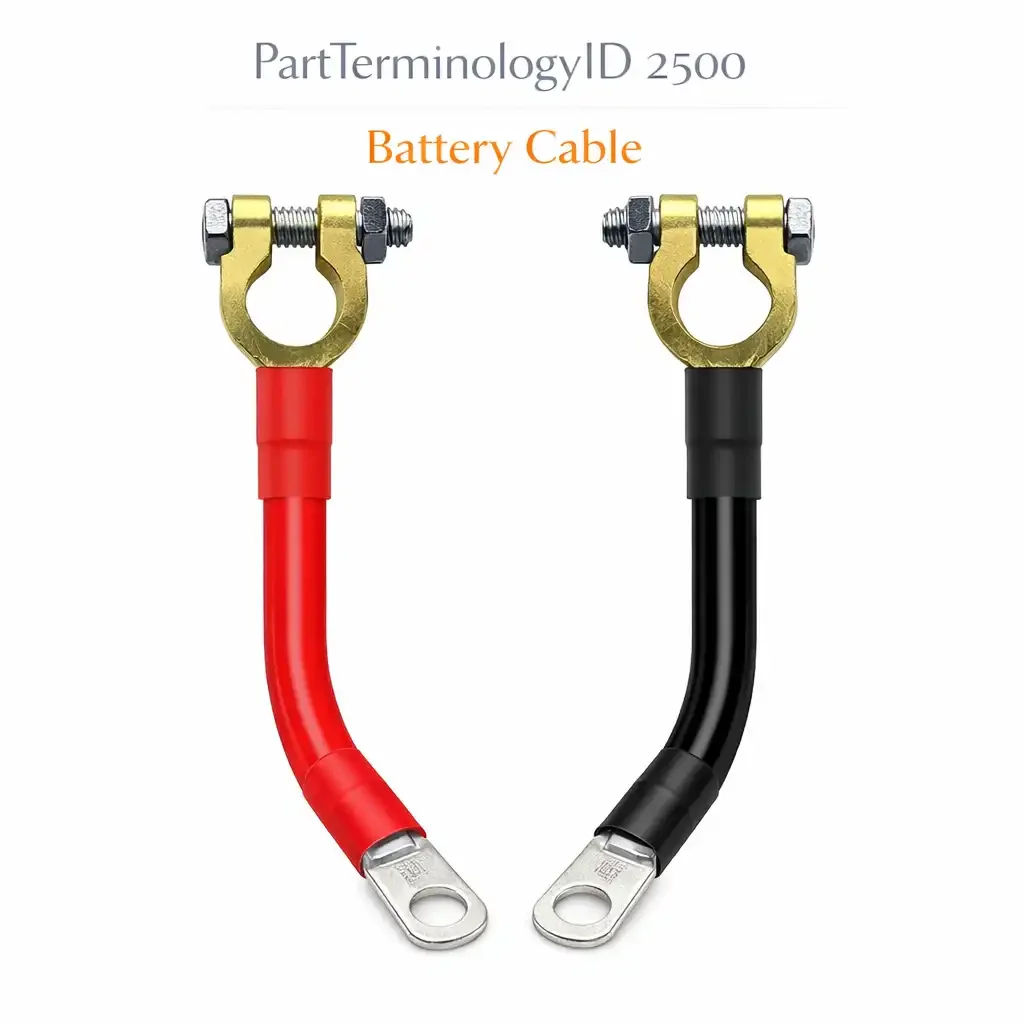
PartTerminologyID 2500, Battery Cable, is the heavy-gauge insulated conductor that carries cranking current from the vehicle battery to the starter motor, returns the cranking current ground path from the engine block or chassis to the battery negative terminal, or carries the alternator charge current from the alternator output terminal to the battery positive terminal, depending on which cable position in the vehicle's electrical system the listing addresses. That definition covers the function correctly and leaves unresolved every question that determines whether the replacement cable fits the battery terminal, reaches the starter or chassis mounting point, carries the cranking current without producing a voltage drop that prevents reliable starting, is terminated with the correct lug diameter at each end for the hardware it connects to, is correctly insulated for the thermal and chemical environment of the specific routing path, and is sold as a complete OE-style assembly with molded ends or as a bulk cable requiring field termination. It does not specify the cable position in the vehicle's electrical system, whether it is the positive cranking cable from battery to starter, the negative ground cable from battery to chassis or engine block, the alternator charge cable from alternator output to battery, or an auxiliary cable in a multi-battery or upfitted vehicle circuit, the wire gauge in AWG or metric cross-section in square millimeters, the cable conductor material and strand count, whether it is copper or copper-clad aluminum, the cable overall length, the terminal type at each end, whether the terminals are top-post clamps, side-post bolt terminals, ring lugs, or stud-mount lugs, the terminal inner diameter at each end, the terminal material and plating, the insulation material and temperature rating, the routing configuration for pre-formed cables, whether the cable is a direct OE replacement with specific routing bends or a universal cable requiring field forming and termination, or whether the listing covers a single cable or a complete battery cable set including both the positive and negative cables and any auxiliary cables in the system. A listing under PartTerminologyID 2500 that provides vehicle year, make, and model without the cable position, the wire gauge, the cable length, the terminal type and diameter at each end, and the routing configuration cannot be evaluated by any buyer who has a corroded or damaged battery cable and is confirming the replacement before pulling the original from the vehicle.
For sellers, PartTerminologyID 2500 is a high-volume listing with a wide buyer population spanning from technicians replacing a factory-damaged cable on a current-production vehicle to performance builders upgrading to larger gauge cable for a high-output electrical system to fleet managers replacing corroded ground cables on commercial vehicles with high-current auxiliary equipment. Each buyer segment has different specification priorities: the OE replacement buyer prioritizes terminal configuration and routing geometry, the performance buyer prioritizes wire gauge and conductor material, and the fleet buyer prioritizes terminal corrosion resistance and cable length with field termination flexibility. The listing must identify which buyer segment it serves and provide the corresponding specification depth.
The additional complexity specific to PartTerminologyID 2500 compared to most other electrical component listings is the voltage drop argument. A battery cable is not simply a conductor that is either connected or not: it is a conductor with a resistance that is determined by its gauge, its length, and its conductor material, and that resistance produces a voltage drop under cranking current that reduces the voltage available at the starter motor terminals. A cable that is nominally connected but is too small in gauge, too long in routing, or partially corroded internally will produce a cranking voltage drop that prevents reliable starting in cold weather even when the battery has adequate cold cranking amperes. The starter receives less voltage than the battery delivers, and the deficit comes directly from the cable resistance.
For sellers, the listing under this PartTerminologyID is only useful if it specifies the cable position, the wire gauge, the overall length, the terminal type and inner diameter at each end, the conductor material, the insulation material and temperature rating, and whether the cable is a pre-formed OE replacement or a universal cable. Without those seven attributes, the listing cannot prevent the gauge-too-small cold crank failure, the length-too-short routing failure, or the terminal diameter mismatch that produces a loose connection with elevated resistance at the most critical junction in the cranking circuit.
What the Battery Cable Does
Carrying cranking current from the battery to the starter
The positive battery cable carries the starting current from the battery positive terminal to the starter motor solenoid terminal during engine cranking. The cranking current on a gasoline passenger vehicle engine is typically 150 to 400 amperes depending on engine displacement, ambient temperature, and starter motor efficiency. On diesel engines, particularly large displacement commercial diesels in cold weather, cranking current can reach 800 to 1,200 amperes.
At these current levels, the resistance of the cable conductor is not negligible. The voltage drop across the cable is equal to the cranking current multiplied by the cable resistance. A 12-gauge cable with a resistance of approximately 5 milliohms per foot produces a voltage drop of 1.5 volts at 300 amperes over a 1-foot length. A longer cable, a smaller gauge, or a cable with internal corrosion increasing its effective resistance can produce a voltage drop of 2 to 4 volts across the entire positive cable run, reducing the voltage at the starter terminals from 12 volts at the battery to as low as 8 volts at the starter. At 8 volts the starter motor produces substantially less torque than at 12 volts, producing the slow labored crank that is the diagnostic signature of excessive cranking circuit resistance.
The ground cable and the return path resistance
The negative battery cable provides the return path for the cranking current from the engine block or chassis to the battery negative terminal. The ground cable resistance contributes equally to the total cranking circuit resistance as the positive cable resistance: a low-resistance positive cable paired with a high-resistance corroded ground cable will produce the same voltage drop at the starter as the equivalent resistance in the positive cable alone.
The ground cable on most vehicles connects the battery negative terminal to the engine block at one point and to the chassis at a second point through a short bonding strap. Both connections must have low resistance for the cranking circuit to function correctly. A corroded engine block ground connection or a broken chassis bonding strap produces the same slow crank symptom as a corroded positive cable. The diagnosis is confirmed by measuring the voltage drop across the ground cable during cranking: more than 0.5 volts across the ground cable indicates excessive ground circuit resistance.
The alternator charge cable
The alternator charge cable connects the alternator output terminal to the battery positive terminal or to the main electrical bus through the main fuse. It carries the alternator output current continuously during engine operation. The alternator charge cable is typically lighter gauge than the starter cable because the maximum alternator output current, typically 80 to 200 amperes, is lower than the peak starter cranking current. However, the charge cable carries current continuously rather than during brief cranking events, which means thermal stress is a more significant design factor for the charge cable than for the starter cable.
A charge cable with inadequate gauge for the alternator's rated output will run warm to hot during sustained high-output charging, degrading the insulation and increasing the cable resistance over time. The charge cable gauge must be adequate for the continuous full-output current of the specific alternator, not just the average charging current.
Wire gauge and the AWG versus metric cross-section argument
Wire gauge for battery cables is expressed in two systems that are both common in the aftermarket and are not directly interchangeable. The American Wire Gauge system uses an inverse logarithmic scale where smaller AWG numbers indicate larger conductors: 4 AWG is larger than 8 AWG, and 0 AWG, also written 1/0 AWG, is larger than 4 AWG. The metric system expresses conductor cross-section in square millimeters, where larger numbers indicate larger conductors.
Common battery cable gauge equivalences include 4 AWG at approximately 21 square millimeters, 2 AWG at approximately 33 square millimeters, 1/0 AWG at approximately 53 square millimeters, and 2/0 AWG at approximately 67 square millimeters. A listing that states the gauge in one system without the equivalent in the other system will produce ordering errors from buyers who interpret the gauge in the wrong system. The listing must state the gauge in both AWG and metric cross-section to prevent system-mismatch ordering errors.
Copper versus copper-clad aluminum
Most OE battery cables use stranded copper conductors. Copper provides the lowest resistance per unit cross-section of any practical conductor material for cable applications and is resistant to the vibration fatigue that would crack a solid conductor. Stranded copper cable is flexible enough to route through the engine bay without cracking under the repeated flexing from engine movement and chassis vibration.
Copper-clad aluminum conductors are used in some budget-tier aftermarket cables to reduce material cost. Copper-clad aluminum has higher resistance per unit cross-section than pure copper: a copper-clad aluminum cable of the same AWG gauge will produce a higher voltage drop than a pure copper cable of the same gauge at the same cranking current. The effective current capacity of a copper-clad aluminum cable is approximately 40 to 50 percent lower than a pure copper cable of the same AWG size. A buyer who orders a 4 AWG cable expecting copper and receives copper-clad aluminum will have a cable that performs at approximately the equivalent of a 6 AWG copper cable.
The listing must state the conductor material. Copper-clad aluminum must not be listed as copper.
Terminal types and the connection resistance argument
The terminal at each end of the battery cable is the interface between the cable conductor and the component it connects to. A terminal with loose contact, inadequate contact area, or surface corrosion at the contact interface produces a resistance at the junction that adds directly to the cable's conductor resistance in the cranking circuit.
Top-post battery clamps contact the battery post across the post circumference. The contact quality depends on the clamp's bore diameter matching the post diameter and on the clamp bolt torque producing adequate clamping force. An undersized clamp bore forces the clamp onto the post with reduced contact area. An oversized bore allows the clamp to sit loosely on the post with intermittent contact under vibration.
Ring lug terminals at the starter solenoid, the chassis ground, or the engine block are torqued against a flat surface. The contact quality depends on the lug face being flat and free of oxide and on the fastener torque being within the specification. A ring lug that has been overtorqued and deformed, or a lug that has oxidized at the contact face, produces a high-resistance junction that is not visible without disassembly and resistance measurement.
The listing must state the terminal type at each end, the terminal inner diameter for clamp-type terminals, and the stud diameter for ring lug terminals.
Internal corrosion and how to confirm a cable requires full replacement
Battery cable corrosion begins at the terminal interface where electrolyte vapors from the battery vent and road moisture enter the insulation at the terminal crimp or clamp. From the terminal entry point, corrosion migrates along the conductor strands under the insulation by capillary action, progressing inward along the cable length at a rate that depends on moisture exposure and the quality of the terminal seal. The external insulation remains intact and shows no discoloration while the conductor strands beneath it oxidize progressively, increasing resistance strand by strand from the terminal toward the cable midpoint.
The correct inspection method is to cut the cable 25mm back from the corroded terminal into clean conductor material. If the exposed strands at the cut face are uniformly bright copper, the conductor is clean and a replacement terminal can be crimped to the cut end. If the exposed strands show any green oxide, white aluminum oxide on copper-clad aluminum cable, or black sulfide deposits, the corrosion has progressed beyond the terminal and the complete cable must be replaced. A cable with internal corrosion beyond the cut point will have elevated resistance throughout the corroded section that no new terminal can correct, because the resistance is in the conductor strands, not in the terminal contact face.
This inspection step is the single most important pre-replacement diagnostic for PartTerminologyID 2500. A buyer who replaces only the corroded terminal on a cable with conductor corrosion progressing 200mm inward will install a new terminal on a cable that still has 200mm of elevated resistance behind the new crimp. The slow crank symptom will persist, and the new terminal will be blamed for a fault that is in the conductor.
Why This Part Generates Returns
Buyers order the wrong battery cable because the cable length is too short to reach from the battery to the starter or chassis ground point with the required routing slack, the terminal inner diameter at the battery end does not match the battery post diameter and the clamp will not seat correctly on the post, the wire gauge is in AWG and the buyer interpreted it as metric cross-section ordering a substantially smaller or larger cable than intended, the conductor is copper-clad aluminum and the buyer expected copper discovering the material difference at the crimped terminal face, the positive and negative cables are confused and a positive cable is routed to the chassis ground position or the reverse, the cable is a pre-formed OE replacement with specific routing bends and the routing does not match the vehicle's battery location which may have been changed from the OE position by a previous owner, the cable length for a pre-formed cable includes the routing bends and the straight length from the catalog description but the actual routed length in the vehicle is longer than the straight-line distance leaving the cable short of the starter terminal, and the ring lug stud diameter at the starter solenoid terminal does not match the solenoid stud and the lug will not fit over the stud.
Status in New Databases
PIES/PCdb: PartTerminologyID 2500, Battery Cable
PIES 8.0 / PCdb 2.0: No change
Top Return Scenarios
Scenario 1: "Gauge listed in AWG, buyer interpreted as metric, ordered 4mm cable instead of 4 AWG cable"
The listing stated 4 AWG battery cable. The buyer interpreted the 4 as a metric cross-section of 4 square millimeters, which is equivalent to approximately 11 AWG. A 4 square millimeter cable is rated for approximately 25 amperes continuous, far below the cranking current requirement. The cable arrived clearly undersized and was returned immediately. The buyer ordered 4 AWG correctly on the second order.
Prevention language: "Wire gauge: 4 AWG (approximately 21mm² cross-section). Battery cable gauges are expressed in American Wire Gauge (AWG), where lower numbers indicate larger conductors. This is not a metric cross-section measurement. A 4 AWG cable is approximately 21 square millimeters in cross-section. Do not interpret the AWG number as a metric cross-section. A 4mm² cable is approximately 11 AWG and is not rated for battery cranking current applications."
Scenario 2: "Positive cable sent for negative ground position, incorrect length and terminal configuration"
The listing did not specify cable position. The buyer needed the negative ground cable from the battery to the engine block. The positive cable from battery to starter arrived. The positive cable is longer than the negative ground cable on this vehicle and the starter solenoid terminal lug does not fit the engine block ground bolt. The buyer returned the cable as the wrong part.
Prevention language: "Cable position: [positive, battery to starter / negative, battery to engine block ground / negative, engine block to chassis bonding strap / alternator charge cable, alternator to battery]. Verify the cable position before ordering. The positive and negative cables on the same vehicle have different lengths, different terminal configurations at each end, and different routing paths. They are not interchangeable."
Scenario 3: "Copper-clad aluminum cable, voltage drop at cranking current equivalent to undersized copper gauge, slow crank in cold weather"
The replacement cable is copper-clad aluminum. The listing stated battery cable without specifying the conductor material. The buyer expected copper. At minus 15 Celsius, the starter motor drew 380 amperes. The copper-clad aluminum cable's effective resistance at that current produced a voltage drop of 2.8 volts, leaving 9.2 volts at the starter terminals rather than the 12 volts the battery delivered. The engine cranked slowly and required three attempts to start.
Prevention language: "Conductor material: [pure stranded copper / copper-clad aluminum]. Copper-clad aluminum conductors have approximately 40 to 50 percent lower current capacity than pure copper conductors of the same AWG gauge. A copper-clad aluminum cable rated 4 AWG performs approximately equivalent to a 6 AWG pure copper cable at cranking current levels. Specify pure stranded copper for reliable cranking in cold weather applications."
Scenario 4: "Pre-formed cable, routing bends included in stated length, actual routed length 120mm short of starter terminal"
The listing stated 900mm overall length for a pre-formed positive cable. The buyer measured the straight-line distance from the battery to the starter as 820mm and assumed the 900mm cable would have adequate slack. The cable's stated length includes the arc length of its molded routing bends. The straight-run portions of the cable sum to only 760mm, and the routed path in the vehicle requires 880mm of straight run to reach the starter terminal with adequate slack. The cable is 120mm short of the starter terminal.
Prevention language: "Cable length: [X]mm overall including routing bends. Pre-formed cable: the stated length includes the arc length of all molded bends. Measure the actual routed path in your vehicle from the battery terminal to the starter solenoid terminal, following the intended routing path rather than the straight-line distance. Add at least 50mm of slack to the measured routed length before selecting a cable length."
Scenario 5: "Ring lug inner diameter 6mm, starter solenoid stud is 8mm, lug will not fit over stud"
The replacement positive cable has a ring lug at the starter end with an inner diameter of 6mm. The starter solenoid main terminal stud is 8mm in diameter. The ring lug will not fit over the 8mm stud. The cable cannot be connected to the starter and was returned.
Prevention language: "Starter end terminal: ring lug, inner diameter [X]mm. Verify the ring lug inner diameter fits over your starter solenoid terminal stud before ordering. Common starter solenoid stud diameters are 6mm, 8mm, and 10mm depending on the starter model and the vehicle application. A ring lug with an inner diameter smaller than the stud diameter will not fit over the stud and cannot be installed."
Scenario 6: "Top-post clamp bore undersize, clamp forced onto battery post, post deformed, battery replaced"
The positive cable's top-post battery clamp has an internal bore of 16mm for a standard top post. The battery in the vehicle has a larger positive post typical of a heavy-duty or commercial-grade battery with an 18mm post diameter. The clamp was forced onto the oversized post, deforming the post and cracking the battery case at the post base. The battery was replaced alongside the cable.
Prevention language: "Battery end terminal: top-post clamp, internal bore [X]mm. Standard passenger vehicle top posts are approximately 17.5mm positive and 16mm negative. Heavy-duty and commercial battery positive posts can reach 19 to 21mm. Verify the clamp bore diameter against your battery post diameter before installing. Do not force a clamp onto an oversized post: post deformation from an undersized clamp can crack the battery case."
Scenario 7: "New terminal crimped to internally corroded conductor, slow crank persists after terminal replacement, cable replaced on second diagnosis"
The buyer identified a corroded battery clamp at the positive terminal and sourced a replacement clamp. The clamp was crimped to the cable after cutting 10mm back from the original clamp base. The exposed conductor at the cut face showed slight discoloration but the buyer proceeded with the crimp. The slow crank symptom persisted after the new clamp installation. On the second diagnosis, the technician cut further back and found heavily oxidized strands for approximately 180mm behind the original clamp position. The complete cable required replacement.
Prevention language: "Before crimping a replacement terminal to this cable, cut the cable back from the corroded terminal until the exposed conductor strands are uniformly bright copper with no green oxide, white deposits, or black discoloration on any strand. Discolored strands indicate corrosion has progressed beyond the terminal into the conductor. A replacement terminal crimped over corroded strands will not restore the cable's original resistance and the slow crank symptom will persist. If corrosion is present beyond the first 25mm behind the terminal, replace the complete cable."
Scenario 8: "Universal cable cut to length, field-crimped terminal with insufficient crimp force, high-resistance junction at crimp, intermittent no-start"
The buyer purchased universal bulk cable cut to the required length and field-crimped ring lug terminals at each end using a ratchet crimper sized for the terminal but without confirming the crimp die was the correct size for the conductor gauge. The crimp appeared visually correct. The first three starts after installation were normal. On the fourth attempt in cold weather, the engine did not crank. Pressing on the positive cable clamp at the battery terminal restored the start. The crimp had not fully compressed the conductor strands against the terminal barrel walls, producing a cold-sensitive intermittent contact that closed under hand pressure.
Prevention language: "For field-terminated universal cable: use a ratchet crimper with the correct die size for the specific terminal barrel and conductor gauge combination. A crimp die one size above the conductor gauge will compress the terminal barrel without fully collapsing the conductor strands against the barrel walls, producing a visually acceptable crimp with inadequate conductor-to-barrel contact area. After crimping, verify each terminal with a pull test: apply 50 pounds of axial force to the terminal and confirm the conductor does not pull through the crimp barrel. A terminal that passes the pull test has adequate mechanical engagement. A terminal that fails under pull test force will fail under thermal cycling and vibration in the vehicle."
What to Include in the Listing
Core essentials
PartTerminologyID: 2500
component: Battery Cable
cable position: positive cranking, negative ground battery-to-block, negative ground block-to-chassis, or alternator charge cable (mandatory, in title)
wire gauge in AWG with metric cross-section equivalent in mm² (mandatory)
conductor material: pure stranded copper or copper-clad aluminum (mandatory)
strand count and strand diameter where available (mandatory)
overall cable length in mm (mandatory)
pre-formed or universal: pre-formed with fixed routing bends or universal straight cable (mandatory)
routing note for pre-formed cables: state that the overall length includes arc length of bends and that the routed path must be measured to confirm fit (mandatory)
terminal type at battery end: top-post clamp, side-post bolt, or ring lug (mandatory)
terminal inner diameter or bore at battery end in mm (mandatory)
terminal material and plating at battery end: tin-plated copper, lead-plated, bare copper (mandatory)
terminal type at component end: ring lug, bolt terminal, or clamp (mandatory)
ring lug inner diameter at component end in mm (mandatory)
stud accommodation range for ring lug terminals (mandatory)
insulation material: PVC, XLPE, or other (mandatory)
insulation temperature rating in Celsius (mandatory)
insulation color: red for positive, black for negative (mandatory)
included hardware: protective boot, heat shrink, terminal bolt, or none (mandatory)
single cable or complete set (mandatory)
quantity: 1 or set count
Fitment essentials
year/make/model/submodel
engine designation where cranking current and cable gauge vary by engine displacement
factory battery location where pre-formed cable routing is position-specific
upfitter or fleet application note where auxiliary cables are included
Dimensional essentials
overall cable length in mm
conductor cross-section in mm²
conductor AWG equivalent
terminal bore diameter at battery end in mm
ring lug inner diameter at component end in mm
cable outer diameter including insulation in mm
Image essentials
full cable shown laid out flat with overall length callout
battery end terminal shown in detail with bore diameter labeled
component end terminal shown in detail with ring lug inner diameter labeled
conductor cross-section shown at the cut end of the cable showing strand count and strand arrangement
copper conductor strands shown clearly for listings specifying pure copper to distinguish from copper-clad aluminum
pre-formed cable shown in the routing configuration with bend positions labeled
cable installed in vehicle context showing battery terminal connection and component end connection
Catalog Checklist for ACES/PIES Teams
PartTerminologyID = 2500
require cable position in title and position attribute field (mandatory)
require wire gauge in both AWG and metric mm² (mandatory)
require conductor material: copper or copper-clad aluminum (mandatory)
require overall length in mm (mandatory)
require pre-formed versus universal designation (mandatory)
require routing measurement note for pre-formed cables (mandatory)
require terminal type and bore diameter at battery end (mandatory)
require terminal type and ring lug inner diameter at component end (mandatory)
require insulation material and temperature rating (mandatory)
require insulation color (mandatory)
require single cable versus complete set designation (mandatory)
prevent AWG-only gauge specification: AWG without the metric equivalent produces system-mismatch ordering errors from buyers who interpret the AWG number as a metric cross-section; both systems must be stated
prevent conductor material omission: copper-clad aluminum listed without material disclosure is a fraudulent specification on a safety-critical component; the conductor material must be stated on every listing
differentiate from battery terminal (PartTerminologyID varies): the terminal is the clamp or lug at the end of the cable; the cable is the conductor assembly including the terminal; a corroded terminal without cable damage may require only the terminal replacement; a cable with internal corrosion or damaged insulation requires cable replacement
differentiate from alternator charge cable where listed separately: some catalog implementations list the alternator-to-battery charge cable as a separate PartTerminologyID from the battery-to-starter cranking cable; verify which position the listing addresses and state the position in the title
differentiate from battery cable set: some listings cover a complete set including positive, negative, and charge cables under a single listing; state the set contents explicitly if the listing covers more than one cable
flag conductor material as a safety-critical attribute: a copper-clad aluminum cable listed as copper or without material disclosure and installed in a high-current cranking application will produce voltage drops that prevent reliable starting and may overheat the cable under sustained cranking attempts; the material disclosure is not optional
flag AWG and metric dual specification as mandatory: the AWG gauge system and the metric mm² system are both in common use and are not numerically equivalent; a single system specification will produce system-mismatch ordering errors from buyers in the other system
flag internal corrosion inspection note as mandatory installation guidance: a new terminal crimped to an internally corroded conductor will not resolve slow crank symptoms; the listing must direct buyers to inspect the conductor strands before committing to a terminal-only replacement
FAQ (Buyer Language)
How do I measure which battery cable I need to replace?
Identify the cable that is damaged: follow the positive cable from the battery positive terminal to the starter motor solenoid main terminal, and the negative cable from the battery negative terminal to the engine block ground stud. Measure the routed length of the original cable following its actual path through the engine bay, not the straight-line distance. Note the terminal type at each end and measure the battery post diameter and the stud diameter at the component end. Note the wire gauge by inspecting the cable label or measuring the conductor diameter at a cut end. Take all measurements before ordering a replacement.
What wire gauge do I need for my application?
For most passenger vehicle gasoline engines, 4 AWG or 2 AWG positive cable and 4 AWG or 2 AWG negative ground cable provides adequate current capacity with acceptable voltage drop at normal cranking currents. For larger displacement engines, diesel engines, or engines with high-compression ratios that require higher cranking torque, 1/0 AWG or 2/0 AWG cable reduces the voltage drop at the higher cranking currents. For performance applications with high-output alternators above 150 amperes, the charge cable should be sized to carry the alternator's maximum output current continuously: 2 AWG for alternators up to 130 amperes, 1/0 AWG for alternators up to 200 amperes.
Can I use a longer cable than the original if I cannot find the exact length?
A longer cable adds resistance to the cranking circuit proportional to the additional length, increasing the voltage drop at cranking current. If the additional length is less than 10 percent of the original cable length, the additional resistance is unlikely to affect cold weather starting. If the additional length is more than 10 percent, upgrade the wire gauge to compensate: for example, if the original cable is 4 AWG and the replacement is 20 percent longer than the original, use 2 AWG for the replacement to keep the total resistance approximately equal.
What is the difference between a positive and negative battery cable?
The positive cable carries current from the battery positive terminal to the starter motor solenoid and to the main electrical bus. It is typically red or has a red terminal boot and is the heavier or equal-gauge cable on most vehicles. The negative cable carries the return current from the engine block and chassis to the battery negative terminal. It is typically black. On most vehicles the negative cable is slightly shorter than the positive cable because the engine block ground point is closer to the battery than the starter motor. The two cables are not interchangeable: the terminal configurations and routing geometry are specific to each position.
My battery cable terminal is corroded but the cable conductor appears undamaged. Can I replace just the terminal?
Yes, if the conductor insulation is intact and there is no evidence of internal corrosion progressing from the terminal into the conductor strands. Cut the cable 25mm back from the corroded terminal into clean, bright conductor material. If the exposed strands are uniformly bright copper color, the conductor is clean and a replacement terminal can be crimped onto the cut end. If the strands are discolored, green, or show white oxide deposits indicating corrosion has progressed into the conductor, replace the complete cable. A cable with internal corrosion beyond the terminal will have elevated resistance throughout the corroded section regardless of the new terminal's quality.
How do I know if my slow crank problem is the battery cable or the battery itself?
Perform a voltage drop test on the battery cable during cranking. Connect a voltmeter across the positive cable from battery terminal to starter solenoid terminal and crank the engine for three seconds. A voltage drop above 0.5 volts across the positive cable indicates excessive cable resistance from corrosion or undersized gauge. Repeat the test across the negative cable from battery terminal to engine block ground. A voltage drop above 0.3 volts across the negative cable indicates a ground circuit resistance problem. If both cables test below their limits but the engine cranks slowly, the battery's internal resistance or insufficient CCA for the ambient temperature is more likely the cause. Test the battery with a conductance tester to confirm its state of health before replacing either the cable or the battery based on a single symptom.
I replaced the battery cable and the slow crank symptom is still present. What should I check next?
Check the battery state of health with a conductance tester. A battery testing below 60 percent of its rated CCA may not have adequate cranking current regardless of the cable's resistance. Check the engine block and chassis ground connections for corrosion at the bolt contact faces: a corroded ground lug face adds resistance at the chassis and block attachment points that is not eliminated by replacing the cable itself. On vehicles with a battery management system, confirm the BMS was coded after any recent battery replacement: an uncoded BMS applying a degraded charging profile will leave the battery chronically undercharged, reducing its available CCA below the engine's minimum requirement on cold mornings.
Cross-Sell Logic
Battery (PartTerminologyID 2476: a battery cable replaced due to corrosion from a leaking battery should prompt battery inspection and replacement if the battery has been damaged by electrolyte leakage)
Battery Terminal (the clamp or lug end of the cable is separately replaceable if only the terminal is corroded and the conductor strands are confirmed clean at 25mm behind the crimp; cross-reference the terminal PartTerminologyID for buyers who need only the terminal)
Alternator (PartTerminologyID 2412: a damaged or undersized charge cable that has been running warm will have elevated resistance that reduces the effective charging voltage at the battery; inspect the alternator output voltage after cable replacement to confirm the charging system is operating correctly)
Starter Motor (a positive cable that has been running with elevated resistance from internal corrosion may have caused repeated slow crank events that accelerated starter brush and commutator wear; inspect the starter if the cable has been degraded for an extended period)
Battery Cable Lug Terminal Set (replacement ring lugs, clamps, and terminal hardware for field termination of universal cable cut to length)
Wire Loom and Cable Conduit (protective sleeving for rerouted or extended battery cables in applications where the cable runs near heat sources or sharp edges)
Frame as "the cable carries the current the battery stores to the starter that uses it. The terminal connects the cable to the battery post. The alternator charges the battery through the charge cable that runs alongside the cranking cable. The starter receives the voltage the cable delivers minus the drop across the cable resistance. Every milliohm of cable resistance is a millivolt of starter voltage lost at cranking current."
Final Take for PartTerminologyID 2500
Battery Cable (PartTerminologyID 2500) is the cranking circuit component where the wire gauge and conductor material together determine the voltage drop that either reaches or misses the starter motor at minus 18 Celsius, and where a listing that omits the conductor material allows copper-clad aluminum to be sold as copper on a safety-critical current path without the buyer's knowledge. Both failures are invisible at installation: a copper-clad aluminum cable looks identical to a copper cable, and an undersized gauge cable looks identical to a correctly sized cable until the temperature drops and the cranking current rises. A third invisible failure is internal conductor corrosion beneath intact insulation that makes a terminal-only replacement feel complete and function poorly, requiring a second diagnosis and a second part order that a conductor inspection note in the listing would have prevented.
State the cable position in the title. State the wire gauge in both AWG and metric cross-section. State the conductor material explicitly. State the overall length with the routing measurement note for pre-formed cables. State the terminal type and bore diameter at the battery end. State the ring lug inner diameter at the component end. State the insulation material and temperature rating. State whether the listing is a single cable or a complete set. Include the internal corrosion conductor inspection note in the installation guidance. That is the same listing strategy as every other PartTerminologyID in this series: specific attributes at every level to become a listing buyers can act on without guessing. For PartTerminologyID 2500, the conductor material and the internal corrosion inspection note are the two attributes that determine whether the replacement cable resolves the slow crank symptom on the first attempt or sends the buyer back to the diagnosis a second time.