
Written by Arthur Simitian | PartsAdvisory
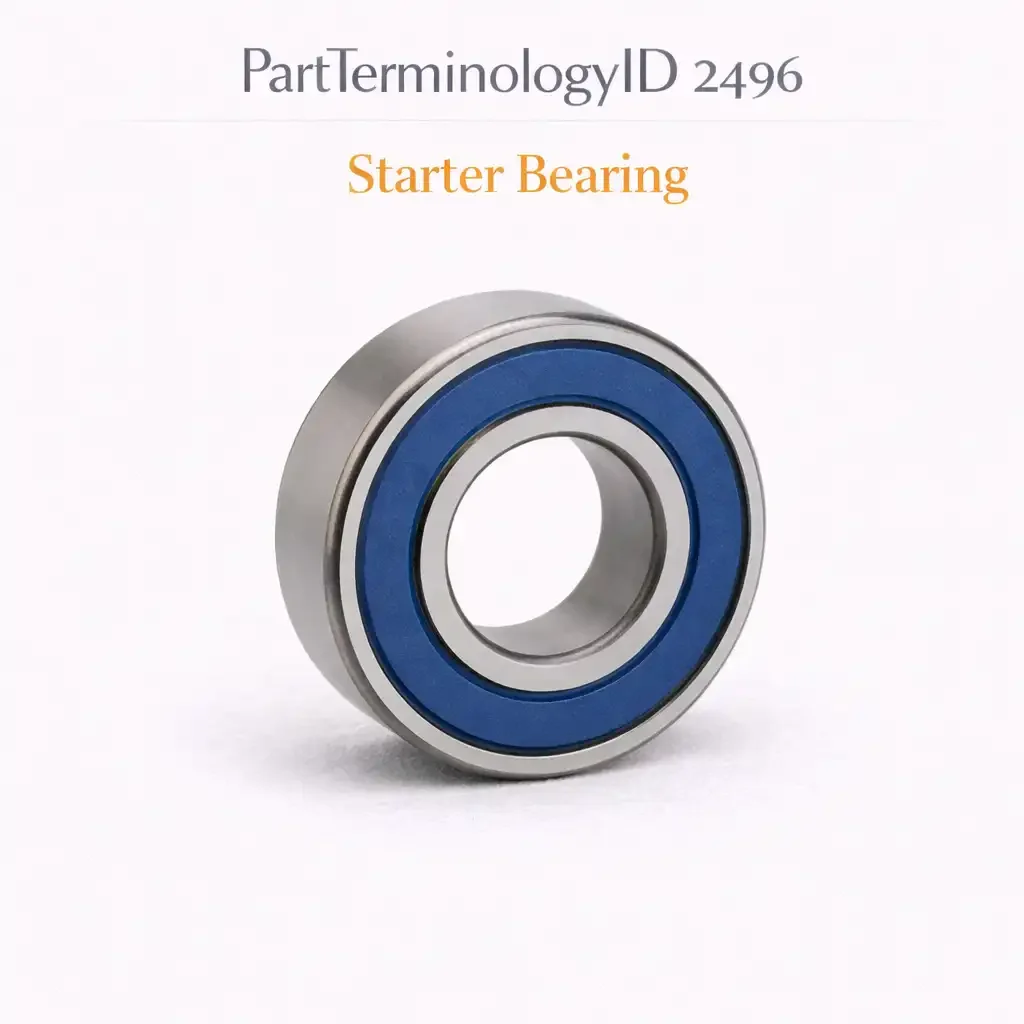
PartTerminologyID 2496, Starter Bearing, is the bearing or bushing that supports the starter motor armature shaft within the starter housing, maintaining the armature's concentric position within the field poles during the high-current, high-torque cranking event and absorbing the radial loads produced by the armature's magnetic centering forces and the pinion gear engagement loads during engagement with the ring gear. That definition covers the function correctly. It does not specify the starter manufacturer and model designation, the bearing type, whether it is a plain bronze bushing, a sintered bronze bushing, a ball bearing, or a needle roller bearing, the bore diameter, the outer diameter, the bearing length for bushings or the width for rolling element bearings, the housing bore diameter and depth that determine the press fit and seating depth, the position within the starter, whether it is the drive end bearing at the pinion end, the commutator end bearing at the brush end, or the intermediate bearing in the armature center on three-bearing starter designs, the load rating for rolling element designs, the oil impregnation specification for sintered bronze bushings, or whether the bushing requires pre-soaking in oil before installation. A listing under PartTerminologyID 2496 that provides vehicle year, make, and model without the bearing type, the bore diameter, the outer diameter, the length or width, and the position cannot be evaluated by a technician who has the original bushing or bearing on the bench and is confirming the replacement before pressing it into the starter housing.
For sellers, PartTerminologyID 2496 serves a technically specific buyer rebuilding a starter motor, either a vintage DC starter or a modern reduction-gear starter, who has disassembled the unit and confirmed the bearing or bushing as worn or damaged. The majority of starter bearings in the aftermarket are plain or sintered bronze bushings rather than rolling element bearings, which distinguishes the starter bearing from the generator bearing PartTerminologyIDs (2488 and 2492) where ball bearings dominate. A sintered bronze bushing requires oil pre-soaking before installation and a different press procedure than a ball bearing, and the listing must state the bushing type and the pre-soak requirement to prevent a dry bushing installation that fails within the first cranking event.
What the Starter Bearing Does
Centering the armature within the field poles during cranking
The starter armature must remain concentric within the field pole assembly throughout the cranking event to maintain the designed air gap between the armature conductors and the field pole faces. A worn bushing that allows the armature to sag eccentrically within the housing reduces the air gap at the sag side and increases it at the opposite side, producing unequal magnetic forces that accelerate the eccentric wear and draw higher current from the battery as the motor efficiency decreases from the misalignment.
The pinion end bushing carries the additional load from the solenoid plunger pushing the drive assembly into mesh with the ring gear and from the reaction force of the ring gear teeth against the pinion during mesh engagement. This load is intermittent, high in magnitude, and applied at an angle determined by the helix of the drive assembly threads, which adds an axial component to the primarily radial bushing load.
Sintered bronze bushings and the oil pre-soak requirement
Sintered bronze bushings are manufactured from a porous bronze powder compact that retains oil in its pore structure. The retained oil migrates to the bearing surface during operation, providing continuous lubrication between the bushing bore and the armature shaft without requiring an external oil supply. A new sintered bushing must be soaked in clean motor oil for a minimum of 24 hours before installation to saturate the pore structure with oil. A dry sintered bushing installed without pre-soaking will run dry on the first cranking event, galling the bushing bore surface and the armature shaft within the first few starts.
The listing must state the pre-soak requirement and the minimum soak duration as part of the installation instructions.
Position and load character by starter design
Starter motors in the aftermarket span from vintage two-bearing designs to modern reduction-gear starters with three or more bearing positions. The drive end position carries the pinion engagement load and requires the highest load capacity of any position in the starter. The commutator end position carries the armature radial load and the brush contact force in a carbon dust environment, identical in character to the commutator end of a DC generator. An intermediate position in the armature center, where present, carries only the armature radial load and is typically the smallest and lowest-loaded bearing in the assembly.
Each position requires a separately specified bearing or bushing. A listing that does not specify the position and the design it is correct for cannot be verified against the starter the buyer has on the bench.
The Specifications That Determine Correct Fitment
Bearing type
Plain bronze bushing, sintered bronze bushing, ball bearing, or needle roller bearing. The type determines the installation procedure, the pre-soak requirement, and the lubrication mechanism.
Position
Drive end, commutator end, or intermediate. Each position has different dimensional and load rating requirements.
Bore diameter and outer diameter
In millimeters to two decimal places. The bore must fit the armature shaft with the correct running clearance for bushings or the interference fit for rolling element bearings. The outer diameter must match the housing bore.
Length for bushings, width for rolling element bearings
In millimeters. The bearing must seat fully within the housing pocket.
Oil pre-soak requirement
Mandatory for sintered bronze bushings. State the minimum soak duration and the oil specification.
Status in New Databases
PIES/PCdb: PartTerminologyID 2496, Starter Bearing
PIES 8.0 / PCdb 2.0: No change
Top Return Scenarios
Scenario 1: "Sintered bushing installed dry, galled within first three starts"
The listing did not state the oil pre-soak requirement. The bushing was pressed in dry and the starter was reassembled. The bushing galled on the armature shaft within the first three cranking events, binding the armature and drawing excessive current that tripped the circuit breaker.
Prevention language: "Bearing type: sintered bronze bushing. Oil pre-soak required: soak in clean motor oil for a minimum of 24 hours before installation. A dry sintered bushing installed without pre-soaking will run without lubrication on the first cranking event and will gall the bushing bore and the armature shaft surface within the first few starts, requiring complete disassembly and replacement of both the bushing and potentially the armature shaft."
Scenario 2: "Drive end bushing ordered for commutator end position, bore diameter mismatch, armature shaft does not fit"
The listing specified a starter bearing by vehicle year, make, and model without stating the position. The drive end and commutator end bushings on this starter have different bore diameters because the armature shaft is stepped, with a larger diameter at the drive end than at the commutator end. The drive end bushing does not accept the smaller commutator end shaft diameter and the bushing must be returned.
Prevention language: "Position: [drive end / commutator end / intermediate]. Bore diameter at this position: [X.XX]mm. Armature shafts on many starter designs are stepped, with different diameters at the drive end and commutator end. The drive end and commutator end bushings are different bore diameters and are not interchangeable. Verify the position before ordering."
Catalog Checklist for ACES/PIES Teams
PartTerminologyID = 2496
require bearing type (mandatory)
require position: drive end, commutator end, or intermediate (mandatory)
require bore diameter in mm to two decimal places (mandatory)
require outer diameter in mm to two decimal places (mandatory)
require length for bushings or width for rolling element bearings (mandatory)
require oil pre-soak note for sintered bronze bushings (mandatory)
differentiate from generator commutator end bearing (2488) and drive end bearing (2492): those PartTerminologyIDs cover DC generator bearings; 2496 covers starter motor bearings; both machines use similar bearing types but different dimensional and load specifications
flag sintered bushing pre-soak as mandatory: dry installation is the most consistent cause of premature starter bushing failure after rebuild and is entirely preventable by one installation note in the listing
Final Take for PartTerminologyID 2496
Starter Bearing (PartTerminologyID 2496) is the PartTerminologyID where the oil pre-soak requirement is the single installation note that most consistently separates a rebuild that lasts from one that fails within the first few starts. State the bearing type. State the position. State the bore and outer diameters. State the length or width. State the pre-soak requirement for sintered bushings with the minimum soak duration. A listing that omits the pre-soak note will generate a galling failure and a return that the buyer attributes to a defective bushing rather than to a dry installation.