
Written by Arthur Simitian | PartsAdvisory
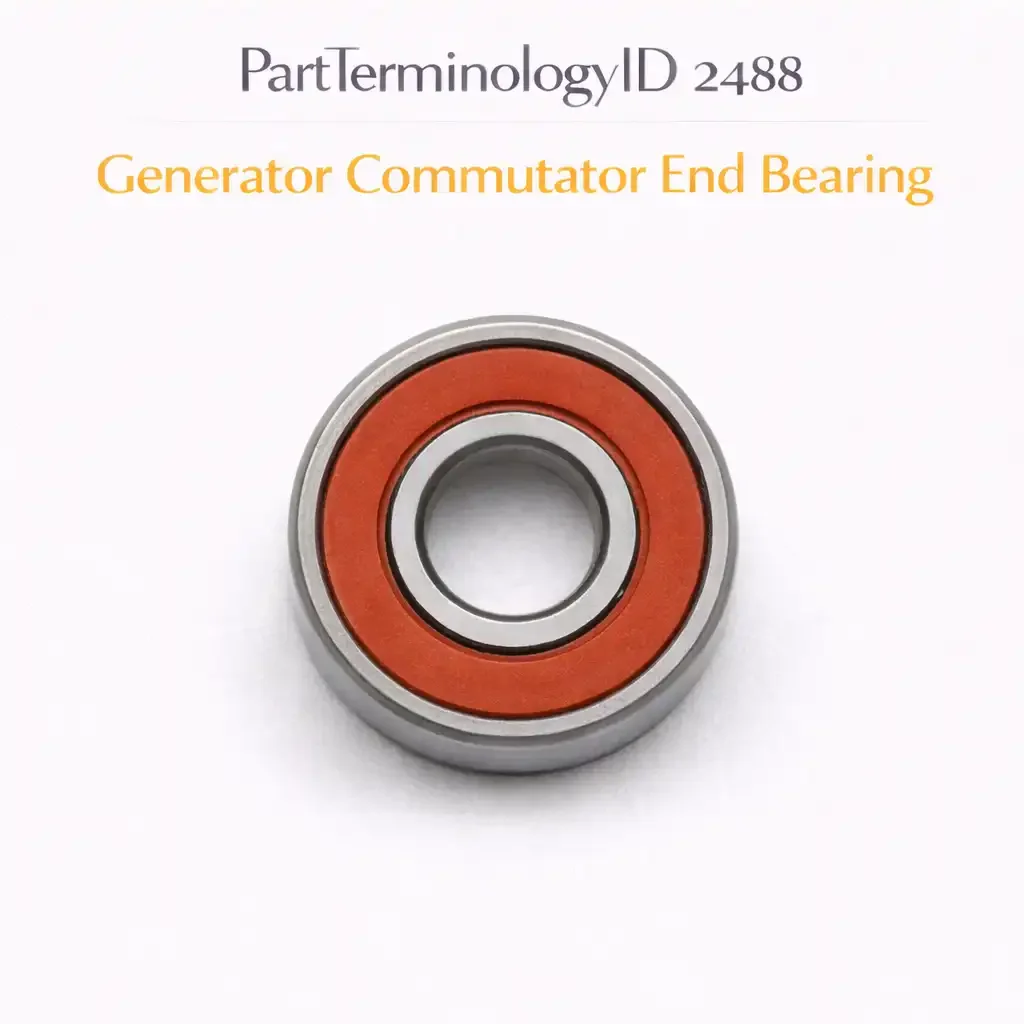
PartTerminologyID 2488, Generator Commutator End Bearing, is the ball or needle bearing pressed into the commutator end housing of a DC generator, supporting the armature shaft at the brush and commutator end of the machine and carrying the combined radial load from the armature weight and the magnetic attraction forces between the armature and the field poles at that end of the housing. That definition covers the function correctly. It does not specify the generator manufacturer and model designation, the bearing bore diameter, the bearing outer diameter, the bearing width, the dynamic radial load rating, the static load rating, the bearing type, whether it is a deep groove ball bearing, a needle roller bearing, or a cylindrical roller bearing, the seal type, whether the bearing is open, single-sealed, or double-sealed, the internal clearance designation, the cage material, the grease specification and fill quantity for sealed bearings, the press-fit interference at the shaft and housing interfaces, or whether the generator is a DC generator from an older vehicle application rather than a modern alternator, which produces AC current rectified internally. A listing under PartTerminologyID 2488 that provides vehicle year, make, and model without the bearing bore diameter, the outer diameter, the width, and the load rating cannot be evaluated by a technician rebuilding a DC generator who has removed the original bearing and is confirming the replacement dimensions before pressing in the new unit.
For sellers, PartTerminologyID 2488 serves a narrow and technically specific buyer population: technicians and hobbyists rebuilding DC generators on vintage and classic vehicles from approximately the 1920s through the mid-1960s, when the transition from DC generators to AC alternators was completed across most domestic and European vehicle platforms. A DC generator is fundamentally different from an alternator: it produces direct current directly through the commutator and brush system rather than producing AC and rectifying it internally. The commutator end of the generator is the end where the brushes contact the commutator segments on the armature shaft, and the bearing at this end supports the shaft against the brush contact force and the magnetic centering force of the field poles.
The buyer for this PartTerminologyID typically has the original bearing in hand, has measured it with a caliper, and is searching by bearing dimensions rather than by vehicle fitment because the vehicle application data for generators on 60-year-old vehicles is often incomplete in modern catalog systems. The listing must serve a dimension-first search rather than a vehicle-fitment-first search.
What the Generator Commutator End Bearing Does
Supporting the armature shaft against brush and magnetic loads
The armature of a DC generator rotates inside the field pole assembly, which produces a radial magnetic attraction force on the armature from each field pole. On a two-pole generator, these forces partially cancel but leave a net radial load that the commutator end bearing must support in addition to the bearing's share of the armature's own weight. The brushes pressing against the commutator segments add a further radial load at the commutator end, directed toward the brush holders.
The commutator end bearing carries a different load character than the drive end bearing, which primarily carries the belt tension load. The commutator end load is lower in magnitude but includes the brush contact force component that cycles with each brush lift and reseat event at the commutator segment boundaries. This cyclic loading is the primary fatigue driver for the commutator end bearing and distinguishes its wear mechanism from the drive end bearing, which wears primarily from steady-state radial load.
The seal type and its consequence for commutator end applications
The commutator end of a DC generator is an environment where carbon dust from brush wear accumulates over the generator's service life. Carbon dust is electrically conductive and abrasive. An open bearing at the commutator end will accumulate carbon dust between the balls and the races, increasing rolling friction and accelerating race wear. A single-sealed bearing reduces carbon ingestion from the commutator side but allows ingestion from the opposite face. A double-sealed bearing provides the best protection against carbon contamination but requires that the sealed-in grease remains adequate for the bearing's service life, since no field lubrication is possible with a sealed bearing.
For commutator end applications, a double-sealed bearing pre-filled with the correct grease quantity is the best-practice specification. An open bearing at this position requires periodic relubrication through a grease fitting in the housing, which is present on many vintage generator designs. If the original generator housing has a grease fitting at the commutator end, an open or single-sealed bearing with field lubrication is appropriate. If the housing has no grease fitting, a double-sealed bearing is required.
The Specifications That Determine Correct Bearing Fitment
Bore diameter
In millimeters to two decimal places. The primary search attribute for a buyer searching by bearing dimensions. The bore must match the armature shaft diameter with the interference fit specified for the original design.
Outer diameter
In millimeters to two decimal places. Must match the housing bore with the correct press fit at the housing interface.
Width
In millimeters. Must fit within the housing bearing pocket depth.
Dynamic radial load rating
In kilonewtons. Must exceed the combined armature, brush, and magnetic loads at the commutator end.
Seal type
Open, single-sealed, or double-sealed. State which face is sealed for single-sealed designs. Match the grease fitting presence in the housing.
Internal clearance
C2, CN, or C3. The clearance designation affects the operating temperature and noise characteristics of the bearing.
Bearing type
Deep groove ball bearing for most DC generator commutator end applications. Needle roller bearings on some heavy-duty designs.
Status in New Databases
PIES/PCdb: PartTerminologyID 2488, Generator Commutator End Bearing
PIES 8.0 / PCdb 2.0: No change
Top Return Scenarios
Scenario 1: "Open bearing at commutator end, no grease fitting in housing, carbon contamination within 5,000 miles"
The replacement bearing is an open design. The generator housing has no grease fitting at the commutator end. Carbon dust from brush wear contaminated the open bearing within 5,000 miles, increasing rolling resistance and producing a bearing whine audible at charging speed.
Prevention language: "Seal type: [open / single-sealed / double-sealed]. Inspect your generator housing for a grease fitting at the commutator end before ordering. If no grease fitting is present, specify a double-sealed bearing pre-filled with high-temperature grease. An open bearing in a housing without a grease fitting will accumulate carbon dust from brush wear and require replacement before the brush set reaches the end of its service life."
Scenario 2: "Bore diameter 0.05mm undersize, excessive press force fractured inner race during installation"
The replacement bearing bore is 0.05mm smaller than the armature shaft diameter. The interference fit produced a press force that exceeded the inner race's hoop stress limit. The inner race cracked during pressing, producing a bearing that rotated roughly and generated heat from the first start.
Prevention language: "Bore diameter: [XX.XX]mm. Verify the bore diameter against the armature shaft diameter before pressing. An interference fit more than 0.03mm tighter than the design specification will produce inner race hoop stress that may crack the race during installation. Use a bearing press with a driver sized to contact the inner race only, and press to a defined stop rather than to a force target."
Catalog Checklist for ACES/PIES Teams
PartTerminologyID = 2488
require bore diameter in mm to two decimal places (mandatory)
require outer diameter in mm to two decimal places (mandatory)
require width in mm (mandatory)
require dynamic load rating in kN (mandatory)
require seal type with grease fitting housing note (mandatory)
require internal clearance designation (mandatory)
differentiate from generator drive end bearing (PartTerminologyID varies): the drive end bearing carries the belt tension load; the commutator end bearing carries the brush contact and magnetic centering loads; the two bearings are typically different sizes with different load ratings and must not be substituted for each other
differentiate from alternator bearing: DC generators and AC alternators are different machines; generator bearings are listed under generator PartTerminologyIDs; alternator bearings within an alternator repair kit are listed under 2456; verify the machine type before ordering
flag seal type as mandatory: an open bearing in a carbon dust environment is the most consistent cause of premature commutator end bearing failure in DC generator rebuilds; the seal type note prevents the most common rebuild interval reduction
Final Take for PartTerminologyID 2488
Generator Commutator End Bearing (PartTerminologyID 2488) is the vintage and classic vehicle PartTerminologyID where the buyer searches by bearing dimensions rather than by vehicle fitment and where the seal type determines whether the rebuild interval matches the brush wear interval or falls short of it. State the bore diameter, the outer diameter, and the width as the primary search confirmation attributes. State the seal type with the grease fitting housing note. State the load rating. That is the complete specification for a technician who has the original bearing on the bench and needs only the dimensional confirmation before pressing in the replacement.